


Richardsonian Romanesque

Encyclopedia


Architectural style
Architectural styles classify architecture in terms of the use of form, techniques, materials, time period, region and other stylistic influences. It overlaps with, and emerges from the study of the evolution and history of architecture...
of Romanesque Revival architecture
Romanesque Revival architecture
Romanesque Revival is a style of building employed beginning in the mid 19th century inspired by the 11th and 12th century Romanesque architecture...
named after architect
Architect
An architect is a person trained in the planning, design and oversight of the construction of buildings. To practice architecture means to offer or render services in connection with the design and construction of a building, or group of buildings and the space within the site surrounding the...
Henry Hobson Richardson
Henry Hobson Richardson
Henry Hobson Richardson was a prominent American architect who designed buildings in Albany, Boston, Buffalo, Chicago, Pittsburgh, and other cities. The style he popularized is named for him: Richardsonian Romanesque...
, whose masterpiece is Trinity Church, Boston
Trinity Church, Boston
Trinity Church in the City of Boston, located in the Back Bay of Boston, Massachusetts, is a parish of the Episcopal Diocese of Massachusetts. The congregation, currently standing at approximately 3,000 households, was founded in 1733. The current rector is The Reverend Anne Bonnyman...
(1872–77), designated a National Historic Landmark
National Historic Landmark
A National Historic Landmark is a building, site, structure, object, or district, that is officially recognized by the United States government for its historical significance...
. Richardson first used elements of the style in his Buffalo State Asylum for the Insane
H.H. Richardson Complex
H.H. Richardson Complex is a recently-coined name for the Buffalo State Asylum for the Insane, a large Medina red sandstone and brick hospital that stands on the grounds of the present day ' in Buffalo, New York...
in Buffalo, New York
Buffalo, New York
Buffalo is the second most populous city in the state of New York, after New York City. Located in Western New York on the eastern shores of Lake Erie and at the head of the Niagara River across from Fort Erie, Ontario, Buffalo is the seat of Erie County and the principal city of the...
, designed in 1870.
History and development
This very free revival styleHistoricism (art)
Historicism refers to artistic styles that draw their inspiration from copying historic styles or artisans. After neo-classicism, which could itself be considered a historicist movement, the 19th century saw a new historicist phase marked by a return to a more ancient classicism, in particular in...
incorporates 11th and 12th century southern French, Spanish and Italian
Italy
Italy , officially the Italian Republic languages]] under the European Charter for Regional or Minority Languages. In each of these, Italy's official name is as follows:;;;;;;;;), is a unitary parliamentary republic in South-Central Europe. To the north it borders France, Switzerland, Austria and...
Romanesque
Romanesque architecture
Romanesque architecture is an architectural style of Medieval Europe characterised by semi-circular arches. There is no consensus for the beginning date of the Romanesque architecture, with proposals ranging from the 6th to the 10th century. It developed in the 12th century into the Gothic style,...
characteristics. It emphasizes clear, strong picturesque massing, round-headed "Romanesque" arches, often springing from clusters of short squat columns, recessed entrances, richly varied rustication
Rustication (architecture)
thumb|upright|Two different styles of rustication in the [[Palazzo Medici-Riccardi]] in [[Florence]].In classical architecture rustication is an architectural feature that contrasts in texture with the smoothly finished, squared block masonry surfaces called ashlar...
, boldly blank stretches of walling contrasting with bands of windows, and cylindrical towers with conical caps embedded in the walling.
Architects working in the style
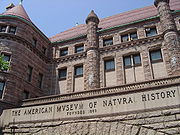
The style includes work by the generation of architects practicing in the 1880s before the influence of the Beaux-Arts styles. It is epitomised by the American Museum of Natural HistoryAmerican Museum of Natural History
The American Museum of Natural History , located on the Upper West Side of Manhattan in New York City, United States, is one of the largest and most celebrated museums in the world...
's original 77th Street building by J. Cleaveland Cady
J. Cleaveland Cady
J Cleaveland Cady was a New York-based architect whose most familiar surviving building is the south range of the American Museum of Natural History on New York's Upper West Side...
of Cady, Berg and See in New York City
New York City
New York is the most populous city in the United States and the center of the New York Metropolitan Area, one of the most populous metropolitan areas in the world. New York exerts a significant impact upon global commerce, finance, media, art, fashion, research, technology, education, and...
. It was seen in smaller communities in this time period such as in St. Thomas, Ontario
Neil R. Darrach
Neil R. Darrach was a noted Canadian architect from St. Thomas, Ontario. He was architect for over five designated heritage properties in St. Thomas, Ontario and Regina, Saskatchewan. He was primarily active in the later 19th century.-Early life:...
's city hall and Menomonie, Wisconsin
Menomonie, Wisconsin
Two other spellings of the name appear elsewhere, see Menomonee and Menominee. For the town, see Menomonie .Menomonie is a city in and the county seat of Dunn County in the western part of the U.S. state of Wisconsin. The city's population was 16,264 as of the 2010 census...
's Mabel Tainter Memorial Building
Mabel Tainter Memorial Building
The Mabel Tainter Center for the Arts, originally named the Mabel Tainter Memorial Building and also known as the Mabel Tainter Theater, is a historic landmark in Menomonie, Wisconsin, and is registered on the U.S. National Register of Historic Places....
, 1890.
Some of the practitioners who most faithfully followed Richardson's proportion, massing and detailing had worked in his office. These include Alexander Wadsworth Longfellow and Frank Alden (Longfellow, Alden & Harlow
Longfellow, Alden & Harlow
Longfellow, Alden & Harlow , of Boston, Massachusetts, and Pittsburgh, Pennsylvania, was the architectural firm of Alexander Wadsworth Longfellow, Jr. , Frank Ellis Alden , and Alfred Branch Harlow . The firm, successors to H. H...
of Boston & Pittsburgh); George Shepley and Charles Coolidge (Richardson's former employees, and his successor firm, Shepley, Rutan & Coolidge of Boston); and Herbert Burdett (Marling & Burdett of Buffalo). Other architects who employed Richardson Romanesque elements in their designs include Spier and Rohns
Spier and Rohns
Spier & Rohns was a noted Detroit architectural firm operated by Frederick Spier and W. C. Rohns, best remembered for designs of churches and railroad stations...
and George D. Mason
George D. Mason
George DeWitt Mason was an American architect who practiced in Detroit, Michigan in the latter part of the 19th and early decades of the 20th centuries.Mason was born in Syracuse, New York , the son of James H. and Zelda E. Mason...
, both firms from Detroit
Detroit, Michigan
Detroit is the major city among the primary cultural, financial, and transportation centers in the Metro Detroit area, a region of 5.2 million people. As the seat of Wayne County, the city of Detroit is the largest city in the U.S. state of Michigan and serves as a major port on the Detroit River...
, Edward J. Lennox, a Toronto based architect who derived many of his designs from the Richardson Style, and John Wellborn Root
John Wellborn Root
John Wellborn Root was an American architect who worked out of Chicago with Daniel Burnham. He was one of the founders of the Chicago School style...
. In Minneapolis, Minnesota
Minneapolis, Minnesota
Minneapolis , nicknamed "City of Lakes" and the "Mill City," is the county seat of Hennepin County, the largest city in the U.S. state of Minnesota, and the 48th largest in the United States...
, Harvey Ellis
Harvey Ellis
Harvey Ellis was an architect, perspective renderer and painter. He worked in Rochester, New York; Utica, New York; St. Paul, Minnesota; Minneapolis, Minnesota; St. Joseph, Missouri; St...
designed in this stye.
The style also influenced the Chicago school
Chicago school (architecture)
Chicago's architecture is famous throughout the world and one style is referred to as the Chicago School. The style is also known as Commercial style. In the history of architecture, the Chicago School was a school of architects active in Chicago at the turn of the 20th century...
of architecture and architects Louis Sullivan
Louis Sullivan
Louis Henri Sullivan was an American architect, and has been called the "father of skyscrapers" and "father of modernism" He is considered by many as the creator of the modern skyscraper, was an influential architect and critic of the Chicago School, was a mentor to Frank Lloyd Wright, and an...
and Frank Lloyd Wright
Frank Lloyd Wright
Frank Lloyd Wright was an American architect, interior designer, writer and educator, who designed more than 1,000 structures and completed 500 works. Wright believed in designing structures which were in harmony with humanity and its environment, a philosophy he called organic architecture...
. In Finland
Finland
Finland , officially the Republic of Finland, is a Nordic country situated in the Fennoscandian region of Northern Europe. It is bordered by Sweden in the west, Norway in the north and Russia in the east, while Estonia lies to its south across the Gulf of Finland.Around 5.4 million people reside...
, Eliel Saarinen
Eliel Saarinen
Gottlieb Eliel Saarinen was a Finnish architect who became famous for his art nouveau buildings in the early years of the 20th century....
was influenced by Richardson.
Dispersion
Research is underway to try to document the westward movement of the artisans and craftsmen, many of whom were immigrant Italians and IrishIrish people
The Irish people are an ethnic group who originate in Ireland, an island in northwestern Europe. Ireland has been populated for around 9,000 years , with the Irish people's earliest ancestors recorded having legends of being descended from groups such as the Nemedians, Fomorians, Fir Bolg, Tuatha...
, who built in the Richardsonian Romanesque tradition. The style began in the East, in and around Boston, where Richardson built the influential Trinity Church
Trinity Church, Boston
Trinity Church in the City of Boston, located in the Back Bay of Boston, Massachusetts, is a parish of the Episcopal Diocese of Massachusetts. The congregation, currently standing at approximately 3,000 households, was founded in 1733. The current rector is The Reverend Anne Bonnyman...
on Copley Square
Copley Square
Copley Square is a public square located in the Back Bay neighborhood of Boston, Massachusetts, named for the donor of the land on which it was developed. The square is named for John Singleton Copley, a famous portrait painter of the late 18th century and native of Boston. A bronze statue of...
. As the style was losing favor in the East, it was gaining popularity further west. Stone carvers and masons trained in the Richardsonian manner appear to have taken the style west, until it died out in the early years of the 20th century.
As an example, four small bank buildings were built in Richardsonian Romanesque style in Osage County, Oklahoma
Osage County, Oklahoma
Osage County is a county in the northern part of the U.S. state of Oklahoma. Coterminous with the Osage Indian Reservation, it is the home of the federally recognized Osage Nation. As of the 2010 census, the population was 47,472 a 6.8 percent increase from 2000, when the population was 44,437...
, during 1904-1911.
Images
For pictures of H.H. Richardson’s own designs and some of the details, see Henry Hobson RichardsonHenry Hobson Richardson
Henry Hobson Richardson was a prominent American architect who designed buildings in Albany, Boston, Buffalo, Chicago, Pittsburgh, and other cities. The style he popularized is named for him: Richardsonian Romanesque...
.
None of the following structures were designed by Richardson. They illustrate the strength of his architectural personality on progressive North American architecture from 1885 to 1905.
They are divided into categories denoting the various difference uses of the buildings.
Civic Buildings
Educational Institutions and Libraries
Service-related buildings
Churches and chapels
Residences
George W. Frank House
George W. Frank House
The Georege W. Frank House is a historic mansion located in Kearney, Nebraska. The George W. Frank House is operated by the University of Nebraska at Kearney.- Frank Family History :...
an 1890's mansion in Kearney, Nebraksa. The house is located at the University of Nebraska at Kearney. The architects of the George W. Frank House
George W. Frank House
The Georege W. Frank House is a historic mansion located in Kearney, Nebraska. The George W. Frank House is operated by the University of Nebraska at Kearney.- Frank Family History :...
are Frank, Bailey & Farmer, the house was completed in 1889.
See also
- Henry Hobson RichardsonHenry Hobson RichardsonHenry Hobson Richardson was a prominent American architect who designed buildings in Albany, Boston, Buffalo, Chicago, Pittsburgh, and other cities. The style he popularized is named for him: Richardsonian Romanesque...
- H.H. Richardson Historic District of North EastonH.H. Richardson Historic District of North EastonH. H. Richardson Historic District of North Easton is a National Historic Landmark District in North Easton, Massachusetts. It consists of five buildings designed by noted 19th century architect Henry Hobson Richardson...
- Romanesque Revival architectureRomanesque Revival architectureRomanesque Revival is a style of building employed beginning in the mid 19th century inspired by the 11th and 12th century Romanesque architecture...
Notations
- Kelsey, Mavis P. and Donald H. Dyal, The Courthouses of Texas: A Guide, Texas A&M University Press, College Station Texas 1993 ISBN 0890965471
- Kvaran, Einar Einarsson, Architectural Sculpture in America unpublished manuscript
- Kvaran, Einar Einarsson, Starkweather Memorial Chapel, Highland Cemetery, Ypsilanti, Michigan, Unpublished paper 1983
- Larson, Paul C., Editor, with Susan Brown, The Spirit of H.H. Richardson on the Midwest Prairies, University Art Museum, University of Minnesota, Minneapolis and Iowa State University Press, Ames 1988
- Ochsner, Jeffrey Karl, H.H.Richardson: Complete Architectural Works, MIT Press, Cambridge MA 1984 ISBN 0262150239
- Ochsner, Jeffrey Karl, and Andersen, Dennis Alan, Distant Corner: Seattle Architects and the Legacy of H. H. Richardson, University of Washington Press, Seattle WA 2003 ISBN 0-295-98238-1
- Van Rensselaer, Mariana Griswold, Henry Hobson Richardson and His Works, Dover Publications, Inc. NY 1959 (Reprint of 1888 edition) ISBN 0486223205