

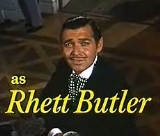
Rhett Butler

Encyclopedia
Rhett Butler is a fictional character and one of the main protagonist
s of Gone with the Wind
by Margaret Mitchell
.
and daughters Honey and India Wilkes
. The novel describes Rhett as "a visitor from Charleston
;" a black sheep, who was expelled from West Point
and is not received by any family with reputation in the whole of Charleston, and perhaps all of South Carolina. Rhett's enthrallment with Scarlett O'Hara
begins when he overhears her declaration of love for Ashley in the library while the rest of the "proper" girls take a nap. He recognizes that she is willful and spirited and that they are alike in many ways, including their disgust for the impending, and later ongoing, war with the Yankees.
They meet again when Scarlett has already lost her first husband, Charles Hamilton, while she is staying with Charles' sister Melanie and their Aunt Pittypat in Atlanta during the war. Rhett, the daring and infamous blockade runner, creates a stir when he outbids (with $150 in gold) ($ as of ) the other gentlemen in order to dance with Scarlett, who is in mourning.
Rhett seemingly ruins Scarlett's reputation after this very public display of frivolity and Scarlett's father, Gerald O'Hara, comes to speak to Rhett and to take Scarlett back to Tara
. However, Rhett, blackguard that he is, gets Gerald intoxicated and he and Rhett come to terms. Gerald returns to Tara and Scarlett remains in Atlanta.
As the Yankees advance towards Atlanta, Scarlett stays behind to help deliver Melanie's baby and then must depend on Rhett to get them out of the city. Scarlett sends Prissy to find Rhett, and when Rhett comes to Aunt Pitty's, he has stolen a horse and buggy in order to "rescue" Scarlett. Once they have fled Atlanta, Rhett - in a single moment of perverse idealism - joins the withdrawing Confederate soldiers for their last stand against General Sherman. Before he leaves, Rhett asks that Scarlett kiss him. She refuses, but he hauls her in - she slaps him and tells him that she hopes he gets killed while in battle. He laughs, and turns into the dark, leaving Scarlett alone with Melanie, Beau, her own young son Wade, and Prissy.
After a great many months, Scarlett returns to Atlanta, this time to solicit money from Rhett to save Tara
from foreclosure, only to learn from Aunt Pitty that he is in military jail, imprisoned by the Yankees for stealing the Confederate gold. Scarlett waltzes in, supposedly horrified that Rhett's life was in danger, all the while maneuvering him to give her money for the plantation. When Rhett sees through her ploy, he laughs in her face and Scarlett attacks him, causing her to faint. After regaining consciousness, she storms out.
On her way back to Aunt Pittypat's she meets Frank Kennedy, her sister Suellen's beau. Learning that Frank has done very well for himself, she plies him with affection, falsely tells him that Suellen is tired of waiting and plans to marry someone else, and finally secures a marriage proposal from him, which she accepts. Once Frank is married to her, he could not possibly allow his wife's kinfolk
to be evicted from Tara, so he provides her with the $300 ($ as of ) which she needs to pay the taxes on Tara.
Two weeks later, Scarlett is shocked when she sees Rhett Butler while she is running Frank's store, free from the Yankees and amused that she has rushed into yet another marriage with a man she does not love, much less the fact that she stole him right out from under her sister's nose.
After Frank Kennedy is killed during a Ku Klux Klan
raid on the shanty town
after Scarlett is attacked, Rhett saves the lives of Ashley Wilkes and several others by alibiing them to the Yankee captain, a man with whom Rhett has played cards on several occasions.
While Scarlett is mourning right after Frank's death, Rhett appears and offers a marriage proposal promising to give her everything. Scarlett accepts only for Rhett's money. In the novel, Rhett's fortune is estimated at $500,000 ($ as of ) Rhett secretly hopes that Scarlett will eventually return the love he's had since the day he saw her at Twelve Oaks. Her continuing affection for Ashley Wilkes becomes a problem for the couple, however.
When their daughter, Bonnie, falls off a pony and dies, the tragedy causes a rift between the two which is impossible to bridge. Rhett eventually leaves because he knows he has to get away from Scarlett. Her confession of love is something that Rhett seems to have expected from the moment he first saw her breathless face when she rushes to him. He knows that Scarlett could never be happy with Ashley and when she discovers that, he does not want to be around when she throws her obsession onto him.
When he finally receives Scarlett's love, it is too late to salvage the love he once had for her, so he leaves her with his famous parting shot: "My dear, I don't give a damn." It has since been immortalized in film in an altered version: "Frankly, my dear, I don't give a damn."
to survive in the chaos surrounding the war. The novel contains several pieces of information about him that do not appear in the film. After being disowned by his family (mainly by his father), he became a professional gambler, and at one point was involved in the California Gold Rush, where he ended up getting a scar on his stomach in a knife fight. He seems to love his mother and his sister Rosemary, but has an adversarial relationship with his father which is never resolved. He also has a younger brother who is never named, and a sister-in-law (both of whom he has little respect or regard for), who own a rice plantation. Rhett is the guardian of a little boy who attends boarding school in New Orleans; it is speculated among readers that this boy is Belle Watling's son (whom Belle mentions briefly to Melanie), and perhaps Rhett's illegitimate son as well.
Despite being thrown out of West Point, the Rhett of the novel is obviously very well-educated, referencing everything from Shakespeare to classical history to German philosophy. He has an understanding of human nature that the obtuse Scarlett never does, and at several points provides insightful perspectives on other characters. He also has an extensive knowledge of women, both physically and psychologically, which Scarlett does not consider to be "decent" (but nonetheless considers fascinating). Rhett has tremendous respect and (gradually) affection for Melanie as a friend, but very little for Ashley. Rhett's understanding of human nature extends to children as well, and he is a much better parent to Scarlett's children from her previous marriages than she is herself; he has a particular affinity with her son Wade, even before Wade is his stepson. When Bonnie is born Rhett showers her with the attention that Scarlett will no longer allow him to give to her and is a devoted, even doting and overindulgent, father.
Like Thomas Sutpen
from Absalom, Absalom!, Rhett decides to join in the Southern cause, but unlike his fellow Confederate
, Ashley Wilkes, Rhett is not spiritually paralyzed by the South's loss.
In the sequels − both in official sequels (Scarlett
, written by Alexandra Ripley
, and Rhett Butler's People
, written by Donald McCaig
) and in the unofficial Winds of Tara by Kate Pinotti − Scarlett finally succeeds in getting Rhett back.
was an almost immediate favorite for both the public and producer David O. Selznick
(except for Gable himself). But as Selznick had no male stars under long-term contract, he needed to go through the process of negotiating to borrow an actor from another studio. Gary Cooper
was thus Selznick's first choice, because Cooper's contract with Samuel Goldwyn
involved a common distribution company, United Artists
, with which Selznick had an eight-picture deal. However, Goldwyn remained noncommittal in negotiations. Warner Bros. offered a package of Bette Davis
, Errol Flynn
, and Olivia de Havilland
for the lead roles in return for the distribution rights. When Gary Cooper turned down the role for Rhett Butler, he was passionately against it. He is quoted saying, "Gone With The Wind is going to be the biggest flop in Hollywood history. I’m glad it’ll be Clark Gable who’s falling flat on his nose, not Gary Cooper". But by then Selznick was determined to get Clark Gable, and eventually found a way to borrow him from Metro-Goldwyn-Mayer
. Selznick's father-in-law, MGM chief Louis B. Mayer
, offered in May 1938 to fund half of the movie's budget in return for a powerful package: 50% of the profits would go to MGM, the movie's distribution would be credited to MGM's parent company, Loew's, Inc., and Loew's would receive 15 percent of the movie's gross income
. Selznick accepted this offer in August, and Gable was cast. But the arrangement to release through MGM meant delaying the start of production until Selznick International completed its eight-picture contract with United Artists. Gable was reluctant to play the role. At the time, he was wary of potentially disappointing a public who had formed a clear impression of the character that he might not necessarily convey in his performance.
, Rhett was played by Clark Gable
.
In the Scarlett
TV mini-series produced in 1994 (based on the above sequel novel), Rhett was played by Timothy Dalton
.
In the musical production by Takarazuka Revue
, Rhett had been played by several top stars of the group, including Yuki Amami
(currently a film/TV actress), Yu Todoroki
(currently one of the directors of the group) and Youka Wao (former leading male role of the Cosmo Troup that retired from the group in July 2006).
In the Margaret Martin musical Gone With The Wind
, the role of Rhett Butler was originated by Darius Danesh
.
Alice Randall
's The Wind Done Gone
is either a parallel historical novel, or (after litigation) a parody. It is told from the slave point of view.
Donald McCaig
's novel Rhett Butler's People
is told from Rhett Butler's perspective.
In the prequel and sequel Rhett Butler's People his parents are called Langston and Elizabeth, his brother is Julian. In this novel Belle Watling's son plays an important role; in the end he is revealed to be another man's son even though he believed Rhett was his father.
Protagonist
A protagonist is the main character of a literary, theatrical, cinematic, or musical narrative, around whom the events of the narrative's plot revolve and with whom the audience is intended to most identify...
s of Gone with the Wind
Gone with the Wind
The slaves depicted in Gone with the Wind are primarily loyal house servants, such as Mammy, Pork and Uncle Peter, and these slaves stay on with their masters even after the Emancipation Proclamation of 1863 sets them free...
by Margaret Mitchell
Margaret Mitchell
Margaret Munnerlyn Mitchell was an American author and journalist. Mitchell won the Pulitzer Prize for Fiction in 1937 for her epic American Civil War era novel, Gone with the Wind, which was the only novel by Mitchell published during her lifetime.-Family:Margaret Mitchell was born in Atlanta,...
.
Role
In the beginning of the novel, we first meet Rhett at the Twelve Oaks Plantation barbecue, the home of John Wilkes and his son AshleyAshley Wilkes
George Ashley Wilkes is a fictional character in the Margaret Mitchell's 1936 novel Gone with the Wind and the later film of the same name. The character also appears in the 1991 book Scarlett, a sequel to Gone with the Wind written by Alexandra Ripley, and in Rhett Butler's People by Donald...
and daughters Honey and India Wilkes
India Wilkes
India Wilkes is the sister of Ashley Wilkes and the rival of Scarlett O'Hara in the novel and film Gone with the Wind. She's a jealous character who despises Scarlett because Scarlett stole the attention of Stuart Tarleton, who courted India previously. India also resents Scarlett for marrying...
. The novel describes Rhett as "a visitor from Charleston
Charleston, South Carolina
Charleston is the second largest city in the U.S. state of South Carolina. It was made the county seat of Charleston County in 1901 when Charleston County was founded. The city's original name was Charles Towne in 1670, and it moved to its present location from a location on the west bank of the...
;" a black sheep, who was expelled from West Point
United States Military Academy
The United States Military Academy at West Point is a four-year coeducational federal service academy located at West Point, New York. The academy sits on scenic high ground overlooking the Hudson River, north of New York City...
and is not received by any family with reputation in the whole of Charleston, and perhaps all of South Carolina. Rhett's enthrallment with Scarlett O'Hara
Scarlett O'Hara
Scarlett O' Hara is the protagonist in Margaret Mitchell's 1936 novel Gone with the Wind and in the later film of the same name...
begins when he overhears her declaration of love for Ashley in the library while the rest of the "proper" girls take a nap. He recognizes that she is willful and spirited and that they are alike in many ways, including their disgust for the impending, and later ongoing, war with the Yankees.
They meet again when Scarlett has already lost her first husband, Charles Hamilton, while she is staying with Charles' sister Melanie and their Aunt Pittypat in Atlanta during the war. Rhett, the daring and infamous blockade runner, creates a stir when he outbids (with $150 in gold) ($ as of ) the other gentlemen in order to dance with Scarlett, who is in mourning.
Rhett seemingly ruins Scarlett's reputation after this very public display of frivolity and Scarlett's father, Gerald O'Hara, comes to speak to Rhett and to take Scarlett back to Tara
Tara Plantation
Tara, the fictional plantation found in Margaret Mitchell's 1936 novel Gone with the Wind, was located near Jonesborough , Georgia...
. However, Rhett, blackguard that he is, gets Gerald intoxicated and he and Rhett come to terms. Gerald returns to Tara and Scarlett remains in Atlanta.
As the Yankees advance towards Atlanta, Scarlett stays behind to help deliver Melanie's baby and then must depend on Rhett to get them out of the city. Scarlett sends Prissy to find Rhett, and when Rhett comes to Aunt Pitty's, he has stolen a horse and buggy in order to "rescue" Scarlett. Once they have fled Atlanta, Rhett - in a single moment of perverse idealism - joins the withdrawing Confederate soldiers for their last stand against General Sherman. Before he leaves, Rhett asks that Scarlett kiss him. She refuses, but he hauls her in - she slaps him and tells him that she hopes he gets killed while in battle. He laughs, and turns into the dark, leaving Scarlett alone with Melanie, Beau, her own young son Wade, and Prissy.
After a great many months, Scarlett returns to Atlanta, this time to solicit money from Rhett to save Tara
Tara Plantation
Tara, the fictional plantation found in Margaret Mitchell's 1936 novel Gone with the Wind, was located near Jonesborough , Georgia...
from foreclosure, only to learn from Aunt Pitty that he is in military jail, imprisoned by the Yankees for stealing the Confederate gold. Scarlett waltzes in, supposedly horrified that Rhett's life was in danger, all the while maneuvering him to give her money for the plantation. When Rhett sees through her ploy, he laughs in her face and Scarlett attacks him, causing her to faint. After regaining consciousness, she storms out.
On her way back to Aunt Pittypat's she meets Frank Kennedy, her sister Suellen's beau. Learning that Frank has done very well for himself, she plies him with affection, falsely tells him that Suellen is tired of waiting and plans to marry someone else, and finally secures a marriage proposal from him, which she accepts. Once Frank is married to her, he could not possibly allow his wife's kinfolk
Family
In human context, a family is a group of people affiliated by consanguinity, affinity, or co-residence. In most societies it is the principal institution for the socialization of children...
to be evicted from Tara, so he provides her with the $300 ($ as of ) which she needs to pay the taxes on Tara.
Two weeks later, Scarlett is shocked when she sees Rhett Butler while she is running Frank's store, free from the Yankees and amused that she has rushed into yet another marriage with a man she does not love, much less the fact that she stole him right out from under her sister's nose.
After Frank Kennedy is killed during a Ku Klux Klan
Ku Klux Klan
Ku Klux Klan, often abbreviated KKK and informally known as the Klan, is the name of three distinct past and present far-right organizations in the United States, which have advocated extremist reactionary currents such as white supremacy, white nationalism, and anti-immigration, historically...
raid on the shanty town
Shanty town
A shanty town is a slum settlement of impoverished people who live in improvised dwellings made from scrap materials: often plywood, corrugated metal and sheets of plastic...
after Scarlett is attacked, Rhett saves the lives of Ashley Wilkes and several others by alibiing them to the Yankee captain, a man with whom Rhett has played cards on several occasions.
While Scarlett is mourning right after Frank's death, Rhett appears and offers a marriage proposal promising to give her everything. Scarlett accepts only for Rhett's money. In the novel, Rhett's fortune is estimated at $500,000 ($ as of ) Rhett secretly hopes that Scarlett will eventually return the love he's had since the day he saw her at Twelve Oaks. Her continuing affection for Ashley Wilkes becomes a problem for the couple, however.
When their daughter, Bonnie, falls off a pony and dies, the tragedy causes a rift between the two which is impossible to bridge. Rhett eventually leaves because he knows he has to get away from Scarlett. Her confession of love is something that Rhett seems to have expected from the moment he first saw her breathless face when she rushes to him. He knows that Scarlett could never be happy with Ashley and when she discovers that, he does not want to be around when she throws her obsession onto him.
When he finally receives Scarlett's love, it is too late to salvage the love he once had for her, so he leaves her with his famous parting shot: "My dear, I don't give a damn." It has since been immortalized in film in an altered version: "Frankly, my dear, I don't give a damn."
Character
In the course of the novel, Rhett becomes increasingly enamored with Scarlett's sheer willWill (philosophy)
Will, in philosophical discussions, consonant with a common English usage, refers to a property of the mind, and an attribute of acts intentionally performed. Actions made according to a person's will are called "willing" or "voluntary" and sometimes pejoratively "willful"...
to survive in the chaos surrounding the war. The novel contains several pieces of information about him that do not appear in the film. After being disowned by his family (mainly by his father), he became a professional gambler, and at one point was involved in the California Gold Rush, where he ended up getting a scar on his stomach in a knife fight. He seems to love his mother and his sister Rosemary, but has an adversarial relationship with his father which is never resolved. He also has a younger brother who is never named, and a sister-in-law (both of whom he has little respect or regard for), who own a rice plantation. Rhett is the guardian of a little boy who attends boarding school in New Orleans; it is speculated among readers that this boy is Belle Watling's son (whom Belle mentions briefly to Melanie), and perhaps Rhett's illegitimate son as well.
Despite being thrown out of West Point, the Rhett of the novel is obviously very well-educated, referencing everything from Shakespeare to classical history to German philosophy. He has an understanding of human nature that the obtuse Scarlett never does, and at several points provides insightful perspectives on other characters. He also has an extensive knowledge of women, both physically and psychologically, which Scarlett does not consider to be "decent" (but nonetheless considers fascinating). Rhett has tremendous respect and (gradually) affection for Melanie as a friend, but very little for Ashley. Rhett's understanding of human nature extends to children as well, and he is a much better parent to Scarlett's children from her previous marriages than she is herself; he has a particular affinity with her son Wade, even before Wade is his stepson. When Bonnie is born Rhett showers her with the attention that Scarlett will no longer allow him to give to her and is a devoted, even doting and overindulgent, father.
Like Thomas Sutpen
Thomas Sutpen
Thomas Sutpen is the focal character of William Faulkner's 1936 novel Absalom, Absalom! Sutpen arrives in Faulkner's imaginary Yoknapatawpha County in Mississippi in the 1830s and established a 100 square mile plantation, Sutpen's Hundred, in an attempt to create his own personal dynasty...
from Absalom, Absalom!, Rhett decides to join in the Southern cause, but unlike his fellow Confederate
Confederate States of America
The Confederate States of America was a government set up from 1861 to 1865 by 11 Southern slave states of the United States of America that had declared their secession from the U.S...
, Ashley Wilkes, Rhett is not spiritually paralyzed by the South's loss.
In the sequels − both in official sequels (Scarlett
Scarlett (novel)
Scarlett is a novel written in 1991 by Alexandra Ripley as a sequel to Margaret Mitchell's Gone with the Wind. The book debuted on the New York Times bestsellers list, but both critics and fans of the original novel found Ripley's version to be inconsistent with the literary quality of Gone with...
, written by Alexandra Ripley
Alexandra Ripley
Alexandra Ripley, née Braid was an American writer best known as the author of Scarlett , the sequel to Gone with the Wind. Her first novel was Who's the Lady in the President's Bed?...
, and Rhett Butler's People
Rhett Butler's People
Rhett Butler's People by Donald McCaig is an authorized sequel to Gone with the Wind. It was published in November 2007.Fully authorized by the Margaret Mitchell estate, Rhett Butler’s People is a novel that parallels Gone with the Wind from Rhett Butler's perspective. The book was unveiled on...
, written by Donald McCaig
Donald McCaig
Donald McCaig is an American novelist, poet and essayist. He lives on a sheep farm in Western Virginia.His 1998 novel set in Civil War Virginia won the Michael Shaara Award for Excellence in Civil War Fiction...
) and in the unofficial Winds of Tara by Kate Pinotti − Scarlett finally succeeds in getting Rhett back.
Searching for Rhett
In the 1939 film version of Gone with the Wind, for the role of Rhett Butler, Clark GableClark Gable
William Clark Gable , known as Clark Gable, was an American film actor most famous for his role as Rhett Butler in the 1939 Civil War epic film Gone with the Wind, in which he starred with Vivien Leigh...
was an almost immediate favorite for both the public and producer David O. Selznick
David O. Selznick
David O. Selznick was an American film producer. He is best known for having produced Gone with the Wind and Rebecca , both of which earned him an Oscar for Best Picture.-Early years:...
(except for Gable himself). But as Selznick had no male stars under long-term contract, he needed to go through the process of negotiating to borrow an actor from another studio. Gary Cooper
Gary Cooper
Frank James Cooper, known professionally as Gary Cooper, was an American film actor. He was renowned for his quiet, understated acting style and his stoic, but at times intense screen persona, which was particularly well suited to the many Westerns he made...
was thus Selznick's first choice, because Cooper's contract with Samuel Goldwyn
Samuel Goldwyn
Samuel Goldwyn was an American film producer, and founding contributor executive of several motion picture studios.-Biography:...
involved a common distribution company, United Artists
United Artists
United Artists Corporation is an American film studio. The original studio of that name was founded in 1919 by D. W. Griffith, Charles Chaplin, Mary Pickford and Douglas Fairbanks....
, with which Selznick had an eight-picture deal. However, Goldwyn remained noncommittal in negotiations. Warner Bros. offered a package of Bette Davis
Bette Davis
Ruth Elizabeth "Bette" Davis was an American actress of film, television and theater. Noted for her willingness to play unsympathetic characters, she was highly regarded for her performances in a range of film genres, from contemporary crime melodramas to historical and period films and occasional...
, Errol Flynn
Errol Flynn
Errol Leslie Flynn was an Australian-born actor. He was known for his romantic swashbuckler roles in Hollywood films, being a legend and his flamboyant lifestyle.-Early life:...
, and Olivia de Havilland
Olivia de Havilland
Olivia Mary de Havilland is a British American film and stage actress. She won the Academy Award for Best Actress in 1946 and 1949. She is the elder sister of actress Joan Fontaine. The sisters are among the last surviving leading ladies from Hollywood of the 1930s.-Early life:Olivia de Havilland...
for the lead roles in return for the distribution rights. When Gary Cooper turned down the role for Rhett Butler, he was passionately against it. He is quoted saying, "Gone With The Wind is going to be the biggest flop in Hollywood history. I’m glad it’ll be Clark Gable who’s falling flat on his nose, not Gary Cooper". But by then Selznick was determined to get Clark Gable, and eventually found a way to borrow him from Metro-Goldwyn-Mayer
Metro-Goldwyn-Mayer
Metro-Goldwyn-Mayer Inc. is an American media company, involved primarily in the production and distribution of films and television programs. MGM was founded in 1924 when the entertainment entrepreneur Marcus Loew gained control of Metro Pictures, Goldwyn Pictures Corporation and Louis B. Mayer...
. Selznick's father-in-law, MGM chief Louis B. Mayer
Louis B. Mayer
Louis Burt Mayer born Lazar Meir was an American film producer. He is generally cited as the creator of the "star system" within Metro-Goldwyn-Mayer in its golden years. Known always as Louis B...
, offered in May 1938 to fund half of the movie's budget in return for a powerful package: 50% of the profits would go to MGM, the movie's distribution would be credited to MGM's parent company, Loew's, Inc., and Loew's would receive 15 percent of the movie's gross income
Gross income
Gross income in United States tax law is receipts and gains from all sources less cost of goods sold. Gross income is the starting point for determining Federal and state income tax of individuals, corporations, estates and trusts, whether resident or nonresident."Except as otherwise provided" by...
. Selznick accepted this offer in August, and Gable was cast. But the arrangement to release through MGM meant delaying the start of production until Selznick International completed its eight-picture contract with United Artists. Gable was reluctant to play the role. At the time, he was wary of potentially disappointing a public who had formed a clear impression of the character that he might not necessarily convey in his performance.
Adaptations and sequels
In the 1939 film adaptationGone with the Wind (film)
Gone with the Wind is a 1939 American historical epic film adapted from Margaret Mitchell's Pulitzer-winning 1936 novel of the same name. It was produced by David O. Selznick and directed by Victor Fleming from a screenplay by Sidney Howard...
, Rhett was played by Clark Gable
Clark Gable
William Clark Gable , known as Clark Gable, was an American film actor most famous for his role as Rhett Butler in the 1939 Civil War epic film Gone with the Wind, in which he starred with Vivien Leigh...
.
In the Scarlett
Scarlett (TV miniseries)
Scarlett is a 1994 six hour miniseries loosely based on the sequel to Margaret Mitchell's novel, Gone with the Wind, written by Alexandra Ripley...
TV mini-series produced in 1994 (based on the above sequel novel), Rhett was played by Timothy Dalton
Timothy Dalton
Timothy Peter Dalton ) is a Welsh actor of film and television. He is known for portraying James Bond in The Living Daylights and Licence to Kill , as well as Rhett Butler in the television miniseries Scarlett , an original sequel to Gone with the Wind...
.
In the musical production by Takarazuka Revue
Takarazuka Revue
The Takarazuka Revue is a Japanese all-female musical theater troupe based in Takarazuka, Hyōgo Prefecture, Japan. Women play all roles in lavish, Broadway-style productions of Western-style musicals, and sometimes stories adapted from shōjo manga and Japanese folktales. The troupe takes its name...
, Rhett had been played by several top stars of the group, including Yuki Amami
Yuki Amami
is a Japanese actress.-Career:Amami joined the Takarazuka Revue in 1987 and retired in 1995. Amami was the youngest actress in the company's history to be cast in a top male role...
(currently a film/TV actress), Yu Todoroki
Yu Todoroki
Yu Todoroki is a current member of Takarazuka Revue, where she plays an otokoyaku. She joined the Revue in 1985, became the top star of Snow Troupe in 1997, transferred to Superior Members in 2002 and became the youngest member to serve on the company's board of directors in 2003...
(currently one of the directors of the group) and Youka Wao (former leading male role of the Cosmo Troup that retired from the group in July 2006).
In the Margaret Martin musical Gone With The Wind
Gone With The Wind (musical)
Gone with the Wind is a musical based on the Margaret Mitchell's novel of the same name and its 1939 film adaptation, with music and lyrics by Margaret Martin, and a book by Martin, adapted by Sir Trevor Nunn....
, the role of Rhett Butler was originated by Darius Danesh
Darius Danesh
Darius Campbell , also known as Darius Danesh or simply Darius, is a British Iranian platinum-selling singer-songwriter, a West End stage actor, operatic baritone, Sunday Times best-selling author, and an Ambassador for The Prince's Trust.He established himself as a popular West End leading...
.
Alice Randall
Alice Randall
Alice Randall is an American author and songwriter. Randall grew up in Washington, D.C.. She attended Harvard University, where she earned an honors degree in English and American literature, before moving to Nashville in 1983 to become a country songwriter. She currently lives in Nashville,...
's The Wind Done Gone
The Wind Done Gone
The Wind Done Gone is the first novel written by Alice Randall. It was a bestselling historical parallel novel that reinterprets the famous American novel Gone with the Wind by Margaret Mitchell.- Plot summary :...
is either a parallel historical novel, or (after litigation) a parody. It is told from the slave point of view.
Donald McCaig
Donald McCaig
Donald McCaig is an American novelist, poet and essayist. He lives on a sheep farm in Western Virginia.His 1998 novel set in Civil War Virginia won the Michael Shaara Award for Excellence in Civil War Fiction...
's novel Rhett Butler's People
Rhett Butler's People
Rhett Butler's People by Donald McCaig is an authorized sequel to Gone with the Wind. It was published in November 2007.Fully authorized by the Margaret Mitchell estate, Rhett Butler’s People is a novel that parallels Gone with the Wind from Rhett Butler's perspective. The book was unveiled on...
is told from Rhett Butler's perspective.
Butler & Rhett families
Rhett is the eldest child. In Gone with the Wind only his younger sister Rosemary is named; his brother and sister-in-law are mentioned very briefly, but not by name. In the sequel Scarlett, the Butler parents are called Steven and Eleanor, the younger brother is Ross. In this sequel Rhett marries Anne Hampton after divorcing Scarlett and he reunites with Scarlett only after Anne dies. He and Scarlett have a second daughter called Katie "Cat".In the prequel and sequel Rhett Butler's People his parents are called Langston and Elizabeth, his brother is Julian. In this novel Belle Watling's son plays an important role; in the end he is revealed to be another man's son even though he believed Rhett was his father.