


Reuse

Encyclopedia
To reuse is to use an item more than once. This includes conventional reuse where the item is used again for the same function, and new-life reuse where it is used for a different function. In contrast, recycling
is the breaking down of the used item into raw material
s which are used to make new items. By taking useful products and exchanging them, without reprocessing, reuse help save time, money, energy, and resources. In broader economic terms, reuse offers quality products to people and organizations with limited means, while generating jobs and business activity that contribute to the economy.
Historically, financial motivation was one of the main drivers of reuse. In the developing world this driver can lead to very high levels of reuse, however rising wages and consequent consumer demand for the convenience of disposable products has made the reuse of low value items such as packaging uneconomic in richer countries, leading to the demise of many reuse programs. Current environmental awareness is gradually changing attitudes and regulations, such as the new packaging regulations, are gradually beginning to reverse the situation.
One example of conventional reuse is the doorstep delivery of milk
in refillable bottle
s; other examples include the retreading of tires and the use of returnable/reusable plastic boxes, shipping container
s, instead of single-use corrugated fiberboard boxes.
Disadvantages are also apparent:
These services facilitate the transaction and redistribution of unwanted, yet perfectly usable, materials and equipment from one entity to another. The entities that benefit from either side of this service (as donors, sellers, recipients, or buyers) can be businesses, nonprofits, schools, community groups, and individuals. Some maintain a physical space (a reuse center), and others act as a matching service (a virtual exchange). Reuse centers generally maintain both warehouses and trucks. They take possession of the donated materials and make them available for redistribution or sale. Virtual exchanges do not have physical space or trucks, but instead allow users to post listings of materials available and wanted (for free or at low cost) on an online materials exchange website. Staff will help facilitate the exchange of these materials without ever taking possession of the materials.
Reuse centers include Goodwill Industries
, Salvation Army
, Second Harvest Food Bank, and Habitat for Humanity ReStores. Virtual exchangees include CalMax (California, US) or WasteMatch (New York, US). Lesser known organizations such as Alchemy Goods (Seattle, WA, US) and STAY VOCAL
(Norwell, MA, US) have received increasing attention as reuse companies.
Helpful consumer resources exist for exchanging usable materials, such as the Freecycle network which is a grassroots and entirely nonprofit movement of people who are giving (and getting) stuff for free in their own towns. It's all about reuse and keeping good stuff out of landfills. Each local group is moderated by a local volunteer. Membership is free. In, addition, there are directory-based resources such as RecycleChicken.com which point consumers to local and national locations for reuse and repurposing of materials not normally accepted in recycling
programs.
Teleplan
Camera Repair has introduced a free camera recycling program through the reuse of cameras.
In Marrickville (a suburb of Sydney, Australia)
, Reverse Garbage is the largest reuse centre in the country, diverting more than 12,000 cubic metres of resources from landfills each year. In the same community centre, The Bower Reuse and Repair Centre diverts more than 7,500 cubic metres of 'waste' from landfills a year in a building entirely made of salvaged materials.
s (CRTs) and refurbish them in a factory environment in order to meet the same/similar specifications as new products. Xerox
(copy machines), Video Display Corp. (CRTs), and Cummins Engine are examples of refurbishing factories in the USA. Rolls Royce
has a very large aircraft remanufacturing factory in Singapore; Caterpillar
recently announced the opening of a tractor refurbishing plant in China. Some factories operate in competition with the original equipment manufacturer
(OEM). When the refurbished item is resold under a new label (used monitor CRTs made into TVs, or cameras resold under a new label) this has been found legal by most courts.
When the item is resold under the same OEM name, it is informally considered a "gray market" item - if it is sold as used, it's legal, if it's represented as an OEM product eligible for rebate
s and warranties, it is considered "counterfeit" or "black market". The automobile parts industry in the USA is governed by laws on the disclosure of "used" parts and, in some states, mattress
es which have been used are required to be sanitized or destroyed. Whether these laws are in place to protect consumers from black market items, or to protect manufacturers ("hindsight obsolescence"), is often an area of intense debate. Fuji Photo Film Co. v. Jazz Photo Corp. is a recent example of the war between patent holders and refurbishing factories. To quote the 2003 District Court of New Jersey:"Thus, the key issue in the dispute between Fuji and Jazz is whether the cameras sold by Jazz are "refurbished" in such a way that they can be considered to have been permissibly "repaired" or impermissibly "reconstructed."
 Deposit programs offer customers a financial incentive to return packaging for reuse. Although no longer common, international experience is showing that they can still be an effective way to encourage packaging reuse. However, financial incentive, unless great, may be less of an incentive than convenience: statistics show that, on average, a milk bottle is returned 12 times, whereas a lemonade bottle with a 15p deposit is returned, on average, only 3 times.
Refillable bottles are used extensively in many European countries; for example in Denmark
, 98% of bottles are refillable, and 98% of those are returned by consumers. These systems are typically supported by deposit laws
and other regulations.
Sainsbury Ltd have operated a plastic carrier bag
cash refund scheme in 1991 - “the penny back scheme”. The scheme is reported to save 970 tonnes of plastic per annum. The scheme has now been extended to a penny back on a voucher which can be contributed to schools registered on the scheme; it estimates this will raise the savings in plastic to 2500 tonnes per annum.
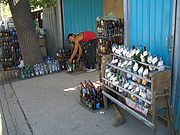
 In some developing nations like India and Pakistan, the cost of new bottles often forces manufacturers to collect and refill old glass bottles for selling cola
and other drinks. India and Pakistan also have a way of reusing old newspapers: "Kabadiwalas" buy these from the readers for scrap value and reuse them as packaging or recycle them. Scrap intermediaries help consumer dispose of other materials including metals and plastics.
The benefits of closed-loop reuse are primarily due to low additional transport costs being involved, the empty lorry returning with the empty crates.
There have been some recent attempts to get the public to join in on closed loop reuse schemes where shoppers use reusable plastic baskets in place of carrier bags for transporting their goods home from the supermarket; these baskets fit on specially designed trolleys making shopping supposedly easier.
, Regives Network Scavenger and Freesharing Networks or through anti-poverty charities such as the Red Cross, United Way, Salvation Army
, and Goodwill
which give these items to those who could not afford them new. Other organizations such as iLoveSchools have websites where both new and used goods can be offered to any of America's school teachers so their life can be extended and help schoolchildren. The average American, for example, throws away 67.9 pounds of used clothing and rags. With the U.S. population at approximately 296 million people, that translates into 20 billion pounds of used clothing and textiles that are tossed into the landfills each year. This has partly motivated movements such as The Compact
, whose members promise not to buy anything new for a year, and rely on reusing items that otherwise would be thrown away. Reuse not only reduces landfill
inline with the waste minimization program but can help raise money for a good cause.
Printer cartridges & toner
Printer ink cartridge
s can be reused. They are sorted into different brands and models which may then be refilled, or resold back to the companies that created these cartridges. The companies then refill the ink reservoir which can be sold back to consumers. Toner cartridge
s are recycled the same way as ink cartridges, using toner instead of ink. This method is highly efficient as there is no energy spent on melting and recreating the cartridges.
style of house, that uses tires as insulating walls and bottles as glass walls. Reuse is not limited to repeated uses for the same purpose. Examples of repurposing include using tires as boat fenders and steel drums as feeding troughs. Incinerator and power plant exhaust stack fly-ash is used extensively as an additive to concrete, providing increased strength. This type of reuse can sometimes make use of items which are no longer usable for their original purposes, for example using worn-out clothes as rag
s.
Repurposing is also an advantage that cable networks can take in order to produce more revenue for the show and company. Its possibly a hidden term that most people, unless in the communication business, would know because it isnt used as a term normally. In this case we are using repurposing to define the way cable networks have successful shorten the length and time between the original and syndication of when the same show from the same series is aired. When deciding to make this agreement, the production companies must further balance out the cost of doing so and how would it affect the audience due to different time zones.
An Example of repurposing would be ABC and USA arranging financial rights to air the television series Law and Order: SVU. With different cable networks joining together it could be seen as a step to the removal of "fin-syn" rules and have more conglomerations.
There was some cable broadcasters that did not want to go through other networks by repurposing but instead wanted to put the same show on the same channel but at a different time.
If money was an object then this is the choice that your company would want to go for instead.
This sort of scheme needs to have a far broader base than is currently the case, it requires organization and the setting up of waste brokerages where lists of currently available wastes are and the quantities available. One of the problems is once a demand for a waste is known or shown then the material is no longer a “waste” but a sellable commodity which often prices itself out of the market, c.f waste cement kiln dust and N-viro (lime conditioned sewage sludge fertilizer). In the former East Germany, organic household waste was collected and used as fodder for pigs. This integrated system was made possible by the state's control of agriculture; the complexities of continuing it in a market economy after German reunification meant the system had to be discontinued.
These include, but are not limited, to:
differs from reuse in that it breaks down the item into raw materials which are then used to make new items, as opposed to reusing the intact item. As this extra processing requires energy, as a rule of thumb reuse is environmentally preferable to recycling ("reduce, reuse, recycle
"), though recycling does have a significant part to play as it can often make use of items which are broken, worn out or otherwise unsuitable for reuse. However, as transport emissions are significant portion of the environmental impact of both reuse and recycling, in some cases recycling is the more prudent course as reuse can require long transport distances. A complex life cycle analysis may be required during a products design phase to determine the efficacy of reuse, recycling, or neither, and produce accordingly.
, notably program code for the software that drives computers and the Internet
, but also the documentation
that explains how to use every modern device. And it is proposed as a way to improve education by assembling a great library of shareable learning object
s that can be reused in learning management system
s.
Software reuse grew out of the standard subroutine
libraries of the 1960s. It is the main principle of today's object-oriented programming
. Instead of constantly reinventing software wheels, programming language
s like C++
, Java
, Objective-C
, and others are building vast collections of reusable software objects and components
.
Reuse is closely related to the concept of single source publishing
in which text written once is output to multiple publishing channels like print, the web
, mobile devices, and online help
. Reuse of information always has a single source, but not all single-sourced information is reused in multiple different contexts.
Reuse of information has a tremendous return on investment
for organizations whose documentation
is translated into many languages. Translation memory
systems can store text that has already been translated into dozens of languages for retrieval and reuse.
Recycling
Recycling is processing used materials into new products to prevent waste of potentially useful materials, reduce the consumption of fresh raw materials, reduce energy usage, reduce air pollution and water pollution by reducing the need for "conventional" waste disposal, and lower greenhouse...
is the breaking down of the used item into raw material
Raw material
A raw material or feedstock is the basic material from which a product is manufactured or made, frequently used with an extended meaning. For example, the term is used to denote material that came from nature and is in an unprocessed or minimally processed state. Latex, iron ore, logs, and crude...
s which are used to make new items. By taking useful products and exchanging them, without reprocessing, reuse help save time, money, energy, and resources. In broader economic terms, reuse offers quality products to people and organizations with limited means, while generating jobs and business activity that contribute to the economy.
Historically, financial motivation was one of the main drivers of reuse. In the developing world this driver can lead to very high levels of reuse, however rising wages and consequent consumer demand for the convenience of disposable products has made the reuse of low value items such as packaging uneconomic in richer countries, leading to the demise of many reuse programs. Current environmental awareness is gradually changing attitudes and regulations, such as the new packaging regulations, are gradually beginning to reverse the situation.
One example of conventional reuse is the doorstep delivery of milk
Milk
Milk is a white liquid produced by the mammary glands of mammals. It is the primary source of nutrition for young mammals before they are able to digest other types of food. Early-lactation milk contains colostrum, which carries the mother's antibodies to the baby and can reduce the risk of many...
in refillable bottle
Bottle
A bottle is a rigid container with a neck that is narrower than the body and a "mouth". By contrast, a jar has a relatively large mouth or opening. Bottles are often made of glass, clay, plastic, aluminum or other impervious materials, and typically used to store liquids such as water, milk, soft...
s; other examples include the retreading of tires and the use of returnable/reusable plastic boxes, shipping container
Shipping container
A shipping container is a container with strength suitable to withstand shipment, storage, and handling. Shipping containers range from large reusable steel boxes used for intermodal shipments to the ubiquitous corrugated boxes...
s, instead of single-use corrugated fiberboard boxes.
Advantages & disadvantages
Reuse has certain potential advantages:- Energy and raw materials savings as replacing many single use products with one reusable one reduces the number that need to be manufactured.
- Reduced disposal needs and costs.
- RefurbishmentRefurbishmentRefurbishment may refer to:*Refurbishment *Antiques restoration*Automotive restoration...
can bring sophisticated, sustainable, well paid jobs to underdeveloped economies. - Cost savings for business and consumers as a reusable product is often cheaper than the many single use products it replaces.
- Some older items were better handcrafted and appreciate in value.
Disadvantages are also apparent:
- Reuse often requires cleaning or transport, which have environmental costs.
- Some items, such as freon appliances or infant auto seats, could be hazardous or less energy efficient as they continue to be used.
- Reusable products need to be more durable than single-use products, and hence require more material per item. This is particularly significant if only a small proportion of the reusable products are in fact reused.
- Sorting and preparing items for reuse takes time, which is inconvenient for consumers and costs money for businesses.
Reuse centers & virtual exchanges
]These services facilitate the transaction and redistribution of unwanted, yet perfectly usable, materials and equipment from one entity to another. The entities that benefit from either side of this service (as donors, sellers, recipients, or buyers) can be businesses, nonprofits, schools, community groups, and individuals. Some maintain a physical space (a reuse center), and others act as a matching service (a virtual exchange). Reuse centers generally maintain both warehouses and trucks. They take possession of the donated materials and make them available for redistribution or sale. Virtual exchanges do not have physical space or trucks, but instead allow users to post listings of materials available and wanted (for free or at low cost) on an online materials exchange website. Staff will help facilitate the exchange of these materials without ever taking possession of the materials.
Reuse centers include Goodwill Industries
Goodwill Industries
Goodwill Industries International is a not-for-profit organization that provides job training, employment placement services and other community-based programs for people who have a disability, lack education or job experience, or face employment challenges...
, Salvation Army
Salvation Army
The Salvation Army is a Protestant Christian church known for its thrift stores and charity work. It is an international movement that currently works in over a hundred countries....
, Second Harvest Food Bank, and Habitat for Humanity ReStores. Virtual exchangees include CalMax (California, US) or WasteMatch (New York, US). Lesser known organizations such as Alchemy Goods (Seattle, WA, US) and STAY VOCAL
STAY VOCAL
STAY VOCAL is a reuse apparel brand based in Norwell, Massachusetts in the United States that encourages people to reuse whenever and wherever possible. Reusing materials can yield the same benefits as recycling but without the energy expended to create new products...
(Norwell, MA, US) have received increasing attention as reuse companies.
Helpful consumer resources exist for exchanging usable materials, such as the Freecycle network which is a grassroots and entirely nonprofit movement of people who are giving (and getting) stuff for free in their own towns. It's all about reuse and keeping good stuff out of landfills. Each local group is moderated by a local volunteer. Membership is free. In, addition, there are directory-based resources such as RecycleChicken.com which point consumers to local and national locations for reuse and repurposing of materials not normally accepted in recycling
Recycling
Recycling is processing used materials into new products to prevent waste of potentially useful materials, reduce the consumption of fresh raw materials, reduce energy usage, reduce air pollution and water pollution by reducing the need for "conventional" waste disposal, and lower greenhouse...
programs.
Teleplan
Teleplan
Teleplan International N.V. is one of the suppliers of high-tech after-market services and provides "total lifecycle care solutions" for the world of Computers, Communications and Consumer Electronics . The "lifecycle care concept" ranges from simple repairs to the most sophisticated technological...
Camera Repair has introduced a free camera recycling program through the reuse of cameras.
In Marrickville (a suburb of Sydney, Australia)
Marrickville, New South Wales
Marrickville, a suburb of Sydney's Inner West is located 7 kilometres south-west of the Sydney central business district in the state of New South Wales, Australia and is the largest suburb in the Marrickville Council local government area...
, Reverse Garbage is the largest reuse centre in the country, diverting more than 12,000 cubic metres of resources from landfills each year. In the same community centre, The Bower Reuse and Repair Centre diverts more than 7,500 cubic metres of 'waste' from landfills a year in a building entirely made of salvaged materials.
Remanufacturing
The most involved reuse organizations are "repair and overhaul" industries which take valuable parts, such as engine blocks, office furniture, toner cartridges, single-use cameras, aircraft hulls, and cathode ray tubeCathode ray tube
The cathode ray tube is a vacuum tube containing an electron gun and a fluorescent screen used to view images. It has a means to accelerate and deflect the electron beam onto the fluorescent screen to create the images. The image may represent electrical waveforms , pictures , radar targets and...
s (CRTs) and refurbish them in a factory environment in order to meet the same/similar specifications as new products. Xerox
Xerox
Xerox Corporation is an American multinational document management corporation that produced and sells a range of color and black-and-white printers, multifunction systems, photo copiers, digital production printing presses, and related consulting services and supplies...
(copy machines), Video Display Corp. (CRTs), and Cummins Engine are examples of refurbishing factories in the USA. Rolls Royce
Rolls-Royce plc
Rolls-Royce Group plc is a global power systems company headquartered in the City of Westminster, London, United Kingdom. It is the world’s second-largest maker of aircraft engines , and also has major businesses in the marine propulsion and energy sectors. Through its defence-related activities...
has a very large aircraft remanufacturing factory in Singapore; Caterpillar
Caterpillar Inc.
Caterpillar Inc. , also known as "CAT", designs, manufactures, markets and sells machinery and engines and sells financial products and insurance to customers via a worldwide dealer network. Caterpillar is the world's largest manufacturer of construction and mining equipment, diesel and natural gas...
recently announced the opening of a tractor refurbishing plant in China. Some factories operate in competition with the original equipment manufacturer
Original Equipment Manufacturer
An original equipment manufacturer, or OEM, manufactures products or components that are purchased by a company and retailed under that purchasing company's brand name. OEM refers to the company that originally manufactured the product. When referring to automotive parts, OEM designates a...
(OEM). When the refurbished item is resold under a new label (used monitor CRTs made into TVs, or cameras resold under a new label) this has been found legal by most courts.
When the item is resold under the same OEM name, it is informally considered a "gray market" item - if it is sold as used, it's legal, if it's represented as an OEM product eligible for rebate
Rebate
Rebate can refer to:* Rebate or rabbet, a woodworking term for a groove* Film rebate, the term for the border around photographic film- Money :* Rebate , a type of sales promotion used in marketing* Tax rebate, a reduction in taxation demanded...
s and warranties, it is considered "counterfeit" or "black market". The automobile parts industry in the USA is governed by laws on the disclosure of "used" parts and, in some states, mattress
Mattress
A mattress is a manufactured product to sleep or lie on, consisting of resilient materials and covered with an outer fabric or ticking. In the developed world it is typically part of a bed set and is placed upon a foundation....
es which have been used are required to be sanitized or destroyed. Whether these laws are in place to protect consumers from black market items, or to protect manufacturers ("hindsight obsolescence"), is often an area of intense debate. Fuji Photo Film Co. v. Jazz Photo Corp. is a recent example of the war between patent holders and refurbishing factories. To quote the 2003 District Court of New Jersey:"Thus, the key issue in the dispute between Fuji and Jazz is whether the cameras sold by Jazz are "refurbished" in such a way that they can be considered to have been permissibly "repaired" or impermissibly "reconstructed."
Deposit programs
Refillable bottles are used extensively in many European countries; for example in Denmark
Denmark
Denmark is a Scandinavian country in Northern Europe. The countries of Denmark and Greenland, as well as the Faroe Islands, constitute the Kingdom of Denmark . It is the southernmost of the Nordic countries, southwest of Sweden and south of Norway, and bordered to the south by Germany. Denmark...
, 98% of bottles are refillable, and 98% of those are returned by consumers. These systems are typically supported by deposit laws
Container deposit legislation
Container-deposit legislation is any law that requires collection of a monetary deposit on soft-drink, juice, milk, water, alcoholic-beverage, and/or other containers at the point of sale...
and other regulations.
Sainsbury Ltd have operated a plastic carrier bag
Plastic bag
A plastic bag, polybag, or pouch is a type of packaging made of thin, flexible, plastic film, nonwoven fabric, or plastic textile. Plastic bags are used for containing and transporting goods such as foods, produce, powders, ice, magazines, comic books, chemicals and waste.Most plastic bags are...
cash refund scheme in 1991 - “the penny back scheme”. The scheme is reported to save 970 tonnes of plastic per annum. The scheme has now been extended to a penny back on a voucher which can be contributed to schools registered on the scheme; it estimates this will raise the savings in plastic to 2500 tonnes per annum.
Cola
Cola is a carbonated beverage that was typically flavored by the kola nut as well as vanilla and other flavorings, however, some colas are now flavored artificially. It became popular worldwide after druggist John Pemberton invented Coca-Cola in 1886...
and other drinks. India and Pakistan also have a way of reusing old newspapers: "Kabadiwalas" buy these from the readers for scrap value and reuse them as packaging or recycle them. Scrap intermediaries help consumer dispose of other materials including metals and plastics.
Closed-loop programs
These apply primarily to items of packaging, for example, where a company is involved in the regular transportation of goods from a central manufacturing facility to warehouses or warehouses to retail outlets. In these cases there is considerable benefit to using reusable “transport packaging” such as plastic crates or pallets.The benefits of closed-loop reuse are primarily due to low additional transport costs being involved, the empty lorry returning with the empty crates.
There have been some recent attempts to get the public to join in on closed loop reuse schemes where shoppers use reusable plastic baskets in place of carrier bags for transporting their goods home from the supermarket; these baskets fit on specially designed trolleys making shopping supposedly easier.
Refilling programs
There have been some market-led initiatives to encourage packaging reuse by companies introducing refill packs of certain commodities (mainly soap powders and cleaning fluids), the contents being transferred before use into a reusable package kept by the customer, with the savings in packaging being passed onto the customer by lower shelf prices. The refill pack itself is not reused, but being a minimal package for carrying the product home, it requires less material than one with the durability and features (reclosable top, convenient shape, etc.) required for easy use of the product, while avoiding the transport cost and emissions of returning the reusable package to the factory.Regiving/regifting
Some items, such as clothes and children's toys, often become unwanted before they wear out due to changes in their owner's needs or preferences; these can be reused by selling or giving them to new owners. Regiving can take place informally between family, friends, or neighbours, through explicitly environmental organisations such as FreecycleThe Freecycle Network
The Freecycle Network is a non-profit organization registered in the state of Arizona, USA, and separately registered as a UK charity, that organizes a worldwide network of "gifting" groups, aiming to divert reusable goods from landfills...
, Regives Network Scavenger and Freesharing Networks or through anti-poverty charities such as the Red Cross, United Way, Salvation Army
Salvation Army
The Salvation Army is a Protestant Christian church known for its thrift stores and charity work. It is an international movement that currently works in over a hundred countries....
, and Goodwill
Goodwill Industries
Goodwill Industries International is a not-for-profit organization that provides job training, employment placement services and other community-based programs for people who have a disability, lack education or job experience, or face employment challenges...
which give these items to those who could not afford them new. Other organizations such as iLoveSchools have websites where both new and used goods can be offered to any of America's school teachers so their life can be extended and help schoolchildren. The average American, for example, throws away 67.9 pounds of used clothing and rags. With the U.S. population at approximately 296 million people, that translates into 20 billion pounds of used clothing and textiles that are tossed into the landfills each year. This has partly motivated movements such as The Compact
The Compact
- USA :'The Compact is a social and environmental movement whose members promise not to buy anything new for a year. It was started in San Francisco. The movement began as a challenge among 10 friends in 2006.Goals of The Compact:...
, whose members promise not to buy anything new for a year, and rely on reusing items that otherwise would be thrown away. Reuse not only reduces landfill
Landfill
A landfill site , is a site for the disposal of waste materials by burial and is the oldest form of waste treatment...
inline with the waste minimization program but can help raise money for a good cause.
Printer cartridges & tonerTonerToner is a powder used in laser printers and photocopiers to form the printed text and images on the paper. In its early form it was simply carbon powder. Then, to improve the quality of the printout, the carbon was melt-mixed with a polymer...
s reuse
Printer ink cartridgeInk cartridge
An ink cartridge or inkjet cartridge is a replaceable component of an inkjet printer that contains the ink that is deposited onto paper during printing....
s can be reused. They are sorted into different brands and models which may then be refilled, or resold back to the companies that created these cartridges. The companies then refill the ink reservoir which can be sold back to consumers. Toner cartridge
Toner cartridge
A toner cartridge, also called laser toner, is the consumable component of a laser printer. Toner cartridges contain toner powder, a fine, dry mixture of plastic particles, carbon, and black or other coloring agents that make the actual image on the paper...
s are recycled the same way as ink cartridges, using toner instead of ink. This method is highly efficient as there is no energy spent on melting and recreating the cartridges.
Repurposing
Repurposing is to use a tool for use as another tool, usually for a purpose unintended by the original tool-maker. Typically, repurposing is done using items usually considered to be junk or garbage. A good example of this would be the EarthshipEarthship
An earthship is a type of passive solar house made of natural and recycled materials. Designed and marketed by Earthship Biotecture of Taos, New Mexico, the homes are primarily constructed to work as autonomous buildings and are generally made of earth-filled tires, using thermal mass...
style of house, that uses tires as insulating walls and bottles as glass walls. Reuse is not limited to repeated uses for the same purpose. Examples of repurposing include using tires as boat fenders and steel drums as feeding troughs. Incinerator and power plant exhaust stack fly-ash is used extensively as an additive to concrete, providing increased strength. This type of reuse can sometimes make use of items which are no longer usable for their original purposes, for example using worn-out clothes as rag
Rag
Rag or rags may refer to:*A torn, threadbare or otherwise inferior piece of textile.*A piece of ragtime music.*Raga, the musical scale of a composition in Indian classical music.*Rag...
s.
Repurposing is also an advantage that cable networks can take in order to produce more revenue for the show and company. Its possibly a hidden term that most people, unless in the communication business, would know because it isnt used as a term normally. In this case we are using repurposing to define the way cable networks have successful shorten the length and time between the original and syndication of when the same show from the same series is aired. When deciding to make this agreement, the production companies must further balance out the cost of doing so and how would it affect the audience due to different time zones.
An Example of repurposing would be ABC and USA arranging financial rights to air the television series Law and Order: SVU. With different cable networks joining together it could be seen as a step to the removal of "fin-syn" rules and have more conglomerations.
There was some cable broadcasters that did not want to go through other networks by repurposing but instead wanted to put the same show on the same channel but at a different time.
If money was an object then this is the choice that your company would want to go for instead.
Waste exchanges
A waste exchange, or virtual exchange (see above), facilitates the use of a waste product from one process as a raw material for another. As with new life reuse of finished items, this avoids the environmental costs of disposing of the waste and obtaining new raw material, and may still be possible if the nature of the process makes avoiding production of the waste or recycling it back into the original process impossible.This sort of scheme needs to have a far broader base than is currently the case, it requires organization and the setting up of waste brokerages where lists of currently available wastes are and the quantities available. One of the problems is once a demand for a waste is known or shown then the material is no longer a “waste” but a sellable commodity which often prices itself out of the market, c.f waste cement kiln dust and N-viro (lime conditioned sewage sludge fertilizer). In the former East Germany, organic household waste was collected and used as fodder for pigs. This integrated system was made possible by the state's control of agriculture; the complexities of continuing it in a market economy after German reunification meant the system had to be discontinued.
Measuring the impact of reuse, reuse metrics
There are many ways of measuring the positive environmental, economic and social impact data reuse has on our communities.These include, but are not limited, to:
- # of tons diverted from the landfill
- $ avoided dispoal costs (donor/seller)
- $ avoided purchase costs (recipient/buyer)
- $ value of materials donated (donor)
- $ revenues earned (donor/seller)
- # of jobs created or retained
- # of families/individuals/organizations assisted
Internalized environmental costs
This is an economist's way of saying introduce an environmental tax: a charge on items which reflects the environmental costs of their manufacture and disposal. This makes the environmental benefit of using one reusable item instead of many disposable ones into a financial incentive. Such charges have been introduced in some countries. Such schemes are said to encourage reuse.Comparison to recycling
RecyclingRecycling
Recycling is processing used materials into new products to prevent waste of potentially useful materials, reduce the consumption of fresh raw materials, reduce energy usage, reduce air pollution and water pollution by reducing the need for "conventional" waste disposal, and lower greenhouse...
differs from reuse in that it breaks down the item into raw materials which are then used to make new items, as opposed to reusing the intact item. As this extra processing requires energy, as a rule of thumb reuse is environmentally preferable to recycling ("reduce, reuse, recycle
Waste hierarchy
The waste hierarchy refers to the 3 Rs of reduce, reuse, recycle, or and [ which classify waste management strategies according to their desirability. The Rs are meant to be a hierarchy, in order of importance...
"), though recycling does have a significant part to play as it can often make use of items which are broken, worn out or otherwise unsuitable for reuse. However, as transport emissions are significant portion of the environmental impact of both reuse and recycling, in some cases recycling is the more prudent course as reuse can require long transport distances. A complex life cycle analysis may be required during a products design phase to determine the efficacy of reuse, recycling, or neither, and produce accordingly.
Reuse of information
Besides the great amount of reuse of our physical resources, there is now a powerful argument for reuse of informationInformation
Information in its most restricted technical sense is a message or collection of messages that consists of an ordered sequence of symbols, or it is the meaning that can be interpreted from such a message or collection of messages. Information can be recorded or transmitted. It can be recorded as...
, notably program code for the software that drives computers and the Internet
Internet
The Internet is a global system of interconnected computer networks that use the standard Internet protocol suite to serve billions of users worldwide...
, but also the documentation
Documentation
Documentation is a term used in several different ways. Generally, documentation refers to the process of providing evidence.Modules of Documentation are Helpful...
that explains how to use every modern device. And it is proposed as a way to improve education by assembling a great library of shareable learning object
Learning object
A learning object is "a collection of content items, practice items, and assessment items that are combined based on a single learning objective". The term is credited to Wayne Hogins when he created a working group in 1994 bearing the name though the concept was first described by Gerard in 1967...
s that can be reused in learning management system
Learning management system
A learning management system is a software application for the administration, documentation, tracking, and reporting of training programs, classroom and online events, e-learning programs, and training content...
s.
Software reuse grew out of the standard subroutine
Subroutine
In computer science, a subroutine is a portion of code within a larger program that performs a specific task and is relatively independent of the remaining code....
libraries of the 1960s. It is the main principle of today's object-oriented programming
Object-oriented programming
Object-oriented programming is a programming paradigm using "objects" – data structures consisting of data fields and methods together with their interactions – to design applications and computer programs. Programming techniques may include features such as data abstraction,...
. Instead of constantly reinventing software wheels, programming language
Programming language
A programming language is an artificial language designed to communicate instructions to a machine, particularly a computer. Programming languages can be used to create programs that control the behavior of a machine and/or to express algorithms precisely....
s like C++
C++
C++ is a statically typed, free-form, multi-paradigm, compiled, general-purpose programming language. It is regarded as an intermediate-level language, as it comprises a combination of both high-level and low-level language features. It was developed by Bjarne Stroustrup starting in 1979 at Bell...
, Java
Java (programming language)
Java is a programming language originally developed by James Gosling at Sun Microsystems and released in 1995 as a core component of Sun Microsystems' Java platform. The language derives much of its syntax from C and C++ but has a simpler object model and fewer low-level facilities...
, Objective-C
Objective-C
Objective-C is a reflective, object-oriented programming language that adds Smalltalk-style messaging to the C programming language.Today, it is used primarily on Apple's Mac OS X and iOS: two environments derived from the OpenStep standard, though not compliant with it...
, and others are building vast collections of reusable software objects and components
Component-based software engineering
Component-based software engineering is a branch of software engineering that emphasizes the separation of concerns in respect of the wide-ranging functionality available throughout a given software system...
.
Reuse is closely related to the concept of single source publishing
Single source publishing
Single source publishing, also known as single sourcing, allows the same content to be used in different documents or in various formats. The labour-intensive and expensive work of editing need only be carried out once, on one document. Further transformations are carried out mechanistically, by...
in which text written once is output to multiple publishing channels like print, the web
World Wide Web
The World Wide Web is a system of interlinked hypertext documents accessed via the Internet...
, mobile devices, and online help
Online help
Online help is topic-oriented, procedural or reference information delivered through computer software. It is a form of user assistance. Most online help is designed to give assistance in the use of a software application or operating system, but can also be used to present information on a broad...
. Reuse of information always has a single source, but not all single-sourced information is reused in multiple different contexts.
Reuse of information has a tremendous return on investment
Return on investment
Return on investment is one way of considering profits in relation to capital invested. Return on assets , return on net assets , return on capital and return on invested capital are similar measures with variations on how “investment” is defined.Marketing not only influences net profits but also...
for organizations whose documentation
Documentation
Documentation is a term used in several different ways. Generally, documentation refers to the process of providing evidence.Modules of Documentation are Helpful...
is translated into many languages. Translation memory
Translation memory
A translation memory, or TM, is a database that stores so-called "segments", which can be sentences or sentence-like units that have previously been translated. A translation memory system stores the words, phrases and paragraphs that have already been translated, in order to aid human translators...
systems can store text that has already been translated into dozens of languages for retrieval and reuse.
See also
- Code reuseCode reuseCode reuse, also called software reuse, is the use of existing software, or software knowledge, to build new software.-Overview:Ad hoc code reuse has been practiced from the earliest days of programming. Programmers have always reused sections of code, templates, functions, and procedures...
- Creative Commons licensesCreative Commons licensesCreative Commons licenses are several copyright licenses that allow the distribution of copyrighted works. The licenses differ by several combinations that condition the terms of distribution. They were initially released on December 16, 2002 by Creative Commons, a U.S...
- Bag for life
- Computer recyclingComputer recyclingComputer recycling or electronic recycling is the recycling or reuse of computers or other electronics. It includes both finding another use for materials , and having systems dismantled in a manner that allows for the safe extraction of the constituent materials for reuse in other...
- Eco-actionEco-actionAn eco-action is any action or activity within a program that is intended to have a positive impact on the environment. For this reason it is often used as a synonym for environmental action....
- Green Bags
- Kashless.orgKashless.orgKashless.org was a web-based marketplace where everything is free . Kashless provided a platform to find and redistribute any used or unwanted items, with the goal of reducing users' carbon footprint by consuming less...
- Micro-SustainabilityMicro-SustainabilityMicro-sustainability focuses on the small environmental actions that when calculated collectively result in a large environmental impact. Micro-sustainability centers on individual efforts, behavior modification and creating attitudinal changes, which result in an environmentally conscious...
- Rechargeable batteryRechargeable batteryA rechargeable battery or storage battery is a group of one or more electrochemical cells. They are known as secondary cells because their electrochemical reactions are electrically reversible. Rechargeable batteries come in many different shapes and sizes, ranging anything from a button cell to...
- Nickel-metal hydride battery
- RecyclingRecyclingRecycling is processing used materials into new products to prevent waste of potentially useful materials, reduce the consumption of fresh raw materials, reduce energy usage, reduce air pollution and water pollution by reducing the need for "conventional" waste disposal, and lower greenhouse...
- RemanufacturingRemanufacturingRemanufacturing is the process of disassembly and recovery at the module level and, eventually, at the component level. It requires the repair or replacement of worn out or obsolete components and modules. Parts subject to degradation affecting the performance or the expected life of the whole are...
- Reusing water bottles
- Used good
- Waste minimization