


Resettlement Administration

Encyclopedia
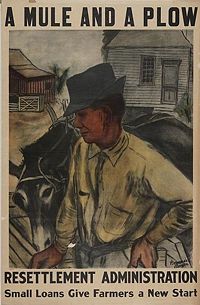
The RA was the brainchild of Rexford G. Tugwell
Rexford Tugwell
Rexford Guy Tugwell was an agricultural economist who became part of Franklin D. Roosevelt's first "Brain Trust," a group of Columbia academics who helped develop policy recommendations leading up to Roosevelt's 1932 election as President...
, an economics professor at Columbia University
Columbia University
Columbia University in the City of New York is a private, Ivy League university in Manhattan, New York City. Columbia is the oldest institution of higher learning in the state of New York, the fifth oldest in the United States, and one of the country's nine Colonial Colleges founded before the...
, who became an advisor to Franklin D. Roosevelt
Franklin D. Roosevelt
Franklin Delano Roosevelt , also known by his initials, FDR, was the 32nd President of the United States and a central figure in world events during the mid-20th century, leading the United States during a time of worldwide economic crisis and world war...
during the latter's successful campaign for the presidency in 1932 and then held positions in the United States Department of Agriculture
United States Department of Agriculture
The United States Department of Agriculture is the United States federal executive department responsible for developing and executing U.S. federal government policy on farming, agriculture, and food...
. Roosevelt established the RA under Executive Order 7027, and Tugwell became its first and only head. The new organization had four divisions: Rural Rehabilitation, Rural Resettlement, Land Utilization, and Suburban Resettlement.
However, Tugwell's goal of moving 650,000 people from 100000000 acres (404,686 km²) off exhausted, worn-out land was unpopular among the majority in Congress. This goal seemed socialistic
Socialism
Socialism is an economic system characterized by social ownership of the means of production and cooperative management of the economy; or a political philosophy advocating such a system. "Social ownership" may refer to any one of, or a combination of, the following: cooperative enterprises,...
to some and threatened to deprive influential farm owners of their tenant workforce. The RA was thus left with only enough resources to relocate a few thousand people from 9000000 acres (36,421.7 km²) and build several greenbelt cities, which planners admired as models for a cooperative future that never arrived.
The main focus of the RA was to now build relief camps in California for migratory workers, especially refugees from the drought-struck Dust Bowl of the Southwest. This move was resisted by a large share of Californians, who did not want destitute migrants to settle in their midst. The RA managed to construct ninety-five camps that gave migrants unaccustomed clean quarters with running water and other amenities, but the 75,000 people who had the benefit of these camps were a small share of those in need and could only stay temporarily. After facing enormous criticism for his poor management of the RA, Tugwell resigned in 1936. On January 1, 1937, with hopes of making the RA more effective, the Resettlement Administration was transferred to the Department of Agriculture through executive order 7530.
In the face of Congressional criticism, in September 1937 it was folded into a new body, the Farm Security Administration
Farm Security Administration
Initially created as the Resettlement Administration in 1935 as part of the New Deal in the United States, the Farm Security Administration was an effort during the Depression to combat American rural poverty...
(FSA), which operated until 1946.
The RA worked with nearly 200 communities on its projects, notably including:
- Farmstead / Jasper, Alabama, this development, began by the WPA, incuded 40 homes, churches, a civic center, and a school.
- Arthurdale, West VirginiaArthurdale, West VirginiaArthurdale is an unincorporated community in Preston County, West Virginia, United States. Arthurdale was named for Richard Arthur, former owner of the land on which it was built, who had sold the land to the federal government under a tax default....
, (first community begun by Subsistence Homesteads and pet project of Eleanor RooseveltEleanor RooseveltAnna Eleanor Roosevelt was the First Lady of the United States from 1933 to 1945. She supported the New Deal policies of her husband, distant cousin Franklin Delano Roosevelt, and became an advocate for civil rights. After her husband's death in 1945, Roosevelt continued to be an international...
) - Cahaba Village in Trussville, AlabamaTrussville, AlabamaTrussville is a city in Jefferson and St. Clair counties in the U.S. state of Alabama. The population was 19,933 at the 2010 census. Trussville was ranked as number 56 out of 100 in Money Magazines Best Places to Live 2005.-Geography:...
(begun by the Works Progress AdministrationWorks Progress AdministrationThe Works Progress Administration was the largest and most ambitious New Deal agency, employing millions of unskilled workers to carry out public works projects, including the construction of public buildings and roads, and operated large arts, drama, media, and literacy projects...
) - Jersey HomesteadsRoosevelt, New JerseyRoosevelt was originally called Jersey Homesteads, and was created during the Great Depression as part of President Roosevelt's New Deal. The town was home to a cooperative farming and manufacturing project...
(begun by the Division of Subsistence Homesteads) - Cumberland HomesteadsCumberland HomesteadsCumberland Homesteads is a community located in Cumberland County, Tennessee, USA. Established by the New Deal-era Division of Subsistence Homesteads in 1934, the community was envisioned by federal planners as a model of cooperative living for the region's distressed farmers, coal miners, and...
near Crossville, TennesseeCrossville, TennesseeCrossville is a city in and the county seat of Cumberland County, Tennessee, United States. The population was 10,795 at the 2010 Census.-Geography:Crossville is located at...
(begun by the Division of Subsistence Homesteads) - Greenbelt, MarylandGreenbelt, MarylandGreenbelt is a city in Prince George's County, Maryland, United States. Contained within today's City of Greenbelt is the historic planned community now known locally as "Old Greenbelt" and designated as the Greenbelt Historic District...
, completely planned and constructed by the RA outside Washington, D.C.Washington, D.C.Washington, D.C., formally the District of Columbia and commonly referred to as Washington, "the District", or simply D.C., is the capital of the United States. On July 16, 1790, the United States Congress approved the creation of a permanent national capital as permitted by the U.S. Constitution.... - Greendale, WisconsinGreendale, WisconsinGreendale is a village in Milwaukee County, Wisconsin, United States. The population was 14,405 at the 2000 census.-History:Greendale was settled in 1938 as a public cooperative community in the New Deal Era...
, another new town built by the RA, outside Milwaukee, WisconsinMilwaukee, WisconsinMilwaukee is the largest city in the U.S. state of Wisconsin, the 28th most populous city in the United States and 39th most populous region in the United States. It is the county seat of Milwaukee County and is located on the southwestern shore of Lake Michigan. According to 2010 census data, the... - Greenhills, OhioGreenhills, OhioGreenhills is a village in Hamilton County, Ohio, United States. The population was 4,103 at the 2000 census. It is a planned community that was established by the United States federal government during the Great Depression.-Geography:...
, the third of the RA's new towns, built outside Cincinnati, OhioCincinnati, OhioCincinnati is a city in the U.S. state of Ohio. Cincinnati is the county seat of Hamilton County. Settled in 1788, the city is located to north of the Ohio River at the Ohio-Kentucky border, near Indiana. The population within city limits is 296,943 according to the 2010 census, making it Ohio's... - Hickory Ridge, VirginiaHickory Ridge, VirginiaHickory Ridge is an extinct unincorporated town in Prince William County, Virginia. The town was located on land that is now part of Prince William Forest Park, a National Park Service property located adjacent to Marine Corps Base Quantico...
(now Prince William Forest ParkPrince William Forest ParkPrince William Forest Park was established as Chopawamsic Recreational Demonstration Area in 1936 and is located in southeastern Prince William County, Virginia, adjacent to the Marine Corps Base Quantico. The park is the largest protected natural area in the Washington, D.C. metropolitan region at...
) - Caney Lakes Recreation AreaCaney Lakes Recreation AreaNot to be confused with another Caney Lake at Jimmie Davis State Park southwest of Chatham in Jackson Parish, LouisianaCaney Lakes Recreation Area, located the Kisatchie National Forest north of Minden in Webster Parish in northwestern Louisiana, offers opportunities for bicycling, hiking,...
in Webster ParishWebster Parish, LouisianaWebster Parish is a parish located in the U.S. state of Louisiana. The seat of the parish is Minden. In 2010, its population was 41,207....
, LouisianaLouisianaLouisiana is a state located in the southern region of the United States of America. Its capital is Baton Rouge and largest city is New Orleans. Louisiana is the only state in the U.S. with political subdivisions termed parishes, which are local governments equivalent to counties... - Greenbrook, New Jersey (planned by the RA but never built)
The RA also funded projects recording aspects of its work and context, including:
- The Photography Project, which documented the rural poverty of the Great DepressionGreat DepressionThe Great Depression was a severe worldwide economic depression in the decade preceding World War II. The timing of the Great Depression varied across nations, but in most countries it started in about 1929 and lasted until the late 1930s or early 1940s...
, producing thousands of images that are now stored and available at the Library of CongressLibrary of CongressThe Library of Congress is the research library of the United States Congress, de facto national library of the United States, and the oldest federal cultural institution in the United States. Located in three buildings in Washington, D.C., it is the largest library in the world by shelf space and...
. Was headed up by Roy StrykerRoy StrykerRoy Emerson Stryker was an American economist, government official, and photographer. He is most famous for heading the Information Division of the Farm Security Administration during the Great Depression and launching the documentary photography movement of the FSA.After serving in the infantry...
. - The Film Project, which produced two documentaries directed by Pare LorentzPare LorentzPare Lorentz was an American filmmaker known for his movies about the New Deal. Born Leonard MacTaggart Lorentz in Clarksburg, West Virginia, he was educated at Wesleyan College and West Virginia University. As a young film critic in New York and Hollywood, Lorentz spoke out against censorship in...
and scored by Virgil ThomsonVirgil ThomsonVirgil Thomson was an American composer and critic. He was instrumental in the development of the "American Sound" in classical music...
, The Plow That Broke the PlainsThe Plow That Broke the PlainsThe Plow That Broke the Plains is a short documentary film which shows what happened to the Great Plains region of the United States and Canada when uncontrolled agricultural farming led to the Dust Bowl...
and The RiverThe River (1938 film)The River is a 1938 short documentary film which shows the importance of the Mississippi River to the United States, and how farming and timber practices had caused topsoil to be swept down the river and into the Gulf of Mexico, leading to catastrophic floods and impoverishing farmers...
; - Sidney Robertson CowellSidney Robertson CowellSidney Robertson Cowell was an American ethnographer and the wife of the composer Henry Cowell. She was born at San Francisco, California....
's recordings of folk songs, conducted during the summer of 1937, sponsored by the RA's Special Skills Division, and now stored at the University of Wisconsin.