

Repnin Sejm

Encyclopedia
General sejm
The general sejm was the parliament of Poland for four centuries from the late 15th until the late 18th century.-Genesis:The power of early sejms grew during the period of Poland's fragmentation , when the power of individual rulers waned and that of various councils and wiece grew...
(session of the parliament
Parliament
A parliament is a legislature, especially in those countries whose system of government is based on the Westminster system modeled after that of the United Kingdom. The name is derived from the French , the action of parler : a parlement is a discussion. The term came to mean a meeting at which...
) of the Polish–Lithuanian Commonwealth that took place between 1767 and 1768 in Warsaw
Warsaw
Warsaw is the capital and largest city of Poland. It is located on the Vistula River, roughly from the Baltic Sea and from the Carpathian Mountains. Its population in 2010 was estimated at 1,716,855 residents with a greater metropolitan area of 2,631,902 residents, making Warsaw the 10th most...
. This session followed the Sejms of 1764
Convocation Sejm (1764)
The Convocation Sejm of 1764 was a session of the Sejm of the Polish-Lithuanian Commonwealth. It took place in Warsaw from 7 May to 23 June, and was a confederated convocation sejm, tasked with preparing a new royal election to fill the throne of the Commonwealth...
to 1766, where the newly elected King of Poland, Stanisław August Poniatowski, attempted with some successes to push through reforms to strengthen the government of the Commonwealth. These reforms were viewed as dangerous by Poland's neighbors, who preferred a weak Commonwealth and did not want to see it threaten their own political and military aspirations. The Russian Empire
Russian Empire
The Russian Empire was a state that existed from 1721 until the Russian Revolution of 1917. It was the successor to the Tsardom of Russia and the predecessor of the Soviet Union...
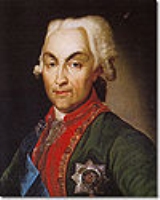
sent ambassador Nicholas Repnin
Nicholas Repnin
Prince Nikolai Vasilyevich Repnin was an Imperial Russian statesman and general from the Repnin princely family who played a key role in the dissolution of the Polish-Lithuanian Commonwealth.- Rule of Poland :...
, who became the driving force behind the Sejm proceedings. The Repnin Sejm marked one of the important milestones in increasing Polish dependence on the Russian Empire, and turning it into a Russian protectorate
Protectorate
In history, the term protectorate has two different meanings. In its earliest inception, which has been adopted by modern international law, it is an autonomous territory that is protected diplomatically or militarily against third parties by a stronger state or entity...
. This dependent position was bluntly spelled out in Nikita Ivanovich Panin
Nikita Ivanovich Panin
Count Nikita Ivanovich Panin was an influential Russian statesman and political mentor to Catherine the Great for the first eighteen years of her reign. In that role he advocated the Northern Alliance, closer ties with Frederick the Great of Prussia and the establishment of an advisory privy...
's letter to King Poniatowski, in which he made it clear that Poland was now in the Russian sphere of influence
Sphere of influence
In the field of international relations, a sphere of influence is a spatial region or conceptual division over which a state or organization has significant cultural, economic, military or political influence....
.
History
The Ambassador of the Russian EmpireRussian Empire
The Russian Empire was a state that existed from 1721 until the Russian Revolution of 1917. It was the successor to the Tsardom of Russia and the predecessor of the Soviet Union...
to Warsaw Prince Nicholas Repnin
Nicholas Repnin
Prince Nikolai Vasilyevich Repnin was an Imperial Russian statesman and general from the Repnin princely family who played a key role in the dissolution of the Polish-Lithuanian Commonwealth.- Rule of Poland :...
received orders from Russian Empress Catherine the Great to bribe and coerce the Sejm deputies in order to push legislation favourable to Russia, in effect "a carefully drafted plan for destroying the republic". At that time Poland had a population of about 11.5 million, out of which about 1 million were non-Catholics. In his preparations Repnin fostered unrest among the religious minorities – Protestants (mostly in Royal Prussia
Royal Prussia
Royal Prussia was a Region of the Kingdom of Poland and of the Polish-Lithuanian Commonwealth . Polish Prussia included Pomerelia, Chełmno Land , Malbork Voivodeship , Gdańsk , Toruń , and Elbląg . It is distinguished from Ducal Prussia...
and Greater Poland
Greater Poland
Greater Poland or Great Poland, often known by its Polish name Wielkopolska is a historical region of west-central Poland. Its chief city is Poznań.The boundaries of Greater Poland have varied somewhat throughout history...
) and Eastern Orthodox (mostly in the Grand Duchy of Lithuania
Grand Duchy of Lithuania
The Grand Duchy of Lithuania was a European state from the 12th /13th century until 1569 and then as a constituent part of Polish-Lithuanian Commonwealth until 1791 when Constitution of May 3, 1791 abolished it in favor of unitary state. It was founded by the Lithuanians, one of the polytheistic...
), who wanted to have equal rights with the Roman Catholics. Repnin was well aware that a Catholic-dominated Sejm would be strongly opposed to such demands. He also calculated that such a demand itself would make the szlachta
Szlachta
The szlachta was a legally privileged noble class with origins in the Kingdom of Poland. It gained considerable institutional privileges during the 1333-1370 reign of Casimir the Great. In 1413, following a series of tentative personal unions between the Grand Duchy of Lithuania and the Kingdom of...
suspicious of all reform, including the recent reforms of King Stanisław August Poniatowski and his supporters from the magnate Czartoryski family. Repnin's calculations were proven correct at the Sejm of 1766, which not only rejected the dissident bill, but repealed all the Poniatowski's reforms. This weakened the position of King Poniatowski. Supporters of the previous King Augustus III of Poland
Augustus III of Poland
Augustus III, known as the Saxon ; ; also Prince-elector Friedrich August II was the Elector of Saxony in 1733-1763, as Frederick Augustus II , King of Poland and Grand Duke of Lithuania in 1734-1763.-Biography:Augustus was the only legitimate son of Augustus II the Strong, Imperial Prince-Elector...
from the Electorate of Saxony
Electorate of Saxony
The Electorate of Saxony , sometimes referred to as Upper Saxony, was a State of the Holy Roman Empire. It was established when Emperor Charles IV raised the Ascanian duchy of Saxe-Wittenberg to the status of an Electorate by the Golden Bull of 1356...
, led by Gabriel Podoski
Gabriel Podoski
Gabriel Podoski was a Polish priest and politician. Archbishop of Gniezno .He was one of the Polish nobles in Russian service and supported their position. One of the leaders of the Radom Confederation...
, started a campaign to dethrone the king.
In order to further Russian goals, Repnin encouraged the formation of two Protestant konfederacjas of Sluck and Toruń
Torun
Toruń is an ancient city in northern Poland, on the Vistula River. Its population is more than 205,934 as of June 2009. Toruń is one of the oldest cities in Poland. The medieval old town of Toruń is the birthplace of the astronomer Nicolaus Copernicus....
and later, Catholic (Radom Confederation
Radom Confederation
Radom Confederation was a konfederacja of nobility in the Polish-Lithuanian Commonwealth formed in Radom on 23 June 1767 to prevent reforms and defend the Golden Liberties...
, led by Karol Stanisław "Panie Kochanku" Radziwiłł). The first act of the Radom Confederation was to send a delegation to Saint Petersburg
Saint Petersburg
Saint Petersburg is a city and a federal subject of Russia located on the Neva River at the head of the Gulf of Finland on the Baltic Sea...
, petitioning Catherine to guarantee the liberties of the Republic, and allow the proper legislation to be settled by the Russian ambassador at Warsaw. With Russian troops sent to "protect" the various pro-Russian factions and this carte blanche in his pocket, Repnin proceeded to treat the deputies of the Sejm as if they were already servants of the Russian empress.
The opposition was headed by four bishops: Bishop of Lviv Wacław Hieronim Sierakowski (1699–1784), Bishop of Chełm Feliks Paweł Turski (1729–1800), Bishop of Cracow Kajetan Ignaty Sołtyk (1715–1788), and Bishop of Kiev
Bishop of Kiev
Bishop of Kiev, or Kyiv, can refer to:* the ancient Metropolitan of Kiev * the Roman Catholic Bishop of Kiev * the Ukrainian Orthodox Church Metropolitan of Kiev...
Józef Andrzej Załuski (1702–1774). To break the opposition, Repnin, in the very Polish capital ordered the arrest of four vocal opponents of his policies, namely bishops Józef Andrzej Załuski and Kajetan Sołtyk and hetman
Hetman
Hetman was the title of the second-highest military commander in 15th- to 18th-century Poland and the Grand Duchy of Lithuania, which together, from 1569 to 1795, comprised the Polish-Lithuanian Commonwealth, or Rzeczpospolita....
Wacław Rzewuski with his son Seweryn. All of them members of Senate of Poland
Senate of Poland
The Senate is the upper house of the Polish parliament, the lower house being the 'Sejm'. The history of the Polish Senate is rich in tradition and stretches back over 500 years, it was one of the first constituent bodies of a bicameral parliament in Europe and existed without hiatus until the...
, they were arrested by Russian troops on October 13, 1767 and imprisoned in Kaluga
Kaluga
Kaluga is a city and the administrative center of Kaluga Oblast, Russia, located on the Oka River southwest of Moscow. Population: It is served by Grabtsevo Airport.-History:...
for 5 years.
Through the Polish nobles
Szlachta
The szlachta was a legally privileged noble class with origins in the Kingdom of Poland. It gained considerable institutional privileges during the 1333-1370 reign of Casimir the Great. In 1413, following a series of tentative personal unions between the Grand Duchy of Lithuania and the Kingdom of...
that he bribed (like Gabriel Podoski
Gabriel Podoski
Gabriel Podoski was a Polish priest and politician. Archbishop of Gniezno .He was one of the Polish nobles in Russian service and supported their position. One of the leaders of the Radom Confederation...
, Primate of Poland) or threatened by the presence of over 10,000 Russian soldiers in Warsaw and even in the very chambers of the parliament, Repnin, despite some misgivings about the methods he was ordered to employ, de facto dictated the terms of that Sejm. The intimidated Sejm, which met in October 1767 and adjourned till February 1768, appointed a commission (the so-called Delegated Sejm) which drafted a Polish–Russian treaty, approved in a "silent session" (without debate) on February 27, 1768. The legislation undid some of the reforms of 1764 under King Poniatowski and pushed through legislation which ensured that the political system
Political system
A political system is a system of politics and government. It is usually compared to the legal system, economic system, cultural system, and other social systems...
of the Commonwealth would be ineffective and easily controlled by its foreign neighbours. The liberum veto
Liberum veto
The liberum veto was a parliamentary device in the Polish-Lithuanian Commonwealth. It allowed any member of the Sejm to force an immediate end to the current session and nullify any legislation that had already been passed at the session by shouting Nie pozwalam! .From the mid-16th to the late 18th...
, wolna elekcja (free election), neminem captivabimus
Neminem captivabimus
Neminem captivabimus is a legal term in Lithuanian and Polish historical law.Short for , ....
, rights to form the confederation
Confederation (Poland)
A konfederacja was an ad hoc association formed by Polish-Lithuanian szlachta A konfederacja (Polish for "confederation") was an ad hoc association formed by Polish-Lithuanian szlachta A konfederacja (Polish for "confederation") was an ad hoc association formed by Polish-Lithuanian szlachta...
and rokosz
Rokosz
A rokosz originally was a gathering of all the Polish szlachta , not merely of deputies, for a sejm. The term was introduced to the Polish language from Hungary, where analogous gatherings took place at a field called Rákos....
— in other words, all the important privileges of the Golden Liberty
Golden Liberty
Golden Liberty , sometimes referred to as Golden Freedoms, Nobles' Democracy or Nobles' Commonwealth refers to a unique aristocratic political system in the Kingdom of Poland and later, after the Union of Lublin , in the Polish-Lithuanian Commonwealth...
, which made the Commonwealth so ungovernable — were guaranteed as unalterable parts in the Cardinal Laws
Cardinal laws
The Cardinal Laws were a constitution enacted in Warsaw, Poland, by the Repnin Sejm of 1767–68. Ostensibly the Cardinal Laws were intended to ensure the "Golden Liberty" of the Polish-Lithuanian nobility, as demanded by nobles united in the Radom Confederation...
.
The Sejm, however, also passed some more beneficial reforms. Russia, which had used the pretext of increased religious freedoms for the Protestant and Orthodox Christians
Eastern Orthodox Church
The Orthodox Church, officially called the Orthodox Catholic Church and commonly referred to as the Eastern Orthodox Church, is the second largest Christian denomination in the world, with an estimated 300 million adherents mainly in the countries of Belarus, Bulgaria, Cyprus, Georgia, Greece,...
to destabilize the Commonwealth in the first place, now had to push those reforms through the Sejm to save face. Thus the legislation of the Sejm granted those religious minorities the same status as that of the previously dominant Roman Catholics, and some privileges of the Catholic clergy were limited. In addition, the penalty for killing a peasant was increased from a fine to death, liberum veto was abolished on sejmik
Sejmik
A sejmik was a regional assembly in the Polish–Lithuanian Commonwealth, and earlier in the Kingdom of Poland. Sejmiks existed until the end of the Commonwealth in 1795 following the partitions of the Commonwealth...
s (local parliaments), and a mint
Mint (coin)
A mint is an industrial facility which manufactures coins for currency.The history of mints correlates closely with the history of coins. One difference is that the history of the mint is usually closely tied to the political situation of an era...
was created. All those reforms were guaranteed by the Russian Empress, Catherine II. The resulting reaction among Poland's Roman Catholic leadership to the laws granting privileges to the Protestants, as well as the deep resentment of Russia's meddling in the Commonwealth's domestic affairs, led to the War of the Bar Confederation
Bar Confederation
The Bar Confederation was an association of Polish nobles formed at the fortress of Bar in Podolia in 1768 to defend the internal and external independence of the Polish–Lithuanian Commonwealth against Russian influence and against King Stanisław August Poniatowski and Polish reformers who were...
(1768–1772), directed against Poniatowski and Russia, which ended with Russian victory and the First Partition of Poland
First Partition of Poland
The First Partition of Poland or First Partition of the Polish-Lithuanian Commonwealth took place in 1772 as the first of three partitions that ended the existence of the Polish-Lithuanian Commonwealth by 1795. Growth in the Russian Empire's power, threatening the Kingdom of Prussia and the...
.