

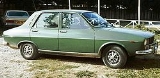
Renault 12

Encyclopedia
The Renault 12 is a family car produced by French automaker Renault
between 1969 and 1980. Available as a saloon (Berline) and estate
(Break), it was also produced under licence in many countries across the globe into the early 21st century.
In its first few years the 12 received praise from the European press for its spacious, comfortable interior, its styling, its performance and its low fuel consumption. However it fared worse in the North American press: in a test of the 1974 model, Road & Track
was critical of the engine's "obtrusive" noise, and called the heavy, non-power steering "a serious design flaw". They also gave it "very poor marks" for the ventilation system.
Renault 12 production and sales ended in western Europe in 1980, but the model continued to be produced and sold by Renault affiliates elsewhere. The last R12 was produced in 1999 in Turkey
, whilst Romanian automaker Dacia
continued producing the R12-based 1310
sedan and estate until 2004 and the R12-based Dacia Pick-Up until December 2006.
Overall, the Renault 12 was a successful car, selling 2.5 million units.
and the Renault 16
. The demands for Project 117 were:
The Renault 12's design dates back to the genesis of the Renault 16; indeed, some initial R16 concept designs resemble the R12 more than the ultimate design of the R16. However, the R12 was technically quite different from either the R16 or the smaller Renault 4
. Like all new Renaults at the time the car had front wheel drive, but the R12 had a very different layout. The engine was placed longitudinally ahead of the front wheels, while it was behind the wheels on the R4 and R16; the engine itself was the iron cast Cléon unit
used since 1962 in the Renault 8/10
(the engine's size was increased to 1289 cc for use in the 12). The placement of the engine allowed the R12 to have a very simple design of the gear-selector that was placed on the floor of the car, and not on the dashboard as with the R4 or on the steering column as with the R16. The handle to operate the handbrake was placed under the dashboard. The R12's suspension differed from the R4 and R16 also, using a rigid (but light) rear axle
as opposed to four-wheel independent suspension.The handbrake was later relocated to a position between the two front seats.
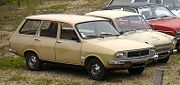
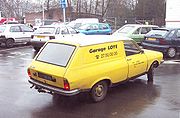 At the time of its launch in October 1969 at the Paris Motor Show, the Renault 12 was only available as a four-door saloon, in L and TL specifications, both of which were powered by a 1289 cc engine rated at 54 PS. The more expensive TL featured two separate reclining front seats instead of one front bench seat, arm rests on the doors, lights in the boot and glovebox, a heated rear window, and extra warning lights.
In 1970, two new variants were introduced. The estate was launched with the same trim levels and engines as in the saloon and a high performance Renault 12 Gordini model was introduced equipped with the all-aluminium
1565 cc block from the R16 TS fitted with two double-barrel Weber carburettors producing 125 PS, a reinforced crankshaft
, a five speed gearbox, ventilated disc brakes on the front wheels and normal disc brakes on the rear wheels, as well as a tuned suspension. The Gordini was able to reach 185 km/h (115 mph) and was sold with paint schemes comprising a solid pastel colour (there were several to choose from) with double white stripes added on, the most famous combination being French Blue with stripes. 2225 Renault 12 Gordinis were sold in 1971 but after that sales began a free fall. Renault stopped production of the Gordini in 1974 after 5188 had been sold (compared to 11,607 Renault 8 Gordinis).
In October 1972, the more upmarket R12 TS was introduced. It used same 1289 cc engine as in other R12s, but was equipped with a single, double barrel Weber carburettor, which increased power to 64 PS and raised top speed to 150 km/h (93 mph). Aesthetically, the car was distinguishable from other R12s by its special Gordini-style wheels, a chrome
strip along the side of the car, and in some countries, two extra headlights. The TS also featured integrated headrests, a tachometer
and a cooling-fluid temperature gauge.
In October 1973, the R12 TR appeared. This model slotted between the TL and TS, and had automatic transmission
as standard.
The whole range was facelifted in 1975 with a new grill, rear lamps and dashboard.
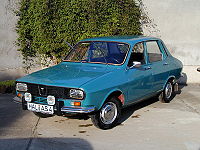
Dacia acquired the tooling and basic designs of the Renault 12 and manufactured it in various body styles in Romania
, as the Dacia 1300, between 1969 and 1979. Also, the successor of this car, named Dacia 1310, was based on Dacia 1300. The production of the 1310 started in 1979 and stopped in 2004.
The 35 years of production saw the manufacturing of a total of 1,979,730 vehicles plus, between 1975–2006, a total of 318,969 vehicles belonging to the range that came to be known under the generic name of "Pick Up".
between 1971 and 2000. The earlier models were similar to the original R12, then the car underwent a facelift in the 1980s and was marketed under the name Renault Toros until it was discontinued.
It was built at Renault Australia's assembly plant in the Melbourne suburb of Heidelberg
from CKD kits. Various components such as seats were sourced locally.
The Australian range generally followed the UK models, including the 1975 facelift but, from about 1971, when new Australian Design Rules were introduced, had to have a special local wiper mechanism with a conventional right hand drive pattern (parking on the passenger side) This also affected locally assembled Peugeot 504 and Triumph 2.5 models.
In October 1976 the 1289 cc engine was replaced by a larger capacity 1397 cc unit, and this new model was marketed as the Renault 1.4 Litre. In May 1978 it was renamed again and became the Renault Virage. This was identical to the 12, but incorporated twin round headlamps.
Production in Australia ended in 1980.
front wheel drive layout contrasted with most. The engine, an R16 all-aluminum 1.6 L (1647 cc) unit which produced 65 hp, was specific to the U.S. market. It was upgraded in 1975 with hemispherical heads and a higher compression ratio
for 72 hp.
, a version of the 12 was sold as the Ford Corcel
and later the Ford Del Rey, when Ford do Brasil acquired the factory and rights to build the car from Willys-Overland, which had jointly developed the Brazilian version with Renault
in the late 1960s. The Corcel was in fact launched in Brazil in 1968, before the Renault 12 was launched in France.
The Renault 12 was popular in Argentina
and Colombia
, during the 1970s and 1980s. In Colombia, this car was assembled at the plant of Renault SOFASA
between 1973 to 1981, from CKDs that came from Argentina and France. In Argentina
, the local versions being made at the "Santa Isabel" plant of Renault Argentina in the province of Córdoba. Production ran from November 1971 to the same month of 1994 (1973 to 1992 for the Break); totaling around 450.000 units.
Drivetrains began as 1289 cc, switching effectively to 1397 cc for all versions in 1977, with a last increase in bore and stroke in 1992 reaching 1600 cc. Gearboxes were 4 speed manuals until 1988, and 5 speed boxes thereafter. The R12 had a slightly higher status in this country than other places, given the fact that the Argentine Renault cars lineup was narrow at the time (R4
, R6
and Renault Torino
). This caused the factory to add extras such as air conditioning and quality upholstery to close the gap between this car and the Torino until the arrival of the R18
in 1982. For this same reason, virtually all of the estate models (Break) were built with the TS's mechanical and comfort features.
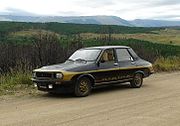 The R12 Alpine was a sports version designed to improve the marque's image at local rallying
. The main features were the 1397 cc engine from the R5 Alpine (built locally with imported parts), bulbous fiberglass bonnet, competition-tuned suspension, and custom paint schemes. The engine turned out 110 PS, giving the Alpine a top speed of around 175 km/h (109 mph). The new suspension was also as good as the power plant, being rated at the time as "outstanding" and "Goes like on rails" (CORSA Magazine). Renault was not interested in volume production, though, and only 493 units were made between 1977 and 1980 (sold from 1978 onwards). Plus, the Alpine's hand-building process and imported parts made it cost about 40% more than the basic TL version. R12 Alpine parts were sometimes used by rallying R12 TS's, as they gave the car quite desirable characteristics but, like the R12 Alpine itself, these parts were rare.
Renault
Renault S.A. is a French automaker producing cars, vans, and in the past, autorail vehicles, trucks, tractors, vans and also buses/coaches. Its alliance with Nissan makes it the world's third largest automaker...
between 1969 and 1980. Available as a saloon (Berline) and estate
Station wagon
A station wagon is a body style variant of a sedan/saloon with its roof extended rearward over a shared passenger/cargo volume with access at the back via a third or fifth door , instead of a trunk lid...
(Break), it was also produced under licence in many countries across the globe into the early 21st century.
In its first few years the 12 received praise from the European press for its spacious, comfortable interior, its styling, its performance and its low fuel consumption. However it fared worse in the North American press: in a test of the 1974 model, Road & Track
Road & Track
Road & Track is an American automotive enthusiast magazine. It is owned by Hearst Magazines, and is published monthly. The editorial offices are located in Newport Beach, California.-History:...
was critical of the engine's "obtrusive" noise, and called the heavy, non-power steering "a serious design flaw". They also gave it "very poor marks" for the ventilation system.
Renault 12 production and sales ended in western Europe in 1980, but the model continued to be produced and sold by Renault affiliates elsewhere. The last R12 was produced in 1999 in Turkey
Turkey
Turkey , known officially as the Republic of Turkey , is a Eurasian country located in Western Asia and in East Thrace in Southeastern Europe...
, whilst Romanian automaker Dacia
Dacia (car)
Automobile Dacia S.A. is a Romanian car manufacturer, named for the historic region that constitutes much of present-day Romania. It is now a subsidiary of the French carmaker Renault. The company is the main exporter from Romania with 10% of total exports....
continued producing the R12-based 1310
Dacia 1300
The Dacia 1300 was a car manufactured during the Cold War by Romanian auto marque Dacia. "1300" represents the car's engine displacement.The first Dacia 1300 left the assembly line on 23 August 1969...
sedan and estate until 2004 and the R12-based Dacia Pick-Up until December 2006.
Overall, the Renault 12 was a successful car, selling 2.5 million units.
The project
In 1965, Renault began to study a new model to bridge the gap between the Renault 8Renault 8
The Renault 8 and Renault 10 are two small family cars produced by the French manufacturer Renault in the 1960s and early 1970s....
and the Renault 16
Renault 16
The Renault 16 is a hatchback produced by French automaker Renault between 1965 and 1980 in Le Havre, France. The reviewer in the May 1965 edition of the English "Motoring Illustrated" said: "The Renault Sixteen can thus be described as a large family car but one that is neither a four door saloon...
. The demands for Project 117 were:
- "The car had to be economical, not very sophisticated. It had to have a roomy interior, and a large boot, and a small engine will suffice. The car had to be easy to produce, so it could be made all over the world. It had to be reliable for the export markets, and comfortable enough for France. It should be usable as a base for multiple variations."
The Renault 12's design dates back to the genesis of the Renault 16; indeed, some initial R16 concept designs resemble the R12 more than the ultimate design of the R16. However, the R12 was technically quite different from either the R16 or the smaller Renault 4
Renault 4
The Renault 4, also known as the 4L , is a hatchback economy car produced by the French automaker Renault between 1961 and 1992. It was the first front-wheel drive family car produced by Renault....
. Like all new Renaults at the time the car had front wheel drive, but the R12 had a very different layout. The engine was placed longitudinally ahead of the front wheels, while it was behind the wheels on the R4 and R16; the engine itself was the iron cast Cléon unit
Renault Cléon engine
The Cléon engine was a 5-bearing straight-4 automobile engine from Renault. Introduced at the Geneva Motor Show in 1962 with the Renault Floride S, the engine was a development of the 3-bearing Ventoux engine from the 1950s. It is an overhead valve design and in Renault tradition, features "wet"...
used since 1962 in the Renault 8/10
Renault 8
The Renault 8 and Renault 10 are two small family cars produced by the French manufacturer Renault in the 1960s and early 1970s....
(the engine's size was increased to 1289 cc for use in the 12). The placement of the engine allowed the R12 to have a very simple design of the gear-selector that was placed on the floor of the car, and not on the dashboard as with the R4 or on the steering column as with the R16. The handle to operate the handbrake was placed under the dashboard. The R12's suspension differed from the R4 and R16 also, using a rigid (but light) rear axle
Axle
An axle is a central shaft for a rotating wheel or gear. On wheeled vehicles, the axle may be fixed to the wheels, rotating with them, or fixed to its surroundings, with the wheels rotating around the axle. In the former case, bearings or bushings are provided at the mounting points where the axle...
as opposed to four-wheel independent suspension.The handbrake was later relocated to a position between the two front seats.
Versions
In 1970, two new variants were introduced. The estate was launched with the same trim levels and engines as in the saloon and a high performance Renault 12 Gordini model was introduced equipped with the all-aluminium
Aluminium
Aluminium or aluminum is a silvery white member of the boron group of chemical elements. It has the symbol Al, and its atomic number is 13. It is not soluble in water under normal circumstances....
1565 cc block from the R16 TS fitted with two double-barrel Weber carburettors producing 125 PS, a reinforced crankshaft
Crankshaft
The crankshaft, sometimes casually abbreviated to crank, is the part of an engine which translates reciprocating linear piston motion into rotation...
, a five speed gearbox, ventilated disc brakes on the front wheels and normal disc brakes on the rear wheels, as well as a tuned suspension. The Gordini was able to reach 185 km/h (115 mph) and was sold with paint schemes comprising a solid pastel colour (there were several to choose from) with double white stripes added on, the most famous combination being French Blue with stripes. 2225 Renault 12 Gordinis were sold in 1971 but after that sales began a free fall. Renault stopped production of the Gordini in 1974 after 5188 had been sold (compared to 11,607 Renault 8 Gordinis).
In October 1972, the more upmarket R12 TS was introduced. It used same 1289 cc engine as in other R12s, but was equipped with a single, double barrel Weber carburettor, which increased power to 64 PS and raised top speed to 150 km/h (93 mph). Aesthetically, the car was distinguishable from other R12s by its special Gordini-style wheels, a chrome
Chrome plating
Chrome plating, often referred to simply as chrome, is a technique of electroplating a thin layer of chromium onto a metal object. The chromed layer can be decorative, provide corrosion resistance, ease cleaning procedures, or increase surface hardness.-Process:A component to be chrome plated will...
strip along the side of the car, and in some countries, two extra headlights. The TS also featured integrated headrests, a tachometer
Tachometer
A tachometer is an instrument measuring the rotation speed of a shaft or disk, as in a motor or other machine. The device usually displays the revolutions per minute on a calibrated analogue dial, but digital displays are increasingly common...
and a cooling-fluid temperature gauge.
In October 1973, the R12 TR appeared. This model slotted between the TL and TS, and had automatic transmission
Automatic transmission
An automatic transmission is one type of motor vehicle transmission that can automatically change gear ratios as the vehicle moves, freeing the driver from having to shift gears manually...
as standard.
The whole range was facelifted in 1975 with a new grill, rear lamps and dashboard.
Romania
Dacia acquired the tooling and basic designs of the Renault 12 and manufactured it in various body styles in Romania
Romania
Romania is a country located at the crossroads of Central and Southeastern Europe, on the Lower Danube, within and outside the Carpathian arch, bordering on the Black Sea...
, as the Dacia 1300, between 1969 and 1979. Also, the successor of this car, named Dacia 1310, was based on Dacia 1300. The production of the 1310 started in 1979 and stopped in 2004.
The 35 years of production saw the manufacturing of a total of 1,979,730 vehicles plus, between 1975–2006, a total of 318,969 vehicles belonging to the range that came to be known under the generic name of "Pick Up".
Turkey
A Renault 12-based car was made in Turkey by Oyak-RenaultOyak-Renault
Oyak Renault Otomobil Fabrikaları A.Ş. is a Turkish automotive manufacturer located in Bursa. It is co-owned by Oyak and Renault. Oyak owns 49% and Renault owns 51% of the company....
between 1971 and 2000. The earlier models were similar to the original R12, then the car underwent a facelift in the 1980s and was marketed under the name Renault Toros until it was discontinued.
Australia
The Renault 12 won Australia's Wheels magazine's Car of the Year award in 1970.It was built at Renault Australia's assembly plant in the Melbourne suburb of Heidelberg
Heidelberg, Victoria
Heidelberg is a suburb in Melbourne, Victoria, Australia, 11 km north-east from Melbourne's central business district. Its Local Government Area is the City of Banyule....
from CKD kits. Various components such as seats were sourced locally.
The Australian range generally followed the UK models, including the 1975 facelift but, from about 1971, when new Australian Design Rules were introduced, had to have a special local wiper mechanism with a conventional right hand drive pattern (parking on the passenger side) This also affected locally assembled Peugeot 504 and Triumph 2.5 models.
In October 1976 the 1289 cc engine was replaced by a larger capacity 1397 cc unit, and this new model was marketed as the Renault 1.4 Litre. In May 1978 it was renamed again and became the Renault Virage. This was identical to the 12, but incorporated twin round headlamps.
Production in Australia ended in 1980.
North America
The American-market Renault 12 came in three trim lines: 12, 12 L, and 12 TL, ranging in price from an inexpensive US$ 2975 to US$ 3448. It was a slightly larger car than most European imports, and the longitudinalLongitudinal engine
In automotive engineering, a longitudinal engine is an internal combustion engine in which the crankshaft is oriented along the long axis of the vehicle, front to back....
front wheel drive layout contrasted with most. The engine, an R16 all-aluminum 1.6 L (1647 cc) unit which produced 65 hp, was specific to the U.S. market. It was upgraded in 1975 with hemispherical heads and a higher compression ratio
Compression ratio
The 'compression ratio' of an internal-combustion engine or external combustion engine is a value that represents the ratio of the volume of its combustion chamber from its largest capacity to its smallest capacity...
for 72 hp.
South America
In BrazilBrazil
Brazil , officially the Federative Republic of Brazil , is the largest country in South America. It is the world's fifth largest country, both by geographical area and by population with over 192 million people...
, a version of the 12 was sold as the Ford Corcel
Ford Corcel
The Ford Corcel is a car which was sold by the Ford Motor Company in Brazil, Chile and Venezuela.The Corcel's origins lay in the Renault 12. Willys-Overland's Brazilian operation included manufacturing the Renault Dauphine and Gordini and, when it was bought by Ford do Brasil in 1967, plans were...
and later the Ford Del Rey, when Ford do Brasil acquired the factory and rights to build the car from Willys-Overland, which had jointly developed the Brazilian version with Renault
Renault
Renault S.A. is a French automaker producing cars, vans, and in the past, autorail vehicles, trucks, tractors, vans and also buses/coaches. Its alliance with Nissan makes it the world's third largest automaker...
in the late 1960s. The Corcel was in fact launched in Brazil in 1968, before the Renault 12 was launched in France.
The Renault 12 was popular in Argentina
Argentina
Argentina , officially the Argentine Republic , is the second largest country in South America by land area, after Brazil. It is constituted as a federation of 23 provinces and an autonomous city, Buenos Aires...
and Colombia
Colombia
Colombia, officially the Republic of Colombia , is a unitary constitutional republic comprising thirty-two departments. The country is located in northwestern South America, bordered to the east by Venezuela and Brazil; to the south by Ecuador and Peru; to the north by the Caribbean Sea; to the...
, during the 1970s and 1980s. In Colombia, this car was assembled at the plant of Renault SOFASA
Sofasa
Sofasa is an automobile company in Colombia that assembles imported Renault, Toyota and Delta Daihatsu vehicles. The company then exports to the Andean Community of Nations and supplies the national market of automobiles in Colombia....
between 1973 to 1981, from CKDs that came from Argentina and France. In Argentina
Argentina
Argentina , officially the Argentine Republic , is the second largest country in South America by land area, after Brazil. It is constituted as a federation of 23 provinces and an autonomous city, Buenos Aires...
, the local versions being made at the "Santa Isabel" plant of Renault Argentina in the province of Córdoba. Production ran from November 1971 to the same month of 1994 (1973 to 1992 for the Break); totaling around 450.000 units.
Drivetrains began as 1289 cc, switching effectively to 1397 cc for all versions in 1977, with a last increase in bore and stroke in 1992 reaching 1600 cc. Gearboxes were 4 speed manuals until 1988, and 5 speed boxes thereafter. The R12 had a slightly higher status in this country than other places, given the fact that the Argentine Renault cars lineup was narrow at the time (R4
Renault 4
The Renault 4, also known as the 4L , is a hatchback economy car produced by the French automaker Renault between 1961 and 1992. It was the first front-wheel drive family car produced by Renault....
, R6
Renault 4
The Renault 4, also known as the 4L , is a hatchback economy car produced by the French automaker Renault between 1961 and 1992. It was the first front-wheel drive family car produced by Renault....
and Renault Torino
Renault Torino
The IKA Torino, later Renault Torino, is a mid-sized automobile made by Industrias Kaiser Argentina under an agreement with American Motors in 1966. The 1966 Torino was IKA’s first integral national product and IKA was eventually bought out by Renault in 1975 to form Renault Argentina S.A...
). This caused the factory to add extras such as air conditioning and quality upholstery to close the gap between this car and the Torino until the arrival of the R18
Renault 18
The Renault 18 is a large family car produced by French manufacturer Renault between 1978 and 1993 .-Development:...
in 1982. For this same reason, virtually all of the estate models (Break) were built with the TS's mechanical and comfort features.
Renault 12 Alpine
Rallying
Rallying, also known as rally racing, is a form of auto racing that takes place on public or private roads with modified production or specially built road-legal cars...
. The main features were the 1397 cc engine from the R5 Alpine (built locally with imported parts), bulbous fiberglass bonnet, competition-tuned suspension, and custom paint schemes. The engine turned out 110 PS, giving the Alpine a top speed of around 175 km/h (109 mph). The new suspension was also as good as the power plant, being rated at the time as "outstanding" and "Goes like on rails" (CORSA Magazine). Renault was not interested in volume production, though, and only 493 units were made between 1977 and 1980 (sold from 1978 onwards). Plus, the Alpine's hand-building process and imported parts made it cost about 40% more than the basic TL version. R12 Alpine parts were sometimes used by rallying R12 TS's, as they gave the car quite desirable characteristics but, like the R12 Alpine itself, these parts were rare.