


Religious studies

Encyclopedia

Academia
Academia is the community of students and scholars engaged in higher education and research.-Etymology:The word comes from the akademeia in ancient Greece. Outside the city walls of Athens, the gymnasium was made famous by Plato as a center of learning...
field of multi-disciplinary, secular study of religious
Religion
Religion is a collection of cultural systems, belief systems, and worldviews that establishes symbols that relate humanity to spirituality and, sometimes, to moral values. Many religions have narratives, symbols, traditions and sacred histories that are intended to give meaning to life or to...
beliefs, behaviors
Religious behaviour
The religions of the world consist of religious images and religious behaviour. The images of the religions from the past and of present day religions, like gods, ghosts and worshipped ancestors, concepts of guilt, dogmatic teachings and ideas of the hereafter, are generally quite well known...
, and institutions. It describes, compares, interprets, and explains religion, emphasizing systematic, historically based, and cross-cultural perspectives.
While theology
Theology
Theology is the systematic and rational study of religion and its influences and of the nature of religious truths, or the learned profession acquired by completing specialized training in religious studies, usually at a university or school of divinity or seminary.-Definition:Augustine of Hippo...
attempts to understand the nature and intentions of a supernatural force (such as deities), religious studies tries to study religious behavior and belief from outside any particular religious viewpoint. Religious studies draws upon multiple disciplines and their methodologies including anthropology
Anthropology of religion
The anthropology of religion involves the study of religious institutions in relation to other social institutions, and the comparison of religious beliefs and practices across cultures.-History:...
, sociology
Sociology of religion
The sociology of religion concerns the role of religion in society: practices, historical backgrounds, developments and universal themes. There is particular emphasis on the recurring role of religion in all societies and throughout recorded history...
, psychology
Psychology of religion
Psychology of religion consists of the application of psychological methods and interpretive frameworks to religious traditions, as well as to both religious and irreligious individuals. The science attempts to accurately describe the details, origins, and uses of religious beliefs and behaviours...
, philosophy
Philosophy of religion
Philosophy of religion is a branch of philosophy concerned with questions regarding religion, including the nature and existence of God, the examination of religious experience, analysis of religious language and texts, and the relationship of religion and science...
, and history of religion.
Religious studies originated in the nineteenth century, when scholarly and historical analysis of the Bible had flourished, and Hindu and Buddhist texts
Buddhist texts
Buddhist texts can be categorized in a number of ways. The Western terms "scripture" and "canonical" are applied to Buddhism in inconsistent ways by Western scholars: for example, one authority refers to "scriptures and other canonical texts", while another says that scriptures can be categorized...
were first being translated into European languages. Early influential scholars included Friedrich Max Müller, in England, and Cornelius P. Tiele
Cornelis Petrus Tiele
Cornelis Petrus Tiele, was a Dutch theologian and scholar.-Life:He was born at Leiden. He was educated at Amsterdam, first studying at the Athenaeum Illustre, as the communal high school of the capital was then named, and afterwards at the seminary of the Remonstrant Brotherhood.He was destined...
, in the Netherlands. Today religious studies is practiced by scholars worldwide.
In its early years, it was known as Comparative Religion
Comparative religion
Comparative religion is a field of religious studies that analyzes the similarities and differences of themes, myths, rituals and concepts among the world's religions...
or the Science of Religion and, in the USA, there are those who today also know the field as the History of religion (associated with methodological traditions traced to the University of Chicago in general, and in particular Mircea Eliade
Mircea Eliade
Mircea Eliade was a Romanian historian of religion, fiction writer, philosopher, and professor at the University of Chicago. He was a leading interpreter of religious experience, who established paradigms in religious studies that persist to this day...
, from the late 1950s through to the late 1980s). The field is known as Religionswissenschaft in Germany and Sciences de la religion in the French-speaking world.
The term "religion" originated from the Latin noun "religio", that was nominalized from one of three verbs: "relegere" (to turn to constantly/observe conscientiously); "religare" (to bind oneself [back]); and "reeligare" (to choose again). Because of these three different meanings, an etymological analysis alone does not resolve the ambiguity of defining religion, since each verb points to a different understanding of what religion is. During the Medieval Period, the term "religious" was used as a noun to describe someone who had joined a monastic order (a "religious"). Despite this change in meaning, it is important to note the term "religion" is primarily a Christian term. Judaism and Hinduism, for example, do not include this term in their vocabulary.
Religious studies vs. theology
Western philosophy of religion, as the basic ancestor of modern religious studies, is differentiated from theology and the many Eastern philosophical traditions by generally being written from a third party perspective. The scholar need not be a believer. Theology stands in contrast to the philosophy of religion and religious studies in that, generally, the scholar is first and foremost a believer employing both logic and scripture as evidence. Theology according to this understanding fits with the definition which Anselm of CanterburyAnselm of Canterbury
Anselm of Canterbury , also called of Aosta for his birthplace, and of Bec for his home monastery, was a Benedictine monk, a philosopher, and a prelate of the church who held the office of Archbishop of Canterbury from 1093 to 1109...
gave to it in the 11th century, credo ut intelligam
Credo ut intelligam
Credo ut intelligam is Latin for "I believe so that I may understand" and is a maxim of Anselm of Canterbury, which is based on a saying of Augustine of Hippo to relate faith and reason...
, or faith seeking understanding. The theologian then has the task of making intelligible, or clarifying, the religious commitments to which he or she ascribes. The scholar of religious studies has no such allegiances.
Intellectual foundation and background
Before religious studies became a field in its own right, flourishing in the United States in the late 1960s, several key intellectual figures explored religion from a variety of perspectives. One of these figures was the famous pragmatist
Pragmatism
Pragmatism is a philosophical tradition centered on the linking of practice and theory. It describes a process where theory is extracted from practice, and applied back to practice to form what is called intelligent practice...
William James
William James
William James was a pioneering American psychologist and philosopher who was trained as a physician. He wrote influential books on the young science of psychology, educational psychology, psychology of religious experience and mysticism, and on the philosophy of pragmatism...
. His 1902 Gifford lectures
Gifford Lectures
The Gifford Lectures were established by the will of Adam Lord Gifford . They were established to "promote and diffuse the study of Natural Theology in the widest sense of the term — in other words, the knowledge of God." The term natural theology as used by Gifford means theology supported...
and book The Varieties of Religious Experience
The Varieties of Religious Experience
The Varieties of Religious Experience: A Study in Human Nature is a book by the Harvard University psychologist and philosopher William James that comprises his edited Gifford Lectures on "Natural Theology" delivered at the University of Edinburgh in Scotland between 1901 and 1902.These lectures...
examined religion from a psychological-philosophical perspective and is still influential today. His essay The Will to Believe defends the rationality of faith.
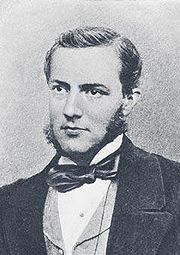
Max Weber
Max Weber
Karl Emil Maximilian "Max" Weber was a German sociologist and political economist who profoundly influenced social theory, social research, and the discipline of sociology itself...
studied religion from an economic perspective in The Protestant Ethic and the Spirit of Capitalism
The Protestant Ethic and the Spirit of Capitalism
The Protestant Ethic and the Spirit of Capitalism is a book written by Max Weber, a German sociologist, economist, and politician. Begun as a series of essays, the original German text was composed in 1904 and 1905, and was translated into English for the first time by Talcott Parsons in 1930...
(1904-5), his most famous work. As a major figure in sociology
Sociology
Sociology is the study of society. It is a social science—a term with which it is sometimes synonymous—which uses various methods of empirical investigation and critical analysis to develop a body of knowledge about human social activity...
, he has no doubt influenced later sociologists of religion.
Émile Durkheim
Émile Durkheim
David Émile Durkheim was a French sociologist. He formally established the academic discipline and, with Karl Marx and Max Weber, is commonly cited as the principal architect of modern social science and father of sociology.Much of Durkheim's work was concerned with how societies could maintain...
also holds continuing influence as one of the fathers of sociology. He explored Protestant
Protestantism
Protestantism is one of the three major groupings within Christianity. It is a movement that began in Germany in the early 16th century as a reaction against medieval Roman Catholic doctrines and practices, especially in regards to salvation, justification, and ecclesiology.The doctrines of the...
and Catholic
Catholic
The word catholic comes from the Greek phrase , meaning "on the whole," "according to the whole" or "in general", and is a combination of the Greek words meaning "about" and meaning "whole"...
attitudes and doctrines regarding suicide in his work Suicide. In 1912 he published his most memorable work on religion, Elementary Forms of the Religious Life.
History
Common Era
Common Era ,abbreviated as CE, is an alternative designation for the calendar era originally introduced by Dionysius Exiguus in the 6th century, traditionally identified with Anno Domini .Dates before the year 1 CE are indicated by the usage of BCE, short for Before the Common Era Common Era...
– ca. 476 BCE) and Herodotus
Herodotus
Herodotus was an ancient Greek historian who was born in Halicarnassus, Caria and lived in the 5th century BC . He has been called the "Father of History", and was the first historian known to collect his materials systematically, test their accuracy to a certain extent and arrange them in a...
(ca. 484 BCE – 425 BCE). Later, during the Middle Ages
Middle Ages
The Middle Ages is a periodization of European history from the 5th century to the 15th century. The Middle Ages follows the fall of the Western Roman Empire in 476 and precedes the Early Modern Era. It is the middle period of a three-period division of Western history: Classic, Medieval and Modern...
, Islam
Islam
Islam . The most common are and . : Arabic pronunciation varies regionally. The first vowel ranges from ~~. The second vowel ranges from ~~~...
ic scholars studied Persian
Zoroastrianism
Zoroastrianism is a religion and philosophy based on the teachings of prophet Zoroaster and was formerly among the world's largest religions. It was probably founded some time before the 6th century BCE in Greater Iran.In Zoroastrianism, the Creator Ahura Mazda is all good, and no evil...
, Jewish
Judaism
Judaism ) is the "religion, philosophy, and way of life" of the Jewish people...
, Christian
Christianity
Christianity is a monotheistic religion based on the life and teachings of Jesus as presented in canonical gospels and other New Testament writings...
, and Indian religions. The first history of religion was the Treatise on the Religious and Philosophical Sects (1127 CE), written by the Muslim scholar Muhammad al-Shahrastani. Peter the Venerable
Peter the Venerable
Peter the Venerable , also known as Peter of Montboissier, abbot of the Benedictine abbey of Cluny, born to Blessed Raingarde in Auvergne, France. He has been honored as a saint but has never been formally canonized.-Life:Peter was "Dedicated to God" at birth and given to the monastery at...
, also working in the twelfth century, studied Islam and made possible a Latin translation of the Qur'an
Qur'an
The Quran , also transliterated Qur'an, Koran, Alcoran, Qur’ān, Coran, Kuran, and al-Qur’ān, is the central religious text of Islam, which Muslims consider the verbatim word of God . It is regarded widely as the finest piece of literature in the Arabic language...
.
Notwithstanding the long interest in the study of religion, the academic discipline Religious Studies is relatively new. Dr. Chris Partridge notes that the "first professorships were established as recently as the final quarter of the nineteenth century."http://www.uccf.org.uk/yourcourse/rtsf/docs/academicstudyofreligion.pdf
In the nineteenth century, the study of religion was done through the eyes of science. Max Müller
Max Müller
Friedrich Max Müller , more regularly known as Max Müller, was a German philologist and Orientalist, one of the founders of the western academic field of Indian studies and the discipline of comparative religion...
was the first Professor of Comparative Religion at Oxford University, a chair created especially for him. In his Introduction to the Science of Religion (1873) he wrote that it is "the duty of those who have devoted their life to the study of the principal religions of the world in their original documents, and who value and reverence it in whatever form it may present itself, to take possession of this new territory in the name of true science."
Partridge writes that "by the second half of the twentieth century the study of religion had emerged as a prominent and important field of academic enquiry." He cites the growing distrust of the empiricism of the nineteenth century and the growing interest in non-Christian religions and spirituality coupled with convergence of the work of social scientists and that of scholars of religion as factors involved in the rise of Religious Studies.
In the 1960s and 1970s, the term "religious studies" became common and interest in the field increased. New departments were founded and influential journals of religious studies were initiated (for example, Religious Studies and Religion). In the forward to Approaches to the Study of Religion, Ninian Smart
Ninian Smart
Professor Roderick Ninian Smart was a Scottish writer and university educator. He was a pioneer in the field of secular religious studies...
wrote that "in the English-speaking world [religious studies] basically dates from the 1960s, although before then there were such fields as 'the comparative study of religion', the 'history of religion', the 'sociology of religion' and so on..."
In the 1980s, in both Britain and America
United States
The United States of America is a federal constitutional republic comprising fifty states and a federal district...
, "the decrease in student applications and diminishing resources in the 1980s led to cut backs affecting religious studies departments." (Partridge) Later in the decade, religious studies began to pick up as a result of integrating religious studies with other disciplines and forming programs of study that mixed the discipline with more utilitarian study.
Philosophy of religion uses philosophical tools to evaluate religious claims and doctrines. Western philosophy has traditionally been employed by English speaking scholars. (Some other cultures have their own philosophical traditions including Indian
Hinduism
Hinduism is the predominant and indigenous religious tradition of the Indian Subcontinent. Hinduism is known to its followers as , amongst many other expressions...
, Muslim
Islam
Islam . The most common are and . : Arabic pronunciation varies regionally. The first vowel ranges from ~~. The second vowel ranges from ~~~...
, and Jewish
Judaism
Judaism ) is the "religion, philosophy, and way of life" of the Jewish people...
.) Common issues considered by the (Western) philosophy of religion are the existence of God
God
God is the English name given to a singular being in theistic and deistic religions who is either the sole deity in monotheism, or a single deity in polytheism....
, belief and rationality, cosmology
Religious cosmology
A Religious cosmology is a way of explaining the origin, the history and the evolution of the universe based on the religious mythology of a specific tradition...
, and logical inferences of logical consistency from sacred texts.
Although philosophy has long been used in evaluation of religious claims (e.g. Augustine
Augustine of Hippo
Augustine of Hippo , also known as Augustine, St. Augustine, St. Austin, St. Augoustinos, Blessed Augustine, or St. Augustine the Blessed, was Bishop of Hippo Regius . He was a Latin-speaking philosopher and theologian who lived in the Roman Africa Province...
and Pelagius
Pelagius
Pelagius was an ascetic who denied the need for divine aid in performing good works. For him, the only grace necessary was the declaration of the law; humans were not wounded by Adam's sin and were perfectly able to fulfill the law apart from any divine aid...
's debate concerning original sin), the rise of scholasticism
Scholasticism
Scholasticism is a method of critical thought which dominated teaching by the academics of medieval universities in Europe from about 1100–1500, and a program of employing that method in articulating and defending orthodoxy in an increasingly pluralistic context...
in the 11th century, which represented "the search for order in intellectual life" (Russell, 170), more fully integrated the Western philosophical tradition (with the introduction of translations of Aristotle
Aristotle
Aristotle was a Greek philosopher and polymath, a student of Plato and teacher of Alexander the Great. His writings cover many subjects, including physics, metaphysics, poetry, theater, music, logic, rhetoric, linguistics, politics, government, ethics, biology, and zoology...
) in religious study.
There is some amount of overlap between subcategories of religious studies and the discipline itself. Religious studies seeks to study religious phenomena as a whole, rather than be limited to the approaches of its subcategories.
Anthropology of religion
The anthropology of religionAnthropology of religion
The anthropology of religion involves the study of religious institutions in relation to other social institutions, and the comparison of religious beliefs and practices across cultures.-History:...
is principally concerned with the common basic needs of man that religion fulfills.
Cultural anthropology of religion
The cultural anthropologyCultural anthropology
Cultural anthropology is a branch of anthropology focused on the study of cultural variation among humans, collecting data about the impact of global economic and political processes on local cultural realities. Anthropologists use a variety of methods, including participant observation,...
of religion is principally concerned with the cultural aspects of religion. Of primary concern to the cultural anthropologist of religions are rituals, beliefs, religious art, and practices of piety.
Economics of religion
Gallup surveys have found that the world's poorest countries may be the most religious. Of those countries with average per-capita incomes under $2000, 95% reported that religion played an important role in their daily lives. This is contrasted by the average of 47% from the richest countries, with incomes over $25000 (with the United States breaking the trend by reporting at 65%).Social scientists have suggested that religion plays a functional role (helping people cope) in poorer nations.
The New York Times offers a graphic illustrating the correlation (not necessarily causation) between religion and poverty.
Geography of religion
The geography of religion is principally concerned with the spatial elements of religious practice and embodiment. In the 1960s and 1970s, geographers of religion such as Wilbur Zelinsky and David Sopher were mostly associated with the "Berkeley school" of cultural geography and focused mostly on the cultural imprints of religion on the landscape. Since the turn in the new cultural geography of religion through the work of James Duncan on the City as Text, geographers of religion have focused on what Lily Kong has called the "politics and poetics" of religion, especially in relation to the political geographies of secular nation-states. Recent interest in the geography of religion has focused on how religious practitioners enact sacred space through their embodied sacred practices as well as the relationship between religion and geopolitics.History of religion
The history of religions is not concerned with theological claims apart from their historical significance. Some topics of this discipline are the historicityHistoricity
Historicity may mean:*the quality of being part of recorded history, as opposed to prehistory*the quality of being part of history as opposed to being a historical myth or legend, for example:** Historicity of the Iliad**Historicity...
of religious figures, events, and the evolution of doctrinal matters.
Literary approaches
There are many approaches to the study of sacred texts. One of these approaches is to interpret the text as a literary object. Metaphor, thematic elements, and the nature and motivations of the characters are of interest in this approach. An example of this approach is God: A BiographyGod: A Biography
God: A Biography is a nonfiction book by Jack Miles. The book recounts the tale of existence of the Judeo-Christian deity as the protagonist of the Hebrew Tanak or Christian Bible Old Testament. The Tanak and the Old Testament contain the same books, however, the order of the books is different...
, by Jack Miles
Jack Miles
Jack Miles is an American author and winner of both the Pulitzer Prize and the MacArthur Fellowship. His work on religion, politics, and culture has appeared in numerous national publications, including The Atlantic Monthly, The New York Times, The Boston Globe, The Washington Post, and The Los...
.
Neurological approaches
Recently there has been an interesting meeting between neurologyNeurology
Neurology is a medical specialty dealing with disorders of the nervous system. Specifically, it deals with the diagnosis and treatment of all categories of disease involving the central, peripheral, and autonomic nervous systems, including their coverings, blood vessels, and all effector tissue,...
and religion, especially Buddhism
Buddhism
Buddhism is a religion and philosophy encompassing a variety of traditions, beliefs and practices, largely based on teachings attributed to Siddhartha Gautama, commonly known as the Buddha . The Buddha lived and taught in the northeastern Indian subcontinent some time between the 6th and 4th...
. Also of interest has been the temporal lobe, the "God center" of the brain. (Ramachandran, ch. 9) Although not a widely accepted discipline within religious studies, neurological findings in regard to religious experience may very well become of more widespread interest to scholars of religion. Scientific investigators have used a SPECTscanner to analyze the brain activity of both Christian contemplatives and Buddhist meditators, finding them to be quite similar.
Origin of religion
The "origin of religion" refers to the emergence of religious behavior in prehistoryPrehistory
Prehistory is the span of time before recorded history. Prehistory can refer to the period of human existence before the availability of those written records with which recorded history begins. More broadly, it refers to all the time preceding human existence and the invention of writing...
, before written records.
Psychology of religion
The psychology of religion is concerned with what psychological principles are operative in religious communities and practitioners. William James was one of the first academics to bridge the gap between the emerging science of psychologyPsychology
Psychology is the study of the mind and behavior. Its immediate goal is to understand individuals and groups by both establishing general principles and researching specific cases. For many, the ultimate goal of psychology is to benefit society...
and the study of religion. A few issues of concern to the psychologist of religions are the psychological nature of religious conversion
Religious conversion
Religious conversion is the adoption of a new religion that differs from the convert's previous religion. Changing from one denomination to another within the same religion is usually described as reaffiliation rather than conversion.People convert to a different religion for various reasons,...
, the making of religious decisions, and the psychological factors in evaluating religious claims.
Sigmund Freud was another influential figure in the field of psychology and religion. He used his psychoanalytic theory to explain religious beliefs, practices, and rituals in order to justify the role of religion in the development of human culture.
Sociology of religion
The sociology of religion concerns the dialecticDialectic
Dialectic is a method of argument for resolving disagreement that has been central to Indic and European philosophy since antiquity. The word dialectic originated in Ancient Greece, and was made popular by Plato in the Socratic dialogues...
al relationship between religion and society
Society
A society, or a human society, is a group of people related to each other through persistent relations, or a large social grouping sharing the same geographical or virtual territory, subject to the same political authority and dominant cultural expectations...
; the practices, historical backgrounds, developments, universal themes and roles of religion in society. There is particular emphasis on the recurring role of religion in all societies and throughout recorded history. The sociology of religion is distinguished from the philosophy of religion in that it does not set out to assess the validity of religious beliefs, though the process of comparing multiple conflicting dogma
Dogma
Dogma is the established belief or doctrine held by a religion, or a particular group or organization. It is authoritative and not to be disputed, doubted, or diverged from, by the practitioners or believers...
s may require what Peter L. Berger
Peter L. Berger
Peter Ludwig Berger is an Austrian-born American sociologist well known for his work, co-authored with Thomas Luckmann, The Social Construction of Reality: A Treatise in the Sociology of Knowledge .-Biography:...
has described as inherent "methodological atheism". Whereas the sociology of religion broadly differs from theology in assuming the invalidity of the supernatural, theorists tend to acknowledge socio-cultural reification
Reification
Reification generally refers to bringing into being or turning concrete.Specifically, reification may refer to:*Reification , making a data model for a previously abstract concept...
of religious practise.
It may be said that the modern formal discipline of sociology began with the analysis of religion in Durkheim's 1897 study of suicide
Suicide (book)
Suicide was one of the groundbreaking books in the field of sociology. Written by French sociologist Émile Durkheim and published in 1897 it was a case study of suicide, a publication unique for its time which provided an example of what the sociological...
rates amongst Catholic
Catholic
The word catholic comes from the Greek phrase , meaning "on the whole," "according to the whole" or "in general", and is a combination of the Greek words meaning "about" and meaning "whole"...
and Protestant populations. The works of Max Weber emphasised the relationship between religious belief and the economic foundations of society
The Protestant Ethic and the Spirit of Capitalism
The Protestant Ethic and the Spirit of Capitalism is a book written by Max Weber, a German sociologist, economist, and politician. Begun as a series of essays, the original German text was composed in 1904 and 1905, and was translated into English for the first time by Talcott Parsons in 1930...
. Contemporary debates have centred on issues such as secularization
Secularization
Secularization is the transformation of a society from close identification with religious values and institutions toward non-religious values and secular institutions...
, civil religion
Civil religion
The intended meaning of the term civil religion often varies according to whether one is a sociologist of religion or a professional political commentator...
, and the cohesiveness of religion in the context of globalization
Globalization
Globalization refers to the increasingly global relationships of culture, people and economic activity. Most often, it refers to economics: the global distribution of the production of goods and services, through reduction of barriers to international trade such as tariffs, export fees, and import...
and multiculturalism
Multiculturalism
Multiculturalism is the appreciation, acceptance or promotion of multiple cultures, applied to the demographic make-up of a specific place, usually at the organizational level, e.g...
.
The sociology of religion also deals with how religion impacts society regarding the positive and negatives of what happens when religion is mixed with society. Theorist such as Marx states that “religion is the opium of the people” - the idea that religion has become a way for people to deal with their problems. At least one comprehensive study refutes this idea. Research has found that secular democracies like France
France
The French Republic , The French Republic , The French Republic , (commonly known as France , is a unitary semi-presidential republic in Western Europe with several overseas territories and islands located on other continents and in the Indian, Pacific, and Atlantic oceans. Metropolitan France...
or Scandinavia
Scandinavia
Scandinavia is a cultural, historical and ethno-linguistic region in northern Europe that includes the three kingdoms of Denmark, Norway and Sweden, characterized by their common ethno-cultural heritage and language. Modern Norway and Sweden proper are situated on the Scandinavian Peninsula,...
outperform more theistic democracies on various measures of societal health. The authors explain that "Pressing questions include the reasons, whether theistic or non-theistic, that the exceptionally wealthy U.S. is so inefficient that it is experiencing a much higher degree of societal distress than are less religious, less wealthy prosperous democracies. Conversely, how do the latter achieve superior societal health while having little in the way of the religious values or institutions?"
Methodologies
A number of methodologies are used in Religious Studies. Methodologies are hermeneutics, or interpretive models, that provide a structure for the analysis of religious phenomena.Phenomenology
Phenomenology is "arguably the most influential approach to the study of religion in the twentieth century." (Partridge) The term is first found in the title of the work of the influential philosopher of German IdealismGerman idealism
German idealism was a philosophical movement that emerged in Germany in the late 18th and early 19th centuries. It developed out of the work of Immanuel Kant in the 1780s and 1790s, and was closely linked both with romanticism and the revolutionary politics of the Enlightenment...
, Georg Wilhelm Friedrich Hegel
Georg Wilhelm Friedrich Hegel
Georg Wilhelm Friedrich Hegel was a German philosopher, one of the creators of German Idealism. His historicist and idealist account of reality as a whole revolutionized European philosophy and was an important precursor to Continental philosophy and Marxism.Hegel developed a comprehensive...
, entitled The Phenomenology of Spirit. Phenomenology had been practiced long before its being made explicit as a philosophical method by Edmund Husserl
Edmund Husserl
Edmund Gustav Albrecht Husserl was a philosopher and mathematician and the founder of the 20th century philosophical school of phenomenology. He broke with the positivist orientation of the science and philosophy of his day, yet he elaborated critiques of historicism and of psychologism in logic...
, who is considered to be its founder. In the context of Phenomenology of religion
Phenomenology of religion
The phenomenology of religion concerns the experiential aspect of religion, describing religious phenomena in terms consistent with the orientation of the worshippers. It views religion as being made up of different components, and studies these components across religious traditions so that an...
however, the term was first used by Pierre Daniel Chantepie de la Saussaye in his work "Lehrbuch der Religiongeschichte" (1887). Chantepie's phenomenology catalogued observable characteristics of religion much like a zoologist would categorize animals or an entomologist would categorize insects.
In part due to Husserl's
Edmund Husserl
Edmund Gustav Albrecht Husserl was a philosopher and mathematician and the founder of the 20th century philosophical school of phenomenology. He broke with the positivist orientation of the science and philosophy of his day, yet he elaborated critiques of historicism and of psychologism in logic...
influence, "phenomenology" came to "refer to a method which is more complex and claims rather more for itself than did Chantepie’s mere cataloguing of facts." (Partridge) Husserl argued that the foundation of knowledge is consciousness
Consciousness
Consciousness is a term that refers to the relationship between the mind and the world with which it interacts. It has been defined as: subjectivity, awareness, the ability to experience or to feel, wakefulness, having a sense of selfhood, and the executive control system of the mind...
. He recognized "how easy it is for prior beliefs and interpretations to unconsciously influence one’s thinking, Husserl’s phenomenological method sought to shelve all these presuppositions and interpretations." (Partridge) Husserl introduced the term "eidetic vision" to describe the ability to observe without "prior beliefs and interpretations" influencing understanding and perception.
His other main conceptual contribution is the idea of the epoche
Epoché
Epoché is an ancient Greek term which, in its philosophical usage, describes the theoretical moment where all judgments about the existence of the external world, and consequently all action in the world, is suspended...
: setting aside metaphysical questions and observing phenomena in and of themselves, without any bias or commitments on the part of the investigator. The epoche, also known as phenomenological reduction or bracketing, involves approaching a phenomenon or phenomena from a neutral standpoint, instead of with our own particular attitudes. In performing this reduction, whatever phenomenon or phenomena we approach are understood in themselves, rather than from our own perspectives. In the field of religious studies, a contemporary advocate of the phenomenological method is Ninian Smart. He suggests that we should perform the epoche as a means to engage in cross-cultural studies. In doing so, we can take the beliefs, symbols, rituals etc. of the other from within their own perspective, rather than imposing ours on them. Another earlier scholar who employs the phenomenological method for studying religion is Gerardus van der Leeuw
Gerardus van der Leeuw
Gerardus van der Leeuw was a Dutch historian and philosopher of religion.He is best known for his work Religion in Essence and Manifestation: A Study in Phenomenology, an application of philosophical phenomenology to religion...
. In his Religion in Essence and Manifestation (1933), he outlines what a phenomenology of religion should look like:
- Firstly, argues van der Leeuw, the student of religion needs to classify the religious phenomena into distinct categories: e.g. sacrifice, sacrament, sacred space, sacred time, sacred word, festivals, and myth.
- Secondly, scholars then need to interpolate the phenomena into the their own lives. That is to say, they need to empathetically (Einfühlung) try and understand the religion from within....The life examined by the religious studies scholar, insists van der Leeuw, needs to "acquire its place in the life of the student himself who should understand it out of his inner self."
- Thirdly, van der Leeuw stresses perhaps the fundamental phenomenological principle, namely epoch, the suspension of value-judgements and the adoption of a neutral stance.
- Fourthly, scholars needs to clarify any apparent structural relationships and make sense of the information. In so doing, they move towards a holistic understanding of how the various aspects of a religion relate and function together.
- Fifthly, this leads naturally to a stage at which "all these activities, undertaken together and simultaneously, constitute genuine understanding [Verstehen]: the chaotic and obstinate 'reality' thus becomes a manifestation, a revelation" (eidetic vision).
- Sixthly, having thus attained this general grasp, there is a continual need to make sure that it tallies with the up-to-date research of other disciplines, such as archaeology, history, philology etc. For van der Leeuw, as for other phenomenologists, the continual checking of one’s results is crucial to the maintenance of scholarly objectivity. In order to avoid degeneration into fantasy, phenomenology must always feed on facts.
- Finally, having gone through the above six stages, the phenomenologist should be as close as anyone can be to an understanding of the 'meaning' of the religious phenomena studied and be in a position to relate his understanding to others.
Most phenomenologists are aware of the fact that understanding is asymptotic and there will never be complete and absolute understanding. By setting aside metaphysical issues (such as a Christian phenomenologist would do with monotheism/polytheism while studying Hinduism), phenomenologists keep religious studies separate from theology and (hopefully) decrease their bias and come away with a more accurate picture.
Seven generally agreed upon features of phenomenology are as follows:
- Phenomenologists tend to oppose the acceptance of unobservable matters and grand systems erected in speculative thinking;
- Phenomenologists tend to oppose naturalism (also called objectivism and positivism), which is the worldview growing from modern natural science and technology that has been spreading from Northern Europe since the Renaissance;
- Positively speaking, phenomenologists tend to justify cognition (and some also evaluation and action) with reference to what Edmund Husserl called Evidenz, which is awareness of a matter itself as disclosed in the most clear, distinct, and adequate way for something of its kind;
- Phenomenologists tend to believe that not only objects in the natural and cultural worlds, but also ideal objects, such as numbers, and even conscious life itself can be made evident and thus known;
- Phenomenologists tend to hold that inquiry ought to focus upon what might be called "encountering" as it is directed at objects and, correlatively, upon "objects as they are encountered" (this terminology is not widely shared, but the emphasis on a dual problematics and the reflective approach it requires is);
- Phenomenologists tend to recognize the role of description in universal, a priori, or "eidetic" terms as prior to explanation by means of causes, purposes, or grounds; and
- Phenomenologists tend to debate whether or not what Husserl calls the transcendental phenomenological epochê and reduction is useful or even possible.
source
Functionalism
FunctionalismStructural functionalism
Structural functionalism is a broad perspective in sociology and anthropology which sets out to interpret society as a structure with interrelated parts. Functionalism addresses society as a whole in terms of the function of its constituent elements; namely norms, customs, traditions and institutions...
, in regard to religious studies, is the analysis of religions and their various communities of adherents using the functions of particular religious phenomena to interpret the structure of religious communities and their beliefs. A major criticism of functionalism is that it lends itself to teleological
Teleology
A teleology is any philosophical account which holds that final causes exist in nature, meaning that design and purpose analogous to that found in human actions are inherent also in the rest of nature. The word comes from the Greek τέλος, telos; root: τελε-, "end, purpose...
explanations. An example of a functionalist approach is understanding the dietary restrictions contained in the Pentateuch as having the function of promoting health or providing social identity (i.e. a sense of belonging though common practice).
Criticism of religious studies
A group of scholars have criticized religious studies beginning in the 1990s as a theological project which actually imposes views onto the people it aims to survey. Prominent voices in this critical view include Robert A. OrsiRobert A. Orsi
-Life:Orsi was born and raised in the Bronx borough of New York City. He majored in religion and sociology at Trinity College and graduated salutatorian in 1975, receiving both a Danforth and Watson Scholarship. He attended graduate school in religion at Yale University where his prize-winning...
, Timothy Fitzgerald, Talal Asad
Talal Asad
Talal Asad is an anthropologist at the City University of New York.Asad has made important theoretical contributions to post-colonialism, Christianity, Islam, and ritual studies and has recently called for, and initiated, an anthropology of secularism...
, Tomoko Masuzawa, G.A. Oddie, Richard King, Russell T. McCutcheon
Russell T. McCutcheon
Russell T. McCutcheon is a Canadian scholar with a Ph.D. in religious studies from the University of Toronto in 1995. He is a professor and was department chair from 2001-2009 at the University of Alabama. He was one of the editors of the quarterly periodical Method & Theory in the Study of...
, and Daniel Dubuisson. Their areas of research overlap heavily with postcolonial studies.
Influential figures
- Karl MarxKarl MarxKarl Heinrich Marx was a German philosopher, economist, sociologist, historian, journalist, and revolutionary socialist. His ideas played a significant role in the development of social science and the socialist political movement...
, Theses on FeuerbachTheses on FeuerbachThe "Theses on Feuerbach" are eleven short philosophical notes written by Karl Marx in 1845. They outline a critique of the ideas of Marx's fellow Young Hegelian philosopher Ludwig Feuerbach...
(1845), and Das KapitalDas KapitalDas Kapital, Kritik der politischen Ökonomie , by Karl Marx, is a critical analysis of capitalism as political economy, meant to reveal the economic laws of the capitalist mode of production, and how it was the precursor of the socialist mode of production.- Themes :In Capital: Critique of...
(1867) - James FrazerJames FrazerSir James George Frazer , was a Scottish social anthropologist influential in the early stages of the modern studies of mythology and comparative religion...
, The Golden BoughThe Golden BoughThe Golden Bough: A Study in Magic and Religion is a wide-ranging, comparative study of mythology and religion, written by Scottish anthropologist Sir James George Frazer . It first was published in two volumes in 1890; the third edition, published 1906–15, comprised twelve volumes...
(1890) - Max Weber, The Protestant Ethic and the Spirit of CapitalismThe Protestant Ethic and the Spirit of CapitalismThe Protestant Ethic and the Spirit of Capitalism is a book written by Max Weber, a German sociologist, economist, and politician. Begun as a series of essays, the original German text was composed in 1904 and 1905, and was translated into English for the first time by Talcott Parsons in 1930...
(1905) - Sigmund FreudSigmund FreudSigmund Freud , born Sigismund Schlomo Freud , was an Austrian neurologist who founded the discipline of psychoanalysis...
, Totem and TabooTotem and TabooTotem and Taboo: Resemblances Between the Mental Lives of Savages and Neurotics is a book by Sigmund Freud published in German in 1913 under the title Totem und Tabu: Einige Übereinstimmungen im Seelenleben der Wilden und der Neurotiker...
(1913), The Future of an Illusion (1927) - Rene GirardRené GirardRené Girard is a French historian, literary critic, and philosopher of social science. His work belongs to the tradition of anthropological philosophy...
, Violence and the Sacred (1972) - Rudolf OttoRudolf OttoRudolf Otto was an eminent German Lutheran theologian and scholar of comparative religion.-Life:Born in Peine near Hanover, Otto attended the Gymnasium Andreanum in Hildesheim and studied at the universities of Erlangen and Göttingen, where he wrote his dissertation on Martin Luther's...
, The Idea of the Holy (1917) - Carl JungCarl JungCarl Gustav Jung was a Swiss psychiatrist and the founder of Analytical Psychology. Jung is considered the first modern psychiatrist to view the human psyche as "by nature religious" and make it the focus of exploration. Jung is one of the best known researchers in the field of dream analysis and...
, Psychology and Religion: West and East (1938) - Joseph CampbellJoseph CampbellJoseph John Campbell was an American mythologist, writer and lecturer, best known for his work in comparative mythology and comparative religion. His work is vast, covering many aspects of the human experience...
, The Hero With a Thousand FacesThe Hero with a Thousand FacesThe Hero with a Thousand Faces is a non-fiction book, and seminal work of comparative mythology by Joseph Campbell...
(1949), The Power of MythThe Power of MythThe companion book for the series, The Power of Myth, was released in 1988 at the same time the series aired on PBS...
(1988) - Alan WattsAlan WattsAlan Wilson Watts was a British philosopher, writer, and speaker, best known as an interpreter and popularizer of Eastern philosophy for a Western audience. Born in Chislehurst, he moved to the United States in 1938 and began Zen training in New York...
, Myth and Ritual in Christianity (1953) - Clifford GeertzClifford GeertzClifford James Geertz was an American anthropologist who is remembered mostly for his strong support for and influence on the practice of symbolic anthropology, and who was considered "for three decades...the single most influential cultural anthropologist in the United States." He served until...
, The Religion of Java (1960) - Wilfred Cantwell SmithWilfred Cantwell SmithWilfred Cantwell Smith was a Canadian professor of comparative religion who from 1964-1973 was director of Harvard's Center for the Study of World Religions. The Harvard Gazette characterized him as one of the field's most influential figures of the past century...
, The Meaning and End of Religion (1962) - E.E. Evans-Pritchard, Theories of Primitive Religion (1965)
- Peter L. BergerPeter L. BergerPeter Ludwig Berger is an Austrian-born American sociologist well known for his work, co-authored with Thomas Luckmann, The Social Construction of Reality: A Treatise in the Sociology of Knowledge .-Biography:...
, The Sacred Canopy (1967) - Ninian SmartNinian SmartProfessor Roderick Ninian Smart was a Scottish writer and university educator. He was a pioneer in the field of secular religious studies...
, The Religious Experience of Mankind (1969) (retitled The Religious Experience in 1991 edition) - Victor TurnerVictor TurnerVictor Witter Turner was a British cultural anthropologist best known for his work on symbols, rituals and rites of passage...
, The Ritual Process (1969) - J.Z. Smith, Map is not Territory: Studies in the History of Religions (1978)
- David Chidester, Savage Systems: Colonialism and Comparative Religion in Southern Africa (1996)
- Talal AsadTalal AsadTalal Asad is an anthropologist at the City University of New York.Asad has made important theoretical contributions to post-colonialism, Christianity, Islam, and ritual studies and has recently called for, and initiated, an anthropology of secularism...
, Genealogies of Religion: Discipline and Reasons of Power in Christianity and Islam (1993) - Mark C. TaylorMark C. TaylorMark C. Taylor is a philosopher of religion and cultural critic who has published more than twenty books on theology, philosophy, art and architecture, media, technology, economics, and the natural sciences...
, [Ed.] Critical Terms for Religious Studies (1998) - Tomoko Masuzawa, The Invention of World Religions (2005)
- Bruce LincolnBruce LincolnBruce Lincoln is Caroline E. Haskell Professor of the History of Religions in the Divinity School of the University of Chicago.For many years his primary scholarly concern was the study of Indo-European religion, where his work came to criticize the ideological presuppositions of research on...
, Discourse and the Construction of Society (1989) - Claude Lévi-StraussClaude Lévi-StraussClaude Lévi-Strauss was a French anthropologist and ethnologist, and has been called, along with James George Frazer, the "father of modern anthropology"....
, Tristes Tropiques (1955) - Caroline Walker Bynum, Fragmentation and Redemption: Essays on Gender and the Human Body in Medieval Religion (1991)
- Catherine Bell, Ritual Theory, Ritual Practice (1992)
- Charles H. Long, Significations: Signs, Symbols, and Images in the Interpretation of Religion (1986)
See also
- List of religious scholars
- EducationEducationEducation in its broadest, general sense is the means through which the aims and habits of a group of people lives on from one generation to the next. Generally, it occurs through any experience that has a formative effect on the way one thinks, feels, or acts...
- Sacred-profane dichotomySacred-profane dichotomyFrench sociologist Émile Durkheim considered the dichotomy between the sacred and the profane to be the central characteristic of religion: "religion is a unified system of beliefs and practices relative to sacred things, that is to say, things set apart and forbidden." In Durkheim's theory, the...
- Theories of religionTheories of religionTheories of religion can be divided into substantive theories and functional or reductionist theories...
- International Association for the Scientific Study of Religion
- Religion and science
- International Society for the Sociology of ReligionInternational Society for the Sociology of ReligionThe International Society for the Sociology of Religion , also known as the Société Internationale de Sociologie des Religions , arose in 1989 from the International Conference on Sociology of Religion , founded in 1948...
- Religious educationReligious educationIn secular usage, religious education is the teaching of a particular religion and its varied aspects —its beliefs, doctrines, rituals, customs, rites, and personal roles...
Further reading
- Durkheim, Emile. The Elementary Forms of Religious Life.
- Eliade, Mircea. The Sacred and the Profane: The Nature of Religion. Translated by Willard R. Trask. San Diego: Harcourt, 1987.
- Freud, Sigmund. The Future of an Illusion. Edited by James Strachey. New York: W.W. Norton and Company, 1989.
- James, William. The Varieties of Religious Experience: A Study in Human Nature. New York: Penguin, 1982.
- Miles, Jack. God: A Biography. New York: Vintage, 1996.
- Pals, Daniel L. Eight Theories of Religion. 2nd Edition. New York: Oxford University Press, 2006.
- Sloan Wilson, David. Darwin's Cathedral: Evolution, Religion and the Nature of Society. Chicago: University of Chicago Press, 2003.
- Smith, Huston. The World's Religions. New York: HarperCollins, 1991.
- Stark, Rodney. Discovering God: The Origins of Great Religions and the Evolution of Belief. New York: HarperCollins, 2007.
External links
- The Institute for the Biocultural Study of Religion (IBCSR)
- IBCSR Research Review - briefly annotates and furnishes online information about scholarly articles and books related to brain, behavior, culture, and religion.
- The Religious Research Association
- The Society for the Scientific Study of Religion (SSSR)
- The Institute for the Study of American Religion
- The International Society for the Sociology of Religion
Academic societies
- Australian Association for the Study of Religions (AASR).
- Australasian Philosophy of Religion Association (APRA).
- American Academy of Religion (AAR).
- Council of Societies for the Study of Religion.
- European Association for the Study of Religions (EASR).
- International Association for the Cognitive Science of Religion (IACSR).
- International Association for the History of Religions (IAHR).
- New Zealand Association for the Study of Religions (NZASR).
- North American Association for the Study of Religion (NAASR).
- Society for the Scientific Study of Religion (SSSR).