


Religious prostitution

Encyclopedia
Sacred prostitution, temple prostitution, or religious prostitution is a practice of worship
that includes hieros gamos
or sacred marriage performed as a fertility rite
and part of sacred
sexual ritual
.
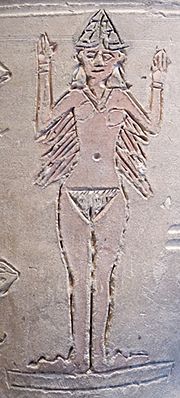 In the Ancient Near East
along the Tigris
and Euphrates
rivers there were many shrines and temples or "houses of heaven" dedicated to various deities documented by the Ancient Greek
historian Herodotus
in The Histories
where sacred prostitution was a common practice. According to Samuel Noah Kramer
in The Sacred Marriage Rite, in late Sumerian history kings established their legitimacy by taking part in the ceremony in the temple for one night, on the tenth day of the New Year festival Akitu
. It came to an end when the emperor Constantine
in the fourth century AD destroyed the goddess
temples and replaced them with Christianity
.
The practice is well disputed among scholars, partly due to doubts cast on the histories of Herodotus.
was the first to state that the ancient Mesopotamians practiced temple prostitution:
ern cultures, despite many popular descriptions of the habit. It is a general belief among scholars that a form of "Sacred Marriage" ritual or Hieros gamos
was staged between the king of a Sumer
ian city-state and the High Priestess of Inanna
, the Sumerian goddess of sexual love, fertility, and warfare, but to date there is no certain evidence that sexual intercourse was included.
Along the Tigris
and Euphrates
rivers there were many shrines and temples dedicated to Inanna. The temple of Eanna, meaning "house of heaven" in Uruk
was the greatest of these.
The temple housed priestesses of the goddess, but there is no evidence whatsoever that any kind of sexual services were performed by them or other women included in any cult.
uses two different words for prostitute, zonah (זנה) and kedeshah (קדשה). The word zonah simply meant an ordinary prostitute or loose woman. But the word kedeshah literally means "consecrated (feminine form)", from the Semitic root q-d-sh (קדש) meaning "holy" or "set apart".
Whatever the cultic significance of a kedeshah to a follower of the Canaanite religion, the Hebrew Bible makes it clear that cultic prostitution had no place in Judaism. Thus tells followers:
The meaning of the male form kadesh or qadesh is not entirely clear.
The Hebrew word keleb (dog) in the next line may also signify a male dancer or prostitute,
, and according to the contemporary Christian writer Eusebius temple prostitution was still being carried on in the Phoenicia
n cities of Aphaca and Heliopolis
(Baalbek
) until closed down by the emperor Constantine
in the fourth century AD.
In Ancient Greece
, known cases of "Sacred prostitution" were in Sicily
, in the Kingdom of Pontus
Cyprus
, in Cappadocia
, and the city of Corinth
where the temple of Aphrodite
housed a significant number of servants at least since the classical antiquity
. In 464 BC a man named Xenophon, a citizen of Corinth
who was an acclaimed runner and winner of pentathlon
at the Olympic Games, dedicated one hundred young girls to the temple of the goddess as a sign of thanksgiving. We know this because of a hymn which Pindar
was commissioned to write (fragment 122 Snell), celebrating "the very welcoming girls, servants of Peïtho and luxurious Corinth". Strabo
writing during the Roman period, states that the temple had formerly, during the Greek period, hosted more than a thousand sacred slave-prostitutes (VIII, 6, 20).
In the Biblical / Apocryphal book the Greek rulers of Jerusalem are accused of bringing prostitutes (hetairai) into the Jerusalem Temple and having sex with them there:
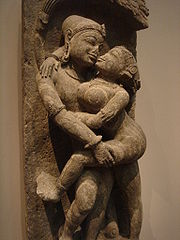 In Tantric Buddhism, yab-yum
is the male deity
in sexual union with his female consort. The symbolism is associated with Anuttarayoga tantra where the male figure is usually linked to compassion (Karuṇā
) and skillful means (upāya-kauśalya
), and the female partner to insight (Prajñā
).
The symbolism of union and sexual polarity is a central teaching in Tantric Buddhism, especially in Tibet
. The union is realized by the practitioner as a mystical experience within one's own body. Yab-yum is generally understood to represent the primordial (or mystical) union of wisdom and compassion.
 Maithuna
is a Sanskrit
term used in Tantra
most often translated as sexual union in a ritual context. It constitutes the main part of the Grand Ritual of Tantra known as Panchamakara
, Panchatattva, and Tattva Chakra.
Maithuna refers to male-female couples and their union in the physical, sexual sense and is synonymous with kriya
nishpatti (mature cleansing). Just as neither spirit nor matter by itself is effective, but both working together bring harmony, so is maithuna effective only when the union is consecrated. The couple becomes divine
for the time being: she is Shakti
and he is a Shakta, or worshipper of Shakti. The scriptures warn that unless this spiritual transformation occurs, the union is carnal and sinful.
Candi Sukuh
is a 15th century Candi of Indonesia
located on the western slope of Mount Lawu
a sacred place for worshiping the ancestors, nature spirits and the sexual union of the fertility cults.
Monuments include a standing lingga, now in the National Museum of Indonesia
. The lingga statue has a dedicated inscription carved from top to bottom representing a vein
followed by a chronogram date equivalent to 1440. The inscription translates "Consecration
of the Holy Ganges
sudhi in ... the sign of masculinity is the essence of the world."
is the supreme being
in Shaktism
. Devi is synonymous with Shakti
, the female aspect of the divine. She is the female counterpart without whom the male aspect, which represents consciousness or discrimination, remains impotent and void. As the female manifestation of the supreme lord, she is also called Prakriti, as she balances out the male aspect of the divine Purusha
.
In Hindu philosophy
, according to Tantra
, Yoni
is the origin of life and an abstract representation of Shakti
and Devi
, the creative force that moves through the entire universe. The lingam
is the creative power of nature and represents the god Shiva
. The linga stone is placed in the yoni and represents the abstract form of creation.
In Southern India
, devadasi
is the practice of hierodulic prostitution, with similar customary forms such as basavi, and involves dedicating pre-pubescent and young adolescent girls from villages in a forced ritual marriage to a deity or a temple, who then work in the temple and function as spiritual guides, dancers, and prostitutes servicing male devotees in the temple. Human Rights Watch
reports affirm that devadasis are forced into this service and, at least in some cases, to practice prostitution for upper-caste members.
Various state governments in India
have enacted laws to ban this practice prior to India's independence and since. They include Bombay Devdasi Act, 1934, Devdasi (Prevention of dedication) Madras Act, 1947, Karnataka Devdasi (Prohibition of dedication) Act, 1982, and Andhra Pradesh Devdasi (Prohibition of dedication) Act, 1988. However, the tradition continues in certain regions of India, particularly the states of Karnataka
and Andhra Pradesh
.
A similar practice of Kāmamudrā often involved immature girls, and was criticized as only benefiting the tulku
s.
In some parts of ancient India
, Nagarvadhu
"bride of the city" was a tradition where women competed to win the title. The most beautiful woman was chosen as the Nagarvadhu and was respected like a goddess
. She served as a courtesan
, and the price for a single night's dance was very high, within reach only for the king
, the prince
s and the lord
s.
is an ancient custom practiced in the far western regions of Nepal
where a young girl is offered to the local Hindu
temple to fulfill an earlier made promise to gain religious merit. The girl serves the temple as a prostitute
, similar to India's devadasi
tradition. The practice is in decline, but girls are still dedicated. The child of a Deuki is known as a Devi.
and Mayan cultures) was both the patron of homosexuals and homosexual prostitutes. The Inca sometimes dedicated young boys as temple prostitutes. The boys were dressed in girls clothing, and chiefs and headmen would have ritual homosexual intercourse with them during religious ceremonies and on holidays.
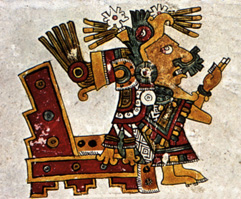
The conquistadores were horrified by the widespread acceptance of homosexuality, ephebophilia, pederasty, and pedophilia among Central and South American peoples, and used torture, burning at the stake, mass beheadings, and other means to stamp it out both as a religious practice and social custom.
, Stephanie Lynn Budin and others, have questioned whether sacred prostitution, as an institution whereby women and men sold sex for the profit of deities and temples, did in fact ever actually exist at all. Julia Assante believes that the classical view of temple prostitution is more of a construct of the 19th Century Western European mindset than a true representation of the facts. While there may well have been some religious prostitution centred around the temples of Inanna
/Ishtar
, Assante suggests that the concept of the 'Sacred Marriage' hieros gamos
has in fact been misunderstood. It was previously believed to have been a custom whereby the king coupled with the high priestess to represent the union of Dumuzid
with Inanna
(later called Ishtar
). It's much more likely that these unions never occurred, but were embellishments to the image of the king; hymns which praise Middle Eastern kings for coupling with the goddess Ishtar
often also speak of him as running 320 kilometres, offering sacrifices, feasting with the sun-god Utu
, and receiving a royal crown from An
, all in a single day. One scholar comments: "No one, to the best of my knowledge, has been so wooden-minded to propose that human actors played the role of Utu and An at the banquet". Not all authors are convinced, however.
Children of God, also known as The Family, who called this practice "Flirty Fishing
". They later abolished the practice due to the growing AIDS
epidemic.
In Ventura County, California, Wilbur and Mary Ellen Tracy
established their own temple, the Church Of The Most High Goddess, in the wake of what they described as a divine revelation. Sexual acts played a fundamental role in the church's sacred rites, which were performed by Mary Ellen Tracy herself in her assumed role of High Priestess. Local newspaper articles about the Neopagan church quickly aroused the attention of local law enforcement officials, and in April 1989, the Tracys' house was searched and the couple arrested on charges of pimping, pandering
and prostitution
. They were subsequently convicted in a trial in state court and sentenced to jail terms: Wilbur Tracy for 180 days plus a $1,000.00 fine; Mary Ellen Tracy for 90 days plus mandatory screening for STDs
.
Worship
Worship is an act of religious devotion usually directed towards a deity. The word is derived from the Old English worthscipe, meaning worthiness or worth-ship — to give, at its simplest, worth to something, for example, Christian worship.Evelyn Underhill defines worship thus: "The absolute...
that includes hieros gamos
Hieros gamos
Hieros gamos or Hierogamy refers to a sexual ritual that plays out a marriage between a god and a goddess, especially when enacted in a symbolic ritual where human participants represent the deities. It is the harmonization of opposites...
or sacred marriage performed as a fertility rite
Fertility rite
Fertility rites are religious rituals that reenact, either actually or symbolically, sexual acts and/or reproductive processes: 'sexual intoxication is a typical component of the...rites of the various functional gods who control reproduction, whether of man, beast, cattle, or grains of seed'..They...
and part of sacred
Sacred
Holiness, or sanctity, is in general the state of being holy or sacred...
sexual ritual
Sexual ritual
Sexual rituals fall into two categories: culture-created, and natural behaviour, the human animal having developed sex rituals from evolutionary instincts for reproduction, which are then integrated into society, and elaborated to include aspects such as marriage rites, dances, etc...
.
Ancient Near East
Ancient Near East
The ancient Near East was the home of early civilizations within a region roughly corresponding to the modern Middle East: Mesopotamia , ancient Egypt, ancient Iran The ancient Near East was the home of early civilizations within a region roughly corresponding to the modern Middle East: Mesopotamia...
along the Tigris
Tigris
The Tigris River is the eastern member of the two great rivers that define Mesopotamia, the other being the Euphrates. The river flows south from the mountains of southeastern Turkey through Iraq.-Geography:...
and Euphrates
Euphrates
The Euphrates is the longest and one of the most historically important rivers of Western Asia. Together with the Tigris, it is one of the two defining rivers of Mesopotamia...
rivers there were many shrines and temples or "houses of heaven" dedicated to various deities documented by the Ancient Greek
Ancient Greek
Ancient Greek is the stage of the Greek language in the periods spanning the times c. 9th–6th centuries BC, , c. 5th–4th centuries BC , and the c. 3rd century BC – 6th century AD of ancient Greece and the ancient world; being predated in the 2nd millennium BC by Mycenaean Greek...
historian Herodotus
Herodotus
Herodotus was an ancient Greek historian who was born in Halicarnassus, Caria and lived in the 5th century BC . He has been called the "Father of History", and was the first historian known to collect his materials systematically, test their accuracy to a certain extent and arrange them in a...
in The Histories
Histories (Herodotus)
The Histories of Herodotus is considered one of the seminal works of history in Western literature. Written from the 450s to the 420s BC in the Ionic dialect of classical Greek, The Histories serves as a record of the ancient traditions, politics, geography, and clashes of various cultures that...
where sacred prostitution was a common practice. According to Samuel Noah Kramer
Samuel Noah Kramer
Samuel Noah Kramer was one of the world's leading Assyriologists and a world renowned expert in Sumerian history and Sumerian language.-Biography:...
in The Sacred Marriage Rite, in late Sumerian history kings established their legitimacy by taking part in the ceremony in the temple for one night, on the tenth day of the New Year festival Akitu
Akitu
Akitu was a spring festival in ancient Mesopotamia....
. It came to an end when the emperor Constantine
Constantine I
Constantine the Great , also known as Constantine I or Saint Constantine, was Roman Emperor from 306 to 337. Well known for being the first Roman emperor to convert to Christianity, Constantine and co-Emperor Licinius issued the Edict of Milan in 313, which proclaimed religious tolerance of all...
in the fourth century AD destroyed the goddess
Goddess
A goddess is a female deity. In some cultures goddesses are associated with Earth, motherhood, love, and the household. In other cultures, goddesses also rule over war, death, and destruction as well as healing....
temples and replaced them with Christianity
Christianity
Christianity is a monotheistic religion based on the life and teachings of Jesus as presented in canonical gospels and other New Testament writings...
.
The practice is well disputed among scholars, partly due to doubts cast on the histories of Herodotus.
Mesopotamia
The ancient Greek historian HerodotusHerodotus
Herodotus was an ancient Greek historian who was born in Halicarnassus, Caria and lived in the 5th century BC . He has been called the "Father of History", and was the first historian known to collect his materials systematically, test their accuracy to a certain extent and arrange them in a...
was the first to state that the ancient Mesopotamians practiced temple prostitution:
The foulest Babylonian custom is that which compels every woman of the land to sit in the temple of AphroditeAphroditeAphrodite is the Greek goddess of love, beauty, pleasure, and procreation.Her Roman equivalent is the goddess .Historically, her cult in Greece was imported from, or influenced by, the cult of Astarte in Phoenicia....
and have intercourse with some stranger once in her life. Many women who are rich and proud and disdain to mingle with the rest, drive to the temple in covered carriages drawn by teams, and stand there with a great retinue of attendants. But most sit down in the sacred plot of Aphrodite, with crowns of cord on their heads; there is a great multitude of women coming and going; passages marked by line run every way through the crowd, by which the men pass and make their choice. Once a woman has taken her place there, she does not go away to her home before some stranger has cast money into her lap, and had intercourse with her outside the temple; but while he casts the money, he must say, “I invite you in the name of Mylitta” (that is the Assyrian name for Aphrodite). It does not matter what sum the money is; the woman will never refuse, for that would be a sin, the money being by this act made sacred. So she follows the first man who casts it and rejects no one. After their intercourse, having discharged her sacred duty to the goddess, she goes away to her home; and thereafter there is no bribe however great that will get her. So then the women that are fair and tall are soon free to depart, but the uncomely have long to wait because they cannot fulfill the law; for some of them remain for three years, or four. There is a custom like this in some parts of Cyprus.
Sacred Marriage
Sacred prostitution has not been substantiated regarding any Ancient Near EastAncient Near East
The ancient Near East was the home of early civilizations within a region roughly corresponding to the modern Middle East: Mesopotamia , ancient Egypt, ancient Iran The ancient Near East was the home of early civilizations within a region roughly corresponding to the modern Middle East: Mesopotamia...
ern cultures, despite many popular descriptions of the habit. It is a general belief among scholars that a form of "Sacred Marriage" ritual or Hieros gamos
Hieros gamos
Hieros gamos or Hierogamy refers to a sexual ritual that plays out a marriage between a god and a goddess, especially when enacted in a symbolic ritual where human participants represent the deities. It is the harmonization of opposites...
was staged between the king of a Sumer
Sumer
Sumer was a civilization and historical region in southern Mesopotamia, modern Iraq during the Chalcolithic and Early Bronze Age....
ian city-state and the High Priestess of Inanna
Inanna
Inanna, also spelled Inana is the Sumerian goddess of sexual love, fertility, and warfare....
, the Sumerian goddess of sexual love, fertility, and warfare, but to date there is no certain evidence that sexual intercourse was included.
Along the Tigris
Tigris
The Tigris River is the eastern member of the two great rivers that define Mesopotamia, the other being the Euphrates. The river flows south from the mountains of southeastern Turkey through Iraq.-Geography:...
and Euphrates
Euphrates
The Euphrates is the longest and one of the most historically important rivers of Western Asia. Together with the Tigris, it is one of the two defining rivers of Mesopotamia...
rivers there were many shrines and temples dedicated to Inanna. The temple of Eanna, meaning "house of heaven" in Uruk
Uruk
Uruk was an ancient city of Sumer and later Babylonia, situated east of the present bed of the Euphrates river, on the ancient dry former channel of the Euphrates River, some 30 km east of modern As-Samawah, Al-Muthannā, Iraq.Uruk gave its name to the Uruk...
was the greatest of these.
The temple housed priestesses of the goddess, but there is no evidence whatsoever that any kind of sexual services were performed by them or other women included in any cult.
In the Hebrew Bible
The Hebrew BibleHebrew Bible
The Hebrew Bible is a term used by biblical scholars outside of Judaism to refer to the Tanakh , a canonical collection of Jewish texts, and the common textual antecedent of the several canonical editions of the Christian Old Testament...
uses two different words for prostitute, zonah (זנה) and kedeshah (קדשה). The word zonah simply meant an ordinary prostitute or loose woman. But the word kedeshah literally means "consecrated (feminine form)", from the Semitic root q-d-sh (קדש) meaning "holy" or "set apart".
Whatever the cultic significance of a kedeshah to a follower of the Canaanite religion, the Hebrew Bible makes it clear that cultic prostitution had no place in Judaism. Thus tells followers:
None of the daughters of Israel shall be a kedeshah, nor shall any of the sons of Israel be a kadesh.
You shall not bring the hire of a prostitute (zonah) or the wages of a dog (keleb) into the house of the Lord your God to pay a vow, for both of these are an abomination to the Lord your God.
The meaning of the male form kadesh or qadesh is not entirely clear.
The Hebrew word keleb (dog) in the next line may also signify a male dancer or prostitute,
In other texts
The Canaanite equivalent of Ishtar was AstarteAstarte
Astarte is the Greek name of a goddess known throughout the Eastern Mediterranean from the Bronze Age to Classical times...
, and according to the contemporary Christian writer Eusebius temple prostitution was still being carried on in the Phoenicia
Phoenicia
Phoenicia , was an ancient civilization in Canaan which covered most of the western, coastal part of the Fertile Crescent. Several major Phoenician cities were built on the coastline of the Mediterranean. It was an enterprising maritime trading culture that spread across the Mediterranean from 1550...
n cities of Aphaca and Heliopolis
Baalbek
Baalbek is a town in the Beqaa Valley of Lebanon, altitude , situated east of the Litani River. It is famous for its exquisitely detailed yet monumentally scaled temple ruins of the Roman period, when Baalbek, then known as Heliopolis, was one of the largest sanctuaries in the Empire...
(Baalbek
Baalbek
Baalbek is a town in the Beqaa Valley of Lebanon, altitude , situated east of the Litani River. It is famous for its exquisitely detailed yet monumentally scaled temple ruins of the Roman period, when Baalbek, then known as Heliopolis, was one of the largest sanctuaries in the Empire...
) until closed down by the emperor Constantine
Constantine I
Constantine the Great , also known as Constantine I or Saint Constantine, was Roman Emperor from 306 to 337. Well known for being the first Roman emperor to convert to Christianity, Constantine and co-Emperor Licinius issued the Edict of Milan in 313, which proclaimed religious tolerance of all...
in the fourth century AD.
In Ancient Greece
Ancient Greece
Ancient Greece is a civilization belonging to a period of Greek history that lasted from the Archaic period of the 8th to 6th centuries BC to the end of antiquity. Immediately following this period was the beginning of the Early Middle Ages and the Byzantine era. Included in Ancient Greece is the...
, known cases of "Sacred prostitution" were in Sicily
Sicily
Sicily is a region of Italy, and is the largest island in the Mediterranean Sea. Along with the surrounding minor islands, it constitutes an autonomous region of Italy, the Regione Autonoma Siciliana Sicily has a rich and unique culture, especially with regard to the arts, music, literature,...
, in the Kingdom of Pontus
Pontus
Pontus or Pontos is a historical Greek designation for a region on the southern coast of the Black Sea, located in modern-day northeastern Turkey. The name was applied to the coastal region in antiquity by the Greeks who colonized the area, and derived from the Greek name of the Black Sea: Πόντος...
Cyprus
Cyprus
Cyprus , officially the Republic of Cyprus , is a Eurasian island country, member of the European Union, in the Eastern Mediterranean, east of Greece, south of Turkey, west of Syria and north of Egypt. It is the third largest island in the Mediterranean Sea.The earliest known human activity on the...
, in Cappadocia
Cappadocia
Cappadocia is a historical region in Central Anatolia, largely in Nevşehir Province.In the time of Herodotus, the Cappadocians were reported as occupying the whole region from Mount Taurus to the vicinity of the Euxine...
, and the city of Corinth
Corinth
Corinth is a city and former municipality in Corinthia, Peloponnese, Greece. Since the 2011 local government reform it is part of the municipality Corinth, of which it is the seat and a municipal unit...
where the temple of Aphrodite
Aphrodite
Aphrodite is the Greek goddess of love, beauty, pleasure, and procreation.Her Roman equivalent is the goddess .Historically, her cult in Greece was imported from, or influenced by, the cult of Astarte in Phoenicia....
housed a significant number of servants at least since the classical antiquity
Classical antiquity
Classical antiquity is a broad term for a long period of cultural history centered on the Mediterranean Sea, comprising the interlocking civilizations of ancient Greece and ancient Rome, collectively known as the Greco-Roman world...
. In 464 BC a man named Xenophon, a citizen of Corinth
Corinth
Corinth is a city and former municipality in Corinthia, Peloponnese, Greece. Since the 2011 local government reform it is part of the municipality Corinth, of which it is the seat and a municipal unit...
who was an acclaimed runner and winner of pentathlon
Pentathlon
A pentathlon is a contest featuring five different events. The name is derived from Greek: combining the words pente and -athlon . The first pentathlon was documented in Ancient Greece and was part of the Ancient Olympic Games...
at the Olympic Games, dedicated one hundred young girls to the temple of the goddess as a sign of thanksgiving. We know this because of a hymn which Pindar
Pindar
Pindar , was an Ancient Greek lyric poet. Of the canonical nine lyric poets of ancient Greece, his work is the best preserved. Quintilian described him as "by far the greatest of the nine lyric poets, in virtue of his inspired magnificence, the beauty of his thoughts and figures, the rich...
was commissioned to write (fragment 122 Snell), celebrating "the very welcoming girls, servants of Peïtho and luxurious Corinth". Strabo
Strabo
Strabo, also written Strabon was a Greek historian, geographer and philosopher.-Life:Strabo was born to an affluent family from Amaseia in Pontus , a city which he said was situated the approximate equivalent of 75 km from the Black Sea...
writing during the Roman period, states that the temple had formerly, during the Greek period, hosted more than a thousand sacred slave-prostitutes (VIII, 6, 20).
In the Biblical / Apocryphal book the Greek rulers of Jerusalem are accused of bringing prostitutes (hetairai) into the Jerusalem Temple and having sex with them there:
- The Gentiles filled the temple with debauchery and revelry; they amused themselves with prostitutes and had intercourse with women even in the sacred court.
Buddhism
Yab-Yum
Yab-yum is a common symbol in the Buddhist art of India, Bhutan, Nepal, and Tibet representing the male deity in sexual union with his female consort...
is the male deity
Deity
A deity is a recognized preternatural or supernatural immortal being, who may be thought of as holy, divine, or sacred, held in high regard, and respected by believers....
in sexual union with his female consort. The symbolism is associated with Anuttarayoga tantra where the male figure is usually linked to compassion (Karuṇā
Karuna
Karuā is generally translated as "compassion" or "pity". It is part of the spiritual path of both Buddhism and Jainism.-Buddhism:...
) and skillful means (upāya-kauśalya
Upaya
Upaya is a term in Mahayana Buddhism which is derived from the root upa√i and refers to a means that goes or brings one up to some goal, often the goal of Enlightenment. The term is often used with kaushalya ; upaya-kaushalya means roughly "skill in means"...
), and the female partner to insight (Prajñā
Prajña
Prajñā or paññā is wisdom, understanding, discernment or cognitive acuity. Such wisdom is understood to exist in the universal flux of being and can be intuitively experienced through meditation...
).
The symbolism of union and sexual polarity is a central teaching in Tantric Buddhism, especially in Tibet
Tibet
Tibet is a plateau region in Asia, north-east of the Himalayas. It is the traditional homeland of the Tibetan people as well as some other ethnic groups such as Monpas, Qiang, and Lhobas, and is now also inhabited by considerable numbers of Han and Hui people...
. The union is realized by the practitioner as a mystical experience within one's own body. Yab-yum is generally understood to represent the primordial (or mystical) union of wisdom and compassion.
Maithuna
Maithuna or Mithuna is a Sanskrit term used in Tantra most often translated as sexual union in a ritual context. It is the most important of the five makara and constitutes the main part of the Grand Ritual of Tantra variously known as Panchamakara, Panchatattva, and Tattva Chakra. Although some...
is a Sanskrit
Sanskrit
Sanskrit , is a historical Indo-Aryan language and the primary liturgical language of Hinduism, Jainism and Buddhism.Buddhism: besides Pali, see Buddhist Hybrid Sanskrit Today, it is listed as one of the 22 scheduled languages of India and is an official language of the state of Uttarakhand...
term used in Tantra
Tantra
Tantra , anglicised tantricism or tantrism or tantram, is the name scholars give to an inter-religious spiritual movement that arose in medieval India, expressed in scriptures ....
most often translated as sexual union in a ritual context. It constitutes the main part of the Grand Ritual of Tantra known as Panchamakara
Panchamakara
Panchamakara, also known as the Five Ms, is a Tantric term referring to the five substances used in a Tantric puja or sadhana:...
, Panchatattva, and Tattva Chakra.
Maithuna refers to male-female couples and their union in the physical, sexual sense and is synonymous with kriya
Kriya
Kriya most commonly refers to a "completed action", technique or practice within a yoga discipline meant to achieve a specific result. Types of kriya may vary widely between different schools of yoga. Another meaning of Kriya is the outward physical manifestations of awakened kundalini...
nishpatti (mature cleansing). Just as neither spirit nor matter by itself is effective, but both working together bring harmony, so is maithuna effective only when the union is consecrated. The couple becomes divine
Divinity
Divinity and divine are broadly applied but loosely defined terms, used variously within different faiths and belief systems — and even by different individuals within a given faith — to refer to some transcendent or transcendental power or deity, or its attributes or manifestations in...
for the time being: she is Shakti
Shakti
Shakti from Sanskrit shak - "to be able," meaning sacred force or empowerment, is the primordial cosmic energy and represents the dynamic forces that are thought to move through the entire universe in Hinduism. Shakti is the concept, or personification, of divine feminine creative power, sometimes...
and he is a Shakta, or worshipper of Shakti. The scriptures warn that unless this spiritual transformation occurs, the union is carnal and sinful.
Candi Sukuh
Candi Sukuh
Sukuh is a 15th century Javanese-Hindu temple that is located on the western slope of Mount Lawu on the border between Central and East Java provinces....
is a 15th century Candi of Indonesia
Candi of Indonesia
Candi are the Hindu and Buddhist temples and sanctuaries of Indonesia, mostly built during the 8th to 15th centuries...
located on the western slope of Mount Lawu
Mount Lawu
Mount Lawu, or Gunung Lawu, is a massive compound stratovolcano straddling the border between East Java and Central Java, Indonesia. The north side is deeply eroded and the eastern side contains parasitic crater lakes and parasitic cones. A fumarolic area is located on the south flank at 2,550 m...
a sacred place for worshiping the ancestors, nature spirits and the sexual union of the fertility cults.
Monuments include a standing lingga, now in the National Museum of Indonesia
National Museum of Indonesia
The National Museum of Indonesia , is an archeological, historical, ethnological, and geographical museum located in Jakarta. Popularly known as Elephant Building after the elephant statue in its forecourt. Its broad and fascinating collections covers all of Indonesia's territory and almost all of...
. The lingga statue has a dedicated inscription carved from top to bottom representing a vein
Vein
In the circulatory system, veins are blood vessels that carry blood towards the heart. Most veins carry deoxygenated blood from the tissues back to the heart; exceptions are the pulmonary and umbilical veins, both of which carry oxygenated blood to the heart...
followed by a chronogram date equivalent to 1440. The inscription translates "Consecration
Consecration
Consecration is the solemn dedication to a special purpose or service, usually religious. The word "consecration" literally means "to associate with the sacred". Persons, places, or things can be consecrated, and the term is used in various ways by different groups...
of the Holy Ganges
Ganges River
The Ganges or Ganga, , is a trans-boundary river of India and Bangladesh. The river rises in the western Himalayas in the Indian state of Uttarakhand, and flows south and east through the Gangetic Plain of North India into Bangladesh, where it empties into the Bay of Bengal. By discharge it...
sudhi in ... the sign of masculinity is the essence of the world."
Hinduism and India
DeviDevi
Devī is the Sanskrit word for Goddess, used mostly in Hinduism, its related masculine term is deva. Devi is synonymous with Shakti, the female aspect of the divine, as conceptualized by the Shakta tradition of Hinduism. She is the female counterpart without whom the male aspect, which represents...
is the supreme being
Supreme Being
The term Supreme Being is often defined simply as "God", and it is used with this meaning by theologians of many religious faiths, including, but not limited to, Christianity, Islam, Hinduism, and Deism. However, the term can also refer to more complex or philosophical interpretations of the...
in Shaktism
Shaktism
Shaktism is a denomination of Hinduism that focuses worship upon Shakti or Devi – the Hindu Divine Mother – as the absolute, ultimate Godhead...
. Devi is synonymous with Shakti
Shakti
Shakti from Sanskrit shak - "to be able," meaning sacred force or empowerment, is the primordial cosmic energy and represents the dynamic forces that are thought to move through the entire universe in Hinduism. Shakti is the concept, or personification, of divine feminine creative power, sometimes...
, the female aspect of the divine. She is the female counterpart without whom the male aspect, which represents consciousness or discrimination, remains impotent and void. As the female manifestation of the supreme lord, she is also called Prakriti, as she balances out the male aspect of the divine Purusha
Purusha
In some lineages of Hinduism, Purusha is the "Self" which pervades the universe. The Vedic divinities are interpretations of the many facets of Purusha...
.
In Hindu philosophy
Hindu philosophy
Hindu philosophy is divided into six schools of thought, or , which accept the Vedas as supreme revealed scriptures. Three other schools do not accept the Vedas as authoritative...
, according to Tantra
Tantra
Tantra , anglicised tantricism or tantrism or tantram, is the name scholars give to an inter-religious spiritual movement that arose in medieval India, expressed in scriptures ....
, Yoni
Yoni
Yoni is the Sanskrit word for the vagina. Its counterpart is the lingam as interpreted by some, the phallus.It is also the divine passage, womb or sacred temple...
is the origin of life and an abstract representation of Shakti
Shakti
Shakti from Sanskrit shak - "to be able," meaning sacred force or empowerment, is the primordial cosmic energy and represents the dynamic forces that are thought to move through the entire universe in Hinduism. Shakti is the concept, or personification, of divine feminine creative power, sometimes...
and Devi
Devi
Devī is the Sanskrit word for Goddess, used mostly in Hinduism, its related masculine term is deva. Devi is synonymous with Shakti, the female aspect of the divine, as conceptualized by the Shakta tradition of Hinduism. She is the female counterpart without whom the male aspect, which represents...
, the creative force that moves through the entire universe. The lingam
Lingam
The Lingam is a representation of the Hindu deity Shiva used for worship in temples....
is the creative power of nature and represents the god Shiva
Shiva
Shiva is a major Hindu deity, and is the destroyer god or transformer among the Trimurti, the Hindu Trinity of the primary aspects of the divine. God Shiva is a yogi who has notice of everything that happens in the world and is the main aspect of life. Yet one with great power lives a life of a...
. The linga stone is placed in the yoni and represents the abstract form of creation.
In Southern India
India
India , officially the Republic of India , is a country in South Asia. It is the seventh-largest country by geographical area, the second-most populous country with over 1.2 billion people, and the most populous democracy in the world...
, devadasi
Devadasi
In Hinduism, the devadasi tradition is a religious tradition in which girls are "married" and dedicated to a deity or to a temple and includes performance aspects such as those that take place in the temple as well as in the courtly and mujuvani [telegu] or home context. Dance and music were...
is the practice of hierodulic prostitution, with similar customary forms such as basavi, and involves dedicating pre-pubescent and young adolescent girls from villages in a forced ritual marriage to a deity or a temple, who then work in the temple and function as spiritual guides, dancers, and prostitutes servicing male devotees in the temple. Human Rights Watch
Human Rights Watch
Human Rights Watch is an international non-governmental organization that conducts research and advocacy on human rights. Its headquarters are in New York City and it has offices in Berlin, Beirut, Brussels, Chicago, Geneva, Johannesburg, London, Los Angeles, Moscow, Paris, San Francisco, Tokyo,...
reports affirm that devadasis are forced into this service and, at least in some cases, to practice prostitution for upper-caste members.
Various state governments in India
India
India , officially the Republic of India , is a country in South Asia. It is the seventh-largest country by geographical area, the second-most populous country with over 1.2 billion people, and the most populous democracy in the world...
have enacted laws to ban this practice prior to India's independence and since. They include Bombay Devdasi Act, 1934, Devdasi (Prevention of dedication) Madras Act, 1947, Karnataka Devdasi (Prohibition of dedication) Act, 1982, and Andhra Pradesh Devdasi (Prohibition of dedication) Act, 1988. However, the tradition continues in certain regions of India, particularly the states of Karnataka
Karnataka
Karnataka , the land of the Kannadigas, is a state in South West India. It was created on 1 November 1956, with the passing of the States Reorganisation Act and this day is annually celebrated as Karnataka Rajyotsava...
and Andhra Pradesh
Andhra Pradesh
Andhra Pradesh , is one of the 28 states of India, situated on the southeastern coast of India. It is India's fourth largest state by area and fifth largest by population. Its capital and largest city by population is Hyderabad.The total GDP of Andhra Pradesh is $100 billion and is ranked third...
.
A similar practice of Kāmamudrā often involved immature girls, and was criticized as only benefiting the tulku
Tulku
In Tibetan Buddhism, a tulku is a particular high-ranking lama, of whom the Dalai Lama is one, who can choose the manner of his rebirth. Normally the lama would be reincarnated as a human, and of the same sex as his predecessor. In contrast to a tulku, all other sentient beings including other...
s.
In some parts of ancient India
History of India
The history of India begins with evidence of human activity of Homo sapiens as long as 75,000 years ago, or with earlier hominids including Homo erectus from about 500,000 years ago. The Indus Valley Civilization, which spread and flourished in the northwestern part of the Indian subcontinent from...
, Nagarvadhu
Nagarvadhu
Nagarvadhu or Nagar Vadhu was a tradition followed in some parts of ancient India.Women competed to win the title of a Nagarvadhu, and it was not considered a taboo. The most beautiful woman was chosen as the Nagarvadhu....
"bride of the city" was a tradition where women competed to win the title. The most beautiful woman was chosen as the Nagarvadhu and was respected like a goddess
Goddess
A goddess is a female deity. In some cultures goddesses are associated with Earth, motherhood, love, and the household. In other cultures, goddesses also rule over war, death, and destruction as well as healing....
. She served as a courtesan
Courtesan
A courtesan was originally a female courtier, which means a person who attends the court of a monarch or other powerful person.In feudal society, the court was the centre of government as well as the residence of the monarch, and social and political life were often completely mixed together...
, and the price for a single night's dance was very high, within reach only for the king
Monarch
A monarch is the person who heads a monarchy. This is a form of government in which a state or polity is ruled or controlled by an individual who typically inherits the throne by birth and occasionally rules for life or until abdication...
, the prince
Prince
Prince is a general term for a ruler, monarch or member of a monarch's or former monarch's family, and is a hereditary title in the nobility of some European states. The feminine equivalent is a princess...
s and the lord
Lord
Lord is a title with various meanings. It can denote a prince or a feudal superior . The title today is mostly used in connection with the peerage of the United Kingdom or its predecessor countries, although some users of the title do not themselves hold peerages, and use it 'by courtesy'...
s.
Asia
DeukiDeuki
Deuki is an ancient custom practiced in the far western regions of Nepal where a young girl is offered to the local Hindu temple to fulfill an earlier made promise to gain religious merit....
is an ancient custom practiced in the far western regions of Nepal
Nepal
Nepal , officially the Federal Democratic Republic of Nepal, is a landlocked sovereign state located in South Asia. It is located in the Himalayas and bordered to the north by the People's Republic of China, and to the south, east, and west by the Republic of India...
where a young girl is offered to the local Hindu
Hindu
Hindu refers to an identity associated with the philosophical, religious and cultural systems that are indigenous to the Indian subcontinent. As used in the Constitution of India, the word "Hindu" is also attributed to all persons professing any Indian religion...
temple to fulfill an earlier made promise to gain religious merit. The girl serves the temple as a prostitute
Prostitution
Prostitution is the act or practice of providing sexual services to another person in return for payment. The person who receives payment for sexual services is called a prostitute and the person who receives such services is known by a multitude of terms, including a "john". Prostitution is one of...
, similar to India's devadasi
Devadasi
In Hinduism, the devadasi tradition is a religious tradition in which girls are "married" and dedicated to a deity or to a temple and includes performance aspects such as those that take place in the temple as well as in the courtly and mujuvani [telegu] or home context. Dance and music were...
tradition. The practice is in decline, but girls are still dedicated. The child of a Deuki is known as a Devi.
Central and South America
The Mayans maintained several phallic religious cults, possibly involving homosexual temple prostitution. Aztec religious leaders were heterosexually celibate and engaged in homosexuality with one another as a religious practice, temple idols were often depicted engaging in homosexuality, and the god Xochipili (taken from both ToltecToltec
The Toltec culture is an archaeological Mesoamerican culture that dominated a state centered in Tula, Hidalgo in the early post-classic period of Mesoamerican chronology...
and Mayan cultures) was both the patron of homosexuals and homosexual prostitutes. The Inca sometimes dedicated young boys as temple prostitutes. The boys were dressed in girls clothing, and chiefs and headmen would have ritual homosexual intercourse with them during religious ceremonies and on holidays.
- IchpuchtliIchpuchtliXochiquetzal is an Aztec Goddess. Xochiquetzal is also more commonly known as Ichpuchtli or Xochiquetzal-Ichpuchtli combined. She is the ruler of love, marriage, flowers, art, music, women, magic, spinning, fertility, sex, weaving, and changes. Ichpuchtli is also the Goddess of Sacred...
is a goddess of Sacred prostitution, ruler of love, marriage, flowers, art, music, women, magic, spinning, fertility, sex, weaving, and changes. - XochiquetzalXochiquetzalIn Aztec mythology, Xochiquetzal was a goddess associated with concepts of fertility, beauty, and female sexual power, serving as a protector of young mothers and a patroness of pregnancy, childbirth, and the crafts practised by women such as weaving and embroidery...
is a goddess of sexual power, patroness of prostitutes and artisans involved in the manufacture of luxury items.
The conquistadores were horrified by the widespread acceptance of homosexuality, ephebophilia, pederasty, and pedophilia among Central and South American peoples, and used torture, burning at the stake, mass beheadings, and other means to stamp it out both as a religious practice and social custom.
Revisionist criticism of "widespread sacred prostitution"
Recently some scholars, such as Robert A. OdenRobert A. Oden
Robert Allen Oden Jr. was the president of Kenyon College from 1995-2002, and president of Carleton College from July 1, 2002 until June 30, 2010...
, Stephanie Lynn Budin and others, have questioned whether sacred prostitution, as an institution whereby women and men sold sex for the profit of deities and temples, did in fact ever actually exist at all. Julia Assante believes that the classical view of temple prostitution is more of a construct of the 19th Century Western European mindset than a true representation of the facts. While there may well have been some religious prostitution centred around the temples of Inanna
Inanna
Inanna, also spelled Inana is the Sumerian goddess of sexual love, fertility, and warfare....
/Ishtar
Ishtar
Ishtar is the Assyrian and Babylonian goddess of fertility, love, war, and sex. She is the counterpart to the Sumerian Inanna and to the cognate north-west Semitic goddess Astarte.-Characteristics:...
, Assante suggests that the concept of the 'Sacred Marriage' hieros gamos
Hieros gamos
Hieros gamos or Hierogamy refers to a sexual ritual that plays out a marriage between a god and a goddess, especially when enacted in a symbolic ritual where human participants represent the deities. It is the harmonization of opposites...
has in fact been misunderstood. It was previously believed to have been a custom whereby the king coupled with the high priestess to represent the union of Dumuzid
Dumuzid, the Shepherd
Dumuzid or Dumuzi, called "the Shepherd", from Bad-tibira in Sumer, was, according to the Sumerian King List, the fifth predynastic king in the legendary period before the Deluge. The list further states that Dumuzid ruled for 36,000 years....
with Inanna
Inanna
Inanna, also spelled Inana is the Sumerian goddess of sexual love, fertility, and warfare....
(later called Ishtar
Ishtar
Ishtar is the Assyrian and Babylonian goddess of fertility, love, war, and sex. She is the counterpart to the Sumerian Inanna and to the cognate north-west Semitic goddess Astarte.-Characteristics:...
). It's much more likely that these unions never occurred, but were embellishments to the image of the king; hymns which praise Middle Eastern kings for coupling with the goddess Ishtar
Ishtar
Ishtar is the Assyrian and Babylonian goddess of fertility, love, war, and sex. She is the counterpart to the Sumerian Inanna and to the cognate north-west Semitic goddess Astarte.-Characteristics:...
often also speak of him as running 320 kilometres, offering sacrifices, feasting with the sun-god Utu
Utu
Utu is the Sun god in Sumerian mythology, the son of the moon god Nanna and the goddess Ningal. His brother and sisters are Ishkur and Inanna and Erishkigal....
, and receiving a royal crown from An
Anu
In Sumerian mythology, Anu was a sky-god, the god of heaven, lord of constellations, king of gods, Consort of Antu, spirits and demons, and dwelt in the highest heavenly regions. It was believed that he had the power to judge those who had committed crimes, and that he had created the stars as...
, all in a single day. One scholar comments: "No one, to the best of my knowledge, has been so wooden-minded to propose that human actors played the role of Utu and An at the banquet". Not all authors are convinced, however.
Recent Western occurrences
In the 1970s and early 1980s, some religious cults practiced sacred prostitution as an instrument to recruit new converts. Among them was the alleged cultCult
The word cult in current popular usage usually refers to a group whose beliefs or practices are considered abnormal or bizarre. The word originally denoted a system of ritual practices...
Children of God, also known as The Family, who called this practice "Flirty Fishing
Flirty fishing
Flirty Fishing is a form of evangelistic religious prostitution practiced from around 1974 to 1987 by female members in the new religious movement, the Children of God, now known as The Family International.-Etymology, definition:...
". They later abolished the practice due to the growing AIDS
AIDS
Acquired immune deficiency syndrome or acquired immunodeficiency syndrome is a disease of the human immune system caused by the human immunodeficiency virus...
epidemic.
In Ventura County, California, Wilbur and Mary Ellen Tracy
Mary Ellen Tracy
Mary Ellen Tracy is the self-proclaimed high priestess of the Church of the Most High Goddess, who was convicted in 1989 of a single misdemeanor count of running a house of prostitution in connection with the operation of the church, located in West Los Angeles, California. Ms...
established their own temple, the Church Of The Most High Goddess, in the wake of what they described as a divine revelation. Sexual acts played a fundamental role in the church's sacred rites, which were performed by Mary Ellen Tracy herself in her assumed role of High Priestess. Local newspaper articles about the Neopagan church quickly aroused the attention of local law enforcement officials, and in April 1989, the Tracys' house was searched and the couple arrested on charges of pimping, pandering
Procuring (prostitution)
Procuring or pandering is the facilitation or provision of a prostitute in the arrangement of a sex act with a customer. Examples of procuring include:*trafficking a prostitute into a country for the purpose of soliciting sex...
and prostitution
Prostitution
Prostitution is the act or practice of providing sexual services to another person in return for payment. The person who receives payment for sexual services is called a prostitute and the person who receives such services is known by a multitude of terms, including a "john". Prostitution is one of...
. They were subsequently convicted in a trial in state court and sentenced to jail terms: Wilbur Tracy for 180 days plus a $1,000.00 fine; Mary Ellen Tracy for 90 days plus mandatory screening for STDs
Sexually transmitted disease
Sexually transmitted disease , also known as a sexually transmitted infection or venereal disease , is an illness that has a significant probability of transmission between humans by means of human sexual behavior, including vaginal intercourse, oral sex, and anal sex...
.
See also
- DeukiDeukiDeuki is an ancient custom practiced in the far western regions of Nepal where a young girl is offered to the local Hindu temple to fulfill an earlier made promise to gain religious merit....
- Sex workerSex workerA sex worker is a person who works in the sex industry. The term is usually used in reference to those in the sex industry that actually provide such sexual services, as opposed to management and staff of such industries...
- Sex magicSex magicSex magic is a term for various types of sexual activity used in magical, ritualistic or otherwise religious and spiritual pursuits. One practice of sex magic is using the energy of sexual arousal or orgasm with visualization of a desired result...
- DevadasiDevadasiIn Hinduism, the devadasi tradition is a religious tradition in which girls are "married" and dedicated to a deity or to a temple and includes performance aspects such as those that take place in the temple as well as in the courtly and mujuvani [telegu] or home context. Dance and music were...
- Primitive promiscuity
- HetaeraHetaeraIn ancient Greece, hetaerae were courtesans, that is to say, highly educated, sophisticated companions...
- Hijra (South Asia)Hijra (South Asia)In the culture of South Asia, hijras or chakka in Kannada, khusra in Punjabi and kojja in Telugu are physiological males who have feminine gender identity, women's clothing and other feminine gender roles. Hijras have a long recorded history in the Indian subcontinent, from the antiquity, as...
- Sexuality in ancient RomeSexuality in Ancient RomeSexual attitudes and behaviors in ancient Rome are indicated by Roman art, literature and inscriptions, and to a lesser extent by archaeological remains such as erotic artifacts and architecture...
- List of fertility deities
- List of love and lust deities
External links
- Hierodulic Servitude
- Stuckey, H. Johanna. "Sacred Prostitutes". MatriFocus. 2005 vol 5-1.
- Prostitution , and a discussion
- Jenin Younes (2008), Sacred Prostitution in Ancient Israel