


Rehoboam

Encyclopedia
Rehoboam was initially king of the United Monarchy of Israel but after the ten northern tribes of Israel rebelled in 932/931 BC to form the independent Kingdom of Israel he was king of the Kingdom of Judah
, or southern kingdom. He was a son of Solomon
and a grandson of David. His mother was Naamah
the Ammon
ite.
dates the start of Rehoboam's reign to the mid 10th century BC. His reign is described in and and in In the Hebrew Bible
, Rehoboam was 41 years old when he ascended the throne.
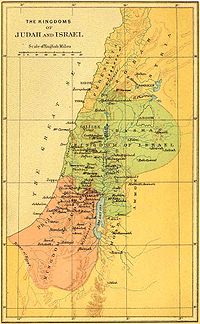 The people, led by Jeroboam
, feared that Rehoboam would continue to tax them heavily - as had his father Solomon. Jeroboam and the people promised their loyalty in return for lesser burdens. The older men counseled Rehoboam at least to speak to the people in a civil manner (it is not clear whether they counseled him to accept the demands). However, the new king sought the advice from the people he had grown up with, who advised the king to show no weakness to the people, and to tax them even more, which Rehoboam did. He proclaimed to the people,
Jeroboam and the people rebelled, with the ten northern tribes
breaking away and forming a separate kingdom. The new breakaway kingdom continued to be called Kingdom of Israel, and was also known as Samaria
, or Ephraim
or the northern Kingdom. The realm Rehoboam was left with was called Kingdom of Judah
.
The text reports that Israel and Judah were in a state of war throughout his 17 year reign.
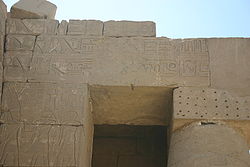 In the 5th year of Rehoboam's reign Shishaq, king of Egypt, brought a huge army and took many cities. When they laid siege to Jerusalem, Rehoboam gave Shishaq all of the treasures out of the temple as a tribute. Judah became a vassal state of Egypt.
An account of this invasion from the Egyptian perspective can be found in the Shishaq Relief
at the Bubastis Portal
near the Temple of Amun at Karnak
.
, daughter of Absalom
, David
's son. His sons with Maacah were Abijah, Attai, Ziza, and Shelomith. The names of his other wives, sons and all his daughters are not given.
Rehoboam reigned for 17 years. When he died he was buried beside his ancestors in Jerusalem. He was succeeded by his son Abijah
.
has calculated the date for the division of the kingdom is 931-930 BC. Thiele noticed that for the first seven kings of Israel (ignoring Zimri's inconsequential seven-day reign), the synchronisms to Judean kings fell progressively behind by one year for each king. Thiele saw this as evidence that the northern kingdom was measuring the years by a non-accession system (first partial year of reign was counted as year one), whereas the southern kingdom was using the accession method (it was counted as year zero). Once this was understood, the various reign lengths and cross-synchronisms for these kings was worked out, and the sum of reigns for both kingdoms produced 931/930 BC for the division of the kingdom when working backwards from the Battle of Qarqar
in 853 BC.
Kingdom of Judah
The Kingdom of Judah was a Jewish state established in the Southern Levant during the Iron Age. It is often referred to as the "Southern Kingdom" to distinguish it from the northern Kingdom of Israel....
, or southern kingdom. He was a son of Solomon
Solomon
Solomon , according to the Book of Kings and the Book of Chronicles, a King of Israel and according to the Talmud one of the 48 prophets, is identified as the son of David, also called Jedidiah in 2 Samuel 12:25, and is described as the third king of the United Monarchy, and the final king before...
and a grandson of David. His mother was Naamah
Naamah (wife of Solomon)
Naamah was the wife of King Solomon, and mother of his heir, Rehoboam, according to both , and in the Hebrew Bible. She was an Ammonite, and the only one of Solomon's wives to be mentioned, within the Hebrew Bible, as having borne a child....
the Ammon
Ammon
Ammon , also referred to as the Ammonites and children of Ammon, was an ancient nation located east of the Jordan River, Gilead, and the Dead Sea, in present-day Jordan. The chief city of the country was Rabbah or Rabbath Ammon, site of the modern city of Amman, Jordan's capital...
ite.
Biblical narrative
Conventional Bible chronologyChronology of the Bible
The chronology of the Bible is the elaborate system of genealogies, generations, reign-periods, and other means by which Hebrew Bible measures the passage of time and thus give a chronological framework to biblical history from the Creation until the historical kingdoms of Israel and Judah.The...
dates the start of Rehoboam's reign to the mid 10th century BC. His reign is described in and and in In the Hebrew Bible
Hebrew Bible
The Hebrew Bible is a term used by biblical scholars outside of Judaism to refer to the Tanakh , a canonical collection of Jewish texts, and the common textual antecedent of the several canonical editions of the Christian Old Testament...
, Rehoboam was 41 years old when he ascended the throne.
Jeroboam
Jeroboam was the first king of the northern Israelite Kingdom of Israel after the revolt of the ten northern Israelite tribes against Rehoboam that put an end to the United Monarchy....
, feared that Rehoboam would continue to tax them heavily - as had his father Solomon. Jeroboam and the people promised their loyalty in return for lesser burdens. The older men counseled Rehoboam at least to speak to the people in a civil manner (it is not clear whether they counseled him to accept the demands). However, the new king sought the advice from the people he had grown up with, who advised the king to show no weakness to the people, and to tax them even more, which Rehoboam did. He proclaimed to the people,
- "Whereas my father laid upon you a heavy yoke, so shall I add tenfold thereto. Whereas my father chastised (tortured) you with whips, so shall I chastise you with scorpions. For my littlest finger is thicker than my father's loins; and your backs, which bent like reeds at my father's touch, shall break like straws at my own touch."
Jeroboam and the people rebelled, with the ten northern tribes
Ten Lost Tribes
The Ten Lost Tribes of Israel refers to those tribes of ancient Israel that formed the Kingdom of Israel and which disappeared from Biblical and all other historical accounts after the kingdom was destroyed in about 720 BC by ancient Assyria...
breaking away and forming a separate kingdom. The new breakaway kingdom continued to be called Kingdom of Israel, and was also known as Samaria
Samaria
Samaria, or the Shomron is a term used for a mountainous region roughly corresponding to the northern part of the West Bank.- Etymology :...
, or Ephraim
Ephraim
Ephraim ; was, according to the Book of Genesis, the second son of Joseph and Asenath. Asenath was an Egyptian woman whom Pharaoh gave to Joseph as wife, and the daughter of Potipherah, a priest of On. Ephraim was born in Egypt before the arrival of the children of Israel from Canaan...
or the northern Kingdom. The realm Rehoboam was left with was called Kingdom of Judah
Kingdom of Judah
The Kingdom of Judah was a Jewish state established in the Southern Levant during the Iron Age. It is often referred to as the "Southern Kingdom" to distinguish it from the northern Kingdom of Israel....
.
Civil war
Rehoboam went to war against the new Kingdom of Israel with a force of 180,000 soldiers. However, he was advised against fighting his brethren, and so returned to Jerusalem. He built elaborate defenses and strongholds, along with fortified cities.The text reports that Israel and Judah were in a state of war throughout his 17 year reign.
Egyptian invasion
An account of this invasion from the Egyptian perspective can be found in the Shishaq Relief
Shishaq Relief
The Shishaq Relief is a series of inscriptions recounting pharaoh Shishaq's invasion of Judah and Israel in 925 BC. It is located at the Bubastis Portal outside the Temple of Amun at Karnak.-Biblical narrative:The Biblical narrative recounts:...
at the Bubastis Portal
Bubastis Portal
This portal gate is located in Karnak, within the Precinct of Amun-Re temple complex, between the temple of Ramesses III and the second pylon.It records the conquests and military campaigns in Syria-Palestine of Shoshenq I, of the Twenty-second Dynasty....
near the Temple of Amun at Karnak
Karnak
The Karnak Temple Complex—usually called Karnak—comprises a vast mix of decayed temples, chapels, pylons, and other buildings, notably the Great Temple of Amun and a massive structure begun by Pharaoh Ramses II . Sacred Lake is part of the site as well. It is located near Luxor, some...
.
Succession
Rehoboam had 18 wives and 60 concubines. They bore him 28 sons and 60 daughters. His wives included Mahalath, the daughter of Jerimoth the son of David, and Abihail, the daughter of Eliab the son of Jesse. His sons with Abihail were Jeush, Shemariah, and Zaham. After Abihail he married MaacahMaacah
Maacah is a non-gender-specific personal name used in the Bible to refer to:*A child of Abraham's brother Nachor, evidently a boy. *The wife of Machir, Manasseh's son....
, daughter of Absalom
Absalom
According to the Bible, Absalom or Avshalom was the third son of David, King of Israel with Maachah, daughter of Talmai, King of Geshur. describes him as the most handsome man in the kingdom...
, David
David
David was the second king of the united Kingdom of Israel according to the Hebrew Bible and, according to the Gospels of Matthew and Luke, an ancestor of Jesus Christ through both Saint Joseph and Mary...
's son. His sons with Maacah were Abijah, Attai, Ziza, and Shelomith. The names of his other wives, sons and all his daughters are not given.
Rehoboam reigned for 17 years. When he died he was buried beside his ancestors in Jerusalem. He was succeeded by his son Abijah
Abijam
Abijam was the fourth king of the House of David and the second of the Kingdom of Judah. He was the son of Rehoboam, the grandson of Solomon and the great-grandson of David. The Chronicler refers to him as Abijah ....
.
Chronology
Using the information in Kings and Chronicles Edwin ThieleEdwin R. Thiele
Edwin R. Thiele was an American missionary in China, an editor, archaeologist, writer, and Old Testament professor. He is best known for his chronological studies of the Hebrew kingdom period.- Biography :...
has calculated the date for the division of the kingdom is 931-930 BC. Thiele noticed that for the first seven kings of Israel (ignoring Zimri's inconsequential seven-day reign), the synchronisms to Judean kings fell progressively behind by one year for each king. Thiele saw this as evidence that the northern kingdom was measuring the years by a non-accession system (first partial year of reign was counted as year one), whereas the southern kingdom was using the accession method (it was counted as year zero). Once this was understood, the various reign lengths and cross-synchronisms for these kings was worked out, and the sum of reigns for both kingdoms produced 931/930 BC for the division of the kingdom when working backwards from the Battle of Qarqar
Battle of Qarqar
The Battle of Qarqar was fought in 853 BC when the army of Assyria led by king Shalmaneser III encountered an allied army of 12 kings at Qarqar led by Hadadezer of Damascus and King Ahab of Israel...
in 853 BC.