

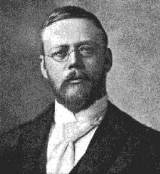
Reginald Fessenden

Encyclopedia
Reginald Aubrey Fessenden (October 6, 1866 – July 22, 1932), a naturalized American citizen born in Canada, was an inventor who performed pioneering experiments in radio
, including early—and possibly the first—radio transmissions of voice and music. In his later career he received hundreds of patents for devices
in fields such as high-powered transmitting, sonar
, and television
.
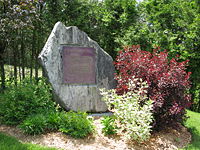 Reginald Aubrey Fessenden was born October 6, 1866, in East Bolton
, Canada East
, the eldest of the Reverend Joseph Elisha Fessenden and Clementina Trenholme
Fessenden's four children. Joseph Fessenden was a priest of the Church of England in Canada
, and through the years the family moved to a number of postings within the Province of Ontario. While growing up, Reginald was an accomplished student. In 1877, at the age of eleven, he attended Trinity College School
in Port Hope, Ontario
for two years. At the age of fourteen, Bishop's College School
in Lennoxville, Quebec
granted Fessenden a mathematics mastership. At this time, Bishop's College School was a feeder school of Bishop's University
and shared the same campus and buildings. In June 1878, the school had an enrolment of only 43 boys. Thus, while Fessenden was only a teenager, he was teaching mathematics to the young children at the school while simultaneously studying with the older students at Bishop's University
. Total enrolment at the university for the school year 1883-84 was twenty-five (all male) students. At the age of eighteen, Fessenden left Bishop's without having been awarded a degree, even though he had "done substantially all the work necessary". (This lack of a degree may have hurt Fessenden's employment opportunities—when McGill University
established an electrical engineering department, Fessenden was turned down on an application to be the chairman, in favor of an American.)
The next two years he worked as the principal, and sole teacher, at the Whitney Institute in Bermuda
. While there, he became engaged to Helen Trott. They married in September, 1890, and later had a son, Reginald Kennelly Fessenden.
in 1886, with hopes of gaining employment with the famous inventor, Thomas Edison
. As recounted in his 1925 Radio News autobiography, his initial attempts were rebuffed—in his first application Fessenden wrote, "Do not know anything about electricity, but can learn pretty quick," to which Edison replied, "Have enough men now who do not know about electricity." However, Fessenden persevered, and before the end of the year was hired for a semi-skilled position as an assistant tester for the Edison Machine Works, which was laying underground electrical mains in New York City. He quickly proved his worth, and received a series of promotions, with increasing responsibility for the project. In late 1886, Fessenden began working directly for Thomas Edison
at the inventor's new laboratory in West Orange, New Jersey
. A broad range of projects included work in solving problems in chemistry, metallurgy, and electricity. However, in 1890, facing financial problems, Edison was forced to lay off most of the laboratory employees, including Fessenden.
Taking advantage of his recent practical experience, Fessenden was able to find positions with a series of manufacturing companies. Next, in 1892, he received an appointment as professor for the newly formed Electrical Engineering department at Purdue University
in West Lafayette, Indiana—while there he helped the Westinghouse Corporation install the lighting for the 1893 World Columbian Exposition in Chicago
. Shortly thereafter in the same year, George Westinghouse
personally recruited Fessenden for the newly created position of chair of the Electrical Engineering department at the Western University of Pennsylvania, renamed to the University of Pittsburgh
in 1908. Fessenden began experimenting with wireless telephones in 1898; by 1899 he had a wireless communication system functioning between Pittsburgh and Allegheny City
.
was having in developing a practical radio transmitting and receiving system. Fessenden began limited radio experimentation, and soon came to the conclusion that he could develop a far more efficient system than the spark-gap transmitter
and coherer
-receiver
combination which had been championed by Oliver Lodge and Marconi.
that consisted of a fine wire dipped in nitric acid, and for the next few years this later device would set the standard for sensitivity in radio reception. As his work progressed, Fessenden also evolved the heterodyne principle, which combined two signals to produce a third audible tone. However, heterodyne reception was not fully practical for a decade after it was invented, since it required a means for producing a stable local signal, which awaited the development of the oscillating vacuum-tube.
The initial work took place at Cobb Island, Maryland, located about 80 kilometres (49.7 mi) downstream from Washington, DC. While there, Fessenden, experimenting with a high-frequency spark transmitter, successfully transmitted speech on December 23, 1900 over a distance of about 1.6 kilometers (one mile), which appears to have been the first audio radio transmission. At this time the sound quality was too distorted to be commercially practical, but as a test this did show that with further technical refinements it would become possible to transmit audio using radio signals.
As the experimentation expanded, additional stations were built along the Atlantic Coast in both North Carolina and Virginia. However, in the midst of promising advances, Fessenden became embroiled in disputes with his sponsor. In particular, he charged that Bureau Chief Willis Moore had attempted to gain a half-share of the patents — Fessenden refused to sign over the rights, and his work for the Weather Bureau ended in August, 1902. (This incident recalled F. O. J. Smith, a member of the House of Representatives from Maine, who had managed to gain a one-quarter interest in the Morse telegraph.)
businessmen, Hay Walker, Jr., and Thomas H. Given, financed the formation of National Electric Signaling Company (NESCO) to carry on Fessenden's research. This included the development of both a high-power rotary-spark transmitter for long-distance radiotelegraph service, and a lower-powered continuous-wave alternator-transmitter, which could be used for both telegraphic and audio transmissions. Brant Rock, Massachusetts
became the center of operations for the new company.
Fessenden felt that, ultimately, a continuous-wave transmitter—one that produced a pure sine-wave signal on a single frequency—would be far more efficient, particularly because it could be used for quality audio transmissions. Fessenden contracted with General Electric to help design and produce a series of high-frequency alternator-transmitters.
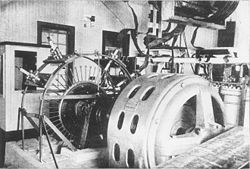 It was decided to try to establish a transatlantic radiotelegraph service, and, in January, 1906, employing his rotary-spark transmitters
, Fessenden made the first successful two-way transatlantic transmission, exchanging Morse code
messages between a station constructed at Brant Rock and an identical one built at Machrihanish
, Scotland
. (Marconi had only achieved one-way transmissions at this time.) However, the transmitters could not bridge this distance during daylight hours or in the summer, so work was suspended until later in the year. Then, on December 6, 1906, "owing to the carelessness of one of the contractors employed in shifting some of the supporting cables", the Machrihanish radio tower collapsed, abruptly ending the transatlantic work before it could ever go into commercial service.

signal on a single frequency—would be far more efficient, particularly because it could be used for quality audio transmissions. His design idea was to take a basic electrical alternator, which normally operated at speeds that produced alternating current of at most a few hundred hertz
, and greatly speed it up in order to create electrical currents at tens of kilohertz. Thus, the high-speed alternator would produce a steady radio signal when connected to an aerial. Then, by simply placing a carbon microphone
in the transmission line, the strength of the signal could be varied in order to add sounds to the transmission—in other words, amplitude modulation
would be used to impress audio on the radio frequency
carrier wave
. However, it would take many years of expensive development before even a prototype alternator-transmitter would be ready, and a few more years beyond that for high-power versions to become available.
Fessenden contracted with General Electric to help design and produce a series of high-frequency alternator
-transmitters. In 1903, Charles Proteus Steinmetz
of GE delivered a 10 kHz version which proved of limited use and could not be directly used as a radio transmitter. Fessenden's request for a faster, more powerful unit was assigned to Ernst F. W. Alexanderson
, and in August, 1906 he delivered an improved model which operated at a transmitting frequency of approximately 50 kHz, although with far less power than Fessenden's rotary-spark transmitters.
The alternator-transmitter achieved the goal of transmitting quality audio signals, but the lack of any way to amplify the signals meant they were somewhat weak. On December 21, 1906, Fessenden made an extensive demonstration of the new alternator-transmitter at Brant Rock, showing its utility for point-to-point wireless telephony, including interconnecting his stations to the wire telephone network. A detailed review of this demonstration appeared in The American Telephone Journal.
A few days later, two additional demonstrations took place, which appear to be the first audio radio broadcasts of entertainment and music ever made to a general audience—maybe. (Beginning in 1904, the U.S. Navy had broadcast daily time signals and weather reports, but these employed spark transmitters, transmitting in Morse code). On the evening of December 24, 1906 (Christmas Eve
), Fessenden used the alternator-transmitter to send out a short program from Brant Rock. It included a phonograph record of Ombra mai fu
(Largo) by George Frideric Handel
, followed by Fessenden himself playing the song O Holy Night
on the violin
. Finishing with reading a passage from the Bible
: 'Glory to God in the highest and on earth peace to men of good will' (Gospel of Luke
2:14). He petitioned his listeners to write in about the quality of the broadcast as well as their location when they heard it. Surprisingly, his broadcast was heard several hundred miles away, however accompanying the broadcast was a disturbing noise. This noise was due to irregularities in the spark gap transmitter he used.
On December 31, New Year's Eve
, a second short program was broadcast. The main audience for both these transmissions was an unknown number of shipboard radio operators along the East Coast of the United States
. Fessenden claimed that the Christmas Eve broadcast had been heard "as far down" as Norfolk, Virginia
, while the New Year Eve's broadcast had reached places in the Caribbean
. Although now seen as a landmark, these two broadcasts were barely noticed at the time and soon forgotten— the only first-hand account appears to be a letter Fessenden wrote on January 29, 1932 to his former associate, Samuel M. Kinter. There are no known accounts in any ships' radio logs, nor any contemporary literature, of the reported holiday demonstrations.
(Broadcasting historian James E. O'Neal, in a series of articles on the Radio World website, suggests that Fessenden, writing a quarter-century after the fact, may have confused the dates; O'Neal suggests Fessenden was remembering instead a series of tests he'd conducted in 1909.)
There is solid historical evidence, however, that Fessenden's demonstrations of "wireless telephony" were well known at the time. Documentation of Fessenden's demonstration of radio-transmitted voice is provided by a New York Time's article, dated Sunday, September 1, 1907, titled: "Telephoning at Sea". It announced that the "Navy Department is about to install wireless telephone apparatus on all battleships destined for the Pacific, this Fall. Practicable wireless telephony over a distance of five miles in all weathers is guaranteed by the company furnishing the instruments. Under favorable conditions, it is reported, a much greater distance for communication is possible." The article accurately describes the science involved, saying: "The Hertzian waves will penetrate opaque substances, and the amplitude and intensity of the waves may be so varied as to reproduce faithfully the vibrations of the human voice." The same article further states that: "recently, the Fessenden wireless system demonstrated the practicability of transmitting spoken words from a tall mast at Brent Rock to Plymouth, twelve miles away."
Intense competition among developers of wireless technology, and the expectation of possible government
contracts may have limited the scope of public promotion of the apparatus features and capabilities.
Fessenden's broadcast foreshadowed of the future of radio. (Although primarily designed for transmissions spanning a few kilometers, on a couple of occasions the test Brant Rock audio transmissions were apparently overheard by NESCO employee James C. Armor across the Atlantic at the Machrihanish
site).
in 1906 may have led to suspicion that he was trying to freeze Walker and Given out of a potentially lucrative competing transatlantic service. There were growing strains between Fessenden and the company owners, and finally Fessenden was dismissed from NESCO in January 1911. He in turn brought suit against NESCO for breach of contract. Fessenden won the initial court trial and was awarded damages, however, NESCO prevailed on appeal. To conserve assets, NESCO went into receivership in 1912, and Samuel Kintner was appointed general manager of the company—the legal stalemate would continue for over 15 years. In 1917, NESCO finally emerged from receivership, and was soon renamed the International Radio Telegraph Company. The company was sold to Westinghouse in 1920, and the next year its assets, including numerous important Fessenden patents, were sold to the Radio Corporation of America, which also inherited the Fessenden legal proceedings. Finally, on March 1, 1928, Fessenden settled his outstanding lawsuits with RCA, receiving a large cash payment.
capable of transmitting across the Atlantic, and by 1916 the Fessenden-Alexanderson alternator was more reliable for transatlantic communication than spark apparatus. Also, after 1920, audio
radio broadcast
ing became widespread, using vacuum-tube transmitters rather than the alternator, but employing the continuous-wave AM signals that Fessenden had helped introduce in 1906. In 1921, the Institute of Radio Engineers
presented Fessenden with its IRE Medal of Honor, and the next year the Board of Directors of City Trusts of Philadelphia awarded him a John Scott Medal and a cash prize of $800 for "his invention of a reception scheme for continuous wave
telegraphy and telephony", and recognized him as "One whose labors had been of great benefit". Fessenden's first radio broadcast in 1906 is recognized as an IEEE Milestone.
His legacy to radio includes three of his most notable achievements: the first audio transmission by radio (1900), the first two-way transatlantic radio transmission (1906), and the first radio broadcast of entertainment and music (1906).
power plant for the newly formed Hydro-Electric Power Commission of Ontario. However, his most extensive work was in developing a type of sonar
system, the so-called Fessenden oscillator
, for submarines to signal each other, as well as a method for locating icebergs, to help avoid another disaster like the one that sank Titanic. At the outbreak of World War I
, Fessenden volunteered his services to the Canadian government and was sent to London, England where he developed a device to detect enemy artillery and another to locate enemy submarines.
An inveterate tinkerer, Fessenden eventually became the holder of more than 500 patents. He could often be found in a river or lake, floating on his back, a cigar sticking out of his mouth and a hat pulled down over his eyes. At home he liked to lie on the carpet, a cat on his chest. In this state of relaxation, Fessenden could imagine, invent and think his way to new ideas, including a version of microfilm, that helped him to keep a compact record of his inventions, projects and patents. He patented the basic ideas leading to reflection seismology
, a technique important for its use in exploring for petroleum
. In 1915 he invented the fathometer, a sonar
device used to determine the depth of water for a submerged object by means of sound waves, for which he won Scientific American's
Gold Medal in 1929. Fessenden also received patents for tracer bullets
, paging, television apparatus, turbo electric drive for ships, and more.
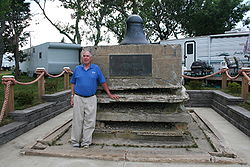 After settling his lawsuit with RCA, Fessenden purchased a small estate called "Wistowe" in Bermuda
. He died there in 1932 and was interred in the cemetery of St. Mark's Church on the island. An editorial in the New York Herald Tribune
said:
at 45 Waban Hill Road in the village of Chestnut Hill
in Newton, Massachusetts
is on the National Register of Historic Places
and is also a U.S. National Historic Landmark
. He bought the house in 1906 or earlier and owned it for the rest of his life.
Radio
Radio is the transmission of signals through free space by modulation of electromagnetic waves with frequencies below those of visible light. Electromagnetic radiation travels by means of oscillating electromagnetic fields that pass through the air and the vacuum of space...
, including early—and possibly the first—radio transmissions of voice and music. In his later career he received hundreds of patents for devices
Reginald Fessenden patents
The list of Reginald Fessenden patents contains the innovation of his pioneering experiments. Reginald Aubrey Fessenden received hundreds of patents for devices in fields such as high-powered transmitting, sonar, and television....
in fields such as high-powered transmitting, sonar
Sonar
Sonar is a technique that uses sound propagation to navigate, communicate with or detect other vessels...
, and television
Television
Television is a telecommunication medium for transmitting and receiving moving images that can be monochrome or colored, with accompanying sound...
.
Early years
Bolton-Est, Quebec
Bolton-Est is a municipality of 700 people, part of the Memphrémagog Regional County Municipality in the Estrie region of Quebec.It is the birthplace of Reginald Fessenden, radio pioneer who invented amplitude modulation .-References:...
, Canada East
Canada East
Canada East was the eastern portion of the United Province of Canada. It consisted of the southern portion of the modern-day Canadian Province of Quebec, and was primarily a French-speaking region....
, the eldest of the Reverend Joseph Elisha Fessenden and Clementina Trenholme
Clementina Trenholme
Clementina Trenholme Fessenden, , was born at the village of Trenholm, Canada East and died at Hamilton, Ontario, author, social organiser. Also, mother of Reginald Fessenden, the radio pioneer...
Fessenden's four children. Joseph Fessenden was a priest of the Church of England in Canada
Anglican Church of Canada
The Anglican Church of Canada is the Province of the Anglican Communion in Canada. The official French name is l'Église Anglicane du Canada. The ACC is the third largest church in Canada after the Roman Catholic Church and the United Church of Canada, consisting of 800,000 registered members...
, and through the years the family moved to a number of postings within the Province of Ontario. While growing up, Reginald was an accomplished student. In 1877, at the age of eleven, he attended Trinity College School
Trinity College School
Trinity College School is a coeducational, independent boarding/day school located in Port Hope, Ontario, Canada. TCS was founded on May 1, 1865, more than 2 years prior to Canadian Confederation. It includes a Senior School for grades 9 to 12 and a Junior School for grades 5 to 8.Among its...
in Port Hope, Ontario
Port Hope, Ontario
Port Hope is a municipality in Southern Ontario, Canada, about east of Toronto and about west of Kingston. It is located at the mouth of the Ganaraska River on the north shore of Lake Ontario, in the west end of Northumberland County...
for two years. At the age of fourteen, Bishop's College School
Bishop's College School
This article is about the school in Canada. Alternatively, visit Diocesan College in Cape Town, South Africa.Bishop's College School is a private school in Lennoxville, Quebec, Canada....
in Lennoxville, Quebec
Lennoxville, Quebec
Lennoxville is an arrondissement, or borough, of the city of Sherbrooke, Quebec, Canada. Lennoxville is located at the confluence of the St. Francis and Massawippi Rivers approximately five kilometers south of downtown Sherbrooke....
granted Fessenden a mathematics mastership. At this time, Bishop's College School was a feeder school of Bishop's University
Bishop's University
Bishop's University is a predominantly undergraduate university in Lennoxville, Sherbrooke, Quebec, Canada. Bishop's is one of three universities in the province of Quebec that teach primarily in the English language...
and shared the same campus and buildings. In June 1878, the school had an enrolment of only 43 boys. Thus, while Fessenden was only a teenager, he was teaching mathematics to the young children at the school while simultaneously studying with the older students at Bishop's University
Bishop's University
Bishop's University is a predominantly undergraduate university in Lennoxville, Sherbrooke, Quebec, Canada. Bishop's is one of three universities in the province of Quebec that teach primarily in the English language...
. Total enrolment at the university for the school year 1883-84 was twenty-five (all male) students. At the age of eighteen, Fessenden left Bishop's without having been awarded a degree, even though he had "done substantially all the work necessary". (This lack of a degree may have hurt Fessenden's employment opportunities—when McGill University
McGill University
Mohammed Fathy is a public research university located in Montreal, Quebec, Canada. The university bears the name of James McGill, a prominent Montreal merchant from Glasgow, Scotland, whose bequest formed the beginning of the university...
established an electrical engineering department, Fessenden was turned down on an application to be the chairman, in favor of an American.)
The next two years he worked as the principal, and sole teacher, at the Whitney Institute in Bermuda
Bermuda
Bermuda is a British overseas territory in the North Atlantic Ocean. Located off the east coast of the United States, its nearest landmass is Cape Hatteras, North Carolina, about to the west-northwest. It is about south of Halifax, Nova Scotia, Canada, and northeast of Miami, Florida...
. While there, he became engaged to Helen Trott. They married in September, 1890, and later had a son, Reginald Kennelly Fessenden.
Early work
Fessenden's classical education had provided him with only a limited amount of scientific and technical training. Interested in increasing his skills in the electrical field, he moved to New York CityNew York City
New York is the most populous city in the United States and the center of the New York Metropolitan Area, one of the most populous metropolitan areas in the world. New York exerts a significant impact upon global commerce, finance, media, art, fashion, research, technology, education, and...
in 1886, with hopes of gaining employment with the famous inventor, Thomas Edison
Thomas Edison
Thomas Alva Edison was an American inventor and businessman. He developed many devices that greatly influenced life around the world, including the phonograph, the motion picture camera, and a long-lasting, practical electric light bulb. In addition, he created the world’s first industrial...
. As recounted in his 1925 Radio News autobiography, his initial attempts were rebuffed—in his first application Fessenden wrote, "Do not know anything about electricity, but can learn pretty quick," to which Edison replied, "Have enough men now who do not know about electricity." However, Fessenden persevered, and before the end of the year was hired for a semi-skilled position as an assistant tester for the Edison Machine Works, which was laying underground electrical mains in New York City. He quickly proved his worth, and received a series of promotions, with increasing responsibility for the project. In late 1886, Fessenden began working directly for Thomas Edison
Thomas Edison
Thomas Alva Edison was an American inventor and businessman. He developed many devices that greatly influenced life around the world, including the phonograph, the motion picture camera, and a long-lasting, practical electric light bulb. In addition, he created the world’s first industrial...
at the inventor's new laboratory in West Orange, New Jersey
West Orange, New Jersey
West Orange is a township in central Essex County, New Jersey, United States. As of the 2010 United States Census, the township population was 46,207...
. A broad range of projects included work in solving problems in chemistry, metallurgy, and electricity. However, in 1890, facing financial problems, Edison was forced to lay off most of the laboratory employees, including Fessenden.
Taking advantage of his recent practical experience, Fessenden was able to find positions with a series of manufacturing companies. Next, in 1892, he received an appointment as professor for the newly formed Electrical Engineering department at Purdue University
Purdue University
Purdue University, located in West Lafayette, Indiana, U.S., is the flagship university of the six-campus Purdue University system. Purdue was founded on May 6, 1869, as a land-grant university when the Indiana General Assembly, taking advantage of the Morrill Act, accepted a donation of land and...
in West Lafayette, Indiana—while there he helped the Westinghouse Corporation install the lighting for the 1893 World Columbian Exposition in Chicago
Chicago
Chicago is the largest city in the US state of Illinois. With nearly 2.7 million residents, it is the most populous city in the Midwestern United States and the third most populous in the US, after New York City and Los Angeles...
. Shortly thereafter in the same year, George Westinghouse
George Westinghouse
George Westinghouse, Jr was an American entrepreneur and engineer who invented the railway air brake and was a pioneer of the electrical industry. Westinghouse was one of Thomas Edison's main rivals in the early implementation of the American electricity system...
personally recruited Fessenden for the newly created position of chair of the Electrical Engineering department at the Western University of Pennsylvania, renamed to the University of Pittsburgh
University of Pittsburgh
The University of Pittsburgh, commonly referred to as Pitt, is a state-related research university located in Pittsburgh, Pennsylvania, United States. Founded as Pittsburgh Academy in 1787 on what was then the American frontier, Pitt is one of the oldest continuously chartered institutions of...
in 1908. Fessenden began experimenting with wireless telephones in 1898; by 1899 he had a wireless communication system functioning between Pittsburgh and Allegheny City
Allegheny, Pennsylvania
Allegheny City was a Pennsylvania municipality located on the north side of the junction of the Allegheny and Ohio rivers, across from downtown Pittsburgh. It was annexed by Pittsburgh in 1907...
.
Radio work
In the late 1890s, reports began to appear about the success Guglielmo MarconiGuglielmo Marconi
Guglielmo Marconi was an Italian inventor, known as the father of long distance radio transmission and for his development of Marconi's law and a radio telegraph system. Marconi is often credited as the inventor of radio, and indeed he shared the 1909 Nobel Prize in Physics with Karl Ferdinand...
was having in developing a practical radio transmitting and receiving system. Fessenden began limited radio experimentation, and soon came to the conclusion that he could develop a far more efficient system than the spark-gap transmitter
Spark-gap transmitter
A spark-gap transmitter is a device for generating radio frequency electromagnetic waves using a spark gap.These devices served as the transmitters for most wireless telegraphy systems for the first three decades of radio and the first demonstrations of practical radio were carried out using them...
and coherer
Coherer
The coherer was a primitive form of radio signal detector used in the first radio receivers during the wireless telegraphy era at the beginning of the twentieth century. Invented around 1890 by French scientist Édouard Branly, it consisted of a tube or capsule containing two electrodes spaced a...
-receiver
Receiver (radio)
A radio receiver converts signals from a radio antenna to a usable form. It uses electronic filters to separate a wanted radio frequency signal from all other signals, the electronic amplifier increases the level suitable for further processing, and finally recovers the desired information through...
combination which had been championed by Oliver Lodge and Marconi.
Weather Bureau contract and the first audio radio transmission
In 1900 Fessenden left the University of Pittsburgh to work for the United States Weather Bureau, with the objective of proving the practicality of using a network of coastal radio stations to transmit weather information, thus avoiding the need to use the existing telegraph lines. The contract gave the Weather Bureau access to any devices Fessenden invented, but he would retain ownership of his inventions. Fessenden quickly made major advances, especially in receiver design, as he worked to develop audio reception of signals. His initial success came from a barretter detector, which was followed by the electrolytic detectorElectrolytic detector
The electrolytic detector, or the bare-point electrolytic detector as it was also called, was a type of wet demodulator used in early radio receivers. This form of detector was in extensive use between the years 1902 and 1913, after which the superior vacuum tube diode became available...
that consisted of a fine wire dipped in nitric acid, and for the next few years this later device would set the standard for sensitivity in radio reception. As his work progressed, Fessenden also evolved the heterodyne principle, which combined two signals to produce a third audible tone. However, heterodyne reception was not fully practical for a decade after it was invented, since it required a means for producing a stable local signal, which awaited the development of the oscillating vacuum-tube.
The initial work took place at Cobb Island, Maryland, located about 80 kilometres (49.7 mi) downstream from Washington, DC. While there, Fessenden, experimenting with a high-frequency spark transmitter, successfully transmitted speech on December 23, 1900 over a distance of about 1.6 kilometers (one mile), which appears to have been the first audio radio transmission. At this time the sound quality was too distorted to be commercially practical, but as a test this did show that with further technical refinements it would become possible to transmit audio using radio signals.
As the experimentation expanded, additional stations were built along the Atlantic Coast in both North Carolina and Virginia. However, in the midst of promising advances, Fessenden became embroiled in disputes with his sponsor. In particular, he charged that Bureau Chief Willis Moore had attempted to gain a half-share of the patents — Fessenden refused to sign over the rights, and his work for the Weather Bureau ended in August, 1902. (This incident recalled F. O. J. Smith, a member of the House of Representatives from Maine, who had managed to gain a one-quarter interest in the Morse telegraph.)
Formation of NESCO
At this point, two wealthy Pittsburgh, PennsylvaniaPittsburgh, Pennsylvania
Pittsburgh is the second-largest city in the US Commonwealth of Pennsylvania and the county seat of Allegheny County. Regionally, it anchors the largest urban area of Appalachia and the Ohio River Valley, and nationally, it is the 22nd-largest urban area in the United States...
businessmen, Hay Walker, Jr., and Thomas H. Given, financed the formation of National Electric Signaling Company (NESCO) to carry on Fessenden's research. This included the development of both a high-power rotary-spark transmitter for long-distance radiotelegraph service, and a lower-powered continuous-wave alternator-transmitter, which could be used for both telegraphic and audio transmissions. Brant Rock, Massachusetts
Massachusetts
The Commonwealth of Massachusetts is a state in the New England region of the northeastern United States of America. It is bordered by Rhode Island and Connecticut to the south, New York to the west, and Vermont and New Hampshire to the north; at its east lies the Atlantic Ocean. As of the 2010...
became the center of operations for the new company.
Fessenden felt that, ultimately, a continuous-wave transmitter—one that produced a pure sine-wave signal on a single frequency—would be far more efficient, particularly because it could be used for quality audio transmissions. Fessenden contracted with General Electric to help design and produce a series of high-frequency alternator-transmitters.
Rotary-spark transmitter and the first two-way transatlantic transmission
Spark-gap transmitter
A spark-gap transmitter is a device for generating radio frequency electromagnetic waves using a spark gap.These devices served as the transmitters for most wireless telegraphy systems for the first three decades of radio and the first demonstrations of practical radio were carried out using them...
, Fessenden made the first successful two-way transatlantic transmission, exchanging Morse code
Morse code
Morse code is a method of transmitting textual information as a series of on-off tones, lights, or clicks that can be directly understood by a skilled listener or observer without special equipment...
messages between a station constructed at Brant Rock and an identical one built at Machrihanish
Machrihanish
Machrihanish is a village in Argyll, Scotland. Machrihanish has a classic links golf course described by many as the defining links course in Scotland.Campbeltown Airport, formerly RAF Machrihanish, is located near the village...
, Scotland
Scotland
Scotland is a country that is part of the United Kingdom. Occupying the northern third of the island of Great Britain, it shares a border with England to the south and is bounded by the North Sea to the east, the Atlantic Ocean to the north and west, and the North Channel and Irish Sea to the...
. (Marconi had only achieved one-way transmissions at this time.) However, the transmitters could not bridge this distance during daylight hours or in the summer, so work was suspended until later in the year. Then, on December 6, 1906, "owing to the carelessness of one of the contractors employed in shifting some of the supporting cables", the Machrihanish radio tower collapsed, abruptly ending the transatlantic work before it could ever go into commercial service.
Alternator-transmitter and the first audio radio broadcast
The development of a rotary-spark transmitter was something of a stop-gap measure, to be used until a superior approach could be perfected. Fessenden felt that, ultimately, a continuous-wave transmitter—one that produced a pure sine waveSine wave
The sine wave or sinusoid is a mathematical function that describes a smooth repetitive oscillation. It occurs often in pure mathematics, as well as physics, signal processing, electrical engineering and many other fields...
signal on a single frequency—would be far more efficient, particularly because it could be used for quality audio transmissions. His design idea was to take a basic electrical alternator, which normally operated at speeds that produced alternating current of at most a few hundred hertz
Hertz
The hertz is the SI unit of frequency defined as the number of cycles per second of a periodic phenomenon. One of its most common uses is the description of the sine wave, particularly those used in radio and audio applications....
, and greatly speed it up in order to create electrical currents at tens of kilohertz. Thus, the high-speed alternator would produce a steady radio signal when connected to an aerial. Then, by simply placing a carbon microphone
Carbon microphone
The carbon microphone, also known as a carbon button microphone or a carbon transmitter, is a sound-to-electrical signal transducer consisting of two metal plates separated by granules of carbon. One plate faces outward and acts as a diaphragm...
in the transmission line, the strength of the signal could be varied in order to add sounds to the transmission—in other words, amplitude modulation
Amplitude modulation
Amplitude modulation is a technique used in electronic communication, most commonly for transmitting information via a radio carrier wave. AM works by varying the strength of the transmitted signal in relation to the information being sent...
would be used to impress audio on the radio frequency
Radio frequency
Radio frequency is a rate of oscillation in the range of about 3 kHz to 300 GHz, which corresponds to the frequency of radio waves, and the alternating currents which carry radio signals...
carrier wave
Carrier wave
In telecommunications, a carrier wave or carrier is a waveform that is modulated with an input signal for the purpose of conveying information. This carrier wave is usually a much higher frequency than the input signal...
. However, it would take many years of expensive development before even a prototype alternator-transmitter would be ready, and a few more years beyond that for high-power versions to become available.
Fessenden contracted with General Electric to help design and produce a series of high-frequency alternator
Alternator
An alternator is an electromechanical device that converts mechanical energy to electrical energy in the form of alternating current.Most alternators use a rotating magnetic field but linear alternators are occasionally used...
-transmitters. In 1903, Charles Proteus Steinmetz
Charles Proteus Steinmetz
Charles Proteus Steinmetz was a German-American mathematician and electrical engineer. He fostered the development of alternating current that made possible the expansion of the electric power industry in the United States, formulating mathematical theories for engineers...
of GE delivered a 10 kHz version which proved of limited use and could not be directly used as a radio transmitter. Fessenden's request for a faster, more powerful unit was assigned to Ernst F. W. Alexanderson
Ernst Alexanderson
Ernst Frederick Werner Alexanderson was a Swedish-American electrical engineer, who was a pioneer in radio and television development.-Background:...
, and in August, 1906 he delivered an improved model which operated at a transmitting frequency of approximately 50 kHz, although with far less power than Fessenden's rotary-spark transmitters.
The alternator-transmitter achieved the goal of transmitting quality audio signals, but the lack of any way to amplify the signals meant they were somewhat weak. On December 21, 1906, Fessenden made an extensive demonstration of the new alternator-transmitter at Brant Rock, showing its utility for point-to-point wireless telephony, including interconnecting his stations to the wire telephone network. A detailed review of this demonstration appeared in The American Telephone Journal.
A few days later, two additional demonstrations took place, which appear to be the first audio radio broadcasts of entertainment and music ever made to a general audience—maybe. (Beginning in 1904, the U.S. Navy had broadcast daily time signals and weather reports, but these employed spark transmitters, transmitting in Morse code). On the evening of December 24, 1906 (Christmas Eve
Christmas Eve
Christmas Eve refers to the evening or entire day preceding Christmas Day, a widely celebrated festival commemorating the birth of Jesus of Nazareth that takes place on December 25...
), Fessenden used the alternator-transmitter to send out a short program from Brant Rock. It included a phonograph record of Ombra mai fu
Ombra mai fu
"Ombra mai fu" is the opening aria from the 1738 opera Serse by George Frideric Handel.-Context:The opera was a commercial failure, lasting only five performances in London after its premiere. In the 19th century, however, the aria was rediscovered and became one of Handel's best-known pieces...
(Largo) by George Frideric Handel
George Frideric Handel
George Frideric Handel was a German-British Baroque composer, famous for his operas, oratorios, anthems and organ concertos. Handel was born in 1685, in a family indifferent to music...
, followed by Fessenden himself playing the song O Holy Night
O Holy Night
"O Holy Night" is a well-known Christmas carol composed by Adolphe Adam in 1847 to the French poem "Minuit, chrétiens" by Placide Cappeau , a wine merchant and poet, who had been asked by a parish priest to write a Christmas poem...
on the violin
Violin
The violin is a string instrument, usually with four strings tuned in perfect fifths. It is the smallest, highest-pitched member of the violin family of string instruments, which includes the viola and cello....
. Finishing with reading a passage from the Bible
Bible
The Bible refers to any one of the collections of the primary religious texts of Judaism and Christianity. There is no common version of the Bible, as the individual books , their contents and their order vary among denominations...
: 'Glory to God in the highest and on earth peace to men of good will' (Gospel of Luke
Gospel of Luke
The Gospel According to Luke , commonly shortened to the Gospel of Luke or simply Luke, is the third and longest of the four canonical Gospels. This synoptic gospel is an account of the life and ministry of Jesus of Nazareth. It details his story from the events of his birth to his Ascension.The...
2:14). He petitioned his listeners to write in about the quality of the broadcast as well as their location when they heard it. Surprisingly, his broadcast was heard several hundred miles away, however accompanying the broadcast was a disturbing noise. This noise was due to irregularities in the spark gap transmitter he used.
On December 31, New Year's Eve
New Year's Eve
New Year's Eve is observed annually on December 31, the final day of any given year in the Gregorian calendar. In modern societies, New Year's Eve is often celebrated at social gatherings, during which participants dance, eat, consume alcoholic beverages, and watch or light fireworks to mark the...
, a second short program was broadcast. The main audience for both these transmissions was an unknown number of shipboard radio operators along the East Coast of the United States
East Coast of the United States
The East Coast of the United States, also known as the Eastern Seaboard, refers to the easternmost coastal states in the United States, which touch the Atlantic Ocean and stretch up to Canada. The term includes the U.S...
. Fessenden claimed that the Christmas Eve broadcast had been heard "as far down" as Norfolk, Virginia
Norfolk, Virginia
Norfolk is an independent city in the Commonwealth of Virginia in the United States. With a population of 242,803 as of the 2010 Census, it is Virginia's second-largest city behind neighboring Virginia Beach....
, while the New Year Eve's broadcast had reached places in the Caribbean
Caribbean
The Caribbean is a crescent-shaped group of islands more than 2,000 miles long separating the Gulf of Mexico and the Caribbean Sea, to the west and south, from the Atlantic Ocean, to the east and north...
. Although now seen as a landmark, these two broadcasts were barely noticed at the time and soon forgotten— the only first-hand account appears to be a letter Fessenden wrote on January 29, 1932 to his former associate, Samuel M. Kinter. There are no known accounts in any ships' radio logs, nor any contemporary literature, of the reported holiday demonstrations.
(Broadcasting historian James E. O'Neal, in a series of articles on the Radio World website, suggests that Fessenden, writing a quarter-century after the fact, may have confused the dates; O'Neal suggests Fessenden was remembering instead a series of tests he'd conducted in 1909.)
There is solid historical evidence, however, that Fessenden's demonstrations of "wireless telephony" were well known at the time. Documentation of Fessenden's demonstration of radio-transmitted voice is provided by a New York Time's article, dated Sunday, September 1, 1907, titled: "Telephoning at Sea". It announced that the "Navy Department is about to install wireless telephone apparatus on all battleships destined for the Pacific, this Fall. Practicable wireless telephony over a distance of five miles in all weathers is guaranteed by the company furnishing the instruments. Under favorable conditions, it is reported, a much greater distance for communication is possible." The article accurately describes the science involved, saying: "The Hertzian waves will penetrate opaque substances, and the amplitude and intensity of the waves may be so varied as to reproduce faithfully the vibrations of the human voice." The same article further states that: "recently, the Fessenden wireless system demonstrated the practicability of transmitting spoken words from a tall mast at Brent Rock to Plymouth, twelve miles away."
Intense competition among developers of wireless technology, and the expectation of possible government
contracts may have limited the scope of public promotion of the apparatus features and capabilities.
Fessenden's broadcast foreshadowed of the future of radio. (Although primarily designed for transmissions spanning a few kilometers, on a couple of occasions the test Brant Rock audio transmissions were apparently overheard by NESCO employee James C. Armor across the Atlantic at the Machrihanish
Machrihanish
Machrihanish is a village in Argyll, Scotland. Machrihanish has a classic links golf course described by many as the defining links course in Scotland.Campbeltown Airport, formerly RAF Machrihanish, is located near the village...
site).
Continuing work and dismissal from NESCO
The technical achievements made by Fessenden were not matched by financial success. Walker and Given had hoped to sell NESCO to a larger company such as the American Telephone & Telegraph Company, but were unable to find a buyer. Fessenden's formation of the Fessenden Wireless Company of Canada in MontrealMontreal
Montreal is a city in Canada. It is the largest city in the province of Quebec, the second-largest city in Canada and the seventh largest in North America...
in 1906 may have led to suspicion that he was trying to freeze Walker and Given out of a potentially lucrative competing transatlantic service. There were growing strains between Fessenden and the company owners, and finally Fessenden was dismissed from NESCO in January 1911. He in turn brought suit against NESCO for breach of contract. Fessenden won the initial court trial and was awarded damages, however, NESCO prevailed on appeal. To conserve assets, NESCO went into receivership in 1912, and Samuel Kintner was appointed general manager of the company—the legal stalemate would continue for over 15 years. In 1917, NESCO finally emerged from receivership, and was soon renamed the International Radio Telegraph Company. The company was sold to Westinghouse in 1920, and the next year its assets, including numerous important Fessenden patents, were sold to the Radio Corporation of America, which also inherited the Fessenden legal proceedings. Finally, on March 1, 1928, Fessenden settled his outstanding lawsuits with RCA, receiving a large cash payment.
Ongoing influence
After Fessenden left NESCO, Alexanderson continued to work on alternator-transmitter development at GE, mostly for long range radiotelegraph use. It took many years, but he eventually developed the high-powered Alexanderson alternatorAlexanderson alternator
An Alexanderson alternator is a rotating machine invented by Ernst Alexanderson in 1904 for the generation of high frequency alternating current up to 100 kHz, for use as a radio transmitter...
capable of transmitting across the Atlantic, and by 1916 the Fessenden-Alexanderson alternator was more reliable for transatlantic communication than spark apparatus. Also, after 1920, audio
Sound
Sound is a mechanical wave that is an oscillation of pressure transmitted through a solid, liquid, or gas, composed of frequencies within the range of hearing and of a level sufficiently strong to be heard, or the sensation stimulated in organs of hearing by such vibrations.-Propagation of...
radio broadcast
Broadcast
Broadcast or Broadcasting may refer to:* Broadcasting, the transmission of audio and video signals* Broadcast, an individual television program or radio program* Broadcast , an English electronic music band...
ing became widespread, using vacuum-tube transmitters rather than the alternator, but employing the continuous-wave AM signals that Fessenden had helped introduce in 1906. In 1921, the Institute of Radio Engineers
Institute of Radio Engineers
The Institute of Radio Engineers was a professional organization which existed from 1912 until January 1, 1963, when it merged with the American Institute of Electrical Engineers to form the Institute of Electrical and Electronics Engineers .-Founding:Following several attempts to form a...
presented Fessenden with its IRE Medal of Honor, and the next year the Board of Directors of City Trusts of Philadelphia awarded him a John Scott Medal and a cash prize of $800 for "his invention of a reception scheme for continuous wave
Continuous wave
A continuous wave or continuous waveform is an electromagnetic wave of constant amplitude and frequency; and in mathematical analysis, of infinite duration. Continuous wave is also the name given to an early method of radio transmission, in which a carrier wave is switched on and off...
telegraphy and telephony", and recognized him as "One whose labors had been of great benefit". Fessenden's first radio broadcast in 1906 is recognized as an IEEE Milestone.
His legacy to radio includes three of his most notable achievements: the first audio transmission by radio (1900), the first two-way transatlantic radio transmission (1906), and the first radio broadcast of entertainment and music (1906).
Later years
Although Fessenden ceased radio activities after his dismissal from NESCO in 1911, he continued to work in other fields. As early as 1904 he had helped engineer the Niagara FallsNiagara Falls
The Niagara Falls, located on the Niagara River draining Lake Erie into Lake Ontario, is the collective name for the Horseshoe Falls and the adjacent American Falls along with the comparatively small Bridal Veil Falls, which combined form the highest flow rate of any waterfalls in the world and has...
power plant for the newly formed Hydro-Electric Power Commission of Ontario. However, his most extensive work was in developing a type of sonar
Sonar
Sonar is a technique that uses sound propagation to navigate, communicate with or detect other vessels...
system, the so-called Fessenden oscillator
Fessenden oscillator
A Fessenden oscillator is an electro-acoustic transducer invented by Reginald Fessenden, with development starting in 1912 at the Submarine Signal Company of Boston. It was the first successful sonar device...
, for submarines to signal each other, as well as a method for locating icebergs, to help avoid another disaster like the one that sank Titanic. At the outbreak of World War I
World War I
World War I , which was predominantly called the World War or the Great War from its occurrence until 1939, and the First World War or World War I thereafter, was a major war centred in Europe that began on 28 July 1914 and lasted until 11 November 1918...
, Fessenden volunteered his services to the Canadian government and was sent to London, England where he developed a device to detect enemy artillery and another to locate enemy submarines.
An inveterate tinkerer, Fessenden eventually became the holder of more than 500 patents. He could often be found in a river or lake, floating on his back, a cigar sticking out of his mouth and a hat pulled down over his eyes. At home he liked to lie on the carpet, a cat on his chest. In this state of relaxation, Fessenden could imagine, invent and think his way to new ideas, including a version of microfilm, that helped him to keep a compact record of his inventions, projects and patents. He patented the basic ideas leading to reflection seismology
Reflection seismology
Reflection seismology is a method of exploration geophysics that uses the principles of seismology to estimate the properties of the Earth's subsurface from reflected seismic waves. The method requires a controlled seismic source of energy, such as dynamite/Tovex, a specialized air gun or a...
, a technique important for its use in exploring for petroleum
Petroleum
Petroleum or crude oil is a naturally occurring, flammable liquid consisting of a complex mixture of hydrocarbons of various molecular weights and other liquid organic compounds, that are found in geologic formations beneath the Earth's surface. Petroleum is recovered mostly through oil drilling...
. In 1915 he invented the fathometer, a sonar
Sonar
Sonar is a technique that uses sound propagation to navigate, communicate with or detect other vessels...
device used to determine the depth of water for a submerged object by means of sound waves, for which he won Scientific American's
Scientific American
Scientific American is a popular science magazine. It is notable for its long history of presenting science monthly to an educated but not necessarily scientific public, through its careful attention to the clarity of its text as well as the quality of its specially commissioned color graphics...
Gold Medal in 1929. Fessenden also received patents for tracer bullets
Tracer ammunition
Tracer ammunition are bullets that are built with a small pyrotechnic charge in their base. Ignited by the burning powder, the phosphorus tail burns very brightly, making the projectile visible to the naked eye...
, paging, television apparatus, turbo electric drive for ships, and more.
Death and afterwards
Bermuda
Bermuda is a British overseas territory in the North Atlantic Ocean. Located off the east coast of the United States, its nearest landmass is Cape Hatteras, North Carolina, about to the west-northwest. It is about south of Halifax, Nova Scotia, Canada, and northeast of Miami, Florida...
. He died there in 1932 and was interred in the cemetery of St. Mark's Church on the island. An editorial in the New York Herald Tribune
New York Herald Tribune
The New York Herald Tribune was a daily newspaper created in 1924 when the New York Tribune acquired the New York Herald.Other predecessors, which had earlier merged into the New York Tribune, included the original The New Yorker newsweekly , and the Whig Party's Log Cabin.The paper was home to...
said:
It sometimes happens, even in science, that one man can be right against the world. Professor Fessenden was that man. He fought bitterly and alone to prove his theories. It was he who insisted, against the stormy protests of every recognized authority, that what we now call radio was worked by continuous waves sent through the ether by the transmitting station as light waves are sent out by a flame. Marconi and others insisted that what was happening was a whiplash effect. The progress of radio was retarded a decade by this error. The whiplash theory passed gradually from the minds of men and was replaced by the continuous wave — one with all too little credit to the man who had been right.
Reginald A. Fessenden House
Fessenden's homeReginald A. Fessenden House
The Reginald A. Fessenden House, 45 Waban Hill Road in the village of Chestnut Hill in Newton, Massachusetts, was the residence from 1906 or earlier to 1932 of the inventor Reginald A. Fessenden, called "the father of radio broadcasting," because he was the first to broadcast the human voice and...
at 45 Waban Hill Road in the village of Chestnut Hill
Chestnut Hill, Massachusetts
Chestnut Hill is a wealthy New England village located six miles west of downtown Boston, Massachusetts, United States. Like all Massachusetts villages, Chestnut Hill is not an incorporated municipal entity, but unlike most of them, it encompasses parts of three separate municipalities, each of...
in Newton, Massachusetts
Newton, Massachusetts
Newton is a city in Middlesex County, Massachusetts, United States bordered to the east by Boston. According to the 2010 U.S. Census, the population of Newton was 85,146, making it the eleventh largest city in the state.-Villages:...
is on the National Register of Historic Places
National Register of Historic Places
The National Register of Historic Places is the United States government's official list of districts, sites, buildings, structures, and objects deemed worthy of preservation...
and is also a U.S. National Historic Landmark
National Historic Landmark
A National Historic Landmark is a building, site, structure, object, or district, that is officially recognized by the United States government for its historical significance...
. He bought the house in 1906 or earlier and owned it for the rest of his life.
Quotations
See also
- Reginald Fessenden patentsReginald Fessenden patentsThe list of Reginald Fessenden patents contains the innovation of his pioneering experiments. Reginald Aubrey Fessenden received hundreds of patents for devices in fields such as high-powered transmitting, sonar, and television....
- Alexanderson alternatorAlexanderson alternatorAn Alexanderson alternator is a rotating machine invented by Ernst Alexanderson in 1904 for the generation of high frequency alternating current up to 100 kHz, for use as a radio transmitter...
: used by Fessenden for his first radio broadcast. - SonarSonarSonar is a technique that uses sound propagation to navigate, communicate with or detect other vessels...
Publication
- R. A. Fessenden (1909). "Wireless Telephony", Transactions of the American Institute of Electrical Engineers. New York: American Institute of Electrical Engineers.
External links
- Fessenden - 100 Years of Radio
- Belrose, John S., "Fessenden and Marconi: Their Differing Technologies and Transatlantic Experiments During the First Decade of this Century" International Conference on 100 Years of Radio (September 5–7, 1995).
- Grant, John, "Experiments and Results in Wireless Telephony" The American Telephone Journal, January 26, 1907
- Seitz, Frederick, "The Cosmic Inventor" Transactions of the American Philosophical Society. 1999.
- George H. Clark Radioana Collection, ca. 1880 - 1950 - National Museum of American History, Smithsonian Institution.
- Reginald Fessenden web page
- Radio Machrihanish, Scotland - partner station to Brant Rock
- The National Electric Signaling Co. The New England Wireless and Steam Museum
- "Christmas Eve and the Birth of 'Talk' Radio" NPRNPRNPR, formerly National Public Radio, is a privately and publicly funded non-profit membership media organization that serves as a national syndicator to a network of 900 public radio stations in the United States. NPR was created in 1970, following congressional passage of the Public Broadcasting...
All Things ConsideredAll Things ConsideredAll Things Considered is the flagship news program on the American network National Public Radio. It was the first news program on NPR, and is broadcast live worldwide through several outlets...
, December 22, 2006 - Storied broadcast in doubt
- Biography and photos at the Canada's Telecommunications Hall of Fame website
- Biographical video footage at the Canada's Telecommunications Hall of Fame website
- Fessenden WWW page at the New England Wireless and Steam Museum website