

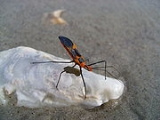
Reduviidae

Overview
Cosmopolitan distribution
In biogeography, a taxon is said to have a cosmopolitan distribution if its range extends across all or most of the world in appropriate habitats. For instance, the killer whale has a cosmopolitan distribution, extending over most of the world's oceans. Other examples include humans, the lichen...
family
Family (biology)
In biological classification, family is* a taxonomic rank. Other well-known ranks are life, domain, kingdom, phylum, class, order, genus, and species, with family fitting between order and genus. As for the other well-known ranks, there is the option of an immediately lower rank, indicated by the...
of predatory insect
Insect
Insects are a class of living creatures within the arthropods that have a chitinous exoskeleton, a three-part body , three pairs of jointed legs, compound eyes, and two antennae...
s in the suborder Heteroptera
Heteroptera
Heteroptera is a group of about 40,000 species of insects in the Hemiptera. Sometimes called "true bugs", that name more commonly refers to Hemiptera as a whole, and "typical bugs" might be used as a more unequivocal alternative since among the Hemiptera the heteropterans are most consistently and...
. It includes assassin bugs (genera
Genus
In biology, a genus is a low-level taxonomic rank used in the biological classification of living and fossil organisms, which is an example of definition by genus and differentia...
include Melanolestes
Melanolestes
Melanolestes is a Nearctic and Neotropical genus of assassin bugs . Nine species are known :* Melanolestes argentinus Berg* Melanolestes degener Walker* Melanolestes morio Erichson* Melanolestes picicornis Stål...
, Platymeris
Platymeris
Platymeris is a genus of assassin bug . Platymeris species are often used in laboratories and as pets. The venom of this genus has been studied in a laboratory setting.- Species list:Platymeris biguttatusPlatymeris charon...
, Pselliopus
Pselliopus
Pselliopus is a common genus of assassin bug family , in the subfamily Harpactorinae. The genus is restricted to the New World,, with 22 species described. Some species, such as Pselliopus barberi, are conspicuous because of their bright coloring and relatively large size...
, Rasahus
Rasahus
Rasahus is a Neotropical genus of assassin bugs . 26 species have been described.-Partial species lis t:*Rasahus biguttatus *Rasahus hamatus *Rasahus scutellaris...
, Reduvius
Reduvius
Reduvius is a large genus of reduviids or assassin bugs. The masked hunter, Reduvius personatus, is a well-known example of this genus.-Partial list of species:*Reduvius fedtschenkianus *Reduvius jakovleffi Reuter, 1892...
, Rhiginia
Rhiginia
Rhiginia is a New World genus of the Ectrichodiinae subfamily of the reduviid . Species of this genus are generally active, alert and strong fliers.-partial list of species:*Rhiginia cinctiventris...
, Sinea
Sinea
Sinea is a New World genus of assassin bugs, in the subfamily Harpactorinae. 13 species have been described, mostly from the Southwestern United States and Central America.-Partial list of species:*Sinea anacantha Hussey, 1953...
, Triatoma
Triatoma
Triatoma is a genus of assassin bug in the subfamily Triatominae The members of Triatoma are blood-sucking insects that can transmit serious diseases, such as Chagas disease....
, and Zelus
Zelus (genus)
Zelus is a genus of assassin bug family , in the subfamily Harpactorinae. There are currently 60 described species, most of which are found in Central and South America. Five species are present in North America....
), wheel bug
Wheel bug
The wheel bug , in the family Reduviidae, is one of the largest terrestrial true bugs in North America, being up to 1.5 inches, or 38 mm, in length; it is the only member of its genus. A characteristic structure is the wheel-shaped pronotal armor...
s (Arilus cristatus), and thread-legged bugs (the subfamily Emesinae
Emesinae
Emesinae, or thread-legged bugs, are a subfamily of the Reduviidae . They are conspicuously different from the other reduviids by their very slender body form. They are stalking, predaceous insects that can be collected on palm fronds, cliffs, spider webbing, or near lights at night...
, including the genus Emesaya
Emesaya
Emesaya is a genus of true bug in the subfamily Emesinae....
). There are about 7000 species altogether, making it one of the largest families in the Hemiptera
Hemiptera
Hemiptera is an order of insects most often known as the true bugs , comprising around 50,000–80,000 species of cicadas, aphids, planthoppers, leafhoppers, shield bugs, and others...
.
Adult insects often range from 4 to 40 mm.
