
Home      Discussion      Topics      Dictionary      Almanac
Signup       Login
Red-footed tortoise

Red-footed tortoise

Overview
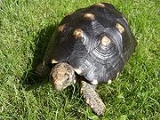
The red-footed tortoise (Chelonoidis carbonaria) is a tortoise
Tortoise
Tortoises are a family of land-dwelling reptiles of the order of turtles . Like their marine cousins, the sea turtles, tortoises are shielded from predators by a shell. The top part of the shell is the carapace, the underside is the plastron, and the two are connected by the bridge. The tortoise...

 native to South America
South America
South America is a continent situated in the Western Hemisphere, mostly in the Southern Hemisphere, with a relatively small portion in the Northern Hemisphere. The continent is also considered a subcontinent of the Americas. It is bordered on the west by the Pacific Ocean and on the north and east...

. It has also been introduced to many islands in the Caribbean
Caribbean
The Caribbean is a crescent-shaped group of islands more than 2,000 miles long separating the Gulf of Mexico and the Caribbean Sea, to the west and south, from the Atlantic Ocean, to the east and north...

. It draws its name from the red or orange scales visible on its limbs, as well as its head and tail. It is popular as a pet, though it is protected under Appendix II of the Convention on International Trade in Endangered Species (CITES), which means that this species may not be exported from its home country without a permit. The red-foot has a larger cousin, the yellow-footed tortoise (Chelonoidis denticulata), also known as the Brazilian giant tortoise
Brazilian Giant Tortoise
The Brazilian giant tortoise, forest tortoise, South American tortoise, South American yellow-footed tortoise, or yellow-footed tortoise is a species of tortoise in the family Testudinidae...

. Many older references use the genus name Geochelone in place of the newer term Chelonoidis for all four South American tortoises.
Discussion
Ask a question about 'Red-footed tortoise'
Start a new discussion about 'Red-footed tortoise'
Answer questions from other users
Full Discussion Forum
 
Unanswered Questions
Encyclopedia
The red-footed tortoise (Chelonoidis carbonaria) is a tortoise
Tortoise
Tortoises are a family of land-dwelling reptiles of the order of turtles . Like their marine cousins, the sea turtles, tortoises are shielded from predators by a shell. The top part of the shell is the carapace, the underside is the plastron, and the two are connected by the bridge. The tortoise...

 native to South America
South America
South America is a continent situated in the Western Hemisphere, mostly in the Southern Hemisphere, with a relatively small portion in the Northern Hemisphere. The continent is also considered a subcontinent of the Americas. It is bordered on the west by the Pacific Ocean and on the north and east...

. It has also been introduced to many islands in the Caribbean
Caribbean
The Caribbean is a crescent-shaped group of islands more than 2,000 miles long separating the Gulf of Mexico and the Caribbean Sea, to the west and south, from the Atlantic Ocean, to the east and north...

. It draws its name from the red or orange scales visible on its limbs, as well as its head and tail. It is popular as a pet, though it is protected under Appendix II of the Convention on International Trade in Endangered Species (CITES), which means that this species may not be exported from its home country without a permit. The red-foot has a larger cousin, the yellow-footed tortoise (Chelonoidis denticulata), also known as the Brazilian giant tortoise
Brazilian Giant Tortoise
The Brazilian giant tortoise, forest tortoise, South American tortoise, South American yellow-footed tortoise, or yellow-footed tortoise is a species of tortoise in the family Testudinidae...

. Many older references use the genus name Geochelone in place of the newer term Chelonoidis for all four South American tortoises.

It is locally known as the savanna tortoise, in Brazil
Brazil
Brazil , officially the Federative Republic of Brazil , is the largest country in South America. It is the world's fifth largest country, both by geographical area and by population with over 192 million people...

 as jabuti, and in Venezuela as morrocoy, among other names.

Description


Red-foot tortoises have red scales on the limbs, as well as red, yellow, and/or orange facial markings. Red-foots will normally reach between 10 and 14 inches (25.4 - 35.6 cm) in carapace length, although in rare cases may grow up to 16 inches (40 cm).

Red-foot males are larger than females in carapace length and weight, but are not wider or taller. Males can easily reach twenty pounds (9 kg) or more, while females weigh a bit less. As with other tortoise species, male red-foots have a concave plastron. As red-foots mature, both sexes develop a unique mid-body constriction (some have referred to it as a "waist") that, from a top view, gives the tortoises a decidedly hourglass appearance. This "hourglass" figure is much more developed in males than in females. Mature males also have longer and wider tails than females.

A red-foot tortoise generally lives 40–50 years.

Range and habitat


The red-foot tortoise is found throughout extreme southern Central America, and central and northern South America including the countries of Panama
Panama
Panama , officially the Republic of Panama , is the southernmost country of Central America. Situated on the isthmus connecting North and South America, it is bordered by Costa Rica to the northwest, Colombia to the southeast, the Caribbean Sea to the north and the Pacific Ocean to the south. The...

, Colombia
Colombia
Colombia, officially the Republic of Colombia , is a unitary constitutional republic comprising thirty-two departments. The country is located in northwestern South America, bordered to the east by Venezuela and Brazil; to the south by Ecuador and Peru; to the north by the Caribbean Sea; to the...

, Venezuela
Venezuela
Venezuela , officially called the Bolivarian Republic of Venezuela , is a tropical country on the northern coast of South America. It borders Colombia to the west, Guyana to the east, and Brazil to the south...

, Guyana
Guyana
Guyana , officially the Co-operative Republic of Guyana, previously the colony of British Guiana, is a sovereign state on the northern coast of South America that is culturally part of the Anglophone Caribbean. Guyana was a former colony of the Dutch and of the British...

, Surinam, French Guyana, Brazil
Brazil
Brazil , officially the Federative Republic of Brazil , is the largest country in South America. It is the world's fifth largest country, both by geographical area and by population with over 192 million people...

, Bolivia
Bolivia
Bolivia officially known as Plurinational State of Bolivia , is a landlocked country in central South America. It is the poorest country in South America...

, Paraguay
Paraguay
Paraguay , officially the Republic of Paraguay , is a landlocked country in South America. It is bordered by Argentina to the south and southwest, Brazil to the east and northeast, and Bolivia to the northwest. Paraguay lies on both banks of the Paraguay River, which runs through the center of the...

, and Argentina
Argentina
Argentina , officially the Argentine Republic , is the second largest country in South America by land area, after Brazil. It is constituted as a federation of 23 provinces and an autonomous city, Buenos Aires...

. They are also found on Trinidad
Trinidad
Trinidad is the larger and more populous of the two major islands and numerous landforms which make up the island nation of Trinidad and Tobago. It is the southernmost island in the Caribbean and lies just off the northeastern coast of Venezuela. With an area of it is also the fifth largest in...

, Barbados
Barbados
Barbados is an island country in the Lesser Antilles. It is in length and as much as in width, amounting to . It is situated in the western area of the North Atlantic and 100 kilometres east of the Windward Islands and the Caribbean Sea; therein, it is about east of the islands of Saint...

, Saint Lucia
Saint Lucia
Saint Lucia is an island country in the eastern Caribbean Sea on the boundary with the Atlantic Ocean. Part of the Lesser Antilles, it is located north/northeast of the island of Saint Vincent, northwest of Barbados and south of Martinique. It covers a land area of 620 km2 and has an...

 etc. and have been introduced to many other islands in the West Indies.

The red-foot occupies a number of habitats within this extensive range. It occurs in all types of forest habitat (rainforest
Rainforest
Rainforests are forests characterized by high rainfall, with definitions based on a minimum normal annual rainfall of 1750-2000 mm...

, temperate forest
Temperate forest
Temperate forests correspond to forest concentrations formed in the northern hemisphere. Main characteristics include: wide leaves, big and tall trees and non seasonal vegetation...

, and dry thorn forest), and also dwells in savanna
Savanna
A savanna, or savannah, is a grassland ecosystem characterized by the trees being sufficiently small or widely spaced so that the canopy does not close. The open canopy allows sufficient light to reach the ground to support an unbroken herbaceous layer consisting primarily of C4 grasses.Some...

 areas, including man-made grasslands resulting from ranching and slash-and-burn agricultural practices. Forest edges and savannas seem to be the preferred habitat for this species, although there is some disagreement over this. Walker (1989) states that red-foots prefer grasslands and dry forest areas, and that rain-forest habitat is most likely marginal. Other authors however, state or suggest that humid forest is the preferred habitat (Legler, 1963) (Moskovits, 1988), although much of their range south of the Amazon
Amazon Rainforest
The Amazon Rainforest , also known in English as Amazonia or the Amazon Jungle, is a moist broadleaf forest that covers most of the Amazon Basin of South America...

 is outside the rain forest region.

Conservation status


In every country in its range, the biggest threat to the survival of red-footed tortoises is overhunting by man. Interestingly enough, tortoises are considered "fish" by the Catholic Church and during holy week, redfoots are consumed in huge numbers. Red-foots are collected and shipped to many different South American cities to be sold as a delicacy. The fact that red-foots can tolerate long periods of time without food and water, otherwise an evolutionary advantage, makes this species both easy and profitable to transport.

Another threat facing red-foot populations is the omnipresent habitat loss and disturbance. Although it has been observed that red-footed tortoises can live on land that has been converted to agriculture, their densities are much lower than they are in natural, unaltered habitat. Tortoises living on agricultural lands are much easier to locate, so higher hunting rates may account for this difference.

Exportation for the pet trade also has a negative effect on red-footed tortoises, although it is much less of a threat to their survival than either hunting or habitat loss. The natural history of the red-foot tortoise provides insight into two areas, the susceptibility of this species to overhunting and habitat loss, and captive husbandry and reproduction.

Conservation efforts include the establishment and protection of wildlife reserves and national parks, where red-footed tortoises and other animals are protected from hunting. Due to a protection law through the Convention on International Trade in Endangered Species of Wild Fauna and Flora (CITES), it is currently illegal to transport a red-foorted tortoise from its home country without proper certification and permits, although some facilities have obtained permits for breeding purposes.

Reproduction


In the wild, the red-foot tortoise lays clutches of 5 to 15 eggs between July and September. They are generally buried in a nest in the ground in typical tortoise style. However, some authors report that locals in Panama have observed eggs laid in leaf-litter on the forest floor. Eggs are oblong (about 2" x 1.5") and have brittle shells. The hatchlings are round and flat, and are about 1.5" in diameter.

In captivity, red-foot tortoises are capable of producing eggs at any time during the year, although seasonal activity may be noted.

It is important that more than one male be included in a breeding group, male to male combat is important in inducing breeding in Red-foots. Male to male combat begins with a round of head bobbing from each male involved, and then proceeds to a wresting match where the males attempt to turn one another over. The succeeding male (usually the largest male) then attempts to mate with the females. The ritualistic head movements displayed by male red-foots are thought to be a method of species recognition. Other tortoise species, most notably the closely related and sometimes sympatric yellow-footed tortoise (Chelonoidis denticulata), have different challenging head movements. Red-foot tortoises have challenging head movements that are a series of lateral jerks, by contrast, Yellow-footed Tortoises utilize a long sideways sweep in their displays. Male red-foots peruse walking (seeming uninterested) females until they can maneuver them into a position for mating. The unique body shape of the male Red-footed tortoise facilitates the mating process by allowing him to maintain his balance during copulation while the female walks around, seemingly attempting to dislodge the male by walking under low-hanging vegetation.

Care


A properly cared-for red-foot is one of the best tortoise species to maintain in captivity. As with any animal, one should put in a great deal of research and deliberation before obtaining a red-foot as a pet. One should be sure that there is a doctor of veterinary medicine with experience with exotic animals including tortoises (preferably red-foots) in the area before obtaining one. In addition, many states prohibit exotic species and one must be aware of local laws before getting a Red-foot of one's own.

Indoor habitats


Housing should be large enough to allow the tortoises plenty of room to explore and exercise. The housing should also allow the right temperatures and moisture levels needed by the species.

Cypress or other hardwood mulches without aromatic resins may be the best substrate for red-foot tortoises because of the way it simultaneously holds moisture, yet offers a dry surface. Other types of substrates are available and can work, but avoid those that can lead to dehydration, fungal growth, etc. such as rabbit pellets or wood shavings.

The habitat should also be equipped with a large sunken water dish, shade, and hiding places.

Red-foot tortoises prefer a temperature of between 80° and 90°F., and high levels of humidity in at least some parts of the habitat (although they do not tolerate being on wet surfaces for very long).

If natural, unfiltered (not blocked by glass or plastic) sunlight is not available, the habitat should be lit for about 12 hours a day. Use low wattage lighting for smaller tortoises. Bulbs that offer at least low levels of UVB lighting are recommended by most, but not all, experts. Some bulbs can combine heat, UVB, and lighting but are generally best for larger habitats.

Hatchling tortoises have been successfully raised in a 16"x24"x6" enclosure.. Juvenile tortoises have been successfully raised in a 28"x15"x13" Rubbermaid container, with a 100 watt porcelain heat emitter and an aquarium bulb as a light source.

Feeding


Red-foot tortoises are omnivores, though eat more plant-derived food than meat by far. In captivity, red-foots should be fed a mixture of high calcium greens, fruits, vegetables, and flowers.

Appropriate greens include dandelion greens, endive, escarole, kale,and hibiscus leaves. Spinach, turnip, and collard greens should be avoided because of the high amount of oxalic acid they contain, which binds the dietary calcium from being used for their bones Flowers are also a common food of choice in the wild. Edible flowers include hibiscus, nasturtium, prickly-pear flowers, and dandelions. Varying the foods offered helps ensure good nutrition.

Good fruits to offer include strawberries, peaches, pineapples, plums, papayas, mangoes, kiwifruits, melons, and prickly pear fruits. Banana should be fed seldom, and with the peel. Fruit should form less than about 1/4 of the weekly diet

Red-foot tortoises in particular seem very sensitive to environmental change. When first acquiring a red-foot, expect a possible long period of fasting. Just when one thinks something is terribly wrong, the red-foot will suddenly start eating again once she/he feels comfortable with the surrounding (SFCRC - 2003). This fasting aspect is more prominent and longer in duration in WC (wild caught) individuals than with long term captives or CB (captive bred) individuals.

Shell health and pyramiding


The most common problem related to tortoise shell health is called "pyramiding". Pyramiding is a form of metabolic bone disease (MBD). It is characterized by a build up or stacking of keratin in the scutes. There are many factors that contribute to pyramiding, and much disagreement about the primary cause between herpetologists, veterinarians, and breeders. Traditionally, the focus has been on protein, because protein in the diet causes the shell to put down heavy layers of keratin, resulting in conical scutes on the shell. Lack of calcium may also result in the soft shells that often accompany pyramiding. More recently, research suggests that humidity is key to carapace health in Red-foots and other species.

Another less common shell health issue is known as "shell rot." Shell-rot is a generic term which describes the visible effects of bacterial or fungal diseases, or long-term contact with too-damp surfaces, of a tortoise's shell. Some common causes of shell rot include wet surfaces, improper enclosure humidity, poor hygiene, ticks, and aggression by other tortoises. Deep-seated shell abscesses are particularly serious, and invariably require surgical draining and removal, followed by selective treatment with systemic anti-microbials. If detected early enough, the fungus may be treated with a cleansing, at least twice daily, with a povidone-iodine or chlorhexidine solution.

Potential speciation


The species has radiated varieties throughout its various habitats. While there are no officially credited sub-species, data suggests that red-foots are adapting fairly quickly. While genetic data is still lacking, this species may be yet another 'poster-child' for evolution, and more specifically, speciation.

Depending on the source, there may be as many as seven 'types' of red-foots. Further research may decide if they are races, regional variations, sub-species, or species. The most obvious difference is plastron coloration. Red-foots from north of the Amazon
Amazon Rainforest
The Amazon Rainforest , also known in English as Amazonia or the Amazon Jungle, is a moist broadleaf forest that covers most of the Amazon Basin of South America...

 have mostly pale plastrons, often with fairly distinctive darker markings. Red-foots from south of the Amazon have mostly dark plastrons. 'Southern' red-foots also have an enlarged, slightly hooked scale near the elbow on the forelimbs and less of the earlier referenced "hourglass" waist shape.

Within the 'northern' populations, the types, according to Pritchard, are:
  1. Most of Venezuela
    Venezuela
    Venezuela , officially called the Bolivarian Republic of Venezuela , is a tropical country on the northern coast of South America. It borders Colombia to the west, Guyana to the east, and Brazil to the south...

     and to the east. These are the 'typical' red-foots that most descriptions are based on, and commonly seen as pets or in photos. There are color variations within this group- those from French Guiana
    French Guiana
    French Guiana is an overseas region of France, consisting of a single overseas department located on the northern Atlantic coast of South America. It has borders with two nations, Brazil to the east and south, and Suriname to the west...

    , for example, often have more yellow on the snout and top of the head
  2. Falcon region of Venezuela
    Venezuela
    Venezuela , officially called the Bolivarian Republic of Venezuela , is a tropical country on the northern coast of South America. It borders Colombia to the west, Guyana to the east, and Brazil to the south...

    . Lighter carapace and no markings on the pale plastron. This is based on a relatively small number of specimens.
  3. West of Venezuela
    Venezuela
    Venezuela , officially called the Bolivarian Republic of Venezuela , is a tropical country on the northern coast of South America. It borders Colombia to the west, Guyana to the east, and Brazil to the south...

     into Panama
    Panama
    Panama , officially the Republic of Panama , is the southernmost country of Central America. Situated on the isthmus connecting North and South America, it is bordered by Costa Rica to the northwest, Colombia to the southeast, the Caribbean Sea to the north and the Pacific Ocean to the south. The...

    . Carapace coloration is more of a brown than the typical black.
  4. Island forms, especially from the Lesser Antilles
    Lesser Antilles
    The Lesser Antilles are a long, partly volcanic island arc in the Western Hemisphere. Most of its islands form the eastern boundary of the Caribbean Sea with the Atlantic Ocean, with the remainder located in the southern Caribbean just north of South America...

    , may have smaller overall sizes, but this may be due to human influences, etc.


The 'southern' group includes:
  1. The Gran Chaco region, centered in Bolivia
    Bolivia
    Bolivia officially known as Plurinational State of Bolivia , is a landlocked country in central South America. It is the poorest country in South America...

     and Paraguay
    Paraguay
    Paraguay , officially the Republic of Paraguay , is a landlocked country in South America. It is bordered by Argentina to the south and southwest, Brazil to the east and northeast, and Bolivia to the northwest. Paraguay lies on both banks of the Paraguay River, which runs through the center of the...

    . These tortoises are generally larger than most 'northern' types and males lack the 'wasp waist'.
  2. Pritchard lists a 'northeastern Brazilian' form that looks much like a 'northern' red-foot but is larger and has ray-like patterns on the mostly dark plastron. While this pattern is seen, there is little known about the actual range, etc.
  3. A well-known type is the so-called 'cherry-head' from south-eastern Brazil
    Brazil
    Brazil , officially the Federative Republic of Brazil , is the largest country in South America. It is the world's fifth largest country, both by geographical area and by population with over 192 million people...

    (but the exact range is unknown). 'Cherry-heads' can be identified by the typical 'southern' dark plastron and 'elbow spur', as well as bright colored, matching, scales on the head and limbs on dark skin. The colors are usually a bright or brick red but can be orange, etc. as well. An unusual characteristic is a slightly humped nose.


'Cherry-heads' are a popular 'type' because of the unique coloration and are considered hardier and more cold tolerant than other Red-foot types. Some seem to reach sexual maturity at a smaller size and may remain smaller, but most seem to be average size or bigger.


External links