
The side view when unstrung, the frontal view, and the cross-section of the working limbs are important elements of the
bow shape.
Straight bow
Many bows, especially traditional
self bowA self bow is a bow made from a single piece of wood. Extra material such as horn nocks on the ends, or built-up handles, would normally be accepted as part of a self bow...
s, are made approximately straight in side-view profile. They are generally referred to as straight, despite the minor curves of natural wood and the "set" or curvature that a bow takes after use.
Recurve bow
A recurve bow has tips that curve away from the archer when the bow is unstrung. By one technical definition, the difference between recurve and other bows is that the string touches sections of the limbs of recurve bows when the bow is strung. A recurve bow stores more energy than an equivalent straight-limbed bow, potentially giving a greater amount of cast to the arrow. A recurve will permit a shorter bow than the simple bow for a given arrow energy and this form was often preferred by archers in environments where long weapons could be cumbersome, such as in brush and forest terrain, or while on horseback. By contrast, the traditional straight longbow tends to "stack"—that is, the required draw force increases more rapidly per unit of draw length as the string is drawn back.
Recurved limbs also put greater strain on the materials used to make the bow, and they may make more noise with the shot. Extreme recurve may make the bow unstable when being strung. An unstrung recurve bow can have a confusing shape and many
Native AmericanNative Americans in the United States is the phrase that describes indigenous peoples from North America now encompassed by the continental United States, including parts of Alaska and the island state of Hawaii. They comprise a large number of distinct tribes, states, and ethnic groups, many of...
weapons, when separated from their original owners and cultures, were incorrectly strung backwards and destroyed when attempts were made to shoot them.
Historical and current use
Recurve bows made out of
composite materialsA composite bow is a bow made from disparate materials laminated together, usually applied under tension. Different materials are used in order to take advantage of the properties of each material....
were used by, among other groups, the Scythians,
HyksosbfThe Hyksos were an Asiatic people who invaded the eastern Nile Delta, in the Twelfth dynasty of Egypt initiating the Second Intermediate Period of Ancient Egypt...
, Magyars, Huns,
GreeksThe Greeks , also known as Hellenes, are a nation and ethnic group native to Greece, Cyprus and neighbouring regions, who can also be found in diaspora communities around the world....
,
TurksThe Turkic peoples are Eurasian peoples residing in northern, central and western Eurasia. They speak languages belonging to the Turkic language family. They share, to varying degrees, certain cultural traits and historical backgrounds...
, Mongols, and
ChineseThe term Chinese people may refer to any of the following:*People who reside in and hold citizenship of the People's Republic of China or the Republic of China . This definition stems from a legal perspective...
. The recurve bow spread to Egypt and much of Asia in the second millennium BC. Presumably Greek and Phoenician influence would have introduced the recurve form to the rest of the Mediterranean region. The standard weapon of Roman imperial archers was a composite recurve, and the stiffening laths used to form the actual recurved ends have been found on Roman sites throughout the Empire, as far north as
Bar HillBar Hill is a purpose-built village with a population of 4,000 about 4 miles northwest of Cambridge, England on the A14 road.Planning for the village began in the late 1950s to alleviate the housing shortage in South Cambridgeshire, and the first residents arrived in 1967...
on the
Antonine WallThe Antonine Wall also known as the Severan Wall, is a stone and turf fortification, built by the Romans across what is now the central belt of Scotland and is also known as the Clyde-Forth frontier line...
in Scotland. During the Middle Ages composite recurve bows were used in the drier European countries; the all-wooden straight
longbowFor the military helicopter, see Apache LongbowA longbow is a type of bow that is tall ; this will allow its user a fairly long draw, at least to the jaw . A longbow is not significantly recurved...
was the normal form in wetter areas. Recurved bows depicted in the British Isles (see illustrations in "The Great War Bow") may have been composite weapons, or wooden bows with ends recurved by heat and force, or simply artistic licence. Many
North AmericanThe indigenous peoples of the Americas are the pre-Columbian inhabitants of the Americas, their descendants, and many ethnic groups who identify with those peoples...
bows were recurved, especially West Coast bows. Recurve bows went out of widespread use with the availability of effective firearms.
Self bowA self bow is a bow made from a single piece of wood. Extra material such as horn nocks on the ends, or built-up handles, would normally be accepted as part of a self bow...
s,
composite bowA composite bow is a bow made from disparate materials laminated together, usually applied under tension. Different materials are used in order to take advantage of the properties of each material....
s, and
laminated bowA laminated bow is a bow in which different materials are laminated together to form the bow stave itself. Traditional composite bows are normally not included, although their construction with horn, wood, and sinew might bring them within the above definition. This term usually refers to bows made...
s using the recurve form are still made and used by amateur and professional bowyers.
The modern recurve bow
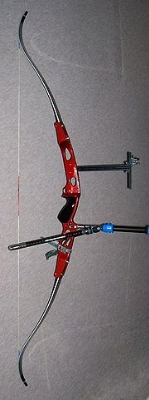
The unqualified phrase "recurve bow" or just "a recurve" in modern archery circles will usually refer to a typical modern recurve bow, as used by archers in the Olympics and many other competitive events. It will employ advanced technologies and materials. The limbs are usually made from
multiple layersA laminated bow is a bow in which different materials are laminated together to form the bow stave itself. Traditional composite bows are normally not included, although their construction with horn, wood, and sinew might bring them within the above definition. This term usually refers to bows made...
of fibreglass, carbon and/or wood on a core of carbon foam or wood. The riser (the handle section of the bow) is generally separate and is constructed from wood, carbon, aluminium alloy or magnesium alloy. Several manufacturers produce risers made of carbon fibre (with metal fittings) or aluminium with carbon fibre. Risers for beginners are usually made of wood or plastic. The synthetic materials allow predictable manufacture for consistent performance. The greater mass of a modern bow is itself an aid to stability, and therefore to accuracy.
The modern recurve is the only form of bow permitted in the
OlympicsThe Olympic Games are a major international event of summer and winter sports, in which thousands of athletes compete in a wide variety of events. The Games are currently held every two years, with Summer and Winter Olympic Games alternating. Originally, the ancient Olympic Games were held in...
(though the
Compound bowA compound bow is a modern bow that uses a levering system, usually of cables and pulleys, to bend the limbs.The limbs of a compound bow are usually much stiffer than those of a recurve bow or longbow. This limb stiffness makes the compound bow more energy efficient than other bows, but the limbs...
is permitted in some categories at the
Paralympic GamesThe Paralympic Games are a multi-sport event for athletes with physical and visual disabilities. This includes athletes with mobility disabilities, amputations, blindness, and cerebral palsy. The Paralympic Games are held every four years, following the Olympic Games, and are governed by the...
) and is the most widely used by European and Asian sporting archers.
The modern Olympic-style recurve is a development of the American
Flat BowA flatbow is a bow with non-recurved, flat, relatively wide limbs that are approximately rectangular in cross-section. Because the limbs are relatively wide, flatbows will usually narrow and become deeper at the handle, with a rounded, non-bending, handle for easier grip...
, with rectangular-section limbs that taper towards the limb tips. Most recurves today are "take-down" bows—that is, the limbs can be detached from the riser for ease of transportation and storage, and for interchangeability. Older recurves and some modern hunting recurves are one-piece bows. Hunters often prefer one-piece bows over take-down bows because the limb pockets on take-down bows can be a source of noise while drawing.
Modern recurve bow terminology
- Arrow rest - Where the arrow rests during draw. These may be simple fixed rests or may be spring-loaded or magnetic flip rests.
- Back (of bow) - The face of the bow on the opposite side to the string
- Belly (of bow) - The face of the bow on the same side as the string
- Bow sight - An aiming aid attached to the riser
- Sling - A strap attached to the bow handle, wrist or fingers to stop the bow falling from the hand
- Brace height - The distance between the deepest part of the grip and the string
- Grip - The part of the bow held by the bow hand
- Limbs - The upper and lower working parts of the bow, which come in a variety of different poundages
- Nocking point - The place on the bowstring where the nock (end) of an arrow is fitted
- Riser - The rigid centre section of a bow to which the limbs are attached
- String
A bow string joins the two ends of the bow stave and launches the arrow. Desirable properties include light weight, strength, resistance to abrasion, and resistance to water...
- The cord that attaches to both limb tips and transforms stored energy from the limbs into kinetic energy in the arrow
- Tab
A finger tab or Archer Tab used in archery is a small leather or synthetic patch that protects an archer's fingers from the bowstring. It is strapped or otherwise attached to an archer's hand. In summertime, tabs are far more comfortable than gloves and can more conveniently use thicker material...
or Thumb ringA thumb ring is a piece of equipment designed to protect the thumb during archery. This is a ring of stone, horn, wood, ivory, metal, ceramics, plastic, or glass or which fits over the end of the thumb, coming to rest at the outer edge of the outer joint. A flat area extends from the ring to...
- A protection for the digits that draw the string. Also provides better release performance. Usually made of leather.
- Tiller - The difference between the limb-string distances measured where the limbs are attached to the riser. Usually the upper distance is slightly more than the bottom one, resulting in a positive tiller. Reflects the power-balance between both limbs.
Other equipment
Recurve archers often have many other pieces of equipment attached to their recurve bows, such as:
- Clicker - a blade or wire device fitted to the riser, positioned to drop off the arrow when the archer has reached optimum draw length. Used correctly, this ensures the same cast-force each time. Many archers train themselves to shoot automatically when the clicker drops off the arrow.
- Kisser - a button or nodule attached to the bowstring. The archer touches the kisser to the same spot on the face each time (usually the mouth) to give a consistent vertical reference.
- Plunger Button - a fine-tuning device consisting of a spring-cushioned tip inside a housing. The plunger button screws through the riser so that the tip emerges above the rest. The side of the arrow is in contact with the tip when the arrow is on the rest. The spring is tuned so that it allows a certain amount of movement of the arrow towards the riser on release, bringing the arrow to the ideal "centre shot" location. The plunger button is used to compensate for the arrow's flex, since the arrow flexes as the string pushes onto it with a very high acceleration, creating what is known as the archer's paradox
The term archer's paradox refers to the flexing of an arrow shaft that occurs when it is shot from a non-centershot bow. Coined by Robert P. Elmer in the 1930s, the archer's paradox centers around the idea that, in order to be accurate, an arrow must have the correct stiffness, or "spine", to flex...
. The device is also known as a pressure button or Berger button (after its inventor, Vic Berger).
- Stabilizers - weight-bearing rods attached to a recurve bow to balance the bow to the archer's liking, dampen the effect of torque
Torque, also called moment or moment of force , is the tendency of a force to rotate an object about an axis, fulcrum, or pivot. Just as a force is a push or a pull, a torque can be thought of as a twist....
and dissipate vibration.
Reflex bow
A
reflex bow is a
bowA bow is a weapon that projects arrows powered by the elasticity of the bow. Essentially, it is a form of spring. As the bow is drawn, energy is stored in the limbs of the bow and transformed into rapid motion when the string is released, with the string transferring this force to the arrow...
that has curved or curled arms that turn away from the archer throughout their length. When unstrung, the entire length of the bow curves forward from the belly (away from the archer), resembling a "C"; this differentiates a reflex bow from a
recurve bowThe side view when unstrung, the frontal view, and the cross-section of the working limbs are important elements of the bow shape.-Straight bow:Many bows, especially traditional self bows, are made approximately straight in side-view profile...
in which only the outer parts of the limbs turn away from the archer. The curves put the materials of the bow under greater stress, allowing a fairly short bow to have a high draw weight and a long draw length. The materials and workmanship must be of high quality. Highly-reflexed bows are more difficult to string and may reverse themselves suddenly; they have seldom been used for hunting or for war.
History
Bows of traditional materials with significant reflex are almost all
composite bowsA composite bow is a bow made from disparate materials laminated together, usually applied under tension. Different materials are used in order to take advantage of the properties of each material....
, made of the classic three layers of horn, wood, and sinew; they are a variant of the recurve form normally used for such bows. Highly reflexed composite bows are still used in
KoreaThe Korean Bow is a waterbuffalo horn-based composite reflex bow, standardized about 1900 CE from the variety of such weapons in earlier use...
and were common in
TurkishThe Turkish bow is a recurved composite bow. It has been used throughout Turkish history by the Turkish cavalry archers since the arrival of Turks from Central Asia...
and Indian
traditional archeryArchery is the art, practice, or skill of propelling arrows with the use of a bow. Archery has historically been used for hunting and combat; in modern times, however, its main use is that of a recreational activity...
.
There is an interesting section in
HomerHomer is a legendary ancient Greek epic poet, traditionally said to be the author of the epic poems the Iliad and the Odyssey...
's
OdysseyThe Odyssey is one of two major ancient Greek epic poems attributed to Homer. It is, in part, a sequel to the Iliad, the other work traditionally ascribed to Homer. The poem is fundamental to the modern Western canon. Indeed it is the second—the Iliad being the first—extant work of...
when the suitors attempt to string Odysseus' bow and are unable to do so, whereas Odysseus is able to string it
without standing up. A reflex bow is almost impossible to string unless you know the technique and is easiest to string from a sitting position. This passage has been suggested as evidence that reflex bows were just beginning to spread into the Aegean area at the time of writing.
Decurve bow
A
decurve bow is a bow that has arms curved or curled at the ends to turn towards the archer. This bow form reduces the strain on the bow when it is used, and the bow may be under no tension at all when strung, so that it can be kept ready for immediate use at all times. It also reduces the energy stored in the bow, and the speed of the
arrowAn arrow is a pointed projectile that is shot with a bow. It predates recorded history and is common to most cultures.- Structure :A normal arrow consists of a shaft with an arrowhead attached to the front end, with fletchings and a nock at the other....
. The form is seldom used in modern or historical bows, but was occasionally used by groups such as the
MohaveMohave and Mojave are both tribally accepted and interchangeably used phonetic spellings for a Native American people known among themselves as the Aha macave...
who did not have easy access to good quality bow wood. It allowed them to make effective hunting weapons from the poor-quality material available.
Deflex bow
A
deflex bow is a bow that has arms curved or curled at the base, to turn towards the archer. This bow form reduces the strain on the limbs and also the energy stored by the weapon. Most modern recurve bows are built with some degree of deflex. It has been used occasionally in traditional bows, for example to make a bow that looks like a traditional hornbow without using any actual horn.
Outline in frontal view
Bows usually taper from the handle to the tips. Tapering may reduce mass in the outer limb; this increases the speed at which the tips move which propels arrows faster. Shapes may be optimized for various purposes, especially maximum speed of the arrow; the details are the subject of active research.
Narrow bows normally taper uniformly. However, the taper of flat bows varies. The working limbs of "
paddleA paddle is a tool used for pushing against liquids, either as a form of propulsion in a boat or as an implement for mixing.-Materials and designs:...
" bows maintain width for almost the entire limb length, "
pyramidA pyramid is a building where the outer surfaces are triangular and converge at a point. The base of a pyramid can be trilateral, quadrilateral, or any polygon shape, meaning that a pyramid has at least four faces...
" bows taper uniformly from the handle to a narrow tip, and "
Holmegaard-styleThe Holmegaard bows are a series of self bows found in the bogs of Northern Europe dating from the Mesolithic period. They are named after the Holmegaard area of Denmark in which the first and oldest specimens were found.-Description:...
" bows remain full width to about two-thirds of the way along the limb, then narrow sharply. "
Eiffel TowerThe Eiffel Tower is a 19th century iron lattice tower located on the Champ de Mars in Paris that has become both a global icon of France and one of the most recognizable structures in the world. The Eiffel Tower, which is the tallest building in Paris, is the single most visited paid monument in...
" bows taper sharply, but smoothly, to a very narrow outer tip.
Cross-section of limbs
The optimal cross-section of the bending section of a bow limb is
rectangularIn Euclidean geometry, the term rectangle normally refers to a quadrilateral with four right angles. This is a simple rectangle. A simple rectangle with vertices ABCD would be denoted as ....
, and almost all modern bows have such limbs. However, many, perhaps most, traditional bows have had a cross-section closer to circular, with every possible variation being used at some point. Current definitions of the traditional
longbowFor the military helicopter, see Apache LongbowA longbow is a type of bow that is tall ; this will allow its user a fairly long draw, at least to the jaw . A longbow is not significantly recurved...
require approximations of a D-shaped cross section.
See also
- Bow (weapon)
A bow is a weapon that projects arrows powered by the elasticity of the bow. Essentially, it is a form of spring. As the bow is drawn, energy is stored in the limbs of the bow and transformed into rapid motion when the string is released, with the string transferring this force to the arrow...
- Crossbow
A crossbow is a weapon consisting of a bow mounted on a stock that shoots projectiles, often called bolts. The medieval crossbow was called by many names, most of which derived from the word ballista, a siege engine resembling a crossbow in mechanism and appearance.Crossbows historically played a...
- Mongol bow
The Mongol bow is a recurved composite bow renowned for its military effectiveness. The old Mongolian bows that were used during the times of Genghis Khan were smaller than the modern weapons used at most Naadam festivals today. Modern Mongolian bows are larger and have string bridges...
- English longbow
Self longbows, widespread across Europe since Mesolithic times, were used in medieval Europe as a decisive weapon of war. Particularly powerful bows were employed to penetrate all but the best of contemporary armour....
- Longbow
For the military helicopter, see Apache LongbowA longbow is a type of bow that is tall ; this will allow its user a fairly long draw, at least to the jaw . A longbow is not significantly recurved...
- Flatbow
A flatbow is a bow with non-recurved, flat, relatively wide limbs that are approximately rectangular in cross-section. Because the limbs are relatively wide, flatbows will usually narrow and become deeper at the handle, with a rounded, non-bending, handle for easier grip...
- Archery
Archery is the art, practice, or skill of propelling arrows with the use of a bow. Archery has historically been used for hunting and combat; in modern times, however, its main use is that of a recreational activity...
- Horse archer
- Bow draw
A bow draw is the method used to draw a bow. Currently, the most common method is the Mediterranean Draw, long the usual method in European archery. Other methods include the Pinch Draw and the Mongolian Draw.- Pinch Draw or "primary release":...
Further reading
- The Traditional Bowyers Bible Volume 1. The Lyons Press, 1992. ISBN 1-58574-085-3
- The Traditional Bowyers Bible Volume 2. The Lyons Press, 1992. ISBN 1-58574-086-1
- The Traditional Bowyers Bible Volume 3. The Lyons Press, 1994. ISBN 1-58574-087-X
- The Traditional Bowyers Bible Volume 4. The Lyons Press, 2008. ISBN 978-0-9645741-6-8