

Reconstruction of Iraq

Encyclopedia
Investment in post-2003 Iraq refers to international efforts to rebuild the infrastructure of Iraq
since the Iraq War in 2003.
Along with the economic reform of Iraq
, international projects have been implemented to repair and upgrade Iraqi water and sewage treatment plants
, electricity production, hospitals, schools, housing, and transportation systems. Much of the work has been funded by the Iraq Relief and Reconstruction Fund
, and the Coalition Provisional Authority
.
A significant event for aid or investment in post-2003 Iraq was the Madrid Conference on Reconstruction on October 23, 2003, which was attended by representatives from over 25 nations. Funds assembled at this conference and from other sources have been administered by the United Nations
and the World Bank
.
While reconstruction efforts have produced some successes, problems have arisen with the implementation of internationally funded Iraq reconstruction efforts. These include inadequate security, pervasive corruption, insufficient funding and poor coordination among international agencies and local communities. Many suggest that the efforts were hampered by a poor understanding of Iraq on the part of the international community assisting with the reconstruction.
The March 2003 invasion of Iraq produced further degradation of Iraq’s water supply, sewerage and electrical supply systems. Treatment plants, pumping stations and generating stations were stripped of their equipment, supplies and electrical wiring by looters. The once-capable cadre of engineers and operating technicians were scattered or left the country. Reconstruction efforts faced a nation with a severely degraded infrastructure.
(IRRF) in April 2003. The IRRF is administered and funded by the United States. An initial allocation of $2.5 billion was made for immediate food, medicine and water relief.
The “Madrid Conference on Reconstruction” held in Spain October 23–24, 2003 was organized by the United States to solicit donor pledges from the international community. About $33 billion in grants and loans were pledged. Of this, $18.4 billion was from the U.S. with another $5 billion from Japan, $812 million from the EU, $500 million from Kuwait and offers of loans from World Bank and the IMF amounting from $5.5 to $9.25 billion. Some countries pledged to reduce the debt that Iraq owed to them and to provide direct donations in forms such as food and fuel. The pledge by the United States was fulfilled in November 2003 by adding $18.4 billion to the IRRF.
Much of the non-U.S. pledged money is managed through two additional funds that have been created under the facilitation of the International Reconstruction Fund Facility for Iraq. The funds are managed by the United Nations Development Group (UNDG) and by the World Bank. Twenty-six donor nations participate in this effort with total pledges, as of June 30, 2006, of $1.4 billion. The United States donates a small amount to these funds but does not control their disbursement.
As of December 30, 2005 the UNDG and World Bank Funds had expended about $0.51 billion and $0.39 billion, respectively. The United States managed IRRF had expended about $11.4 billion as of March 2006.
As of 2009, current spending in Iraq seems to have increased a bit with some consideration of new projects. Since March 2003,the figure has come to a tune of $50 billion (US Dollars) - as the amount appropriated by the US congress in relief and reconstruction. A new inspectorate under the office of Special Inspector General for Iraq Reconstruction (SIGIR)is in place to oversee key essential areas of development. Among these include the establishment of new Iraq forces, creating a free market economy, and put the country on path to achieving an effective democracy.
Among the most recent developments (January 2009), also include the initiative in effect to re-define the bilateral relationship between Iraq and the United states, as a way of facilitating "future reconstruction efforts"
estimated an additional US$20 billion in need including US$5 billion for security and police and US$8 billion for oil industry infrastructure.
In 2007 the Government of Iraq and the United Nations
created the International Compact with Iraq
a visioning and planning entity which identified reconstruction as an essential element for meeting human needs and economic development.
Funds held by the United Nations Development Group are disbursed through United Nations agencies such as the World Health Organization, UNICEF and the UN Development Program. These UN agencies directly contract with equipment suppliers and construction companies. Disbursement of funds by the UN began in June 2004. Funds held by the World Bank are disbursed directly to Iraqi government agencies including the Municipality of Baghdad and national ministries. Granting of funds to Iraqi agencies began in December 2004.
Funds held by the US-operated Iraq Relief and Reconstruction Fund have been managed by a series of US agencies. Beginning in May 2003, the Coalition Provisional Authority (CPA) began oversight of reconstruction efforts in Iraq. Within the CPA the Project Management Office (PMO) was created to manage reconstruction projects. Both the CPA and PMO were divisions of the US Department of Defense. On June 28, 2004, the CPA was dissolved and the Iraqi interim government took power. At this time, the management of reconstruction projects was transferred to the Iraq Reconstruction and Management Office (IRMO), a division of the US Department of State, and the Project and Contracting Office (PCO), a division of the Department of Defense, both under the oversight of the US State Department Mission to Baghdad. On December 4, 2005 the PCO was merged with the US Army Corps of Engineers, Gulf Region Division. Since October 2004, contracting support for Iraq reconstruction has also been provided by the U.S. Army’s Joint Contracting Command-Iraq/Afghanistan. Other U.S. Government agencies, including the U.S. Agency for International Development
(USAID) and the State Department, have also issued contracts funded by the Iraq Relief and Reconstruction Fund.
Funds from the US-operated IRRF are largely disbursed through contracts to private firms. Several US companies have been particularly prominent in receiving Iraq reconstruction funds. Bechtel
of San Francisco, USA has been awarded over $2.4 billion for infrastructure rehabilitation through USAID contracts. Flour AMEC, LLC, Greenville, South Carolina, USA has been awarded nearly $1 billion for water, sewer of solid waste management systems. Parsons Corporation
of Pasadena, California has been awarded $1.3 billion for construction services. Washington Group International
of Boise, Idaho, USA has received awards of $580 million for water resource reconstruction projects. Kellogg, Brown and Root
(KBR), a subsidiary of Halliburton
of Houston, Texas has received awards of $580 million. Another $1.2 billion has been distributed to Iraqi contractors. In 2005/2006 Symbion Power
of the US were awarded $250 million of competitively bid new fixed price electrical infrastructure work throughout the country. Symbion Power
is a privately owned engineering firm with an ownership structure that involves a security company Hart Security.The dollar figures provided here are as of July 2006.
(SIGIR). In October, 2004, the U.S. Congress created SIGIR which is charged with oversight of the use and potential misuse of the IRRF. The SIGIR conducts audits, investigations and inspections and issues quarterly reports to Congress. The SIGIR reports and U.S. Congressional testimony of Stuart Bowen, the Inspector General, are a primary source of information on the overall status of U.S. funded Iraq reconstruction. The rate of disbursement of funds administered by the United Nations and World Bank has been slow. Iraqi agencies and ministries are often unable to receive or process funds. Many United Nations agencies have had great difficulty operating in Iraq due to the poor security situation.
have discussed the importance of using local organisations and also understanding the violence not a single insurmountable challenge, but understanding various acts of violence more individually, sharing the knowledge between agencies and responding more appropriately - the formation of the NGO Coordination Committee in Iraq is a step in this direction.
Attacks and vandalism have also affected completed projects including sabotage of oil pipelines and high-voltage electricity towers. However, the Commander of the Multi-National Force-Iraq, General David Petraeus, announced in May, 2008 that oil and electricity production have exceeded pre-war levels as the "surge" and enlistment of local Iraqis in security forces has brought calm to many areas of the nation.
(CPA). One audit put the total number as high as $8.8 billion. Fraudulent contractors such as Philip Bloom often bribed CPA officials in exchange for contracts that were never performed.
An article in the New York Times describes "irregularities including millions of reconstruction dollars stuffed casually into footlockers and filing cabinets, an American soldier in the Philippines who gambled away cash belonging to Iraq, and three Iraqis who plunged to their deaths in a rebuilt hospital elevator that had been improperly certified as safe." While the US government has begun the process of prosecuting contractors that stole American tax dollars, the Iraqi government currently has no means of reacquiring Iraqi assets that were stolen by US contractors. This is partially due to a decree passed by the CPA that gives civilian contractors in Iraq immunity from all Iraqi jurisdiction.
As part of reconstruction, no-bid contracts have been awarded to large American corporations including Halliburton
and Bechtel
. Halliburton in particular has been singled out for receiving what is perceived to be government favoritism for doing a shoddy job of rebuilding Iraq's oil infrastructure. When the Pentagon's own auditors determined that about $263 million of a Halliburton subsidiary's costs were potentially excessive, the Army still paid the company all but $10.1 million of the disputed costs.
Bechtel Corp. became the first major U.S. contractor to announce that it was pulling out of Iraq in Fall 2006.
Some say that the reconstruction would have been both much more efficient and inexpensive if more contracts were granted to local Iraqi firms, many of whom were shut out of the process due to the fact that they were state-owned. Congressman Henry Waxman
was once told by members of the Iraqi governing council that paying Iraqi companies to rebuild Iraq instead of American ones would save American tax payers 90% of the costs.
By Summer of 2008, oil and electricity levels returned to pre-invasion (i.e. pre-March, 2003) levels.
Much of the efforts to rebuild Iraq's electrical infrastructure has been largely dependent on the repair and construction of transmission lines and substations by global engineering firms willing to work in hostile territories.
In May 2006, the United Nations World Food Program (WFP) concluded its most recent food security survey.
It found that 15 percent of the total Iraqi population (just over 4 million people) is food insecure and in dire need of different types of humanitarian assistance, including food, despite the rations they are receiving from the Public Distribution System (PDS). This is an increase from the estimated 11 percent (2.6 million people) deemed to be extremely poor in WFP’s first survey in September 2004. The May 2006 survey also indicated that a further 8.3 million people would be rendered food insecure if they were not provided with a PDS ration, compared to 3.6 million people in the previous survey. An earlier survey, conducted in July 2005, found that acute malnutrition rates for children was nine percent overall, but with rates for children between 6 and 12 months old reaching 13 percent and 12 percent for those aged between one and two years.
In 2007, the WFP continues to provide emergency food provisions to about 1.1 million Iraqis. WFP has assisted in the establishment of a Food Security Unit, located in the Iraq Ministry of Planning and Development Cooperation, which collects food security information. The PDS is still a major contributor in stabilizing the food supply in Iraq. For the poor and food insecure, the PDS represents by far the single most important food source in their diet.
A modern landfill
, built to international environmental standards, is planned for southwest Baghdad, with the capacity to handle 2,230 cubic meters of waste
per day. The construction was halted prior to completion in November 2005, due to security concerns. There has been some limited utilization of the landfill, however full utilization has not yet been implemented.
Recent reports on waste collection
, note that being a garbage collector may be one of the most dangerous jobs in Iraq. Most of the 500 municipal workers who have been killed in Baghdad since 2005 have been waste collector
s. There are inadequate waste collection vehicles with only 380 presently in service. Before the invasion there were 1200 working trucks. Most of the vehicles were destroyed or lost in the looting that seized the capital after the American invasion. The deputy mayor of Baghdad estimates the city needs 1,500 waste collection vehicles.
The situation has been characterized by some Oil Ministry officials as chaotic, with one official stating "We do not know the exact quantity of oil we are exporting, we do not exactly know the prices we are selling it for, and we do not know where the oil revenue is going to."
In Summer, 2008, the nation's Parliament still had not produced a comprehensive "hydrocarbon law" (oil law) apportioning revenue between local governorates and the central government. While oil production in early 2008 exceeded pre-war levels and continued to climb, disagreements remained among oil-rich regions, oil-poor regions, and the national government over contracting rights and revenue-sharing.
, it began to deteriorate. Prior to the Iraq War, healthcare spending amounted to 50 cents (US) per Iraqi per year. Today, the Iraqi healthcare system has regressed to a chronic and smoldering condition. Infections are widespread, the infant mortality rate has surged, and medical shortages all threaten the once functioning medical system. US based NGO, Giving Children Hope, has an on-going healthcare development program in Iraq that equips hospitals and clinics with needed supplies and equipment in conjunction with the US military. http://71.6.192.13/healthcare-development-in-iraq1.html
However, the situation in Iraqi Kurdistan
(the three northern governorates with primarily Kurdish
populations) is quite different. Due to their better stability, the Kurdish semi-autonomous area enjoys health care superior to that under Saddam. Health workers have not left the provinces for Syria
or Jordan
, as they have in sectarian Iraq, and new programs for continuing professional education in major Iraqi Kurdish cities reflect the optimism of the area.
With the primarily Sunni Al Anbar governorate to the west experiencing increased stability due to the U.S. troop surge and the Sunni rejection of Al Qaeda in Iraq, International Health
http://fhp.osd.mil/intlhealth/ analysts hope to see improved health care there, as well. It remains to be seen whether non-governmental organizations and the Shiite-dominated central Iraqi government will take advantage of the enhanced security to enact sustainable services and other improvements. Local initiatives in June 2008 included contracting with the International Medical Corps for a comprehensive Anbar continuing medical education program, rights of return for expatriate health professionals, and an overhaul of nursing, with innovative programs paralleling the "diploma" nursing track of the West, and a goal of attracting women to nursing as a career (70% of Iraqi nurses are male).
Until late 2007, the Ministry of Health had been apportioned by the new Shiite majority to politicians aligned with Moqtada Al Sadr, a minority Shiite party leader and head of a sect prominent in East Baghdad slums. Allegations abounded of abductions of Sunni patients, and Iraqi Security Force (Army and Police) patients, from their hospital beds. The Inspector General was prosecuted for corruption, and the Facilities Protective Service (FPS) commander was dismissed for running a Mafia-like organization, contributing weapons and manpower to terrorist and other gangs.
At the close of 2007, a new Minister of Health, Saleh Al-Hasnawi, was appointed and began ministerial reforms. The Inspector General was replaced and a new openness was encouraged. In June, 2008, the Minister of Health convened a National Strategic Planning Conference in Baghdad. At this conference, attended by professionals, NGOs and Provincial Reconstruction Team
s from all over Iraq, he announced that Iraq would direct its own health reconstruction, funding it with Iraqi money according to Iraqi priorities. Although there is still a place for external expert advice, the determination of the Iraqis to direct their own health development was clear.
There are sparse data on the role of private practice in Iraq. Estimates range as high as 70% of outpatient visits, compared to approximately 30% before the war. Iraq has included health care as a constitutional right; as government-sponsored care becomes more accessible, the future of private practice will likely change, but it is an ingrained feature of the Iraqi healthcare fabric.
In 2004, Iraq’s Postmaster General, Mr. Ibraheem Hussien Ali, and CPA/MoC postal advisors initiated an effort to correct and modernize the Iraqi Postal Code system.
Hisham N. Ashkouri
to transform 9 km² of silt deposits
into an "an up-market commercial and residential neighborhood" astride the Tigris River in central Baghdad
, as well as nearby Tahrir Square
. Tahrir Square was originally part of the central business district of Baghdad, and Phase I of the plan focuses on the redevelopment of this area. http://www.menafn.com/qn_news_story_s.asp?storyid=64178
When finished, the "commerce, banking, medical, housing, broadcast and IT, exhibition, conventions and cultural centers" of which the plan is comprised would be occupied by up to one-half million people. The project received encouragement by the U.S. Department of Commerce as well as other US and Middle East organizations. A smaller-scale proposal of Dr. Ashkouri's is the Sindbad Hotel Complex and Conference Center
, a high-rise hotel and movie theater complex which would be Baghdad's first skyscraper.
Prevailing views are that political and social instability in the region are making such developments unduly risky, despite a high projected return on investment. Security concerns during the survey and construction phases are currently a cost-prohibitive factor.
Infrastructure of Iraq
Infrastructure of Iraq describes the infrastructure of the country of Iraq. Throughout the history of Iraq, the country's infrastructure, along with its politics and economy, have been affected by armed conflicts; none more serious than the 2003 Invasion and subsequent...
since the Iraq War in 2003.
Along with the economic reform of Iraq
Economic reform of Iraq
Economic reform in Iraq describes decisions by the Coalition Provisional Authority to dramatically change the economy of Iraq in the aftermath of the 2003 U.S.-led invasion.Prior to US occupation, Iraq had a centrally planned economy...
, international projects have been implemented to repair and upgrade Iraqi water and sewage treatment plants
Health in Iraq
The state of health in Iraq has fluctuated during its turbulent recent history. During its last decade, the regime of Saddam Hussein cut public health funding by 90 percent, contributing to a substantial deterioration in health care. During that period, maternal mortality increased nearly...
, electricity production, hospitals, schools, housing, and transportation systems. Much of the work has been funded by the Iraq Relief and Reconstruction Fund
Iraq Relief and Reconstruction Fund
The Iraq Relief and Reconstruction Fund was established by the US Congress on November 6, 2003. It allocated $18.4 billion to rebuild Iraq's infrastructure, damaged from years of neglect, sanctions, and war....
, and the Coalition Provisional Authority
Coalition Provisional Authority
The Coalition Provisional Authority was established as a transitional government following the invasion of Iraq by the United States and its allies, members of the Multi-National Force – Iraq which was formed to oust the government of Saddam Hussein in 2003...
.
A significant event for aid or investment in post-2003 Iraq was the Madrid Conference on Reconstruction on October 23, 2003, which was attended by representatives from over 25 nations. Funds assembled at this conference and from other sources have been administered by the United Nations
United Nations
The United Nations is an international organization whose stated aims are facilitating cooperation in international law, international security, economic development, social progress, human rights, and achievement of world peace...
and the World Bank
World Bank
The World Bank is an international financial institution that provides loans to developing countries for capital programmes.The World Bank's official goal is the reduction of poverty...
.
While reconstruction efforts have produced some successes, problems have arisen with the implementation of internationally funded Iraq reconstruction efforts. These include inadequate security, pervasive corruption, insufficient funding and poor coordination among international agencies and local communities. Many suggest that the efforts were hampered by a poor understanding of Iraq on the part of the international community assisting with the reconstruction.
Pre-2003 status of Iraq infrastructure
During the 1970s Iraq made extensive investment in the water sector and other infrastructure using the proceeds of oil revenue. This investment slowed during the Iran-Iraq War of 1980 to 1988, but left Iraq in 1990 with a relatively modern electrical, water supply and sewerage system. During the Gulf War of 1991 aerial bombardment caused severe damage to the electric grid that operated the pumping stations and other facilities for potable water delivery and sewage treatment. The sanctions imposed by the UN at the conclusion of the Gulf War exacerbated these problems by banning the importation of spare parts for equipment and chemicals, such as chlorine, needed for disinfection. As a result of the war and sanctions, delivery of water dropped precipitously. For example, UNICEF estimates that before 1991, 95% of urban dwellers and 75% of rural dwellers were served by modern water supply systems that delivered treated water to homes and businesses. By 1999, urban coverage had dropped to 92% and rural coverage to 46%. Individual water availability showed greater changes. Between 1990 and 2000, the daily per capita share of potable water went from 330 litres to 150 litres in Baghdad, 270 to 110 in other urban areas, and 180 to 65 in rural areas.The March 2003 invasion of Iraq produced further degradation of Iraq’s water supply, sewerage and electrical supply systems. Treatment plants, pumping stations and generating stations were stripped of their equipment, supplies and electrical wiring by looters. The once-capable cadre of engineers and operating technicians were scattered or left the country. Reconstruction efforts faced a nation with a severely degraded infrastructure.
Funding for Iraq reconstruction
Funding of reconstruction efforts began with the creation of the Iraq Relief and Reconstruction FundIraq Relief and Reconstruction Fund
The Iraq Relief and Reconstruction Fund was established by the US Congress on November 6, 2003. It allocated $18.4 billion to rebuild Iraq's infrastructure, damaged from years of neglect, sanctions, and war....
(IRRF) in April 2003. The IRRF is administered and funded by the United States. An initial allocation of $2.5 billion was made for immediate food, medicine and water relief.
The “Madrid Conference on Reconstruction” held in Spain October 23–24, 2003 was organized by the United States to solicit donor pledges from the international community. About $33 billion in grants and loans were pledged. Of this, $18.4 billion was from the U.S. with another $5 billion from Japan, $812 million from the EU, $500 million from Kuwait and offers of loans from World Bank and the IMF amounting from $5.5 to $9.25 billion. Some countries pledged to reduce the debt that Iraq owed to them and to provide direct donations in forms such as food and fuel. The pledge by the United States was fulfilled in November 2003 by adding $18.4 billion to the IRRF.
Much of the non-U.S. pledged money is managed through two additional funds that have been created under the facilitation of the International Reconstruction Fund Facility for Iraq. The funds are managed by the United Nations Development Group (UNDG) and by the World Bank. Twenty-six donor nations participate in this effort with total pledges, as of June 30, 2006, of $1.4 billion. The United States donates a small amount to these funds but does not control their disbursement.
As of December 30, 2005 the UNDG and World Bank Funds had expended about $0.51 billion and $0.39 billion, respectively. The United States managed IRRF had expended about $11.4 billion as of March 2006.
As of 2009, current spending in Iraq seems to have increased a bit with some consideration of new projects. Since March 2003,the figure has come to a tune of $50 billion (US Dollars) - as the amount appropriated by the US congress in relief and reconstruction. A new inspectorate under the office of Special Inspector General for Iraq Reconstruction (SIGIR)is in place to oversee key essential areas of development. Among these include the establishment of new Iraq forces, creating a free market economy, and put the country on path to achieving an effective democracy.
Among the most recent developments (January 2009), also include the initiative in effect to re-define the bilateral relationship between Iraq and the United states, as a way of facilitating "future reconstruction efforts"
Assessing reconstruction needs
In preparation for the October 2003 Madrid Donor Conference, the joint United Nations/World Bank team conducted an assessment of funding needs for reconstruction in Iraq during the period 2004-2007. The resulting report identified 14 sectors and associated funding needs as shown in the Table below. In addition to this US$36 billion, the Coalition Provisional AuthorityCoalition Provisional Authority
The Coalition Provisional Authority was established as a transitional government following the invasion of Iraq by the United States and its allies, members of the Multi-National Force – Iraq which was formed to oust the government of Saddam Hussein in 2003...
estimated an additional US$20 billion in need including US$5 billion for security and police and US$8 billion for oil industry infrastructure.
| Sector | Needs (US$billion) |
|---|---|
| Government Institutions | 0.39 |
| Education | 4.81 |
| Health | 1.60 |
| Employment creation | 0.79 |
| Transport and telecommunications | 3.41 |
| Water, sanitation, solid waste | 6.84 |
| Electricity | 12.12 |
| Urban Management | 0.41 |
| Housing and Land Management | 1.42 |
| Agriculture and Water Resources | 3.03 |
| State-Owned Enterprises | 0.36 |
| Financial Sector | 0.081 |
| Investment Climate | 0.34 |
| Mine Action | 0.23 |
| Total | 35.82 |
In 2007 the Government of Iraq and the United Nations
United Nations
The United Nations is an international organization whose stated aims are facilitating cooperation in international law, international security, economic development, social progress, human rights, and achievement of world peace...
created the International Compact with Iraq
International Compact with Iraq
The International Compact with Iraq is an initiative of the Government of Iraq for a new partnership with the international community. The Compact, jointly chaired by the Government of the Republic of Iraq and the United Nations, with the support of the World Bank, establishes a vision that, "five...
a visioning and planning entity which identified reconstruction as an essential element for meeting human needs and economic development.
Administration of Iraq reconstruction
Funds for Iraq reconstruction are disbursed to Iraqi ministries, non-Iraqi government agencies and various non-governmental groups. These entities then supervise the acquisition of materials and reconstruction work which is conducted by both foreign and Iraqi contractors.Funds held by the United Nations Development Group are disbursed through United Nations agencies such as the World Health Organization, UNICEF and the UN Development Program. These UN agencies directly contract with equipment suppliers and construction companies. Disbursement of funds by the UN began in June 2004. Funds held by the World Bank are disbursed directly to Iraqi government agencies including the Municipality of Baghdad and national ministries. Granting of funds to Iraqi agencies began in December 2004.
Funds held by the US-operated Iraq Relief and Reconstruction Fund have been managed by a series of US agencies. Beginning in May 2003, the Coalition Provisional Authority (CPA) began oversight of reconstruction efforts in Iraq. Within the CPA the Project Management Office (PMO) was created to manage reconstruction projects. Both the CPA and PMO were divisions of the US Department of Defense. On June 28, 2004, the CPA was dissolved and the Iraqi interim government took power. At this time, the management of reconstruction projects was transferred to the Iraq Reconstruction and Management Office (IRMO), a division of the US Department of State, and the Project and Contracting Office (PCO), a division of the Department of Defense, both under the oversight of the US State Department Mission to Baghdad. On December 4, 2005 the PCO was merged with the US Army Corps of Engineers, Gulf Region Division. Since October 2004, contracting support for Iraq reconstruction has also been provided by the U.S. Army’s Joint Contracting Command-Iraq/Afghanistan. Other U.S. Government agencies, including the U.S. Agency for International Development
United States Agency for International Development
The United States Agency for International Development is the United States federal government agency primarily responsible for administering civilian foreign aid. President John F. Kennedy created USAID in 1961 by executive order to implement development assistance programs in the areas...
(USAID) and the State Department, have also issued contracts funded by the Iraq Relief and Reconstruction Fund.
Funds from the US-operated IRRF are largely disbursed through contracts to private firms. Several US companies have been particularly prominent in receiving Iraq reconstruction funds. Bechtel
Bechtel
Bechtel Corporation is the largest engineering company in the United States, ranking as the 5th-largest privately owned company in the U.S...
of San Francisco, USA has been awarded over $2.4 billion for infrastructure rehabilitation through USAID contracts. Flour AMEC, LLC, Greenville, South Carolina, USA has been awarded nearly $1 billion for water, sewer of solid waste management systems. Parsons Corporation
Parsons Corporation
Parsons Corporation is an engineering, construction, and technical and management services firm headquartered in Pasadena, California. Founded in 1944 by engineer Ralph M. Parsons, Parsons Corporation is currently one of the largest such companies in the United States, with revenues exceeding...
of Pasadena, California has been awarded $1.3 billion for construction services. Washington Group International
Washington Group International
Washington Group International was an American corporation which provided integrated engineering, construction and management services to businesses and governments around the world. Based in Boise, Idaho, it had approximately 25,000 employees working in over 40 states and more than 30 countries...
of Boise, Idaho, USA has received awards of $580 million for water resource reconstruction projects. Kellogg, Brown and Root
Kellogg, Brown and Root
KBR, Inc. is an American engineering, construction and private military contracting company, formerly a subsidiary of Halliburton, headquartered in Houston. The company also has large offices in Arlington, Birmingham, Newark, Delaware and Leatherhead, UK. After Halliburton acquired Dresser...
(KBR), a subsidiary of Halliburton
Halliburton
Halliburton is the world's second largest oilfield services corporation with operations in more than 70 countries. It has hundreds of subsidiaries, affiliates, branches, brands and divisions worldwide and employs over 50,000 people....
of Houston, Texas has received awards of $580 million. Another $1.2 billion has been distributed to Iraqi contractors. In 2005/2006 Symbion Power
Symbion Power
Symbion Power is a US power engineering and construction firm that has extensive operations in Iraq and Afghanistan. Since 2005 Symbion has been responsible for the construction of transmission and distribution facilities throughout Iraq. In 2005/2006 the company was awarded $250m of US funded...
of the US were awarded $250 million of competitively bid new fixed price electrical infrastructure work throughout the country. Symbion Power
Symbion Power
Symbion Power is a US power engineering and construction firm that has extensive operations in Iraq and Afghanistan. Since 2005 Symbion has been responsible for the construction of transmission and distribution facilities throughout Iraq. In 2005/2006 the company was awarded $250m of US funded...
is a privately owned engineering firm with an ownership structure that involves a security company Hart Security.The dollar figures provided here are as of July 2006.
Progress of Iraq reconstruction
Reconstruction efforts have been plagued by poor management, mishandling of reconstruction funds, inadequate coordination with Iraqis and widespread attacks on construction sites and contractors as documented by the Office of the Special Inspector General for Iraq ReconstructionSpecial Inspector General for Iraq Reconstruction
The Office of the Special Inspector General for Iraq Reconstruction was created in October 2004 as the successor to the Coalition Provisional Authority Office of Inspector General . SIGIR is an independent government agency created by the Congress to provide oversight of the use – and potential...
(SIGIR). In October, 2004, the U.S. Congress created SIGIR which is charged with oversight of the use and potential misuse of the IRRF. The SIGIR conducts audits, investigations and inspections and issues quarterly reports to Congress. The SIGIR reports and U.S. Congressional testimony of Stuart Bowen, the Inspector General, are a primary source of information on the overall status of U.S. funded Iraq reconstruction. The rate of disbursement of funds administered by the United Nations and World Bank has been slow. Iraqi agencies and ministries are often unable to receive or process funds. Many United Nations agencies have had great difficulty operating in Iraq due to the poor security situation.
Reprogramming reconstruction funds
The original allocation of IRRF funds to the various sectors has undergone a series of reassignments. These allocation changes have occurred in September and December, 2004 and March and December, 2005 and generally involved shifting money from water resources and sanitation and electricity sectors to meet security needs and to provide training and operating funds for facilities already rehabilitated under IRRF funding. The table below shows the changes that occurred in allocations (billions of $US) between September 2004 and December 2005. While the administrative expenses are listed as separate category, an additional $0.60 billion, spread across sectors, was spent on administrative costs in fiscal years 2004 and 2005.| Sector | Allocation Prior to 30 September 2004 | Allocation as of 31 December 2005 |
|---|---|---|
| Electricity | 5.46 | 4.22 |
| Water Resources and Sanitation | 4.25 | 2.13 |
| Security and Law Enforcement | 3.24 | 5.04 |
| Justice, Public Safety Infrastructure and Civil Society | 1.48 | 2.35 |
| Private Sector Development | 0.18 | 0.45 |
| Iraq Debt Forgiveness | 0.00 | 0.35 |
| Oil Infrastructure | 1.70 | 1.74 |
| Health Care | 0.79 | 0.74 |
| Transportation and Telecommunication | 0.50 | 0.47 |
| Education, Refugees and Human Rights | 0.26 | 0.41 |
| Roads, Bridges and Construction | 0.37 | 0.33 |
| Administrative | 0.21 | 0.21 |
| Total | 18.44 | 18.44 |
Reconstruction gap
In October, 2005 the SIGIR introduced the concept of the “reconstruction gap” which was defined as the difference between the reconstruction planned and that which is actually delivered. As of February 2006, the SIGIR reported that only 36% of water sector projects originally planned will be completed and only 70% of the originally-planned electricity sector projects will be completed. This shortfall is attributed to IRRF reprogramming of funds from these sectors to meet security needs, poor cost estimates in the original reconstruction plan, increased material costs and lack of administrative oversight. Estimates of the funds required to close the reconstruction gap are difficult to obtain because there is inadequate information on the cost-to-complete projects already in progress. In addition to funds for reconstruction, SIGIR recommends that funds be allocated for sustaining the infrastructure that is reconstructed. Without funding for supplies, technicians and fuel, the facilities that have been completed may fall into disuse.Security of International Aid Workers
International NGOs (INGOs) have found operating in Iraq highly dangerous to their staff, as between March 2003 and March 2008 94 aid workers were killed, 248 injured, 24 arrested or detained and 89 kidnapped or abducted. This has led to INGOs to either completely unwind their operations, or else go undercover and try to make their activities as low profile as possible. INGOs are not treated as neutral parties by large sections of the population due to their beginning operations alongside the invasion and receiving security and funding from the multinational force and the governments that it consists of. The security situation has also led to much of the management of aid programmes to take place abroad, thus lowering the effectiveness of the programmes and creating a fragmented response. Researchers at the Overseas Development InstituteOverseas Development Institute
The Overseas Development Institute is one of the leading independent think tanks on international development and humanitarian issues. Based in London, its mission is "to inspire and inform policy and practice which lead to the reduction of poverty, the alleviation of suffering and the achievement...
have discussed the importance of using local organisations and also understanding the violence not a single insurmountable challenge, but understanding various acts of violence more individually, sharing the knowledge between agencies and responding more appropriately - the formation of the NGO Coordination Committee in Iraq is a step in this direction.
Attacks on construction activities
Attacks, murders, bombings and armed vandalism are routine threats to reconstruction contractors. Since reconstruction began in March 2003 and as of July 30, 2009, at least 1395 workers on U.S. funded projects have died according to the U.S. Departments of Labor and State. The table below shows the number of worker deaths in each quarter starting with the first reporting by SIGIR. In addition, there have been thousands of insurance claims by construction workers for injuries sustained in attacks. The figures are probably mis-reported, especially among Iraqi contractors. Intimidation of workers has delayed projects and reduced the availability of non-Iraqi expert technicians. It is estimated that 25% of reconstruction funds have been used to provide security to construction workers and job sites.Attacks and vandalism have also affected completed projects including sabotage of oil pipelines and high-voltage electricity towers. However, the Commander of the Multi-National Force-Iraq, General David Petraeus, announced in May, 2008 that oil and electricity production have exceeded pre-war levels as the "surge" and enlistment of local Iraqis in security forces has brought calm to many areas of the nation.
| Year | Quarter 1 | Quarter 2 | Quarter 3 | Quarter 4 |
|---|---|---|---|---|
| 2004 | NA | NA | 22 | 112 |
| 2005 | 44 | 54 | 85 | 52 |
| 2006 | 52 | 59 | 91 | 101 |
| 2007 | 152 | 79 | 72 | 43 |
| 2008 | 58 | 48 | 33 | 35 |
| 2009 | 57 | 29 | ||
Corruption
It has been alleged that large amounts of American tax dollars and seized Iraqi revenues were lost by the Coalition Provisional AuthorityCoalition Provisional Authority
The Coalition Provisional Authority was established as a transitional government following the invasion of Iraq by the United States and its allies, members of the Multi-National Force – Iraq which was formed to oust the government of Saddam Hussein in 2003...
(CPA). One audit put the total number as high as $8.8 billion. Fraudulent contractors such as Philip Bloom often bribed CPA officials in exchange for contracts that were never performed.
An article in the New York Times describes "irregularities including millions of reconstruction dollars stuffed casually into footlockers and filing cabinets, an American soldier in the Philippines who gambled away cash belonging to Iraq, and three Iraqis who plunged to their deaths in a rebuilt hospital elevator that had been improperly certified as safe." While the US government has begun the process of prosecuting contractors that stole American tax dollars, the Iraqi government currently has no means of reacquiring Iraqi assets that were stolen by US contractors. This is partially due to a decree passed by the CPA that gives civilian contractors in Iraq immunity from all Iraqi jurisdiction.
As part of reconstruction, no-bid contracts have been awarded to large American corporations including Halliburton
Halliburton
Halliburton is the world's second largest oilfield services corporation with operations in more than 70 countries. It has hundreds of subsidiaries, affiliates, branches, brands and divisions worldwide and employs over 50,000 people....
and Bechtel
Bechtel
Bechtel Corporation is the largest engineering company in the United States, ranking as the 5th-largest privately owned company in the U.S...
. Halliburton in particular has been singled out for receiving what is perceived to be government favoritism for doing a shoddy job of rebuilding Iraq's oil infrastructure. When the Pentagon's own auditors determined that about $263 million of a Halliburton subsidiary's costs were potentially excessive, the Army still paid the company all but $10.1 million of the disputed costs.
Bechtel Corp. became the first major U.S. contractor to announce that it was pulling out of Iraq in Fall 2006.
Some say that the reconstruction would have been both much more efficient and inexpensive if more contracts were granted to local Iraqi firms, many of whom were shut out of the process due to the fact that they were state-owned. Congressman Henry Waxman
Henry Waxman
Henry Arnold Waxman is the U.S. Representative for , serving in Congress since 1975. He is a member of the Democratic Party. He is considered to be one of the most influential liberal members of Congress...
was once told by members of the Iraqi governing council that paying Iraqi companies to rebuild Iraq instead of American ones would save American tax payers 90% of the costs.
By Summer of 2008, oil and electricity levels returned to pre-invasion (i.e. pre-March, 2003) levels.
Electricity
General Petraeus noted in May, 2008 that electricity levels have exceeded pre-war production; however, this statistic is misleading. The estimated hours per day of electricity availability has shifted. During the Saddam rule, Baghdad received electricity for between 16 and 24 hours per day with 4 to 8 hours received outside of the capital. Information from the Brookings Institution (early 2007) indicates that Baghdad now receives electricity from 4 to 8 hours per day with the remainder of the nation receiving from 8 to 12 hours of electricity per day. Current electricity levels of about 4000 MW have not yet reached the stated goal of nationwide production of 6000 MW.Much of the efforts to rebuild Iraq's electrical infrastructure has been largely dependent on the repair and construction of transmission lines and substations by global engineering firms willing to work in hostile territories.
Food and humanitarian aid
In relation to food and humanitarian aid, Iraq seems to have underscored in different ways. The Office of Reconstruction and Humanitarian Assistance (OHRA) was for example, established with the aim of restoring the basic services with in the Iraqi people. Very little has been achieved however, in relation to the socio-economic rehabilitation. Iraqi people have sustained much more suffering prior to the invasion.In May 2006, the United Nations World Food Program (WFP) concluded its most recent food security survey.
It found that 15 percent of the total Iraqi population (just over 4 million people) is food insecure and in dire need of different types of humanitarian assistance, including food, despite the rations they are receiving from the Public Distribution System (PDS). This is an increase from the estimated 11 percent (2.6 million people) deemed to be extremely poor in WFP’s first survey in September 2004. The May 2006 survey also indicated that a further 8.3 million people would be rendered food insecure if they were not provided with a PDS ration, compared to 3.6 million people in the previous survey. An earlier survey, conducted in July 2005, found that acute malnutrition rates for children was nine percent overall, but with rates for children between 6 and 12 months old reaching 13 percent and 12 percent for those aged between one and two years.
In 2007, the WFP continues to provide emergency food provisions to about 1.1 million Iraqis. WFP has assisted in the establishment of a Food Security Unit, located in the Iraq Ministry of Planning and Development Cooperation, which collects food security information. The PDS is still a major contributor in stabilizing the food supply in Iraq. For the poor and food insecure, the PDS represents by far the single most important food source in their diet.
Water, sanitation and solid waste
As of January 2007, IRRF funded projects have resulted in the construction or rehabilitation of 21 potable water treatment facilities and 200 smaller water systems. Major projects include the Nassriya Water Treatment Plant which will produce 240,000 cubic meters per day. A new water canal to supply clean water to Basrah and Thi Qar was completed in April 2006. These projects have provided capacity to supply water to approximately 5.4 million people (1.67 million cubic meters per day). This compares with the target capacity, at the completion of all IRRF funded water projects, of 2.37 million cubic meters per day needed to provide for 8.4 million people. The water that actually reaches Iraqi citizens is difficult to determine because of significant water losses in the distribution systems.A modern landfill
Landfill
A landfill site , is a site for the disposal of waste materials by burial and is the oldest form of waste treatment...
, built to international environmental standards, is planned for southwest Baghdad, with the capacity to handle 2,230 cubic meters of waste
Waste
Waste is unwanted or useless materials. In biology, waste is any of the many unwanted substances or toxins that are expelled from living organisms, metabolic waste; such as urea, sweat or feces. Litter is waste which has been disposed of improperly...
per day. The construction was halted prior to completion in November 2005, due to security concerns. There has been some limited utilization of the landfill, however full utilization has not yet been implemented.
Recent reports on waste collection
Waste collection
Waste collection is the component of waste management which results in the passage of a waste material from the source of production to either the point of treatment or final disposal...
, note that being a garbage collector may be one of the most dangerous jobs in Iraq. Most of the 500 municipal workers who have been killed in Baghdad since 2005 have been waste collector
Waste collector
A waste collector is a person employed by a public or private enterprise to collect and remove refuse and recyclables from residential, commercial, industrial or other collection site for further processing and disposal...
s. There are inadequate waste collection vehicles with only 380 presently in service. Before the invasion there were 1200 working trucks. Most of the vehicles were destroyed or lost in the looting that seized the capital after the American invasion. The deputy mayor of Baghdad estimates the city needs 1,500 waste collection vehicles.
Oil
Before the 2003 invasion, Iraqi crude oil production was about 2.5 Moilbbl/d (BPD). In 2006 Iraqi crude oil production averaged 2.12 million BPD. In mid-2006, the Iraqi oil minister, said that "he expected output to rise to approximately 4 m BPD by 2010, increasing to 6 m BPD by 2012."The situation has been characterized by some Oil Ministry officials as chaotic, with one official stating "We do not know the exact quantity of oil we are exporting, we do not exactly know the prices we are selling it for, and we do not know where the oil revenue is going to."
In Summer, 2008, the nation's Parliament still had not produced a comprehensive "hydrocarbon law" (oil law) apportioning revenue between local governorates and the central government. While oil production in early 2008 exceeded pre-war levels and continued to climb, disagreements remained among oil-rich regions, oil-poor regions, and the national government over contracting rights and revenue-sharing.
Healthcare
Until the early 1990s, Iraq's healthcare system was considered one of the most advanced in the Middle East. Following the Gulf WarGulf War
The Persian Gulf War , commonly referred to as simply the Gulf War, was a war waged by a U.N.-authorized coalition force from 34 nations led by the United States, against Iraq in response to Iraq's invasion and annexation of Kuwait.The war is also known under other names, such as the First Gulf...
, it began to deteriorate. Prior to the Iraq War, healthcare spending amounted to 50 cents (US) per Iraqi per year. Today, the Iraqi healthcare system has regressed to a chronic and smoldering condition. Infections are widespread, the infant mortality rate has surged, and medical shortages all threaten the once functioning medical system. US based NGO, Giving Children Hope, has an on-going healthcare development program in Iraq that equips hospitals and clinics with needed supplies and equipment in conjunction with the US military. http://71.6.192.13/healthcare-development-in-iraq1.html
However, the situation in Iraqi Kurdistan
Iraqi Kurdistan
Iraqi Kurdistan or Kurdistan Region is an autonomous region of Iraq. It borders Iran to the east, Turkey to the north, Syria to the west and the rest of Iraq to the south. The regional capital is Arbil, known in Kurdish as Hewlêr...
(the three northern governorates with primarily Kurdish
Kurdish people
The Kurdish people, or Kurds , are an Iranian people native to the Middle East, mostly inhabiting a region known as Kurdistan, which includes adjacent parts of Iran, Iraq, Syria, and Turkey...
populations) is quite different. Due to their better stability, the Kurdish semi-autonomous area enjoys health care superior to that under Saddam. Health workers have not left the provinces for Syria
Syria
Syria , officially the Syrian Arab Republic , is a country in Western Asia, bordering Lebanon and the Mediterranean Sea to the West, Turkey to the north, Iraq to the east, Jordan to the south, and Israel to the southwest....
or Jordan
Jordan
Jordan , officially the Hashemite Kingdom of Jordan , Al-Mamlaka al-Urduniyya al-Hashemiyya) is a kingdom on the East Bank of the River Jordan. The country borders Saudi Arabia to the east and south-east, Iraq to the north-east, Syria to the north and the West Bank and Israel to the west, sharing...
, as they have in sectarian Iraq, and new programs for continuing professional education in major Iraqi Kurdish cities reflect the optimism of the area.
With the primarily Sunni Al Anbar governorate to the west experiencing increased stability due to the U.S. troop surge and the Sunni rejection of Al Qaeda in Iraq, International Health
International Health
International health, also called geographic medicine or global health, is a field of health care, usually with a public health emphasis, dealing with health across regional or national boundaries...
http://fhp.osd.mil/intlhealth/ analysts hope to see improved health care there, as well. It remains to be seen whether non-governmental organizations and the Shiite-dominated central Iraqi government will take advantage of the enhanced security to enact sustainable services and other improvements. Local initiatives in June 2008 included contracting with the International Medical Corps for a comprehensive Anbar continuing medical education program, rights of return for expatriate health professionals, and an overhaul of nursing, with innovative programs paralleling the "diploma" nursing track of the West, and a goal of attracting women to nursing as a career (70% of Iraqi nurses are male).
Until late 2007, the Ministry of Health had been apportioned by the new Shiite majority to politicians aligned with Moqtada Al Sadr, a minority Shiite party leader and head of a sect prominent in East Baghdad slums. Allegations abounded of abductions of Sunni patients, and Iraqi Security Force (Army and Police) patients, from their hospital beds. The Inspector General was prosecuted for corruption, and the Facilities Protective Service (FPS) commander was dismissed for running a Mafia-like organization, contributing weapons and manpower to terrorist and other gangs.
At the close of 2007, a new Minister of Health, Saleh Al-Hasnawi, was appointed and began ministerial reforms. The Inspector General was replaced and a new openness was encouraged. In June, 2008, the Minister of Health convened a National Strategic Planning Conference in Baghdad. At this conference, attended by professionals, NGOs and Provincial Reconstruction Team
Provincial reconstruction team
A Provincial Reconstruction Team is a unit introduced by the United States government, consisting of military officers, diplomats, and reconstruction subject matter experts, working to support reconstruction efforts in unstable states. PRTs were first established in Afghanistan in late 2001 or...
s from all over Iraq, he announced that Iraq would direct its own health reconstruction, funding it with Iraqi money according to Iraqi priorities. Although there is still a place for external expert advice, the determination of the Iraqis to direct their own health development was clear.
There are sparse data on the role of private practice in Iraq. Estimates range as high as 70% of outpatient visits, compared to approximately 30% before the war. Iraq has included health care as a constitutional right; as government-sponsored care becomes more accessible, the future of private practice will likely change, but it is an ingrained feature of the Iraqi healthcare fabric.
Postal Code system
In 1991 and 2003, Iraq developed a Postal Code system which was not widely utilized. Both attempts tried to identify the street or delivery address, along with the Province and post office. Unfortunately, both of these attempts had built-in limitations that would not allow for expansion and were much more complex than necessary.In 2004, Iraq’s Postmaster General, Mr. Ibraheem Hussien Ali, and CPA/MoC postal advisors initiated an effort to correct and modernize the Iraqi Postal Code system.
Private sector development
Proposed Baghdad Renaissance Plan
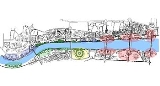
Some private sector developments have also been proposed. One of these, The Proposed Baghdad Renaissance Plan http://www.arcadd.com/baghdad-cbd.htm, is a 25-year scheme, designed by architectArchitecture
Architecture is both the process and product of planning, designing and construction. Architectural works, in the material form of buildings, are often perceived as cultural and political symbols and as works of art...
Hisham N. Ashkouri
Hisham N. Ashkouri
Hisham N. Ashkouri is a Boston and New York-based architect.Dr. Ashkouri graduated first in class in 1970 with a Bachelor of Architecture Degree from the University of Baghdad and continued for his Masters of Architecture at the University of Pennsylvania under the late Louis I. Kahn in 1973...
to transform 9 km² of silt deposits
Alluvium
Alluvium is loose, unconsolidated soil or sediments, eroded, deposited, and reshaped by water in some form in a non-marine setting. Alluvium is typically made up of a variety of materials, including fine particles of silt and clay and larger particles of sand and gravel...
into an "an up-market commercial and residential neighborhood" astride the Tigris River in central Baghdad
Baghdad
Baghdad is the capital of Iraq, as well as the coterminous Baghdad Governorate. The population of Baghdad in 2011 is approximately 7,216,040...
, as well as nearby Tahrir Square
Tahrir Square Development
The Tahrir Square Development in Baghdad, Iraq, is the proposed first phase in architect Hisham N. Ashkouri's Baghdad Renaissance Plan. Based around an established traffic circle on the banks of the Tigris River in Baghdad's Central Business District, the proposed development would develop just...
. Tahrir Square was originally part of the central business district of Baghdad, and Phase I of the plan focuses on the redevelopment of this area. http://www.menafn.com/qn_news_story_s.asp?storyid=64178
When finished, the "commerce, banking, medical, housing, broadcast and IT, exhibition, conventions and cultural centers" of which the plan is comprised would be occupied by up to one-half million people. The project received encouragement by the U.S. Department of Commerce as well as other US and Middle East organizations. A smaller-scale proposal of Dr. Ashkouri's is the Sindbad Hotel Complex and Conference Center
Sindbad Hotel Complex and Conference Center
The Sindbad Hotel Complex and Conference Center was designed by architect Hisham N. Ashkouri in 2004 to be the first new high-rise hotel, conference center and movie theater complex in modern Baghdad, as a symbol of the reconstruction of Iraq...
, a high-rise hotel and movie theater complex which would be Baghdad's first skyscraper.
Prevailing views are that political and social instability in the region are making such developments unduly risky, despite a high projected return on investment. Security concerns during the survey and construction phases are currently a cost-prohibitive factor.
See also
- History of Iraqi insurgencyHistory of Iraqi insurgencyThis is a history of the Iraqi insurgency, the armed opposition to the United States-led multinational force in Iraq in Iraq and the post-2003 Iraqi government.-Build up to insurgency:...
- Post-invasion Iraq, 2003–present
- 2003 Iraq war timeline2003 Iraq war timelineThis is the timeline of the events surrounding the United States led 2003 invasion of Iraq.-March 20, 2003:*At approximately 02:30 UTC, or about 90 minutes after the lapse of the U.S. 48-hour deadline for Iraqi President Saddam Hussein and his sons to leave Iraq, at 5:30 am local time, explosions...
- Development Fund for IraqDevelopment Fund for IraqIn May 2003, following the invasion of Iraq in March of that year, the Central Bank of Iraq-Development Fund for Iraq account was created at the U.S. Federal Reserve Bank of New York at the request of the Coalition Provisional Authority Administrator...
- New Iraqi Army
- Economy of IraqEconomy of IraqIraq's economy is dominated by the petroleum sector, which has traditionally provided about 95% of foreign exchange earnings. In the 1980s, financial problems caused by massive expenditures in the eight-year war with Iran and damage to oil export facilities by Iran led the government to implement...
- Iraq oil law (2007)Iraq oil law (2007)The Iraq oil law, also referred to as the Iraq hydrocarbon law, is a proposed piece of legislation submitted to the Iraqi Council of Representatives in May 2007.The Iraqi government has yet to reach an agreement on the law...
- Iraq sanctionsIraq sanctionsThe Iraq sanctions were a near-total financial and trade embargo imposed by the United Nations Security Council on the nation of Iraq. They began August 6, 1990, four days after Iraq's invasion of Kuwait, stayed largely in force until May 2003 , and certain portions including reparations to Kuwait...
- International Compact with IraqInternational Compact with IraqThe International Compact with Iraq is an initiative of the Government of Iraq for a new partnership with the international community. The Compact, jointly chaired by the Government of the Republic of Iraq and the United Nations, with the support of the World Bank, establishes a vision that, "five...
Links to Iraq reconstruction agencies
- International Reconstruction Fund Facility for Iraq Updates on reconstruction activities by the United Nations and World Bank.
- Task Force to Improve Business and Stability Operations - Iraq
- U.S. Army Corps of Engineers Weekly updates on Iraq reconstruction.
- USAID Assistance to Iraq Homepage Updates and financial summaries on USAID managed reconstruction projects in Iraq.
- Special Inspector General for Iraq Reconstruction Watchdog for fraud, waste, and abuse of U.S. funds intended for Iraq reconstruction. Quarterly updates and expenditure progress.
- Iraq Investment and Reconstruction Task Force (U.S. Dept. of Commerce) Assistance to the private sector for reconstruction and business opportunities.
- International Committee of the Red Cross Operational updates for ICRC activities in Iraq.
- International Federation of Red Cross and Red Crescent Societies Updates on activities of the Iraqi Red Crescent Society.
External articles and references
- Baghdad Invest - Iraq Investment Research - Investment News
- The Ground Truth Project -- A series of exclusive, in-depth interviews and other resources with Iraqis, aid workers, military personnel and others who have spent significant time working to rebuild Iraq from the inside.
- Iraq Inter-Agency Information & Analysis Unit Reports, Maps and Assessments of Iraq from the UN Inter-Agency Information & Analysis Unit
- Map of Iraq- High resolution maps of Iraq.
- Defend America: U.S. Department of Defense News About the War on Terrorism
- Measuring Stability and Security: U.S. Department of Defense Measuring Stability and Security in Iraq Quarterly Reports
- Fact Sheet on Provincial Reconstruction Teams (PRTs)
- * Kenneth M. Pollack, "After Saddam: Assessing the Reconstruction of Iraq". From foreignaffairs.org - author update, January 12, 2004.
- Iraq Analysis Economic Development Page Comprehensive information source listings on reconstruction of Iraq
- Dahar Jamail, "Iraq: The Devastation", AlterNet
- Iraq reconstruction funds missing
- Video Seminar on Iraq Coalition Politics: April 20, 2005, sponsored by the Program in Arms Control, Disarmament, and International Security at the University of Illinois.
- Baghdad Renaissance Plan
- UAE Investors Keen On Taking Part In Baghdad Renaissance Project
- Man With A Plan: Hisham Ashkouri
- Renaissance Plan In The News
- ARCADD, Inc.
- Symbion Power
- Iraqi Dinar - Economic and political news that affect the value of the Iraqi Dinar