
All Topics  
Reboiler


   Email Print
   Bookmark   Link


Reboiler


For other uses see Reboiler (disambiguation)
Reboiler (disambiguation)

Reboiler may refer to* Reboiler , a type of heat exchanger* Re-boiler , to fit a new boiler to a steam-driven machine...
Reboilers are heat exchangers typically used to provide heat to the bottom of industrial distillation
Continuous distillation

Continuous distillation, a form of distillation, is an ongoing separation in which a mixture is continuously fed into the process and separated fractions are removed continuously as output streams as time passes during the operation....
 columns. They boil the liquid from the bottom of a distillation column to generate vapors which are returned to the column to drive the distillation separation.

Proper reboiler operation is vital to effective distillation. In a typical classical distillation column, all the vapor driving the separation comes from the reboiler.


Discussion
Ask a question about 'Reboiler'
Start a new discussion about 'Reboiler'
Answer questions from other users
Full Discussion Forum


Encyclopedia


For other uses see Reboiler (disambiguation)
Reboiler (disambiguation)

Reboiler may refer to* Reboiler , a type of heat exchanger* Re-boiler , to fit a new boiler to a steam-driven machine...
Reboilers are heat exchangers typically used to provide heat to the bottom of industrial distillation
Continuous distillation

Continuous distillation, a form of distillation, is an ongoing separation in which a mixture is continuously fed into the process and separated fractions are removed continuously as output streams as time passes during the operation....
 columns. They boil the liquid from the bottom of a distillation column to generate vapors which are returned to the column to drive the distillation separation.

Proper reboiler operation is vital to effective distillation. In a typical classical distillation column, all the vapor driving the separation comes from the reboiler. The reboiler receives a liquid stream from the column bottom and may partially or completely vaporize that stream. Steam
Steam

In physical chemistry, and in engineering, steam refers to vaporized water. It is a pure, completely invisible gaseous phase . At standard temperature and pressure, pure steam occupies about 1,600 times the volume of an equal mass of liquid water....
 usually provides the heat required for the vaporization.

Types of reboilers


The most critical element of reboiler design is the selection of the proper type of reboiler for a specific service. Most reboilers are of the shell and tube heat exchanger
Shell and tube heat exchanger

A shell and tube heat exchanger is a class of heat exchanger designs. It is the most common type of heat exchanger in oil refineries and other large chemical processes, and is suited for higher-pressure applications....
 type and normally steam is used as the heat source in such reboilers. However, other heat transfer
Heat transfer

Heat transfer is the transition of thermal energy or simply heat from a hotter object to a cooler object . When an object or fluid is at a different temperature than its thermodynamic system or another object, transfer of thermal energy, also known as heat transfer, or heat exchange, occurs in such a way that the body and the surround...
 fluids like hot oil or Dowtherm (TM) may be used. Fuel-fired furnace
Furnace

File:Piec krepa.JPGA furnace is a device used for heating. The name derives from Latin fornax, oven. The earliest furnace was excavated at Balakot, a site of the Indus Valley Civilization, dating back to its mature phase ....
s may also be used as reboilers in some cases.

Commonly used heat exchanger type reboilers are:

Kettle reboilers

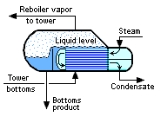
Image 1 depicts a typical steam-heated kettle reboiler. Kettle reboilers are very simple and reliable. They may require pumping
Pump

A pump is a device used to move fluids, such as gases, liquids or Slurry. A pump displaces a volume by physical or mechanical action. One common misconception about pumps is the thought that they create pressure....
 of the column bottoms liquid into the kettle, or there may be sufficient liquid head to deliver the liquid into the reboiler. In this reboiler type, steam flows through the tube bundle and exits as condensate. The liquid from the bottom of the tower, commonly called the bottoms, flows through the shell side. There is a retaining wall or overflow weir separating the tube bundle from the reboiler section where the residual reboiled liquid (called the bottoms product) is withdrawn, so that the tube bundle is kept covered with liquid.

Thermosyphon reboilers

These do not require pumping of the column bottoms liquid into the reboiler. Natural circulation is obtained by using the density
Density

The density of a material is defined as its mass per unit volume. The symbol of density is ....
 difference between the reboiler inlet column bottoms liquid and the reboiler outlet liquid-vapor mixture to provide sufficient liquid head to deliver the tower bottoms into the reboiler. Thermosyphon reboilers are more complex than kettle reboilers and require more attention from the plant operators.

There are many types of thermosyphon reboilers. They may be vertical or horizontal and they may also be once-through or recirculating. Some fluids being reboiled may be temperature-sensitive and, for example, subject to polymerization
Polymerization

In polymer chemistry, polymerization is a process of reacting monomer molecules together in a chemical reaction to form three-dimensional networks or polymer chains....
 by contact with high temperature heat transfer tube walls. In such cases, it is best to have a high liquid recirculation rate to avoid having high tube wall temperatures which would cause polymerization and, hence, fouling of the tubes. The thermosiphon reboiler depicted in Image 2 is a typical steam-heated recirculating thermosiphon reboiler.

Relative volatility of feed to reboiler must be considered before designing thermosyphon reboilers.

Fired reboiler

Fired heaters
Furnace

File:Piec krepa.JPGA furnace is a device used for heating. The name derives from Latin fornax, oven. The earliest furnace was excavated at Balakot, a site of the Indus Valley Civilization, dating back to its mature phase ....
 (furnaces) may be used as a distillation column reboiler. A pump is required to circulate the column bottoms through the heat transfer tubes in the furnace's convection and radiant sections.

Image 3 depicts a fired heater being used in a configuration that provides recirculation of the column bottoms liquid. However, with some relatively minor changes inside the bottom section of the distillation column, a fired heater can also be used in once-through configuration.

The heat source for the fired heater reboiler may be either fuel gas or fuel oil. Coal would rarely, if ever, be used as the fuel for a fired heater reboiler.

Forced circulation reboilers

This type of reboiler uses a pump
Pump

A pump is a device used to move fluids, such as gases, liquids or Slurry. A pump displaces a volume by physical or mechanical action. One common misconception about pumps is the thought that they create pressure....
 to circulate the column bottoms liquid through the reboilers. Image 4 depicts a typical steam-heated forced circulation reboiler.

It should be noted steam is not the only heat source that can be used. Any fluid stream at a high enough temperature could be used for any of the many shell and tube heat exchanger reboiler types.

See also


  • Vaporization
    Vaporization

    Vaporization of an element or compound is a phase transition from the liquid phase to gas phase. There are two types of vaporization: evaporation and boiling....
  • Boiling
    Boiling

    Boiling, a type of phase transition, is the rapid vaporization of a liquid, which typically occurs when a liquid is heated to its boiling point, the temperature at which the vapor pressure of the liquid is equal to the pressure exerted on the liquid by the surrounding environmental pressure....


Further reading


External links


de: Verdampfer (Verfahrenstechnik)