

Real Academia Española

Encyclopedia
The Royal Spanish Academy is the official royal institution responsible for regulating the Spanish language
. It is based in Madrid
, Spain, but is affiliated with national language academies in twenty-one other hispanophone
(Spanish-speaking) nations through the Association of Spanish Language Academies
. The RAE's emblem is a fiery crucible, and its motto
is "" ("[It] cleans, sets, and casts splendour").
The RAE is a major publisher of dictionaries
and grammar
s, and has a formal procedure for admitting words to its publications. Its website includes an online dictionary and other resources, all in Spanish. Its most famous publication is the (Dictionary of the Spanish Language of the Royal Spanish Academy), the "DRAE".
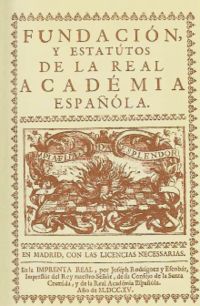 The was founded in 1713, modelled after the Italian (1582) and the French (1635), with the purpose "to fix the voices and vocabularies of the Castilian language with propriety, elegance, and purity". King Philip V
approved its constitution on 3 October 1714, placing it under the Crown's protection.
Its aristocratic founder, , Marquis of Villena
and Duke of Escalona
, described its aims as "to assure that Spanish speakers will always be able to read Cervantes
" – by exercising a progressive up-to-date maintenance of the formal language.
The RAE began establishing rules for the orthography of Spanish beginning in 1741 with the first edition of the (spelled from the second edition onwards). The proposals of the Academy became the official norm in Spain by royal decree in 1844, and they were also gradually adopted by the Spanish speaking countries of Latin America.
Several reforms were introduced in the (1959), and since then the rules have undergone continued adjustment, in consultation with the other national language academies. The current rules and practical recommendations are presented in the latest edition of the (1999).
In 1994, the RAE ruled that the Spanish consonants "CH" and "LL" would hence be alphabetized under "C" and under "L", respectively, and not as separate, discrete letters, as in the past. The RAE eliminated monosyllabic accented vowels where the accent did not serve in changing the word's meaning, examples include: ("gave"), ("saw"), both had an acutely-accented vowel ; yet the monosyllabic word ("I know", the first person, singular, present of , "to know"; and the singular imperative of , "to be") retains its acutely-accented vowel in order to differentiate it from the reflexive pronoun .
, been criticized for being excessively conservative
and slow to change; for excessively concentrating upon linguistic usages of the region of Castile
, while dismissing variant usages from other parts of Spain and other Spanish-speaking countries; and for being slow in revising its authoritative .
Moreover, the dictionary has been criticised for its partial definitions and somewhat limited coverage. For example, the DRAE definition for ("dinosaur") only covers Sauropodomorpha
, just one of the many groups of dinosaurs that existed.
Supporters respond that the RAE's purpose is not registering ephemeral Spanish usages, but to protect a united Castilian language and prevent national variants from becoming incomprehensible to other Spanish speakers.
Critics have acknowledged, however, that recent editions of the (the 20th, 21st, and current 22nd editions) show distinct improvement. One innovation was its publication of a paperback
edition in 1992. Partnerships with companies such as , IBM
, and Microsoft
, enabled the RAE to update and adapt to the current information-technology era, offering a free on-line version of its Diccionario, which may be consulted free of charge at its website.
Spanish language
Spanish , also known as Castilian , is a Romance language in the Ibero-Romance group that evolved from several languages and dialects in central-northern Iberia around the 9th century and gradually spread with the expansion of the Kingdom of Castile into central and southern Iberia during the...
. It is based in Madrid
Madrid
Madrid is the capital and largest city of Spain. The population of the city is roughly 3.3 million and the entire population of the Madrid metropolitan area is calculated to be 6.271 million. It is the third largest city in the European Union, after London and Berlin, and its metropolitan...
, Spain, but is affiliated with national language academies in twenty-one other hispanophone
Hispanophone
Hispanophone or Hispanosphere denotes Spanish language speakers and the Spanish-speaking world. The word derives from the Latin political name of the Iberian Peninsula, Hispania, which comprised basically the territory of the modern states of Spain and Portugal.Hispanophones are estimated at...
(Spanish-speaking) nations through the Association of Spanish Language Academies
Association of Spanish Language Academies
The Association of Spanish Language Academies is the entity which regulates the Spanish language. It was created in Mexico in 1951 and represents the union of all the separate academies in the Spanish-speaking world....
. The RAE's emblem is a fiery crucible, and its motto
Motto
A motto is a phrase meant to formally summarize the general motivation or intention of a social group or organization. A motto may be in any language, but Latin is the most used. The local language is usual in the mottoes of governments...
is "" ("[It] cleans, sets, and casts splendour").
The RAE is a major publisher of dictionaries
Dictionary
A dictionary is a collection of words in one or more specific languages, often listed alphabetically, with usage information, definitions, etymologies, phonetics, pronunciations, and other information; or a book of words in one language with their equivalents in another, also known as a lexicon...
and grammar
Grammar
In linguistics, grammar is the set of structural rules that govern the composition of clauses, phrases, and words in any given natural language. The term refers also to the study of such rules, and this field includes morphology, syntax, and phonology, often complemented by phonetics, semantics,...
s, and has a formal procedure for admitting words to its publications. Its website includes an online dictionary and other resources, all in Spanish. Its most famous publication is the (Dictionary of the Spanish Language of the Royal Spanish Academy), the "DRAE".
History
Philip V of Spain
Philip V was King of Spain from 15 November 1700 to 15 January 1724, when he abdicated in favor of his son Louis, and from 6 September 1724, when he assumed the throne again upon his son's death, to his death.Before his reign, Philip occupied an exalted place in the royal family of France as a...
approved its constitution on 3 October 1714, placing it under the Crown's protection.
Its aristocratic founder, , Marquis of Villena
Villena
Villena is a city in Spain, in the Valencian Community. It is located at the northwest part of Alicante, and borders to the west with Castilla-La Mancha and Murcia, to the north with the province of Valencia and to the east and south with the province of Alicante. It is the capital of the comarca...
and Duke of Escalona
Escalona
Escalona is a municipality located in the north part of the province of Toledo, which in turn is part of the autonomous community of Castile-La Mancha, Spain...
, described its aims as "to assure that Spanish speakers will always be able to read Cervantes
Cervantes
-People:*Alfonso J. Cervantes , mayor of St. Louis, Missouri*Francisco Cervantes de Salazar, 16th-century man of letters*Ignacio Cervantes, Cuban composer*Jorge Cervantes, a world-renowned expert on indoor, outdoor, and greenhouse cannabis cultivation...
" – by exercising a progressive up-to-date maintenance of the formal language.
The RAE began establishing rules for the orthography of Spanish beginning in 1741 with the first edition of the (spelled from the second edition onwards). The proposals of the Academy became the official norm in Spain by royal decree in 1844, and they were also gradually adopted by the Spanish speaking countries of Latin America.
Several reforms were introduced in the (1959), and since then the rules have undergone continued adjustment, in consultation with the other national language academies. The current rules and practical recommendations are presented in the latest edition of the (1999).
In 1994, the RAE ruled that the Spanish consonants "CH" and "LL" would hence be alphabetized under "C" and under "L", respectively, and not as separate, discrete letters, as in the past. The RAE eliminated monosyllabic accented vowels where the accent did not serve in changing the word's meaning, examples include: ("gave"), ("saw"), both had an acutely-accented vowel ; yet the monosyllabic word ("I know", the first person, singular, present of , "to know"; and the singular imperative of , "to be") retains its acutely-accented vowel in order to differentiate it from the reflexive pronoun .
Criticisms of the Academy
The Royal Academy has , especially in the Spanish-speaking AmericasHispanic America
Hispanic America or Spanish America is the region comprising the American countries inhabited by Spanish-speaking populations.These countries have significant commonalities with each other and with Spain, whose colonies they formerly were...
, been criticized for being excessively conservative
Social conservatism
Social Conservatism is primarily a political, and usually morally influenced, ideology that focuses on the preservation of what are seen as traditional values. Social conservatism is a form of authoritarianism often associated with the position that the federal government should have a greater role...
and slow to change; for excessively concentrating upon linguistic usages of the region of Castile
Castile (historical region)
A former kingdom, Castile gradually merged with its neighbours to become the Crown of Castile and later the Kingdom of Spain when united with the Crown of Aragon and the Kingdom of Navarre...
, while dismissing variant usages from other parts of Spain and other Spanish-speaking countries; and for being slow in revising its authoritative .
Moreover, the dictionary has been criticised for its partial definitions and somewhat limited coverage. For example, the DRAE definition for ("dinosaur") only covers Sauropodomorpha
Sauropodomorpha
Sauropodomorpha is an extinct clade of long-necked, herbivorous, saurischian dinosaurs which includes the sauropods and their ancestral relatives. Sauropods generally grew to very large sizes, had long necks and tails, were quadrupedal, and became the largest animals to ever walk the Earth. The...
, just one of the many groups of dinosaurs that existed.
Supporters respond that the RAE's purpose is not registering ephemeral Spanish usages, but to protect a united Castilian language and prevent national variants from becoming incomprehensible to other Spanish speakers.
Critics have acknowledged, however, that recent editions of the (the 20th, 21st, and current 22nd editions) show distinct improvement. One innovation was its publication of a paperback
Paperback
Paperback, softback or softcover describe and refer to a book by the nature of its binding. The covers of such books are usually made of paper or paperboard, and are usually held together with glue rather than stitches or staples...
edition in 1992. Partnerships with companies such as , IBM
IBM
International Business Machines Corporation or IBM is an American multinational technology and consulting corporation headquartered in Armonk, New York, United States. IBM manufactures and sells computer hardware and software, and it offers infrastructure, hosting and consulting services in areas...
, and Microsoft
Microsoft
Microsoft Corporation is an American public multinational corporation headquartered in Redmond, Washington, USA that develops, manufactures, licenses, and supports a wide range of products and services predominantly related to computing through its various product divisions...
, enabled the RAE to update and adapt to the current information-technology era, offering a free on-line version of its Diccionario, which may be consulted free of charge at its website.
Composition
Members of the Academy are known as (Academic Numerary), chosen from among prestigious persons in the arts and sciences, including several Spanish-language authors, known as (the Immortals), similarly to their counterparts. The Números are elected for life by the other academicians. Each academician holds a seat labeled with a letter from the Spanish alphabet; upper- and lower-case letters are separate seats.Current members
, sorted by date of induction:- (H) , Count of Casa Dávalos (1965)
- (g) (1972)
- (e) vacant
- (M) (1980)
- (A) (1980)
- (Z) vacant
- (n) (1985)
- (O) (1985)
- (q) (1987)
- (p) (1987)
- (r) (1988)
- (s) (1988)
- (J) (1990)
- (d) (1991)
- (F) (1991)
- (c) (1992)
- (U) (1994)
- (l) (1994)
- (C) (1995)
- (L) (1996)
- (b) (1996)
- (u) (1996)
- (V) (1997)
- (t) (1997)
- (K) (1998)
- (ñ) (1998)
- (I) (2001)
- (N) (2001)
- (k) (2002)
- (E) (2002)
- (f) (2003)
- (i) (2003)
- (T) (2003)
- (G) (2003)
- (Q) vacant
- (j) (2004)
- (o) (2006)
- (X) (2006)
- (h) (2006)
- (a) (2006)
- (R) (2008)
- (P) (2008)
- (m) (2008)
- (D) (2008)
- (B) (2008)
- (S) (2008)
Notable past academicians
- Dámaso AlonsoDámaso AlonsoDámaso Alonso y Fernández de las Redondas was a Spanish poet, philologist and literary critic. Though a member of the Generation of '27, his best-known work dates from the 1940s onwards. -Early life and education:...
- Vicente Bacallar y Sanna
- Pío BarojaPío BarojaPío Baroja y Nessi was a Spanish Basque writer, one of the key novelists of the Generation of '98. He was a member of an illustrious family, his brother Ricardo was a painter, writer and engraver, and his nephew Julio Caro Baroja, son of his younger sister Carmen, was a well known...
- Camilo José CelaCamilo José CelaCamilo José Cela y Trulock, 1st Marquis of Iria Flavia was a Spanish novelist and short story writer. He was awarded the 1989 Nobel Prize in Literature "for a rich and intensive prose, which with restrained compassion forms a challenging vision of man's vulnerability".-Biography:Cela published his...
- Armando Cotarelo Valledor
- Miguel Delibes Setién
- Leandro Fernández de MoratínLeandro Fernández de MoratínLeandro Fernández de Moratín was a Spanish dramatist, translator and neoclassical poet.-Biography:Moratín was born in Madrid the son of Nicolás Fernández de Moratín, a major literary reformer in Spain from 1762 until his death in 1780.Distrusting the teaching offered in Spain's universities at...
- Antonio MachadoAntonio MachadoAntonio Cipriano José María y Francisco de Santa Ana Machado y Ruiz, known as Antonio Machado was a Spanish poet and one of the leading figures of the Spanish literary movement known as the Generation of '98....
- Christopher Herman Maurer
- Julián MaríasJulián MaríasJulián Marías Aguilera , was a Spanish philosopher. His History of Philosophy is widely accepted as the greatest work written in Spanish on the subject of the history of philosophy...
- Ramón Menéndez PidalRamón Menéndez PidalRamón Menéndez Pidal was a Spanish philologist and historian. He worked extensively on the history of the Spanish language and Spanish folklore and folk poetry. One of his main topics was the history and legend of The Cid....
- Eugenio d'Ors
- Benito Pérez GaldósBenito Pérez GaldósBenito Pérez Galdós was a Spanish realist novelist. Considered second only to Cervantes in stature, he was the leading Spanish realist novelist....
- Manuel José QuintanaManuel José QuintanaManuel José Quintana y Lorenzo , was a Spanish poet and man of letters. He was born at Madrid. After completing his studies at Salamanca he was called to the bar....
- Epifanio C. de los Santos
Joint publications of the RAE and the Association of Spanish Language Academies
- Diccionario de la lengua española (Dictionary of the Spanish Language) (1st edition: 1780, 22nd edition: 2001, the 23rd edition will be published in 2013 to mark the tricentennial of the founding of the RAE). The first edition is in public domainPublic domainWorks are in the public domain if the intellectual property rights have expired, if the intellectual property rights are forfeited, or if they are not covered by intellectual property rights at all...
.- The Diccionario esencial de la lengua española (Essential Dictionary of the Spanish Language) was published in 2006 as a shortened work to span between the 22nd and 23rd editions.
- Ortografía de la lengua española (Orthography of the Spanish Language, 1st edition: 1741, latest edition: 2010). The edition of 1999 was the first orthography to cover the whole Hispanic world, replacing the Nuevas normas de prosodia y ortografía (New Rules for Prosody and Orthography) of 1959. The first edition is in public domain.
- Nueva gramática de la lengua española (New Grammar of the Spanish Language, 1st edition: 1771, latest edition: 2009). The latest edition is the first grammar to cover the whole Hispanic world, replacing the prior Gramática de la lengua española (Grammar of the Spanish Language, 1931) and the Esbozo de una Nueva gramática de la lengua española (Outline of a New Grammar of the Spanish Language, 1973). The first edition is in public domain.
- The Nueva gramática de la lengua española will be published in 3 different versions: The Edición completa (Complete Edition) includes 3,800 pages in two volumes to describe morphology and syntax (published December 4, 2009) plus a third volume of phonetics and phonology and a DVD (early 2010). The Manual edition is a single 750-page volume, which was presented at the 5th Congress of the Spanish Language which convened virtually in ValparaisoValparaísoValparaíso is a city and commune of Chile, center of its third largest conurbation and one of the country's most important seaports and an increasing cultural center in the Southwest Pacific hemisphere. The city is the capital of the Valparaíso Province and the Valparaíso Region...
, Chile, due to the earthquake2010 Chile earthquakeThe 2010 Chile earthquake occurred off the coast of central Chile on Saturday, 27 February 2010, at 03:34 local time , having a magnitude of 8.8 on the moment magnitude scale, with intense shaking lasting for about three minutes. It ranks as the sixth largest earthquake ever to be recorded by a...
, and will be published on April 23, 2010. The Gramática básica (Basic Grammar) is a 250-page pocket reference intended for school use, to be published in late 2010. - The RAE has also published two other works by individual editors: Gramática de la lengua española (Grammar of the Spanish Language, by Emilio Alarcos Llorach, 1994) and Gramática descriptiva de la lengua española (Descriptive Grammar of the Spanish Language, 3 volumes, directed by Ignacio Bosque and Violeta Demonte, 1999).
- The Nueva gramática de la lengua española will be published in 3 different versions: The Edición completa (Complete Edition) includes 3,800 pages in two volumes to describe morphology and syntax (published December 4, 2009) plus a third volume of phonetics and phonology and a DVD (early 2010). The Manual edition is a single 750-page volume, which was presented at the 5th Congress of the Spanish Language which convened virtually in Valparaiso
- Diccionario panhispánico de dudas (Pan-Hispanic Dictionary of Doubts, 1st edition: 2005). Resolves doubts related to the use of the Spanish language.
- Diccionario del estudiante (Student's Dictionary, 1st edition: 2005). Replaces the Diccionario escolar de la RAE (RAE Scholastic Dictionary, 1996).
-
- Diccionario práctico del estudiante (Practical Student's Dictionary, 1st edition: 2007) is an adapted version for Latin America, and is for sale only in the Americas.
-