

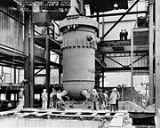
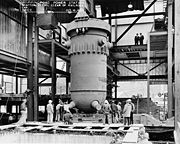
Reactor vessel

Encyclopedia
Nuclear power plant
A nuclear power plant is a thermal power station in which the heat source is one or more nuclear reactors. As in a conventional thermal power station the heat is used to generate steam which drives a steam turbine connected to a generator which produces electricity.Nuclear power plants are usually...
, the reactor vessel is a pressure vessel
Pressure vessel
A pressure vessel is a closed container designed to hold gases or liquids at a pressure substantially different from the ambient pressure.The pressure differential is dangerous and many fatal accidents have occurred in the history of their development and operation. Consequently, their design,...
containing the Nuclear reactor coolant
Nuclear reactor coolant
A nuclear reactor coolant is a coolant in a nuclear reactor used to remove heat from the nuclear reactor core and transfer it to electrical generators and the environment....
and reactor core
Nuclear reactor core
A nuclear reactor core is the portion of a nuclear reactor containing the nuclear fuel components where the nuclear reactions take place.- Description :...
.
Not all power reactors have a reactor vessel. Power reactors are generally classified by the type of coolant rather than by the configuration of the reactor vessel used to contain the coolant. The classifications are:
- Light water reactorLight water reactorThe light water reactor is a type of thermal reactor that uses normal water as its coolant and neutron moderator. Thermal reactors are the most common type of nuclear reactor, and light water reactors are the most common type of thermal reactor...
- Includes the PWRPressurized water reactorPressurized water reactors constitute a large majority of all western nuclear power plants and are one of three types of light water reactor , the other types being boiling water reactors and supercritical water reactors...
, BWRBoiling water reactorThe boiling water reactor is a type of light water nuclear reactor used for the generation of electrical power. It is the second most common type of electricity-generating nuclear reactor after the pressurized water reactor , also a type of light water nuclear reactor...
. Vast majority of nuclear power reactors are of this type. - Graphite moderated reactor - Includes the Chernobyl Reactor RBMKRBMKRBMK is an initialism for the Russian reaktor bolshoy moshchnosti kanalniy which means "High Power Channel-type Reactor", and describes a class of graphite-moderated nuclear power reactor which was built in the Soviet Union. The RBMK reactor was the type involved in the Chernobyl disaster...
that has a highly unusual reactor configuration compared to the vast majority of nuclear powerplants in Russia or around the world. - Gas cooled thermal reactor - Includes the AGRAdvanced gas-cooled reactorAn advanced gas-cooled reactor is a type of nuclear reactor. These are the second generation of British gas-cooled reactors, using graphite as the neutron moderator and carbon dioxide as coolant...
, the Gas Cooled Fast Breeder Reactor or GCFR, and the HTGR. An example of a Gas Cooled Reactor is the British MagnoxMagnoxMagnox is a now obsolete type of nuclear power reactor which was designed and is still in use in the United Kingdom, and was exported to other countries, both as a power plant, and, when operated accordingly, as a producer of plutonium for nuclear weapons...
. - Heavy water reactorHeavy water reactorA pressurised heavy water reactor is a nuclear power reactor, commonly using unenriched natural uranium as its fuel, that uses heavy water as its coolant and moderator. The heavy water coolant is kept under pressure in order to raise its boiling point, allowing it to be heated to higher...
- Utilize heavy water, or water with a higher than normal proportion of the hydrogen isotope deuterium in some manner, however D2O (heavy water) is more expensive and may be used as a main component, but not necessarily as a coolant in this case. An example of a heavy water reactor is Canada's CANDU reactor. - Liquid metal cooled reactorLiquid metal cooled reactorA liquid metal cooled nuclear reactor, liquid metal fast reactor or LMFR is an advanced type of nuclear reactor where the primary coolant is a liquid metal. Liquid metal cooled reactors were first adapted for nuclear submarine use but have also been extensively studied for power generation...
- Utilize a liquid metal, such as sodiumSodiumSodium is a chemical element with the symbol Na and atomic number 11. It is a soft, silvery-white, highly reactive metal and is a member of the alkali metals; its only stable isotope is 23Na. It is an abundant element that exists in numerous minerals, most commonly as sodium chloride...
or a leadLeadLead is a main-group element in the carbon group with the symbol Pb and atomic number 82. Lead is a soft, malleable poor metal. It is also counted as one of the heavy metals. Metallic lead has a bluish-white color after being freshly cut, but it soon tarnishes to a dull grayish color when exposed...
-bismuthBismuthBismuth is a chemical element with symbol Bi and atomic number 83. Bismuth, a trivalent poor metal, chemically resembles arsenic and antimony. Elemental bismuth may occur naturally uncombined, although its sulfide and oxide form important commercial ores. The free element is 86% as dense as lead...
alloyAlloyAn alloy is a mixture or metallic solid solution composed of two or more elements. Complete solid solution alloys give single solid phase microstructure, while partial solutions give two or more phases that may or may not be homogeneous in distribution, depending on thermal history...
to cool the reactor core. - Molten Salt ReactorMolten salt reactorA molten salt reactor is a type of nuclear fission reactor in which the primary coolant, or even the fuel itself is a molten salt mixture...
- Salts, typically fluorides of the alkali metals and alkali earth metals, are used as the coolant. Operation is similar to metal-cooled reactors with high temperatures and low pressures, reducing pressure exerted on the reactor vessel versus water/steam-cooled designs.
Of the main classes of reactor with a pressure vessel, the PWR is unique in that the pressure vessel suffers significant neutron irradiation (called fluence
Fluence
In physics, fluence is the flux integrated over time. For particles, it is defined as the total number of particles that intersect a unit area in a specific time interval of interest, and has units of m–2...
) during operation, and may become brittle over time as a result. In particular, the larger pressure vessel of the BWR is better shielded from the neutron flux, so although more expensive to manufacture in the first place because of this extra size, it has an advantage in not needing annealing
Annealing (metallurgy)
Annealing, in metallurgy and materials science, is a heat treatment wherein a material is altered, causing changes in its properties such as strength and hardness. It is a process that produces conditions by heating to above the recrystallization temperature, maintaining a suitable temperature, and...
to extend its life.
Annealing of PWR reactor vessels to extend their working life is a complex and high-value technology being actively developed by both nuclear service providers (AREVA
Areva
AREVA is a French public multinational industrial conglomerate headquartered in the Tour Areva in Courbevoie, Paris. AREVA is mainly known for nuclear power; it also has interests in other energy projects. It was created on 3 September 2001, by the merger of Framatome , Cogema and...
) and operators of PWRs.
Components of a PWR Reactor Pressure Vessel
PWR Nuclear Reactor Pressure Vessels share some features regardless of design.Reactor Vessel Body
The reactor vessel body is the largest component and is designed to contain the fuel assembly, coolant, and fittings to support coolant flow and support structures. It is usually cylindrical in shape and is open at the top to allow the fuel to be loaded.Reactor Vessel Head
This structure is attached to the top of the reactor vessel body. It contains penetrations to allow the control rod driving mechanism to attach to the control rods in the fuel assembly. The coolant level measurement probe also enters the vessel through the reactor vessel head.Fuel Assembly
The fuel assembly of nuclear fuel usually consisting of uranium or uranium/plutonium mixes. The fuel assembly is usually a rectangular block of gridded fuel rods.Neutron Reflector or Absorber
Protecting the inside of the vessel from fast neutron escaping from the fuel assembly is a cylindrical shield wrapped around the fuel assembly. Reflectors send the neutrons back into the fuel assembly to better utilize the fuel. The main purpose though is to protect the vessel from fast neutron induced damage which can make the vessel brittle and reduce its useful life.See also
- Nuclear physicsNuclear physicsNuclear physics is the field of physics that studies the building blocks and interactions of atomic nuclei. The most commonly known applications of nuclear physics are nuclear power generation and nuclear weapons technology, but the research has provided application in many fields, including those...
- Nuclear reactor physicsNuclear reactor physicsNuclear reactor physics is the branch of science that deals with the study and application of chain reaction to induce controlled rate of fission for energy in reactors....
- Nuclear reactor technology
- Nuclear reactor vessels