

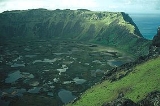
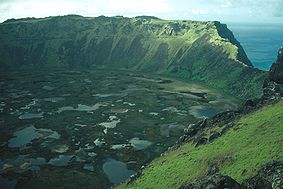
Rano Kau

Encyclopedia
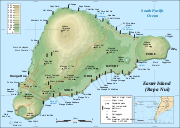
Easter Island
Easter Island is a Polynesian island in the southeastern Pacific Ocean, at the southeasternmost point of the Polynesian triangle. A special territory of Chile that was annexed in 1888, Easter Island is famous for its 887 extant monumental statues, called moai, created by the early Rapanui people...
, a Chile
Chile
Chile ,officially the Republic of Chile , is a country in South America occupying a long, narrow coastal strip between the Andes mountains to the east and the Pacific Ocean to the west. It borders Peru to the north, Bolivia to the northeast, Argentina to the east, and the Drake Passage in the far...
an island in the Pacific Ocean
Pacific Ocean
The Pacific Ocean is the largest of the Earth's oceanic divisions. It extends from the Arctic in the north to the Southern Ocean in the south, bounded by Asia and Australia in the west, and the Americas in the east.At 165.2 million square kilometres in area, this largest division of the World...
. It was formed of basaltic lava flows in the Pleistocene
Pleistocene
The Pleistocene is the epoch from 2,588,000 to 11,700 years BP that spans the world's recent period of repeated glaciations. The name pleistocene is derived from the Greek and ....
with its youngest rocks dated at between 150,000 and 210,000 years ago.
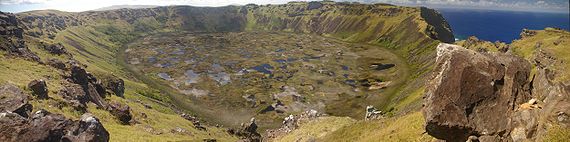
The crater
Crater lake
A crater lake is a lake that forms in a volcanic crater or caldera, such as a maar; less commonly and with lower association to the term a lake may form in an impact crater caused by a meteorite. Sometimes lakes which form inside calderas are called caldera lakes, but often this distinction is not...
which is one of the island's only three natural bodies of fresh water. Most of the volcano is on the coast and has been eroded back to form high sea cliffs which at one point have started to bite into the crater wall. On its northern side, the volcano slopes down to Mataveri International Airport
Mataveri International Airport
-See also:*Extreme points of Earth*Shuttle Down, a 1980 novel by American author G. Harry Stine , which gives a fictional account of the Space Shuttle Atlantis making an emergency landing.-External links:***...
.
Rano Kau is in the world heritage site
World Heritage Site
A UNESCO World Heritage Site is a place that is listed by the UNESCO as of special cultural or physical significance...
of Rapa Nui National Park
Rapa Nui National Park
Rapa Nui National Park is a World Heritage Site located on Easter Island, Chile. The park is divided into seven sections:*Rano Kau *Puna Pau ....
and gives its name to one of the seven sections of the park. The principal archaeological site on Rano Kau is the ruined ceremonial village of Orongo
Orongo
‘Orongo is a stone village and ceremonial centre at the southwestern tip of Rapa Nui . The first half of the ceremonial village's 53 stone masonry houses were investigated and restored in 1974 by American archaeologist William Mulloy...
which is located at the point where the sea cliff and inner crater wall converge. One ahu with several moai
Moai
Moai , or mo‘ai, are monolithic human figures carved from rock on the Chilean Polynesian island of Easter Island between the years 1250 and 1500. Nearly half are still at Rano Raraku, the main moai quarry, but hundreds were transported from there and set on stone platforms called ahu around the...
was recorded on the cliffs at Rano Kau in the 1880s, but had fallen to the beach by the time of the Routledge expedition
Katherine Routledge
Katherine Maria Routledge, née Pease was a British archaeologist who initiated the first true survey of Easter Island....
in 1914.
As well as basalt
Basalt
Basalt is a common extrusive volcanic rock. It is usually grey to black and fine-grained due to rapid cooling of lava at the surface of a planet. It may be porphyritic containing larger crystals in a fine matrix, or vesicular, or frothy scoria. Unweathered basalt is black or grey...
, it contains several other igneous rocks including obsidian
Obsidian
Obsidian is a naturally occurring volcanic glass formed as an extrusive igneous rock.It is produced when felsic lava extruded from a volcano cools rapidly with minimum crystal growth...
(for which it was one of the major sources for the island's stoneworkers) and pumice
Pumice
Pumice is a textural term for a volcanic rock that is a solidified frothy lava typically created when super-heated, highly pressurized rock is violently ejected from a volcano. It can be formed when lava and water are mixed. This unusual formation is due to the simultaneous actions of rapid...
.
The crater is almost a mile across and has its own micro climate. Sheltered from the winds that dry most of the rest of the island, figs and vines flourish at Rano Kau. The inner slope was the site of the last toromiro
Toromiro
Sophora toromiro, commonly known as Toromiro, is a species of flowering tree in the legume family, Fabaceae, that is endemic to Easter Island. Heavy deforestation had eliminated most of the island's forests by the first half of the 17th century , and the once common toromiro became rare and...
tree in the wild until the specimen was chopped down for firewood in 1960.
Geothermal activity
At some point in the early twentieth century, the island's manager took a photograph of steam coming out of the crater wall.External links
http://www.conaf.cl/?seccion_id=23a1f4328b8c8cee9a28642fe01307e7&unidad=2Rapa Nui National ParkRapa Nui National Park
Rapa Nui National Park is a World Heritage Site located on Easter Island, Chile. The park is divided into seven sections:*Rano Kau *Puna Pau ....
]
- Rapa Nui National Park - UNESCO World Heritage Centre
- Guide to Easter Island from the Easter Island Foundation