
All Topics  
Rahimuddin Khan

 
Rahimuddin Khan

   Email Print
   Bookmark   Link


Rahimuddin Khan


General
General

A General officer is an Officer of high military rank. The term or equivalent is used by nearly every country in the world. General can be used as a generic term for all grades of general officer, or it can specifically refer to a single rank that is just called general....
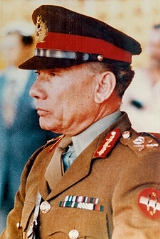
 Rahimuddin Khan (; born 21 July, 1926) was the Martial Law Administrator and longest-serving Governor
Governor of Balochistan

The Governor of Balochistan is the appointed Head of State of the provincial government in Balochistan , Pakistan. The governor is designated by the Prime Minister of Pakistan and is normally regarded a ceremonial post....
 of Balochistan
Balochistan

Balochistan or Baluchistan may refer to:Modern territories* Balochistan , a large region covering southwest Pakistan, southwest Afghanistan and southeast Iran...
, the largest province
Province

A province is a territorial unit, almost always an administrative division, within a country or state....
 of the Pakistan
Pakistan

Pakistan , officially the Islamic Republic of Pakistan, is a country located in South Asia and borders Central Asia and the Middle East. It has a 1,046 kilometre coastline along the Arabian Sea and Gulf of Oman in the south, and is bordered by Afghanistan and Iran in the west, India in the east and People's Republic of China in th...
, from 1978 to 1984. His premier achievement is held to be stabilizing the Baloch insurgency inherited from the Zulfikar Ali Bhutto
Zulfikar Ali Bhutto

Zulfikar Ali Bhutto was a Pakistani politician who served as the President of Pakistan from 1971 to 1973 and as Prime Minister of Pakistan from 1973 to 1977....
 government. However, several of his administrative policies- including the containment of mujahideen
Mujahideen

A Mujahid is a person involved in a jihad. The plural is Mujahideen . The word is from the same Arabic triliteral as jihad ....
 through barbed wire concealment during the Soviet invasion of Afghanistan as well as the construction of nuclear test sites
Pakistan and weapons of mass destruction

The Islamic Republic of Pakistan began focusing on nuclear development in January 1972 under the leadership of Prime Minister of Pakistan Zulfiqar Ali Bhutto ....
 in the Chaghai region
Chagai District

Chagai is the largest Districts of Pakistan of Pakistan and is located on the north west corner of Balochistan , Pakistan. It forms a triangular border with Afghanistan and Iran....
- have become enduring geopolitical realities.

He was made full General when he was appointed Chairman
Chairman of the Joint Chiefs of Staff Committee, Pakistan

The chairman of the Joint Chiefs of Staff Committee, Pakistan of Pakistan is, in principle, the highest ranking military official in the country; even if the Chief of Army Staff appears the one in charge, as can be seen by the number of times the Chief of Army Staff has overthrown the government and declared himself the ruler of the country....
 of the Joint Chiefs of Staff
Joint Chiefs of Staff Committee, Pakistan

In March 1976, the Government of Pakistan adopted the recommendations of the White Paper on Higher Defence Reorganization. A formal committee was established, the membership of which comprised the three service chiefs and the Secretary of the Defence Ministry....
 in March 1984.


Discussion
Ask a question about 'Rahimuddin Khan'
Start a new discussion about 'Rahimuddin Khan'
Answer questions from other users
Full Discussion Forum


Encyclopedia


General
General

A General officer is an Officer of high military rank. The term or equivalent is used by nearly every country in the world. General can be used as a generic term for all grades of general officer, or it can specifically refer to a single rank that is just called general....
 Rahimuddin Khan (; born 21 July, 1926) was the Martial Law Administrator and longest-serving Governor
Governor of Balochistan

The Governor of Balochistan is the appointed Head of State of the provincial government in Balochistan , Pakistan. The governor is designated by the Prime Minister of Pakistan and is normally regarded a ceremonial post....
 of Balochistan
Balochistan

Balochistan or Baluchistan may refer to:Modern territories* Balochistan , a large region covering southwest Pakistan, southwest Afghanistan and southeast Iran...
, the largest province
Province

A province is a territorial unit, almost always an administrative division, within a country or state....
 of the Pakistan
Pakistan

Pakistan , officially the Islamic Republic of Pakistan, is a country located in South Asia and borders Central Asia and the Middle East. It has a 1,046 kilometre coastline along the Arabian Sea and Gulf of Oman in the south, and is bordered by Afghanistan and Iran in the west, India in the east and People's Republic of China in th...
, from 1978 to 1984. His premier achievement is held to be stabilizing the Baloch insurgency inherited from the Zulfikar Ali Bhutto
Zulfikar Ali Bhutto

Zulfikar Ali Bhutto was a Pakistani politician who served as the President of Pakistan from 1971 to 1973 and as Prime Minister of Pakistan from 1973 to 1977....
 government. However, several of his administrative policies- including the containment of mujahideen
Mujahideen

A Mujahid is a person involved in a jihad. The plural is Mujahideen . The word is from the same Arabic triliteral as jihad ....
 through barbed wire concealment during the Soviet invasion of Afghanistan as well as the construction of nuclear test sites
Pakistan and weapons of mass destruction

The Islamic Republic of Pakistan began focusing on nuclear development in January 1972 under the leadership of Prime Minister of Pakistan Zulfiqar Ali Bhutto ....
 in the Chaghai region
Chagai District

Chagai is the largest Districts of Pakistan of Pakistan and is located on the north west corner of Balochistan , Pakistan. It forms a triangular border with Afghanistan and Iran....
- have become enduring geopolitical realities.

He was made full General when he was appointed Chairman
Chairman of the Joint Chiefs of Staff Committee, Pakistan

The chairman of the Joint Chiefs of Staff Committee, Pakistan of Pakistan is, in principle, the highest ranking military official in the country; even if the Chief of Army Staff appears the one in charge, as can be seen by the number of times the Chief of Army Staff has overthrown the government and declared himself the ruler of the country....
 of the Joint Chiefs of Staff
Joint Chiefs of Staff Committee, Pakistan

In March 1976, the Government of Pakistan adopted the recommendations of the White Paper on Higher Defence Reorganization. A formal committee was established, the membership of which comprised the three service chiefs and the Secretary of the Defence Ministry....
 in March 1984. His retirement in 1987 was interrupted by a brief reign as Governor of Sindh, following the dismissal of civilian government in May 1988 by strongman
Strongman (politics)

A strongman is a political leader who rules by force and runs an authoritarian regime. The term is often used interchangeably with "dictator," but differs from a "warlord"....
 President
President of Pakistan

The President of Pakistan is the head of state of the Islamic republic of Pakistan. Pakistan has a parliamentary form of government. According to the Constitution of Pakistan, the President is chosen by the Electoral College of Pakistan to serve a five-year term....
 Muhammad Zia-ul-Haq
Muhammad Zia-ul-Haq

General officer Muhammad Zia-ul-Haq was the president and military ruler of Pakistan from July 1977 to his death in August 1988. Appointed Chief of Army Staff of the Pakistan Army in 1976, General Zia-ul-Haq came to power after he overthrew ruling Prime Minister of Pakistan Zulfikar Ali Bhutto in a military coup d'?tat on July 5, 1977 and b...
. Rahimuddin resigned shortly after President Ghulam Ishaq Khan
Ghulam Ishaq Khan

Ghulam Ishaq Khan was President of Pakistan from August 17, 1988 until July 18, 1993....
 attempted to limit his vast gubernatorial powers.

He is also remembered for sentencing to death
Death Sentence

"Death Sentence" is a short story by the American science-fiction writer Isaac Asimov. It was first published in the November 1943 issue of Astounding Science Fiction and reprinted in the 1972 collection The Early Asimov....
 Bangladesh
Bangladesh

, officially the People's Republic of Bangladesh is a country in South Asia. It is bordered by India on all sides except for a small border with Burma to the far southeast and by the Bay of Bengal to the south....
 founder Shaikh Mujibur Rahman in 1971, having been appointed judge of his military trial by then-President
President of Pakistan

The President of Pakistan is the head of state of the Islamic republic of Pakistan. Pakistan has a parliamentary form of government. According to the Constitution of Pakistan, the President is chosen by the Electoral College of Pakistan to serve a five-year term....
 Yahya Khan
Yahya Khan

Agha Muhammad Yahya Khan was the President of Pakistan from 1969 to 1971, following the resignation of Ayub Khan. He has one son, Ali Yahya and one daughter, Yasmeen Khan....
, during the Bangladesh Liberation War
Bangladesh Liberation War

The Bangladesh Liberation WarBangladesh Liberation War/nomenclature justification was an armed conflict pitting West Pakistan against East Pakistan and India, that resulted in the secession of East Pakistan to become the independent nation of Bangladesh....
. Additionally, he is the only man to hold all four posts of Corps Commander, Governor of Balochistan, Governor of Sindh, and Chairman of the Joint Chiefs of Staff (having held the first two capacities in simultaneity) in the history of Pakistan
History of Pakistan

The history of Pakistan as a state began with independence from British India on 14 August 1947, although the region has been inhabited continuously for at least two million years; its ancient history includes some of the oldest settlements of South Asia and some of its major civilizations....
.

Early military career and rise to power

Born 21 July 1926, in Kaimganj
Kaimganj

See...
, United Provinces, India
India

India, officially the Republic of India , is a country in South Asia. It is the List of countries and outlying territories by total area country by geographical area, the List of countries by population country, and the most populous liberal democracy in the world....
, Rahimuddin Khan migrated to Pakistan after the country's independence on August 14, 1947. Rahimuddin had earlier developed close ties with the reformist Dr Zakir Hussain (who would go on to be the third President of India
President of India

The President of India or Rashtrapati is the head of state and first citizen of India, as well as the Commander-in-Chief of the Indian Military of India....
), and Zakir's brother and intellectual
Intellectual

An intellectual is a person who uses his or her intelligence and Critical thinking, either in their profession or for the benefit of personal pursuits....
 Mahmud Hussain. Shortly after migration to Pakistan, Rahimuddin enrolled in the Pakistan Army
Pakistan Army

The Pakistan Army is the largest branch of the Pakistan military, and is mainly responsible for protection of the state borders, the security of administered territories and defending the national interests of Pakistan within the framework of its international obligations....
. He became Lieutenant on 20 October, 1950, and before becoming a Major in 1957 was stationed at 1 Baluch Division from 1952 to 1954.

Selective Martial law
Martial law

Martial law is the system of rules that takes effect when the military takes control of the normal administration of justice.Martial law is sometimes imposed during wars or occupied territory in the absence of any other civil government....
 was declared over Lahore
Lahore

is the capital of the Pakistani Subdivisions of Pakistan of Punjab and is the List of most populated metropolitan areas in Pakistan city in Pakistan after Karachi....
 in 1953, in response to civil unrest following anti-Lahore Ahmadiyya Movement
Lahore Ahmadiyya Movement

The Lahore Ahmadiyya Movement for the Propagation of Islam, Ahmadiyya Anjuman Ishaat-i-Islam Lahore , formed as a result of ideological differences within the Ahmadiyya, after the demise of Maulana Hakim Noor-ud-Din in 1914, the first Khalifatul Masih after its founder, Mirza Ghulam Ahmad....
 agitations. Captain Rahimuddin was part of the military deployment
Military deployment

Military deployment is the movement of armed forces and their logistical support infrastructure. In most of the world's Navy, a deployment designates an extended period of duty at sea....
 heading the army takeover of Lahore, culminating in the arrest of Maulana Maududi. Among Pakistan's military representatives in CENTO
Cento

Cento is a city and commune in the province of Ferrara, part of the region Emilia-Romagna ....
, he ascended quickly to the higher ranks through the late 1950s to the early 1960s. He was injured during the Indo-Pakistani War of 1965
Indo-Pakistani War of 1965

The Indo-Pakistani War of 1965 was a culmination of skirmishes that took place between April 1965 and September 1965 between India and Pakistan....
 with a broken ankle, and was hospitalized. After his posting at School of Infantry
Infantry

Infantry are soldiers who are primarily trained for the role of fighting on foot. A soldier in the infantry is known as an infantryman. Infantry units have more physically demanding training than other branches of armies, and place a greater emphasis on fitness, physical strength and aggression....
 TAC from 1966 to 1968, he became a Brigadier in 1970 due to a distinguished career service record.

Judge of Shaikh Mujib's Trial

Rahimuddin was appointed sub-martial law administrator to Hyderabad
Hyderabad

Hyderabad may refer to:In India* Hyderabad, Andhra Pradesh, the capital city of the state of Andhra Pradesh in India.* Hyderabad State, the pre-1956 state in India...
 following General Yahya Khan
Yahya Khan

Agha Muhammad Yahya Khan was the President of Pakistan from 1969 to 1971, following the resignation of Ayub Khan. He has one son, Ali Yahya and one daughter, Yasmeen Khan....
's assuming the presidency in 1969 and imposing martial law. Shortly before suffering a large-scale defeat at the hands of neighboring India
India

India, officially the Republic of India , is a country in South Asia. It is the List of countries and outlying territories by total area country by geographical area, the List of countries by population country, and the most populous liberal democracy in the world....
 in the 1971 Indo-Pakistani War, Yahya Khan appointed Brigadier Rahimuddin to be the judge of the special-court trial of Bengali
Bengali people

The Bengali people are the ethnic community from Bengal in South Asia with a history dating back four millennia. They speak Bengali language , a language of the eastern Indo-Aryan languages branch of the Indo-European languages....
 leader Shaikh Mujibur Rahman, to take place in Faisalabad
Faisalabad

is a city located in the Subdivisions of Pakistan of Punjab , Pakistan. It was Geographical renaming Lyallpur. Faisalabad is the List of most populated metropolitan areas in Pakistan city in Pakistan with an estimated 2006 population of 2.6 million ....
. Mujib, who would later become the founder of Bangladesh
Bangladesh

, officially the People's Republic of Bangladesh is a country in South Asia. It is bordered by India on all sides except for a small border with Burma to the far southeast and by the Bay of Bengal to the south....
, had been arrested by West Pakistan
West Pakistan

West Pakistan was the popular and sometimes official name of the western wing of Pakistan until 1971, when the East Pakistan became independent as Bangladesh....
 troops (under President Yahya's orders) for charges of sparking widespread civil disorder in what was then East Pakistan
East Pakistan

East Pakistan was a former Provinces of Pakistan of Pakistan which existed between 1955 and 1971. East Pakistan was created from Bengal Province based on a plebiscite in what was then British Raj in 1947....
. The court proceedings were never made public, although it is generally held by historians that the verdict Brigadier Rahimuddin sentenced Mujib to was the death sentence.

On November 23, 2005, retired Brigadier A.R. Siddiqi, commenting on his latest book on the fall of East Pakistan, wrote:

Brigadier Rahimuddin conclusively awarded Mujib the death sentence, which was put in abeyance by Yahya Khan. However, Yahya's successor as Pakistani head of state, Zulfikar Ali Bhutto
Zulfikar Ali Bhutto

Zulfikar Ali Bhutto was a Pakistani politician who served as the President of Pakistan from 1971 to 1973 and as Prime Minister of Pakistan from 1973 to 1977....
, in his efforts to recognize the new state of Bangladesh, decided to rescind the verdict. Mujib was freed from Pakistani imprisonment in February 1972. This led to a falling out between Bhutto and Rahimuddin.

On January 8 1975, Rahimuddin was promoted to the rank of Major General
Major General

Major General or Major-General is a military rank used in many countries. It is derived from the older rank of Sergeant Major General. A Major General is a high-ranking officer, normally subordinate to the rank of Lieutenant General and senior to the ranks of Brigadier and Brigadier General....
, before being made Lieutenant General
Lieutenant General

Lieutenant General is a military rank used in many countries. The rank traces its origins to the Middle Ages where the title of Lieutenant General was held by the second in command on the battlefield, who was normally subordinate to a Captain General....
 in 1976.

Appointment and term as martial law governor of Balochistan

By the mid-1970s, the increasingly autocratic Zulfikar Ali Bhutto-headed Pakistan Peoples Party
Pakistan Peoples Party

The Pakistan Peoples Party : is a centre-left political party in Pakistan affiliated with Socialist International. To date, its leader has always been a member of the Bhutto family....
 government was in a violent deadlock with the opposing political party
Political party

A political party is a political organization that seeks to attain and maintain politics power within government, usually by participating in electoral campaigns....
 coalition, the Pakistan National Alliance
Pakistan National Alliance

The Pakistan National Alliance was a nine-political party alliance in Pakistan, formed in 1977 to overthrow the rule of Prime Minister of Pakistan Zulfikar Ali Bhutto, the first elected leader of that country....
. After widespread civil disorder, Chief of Army Staff
Chief of Army Staff of the Pakistan Army

The Chief of Army Staff of the Pakistan Army is the highest post in the Pakistan Army. The current Chief of Army Staff is General Ashfaq Parvez Kayani....
 General Muhammad Zia-ul-Haq
Muhammad Zia-ul-Haq

General officer Muhammad Zia-ul-Haq was the president and military ruler of Pakistan from July 1977 to his death in August 1988. Appointed Chief of Army Staff of the Pakistan Army in 1976, General Zia-ul-Haq came to power after he overthrew ruling Prime Minister of Pakistan Zulfikar Ali Bhutto in a military coup d'?tat on July 5, 1977 and b...
 overthrew Bhutto's government in a bloodless coup on July 5 1977. Nearly all of the administrative posts that had been held by members of the Bhutto government were vacated or dissolved, and Lieutenant General Rahimuddin Khan was appointed Martial Law Administrator of Balochistan, Pakistan's largest province. Following the resignation of Fazal Ilahi Chaudhry
Fazal Ilahi Chaudhry

Fazal Ilahi Chaudhry was President of Pakistan from August 14, 1973 until his resignation on September 16, 1978....
 from the post of President of Pakistan on September 16 1978, the provincial governorship of the province was simultaneously vacated by the Bhutto-appointed civilian Khuda Baksh Marri, and Rahimuddin assumed the post of Governor.

Since he had inherited a chaotic and unstable Balochistan from the Bhutto era, General Zia set up an independent military regime within the province, with Lieutenant General Rahimuddin Khan as Governor, a post that gave Rahimuddin carte blanche over all state matters related to the province, and thus a phenomenally large amount of power for a provincial Governor. Having been appointed the head of an independent absolutist military dictatorship, Rahimuddin would implement administrative and legislative action virtually independently of the central government.

Under Rahimuddin's reign, the province of Balochistan witnessed a period of stabilization which is without precedent in the history of Pakistan. This is widely considered to be due to Rahimuddin's completely isolating feudal families from provincial policy. Also, Rahimuddin used iron-fisted military tactics to subdue areas where armed uprisings were yet to take place. This garnered him much controversy, as many provincial authorities argued that the issues of Balochistan were too sensitive to be handled so forcefully. Despite the naysayers, no civil disobedience or anti-government movements effectively took place throughout Rahimuddin's authoritative rule.

General Rahimuddin pointedly ignored the more prominent feudal families of Balochistan from interfering in the major provincial affairs, Nawab Akbar Khan Bugti (who attempted a Baloch uprising as recently as 2005) and Sardar Ataullah Mengal
Ataullah Mengal

Sardar Ataullah Khan Mengal , popularly known as Sardar Ataullah Mengal, is a well known political figure of Pakistan hailing from Balochistan ....
 among them. Indeed, not a single political statement was released by any feudal family patriarch during his reign (the length of which is without precedent). Prominent feudal lords, Ataullah Mengal
Ataullah Mengal

Sardar Ataullah Khan Mengal , popularly known as Sardar Ataullah Mengal, is a well known political figure of Pakistan hailing from Balochistan ....
 and Khair Baksh Marri among them, left the country and stayed abroad, to come back only after Rahimuddin's retirement from the post.

Controlling Soviet-Afghan War refugees

While the Zia government fought a war in Afghanistan
Afghanistan

Afghanistan , officially the Islamic republic of Afghanistan, is a landlocked country that is located approximately in the center of Asia....
 against the Soviet Union
Soviet Union

The Union of Soviet Socialist Republics was a Constitution of the Soviet Union socialist state that existed in Eurasia from 1922 to 1991.The name is a translation of the , romanization of Russian Soyuz Sovetskikh Sotsialisticheskikh Respublik, abbreviated ????, SSSR....
 by proxy (during the Soviet-Afghan War), thousands of Afghan refugees crossed the border to neighbouring Pakistan. This would have highly negative long-term effects on the nation's economy and society. With the large-scale migration of the Afghans, advanced weaponry and hard narcotics that were easily available in Afghanistan started becoming common in Pakistan. Despite many calls on him by the central government to accommodate the refugees in a civil way, General Rahimuddin set up tightly-controlled barbed wire military camps to stagnate any movement of the refugees within his province throughout the duration of the Soviet-Afghan War. In retrospect, this prevented drugs and weaponry from infiltrating Balochistan, despite becoming widespread in several other areas of Pakistan under General Zia's rule.

The Al-Zulfikar airplane hijack

In 1981, a terrorist organization named Al-Zulfiqar
Al-Zulfiqar

Al-Zulfiqar was a leftist organization of Pakistan. It was formed in the late seventies by the sons of former Pakistani Prime Minister, Zulfiqar Ali Bhutto, who was also the Chairman of Pakistan's biggest political party, Pakistan Peoples Party....
 (led by Murtaza Bhutto
Murtaza Bhutto

Mir Ghulam Murtaza Bhutto was a Pakistani politician from the powerful Bhutto family, elder son of former Prime Minister of Pakistan Zulfikar Ali Bhutto and the brother of former Prime Minister of Pakistan Benazir Bhutto....
), hijacked a Pakistan International Airlines
Pakistan International Airlines

Pakistan International Airlines Corporation, more commonly known as Pakistan International Airlines or PIA , is the flag carrier airline of Pakistan, based in Karachi....
 airplane going to Kabul
Kabul

Kabul is the Capital and largest city of Afghanistan, with a population of approximately three million. It is an economic and cultural centre, situated 5,900 foot above sea level in a narrow valley, wedged between the Hindu Kush mountains along the Kabul River....
 and threatened to murder a hostage a day if General Zia-ul-Haq did not accept their demands, which most importantly consisted of the release of political prisoners. General Zia refused, prompting Al-Zulfikar to shoot dead Captain Tariq Rahim, a man they mistakenly believed to be the son of General Rahimuddin Khan. Ironically, Captain Tariq, who bore no relation to General Rahimuddin, was in fact a former Aide de Camp to the deposed Prime Minister Zulfikar Ali Bhutto
Zulfikar Ali Bhutto

Zulfikar Ali Bhutto was a Pakistani politician who served as the President of Pakistan from 1971 to 1973 and as Prime Minister of Pakistan from 1973 to 1977....
, whose death drove his son Murtaza to form Al-Zulfikar and destabilize the country. Despite General Rahimuddin's characteristic stand against any concessions to the terrorists, General Zia released the political prisoners and famously commented on the situation, "We have thrown out the bad eggs and saved innocent lives."

Term as Chairman of the Joint Chiefs of Staff

After his service as Martial Law
Martial law

Martial law is the system of rules that takes effect when the military takes control of the normal administration of justice.Martial law is sometimes imposed during wars or occupied territory in the absence of any other civil government....
 Governor of Balochistan during the crucial stages of the Mujahideen
Mujahideen

A Mujahid is a person involved in a jihad. The plural is Mujahideen . The word is from the same Arabic triliteral as jihad ....
 movement in Afghanistan, Lieutenant General Rahimuddin Khan was promoted to the rank of full General in March 1984, and was appointed Chairman of the Joint Chiefs of Staff
Joint Chiefs of Staff Committee, Pakistan

In March 1976, the Government of Pakistan adopted the recommendations of the White Paper on Higher Defence Reorganization. A formal committee was established, the membership of which comprised the three service chiefs and the Secretary of the Defence Ministry....
. Following Pakistan's return to civilian government, the newly-appointed Prime Minister, Muhammad Khan Junejo (and later Benazir Bhutto
Benazir Bhutto

Benazir Bhutto was a Pakistani politician who chaired the Pakistan Peoples Party , a centre-left List of political parties in Pakistan. Bhutto was the first woman elected to lead a Muslim world, having twice been Prime Minister of Pakistan ....
), significantly reduced the powers of Governor, greatly reducing its status as an independent administrative body to an orthodox government post under the head of state
Head of State

Head of state is the generic term for the individual or collective office that serves as the chief public representative of a monarchic or republican nation-state, federation, commonwealth or any other political state....
. Rahimuddin completed his three year term in March 1987 and formally retired from the Pakistan Army
Pakistan Army

The Pakistan Army is the largest branch of the Pakistan military, and is mainly responsible for protection of the state borders, the security of administered territories and defending the national interests of Pakistan within the framework of its international obligations....
 and simultaneously the military government
Military government

Military government can refer to conditions under either*Military occupation, or*Military dictatorship...
 (this retirement was not final, however, as he would later serve as interim Governor of Sindh in the government of Ghulam Ishaq Khan
Ghulam Ishaq Khan

Ghulam Ishaq Khan was President of Pakistan from August 17, 1988 until July 18, 1993....
). His successor was General Akhtar Abdur Rahman
Akhtar Abdur Rahman

General Akhtar Abdur Rahman was the Director of Inter-Services Intelligence , Pakistan's powerful intelligence agency, during the 1980s. Abdur Rahman was the mastermind, with the support of United States, behind the Soviet war in Afghanistan Mujahideen against the Soviet Union....
, the long serving Director-General of the country's premier intelligence agency, Inter-Services Intelligence
Inter-Services Intelligence

The Directorate for Inter-Services Intelligence is the largest intelligence service in Pakistan. It is one of the three main branches of Pakistan's intelligence agencies....
.

Term as Governor of Sindh

The relationship between General Zia-ul-Haq and Prime Minister Muhammad Khan Junejo,whom ul-Haq appointed in 1985, started to become increasingly strained. Finally, in May 1988, Zia sacked Junejo's government on several charges (including blatant corruption
Political corruption

Political corruption is the use of governmental powers by government officials for illegitimate private gain. Misuse of government power for other purposes, such as repression of political opponents and general police brutality, is not considered political corruption....
 and flagrant nepotism
Nepotism

Nepotism is the showing of favoritism toward relatives or friends based upon that relationship, rather than on an objective evaluation of ability or suitability....
). In a surprise move, Zia then called for elections to be held in November 1988. Due to his previously successful record as provincial] Governor, General Rahimuddin was persuaded out of retirement to form the caretaker government
Caretaker government

In politics, a caretaker government rules temporarily. A caretaker government is often set up following a war until stable democratic rule can be restored, or installed, in which case it is often referred to as a provisional government....
 as interim Governor of Sindh. Despite having scheduled elections in November, Rahimuddin was sworn in till 1990 as a political power move by the military government, to ensure significant leverage over the future civilian victors of the elections.

However, the regime's power structure was drastically altered after a C-130 Hercules
C-130 Hercules

The Lockheed C-130 Hercules is a four-engine turboprop military transport aircraft built by Lockheed. It is the main tactical airlifter for many military forces worldwide....
 airplane with General Zia-ul-Haq and several other senior-most generals onboard fatally exploded in mid-air after it took off from the city of Bahawalpur
Bahawalpur

Bahawalpur is the capital city of Bahawalpur District located in , Punjab, Pakistan Pakistan. The population according to the 1998 census was 403,408, Saraiki , Punjabi language are the local languages of the area while Urdu and English are also spoken....
. General Mirza Aslam Beg
Mirza Aslam Beg

General Mirza Aslam Beg was the Chief of Army Staff of the Pakistan Army of the Pakistan Army succeeding General Muhammad Zia-ul-Haq, after the latter died in the air crash on August 17, 1988....
 became the new Chief of Army Staff and Finance Minister Ghulam Ishaq Khan
Ghulam Ishaq Khan

Ghulam Ishaq Khan was President of Pakistan from August 17, 1988 until July 18, 1993....
 became the new President of Pakistan
President of Pakistan

The President of Pakistan is the head of state of the Islamic republic of Pakistan. Pakistan has a parliamentary form of government. According to the Constitution of Pakistan, the President is chosen by the Electoral College of Pakistan to serve a five-year term....
. General Zia's death ended the eleven-year military dictatorship
Military dictatorship

A military dictatorship is a form of government wherein the political power resides with the military. It is similar but not identical to a stratocracy, a state ruled directly by the military....
. Pakistan was now clear for a return to democracy
Democracy

Democracy is a form of government in which power is held directly or indirectly by citizens under a free electoral system. It is derived from the Greek language d?????at?a , "popular government" which was coined from d???? , "people" and ???t?? , "rule, strength" in the middle of the 5th-4th century BC to denote the political syst...
. With the forecast winners of the November elections being Benazir Bhutto
Benazir Bhutto

Benazir Bhutto was a Pakistani politician who chaired the Pakistan Peoples Party , a centre-left List of political parties in Pakistan. Bhutto was the first woman elected to lead a Muslim world, having twice been Prime Minister of Pakistan ....
, Ghulam Ishaq Khan started to gradually restructure the offices of the interim government so as to more suit a democratic system once it took over.

Retirement

One of Ishaq's first decisions as acting President was to move for the creation the new position of Chief Minister of Sindh. This was to greatly reduce the powers of the Governor, and Rahimuddin, who had enjoyed absolute authority over Balochistan (and subsequently Sindh) for so long, gradually fell out with the President. General Rahimuddin quietly resigned as interim Governor of Sindh, before the Chief Minister position could come into effect. Benazir Bhutto
Benazir Bhutto

Benazir Bhutto was a Pakistani politician who chaired the Pakistan Peoples Party , a centre-left List of political parties in Pakistan. Bhutto was the first woman elected to lead a Muslim world, having twice been Prime Minister of Pakistan ....
 won the November elections (which were held as planned despite the plane crash) and significantly reduced the despotic powers Rahimuddin had held as Governor, greatly reducing its status as an independent administrative body to an orthodox government post under the head of state
Head of State

Head of state is the generic term for the individual or collective office that serves as the chief public representative of a monarchic or republican nation-state, federation, commonwealth or any other political state....
.

Rahimuddin retired from the Pakistan Army
Pakistan Army

The Pakistan Army is the largest branch of the Pakistan military, and is mainly responsible for protection of the state borders, the security of administered territories and defending the national interests of Pakistan within the framework of its international obligations....
 in 1987, before formally retiring from the government after his resignation from the post of Governor of Sindh
Sindh

Sindh is one of the four Subdivisions of Pakistan of Pakistan and historically is home to the Sindhi people. Different cultural and ethnic groups also reside in Sindh including Urdu-speaking Muslim refugees who migrated to Pakistan from India upon independence as well as the people migrated from other provinces after independence....
, holding the Nishan-e-Imtiaz and Sitara-e-Basalat. He now resides in Rawalpindi
Rawalpindi

is a city in the Potwar Plateau near Pakistan's capital city of Islamabad, in the Subdivisions of Pakistan of Punjab . The area was home to the pre-historic Soanian culture indigenous to this region....
 with his wife Saqiba, an established Urdu
Urdu

Urdu is a Central_Indo-Aryan_languages#Central_Zone_.28Madhya_or_Hindi.29 Indo-Aryan languages of the Indo-Iranian languages, belonging to the Indo-European languages family of languages....
 author and niece of intellectual and third President of India
President of India

The President of India or Rashtrapati is the head of state and first citizen of India, as well as the Commander-in-Chief of the Indian Military of India....
, Dr Zakir Hussain
Zakir Hussain (politician)

Dr. Zakir Hussain , was the third President of India from May 13, 1967 until his death on May 3, 1969. He was the first elected Muslim president of India....
. He is the father-in-law of former Federal Minister for Religious Affairs Muhammad Ijaz-ul-Haq
Muhammad Ijaz-ul-Haq

Muhammad Ijaz-ul-Haq is a prominent Pakistani politician and former Federal Minister for Religious Affairs of the Islamic Republic of Pakistan....
, the son of General Zia.

Controversy over authoritarianism and views

General Rahimuddin Khan's two tenures as Governor, particularly during his time as Martial Law Administrator of Balochistan, remain controversial. After the secession of Bangladesh in 1971, many were of the feeling that provincial civil disobedience
Civil disobedience

Civil disobedience is the active refusal to obey certain laws, demands and commands of a government, or of an occupying power , without resorting to physical violence....
 could not be subdued through authoritarian government. Rahimuddin's appointment as Governor and Martial Law Administrator was seen with criticism, with the country's liberal politicians often stating that the central government, headed by General Zia-ul-Haq's military dictatorship, had disinterestedly let Rahimuddin assume unprecedented political power. Inarguably, Rahimuddin did enjoy absolute power concentration over Pakistan's largest province, Balochistan, for an unprecedentedly long period.

The opinion of the international media was that the sectarian and ethnic violence plaguing Pakistan was to be handled in a sensitive and grassroots manner. General Rahimuddin's rule, however, was characterized with a ceasefire of military action yet dictatorial political administration that stabilized the Baloch insurgency, a move that was criticized by many. Despite this, his reign had met approval earlier in 1978 with the declaration of an amnesty for those prepared to give up arms. His refusal to organize and preside over a political cabinet for the duration of his rule over Balochistan influenced many to denounce his overly despotic style of government.

Rahimuddin Khan was, during his tenure as Governor, a vocal critic of the central government's handling of the Soviet-Afghan War, stating the influx of narcotics and advanced weaponry that would become a consequence of the accommodation of Afghan refugees. Due to his administrative independence, General Rahimuddin, in contrast to the rest of the provinces, set up barbed-wire camps throughout the province of Balochistan. This action, beneficial in retrospect, was met with scepticism amongst the other military members of the cabinet. Despite this, he is mostly respected by Pakistan's conservative elements to the present day, despite his controversially authoritarian style of government. His longtime friend, President of Bavaria
Bavaria

Bavaria , with an area of and almost 12.5 million inhabitants, is a region located in the southeast of Germany and is the largest States of Germany of Germany by area....
 Franz Josef Strauss, as well as the former President of Pakistan, General Pervez Musharraf
Pervez Musharraf

General Pervez Musharraf , Nishan-e-Imtiaz, Hilal-e-Imtiaz, Tamgha-e-Basalat, is a former President of Pakistan. Previously, he was Prime Minister of Pakistan as well as Chief of Army Staff of the Pakistan Army of the Pakistan Army....
, have also stated their admiration for the general on several counts.

Legacy

General Rahimuddin is principally credited with the stabilization of Balochistan, due to his stopping the secession-threatening insurgency of the 1970s. Although major fighting had broken down by the time he had taken power, ideological schisms caused splinter groups to form and steadily gain momentum. Despite the overthrow of the Bhutto government in 1977 by General Muhammad Zia-ul-Haq
Muhammad Zia-ul-Haq

General officer Muhammad Zia-ul-Haq was the president and military ruler of Pakistan from July 1977 to his death in August 1988. Appointed Chief of Army Staff of the Pakistan Army in 1976, General Zia-ul-Haq came to power after he overthrew ruling Prime Minister of Pakistan Zulfikar Ali Bhutto in a military coup d'?tat on July 5, 1977 and b...
, calls for secession and widespread civil disobedience remained. Contrary to popular belief, it was General Rahimuddin Khan who initiated the declaration of a general amnesty in Balochistan to those willing to give up arms, and not General Zia, thus effectively ending the insurrection.

Moreover, Rahimuddin's reign as Governor of Balochistan saw the first direct suppression of feudal families in the history of Pakistan. No governor, before or after, has had the political base necessary to defy both feudal and political forces within the province. The provincial government under the famously authoritarian Rahimuddin began to act as a separate entity and military regime independent of the central government, allowing Rahimuddin to be the dictatorial head of the province. Rahimuddin then purposefully isolated feudal leaders such as Nawab Akbar Khan Bugti and Ataullah Mengal
Ataullah Mengal

Sardar Ataullah Khan Mengal , popularly known as Sardar Ataullah Mengal, is a well known political figure of Pakistan hailing from Balochistan ....
 from provincial policy. He also put down all civil disobedience movements (mostly through indirect military action) effectively leading to unprecedented social stability within the province. Due to Martial Law, his reign was the longest in the military history of Pakistan
Military history of Pakistan

The military history of Pakistan can be viewed as the history of modern-day Pakistan, as the military of Pakistan has played and continues to play a vital role in the establishment and shaping of the country since its inception in 1947....
.

It should be noted that one of Rahimuddin's main and often overlooked achievements in the province was the prevention of an influx of drugs and weapons (due to Afghan refugees migrating to Pakistan during the 1980s Soviet-Afghan War) that had plagued many other parts of the country during Zia's rule. Rahimuddin did this by keeping the Afghan mercenaries and refugees in tightly-controlled military camps. Also, a generation of conservative politicians from the province would gain prominence under General Rahimuddin, notably Zafarullah Khan Jamali
Zafarullah Khan Jamali

Mir Zafarullah Khan Jamali is a former Prime Minister of Pakistan and current Chairman of the Pakistan Hockey Federation....
, who would go on to hold the post of Prime Minister of Pakistan
Prime Minister of Pakistan

The Prime Minister of Pakistan, in Urdu language ???? ???? Wazir-e- Azam meaning "Grand Minister", is the Head of Government of Pakistan....
 under the military government of General Pervez Musharraf
Pervez Musharraf

General Pervez Musharraf , Nishan-e-Imtiaz, Hilal-e-Imtiaz, Tamgha-e-Basalat, is a former President of Pakistan. Previously, he was Prime Minister of Pakistan as well as Chief of Army Staff of the Pakistan Army of the Pakistan Army....
, who has also stated his admiration for General Rahimuddin on several counts.

A few weeks after India's second nuclear test (Operation Shakti) on 28 May, 1998, Pakistan detonated five nuclear devices in the Chagai Hills
Chagai Hills

The Chagai Hills are in the north of the Pakistani province of Balochistan , a region lying just south of the Helmand and Nimruz provinces of southern Afghanistan; and the range, at its western end, lying east of Iran's Sistan va Baluchistan....
 in the Chaghai
Chagai District

Chagai is the largest Districts of Pakistan of Pakistan and is located on the north west corner of Balochistan , Pakistan. It forms a triangular border with Afghanistan and Iran....
 district, Balochistan
Balochistan (Pakistan)

Balochistan, or Baluchistan, is a Subdivisions of Pakistan in Pakistan, the largest in the country by geographical area; it is slightly smaller than Norway....
. This operation was named Chagai-I
Chagai-I

Chagai-I refers to the Nuclear testing conducted by Pakistan in 1998. It was named Chagai-I as the tests were conducted in the Chagai District ....
 by Pakistan, the base having been long-constructed by Rahimuddin. After Rahimuddin's retirement, civil disobedience
Civil disobedience

Civil disobedience is the active refusal to obey certain laws, demands and commands of a government, or of an occupying power , without resorting to physical violence....
 movements once again mushroomed throughout the 1990s
1990s

The 1990s or Nineties was the decade that ran from January 1, 1990 to December 31, 1999. During this time, the widespread adoption of personal computers, the Internet, and the increased economic productivity led to the equity market booms around the world, and caused an influx of wealth to the United States, Canada, Europe, and Asia....
. Attempted uprisings took place as recently as 2006, which culminated in the killing of the anti-government tribal leader Akbar Bugti.

Books and references

  • Endgame: East Pakistan; An Onlooker's Journal by Brigadier A.R. Siddiqui
  • Breaking the Curfew by Emma Duncan
  • Working with Zia by Khalid Mahmud Arif
  • Khaki Shadows by Khalid Mahmud Arif
  • Journey to Disillusionment by Sherbaz Mazari
  • The Terrorist Prince by Raja Anwar


See also

  • Baloch Insurgency and Rahimuddin's Stabilization
    Baloch Insurgency and Rahimuddin's Stabilization

    The Baloch Insurgency was a series of secessionist rebellions in Balochistan , the largest province of Pakistan, from 1973 to 1976. Rahimuddin Khan's Stabilization was a series of Public administration reforms and indirect military action aimed at undermining the 1970s insurgency by then-dictator General Rahimuddin Khan from 1977 to 198...
  • Bangladesh Liberation War
    Bangladesh Liberation War

    The Bangladesh Liberation WarBangladesh Liberation War/nomenclature justification was an armed conflict pitting West Pakistan against East Pakistan and India, that resulted in the secession of East Pakistan to become the independent nation of Bangladesh....
  • Soviet-Afghan War
  • Military history of Pakistan
    Military history of Pakistan

    The military history of Pakistan can be viewed as the history of modern-day Pakistan, as the military of Pakistan has played and continues to play a vital role in the establishment and shaping of the country since its inception in 1947....
  • Zia-ul-Haq's Islamization
    Zia-ul-Haq's Islamization

    On December 2, 1978, Muhammad Zia-ul-Haq delivered a nationwide address on the occasion of the first day of the Hijra calendar. He did this in order to usher in an Islamic system to Pakistan....
  • History of Balochistan
    History of Balochistan

    Balochistan is one of the four Subdivisions of Pakistan of Pakistan. The British Empire on October 1, as paramount power in the region reached a security agreement with the country of Balochistan which was ruled by the Khan of Kalat 1887 but the kingdom retained its sovereignty in all other respects....
  • Military dictatorship
    Military dictatorship

    A military dictatorship is a form of government wherein the political power resides with the military. It is similar but not identical to a stratocracy, a state ruled directly by the military....


|-