


Radiosity (heat transfer)

Encyclopedia
Radiosity is a convenient quantity in optics and heat transfer that represents the total radiation
intensity
leaving a surface. Radiosity accounts for two components: the radiation being emitted by the surface, and the radiation being reflected from the surface. In heat transfer
, combining these two factors into one radiosity term helps in determining the net energy exchange between multiple surfaces.
from emitted radiation
, , and the intensity of reflected radiation,
  , are both functions of angle from the surface. So, adding these together, the intensity of the total radiation
leaving the surface is defined as

where represents energy flux
and is the solid angle. The
  term accounts for the projected area
of the surface at an angle. Now, to find the radiosity, the flux is integrated over a hemispherical surface enclosing the unit area for all angles. To generalize further, the radiosity should also be expressed as a function of the wavelength
of the radiation
.

Assuming a diffuse emitter and reflector, is constant and the radiosity reduces to
  over all wavelengths. Furthermore, for a blackbody,
  and the radiosity reduces to
  .
.
 , for a gray, diffuse
surface, is the sum of the reflected and emitted intensities. Or,

where is the gray body radiation due to temperature
  , and
, and  is the incident radiation. Normally,
  is the unknown variable and will depend on the surrounding surfaces. So, if some surface
  is being hit by radiation
from some other surface , then the radiation energy incident on surface
  is
is  . So, the incident intensity is the sum of radiation from all other surfaces per unit surface of area
  .
.
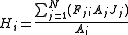
 is the view factor, or shape factor, from surface
  to surface
  . Now, employing the reciprocity relation,
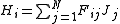
and substituting the incident intensity into the original equation for radiosity, produces

For an surface enclosure, this summation for each surface will generate
  linear equation
s with unknown radiosities. For an enclosure with only a few surfaces, this can be done by hand. But, for a room with many surfaces, linear algebra
and a computer are necessary.
Once the radiosities have been calculated, the net heat transfer at a surface can be determined by finding the difference between the incoming and outgoing energy.

Using the equation for radiosity, , the incident radiation,
  , can be eliminated from the above to obtain
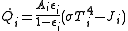
rather than solve the set of linear
radiosity equations. To do this, the heat transfer at each surface, , is expressed as

and is known as the surface resistance. Likewise,
  is the blackbody radiation minus the radiosity and serves as the 'potential difference.' These quantities are formulated to resemble those from an electrical circuit
 .
.
Now performing a similar analysis for the heat transfer from surface to surface
  ,
,

Because the above is between surfaces, is known as the space resistance and
  serves as the potential difference.
Combining the surface elements and space elements, a circuit is formed. The heat transfer is found by using the appropriate potential difference and equivalent resistances, similar to the process used in analyzing electrical circuits
.
surface. In reality, however, the radiosity will have a specular
component from the reflected radiation
. So, the heat transfer between two surfaces relies on both the view factor and the angle of reflected radiation.
It was also assumed that the surface is a gray body and that its emissivity is independent of radiation wavelength
. However, if the range of wavelengths of incident and emitted radiation is large, this will not be the case. In such an application, the radiosity must be calculated mono chromatically and then integrated
over the range of radiation wavelengths.
Yet another assumption is that the surfaces are isothermal
. If they are not, then the radiosity will vary as a function of position along the surface. However, this problem is solved by simply subdividing the surface into smaller elements until the desired accuracy is obtained.
Radiation
In physics, radiation is a process in which energetic particles or energetic waves travel through a medium or space. There are two distinct types of radiation; ionizing and non-ionizing...
intensity
Intensity (physics)
In physics, intensity is a measure of the energy flux, averaged over the period of the wave. The word "intensity" here is not synonymous with "strength", "amplitude", or "level", as it sometimes is in colloquial speech...
leaving a surface. Radiosity accounts for two components: the radiation being emitted by the surface, and the radiation being reflected from the surface. In heat transfer
Heat transfer
Heat transfer is a discipline of thermal engineering that concerns the exchange of thermal energy from one physical system to another. Heat transfer is classified into various mechanisms, such as heat conduction, convection, thermal radiation, and phase-change transfer...
, combining these two factors into one radiosity term helps in determining the net energy exchange between multiple surfaces.
Definition
Consider a unit of surface area. Realistically, the intensityIntensity (physics)
In physics, intensity is a measure of the energy flux, averaged over the period of the wave. The word "intensity" here is not synonymous with "strength", "amplitude", or "level", as it sometimes is in colloquial speech...
from emitted radiation
Radiation
In physics, radiation is a process in which energetic particles or energetic waves travel through a medium or space. There are two distinct types of radiation; ionizing and non-ionizing...
,
, and the intensity of reflected radiation, , are both functions of angle from the surface. So, adding these together, the intensity of the total radiationRadiation
In physics, radiation is a process in which energetic particles or energetic waves travel through a medium or space. There are two distinct types of radiation; ionizing and non-ionizing...
leaving the surface is defined as
where
represents energy fluxHeat flux
Heat flux or thermal flux is the rate of heat energy transfer through a given surface. The SI derived unit of heat rate is joule per second, or watt. Heat flux is the heat rate per unit area. In SI units, heat flux is measured in W/m2]. Heat rate is a scalar quantity, while heat flux is a vectorial...
and
is the solid angle. The term accounts for the projected areaProjected area
Projected area is two-dimensional area measurement of a three-dimensional object by projecting its shape on to an arbitrary plane. This is often used in mechanical engineering related fields, specifically hardness testing, axial stress and terminal velocity....
of the surface at an angle. Now, to find the radiosity, the flux is integrated over a hemispherical surface enclosing the unit area for all angles. To generalize further, the radiosity should also be expressed as a function of the wavelength
Wavelength
In physics, the wavelength of a sinusoidal wave is the spatial period of the wave—the distance over which the wave's shape repeats.It is usually determined by considering the distance between consecutive corresponding points of the same phase, such as crests, troughs, or zero crossings, and is a...
of the radiation
Radiation
In physics, radiation is a process in which energetic particles or energetic waves travel through a medium or space. There are two distinct types of radiation; ionizing and non-ionizing...
.
Assuming a diffuse emitter and reflector,
is constant and the radiosity reduces to over all wavelengths. Furthermore, for a blackbody, and the radiosity reduces to .Radiosity Method
The radiosity, for a gray, diffuseDiffuse reflection
Diffuse reflection is the reflection of light from a surface such that an incident ray is reflected at many angles rather than at just one angle as in the case of specular reflection...
surface, is the sum of the reflected and emitted intensities. Or,
where
is the gray body radiation due to temperature , and is the incident radiation. Normally, is the unknown variable and will depend on the surrounding surfaces. So, if some surface is being hit by radiationRadiation
In physics, radiation is a process in which energetic particles or energetic waves travel through a medium or space. There are two distinct types of radiation; ionizing and non-ionizing...
from some other surface
, then the radiation energy incident on surface is . So, the incident intensity is the sum of radiation from all other surfaces per unit surface of area . is the view factor, or shape factor, from surface to surface . Now, employing the reciprocity relation,and substituting the incident intensity into the original equation for radiosity, produces
For an
surface enclosure, this summation for each surface will generate linear equationLinear equation
A linear equation is an algebraic equation in which each term is either a constant or the product of a constant and a single variable....
s with
unknown radiosities. For an enclosure with only a few surfaces, this can be done by hand. But, for a room with many surfaces, linear algebraLinear algebra
Linear algebra is a branch of mathematics that studies vector spaces, also called linear spaces, along with linear functions that input one vector and output another. Such functions are called linear maps and can be represented by matrices if a basis is given. Thus matrix theory is often...
and a computer are necessary.
Once the radiosities have been calculated, the net heat transfer at a surface can be determined by finding the difference between the incoming and outgoing energy.
Using the equation for radiosity,
, the incident radiation, , can be eliminated from the above to obtainCircuit Analogy
For an enclosure consisting of only a few surfaces, it is often easier to represent the system with an analogous circuitNetwork analysis (electrical circuits)
A network, in the context of electronics, is a collection of interconnected components. Network analysis is the process of finding the voltages across, and the currents through, every component in the network. There are a number of different techniques for achieving this...
rather than solve the set of linear
Linear equation
A linear equation is an algebraic equation in which each term is either a constant or the product of a constant and a single variable....
radiosity equations. To do this, the heat transfer at each surface,
, is expressed asand
is known as the surface resistance. Likewise, is the blackbody radiation minus the radiosity and serves as the 'potential difference.' These quantities are formulated to resemble those from an electrical circuitNetwork analysis (electrical circuits)
A network, in the context of electronics, is a collection of interconnected components. Network analysis is the process of finding the voltages across, and the currents through, every component in the network. There are a number of different techniques for achieving this...
.Now performing a similar analysis for the heat transfer from surface
to surface ,Because the above is between surfaces,
is known as the space resistance and serves as the potential difference.Combining the surface elements and space elements, a circuit is formed. The heat transfer is found by using the appropriate potential difference and equivalent resistances, similar to the process used in analyzing electrical circuits
Network analysis (electrical circuits)
A network, in the context of electronics, is a collection of interconnected components. Network analysis is the process of finding the voltages across, and the currents through, every component in the network. There are a number of different techniques for achieving this...
.
Other Methods
In the radiosity method and circuit analogy, several assumptions were made to simplify the model. The most significant is that the surface is a diffuse emitter. In such a case, the radiosity does not depend on the angle of incidence of reflecting radiation and this information is lost on a diffuseDiffuse reflection
Diffuse reflection is the reflection of light from a surface such that an incident ray is reflected at many angles rather than at just one angle as in the case of specular reflection...
surface. In reality, however, the radiosity will have a specular
Specular reflection
Specular reflection is the mirror-like reflection of light from a surface, in which light from a single incoming direction is reflected into a single outgoing direction...
component from the reflected radiation
Radiation
In physics, radiation is a process in which energetic particles or energetic waves travel through a medium or space. There are two distinct types of radiation; ionizing and non-ionizing...
. So, the heat transfer between two surfaces relies on both the view factor and the angle of reflected radiation.
It was also assumed that the surface is a gray body and that its emissivity is independent of radiation wavelength
Wavelength
In physics, the wavelength of a sinusoidal wave is the spatial period of the wave—the distance over which the wave's shape repeats.It is usually determined by considering the distance between consecutive corresponding points of the same phase, such as crests, troughs, or zero crossings, and is a...
. However, if the range of wavelengths of incident and emitted radiation is large, this will not be the case. In such an application, the radiosity must be calculated mono chromatically and then integrated
Integral
Integration is an important concept in mathematics and, together with its inverse, differentiation, is one of the two main operations in calculus...
over the range of radiation wavelengths.
Yet another assumption is that the surfaces are isothermal
Contour line
A contour line of a function of two variables is a curve along which the function has a constant value. In cartography, a contour line joins points of equal elevation above a given level, such as mean sea level...
. If they are not, then the radiosity will vary as a function of position along the surface. However, this problem is solved by simply subdividing the surface into smaller elements until the desired accuracy is obtained.