

Radauti

Encyclopedia
Rădăuţi is a municipality
in Suceava County
, Romania
with a population of 27,759 inhabitants.
, on a plain between the Suceava
and Suceviţa
rivers, 37 km (23 mi) north from Suceava
, at 375 m (410 yards) altitude. It is one of the oldest settlements in Moldavia, known since the 15th century.
At the 2002 census, 96.4% of inhabitants were ethnic Romanians
, 1% Russians
and Lipovans
, 0.9% Roma, 0.7% Ukrainians
and 0.6% Germans
. 83.4% were Romanian Orthodox, 9.1% Pentecostal
, 3.1% Roman Catholic, 0.9% stated they belonged to another religion, 0.8% were Greek-Catholic
and 0.7% each Baptist
and Lipovan Orthodox
.
property in the area) in a 1392 document (uric) is generally believed to be the town's first mention, and indication of the origin of the name Rădăuți (other theories state that the settlement had its origins in earlier periods, and that the name is a Slavic
-influenced derivative of the Latin
word Rottacenum, as allegedly used by soldiers in the Roman
garrison in Siret
). The oldest mention of Rădăuți as such dates from 1413, in a document issued by Prince Alexandru cel Bun
.
 By the middle of the 14th century, Rădăuți was already a flourishing settlement, the seat of a prominent Eastern Orthodox
church during the times of Bogdan I (1359-1365), and subsequently a bishopric
. Around the St. Nicholas church (Bogdana Monastery
), archaeologists have uncovered a habitation layer preceding Bogdan's period of rule, one which could point to the existence of a local center prior to the formation of the Moldova state.
Awarded the privilege
of organizing fair
s, Rădăuți evolved due to its favorable location midway between the Carpathians
and the tableland area (with traders from both regions establishing contact in the local market). The fairs at Rădăuți have been dated to the time of Stephen the Great
(a document from 1481; however, since the mention includes details of Stephen's intervention in solving a commercial dispute, it is possible that the fairs were well established by then).
Rădăuți was one of the larger cities of the Duchy of Bukovina
during the period of Habsburg
administration (1777-1918). During that time it saw a high level of German
(especially Swabian) immigration.
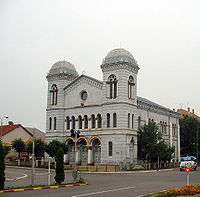 A Jewish community was present before the Habsburg takeover, and is attested to have been overseen by a starost.
Many Jews fleeing the Kingdom of Galicia and Lodomeria (as well as other Habsburg areas) from intense persecution and anti-Semitism
during the Middle Ages settled in Rădăuţi (see History of the Jews in Romania
). The community was allowed a degree of self-administration, and witnessed a period of prosperity and cultural effervescence during the 19th century.
The majority of Rădăuţi's Jewish population was exterminated during the Holocaust. Persecutions became widespread around 1938, when Jews were harassed and attacked by authorities under the Octavian Goga
government; they were confirmed by anti-Semitic legislation passed by the Ion Gigurtu
cabinet, and, in late 1940, exceptionally violent following the establishment of the National Legionary State
. In October 1941, all Jews present in Rădăuţi (more than 10,000) were deported to concentration camps in Transnistria
.
s of Moldavia
, as well as a later ruler, Roman I of Moldavia
. Is the oldest monastery from Moldova
and Bucovina 1365. Inside the monastery are 14th thumbs (like Bogdan I (1359-1365), Laţcu Voievod (1365-1373), Roman I (1391-1394), Ştefan I (1394-1399), Bogdan, the brother Alexandru cel Bun, Bogdan, son of Alexandru cel Bun and others.
Municipalities of Romania
A municipiu is a level of administrative subdivision in Romania, roughly equivalent to city in some English-speaking countries. This status is given to towns that are quite large and urbanized...
in Suceava County
Suceava County
Suceava is a county of Romania, in the historical region of Moldavia and few villages in Transylvania, with the capital city at Suceava.- Demographics :...
, Romania
Romania
Romania is a country located at the crossroads of Central and Southeastern Europe, on the Lower Danube, within and outside the Carpathian arch, bordering on the Black Sea...
with a population of 27,759 inhabitants.
Geography and demographics
Rădăuţi is situated in Bucovina, northern MoldaviaMoldavia
Moldavia is a geographic and historical region and former principality in Eastern Europe, corresponding to the territory between the Eastern Carpathians and the Dniester river...
, on a plain between the Suceava
Suceava River
The Suceava River is a river located in the north-east of Romania, in Suceava County. It rises from the Obcina Mestecăniş in Bukovina, near the border with Ukraine...
and Suceviţa
Sucevita River
The Sucevița River is a tributary of the Suceava River in Romania.-References:* Administrația Națională a Apelor Române - Cadastrul Apelor - București* Institutul de Meteorologie şi Hidrologie - Rîurile României - București 1971...
rivers, 37 km (23 mi) north from Suceava
Suceava
Suceava is the Suceava County seat in Bukovina, Moldavia region, in north-eastern Romania. The city was the capital of the Principality of Moldavia from 1388 to 1565.-History:...
, at 375 m (410 yards) altitude. It is one of the oldest settlements in Moldavia, known since the 15th century.
At the 2002 census, 96.4% of inhabitants were ethnic Romanians
Romanians
The Romanians are an ethnic group native to Romania, who speak Romanian; they are the majority inhabitants of Romania....
, 1% Russians
Russians
The Russian people are an East Slavic ethnic group native to Russia, speaking the Russian language and primarily living in Russia and neighboring countries....
and Lipovans
Lipovans
Lipovans or Lippovans are the Old Believers, mostly of Russian ethnic origin, who settled in the Moldavian Principality, in Dobruja and Eastern Muntenia...
, 0.9% Roma, 0.7% Ukrainians
Ukrainians
Ukrainians are an East Slavic ethnic group native to Ukraine, which is the sixth-largest nation in Europe. The Constitution of Ukraine applies the term 'Ukrainians' to all its citizens...
and 0.6% Germans
Germans
The Germans are a Germanic ethnic group native to Central Europe. The English term Germans has referred to the German-speaking population of the Holy Roman Empire since the Late Middle Ages....
. 83.4% were Romanian Orthodox, 9.1% Pentecostal
Pentecostal Union of Romania
The Pentecostal Union of Romania is Romania's fourth-largest religious body and one of its eighteen officially recognised religious denominations. At the 2002 census, 330,486 Romanians declared themselves to be Pentecostals; ethnically, they were 85.2% Romanians, 10.6% Roma, 1.9% Ukrainians, 1.8%...
, 3.1% Roman Catholic, 0.9% stated they belonged to another religion, 0.8% were Greek-Catholic
Romanian Church United with Rome, Greek-Catholic
The Romanian Church United with Rome, Greek-Catholic is an Eastern Catholic Church which is in full union with the Roman Catholic Church. It is ranked as a Major Archiepiscopal Church and uses the Byzantine liturgical rite in the Romanian language....
and 0.7% each Baptist
Baptist Union of Romania
The Baptist Union of Romania is an alliance of Baptist churches for cooperative ministry in Romania. Since independent churches have no legal standing in Romania, the Baptist Union also provides a mediatorial relationship between churches and government.The first modern-era Baptists in Romania...
and Lipovan Orthodox
Lipovan Orthodox Old-Rite Church
The Lipovan Orthodox Old-Rite Church is the Romanian based jurisdiction of the Belokrinitskaya Hierarchy ....
.
History
The mention of "Radomir's village" (as part of a review of boyarBoyar
A boyar, or bolyar , was a member of the highest rank of the feudal Moscovian, Kievan Rus'ian, Bulgarian, Wallachian, and Moldavian aristocracies, second only to the ruling princes , from the 10th century through the 17th century....
property in the area) in a 1392 document (uric) is generally believed to be the town's first mention, and indication of the origin of the name Rădăuți (other theories state that the settlement had its origins in earlier periods, and that the name is a Slavic
Slavic languages
The Slavic languages , a group of closely related languages of the Slavic peoples and a subgroup of Indo-European languages, have speakers in most of Eastern Europe, in much of the Balkans, in parts of Central Europe, and in the northern part of Asia.-Branches:Scholars traditionally divide Slavic...
-influenced derivative of the Latin
Latin
Latin is an Italic language originally spoken in Latium and Ancient Rome. It, along with most European languages, is a descendant of the ancient Proto-Indo-European language. Although it is considered a dead language, a number of scholars and members of the Christian clergy speak it fluently, and...
word Rottacenum, as allegedly used by soldiers in the Roman
Roman Empire
The Roman Empire was the post-Republican period of the ancient Roman civilization, characterised by an autocratic form of government and large territorial holdings in Europe and around the Mediterranean....
garrison in Siret
Siret
Siret is a town in Romania, Suceava County, one of the oldest towns in, and a former capital of, the former principality of Moldavia. It is located 2 km from the border with Ukraine, being one of the main border passing points in the North of the country, having both a road border post and a...
). The oldest mention of Rădăuți as such dates from 1413, in a document issued by Prince Alexandru cel Bun
Alexandru cel Bun
Alexander cel Bun was a Voivode of Moldavia, reigning between 1400 and 1432, son of Roman I Mușat. He succeeded Iuga to the throne, and, as a ruler, initiated a series of reforms while consolidating the status of the Moldavian Principality....
.
Eastern Orthodox Church
The Orthodox Church, officially called the Orthodox Catholic Church and commonly referred to as the Eastern Orthodox Church, is the second largest Christian denomination in the world, with an estimated 300 million adherents mainly in the countries of Belarus, Bulgaria, Cyprus, Georgia, Greece,...
church during the times of Bogdan I (1359-1365), and subsequently a bishopric
Diocese
A diocese is the district or see under the supervision of a bishop. It is divided into parishes.An archdiocese is more significant than a diocese. An archdiocese is presided over by an archbishop whose see may have or had importance due to size or historical significance...
. Around the St. Nicholas church (Bogdana Monastery
Bogdana Monastery
Bogdana Monastery is an Eastern Orthodox monastery in the town of Rădăuți, northern Romania. Its church is the oldest still standing religious building in Moldavia. The monastery was built by Bogdan I of Moldavia somewhere around 1360....
), archaeologists have uncovered a habitation layer preceding Bogdan's period of rule, one which could point to the existence of a local center prior to the formation of the Moldova state.
Awarded the privilege
Town privileges
Town privileges or city rights were important features of European towns during most of the second millennium.Judicially, a town was distinguished from the surrounding land by means of a charter from the ruling monarch that defined its privileges and laws. Common privileges were related to trading...
of organizing fair
Fair
A fair or fayre is a gathering of people to display or trade produce or other goods, to parade or display animals and often to enjoy associated carnival or funfair entertainment. It is normally of the essence of a fair that it is temporary; some last only an afternoon while others may ten weeks. ...
s, Rădăuți evolved due to its favorable location midway between the Carpathians
Carpathian Mountains
The Carpathian Mountains or Carpathians are a range of mountains forming an arc roughly long across Central and Eastern Europe, making them the second-longest mountain range in Europe...
and the tableland area (with traders from both regions establishing contact in the local market). The fairs at Rădăuți have been dated to the time of Stephen the Great
Stephen III of Moldavia
Stephen III of Moldavia was Prince of Moldavia between 1457 and 1504 and the most prominent representative of the House of Mușat.During his reign, he strengthened Moldavia and maintained its independence against the ambitions of Hungary, Poland, and the...
(a document from 1481; however, since the mention includes details of Stephen's intervention in solving a commercial dispute, it is possible that the fairs were well established by then).
Rădăuți was one of the larger cities of the Duchy of Bukovina
Bukovina
Bukovina is a historical region on the northern slopes of the northeastern Carpathian Mountains and the adjoining plains.-Name:The name Bukovina came into official use in 1775 with the region's annexation from the Principality of Moldavia to the possessions of the Habsburg Monarchy, which became...
during the period of Habsburg
Habsburg Monarchy
The Habsburg Monarchy covered the territories ruled by the junior Austrian branch of the House of Habsburg , and then by the successor House of Habsburg-Lorraine , between 1526 and 1867/1918. The Imperial capital was Vienna, except from 1583 to 1611, when it was moved to Prague...
administration (1777-1918). During that time it saw a high level of German
Germans of Romania
The Germans of Romania or Rumäniendeutsche were 760,000 strong in 1930. They are not a single group; thus, to understand their language, culture, and history, one must view them as independent groups:...
(especially Swabian) immigration.
Jewish history of Rădăuţi
Many Jews fleeing the Kingdom of Galicia and Lodomeria (as well as other Habsburg areas) from intense persecution and anti-Semitism
Anti-Semitism
Antisemitism is suspicion of, hatred toward, or discrimination against Jews for reasons connected to their Jewish heritage. According to a 2005 U.S...
during the Middle Ages settled in Rădăuţi (see History of the Jews in Romania
History of the Jews in Romania
The history of Jews in Romania concerns the Jews of Romania and of Romanian origins, from their first mention on what is nowadays Romanian territory....
). The community was allowed a degree of self-administration, and witnessed a period of prosperity and cultural effervescence during the 19th century.
The majority of Rădăuţi's Jewish population was exterminated during the Holocaust. Persecutions became widespread around 1938, when Jews were harassed and attacked by authorities under the Octavian Goga
Octavian Goga
Octavian Goga was a Romanian politician, poet, playwright, journalist, and translator.-Life:Born in Răşinari, nearby Sibiu, he was an active member in the Romanian nationalistic movement in Transylvania and of its leading group, the Romanian National Party in Austria-Hungary. Before World War I,...
government; they were confirmed by anti-Semitic legislation passed by the Ion Gigurtu
Ion Gigurtu
Ion Gigurtu was a Romanian politician, Land Forces officer, engineer and industrialist who served a brief term as Prime Minister from July 4 to September 4, 1940, under the personal regime of King Carol II. A specialist in mining and veteran of both the Second Balkan War and World War I, he made a...
cabinet, and, in late 1940, exceptionally violent following the establishment of the National Legionary State
National Legionary State
The National Legionary State was the Romanian government from September 6, 1940 to January 23, 1941. It was a single-party regime dictatorship dominated by the overtly fascist Iron Guard in uneasy conjunction with the head of government and Conducător Ion Antonescu, the leader of the Romanian...
. In October 1941, all Jews present in Rădăuţi (more than 10,000) were deported to concentration camps in Transnistria
Transnistria
Transnistria is a breakaway territory located mostly on a strip of land between the Dniester River and the eastern Moldovan border to Ukraine...
.
Bogdana Monastery
The Princely Church at Rădăuţi contained the graves of Bogdan I and his son Laţcu, both Voivodes/PrincePrince
Prince is a general term for a ruler, monarch or member of a monarch's or former monarch's family, and is a hereditary title in the nobility of some European states. The feminine equivalent is a princess...
s of Moldavia
Moldavia
Moldavia is a geographic and historical region and former principality in Eastern Europe, corresponding to the territory between the Eastern Carpathians and the Dniester river...
, as well as a later ruler, Roman I of Moldavia
Roman I of Moldavia
Roman I was Voivode of Moldavia from December 1391 to March 1394. He was the second son of Costea Muşat, the first ruler from the Muşatin family....
. Is the oldest monastery from Moldova
Moldova
Moldova , officially the Republic of Moldova is a landlocked state in Eastern Europe, located between Romania to the West and Ukraine to the North, East and South. It declared itself an independent state with the same boundaries as the preceding Moldavian Soviet Socialist Republic in 1991, as part...
and Bucovina 1365. Inside the monastery are 14th thumbs (like Bogdan I (1359-1365), Laţcu Voievod (1365-1373), Roman I (1391-1394), Ştefan I (1394-1399), Bogdan, the brother Alexandru cel Bun, Bogdan, son of Alexandru cel Bun and others.
Natives
- Avigdor ArikhaAvigdor ArikhaAvigdor Arikha was a painter, draughtsman, printmaker, and art historian.-Biography:Avigdor Arikha was born to German-speaking Jewish parents in Rădăuţi, but grew up in Czernowitz , in Bukovina, Romania., His family faced forced deportation in 1941 to the Romanian-run concentration camps of...
- Israeli painter - Metropolitan Iacov Putneanul
- Saint Bishop Leontie of Rădăuţi
- Benedict Menkes - Romanian biologist
- Dan PagisDan PagisDan Pagis was an Israeli poet, lecturer and holocaust survivor. He was born in Rădăuţi, Bukovina in Romania and imprisoned as a child in a concentration camp in Ukraine...
- Israeli Hebrew poet and literature researcher - Matei VişniecMatei VisniecMatei Vişniec is a playwright, poet and journalist born in Romania and now settled in Paris, working as a journalist at Radio France Internationale.He is known especially for his writings in the French language....
- Romanian poet and playwrighter living in France - Pavel Lucescu - Romanian journalist
External links
- Rădăuţi Online - a Romanian portal about Rădăuți
- Cancan Rădăuțean - a local newspaper about Rădăuți in Romanian