

R-colored vowel

Encyclopedia
]
In phonetics
, an R-colored or rhotic vowel (also called a vocalic R or a rhotacized vowel) is a vowel
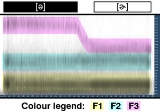
that is modified in a way that results in a lowering in frequency of the third formant
. R-colored vowels can be articulated in various ways; the tip or blade of the tongue may be turned up during at least part of the articulation of the vowel (a retroflex articulation) or the back of the tongue may be bunched: in addition the vocal tract may often be constricted in the region of the epiglottis
. In the International Phonetic Alphabet
, an R-colored vowel is indicated by a modification placed to the right of the regular symbol for the vowel. For example, the IPA symbol for schwa
is ə, while the IPA symbol for an R-colored schwa is ɚ.
R-colored vowels are rare, occurring in less than one percent of the languages of the world: however they occur in two of the most widely spoken varieties: North American English
and Mandarin Chinese. In North American English, they are found in words such as butter, nurse and, for some speakers, start. They also occur in some varieties of Dutch
and of Danish
(some Jutlandic
dialects).
Unstressed [ɚ]: standard, dinner, Lincolnshire, editor, measure, martyr
Stressed [ɑ˞]: start, car
Stressed [ɔ˞]: north, war
In words such as start, many speakers have R-coloring only in the coda of the vowel, rather than as a simultaneous articulation modifying the whole duration. This can be represented in IPA by using a succession of two symbols such as [ɑɚ] or [ɑɹ], rather than the unitary symbol [ɑ˞].
singers and many performers of Country music
in particular and, to a lesser extent, recently-arising genres of music in general. This occurs to a lesser degree in hip-hop music; Flo Rida
's "Low" is a pronounced example of this, with strong emphasis on the r-coloring of the final vowels in lyrics such as "throw my hands in the air" ([ˈʔeɪjɹ̩]). In this particular case, a vowel + r is pronounced as two syllables, a non-rhotic vowel followed by a syllabic r.
. In many words, -r suffix is added to indicate some meaning changes. In simplified written Chinese, the change is indicated with the suffix 儿. (If the word ends in a nasal, the final consonant is lost and the vowel becomes nasalized
if what is lost is a nasal velar (ng.) Major cities that have this form of rhotacized ending include Beijing
, Tianjin
, Tangshan
, Shenyang
, Changchun
, Jilin
, Harbin
, and Qiqihar
. This Erhua
has since spread to other non-Standard Mandarin speaking provincial capitals, such as Shijiazhuang
, Jinan
, Xian, Chongqing
, and Chengdu
.
In rhotic accents of Standard Mandarin Chinese such as accents in cities Beijing
, Tianjin
, most of Hebei
province (e.g. Tangshan
, Baoding
, Chengde
), Eastern Inner Mongolia (e.g. Chifeng
, Hailar
), and the three Northeastern provinces, vocalic r occurs as a diminutive
endings to nouns and the perfective aspect particle . This also occurs in the middle syllables of compound words consisting of 3 or more syllables. For example, the famous restaurant 'Gou Bu Li' (狗不理) in Tianjin is pronounced as 'Gourbli' (Gǒubùlǐ → Gǒurblǐ). 'Do not know' 不知道 (Bu Zhi Dao) is pronounced as 'Burdao' (Bùzhīdào → Bùrdào). The street 'Da Shan Lan' (大栅栏) in Beijing South City is pronounced as 'Da Shi Lar' (Dàshànlàn → Dàshílàr).
had two degrees of rhoticity among all five of its vowels, but few speakers maintain the distinction today, and then only in one or two vowels. An example is non-rhotic [be] "mouth", slightly rhotacized ("half retroflexed") [be˞] "bangle", and fully rhotacized ("fully retroflexed") [be˞˞] "crop".
In phonetics
Phonetics
Phonetics is a branch of linguistics that comprises the study of the sounds of human speech, or—in the case of sign languages—the equivalent aspects of sign. It is concerned with the physical properties of speech sounds or signs : their physiological production, acoustic properties, auditory...
, an R-colored or rhotic vowel (also called a vocalic R or a rhotacized vowel) is a vowel
Vowel
In phonetics, a vowel is a sound in spoken language, such as English ah! or oh! , pronounced with an open vocal tract so that there is no build-up of air pressure at any point above the glottis. This contrasts with consonants, such as English sh! , where there is a constriction or closure at some...
that is modified in a way that results in a lowering in frequency of the third formant
Formant
Formants are defined by Gunnar Fant as 'the spectral peaks of the sound spectrum |P|' of the voice. In speech science and phonetics, formant is also used to mean an acoustic resonance of the human vocal tract...
. R-colored vowels can be articulated in various ways; the tip or blade of the tongue may be turned up during at least part of the articulation of the vowel (a retroflex articulation) or the back of the tongue may be bunched: in addition the vocal tract may often be constricted in the region of the epiglottis
Epiglottis
The epiglottis is a flap that is made of elastic cartilage tissue covered with a mucous membrane, attached to the entrance of the larynx. It projects obliquely upwards behind the tongue and the hyoid bone, pointing dorsally. The term, like tonsils, is often incorrectly used to refer to the uvula...
. In the International Phonetic Alphabet
International Phonetic Alphabet
The International Phonetic Alphabet "The acronym 'IPA' strictly refers [...] to the 'International Phonetic Association'. But it is now such a common practice to use the acronym also to refer to the alphabet itself that resistance seems pedantic...
, an R-colored vowel is indicated by a modification placed to the right of the regular symbol for the vowel. For example, the IPA symbol for schwa
Schwa
In linguistics, specifically phonetics and phonology, schwa can mean the following:*An unstressed and toneless neutral vowel sound in some languages, often but not necessarily a mid-central vowel...
is ə, while the IPA symbol for an R-colored schwa is ɚ.
R-colored vowels are rare, occurring in less than one percent of the languages of the world: however they occur in two of the most widely spoken varieties: North American English
North American English
North American English is the variety of the English language of North America, including that of the United States and Canada. Because of their shared histories and the similarities between the pronunciation, vocabulary and accent of American English and Canadian English, the two spoken languages...
and Mandarin Chinese. In North American English, they are found in words such as butter, nurse and, for some speakers, start. They also occur in some varieties of Dutch
Dutch language
Dutch is a West Germanic language and the native language of the majority of the population of the Netherlands, Belgium, and Suriname, the three member states of the Dutch Language Union. Most speakers live in the European Union, where it is a first language for about 23 million and a second...
and of Danish
Danish language
Danish is a North Germanic language spoken by around six million people, principally in the country of Denmark. It is also spoken by 50,000 Germans of Danish ethnicity in the northern parts of Schleswig-Holstein, Germany, where it holds the status of minority language...
(some Jutlandic
Jutlandic
Jutlandic or Jutish is a term for the western dialects of Danish, spoken on the peninsula of Jutland....
dialects).
In English
The r-colored vowels of General American can be written with vowel-r digraphs:- Stressed [ɝ]:
In words such as start, many speakers have R-coloring only in the coda of the vowel, rather than as a simultaneous articulation modifying the whole duration. This can be represented in IPA by using a succession of two symbols such as [ɑɚ] or [ɑɹ], rather than the unitary symbol [ɑ˞].
In singing
Dropping r-colored vowels when singing has traditionally been nearly universal and a standard part of vocal training, but there are now numerous exceptions, including many IrishIrish people
The Irish people are an ethnic group who originate in Ireland, an island in northwestern Europe. Ireland has been populated for around 9,000 years , with the Irish people's earliest ancestors recorded having legends of being descended from groups such as the Nemedians, Fomorians, Fir Bolg, Tuatha...
singers and many performers of Country music
Country music
Country music is a popular American musical style that began in the rural Southern United States in the 1920s. It takes its roots from Western cowboy and folk music...
in particular and, to a lesser extent, recently-arising genres of music in general. This occurs to a lesser degree in hip-hop music; Flo Rida
Flo Rida
Tramar Dillard , better known by his stage name Flo Rida , is an American rapper and singer-songwriter. He released his debut album, Mail on Sunday, in March 2008. His debut single "Low", featuring T-Pain, was a #1 hit for ten weeks in United States in early 2008. Two other singles resulted from...
's "Low" is a pronounced example of this, with strong emphasis on the r-coloring of the final vowels in lyrics such as "throw my hands in the air" ([ˈʔeɪjɹ̩]). In this particular case, a vowel + r is pronounced as two syllables, a non-rhotic vowel followed by a syllabic r.
In Chinese
In Mandarin Chinese, the rhotacized ending of some words is the prime way by which to distinguish speakers of Standard Northern Mandarin (Beijing Mandarin) and Southwestern Mandarin from those of other forms of Mandarin in China. Mandarin speakers call this phenomenon ErhuaErhua
Erhua ; also called erhuayin refers to a phonological process that adds r-coloring or the "ér" sound to syllables in spoken Mandarin Chinese. It is most common in the speech varieties of North China, especially in the Beijing dialect, as a diminutive suffix for nouns, though some dialects also...
. In many words, -r suffix is added to indicate some meaning changes. In simplified written Chinese, the change is indicated with the suffix 儿. (If the word ends in a nasal, the final consonant is lost and the vowel becomes nasalized
Nasalization
In phonetics, nasalization is the production of a sound while the velum is lowered, so that some air escapes through the nose during the production of the sound by the mouth...
if what is lost is a nasal velar (ng.) Major cities that have this form of rhotacized ending include Beijing
Beijing
Beijing , also known as Peking , is the capital of the People's Republic of China and one of the most populous cities in the world, with a population of 19,612,368 as of 2010. The city is the country's political, cultural, and educational center, and home to the headquarters for most of China's...
, Tianjin
Tianjin
' is a metropolis in northern China and one of the five national central cities of the People's Republic of China. It is governed as a direct-controlled municipality, one of four such designations, and is, thus, under direct administration of the central government...
, Tangshan
Tangshan
"唐山"redirects here. For an alternative name of China, see Names of China#TangTangshan is a largely industrial prefecture-level city in Hebei province, People's Republic of China. It has become known for the 1976 Tangshan earthquake which measured 7.8 on the Richter scale and killed at least...
, Shenyang
Shenyang
Shenyang , or Mukden , is the capital and largest city of Liaoning Province in Northeast China. Currently holding sub-provincial administrative status, the city was once known as Shengjing or Fengtianfu...
, Changchun
Changchun
Changchun is the capital and largest city of Jilin province, located in the northeast of the People's Republic of China, in the center of the Songliao Plain. It is administered as a sub-provincial city with a population of 7,677,089 at the 2010 census under its jurisdiction, including counties and...
, Jilin
Jilin
Jilin , is a province of the People's Republic of China located in the northeastern part of the country. Jilin borders North Korea and Russia to the east, Heilongjiang to the north, Liaoning to the south, and Inner Mongolia to the west...
, Harbin
Harbin
Harbin ; Manchu language: , Harbin; Russian: Харби́н Kharbin ), is the capital and largest city of Heilongjiang Province in Northeast China, lying on the southern bank of the Songhua River...
, and Qiqihar
Qiqihar
- Subdivisions :Qiqihar is divided into 16 divisions: 7 districts , 8 counties and 1 county-level city .-Economy:...
. This Erhua
Erhua
Erhua ; also called erhuayin refers to a phonological process that adds r-coloring or the "ér" sound to syllables in spoken Mandarin Chinese. It is most common in the speech varieties of North China, especially in the Beijing dialect, as a diminutive suffix for nouns, though some dialects also...
has since spread to other non-Standard Mandarin speaking provincial capitals, such as Shijiazhuang
Shijiazhuang
Shijiazhuang is the capital and largest city of North China's Hebei province. Administratively a prefecture-level city, it is about south of Beijing...
, Jinan
Jinan
Jinan is the capital of Shandong province in Eastern China. The area of present-day Jinan has played an important role in the history of the region from the earliest beginnings of civilisation and has evolved into a major national administrative, economic, and transportation hub...
, Xian, Chongqing
Chongqing
Chongqing is a major city in Southwest China and one of the five national central cities of China. Administratively, it is one of the PRC's four direct-controlled municipalities , and the only such municipality in inland China.The municipality was created on 14 March 1997, succeeding the...
, and Chengdu
Chengdu
Chengdu , formerly transliterated Chengtu, is the capital of Sichuan province in Southwest China. It holds sub-provincial administrative status...
.
In rhotic accents of Standard Mandarin Chinese such as accents in cities Beijing
Beijing
Beijing , also known as Peking , is the capital of the People's Republic of China and one of the most populous cities in the world, with a population of 19,612,368 as of 2010. The city is the country's political, cultural, and educational center, and home to the headquarters for most of China's...
, Tianjin
Tianjin
' is a metropolis in northern China and one of the five national central cities of the People's Republic of China. It is governed as a direct-controlled municipality, one of four such designations, and is, thus, under direct administration of the central government...
, most of Hebei
Hebei
' is a province of the People's Republic of China in the North China region. Its one-character abbreviation is "" , named after Ji Province, a Han Dynasty province that included what is now southern Hebei...
province (e.g. Tangshan
Tangshan
"唐山"redirects here. For an alternative name of China, see Names of China#TangTangshan is a largely industrial prefecture-level city in Hebei province, People's Republic of China. It has become known for the 1976 Tangshan earthquake which measured 7.8 on the Richter scale and killed at least...
, Baoding
Baoding
-Administrative divisions:Baoding prefecture-level city consists of 3 municipal districts, 4 county-level cities, 18 counties:-Demographics:The Baoding urban area has a population of around 1,006,000 . The population of the Baoding administrative area is 10,890,000. The considerable majority are...
, Chengde
Chengde
Chengde , previously known as Jehol or Re He , is a prefecture-level city in Hebei province, People's Republic of China, situated northeast of Beijing. It is best known as the site of the Mountain Resort, a vast imperial garden and palace formerly used by the Qing emperors as summer residence...
), Eastern Inner Mongolia (e.g. Chifeng
Chifeng
Chifeng , also known as Ulanhad, is a prefecture-level city in southeastern Inner Mongolia, People's Republic of China. It borders Xilin Gol to the north and west, Tongliao to the northeast, Chaoyang prefecture of Liaoning province to the southeast, and Chengde prefecture of Hebei province to the...
, Hailar
Hailar
Hailar may refer to:* Hailar River, part of the Russia-China border* Hailar District, district in Inner Mongolia, China...
), and the three Northeastern provinces, vocalic r occurs as a diminutive
Diminutive
In language structure, a diminutive, or diminutive form , is a formation of a word used to convey a slight degree of the root meaning, smallness of the object or quality named, encapsulation, intimacy, or endearment...
endings to nouns and the perfective aspect particle . This also occurs in the middle syllables of compound words consisting of 3 or more syllables. For example, the famous restaurant 'Gou Bu Li' (狗不理) in Tianjin is pronounced as 'Gourbli' (Gǒubùlǐ → Gǒurblǐ). 'Do not know' 不知道 (Bu Zhi Dao) is pronounced as 'Burdao' (Bùzhīdào → Bùrdào). The street 'Da Shan Lan' (大栅栏) in Beijing South City is pronounced as 'Da Shi Lar' (Dàshànlàn → Dàshílàr).
Other examples
In the 1930s the Dravidian language BadagaBadaga language
The Badaga language is a southern Dravidian language spoken by approximately 400,000 people in the Nilgiri Hills in Southern India. It is known for its retroflex vowels. The word Badaga refers to the Badaga language as well as the Badaga community/tribe...
had two degrees of rhoticity among all five of its vowels, but few speakers maintain the distinction today, and then only in one or two vowels. An example is non-rhotic [be] "mouth", slightly rhotacized ("half retroflexed") [be˞] "bangle", and fully rhotacized ("fully retroflexed") [be˞˞] "crop".