
All Topics  
Quotient space


Quotient space


In topologyTopology

Topology is a branch of mathematics concerned with spatial properties preserved under bicontinuous deformation ; these are ...
 and related areas of mathematicsMathematics

Mathematics is the discipline that deals with concepts such as quantity, structure, space and change....
, a quotient space (also called an identification space) is, intuitively speaking, the result of identifying or "gluing together" certain points of a given space. The points to be identified are specified by an equivalence relationEquivalence relation

In mathematics, an equivalence relation, denoted by an infix "~", is a binary relation on a set X that is reflexive,...
. This is commonly done in order to construct new spaces from given ones.

Definition


Suppose X is a topological spaceTopological space

Topological spaces are structures that allow one to formalize concepts such as convergence, connectedness and continuity....
 and ~ is an equivalence relationEquivalence relation

In mathematics, an equivalence relation, denoted by an infix "~", is a binary relation on a set X that is reflexive,...
 on X. We define a topology on the quotient set X/~ (the set consisting of all equivalence classEquivalence class

In mathematics, given a set X'' and an equivalence relation ~ on X'', the equivalence class of an element a'' in X''...
es of ~) as follows: a set of equivalence classes in X/~ is openOpen set

In topology and related fields of mathematics, a set U is called open if, intuitively speaking, you can "wiggle" or "cha...
 if and only if their unionUnion (set theory)

In set theory and other branches of mathematics, the union of a collection of sets is the set that contains everything that ...
 is open in X.
This is the quotient topology on the quotient set X/~.

Equivalently, the quotient topology can be characterized in the following manner: Let q : XX/~ be the projection map which sends each element of X to its equivalence class. Then the quotient topology on X/~ is the finest topology for which q is continuousContinuous function (topology)

In topology and related areas of mathematics a continuous function is a morphism between topological spaces....
.

Given a surjective map f : XY from a topological space X to a setSet

In mathematics, a set can be thought of as any collection of distinct things considered as a whole....
 Y we can define the quotient topology on Y as the finest topology for which f is continuous. This is equivalent to saying that a subset VY is open in Y if and only if its preimage f−1(V) is open in X. The map f induces an equivalence relation on X by saying x1~x2 if and only ifIf and only if

In logic and fields that rely on it, such as mathematics and philosophy, "if and only if" is a logical connective between s...
 f(x1) = f(x2). The quotient space X/~ is then homeomorphic to Y (with its quotient topology) via the homeomorphism which sends the equivalence class of x to f(x).

In general, a surjective, continuous map f : XY is said to be a quotient map if Y has the quotient topology determined by f.

Examples

  • Gluing. Often, topologists talk of gluing points together. If X is a topological space and points are to be "glued", then what is meant is that we are to consider the quotient space obtained from the equivalence relation a ~ b if and only if a = b or a = x, b = y (or a = y, b = x). The two points are henceforth interpreted as one point.
  • Consider the unit square I2 = [0,1]×[0,1] and the equivalence relation ~ generated by the requirement that all boundary points be equivalent, thus identifying all boundary points to a single equivalence class. Then I2/~ is homeomorphic to the unit sphereSphere

    A sphere is a perfectly symmetrical geometrical object....
     S2.
  • Adjunction spaceAdjunction space

    An adjunction space is a common construction in topology where one topological space is attached or "glued" onto another....
    . More generally, suppose X is a space and A is a subspace of X. One can identify all points in A to a single equivalence class and leave points outside of A equivalent only to themselves. The resulting quotient space is denoted X/A. The 2-sphere is then homeomorphic to the unit disc with its boundary identified to a single point: D2/∂D2.
  • Consider the set X = R of all real numberReal number

    In mathematics, the set of real numbers, denoted R, is the set of all rational numbers and irrational numbers....
    s with the ordinary topology, and write x ~ y if and only ifIf and only if Summary

    In logic and fields that rely on it, such as mathematics and philosophy, "if and only if" is a logical connective between s...
     xy is an integerInteger

    The integers consist of the positive natural numbers , their negatives and the number zero....
    . Then the quotient space X/~ is homeomorphic to the unit circleUnit circle

    In mathematics, a unit circle is a circle with unit radius, i.e., a circle whose radius is 1....
     S1 via the homeomorphism which sends the equivalence class of x to exp(2πix).
  • A vast generalization of the previous example is the following: Suppose a topological groupTopological group

    In mathematics, a topological group G is a group that is also a topological space such that the group multiplication G...
     G actsGroup action Overview

    In mathematics, a symmetry group describes all symmetries of objects....
     continuously on a space X. One can form an equivalence relation on X by saying points are equivalent if and only if they lie in the same orbit. The quotient space under this relation is called the orbit space, denoted X/G. In the previous example G = Z acts on R by translation. The orbit space R/Z is homeomorphic to S1.


Warning: The notation R/Z is somewhat ambiguous. If Z is understood to be a group acting on R then the quotient is the circle. However, if Z is thought of as a subspace of R, then the quotient is an infinite bouquet of circlesBouquet of circles

In mathematics, a bouquet of circles is a construction in topology occurring when some number of circles are "glued" to each...
 joined at a single point.

Properties


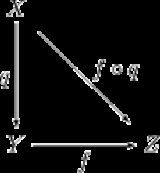
Quotient maps q : XY are characterized by the following property: if Z is any topological space and f : YZ is any function, then f is continuous if and only if f O q is continuous.


The quotient space X/~ together with the quotient map q : XX/~ is characterized by the following universal propertyUniversal property

In various branches of mathematics, certain constructions are frequently defined or characterised by an abstract property which re...
: if g : XZ is a continuous map such that a~b implies g(a)=g(b) for all a and b in X, then there exists a unique continuous map f : X/~ → Z such that g = f O q. We say that g descends to the quotient.

The continuous maps defined on X/~ are therefore precisely those maps which arise from continuous maps defined on X that respect the equivalence relation (in the sense that they send equivalent elements to the same image). This criterion is constantly being used when studying quotient spaces.

Given a continuous surjection f : XY it is useful to have criteria by which one can determine if f is a quotient map. Two sufficient criteria are that f be open or closed. Note that these conditions are only sufficient, not necessary. It is easy to construct examples of quotient maps which are neither open nor closed.

Compatibility with other topological notions

  • Separation
    • In general, quotient spaces are ill-behaved with respect to separation axioms. The separation properties of X need not be inherited by X/~, and X/~ may have separation properties not shared by X.
    • X/~ is a T1 spaceT1 space

      In topology and related branches of mathematics, T1 spaces and R0 spaces are particular kinds of topological spaces....
       if and only if every equivalence class of ~ is closed in X.
    • If the quotient map is open then X/~ is a Hausdorff spaceHausdorff space

      In topology and related branches of mathematics, a Hausdorff space, separated space or T2 space is a topological...
       if and only if ~ is a closed subset of the product space X×X.
  • ConnectednessConnectedness

    In mathematics, connectedness is used to refer to various properties meaning, in some sense, "all one piece"....
    • If a space is connected or path connected, then so are all its quotient spaces.
    • A quotient space of a simply connected or contractible space need not share those properties.
  • CompactnessCompact space

    In mathematics, a subset of Euclidean space Rn is called compact if it is closed and bounded....
    • If a space is compact, then so are all its quotient spaces.
    • A quotient space of a locally compact space need not be locally compact.
  • DimensionDimension

    In common usage, a dimension is a parameter or measurement required to define the characteristics of an object—i.e....
    • The topological dimension of a quotient space can be more (as well as less) than the dimension of the original space; space-filling curveSpace-filling curve

      Space-filling curves or Peano curves are curves, first described by Giuseppe Peano, whose ranges contain the entire 2-...
      s provide such examples.

See also


Topology

  • Subspace (topology)
  • Product space
  • Disjoint union (topology)Disjoint union (topology)

    In topology and related areas of mathematics, the disjoint union of a family of topological spaces is a space formed by equi...
  • Final topologyFinal topology

    In topology and related areas of mathematics, the final topology on a set , with respect to a family of functions into , is ...


Algebra

  • Quotient groupFacts About Quotient group

    In mathematics, given a group G'' and a normal subgroup N'' of G'', the quotient group, or factor group, of G'...
  • Quotient space (linear algebra)Quotient space (linear algebra)

    In linear algebra, the quotient of a vector space V'' by a subspace N'' is a vector space obtained by "collapsing" N''...
  • Quotient categoryQuotient category

    In mathematics, a quotient category is a category obtained from another one by identifying sets of morphisms....


>


