

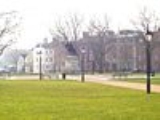
Queen Square, Bristol

Encyclopedia
Queen Square is a 2.4 hectares (5.9 acre) garden square
in the centre of Bristol
, England
. It was originally a fashionable residential address, but now most of the buildings are in office use.
The site on which the Square was built lay outside Bristol's city walls and was known as the Town Marsh. The Square was planned in 1699 and building finished in 1727. It was named in honour of Queen Anne
. The north side and much of the west were destroyed in the Bristol Riots
of 1831 and rebuilt. Many of the buildings now have listed building status.
In 1937 the Inner Circuit Road was driven diagonally across the Square but in 2000 it was removed and the open space restored.
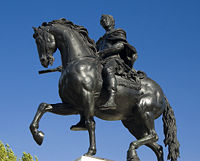 In the centre of the Square is an idealised equestrian statue of William III
by John Michael Rysbrack
, cast in 1733 and erected in 1736 to signify the city's loyalty. The brass statue is on a Portland ashlar pedestal with a moulded plinth and cornice and is a grade I listed building.
, (II* listed), and a terrace (1833) by Henry Rumley, which are now offices, (II* listed).
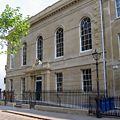 The east side contains some 20th century buildings and the Port Authority Office
(1889) by William Venn Gough
. The Sailors Refuge
which makes up nos 27-29 dates from 1709-11 and is II* listed.
The south side contains varied 18th century buildings. Two are by R.S. Pope. The west side was rebuilt in the 1830s after the riot, largely by Henry Rumley, some of which are still private houses but many are offices.
was developed from the end of the 18th century and through the 19th century, it supplanted Queen Square.
The famous privateer
Woodes Rogers
had a house on the west side. There is a plaque that commemorates this on a building that now occupies the site of his former home.
William Miles (1728 - 1803), Sheriff of Bristol in 1766, Mayor of Bristol in 1780 and Warden of the Merchant Venturers, lived at number 61 (now renumbered as 69/70/71) and the house became the offices of his family's extensive business interests.
After the American Revolution
, the former colonies of America
had their first Embassy in the Square.
of 1831 took place after the House of Lords
rejected the second Reform Bill
, which aimed to get rid of some of the rotten boroughs and give Britain's fast growing industrial towns such as Bristol, Manchester
, Birmingham
, Bradford
and Leeds
, greater representation in the House of Commons. Bristol had been represented in the House of Commons
since 1295, however by 1830 only 6,000 of the 104,000 population had the vote.
The local magistrate Sir Charles Wetherell
, a strong opponent of the Bill, visited Bristol to open the new Assize Courts, on 29 October. He threatened to imprison participants in a disturbance going on outside, and an angry mob chased him to the Mansion House in Queen Square. The magistrate escaped in disguise but the mayor and officials were besieged in the Mansion-house.
The rioters numbered about 500 or 600 young men and continued for three days, during which the palace of the Bishop of Bristol
, the mansion of the Mayor of Bristol, and private homes and property were looted and destroyed, along with demolition of much of the gaol
. Work on the Clifton Suspension Bridge
was halted and Isambard Kingdom Brunel
himself was sworn in as a special constable
.
Lieutenant-Colonel Thomas Brereton
of the Dragoons led a charge with drawn swords through the mob in Queen Square. Hundreds were killed and wounded and the mob dispersed. Brereton was later court-martialled for leniency because he had refused to open fire on the crowds, but shot himself before the conclusion of his trial.
About 100 people involved were tried in January 1832 by Chief Justice Tindal
.
Four men were hanged despite a petition
of 10,000 Bristolian signatures, which was given to King William IV.
By 1966 the Corporation were looking at the possibility of reducing the flow of traffic through the Square by changing the route of the Inner Circuit Road to pass along The Grove and thence across the mouth of St Augustine's Reach. They even considered it possible that the road across Queen Square might eventually be closed if circumstances permitted. By the 1980s it was recognised that the dual carriageway was a "massive intrusion" on the amenity of the Square, and plans were made to "put things right".
In 1992 the dual carriageway was closed to through traffic for an initial six-month trial period. It never reopened. Buses continued to pass around the Square, however, until they were eventually diverted via The Grove and Prince Street.
The Square has now been restored to a very high standard. The railings and forecourts of the surrounding buildings have been reinstated, and the central open space with its promenades and equestrian statue restored to their former grandeur. The restoration is recognised as a major success.
The Square is often used for public events, mostly in the summer months.
Garden square
A garden square is an open space with buildings surrounding a garden, often located in fashionable urban areas. There are many garden squares in London, England, for example. The large estates in London, e.g., the Bedford Estate in Bloomsbury, included garden squares in their development....
in the centre of Bristol
Bristol
Bristol is a city, unitary authority area and ceremonial county in South West England, with an estimated population of 433,100 for the unitary authority in 2009, and a surrounding Larger Urban Zone with an estimated 1,070,000 residents in 2007...
, England
England
England is a country that is part of the United Kingdom. It shares land borders with Scotland to the north and Wales to the west; the Irish Sea is to the north west, the Celtic Sea to the south west, with the North Sea to the east and the English Channel to the south separating it from continental...
. It was originally a fashionable residential address, but now most of the buildings are in office use.
The site on which the Square was built lay outside Bristol's city walls and was known as the Town Marsh. The Square was planned in 1699 and building finished in 1727. It was named in honour of Queen Anne
Anne of Great Britain
Anne ascended the thrones of England, Scotland and Ireland on 8 March 1702. On 1 May 1707, under the Act of Union, two of her realms, England and Scotland, were united as a single sovereign state, the Kingdom of Great Britain.Anne's Catholic father, James II and VII, was deposed during the...
. The north side and much of the west were destroyed in the Bristol Riots
Bristol Riots
The Bristol riots refer to a number of significant riots in the city of Bristol in England.- Bristol Bridge riot, 1793 :The Bristol Bridge Riot of 30 September 1793 began as a protest at renewal of an act levying of tolls on Bristol Bridge, which included the proposal to demolish several houses...
of 1831 and rebuilt. Many of the buildings now have listed building status.
In 1937 the Inner Circuit Road was driven diagonally across the Square but in 2000 it was removed and the open space restored.
Statue
Equestrian statue of William III
Equestrian statue of William III is a historic statue in the centre of Queen Square in Bristol, England.The statue of William III by John Michael Rysbrack, cast in 1733 and erected in 1736 to signify the city's loyalty. The bronze statue is on a Portland ashlar pedestal with a moulded plinth and...
by John Michael Rysbrack
John Michael Rysbrack
Johannes Michel or John Michael Rysbrack, original name Jan Michiel Rijsbrack , was an 18th-century Flemish sculptor. His birth-year is sometimes given as 1693 or 1684....
, cast in 1733 and erected in 1736 to signify the city's loyalty. The brass statue is on a Portland ashlar pedestal with a moulded plinth and cornice and is a grade I listed building.
Architecture
The north side contains the Custom House (1835-7) by Sydney SmirkeSydney Smirke
Sydney Smirke, architect, was born in London, England, the younger brother of Sir Robert Smirke, also an architect. Their father, also Robert Smirke, had been a well-known 18th Century painter.Sydney Smirke's works include:...
, (II* listed), and a terrace (1833) by Henry Rumley, which are now offices, (II* listed).
Queen Square House, Bristol
Queen Square House is an historic building situated in Queen Square, Bristol, England.Originally constructed in 1889 to the plans of William Venn Gough, as the Port of Bristol Authority Docks Office, it is in a richly decorated Classical style with a roof in the French Empire style.It has been...
(1889) by William Venn Gough
William Venn Gough
William Venn Gough was an architect responsible for a number of prominent buildings in Bristol. His works include the Cabot Tower, Colston's Girls' School, Trinity Road Library, and Port of Bristol Authority Docks Office, now Queen Square House, in Queen Square.From 1872 he had an office at...
. The Sailors Refuge
Sailors Refuge, Bristol
The Sailors Refuge is an historic house situated at 27–29 Queen Square, Bristol, England.It dates from 1709–1710 and is one of the few remaining houses from the original construction of the square. It was one of the architecturally richer houses, and provides an example of what the more demanding...
which makes up nos 27-29 dates from 1709-11 and is II* listed.
The south side contains varied 18th century buildings. Two are by R.S. Pope. The west side was rebuilt in the 1830s after the riot, largely by Henry Rumley, some of which are still private houses but many are offices.
Residents
In the 18th century, Queen Square was the most sought after place to live in Bristol, but as CliftonClifton, Bristol
Clifton is a suburb of the City of Bristol in England, and the name of both one of the city's thirty-five council wards. The Clifton ward also includes the areas of Cliftonwood and Hotwells...
was developed from the end of the 18th century and through the 19th century, it supplanted Queen Square.
The famous privateer
Privateer
A privateer is a private person or ship authorized by a government by letters of marque to attack foreign shipping during wartime. Privateering was a way of mobilizing armed ships and sailors without having to spend public money or commit naval officers...
Woodes Rogers
Woodes Rogers
Woodes Rogers was an English sea captain, privateer, and, later, the first Royal Governor of the Bahamas. He is known as the captain of the vessel that rescued the marooned Alexander Selkirk, whose plight is generally believed to have inspired Daniel Defoe's Robinson Crusoe.Rogers came from an...
had a house on the west side. There is a plaque that commemorates this on a building that now occupies the site of his former home.
William Miles (1728 - 1803), Sheriff of Bristol in 1766, Mayor of Bristol in 1780 and Warden of the Merchant Venturers, lived at number 61 (now renumbered as 69/70/71) and the house became the offices of his family's extensive business interests.
After the American Revolution
American Revolution
The American Revolution was the political upheaval during the last half of the 18th century in which thirteen colonies in North America joined together to break free from the British Empire, combining to become the United States of America...
, the former colonies of America
United States
The United States of America is a federal constitutional republic comprising fifty states and a federal district...
had their first Embassy in the Square.
Riot
The Bristol RiotsBristol Riots
The Bristol riots refer to a number of significant riots in the city of Bristol in England.- Bristol Bridge riot, 1793 :The Bristol Bridge Riot of 30 September 1793 began as a protest at renewal of an act levying of tolls on Bristol Bridge, which included the proposal to demolish several houses...
of 1831 took place after the House of Lords
House of Lords
The House of Lords is the upper house of the Parliament of the United Kingdom. Like the House of Commons, it meets in the Palace of Westminster....
rejected the second Reform Bill
Reform Act 1832
The Representation of the People Act 1832 was an Act of Parliament that introduced wide-ranging changes to the electoral system of England and Wales...
, which aimed to get rid of some of the rotten boroughs and give Britain's fast growing industrial towns such as Bristol, Manchester
Manchester
Manchester is a city and metropolitan borough in Greater Manchester, England. According to the Office for National Statistics, the 2010 mid-year population estimate for Manchester was 498,800. Manchester lies within one of the UK's largest metropolitan areas, the metropolitan county of Greater...
, Birmingham
Birmingham
Birmingham is a city and metropolitan borough in the West Midlands of England. It is the most populous British city outside the capital London, with a population of 1,036,900 , and lies at the heart of the West Midlands conurbation, the second most populous urban area in the United Kingdom with a...
, Bradford
Bradford
Bradford lies at the heart of the City of Bradford, a metropolitan borough of West Yorkshire, in Northern England. It is situated in the foothills of the Pennines, west of Leeds, and northwest of Wakefield. Bradford became a municipal borough in 1847, and received its charter as a city in 1897...
and Leeds
Leeds
Leeds is a city and metropolitan borough in West Yorkshire, England. In 2001 Leeds' main urban subdivision had a population of 443,247, while the entire city has a population of 798,800 , making it the 30th-most populous city in the European Union.Leeds is the cultural, financial and commercial...
, greater representation in the House of Commons. Bristol had been represented in the House of Commons
British House of Commons
The House of Commons is the lower house of the Parliament of the United Kingdom, which also comprises the Sovereign and the House of Lords . Both Commons and Lords meet in the Palace of Westminster. The Commons is a democratically elected body, consisting of 650 members , who are known as Members...
since 1295, however by 1830 only 6,000 of the 104,000 population had the vote.
The local magistrate Sir Charles Wetherell
Charles Wetherell
Sir Charles Wetherell , was an English lawyer, politician and judge.Wetherell was born in Oxford, the third son of Reverend Nathan Wetherell, of Durham, Master of the University College and Vice-Chancellor of the University of Oxford...
, a strong opponent of the Bill, visited Bristol to open the new Assize Courts, on 29 October. He threatened to imprison participants in a disturbance going on outside, and an angry mob chased him to the Mansion House in Queen Square. The magistrate escaped in disguise but the mayor and officials were besieged in the Mansion-house.
The rioters numbered about 500 or 600 young men and continued for three days, during which the palace of the Bishop of Bristol
Bishop of Bristol
The Bishop of Bristol heads the Church of England Diocese of Bristol in the Province of Canterbury, in England.The present diocese covers parts of the counties of Somerset and Gloucestershire together with a small area of Wiltshire...
, the mansion of the Mayor of Bristol, and private homes and property were looted and destroyed, along with demolition of much of the gaol
Old City Gaol, Bristol
The Old City Gaol is in Cumberland Road, close to Bristol Harbour, England.It was built in 1832 by Richard Shackleton Pope after the original, which was designed by HH Seward in 1816 was destroyed in the Bristol Riots of 1831...
. Work on the Clifton Suspension Bridge
Clifton Suspension Bridge
Brunel died in 1859, without seeing the completion of the bridge. Brunel's colleagues in the Institution of Civil Engineers felt that completion of the Bridge would be a fitting memorial, and started to raise new funds...
was halted and Isambard Kingdom Brunel
Isambard Kingdom Brunel
Isambard Kingdom Brunel, FRS , was a British civil engineer who built bridges and dockyards including the construction of the first major British railway, the Great Western Railway; a series of steamships, including the first propeller-driven transatlantic steamship; and numerous important bridges...
himself was sworn in as a special constable
Special constable
A Special Constable is a law enforcement officer who is not a regular member of a police force. Some like the Royal Canadian Mounted Police carry the same law enforcement powers as regular members, but are employed in specific roles, such as explosive disposal technicians, court security, campus...
.
Lieutenant-Colonel Thomas Brereton
Thomas Brereton
Lieutenant-Colonel Thomas Brereton was an Irish soldier who led the dragoons against the rioters during the Bristol Riots and was subsequently court-martialled for his leniency.He was the governor of Senegal by the time of the Méduse tragedy....
of the Dragoons led a charge with drawn swords through the mob in Queen Square. Hundreds were killed and wounded and the mob dispersed. Brereton was later court-martialled for leniency because he had refused to open fire on the crowds, but shot himself before the conclusion of his trial.
About 100 people involved were tried in January 1832 by Chief Justice Tindal
Nicholas Conyngham Tindal
Sir Nicolas Conyngham Tindal was a celebrated English lawyer who successfully defended Queen Caroline at her trial for adultery in 1820...
.
Four men were hanged despite a petition
Petition
A petition is a request to do something, most commonly addressed to a government official or public entity. Petitions to a deity are a form of prayer....
of 10,000 Bristolian signatures, which was given to King William IV.
Restoration
In 1937 Bristol Corporation approved the construction of a dual carriageway road diagonally across the Square, from the north-west to the south-east corner. This formed part of the Inner Circuit Road, connecting Redcliffe Way with The Centre, and involved the demolition of property in both corners of the Square and the re-alignment of the Rysbrack statue.By 1966 the Corporation were looking at the possibility of reducing the flow of traffic through the Square by changing the route of the Inner Circuit Road to pass along The Grove and thence across the mouth of St Augustine's Reach. They even considered it possible that the road across Queen Square might eventually be closed if circumstances permitted. By the 1980s it was recognised that the dual carriageway was a "massive intrusion" on the amenity of the Square, and plans were made to "put things right".
In 1992 the dual carriageway was closed to through traffic for an initial six-month trial period. It never reopened. Buses continued to pass around the Square, however, until they were eventually diverted via The Grove and Prince Street.
The Square has now been restored to a very high standard. The railings and forecourts of the surrounding buildings have been reinstated, and the central open space with its promenades and equestrian statue restored to their former grandeur. The restoration is recognised as a major success.
The Square is often used for public events, mostly in the summer months.