

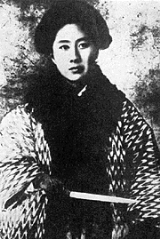
Qiu Jin

Encyclopedia
China
Chinese civilization may refer to:* China for more general discussion of the country.* Chinese culture* Greater China, the transnational community of ethnic Chinese.* History of China* Sinosphere, the area historically affected by Chinese culture...
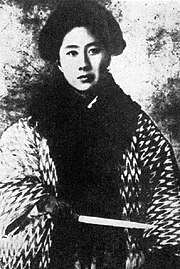
anti-Qing Empire revolutionary, feminist and writer. She was executed after a failed uprising and today is considered a heroine in China.
Biography
Born in XiamenXiamen
Xiamen , also known as Amoy , is a major city on the southeast coast of the People's Republic of China. It is administered as a sub-provincial city of Fujian province with an area of and population of 3.53 million...
, Fujian Province, Qiu grew up in her ancestral home, Shānyīn Village, Shaoxing
Shaoxing
Shaoxing is a prefecture-level city in northeastern Zhejiang province, People's Republic of China. Located on the south bank of the Qiantang River estuary, it borders Ningbo to the east, Taizhou to the southeast, Jinhua to the southwest, and Hangzhou to the west. It was once known as "越"...
Subprefecture, Zhejiang Province. Married, Qiu found herself in contact with new ideas. In 1904 she decided to travel overseas and study in Japan
Japan
Japan is an island nation in East Asia. Located in the Pacific Ocean, it lies to the east of the Sea of Japan, China, North Korea, South Korea and Russia, stretching from the Sea of Okhotsk in the north to the East China Sea and Taiwan in the south...
, leaving her two children behind. She was fond of martial arts, and known by her acquaintances for wearing Western male dress and for her left-wing ideology. She joined the Triads, who at the time advocated the overthrow of the Qing dynasty
Qing Dynasty
The Qing Dynasty was the last dynasty of China, ruling from 1644 to 1912 with a brief, abortive restoration in 1917. It was preceded by the Ming Dynasty and followed by the Republic of China....
and return of Chinese government to the Chinese people. She joined the anti-Qing societies Guangfuhui
Guangfuhui
Guāngfùhuì , or the Restoration Society, was an anti-Qing organization established by Cai Yuanpei in 1904...
, led by Cai Yuanpei
Cai Yuanpei
Cai Yuanpei was a Chinese educator and the president of Peking University. He was known for his critical evaluation of the Chinese culture that led to the influential May Fourth Movement...
, and the Tokyo
Tokyo
, ; officially , is one of the 47 prefectures of Japan. Tokyo is the capital of Japan, the center of the Greater Tokyo Area, and the largest metropolitan area of Japan. It is the seat of the Japanese government and the Imperial Palace, and the home of the Japanese Imperial Family...
-based Tongmenghui
Tongmenghui
The Tongmenghui, also known as the Chinese United League, United League, Chinese Revolutionary Alliance, Chinese Alliance and United Allegiance Society, was a secret society and underground resistance movement formed when merging many Chinese revolutionary groups together by Sun Yat-sen, Song...
led by Sun Yat-sen
Sun Yat-sen
Sun Yat-sen was a Chinese doctor, revolutionary and political leader. As the foremost pioneer of Nationalist China, Sun is frequently referred to as the "Father of the Nation" , a view agreed upon by both the People's Republic of China and the Republic of China...
. She returned to China in 1905.
After returning to China, Qiu Jin started publishing a women's magazine in which she encouraged women to gain financial independence through education and training in various professions. She encouraged women to resist oppression by their families and by the government. At the time it was still customary for women in China to have their feet bound at the age of five. The result of this practice was that the feet were small but crippled. Women's freedom of movement was severely restricted and left them dependent on other people. Such helpless women were, however, more desired as wives, so their families continued the practice to protect their daughters' future security.
Qiu Jin felt that a better future for women lay under a Western-type government instead of the Manchu
Manchu
The Manchu people or Man are an ethnic minority of China who originated in Manchuria . During their rise in the 17th century, with the help of the Ming dynasty rebels , they came to power in China and founded the Qing Dynasty, which ruled China until the Xinhai Revolution of 1911, which...
government that was in power at the time. She joined forces with her cousin Xu Xilin
Xu Xilin
Xu Xilin , was a Chinese revolutionary born in Dongpu, Shanyin, Shaoxing, Zhejiang during the Qing dynasty.Xu was sent to Japan in 1903 for study where he joined other Zhejiang students in rescuing Zhang Taiyan, who was arrested for spreading Anti Qing views...
and together they worked to unite many secret revolutionary societies to work together for the overthrow of the Manchu government.
She was an eloquent orator who spoke out for women's rights
Women's rights
Women's rights are entitlements and freedoms claimed for women and girls of all ages in many societies.In some places these rights are institutionalized or supported by law, local custom, and behaviour, whereas in others they may be ignored or suppressed...
, such as the freedom to marry, freedom of education, and abolishment of bound feet
Foot binding
Foot binding was the custom of binding the feet of young girls painfully tight to prevent further growth. The practice probably originated among court dancers in the early Song dynasty, but spread to upper class families and eventually became common among all classes. The tiny narrow feet were...
. In 1906 she founded a radical women's journal with another female poet, Xu Zihua
Xu Zihua
Xu Zihua was a Chinese poet.She was educated at home and interested in poetry from an early age. She became a widow when she was still young and became the principal of Xunxi Girls' School. Both she and her sister Xu Yunhua were part of the South Association. In 1906, she hired Qiu Jin, an...
, in Shanghai
Shanghai
Shanghai is the largest city by population in China and the largest city proper in the world. It is one of the four province-level municipalities in the People's Republic of China, with a total population of over 23 million as of 2010...
. In 1907 she became head of the Datong school in Shaoxing, ostensibly a school for sport teachers, but really intended for the military training of revolutionaries.
On July 6, 1907 Xu Xilin was caught by the authorities before a scheduled uprising. He confessed his involvement under interrogation and was executed. Immediately after, on July 12, the government troops arrested Qiu Jin at the school for girls where she was a principal. She was tortured but refused to admit her involvement in the plot, but they found incriminating documents and a few days later she was publicly beheaded in her home village, Shānyīn, at the age of 31.. Qiu Jin was acknowledged immediately by the revolutionaries as a heroine and martyr, and she became a symbol of women's independence in China.
Qiu was immortalized in Republican China's popular consciousness and literature after her death. She is now buried beside West Lake
West Lake
Xī Hú is a famous fresh water lake located in the historic center of Hangzhou, the capital of Zhejiang province in eastern China. The lake is divided by the causeways of Sū Tí , Bái Tí , and Yánggōng Tí...
in Hangzhou
Hangzhou
Hangzhou , formerly transliterated as Hangchow, is the capital and largest city of Zhejiang Province in Eastern China. Governed as a sub-provincial city, and as of 2010, its entire administrative division or prefecture had a registered population of 8.7 million people...
. The People's Republic of China
People's Republic of China
China , officially the People's Republic of China , is the most populous country in the world, with over 1.3 billion citizens. Located in East Asia, the country covers approximately 9.6 million square kilometres...
established a museum for her in Shaoxing
Shaoxing
Shaoxing is a prefecture-level city in northeastern Zhejiang province, People's Republic of China. Located on the south bank of the Qiantang River estuary, it borders Ningbo to the east, Taizhou to the southeast, Jinhua to the southwest, and Hangzhou to the west. It was once known as "越"...
City.
Literary works
While Qiu is mainly remembered in the West as revolutionary and feminist, one aspect of her life that gets overlooked is her poetry and essays. Having received an exceptional education in classical literature, reflected in her writing of more traditional poetry (shi and ci) Qiu composed verse with a wide range of metaphors and allusions; mixing classical mythology along with revolutionary rhetoric.For example, in a poem Ayscough translates as, "Capping Rhymes with Sir Shih Ching From Sun's Root Land" (147) we read the following:
秋瑾〈日人石井君索和即用原韻〉
漫云女子不英雄,萬里乘風獨向東。
詩思一帆海空闊,夢魂三島月玲瓏。
銅駝已陷悲回首,汗馬終慚未有功。
如許傷心家國恨,那堪客裡度春風。
Don't tell me women
are not the stuff of heroes,
I alone rode over the East Sea's
winds for ten thousand leagues.
My poetic thoughts ever expand,
like a sail between ocean and heaven.
I dreamed of your three islands,
all gems, all dazzling with moonlight.
I grieve to think of the bronze camels,
guardians of China, lost in thorns.
Ashamed, I have done nothing;
not one victory to my name.
I simply make my war horse sweat.
Grieving over my native land
hurts my heart. So tell me;
how can I spend these days here?
A guest enjoying your spring winds?
Editors Sun Chang and Saussy (642)explain the metaphors as follows:
line 4: "Your islands" translates "sandao," literally "three islands," referring to Honshū, Shikoku and Kyushu, while omitting Hokkaido - an old fashion way of referring to Japan.
line 6: ... the conditions of the bronze camels, symbolic guardians placed before the imperial palace, is traditionally considered to reflect the state of health of the ruling dynasty. But in Qiu's poetry, it reflects instead the state of health of China …
External links
- The Qiu Jin Museum
- Autumn Gem - Qiu Jin documentary film