


Qazvin Province

Encyclopedia
The Qazvin Province is one of the 31 provinces
of Iran
. It is in the north-west of the country, and its center is the city of Qazvin
. The province was created in 1993 out of part of Tehran Province
and includes 20 cities: Qazvin
, Takestan
, Abyek, Buin-Zahra, Eqhbalieh, Mohammadieh, Alvand
, Esfarvarin, Mahmood Abad Nemooneh, Khoram Dasht, Ziä Abad, Avaj
, Shäl
, Danesfahan
, Abgarm
, Ardägh
, Moallem Keläyeh, Razmian Kouhin and Bidestan
in the form of four townships (chief cities) contains 18 sections, 44 rural districts, and 1543 villages.
The province had a population of 1.14 million people by the 2006 census, of which 68.05% lived in cities and 31.95% in villages. The ratio of men to women is 50.7 to 49.3%. 99.61% of the province population were Muslims and 0.39% of the rest came from other religions. The literacy rate is over 82%, ranking 7th in Iran
.
, on the south by Markazi
and on the east by Tehran Province
s.
The famous mountains of the province are those of Siälän, Shäh Alborz, Khashchäl, Sephidkouh, Shojä e din, Alehtareh, Rämand, Ägh dägh, Kharaghän, Saridagh, Soltan pïr, and Siähkouh, in which Siälän with a height of 4175m and Shäh Alborz which is 4056m are the highest. All are part of the central chain of Alborz
. The lowest point of the province is in Tärom e Soflä.
The climate of the province in the northern parts is cold and snowy in winters and temperate in summers. In the southern parts the climate is mild with comparatively cold winters and warm summers.
The majority of the people of the province as well as the city of Qazvin are Persians
and the main language of the people of Qazvin is Persian language
with the Qazvini accent. Other languages include Tati-Persian (in Takestan), Kurdish, Azeri, Luri, Romani.
Archeological findings in the Qazvin plain reveal the existence of urban agricultural settlements as far back as 7000 BC. The name “Qazvin” or “Kasbin” is derived from Cas, an ancient tribe that lived south of the Caspian Sea
millennia ago. The Caspian Sea itself in fact derives its name from the same origin. Qazvin geographically connects Tehran, Isfahan, and the Persian Gulf
to the Caspian seacoast and Asia Minor
, hence its strategic location throughout the ages.
Qazvin has been a hotbed of historical developments in Iranian history. In the early years of the Islamic era Qazvin served as a base for the Arab forces. Destroyed by Genghis Khan
(13th century), the Safavid monarchs made Qazvin the capital of the Safavid empire in 1548 only to have it moved to Isfahan
in 1598. During the Qajar Dynasty and contemporary period, Qazvin has always been one of the most important governmental centers due to its proximity to Tehran. Abbas Mirza
, a Crown Prince
and Minister of Commerce, was also the governor of Qazvin.
Qazvin is situated close to Alamut
, where the famous Hasan-i Sabbah, founder of the secret Ismaili
order of the Assassins
, operated from.
Bombed and occupied by Russian forces in both World Wars, Qazvin is also where the coup d’etat of General Reza Khan, with his Russia
n-trained Cossack
brigade, was launched from - which led to the founding of the Pahlavi dynasty
in 1921.
 Qazvin contains several archeological excavations dating back 9000 years ago. There are also 23 castles from the Ismaili Assassins nearby as well. And in the middle of the city, there lies the ruins of Meimoon Ghal'eh
, one of several Sassanid edifices in the area.
Qazvin contains few buildings from the Safavi era when it was capital of Persia. Perhaps the most famous of the surviving edifices is the Ali Qapu mansion, today a museum in central Qazvin.
According to explorers Pietro Della Valle
, Jean Baptist Tavenier, Johannes Chardin, and others, there have been many Christians of various sects living in Qazvin for centuries. Qazvin is the location of the Saint Hripsime church, and it is also where four Jewish prophets gave tidings of the arrival of Jesus Christ. Their tomb is now a popular shrine called Peighambariyeh.
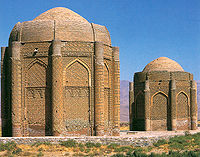 Another grand attraction in Qazvin Province, is the tombs of two Saljuki era princes, Aboo Saeed Bijar son of Sad and Aboo Mansoor Iltai son of Takin, that are located in two separate towers known as the Kharaghan twin towers. Constructed in 1067, these are the first monuments in Islamic Architecture which include a non-conic two-layered dome.
Both towers were severely damaged by a devastating earthquake on March 2003.
Some popular shrines and Mausoleums in Qazvin province are:
s and caravanserai
s:
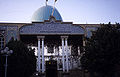 During the 9th century AD seven gates made entrance to the city possible. In Qajar period there existed nine gates surrounding the city which were connected to each other through a wall around the city. These gates (darvāzeh in Persian) were:
Due to 20th century hasty urban expansion, only the last two gates remain standing. Other popular attractions of Qazvin province include:
trade, including cotton
, silk
and velvet
, in addition to leather
. It is on the railroad line and the highway
between Tehran and Tabriz
.
Qazvin has one of the largest power plants feeding electricity into Iran's national power grid, the Shahid Raja'i facility, which provides 7% of the country's electricity.
Provinces of Iran
Iran is subdivided into thirty one provinces , each governed from a local center, usually the largest local city, which is called the capital of that province...
of Iran
Iran
Iran , officially the Islamic Republic of Iran , is a country in Southern and Western Asia. The name "Iran" has been in use natively since the Sassanian era and came into use internationally in 1935, before which the country was known to the Western world as Persia...
. It is in the north-west of the country, and its center is the city of Qazvin
Qazvin
Qazvin is the largest city and capital of the Province of Qazvin in Iran. At the 2006 census, its population was 349,821, in 96,420 families....
. The province was created in 1993 out of part of Tehran Province
Tehran Province
Tehran Province is one of the 31 provinces of Iran. It covers on area of 18,909 square kilometers and is located to the north of the central plateau of Iran....
and includes 20 cities: Qazvin
Qazvin
Qazvin is the largest city and capital of the Province of Qazvin in Iran. At the 2006 census, its population was 349,821, in 96,420 families....
, Takestan
Takestan
Takestan is a city in and the capital of Takestan County, in Qazvin Province, Iran. At the 2006 census its population was 73,625, in 18,685 families.Takestan has a railway station on the Teheran-Tabriz line...
, Abyek, Buin-Zahra, Eqhbalieh, Mohammadieh, Alvand
Alvand
Alvand or Alvand Kuh is a subrange of Zagros in western Iran.This mountain chain is located near Hamedan, with a summit of 3570 m, and consists mainly of intrusive rocks ....
, Esfarvarin, Mahmood Abad Nemooneh, Khoram Dasht, Ziä Abad, Avaj
Avaj
Avaj is a city in and capital of Avaj District, in Buin Zahra County, Qazvin Province, Iran. At the 2006 census its population was 3,695, in 1,042 families....
, Shäl
Shal
Shal is a city in and the capital of Shal District, in Buin Zahra County, Qazvin Province, Iran. At the 2006 census its population was 15,104, in 3,348 families....
, Danesfahan
Danesfahan
Danesfahan is a city in and the capital of Ramand District, in Buin Zahra County, Qazvin Province, Iran. At the 2006 census, its population was 8,687, in 2,141 families....
, Abgarm
Abgarm
Abgarm or Abegarm is a city in and the capital of Abgarm District, in Buin Zahra County, Qazvin Province, Iran. Abgarm lies along Road 37, about 20 kilometres north by road from Avaj. At the 2006 census its population was 5,191, in 1,345 families....
, Ardägh
Ardagh
Ardagh may refer to several villages in Ireland:* Ardagh, County Donegal* Ardagh, County Longford* Ardagh, County Limerick, where the Ardagh Hoard was found in 1868* Ardagh, County Mayo, south of Ballina...
, Moallem Keläyeh, Razmian Kouhin and Bidestan
Bidestan
Bidestan is a city in Mohammadiyeh District, Alborz County, Qazvin Province, Iran. At the 2006 census its population was 20,110, in 5,263 families....
in the form of four townships (chief cities) contains 18 sections, 44 rural districts, and 1543 villages.
The province had a population of 1.14 million people by the 2006 census, of which 68.05% lived in cities and 31.95% in villages. The ratio of men to women is 50.7 to 49.3%. 99.61% of the province population were Muslims and 0.39% of the rest came from other religions. The literacy rate is over 82%, ranking 7th in Iran
Iran
Iran , officially the Islamic Republic of Iran , is a country in Southern and Western Asia. The name "Iran" has been in use natively since the Sassanian era and came into use internationally in 1935, before which the country was known to the Western world as Persia...
.
Geography, climate and people
The province covers 15821 km² between 48-45 to 50-50 east of Greenwich Meridian of longitude and 35-37 to 36-45 north latitude of the equator. The province is bounded on the north by Mazandaran and Gilan, on the west by Hamedan and ZanjanZanjan Province
Zanjan Province is one of the 31 provinces of Iran. Located in the North West of Iran, its capital is Zanjan city. Zanjan province with an area of 36,400 km² has a mostly rural, population of 964,601 . The province lies 330 km northwest of Tehran, connected to it via a freeway.Zanjan...
, on the south by Markazi
Markazi Province
Markazi Province is one of the 31 provinces of Iran. The word markazi means central in Persian. Markazi lies in western Iran. Its capital is Arak. Its population is estimated at 1.35 million...
and on the east by Tehran Province
Tehran Province
Tehran Province is one of the 31 provinces of Iran. It covers on area of 18,909 square kilometers and is located to the north of the central plateau of Iran....
s.
The famous mountains of the province are those of Siälän, Shäh Alborz, Khashchäl, Sephidkouh, Shojä e din, Alehtareh, Rämand, Ägh dägh, Kharaghän, Saridagh, Soltan pïr, and Siähkouh, in which Siälän with a height of 4175m and Shäh Alborz which is 4056m are the highest. All are part of the central chain of Alborz
Alborz
Alborz , also written as Alburz, Elburz or Elborz, is a mountain range in northern Iran stretching from the borders of Azerbaijan and Armenia in the northwest to the southern end of the Caspian Sea, and ending in the east at the borders of Turkmenistan and Afghanistan...
. The lowest point of the province is in Tärom e Soflä.
The climate of the province in the northern parts is cold and snowy in winters and temperate in summers. In the southern parts the climate is mild with comparatively cold winters and warm summers.
The majority of the people of the province as well as the city of Qazvin are Persians
Persian people
The Persian people are part of the Iranian peoples who speak the modern Persian language and closely akin Iranian dialects and languages. The origin of the ethnic Iranian/Persian peoples are traced to the Ancient Iranian peoples, who were part of the ancient Indo-Iranians and themselves part of...
and the main language of the people of Qazvin is Persian language
Persian language
Persian is an Iranian language within the Indo-Iranian branch of the Indo-European languages. It is primarily spoken in Iran, Afghanistan, Tajikistan and countries which historically came under Persian influence...
with the Qazvini accent. Other languages include Tati-Persian (in Takestan), Kurdish, Azeri, Luri, Romani.
History
Qazvin was the location of a former capital of the Persian Empire and contains over 2000 architectural and archeological sites. It is a provincial capital today that has been a cultural center of mass throughout history.Archeological findings in the Qazvin plain reveal the existence of urban agricultural settlements as far back as 7000 BC. The name “Qazvin” or “Kasbin” is derived from Cas, an ancient tribe that lived south of the Caspian Sea
Caspian Sea
The Caspian Sea is the largest enclosed body of water on Earth by area, variously classed as the world's largest lake or a full-fledged sea. The sea has a surface area of and a volume of...
millennia ago. The Caspian Sea itself in fact derives its name from the same origin. Qazvin geographically connects Tehran, Isfahan, and the Persian Gulf
Persian Gulf
The Persian Gulf, in Southwest Asia, is an extension of the Indian Ocean located between Iran and the Arabian Peninsula.The Persian Gulf was the focus of the 1980–1988 Iran-Iraq War, in which each side attacked the other's oil tankers...
to the Caspian seacoast and Asia Minor
Asia Minor
Asia Minor is a geographical location at the westernmost protrusion of Asia, also called Anatolia, and corresponds to the western two thirds of the Asian part of Turkey...
, hence its strategic location throughout the ages.
Qazvin has been a hotbed of historical developments in Iranian history. In the early years of the Islamic era Qazvin served as a base for the Arab forces. Destroyed by Genghis Khan
Genghis Khan
Genghis Khan , born Temujin and occasionally known by his temple name Taizu , was the founder and Great Khan of the Mongol Empire, which became the largest contiguous empire in history after his death....
(13th century), the Safavid monarchs made Qazvin the capital of the Safavid empire in 1548 only to have it moved to Isfahan
Isfahan (city)
Isfahan , historically also rendered in English as Ispahan, Sepahan or Hispahan, is the capital of Isfahan Province in Iran, located about 340 km south of Tehran. It has a population of 1,583,609, Iran's third largest city after Tehran and Mashhad...
in 1598. During the Qajar Dynasty and contemporary period, Qazvin has always been one of the most important governmental centers due to its proximity to Tehran. Abbas Mirza
Abbas Mirza
Prince, Field-Marshal Abbas Mirza born Amol city , was a Qajar crown prince of Persia. He developed a reputation as a military commander during wars with Russia and the Ottoman Empire, as an early modernizer of Persia's armed forces and institutions, and for his death before his father, Fath Ali...
, a Crown Prince
Crown Prince
A crown prince or crown princess is the heir or heiress apparent to the throne in a royal or imperial monarchy. The wife of a crown prince is also titled crown princess....
and Minister of Commerce, was also the governor of Qazvin.
Qazvin is situated close to Alamut
Alamut
Alamut was a mountain fortress located in the South Caspian province of Daylam near the Rudbar region in Iran, approximately 100 kilometres from present-day Tehran, Iran...
, where the famous Hasan-i Sabbah, founder of the secret Ismaili
Ismaili
' is a branch of Shia Islam. It is the second largest branch of Shia Islam, after the Twelvers...
order of the Assassins
Hashshashin
The Assassins were an order of Nizari Ismailis, particularly those of Persia that existed from around 1092 to 1265...
, operated from.
Bombed and occupied by Russian forces in both World Wars, Qazvin is also where the coup d’etat of General Reza Khan, with his Russia
Russia
Russia or , officially known as both Russia and the Russian Federation , is a country in northern Eurasia. It is a federal semi-presidential republic, comprising 83 federal subjects...
n-trained Cossack
Cossack
Cossacks are a group of predominantly East Slavic people who originally were members of democratic, semi-military communities in what is today Ukraine and Southern Russia inhabiting sparsely populated areas and islands in the lower Dnieper and Don basins and who played an important role in the...
brigade, was launched from - which led to the founding of the Pahlavi dynasty
Pahlavi dynasty
The Pahlavi dynasty consisted of two Iranian/Persian monarchs, father and son Reza Shah Pahlavi and Mohammad Reza Shah Pahlavi The Pahlavi dynasty consisted of two Iranian/Persian monarchs, father and son Reza Shah Pahlavi (reg. 1925–1941) and Mohammad Reza Shah Pahlavi The Pahlavi dynasty ...
in 1921.
Main sights
Meimoon Ghal'eh
right|thumb|380px|Meimoon Ghaleh, one of several ancient castle ruins in or near Qazvin, Iran.left|thumb|Meimoon Ghaleh, plan of lower level.right|thumb|Meimoon Ghaleh, plan of main floor.Meimoon Ghal'eh Castle, also known as Mehman Ghal'eh Castle is one of several castle ruins scattered throughout...
, one of several Sassanid edifices in the area.
Qazvin contains few buildings from the Safavi era when it was capital of Persia. Perhaps the most famous of the surviving edifices is the Ali Qapu mansion, today a museum in central Qazvin.
Historical mosques
After Islam, the abundant attendance of mystics (ascetics), as well as the prevalence of tradition (Hadith), religious jurisprudence (Fegh´h), and philosophy in Qazvin, led to the emergence of many mosques and religious schools among which the most magnificent ones are:- Jame e Atigh Mosque: One of the oldest mosques in Iran constructed by the orders of Harun al-RashidHarun al-RashidHārūn al-Rashīd was the fifth Arab Abbasid Caliph in Iraq. He was born in Rey, Iran, close to modern Tehran. His birth date remains a point of discussion, though, as various sources give the dates from 763 to 766)....
in 807AD. In spite of the devastating MongolMongolsMongols ) are a Central-East Asian ethnic group that lives mainly in the countries of Mongolia, China, and Russia. In China, ethnic Mongols can be found mainly in the central north region of China such as Inner Mongolia...
invasion, this mosque still stands today in its full glory. - Heidarieh Mosque: Renovated by Amir Khomär-täsh after the earthquake of 1119 AD, the history of construction of this mosque goes back to pre-Islam, where it was a fire temple.
- Masjed Al-nabiAl-Nabi Mosque, QazvinThe al-Nabi Mosque is a famous mosque in Qazvīn. The mosque has an area of about 14,000m², and bears inscriptions indicating that Fath Ali Shah of the Qajar dynasty was the founder of the mosque. Other sources however indicate that the mosque has been in existence since the Safavid period...
(Soltani Mosque): With an area of 14000 m2, this mosque is one of the most glorious mosques of antiquity, built in the Safavid period. - Sanjideh Mosque: Another mosque of Qazvin dating back to pre-Islamic Iran; a former fire temple. Its present day form is attributed to the Seljukian era.
- Panjeh Ali Mosque: A former place of worship for royal harem members in the Safavid period.
- Peighambarieh School-Mosque: Founded 1644 according to inscription.
- Peighambarieh Shrine: Where four Jewish saints who foretold the coming of Christ, are buried.
- Molla Verdikhani School-Mosque: founded in 1648.
- Salehieh School-Mosque: founded in 1845.
- Sheikhol Islam School-Mosque: renovated in 1903.
- Eltefatieh School: Dating back to the Il-Khanid period.
- Sardar School- Mosque: Made by two brothers Hossein Khan and Hassan Khan Sardar in 1815, as a fulfillment of their promise if they came back victorious from a battle against the Russians.
Churches and Russian architecture
Qazvin actually contains three buildings built by the Russians in the late 19th/early 20th century. Among these is the current Mayor's office (former Ballet Hall), a water reservoir, and the Cantor church where a Russian pilot is buried.According to explorers Pietro Della Valle
Pietro Della Valle
Pietro della Valle was an Italian who traveled throughout Asia during the Renaissance period. His travels took him to the Holy Land, the Middle East, Northern Africa, and as Far as India.-Biography:...
, Jean Baptist Tavenier, Johannes Chardin, and others, there have been many Christians of various sects living in Qazvin for centuries. Qazvin is the location of the Saint Hripsime church, and it is also where four Jewish prophets gave tidings of the arrival of Jesus Christ. Their tomb is now a popular shrine called Peighambariyeh.
Castles and forts
These are castles and fortifications left over mostly from the Isma'ili movement of the Middle Ages:- Alamout CastleAlamutAlamut was a mountain fortress located in the South Caspian province of Daylam near the Rudbar region in Iran, approximately 100 kilometres from present-day Tehran, Iran...
- Lambesar Castle
- Shirkouh Castle
- Qez Qaleh Castle
- Shemiran Castle
- Meimoon Ghal'ehMeimoon Ghal'ehright|thumb|380px|Meimoon Ghaleh, one of several ancient castle ruins in or near Qazvin, Iran.left|thumb|Meimoon Ghaleh, plan of lower level.right|thumb|Meimoon Ghaleh, plan of main floor.Meimoon Ghal'eh Castle, also known as Mehman Ghal'eh Castle is one of several castle ruins scattered throughout...
- Barajin Qaleh
Tombs, shrines and mausoleums
Both towers were severely damaged by a devastating earthquake on March 2003.
Some popular shrines and Mausoleums in Qazvin province are:
- Imamzadeh Hossein
- Peighambarieh (where 4 Jewish prophets are buried)
- Imamzadeh Ismail
- Ameneh Khatoon
- Zobeideh Khatoon (that has also a unique traditional water reservoir)
- Imamzadeh Abazar
- Imamzadeh Abdollah and Imamzadeh Fazlollah in Farsajin
- Imamzadeh Vali in Ziaabad
- Imamzadeh Kamal in Ziaabad
- Imamzadeh Ali in Shekarnab
- Haft Sandoogh Pilgrimage Place
- Tombs of Hassan Abad and Shahkouh
- Soltan Veis
- Mausoleum of Pir e Takestan
- Kafar Gonbad
- Hamdollah MostowfiHamdollah MostowfiHamdollah Mostowfi was a Persian historian, geographer and epic poet.Mostowfi is the author of Nozhat ol-Gholub , Zafar-Nameh , and the Tarikh e Gozideh . His tomb is a structure with a blue turquoise conical dome, at Qazvin.-References and notes:...
's Tomb - Imam Ahmad Ghazali's Tomb
- Molla Khalila's Tomb
- Shahid Sales' Tomb
- Raeesol Mojahedin's Tomb
Traditional reservoirs
In the old days, Qazvin was nicknamed the 'city of water reservoirs'. Of the 100 or so water reservoirs of Qazvin, only 10 remain today, all protected by the Provincial Cultural Heritage Organization. See: List of famous ab anbars of QazvinBazaars and caravanserais
Qazvin has some fine examples of centuries old BazaarBazaar
A bazaar , Cypriot Greek: pantopoula) is a permanent merchandising area, marketplace, or street of shops where goods and services are exchanged or sold. The term is sometimes also used to refer to the "network of merchants, bankers and craftsmen" who work that area...
s and caravanserai
Caravanserai
A caravanserai, or khan, also known as caravansary, caravansera, or caravansara in English was a roadside inn where travelers could rest and recover from the day's journey...
s:
- Sa'd-ol-Saltaneh ComplexCaravanserai of Sa'd al-SaltanehThe Caravanserai of Sa'd al-Saltaneh is a large Caravanserai located in the city of Qazvin in Qazvin Province of Iran.Built during the Qajar era, the caravanserai is one of Persia's best preserved urban caravanserais...
- Qeisarieh
- Saray e Vazir
- Saray e Razavi (Shah)
- Saray e Hadj Reza
- Sadieh Bazaar
- Shah Abbasi Caravanserai of Avaj
- Shah Abbasi Caravanserai of Mohammad Abad
- Hajib Shah Abbasi Caravanserai (Keikhosro)
City Gates and other edifices
- Panbeh Riseh
- Sheikh Abad
- Rasht
- Maghlävak
- Khandaghbar
- Shahzadeh Hossein
- Mossala
- Tehran
- Räh e Koushk
Due to 20th century hasty urban expansion, only the last two gates remain standing. Other popular attractions of Qazvin province include:
- Chehel Sotun Museum-Palace
- Hosseinieh Aminiha, a fine example of Traditional Persian residential architecture indigenous to Qazvin.
- Shah Abbasi Bridge
- Safa Traditional Bath
- Qajar Traditional Bath
Famous people
Aside from Shahzadeh Hossein, a shiite saint, where a handsome shrine has been built, there are an abundance of scientists and mystics who lived in Qazvin, or came from Qazvin, or whose tombs are scattered throughout the cities and villages of the province. Some of these are:- Ali Akbar DehkhodaAli Akbar DehkhodaAllameh Ali Akbar Dehkhoda was a prominent Iranian linguist, and author of the most extensive dictionary of the Persian language ever published.-Biography:...
: Prominent linguist and author of Iran's first modern Persian dictionary, was originally from Qazvin. - Obeid Zakani
- Oveis Qarani: A celebrity of early Islam, thought to have been killed here while fighting against an army of Deilamian origin. His tomb is known as Sultan Veis.
- Hamdollah MostowfiHamdollah MostowfiHamdollah Mostowfi was a Persian historian, geographer and epic poet.Mostowfi is the author of Nozhat ol-Gholub , Zafar-Nameh , and the Tarikh e Gozideh . His tomb is a structure with a blue turquoise conical dome, at Qazvin.-References and notes:...
: The great Il-Khanid historian and writer (1281–1349) and author of The Selected History (Tarikh Gozideh), Nezhatol Qoloub and Zafar Nameh. The turquoise conic dome and its inscription in Sols calligraphy in which Mostowfi’s family tree and his works are introduced are the features that distinguish the tomb from other historical monuments of Qazvin. - Imam Ahmad Ghazali: Famous Iranian Gnostic who died in 1126 CE and was buried beside Shahzadeh Hossein. His tomb up to the end of the 16th century A.D. became the pilgrimage place for mystical sects. Following Shah Tahmasb’ s stubborn policies against philosophers and mystics and destroying Ghazali’s tomb, a group of his disciples took the remains of his body to the present place in Imamzadeh Ismail alley and constructed a new mausoleum for him. The monument was destroyed again in Mohammad Shah Qajar’s period only to be re-constructed by Majdol Islam Qazvini in 1910. Beside Ghazali’s tomb there is another tomb belonging to Soltan Seyed Mohammad Vali which dates back to 1625 CE
- Molla Khalil Ibn Ghazi Qazvini: Famous faghih (religious jurist) and famous commentator of the Qur'anQur'anThe Quran , also transliterated Qur'an, Koran, Alcoran, Qur’ān, Coran, Kuran, and al-Qur’ān, is the central religious text of Islam, which Muslims consider the verbatim word of God . It is regarded widely as the finest piece of literature in the Arabic language...
in Safavid period (d 1678). - Shahidsaless: Killed in 1846. The third religious leader to be killed during prayer (first one being Imam Ali).
- Ra'ees ol-Mojahedin: The late Mirza Hassan Sheikhol Islam son of Mirza Masood Sheikhol Islam, leader of the liberals and constitutionalists of Qazvin whose endeavors and devotion to abolish the Qajar dynasty and conquer Tehran brought the title of Raeesol Mojahedin (chief of fighters) for him.
- TáhirihTáhirihTáhirih or Qurratu'l-`Ayn are both titles of Fátimih Baraghání , an influential poet and theologian of the Bábí Faith in Iran. Her life, influence and execution made her a key figure of the religion...
Agriculture
13,000 km² are under cultivation in the province, covering 12% of the cultivable lands of the country. These are fed by numerous subterranean canals, deep and semi-deep wells, and a large irrigating canal which originates from The Sangbän dam in Taleghän and Ziärän. The agricultural produce of the land is grape, hazelnut, pistachio, almond, walnut, olive, apple, wheat, barely, sugar beet, pomegranate, fig, and cereals. Animal husbandry, and aquatic and poultry breeding are developed throughout the province.Industries
In recent decades, Qazvin has become a developing pole of the country, primarily due to its preferable location. Qazvin today is a center of textileTextile
A textile or cloth is a flexible woven material consisting of a network of natural or artificial fibres often referred to as thread or yarn. Yarn is produced by spinning raw fibres of wool, flax, cotton, or other material to produce long strands...
trade, including cotton
Cotton
Cotton is a soft, fluffy staple fiber that grows in a boll, or protective capsule, around the seeds of cotton plants of the genus Gossypium. The fiber is almost pure cellulose. The botanical purpose of cotton fiber is to aid in seed dispersal....
, silk
Silk
Silk is a natural protein fiber, some forms of which can be woven into textiles. The best-known type of silk is obtained from the cocoons of the larvae of the mulberry silkworm Bombyx mori reared in captivity...
and velvet
Velvet
Velvet is a type of woven tufted fabric in which the cut threads are evenly distributed,with a short dense pile, giving it a distinctive feel.The word 'velvety' is used as an adjective to mean -"smooth like velvet".-Composition:...
, in addition to leather
Leather
Leather is a durable and flexible material created via the tanning of putrescible animal rawhide and skin, primarily cattlehide. It can be produced through different manufacturing processes, ranging from cottage industry to heavy industry.-Forms:...
. It is on the railroad line and the highway
Highway
A highway is any public road. In American English, the term is common and almost always designates major roads. In British English, the term designates any road open to the public. Any interconnected set of highways can be variously referred to as a "highway system", a "highway network", or a...
between Tehran and Tabriz
Tabriz
Tabriz is the fourth largest city and one of the historical capitals of Iran and the capital of East Azerbaijan Province. Situated at an altitude of 1,350 meters at the junction of the Quri River and Aji River, it was the second largest city in Iran until the late 1960s, one of its former...
.
Qazvin has one of the largest power plants feeding electricity into Iran's national power grid, the Shahid Raja'i facility, which provides 7% of the country's electricity.
Colleges and universities
- Imam Khomeini International UniversityImam Khomeini International University-A Brief History Of The University:The IKIU is one of the universities in I.R.Iran which is to be considered as a fruit of the Islamic Revolution. This university is dorned by the holy name of the founder of the Islamic Revolution, Imam Khomeini and under the support, pure effort and willpower of...
- Islamic Azad University of Takestan
- Islamic Azad University of Qazvin
- Qazvin University of Medical SciencesQazvin University of Medical SciencesQazvin University of Medical Sciences, is a medical school in Qazvin Province of Iran.Located in northwest of Tehran in the city of Qazvin, the university was established in 1984, and fell under the Ministry of Health and Medical Education in 1986....
- Shahid Babaee Technical Institute
Official links
- Qazvin Information Network
- Qazvin Province Organization of Commerce
- Qazvin Department of Education
- Qazvin Department of Planning and Management
- Qazvin Department of Natural Resources
- Qazvin Department of Rural Cooperation
- Qazvin Department of Cooperation
- Qazvin Department of Transportation
- Qazvin Department fo Rural Water and Wastes
- Qazvin Department of Technical Training
- Prisons General Office of Qazvin Province
Miscellaneous
- Qazvin Society of Chemists
- Qazvin Bureau of Technicians
- Construction Engineering Regulatory Commission of Qazvin
- Taban Newspaper (based in Qazvin)
- Sedaye Sanat (Economic Monthly from Qazvin)
- Qazvin Phone Directory
- Qazvin Photographer's Guild
- Qazvin Province Information Network
- Qazvin Tourism Bureau
- Qazvin Cultural Heritage Organization
- Mir Emad Qazvini website
- Qazvin Visual Arts Association
- Qazvin Calligraphers Council
- Qazvin Red Crescent Rescue Emergency Unit
- Tebyan (Qazvin Religious Cultural Organization)
- Qazvin Industrial Estates Corporation
- Qazvin Electric Power Company