


Qazakh

Encyclopedia
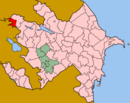
Administrative divisions of Azerbaijan
Politically, Azerbaijan is divided into:*59 districts ,*11 cities ,*1 autonomous republic , which itself contains:**7 districts**1 city...
of Azerbaijan
Azerbaijan
Azerbaijan , officially the Republic of Azerbaijan is the largest country in the Caucasus region of Eurasia. Located at the crossroads of Western Asia and Eastern Europe, it is bounded by the Caspian Sea to the east, Russia to the north, Georgia to the northwest, Armenia to the west, and Iran to...
. It has two exclave
Enclave and exclave
In political geography, an enclave is a territory whose geographical boundaries lie entirely within the boundaries of another territory.An exclave, on the other hand, is a territory legally or politically attached to another territory with which it is not physically contiguous.These are two...
s inside Armenia
Armenia
Armenia , officially the Republic of Armenia , is a landlocked mountainous country in the Caucasus region of Eurasia...
, Yukhari Askipara
Yukhari Askipara
Yuxarı Əskipara is a village in the Qazakh Rayon of Azerbaijan. Together with Aşağı Əskipara , it forms an exclave of Azerbaijan. The exclave is surrounded by Armenia and has been controlled by it since the Nagorno-Karabakh War. The entire exclave is about 37 square kilometers...
and Barkhudarli, both of which came under Armenian control during the Nagorno-Karabakh War
Nagorno-Karabakh War
The Nagorno-Karabakh War was an armed conflict that took place from February 1988 to May 1994, in the small enclave of Nagorno-Karabakh in southwestern Azerbaijan, between the majority ethnic Armenians of Nagorno-Karabakh backed by the Republic of Armenia, and the Republic of Azerbaijan...
.
History
In antiquity, this rayon was part of the province of UtikUtik
Utik was a historic province of the Kingdom of Armenia and a region of Caucasian Albania. Most of the region is located within present-day Azerbaijan immediately west of the Kura River while a part of it lies within the Tavush province of present-day northeastern Armenia.-History:According to...
. The region was referred to as the "Albanian plain" by its local historians Movses Kaghankatvatsi
Movses Kaghankatvatsi
Movses Kaghankatvatsi , or Movses Daskhurantsi , is the reputed author of a 10th-century Old Armenian historiographical work on Caucasian Albania, known as The History of the Country of Albania .- Authorship :...
, Movses Khorenatsi
Movses Khorenatsi
Moses of Chorene, also Moses of Khoren, Moses Chorenensis, or Movses Khorenatsi , or a 7th to 9th century date) was an Armenian historian, and author of the History of Armenia....
, and Hovannes Draskhanakertsi. The region was conquered by a succession of neighbouring powers or invaders, including Sassanid Persians
Sassanid Empire
The Sassanid Empire , known to its inhabitants as Ērānshahr and Ērān in Middle Persian and resulting in the New Persian terms Iranshahr and Iran , was the last pre-Islamic Persian Empire, ruled by the Sasanian Dynasty from 224 to 651...
, the Byzantine Empire
Byzantine Empire
The Byzantine Empire was the Eastern Roman Empire during the periods of Late Antiquity and the Middle Ages, centred on the capital of Constantinople. Known simply as the Roman Empire or Romania to its inhabitants and neighbours, the Empire was the direct continuation of the Ancient Roman State...
, the Arabs
Caliphate
The term caliphate, "dominion of a caliph " , refers to the first system of government established in Islam and represented the political unity of the Muslim Ummah...
, the Seljuq Turks
Seljuq dynasty
The Seljuq ; were a Turco-Persian Sunni Muslim dynasty that ruled parts of Central Asia and the Middle East from the 11th to 14th centuries...
, the Georgians
History of Georgia (country)
The nation of Georgia was first unified as a kingdom under the Bagrationi dynasty in the 9th to 10th century, arising from a number of predecessor states of ancient Colchis and Iberia...
, the Mongols
Mongol Empire
The Mongol Empire , initially named as Greater Mongol State was a great empire during the 13th and 14th centuries...
, the Timurids
Timurid Dynasty
The Timurids , self-designated Gurkānī , were a Persianate, Central Asian Sunni Muslim dynasty of Turko-Mongol descent whose empire included the whole of Iran, modern Afghanistan, and modern Uzbekistan, as well as large parts of contemporary Pakistan, North India, Mesopotamia, Anatolia and the...
, the Kara Koyunlu
Kara Koyunlu
The Kara Koyunlu or Qara Qoyunlu, also called the Black Sheep Turkomans , were a Shi'ite Oghuz Turkic tribal federation that ruled over the territory comprising the present-day Armenia, Azerbaijan, north-western Iran, eastern Turkey and Iraq from about 1375 to 1468.The Kara Koyunlu Turkomans at one...
and Ak Koyunlu
Ak Koyunlu
The Aq Qoyunlu or Ak Koyunlu, also called the White Sheep Turkomans , was an Sunni Oghuz Turkic tribal federation that ruled parts of present-day Eastern Turkey, Armenia, Azerbaijan, northern Iraq, and Iran from 1378 to 1508.-History:According to chronicles from the Byzantine Empire, the Aq Qoyunlu...
Turkoman
Turkmen people
The Turkmen are a Turkic people located primarily in the Central Asian states of Turkmenistan, Afghanistan, and northeastern Iran. They speak the Turkmen language, which is classified as a part of the Western Oghuz branch of the Turkic languages family together with Turkish, Azerbaijani, Qashqai,...
tribes, and finally Safavid Iran
Safavid dynasty
The Safavid dynasty was one of the most significant ruling dynasties of Iran. They ruled one of the greatest Persian empires since the Muslim conquest of Persia and established the Twelver school of Shi'a Islam as the official religion of their empire, marking one of the most important turning...
.
After the Russo-Persian War (1804-1813)
Russo-Persian War (1804-1813)
The 1804-1813 Russo-Persian War, one of the many wars between the Persian Empire and Imperial Russia, began like many wars as a territorial dispute. The Persian king, Fath Ali Shah Qajar, wanted to consolidate the northernmost reaches of his Qajar dynasty by securing land near the Caspian Sea's...
, the Russian Empire
Russian Empire
The Russian Empire was a state that existed from 1721 until the Russian Revolution of 1917. It was the successor to the Tsardom of Russia and the predecessor of the Soviet Union...
gained control of the area by virtue of the Treaty of Gulistan. Under Russian rule, it formed the northeastern part of the Kazakh uyezd of the Elisabethpol Governorate
Elisabethpol Governorate
Elisabethpol Governorate or Elizavetpol Governorate was one of the guberniyas of the Russian Empire, with its centre in Elisabethpol . Its area was 44,136 sq. kilometres, and it had 878,415 inhabitants by 1897....
. A contemporary military historian noted the following ethnographic detail: "Abbas Mirza's route lay through the country of the great tribe of the Casaks, which is extremely strong and thickly wooded." He further notes that: "These have no connection with the Russia
Russia
Russia or , officially known as both Russia and the Russian Federation , is a country in northern Eurasia. It is a federal semi-presidential republic, comprising 83 federal subjects...
n Cossacks. They are descended from men of the Kirgis Casaks, left by Genghis Khan
Genghis Khan
Genghis Khan , born Temujin and occasionally known by his temple name Taizu , was the founder and Great Khan of the Mongol Empire, which became the largest contiguous empire in history after his death....
, and are Mahomedans of the Soonnie [Sunni Muslims] sect. They are frequently called Kara Papaks
Karapapak
The Karapapak are a small ethnic group of Turkic-speaking people who mainly live in Azerbaijan, in Georgia, in the northeast of Turkey near the border with Georgia and Armenia, primarily in the provinces of Ardahan , Kars and Iğdır, and in Iran...
, from wearing black sheep-skin caps."
When the South Caucasus came under British occupation, Sir John Oliver Wardrop
Oliver Wardrop
Sir John Oliver Wardrop, KBE, CMG was a British diplomat, traveller and translator, primarily known as the United Kingdom's first Chief Commissioner of Transcaucasus in Georgia, 1919-21, and also as the founder and benefactor of Kartvelian studies at Oxford University.After traveling to Georgia ...
, British Chief Commissioner in the South Caucasus, decided that assigning the Erivan Governorate
Erivan Governorate
Erivan Governorate was one of the guberniyas of the Russian Empire, with its centre in Erivan . Its area was 27,830 sq. kilometres. It roughly corresponded to what is now most of central Armenia, the Iğdır Province of Turkey, and Azerbaijan's Nakhchivan exclave...
and the Kars Oblast
Kars Oblast
Kars Oblast was one of Transcaucasian governorates of Russian Empire between 1878 and 1917. Its capital was in the city of Kars, presently in the Republic of Turkey. The governorate bordered with the Ottoman Empire, Batum Oblast, Tiflis Governorate, Erivan Governorate, and from 1883 to 1903 with...
to Democratic Republic of Armenia
Democratic Republic of Armenia
The Democratic Republic of Armenia was the first modern establishment of an Armenian state...
(DRA) and the Elisabethpol and Baku
Baku Governorate
Baku Governorate was one of the guberniyas of the Russian Empire, with its centre in Baku. Area : 34,4000 sq. verstas, population : 789,659. The only foreign border of the governorate was Persia, in the south...
Governorates to the Azerbaijan Democratic Republic
Azerbaijan Democratic Republic
The Azerbaijan Democratic Republic was the first successful attempt to establish a democratic and secular republic in the Muslim world . The ADR was founded on May 28, 1918 after the collapse of the Russian Empire that began with the Russian Revolution of 1917 by Azerbaijani National Council in...
(ADR) would solve the region's outstanding disputes. However, this proposal was rejected by both Armenians (who did not wish to give up their claims to Kazakh, Zangezur (today Syunik
Syunik
Syunik is the southernmost province of Armenia. It borders the Vayots Dzor marz to the north, Azerbaijan's Nakhchivan exclave to the west, Karabakh to the east, and Iran to the south. Its capital is Kapan. Other important cities and towns include Goris, Sisian, Meghri, Agarak, and Dastakert...
), and Nagorno-Karabakh
Nagorno-Karabakh
Nagorno-Karabakh is a landlocked region in the South Caucasus, lying between Lower Karabakh and Zangezur and covering the southeastern range of the Lesser Caucasus mountains...
) and Azerbaijanis (who found it unacceptable to give up their claims to Nakhichevan
Nakhichevan
The Nakhchivan Autonomous Republic is a landlocked exclave of Azerbaijan. The region covers 5,363 km² and borders Armenia to the east and north, Iran to the south and west, and Turkey to the northwest...
). As conflict broke out between the two groups, the British left the region in mid-1919.
List of Historic and Tourist Sites
There are 112 protected monuments in the region of Qazakh, of which 54 are archaeological, 46 are architectural, 7 are historical, and 5 are of artistic significance. Historic and tourist sites in this region include:- The House of the Poet Samad Vurgun in Yukhari Salahli village, since 1976.
- The Museum of History and Ethnography, since 1984.
- The Qazakh State Picture Gallery by the Ministry of Culture of AzerbaijanAzerbaijanAzerbaijan , officially the Republic of Azerbaijan is the largest country in the Caucasus region of Eurasia. Located at the crossroads of Western Asia and Eastern Europe, it is bounded by the Caspian Sea to the east, Russia to the north, Georgia to the northwest, Armenia to the west, and Iran to...
, since 1986. - The Memorial museum of Molla Panah VagifMolla Panah VagifMolla Panah Vagif was an 18th-century poet, the founder of the realism genre in the Azerbaijani poetry and also a prominent statesman and diplomat, vizier – the minister of foreign affairs in the Karabakh khanate.- Life :...
and Molla Vali VidadiMolla Vali VidadiMolla Vali Vidadi was an Azerbaijani poet.Little is known about Vidadi. He spent most of his life in his native town of Shamkir where he taught at a religious school he had established himself. According to some sources, Vidadi spent some years in Tiflis, Georgia, where we served as a court poet...
, since 1970. - The House of Teachers Seminary of Qazakh, built in 1910, functioned between 1918 and 1959.
- The Bath House of Israfil Agha, built in the first decade of the 20th century by Israfil Agha Kerbelayev from the village of Kasaman.
- The Damjili Caves, in the village of Dash Salahli, south-east of the mount Avey, cover an area of 360 km2 and refer to MiddleMiddle PaleolithicThe Middle Paleolithic is the second subdivision of the Paleolithic or Old Stone Age as it is understood in Europe, Africa and Asia. The term Middle Stone Age is used as an equivalent or a synonym for the Middle Paleolithic in African archeology. The Middle Paleolithic and the Middle Stone Age...
and Upper PaleolithicUpper PaleolithicThe Upper Paleolithic is the third and last subdivision of the Paleolithic or Old Stone Age as it is understood in Europe, Africa and Asia. Very broadly it dates to between 40,000 and 10,000 years ago, roughly coinciding with the appearance of behavioral modernity and before the advent of...
, MesolithicMesolithicThe Mesolithic is an archaeological concept used to refer to certain groups of archaeological cultures defined as falling between the Paleolithic and the Neolithic....
and NeolithicNeolithicThe Neolithic Age, Era, or Period, or New Stone Age, was a period in the development of human technology, beginning about 9500 BC in some parts of the Middle East, and later in other parts of the world. It is traditionally considered as the last part of the Stone Age...
eras. - Sining Korpu (The Broken Bridge) , 12th century bridge built over the Ehram (Khram) river in the village Ikinji Shikhli.
- Didevan Castle , a 6th-7th century monument in the village of Khanliglar.
- Mount GoyazanMount GoyazanMount Goyazan is a mountain in northwestern Qazakh Rayon of Azerbaijan. It is located in the vicinity of the villages Abbasbeyli and Alpout, and rises 857.9 metres above the sea level. Ruins of a Goyazan fortress from the 14th century were found near the mountain.-See also:*Qazakh Rayon*Tourism in...
, a rare archaeological monument in the village of Abbasbeyli, rises 857.9 metres above sea level. - The Baba Dervish Habitation, an archaeological site in the village Demirchiler.
- The Kazim Bridge in the village of Yukhari AskiparaYukhari AskiparaYuxarı Əskipara is a village in the Qazakh Rayon of Azerbaijan. Together with Aşağı Əskipara , it forms an exclave of Azerbaijan. The exclave is surrounded by Armenia and has been controlled by it since the Nagorno-Karabakh War. The entire exclave is about 37 square kilometers...
, allegedly built during the reign of Shamsi Khan. - The Juma Mosque of Qazakh, built in 1902 by Akhund Haji Zeynalabdin Mahammadli Oglu from the village of Kasaman.
- The Aslanbeyli Mosque built in 1909 by Hamid Efendi, the native of village Aslanbeyli.
- Santepe, an archaeological site dating to the 9th-8th centuries B.C. and the Iron Age.
- The Qazakhbeyli Hills, an archaeological site daiting from the 8th-6th centuries B.C. near the village of Qazakhbeyli.
- The Shikhli Human Camp, an archaeological site near the village of Birinji Shikhli.
- Shakargala, in the Qazakh region.
Prominent people from Qazakh
- Ali-Agha ShikhlinskiAli-Agha ShikhlinskiAli-Agha Ismail-Agha oglu Shikhlinski was lieutenant-general of the Russian tsarist army and Deputy Minister of Defense and General of the Artillery of Azerbaijan Democratic Republic.-Life and military career:...
- (1865–1943) general-lieutenant of the artillery, known as "God of Russian artillery". - Farrukh Gayibov - (1889–1916) the first Azerbaijani pilot, was awarded the 4th class order of "Saint Georgi".
- Ibrahim aga Vakilov - (1853–1934) general, the first Azerbaijani military topographer.
- Javad bey Shikhlinski - (1876–1940) general-mayor, the commander of the division.
- Ibrahim bey UsubovIbrahim bey UsubovIbrahim bey Usubov Musa Agha oglu was an Azerbaijani Major General in Russian Imperial Army and Azerbaijan Democratic Republic.-Early life:...
- (1872–1920) general-mayor, the commander of the division. - Mirza Huseyn afandi Gayibov - (1830–1917) the Chair of the Ecclesiastical Department of Transcaucasia.
- Molla Vali VidadiMolla Vali VidadiMolla Vali Vidadi was an Azerbaijani poet.Little is known about Vidadi. He spent most of his life in his native town of Shamkir where he taught at a religious school he had established himself. According to some sources, Vidadi spent some years in Tiflis, Georgia, where we served as a court poet...
- (1707–1809) prominent poet of Azerbaijan. - Molla Panah VagifMolla Panah VagifMolla Panah Vagif was an 18th-century poet, the founder of the realism genre in the Azerbaijani poetry and also a prominent statesman and diplomat, vizier – the minister of foreign affairs in the Karabakh khanate.- Life :...
- (1717–1797) prominent poet of Azerbaijan and social figure. - Mukhtar Hajiyev - (1876–1938) the first chairman of Azerbaijan Central Executive Committee in 1921
- Samad Vurgun - (1906–1956) National Poet of Azerbaijan (the first who deserved this title)
- Vidadi BabanliVidadi BabanliVidadi Yusif oglu Babanli , is an Azerbaijani writer, dramatist, translator and Merited Artist of Azerbaijan.-Life:Vidadi Babanli was born on 5 January 1927, in Shikhly village of Qazakh Rayon which is now renamed to Mughanly and is under administration of Agstafa Rayon. His father Yusif Babanli...
- (1927-) National Writer of Azerbaijjan - Osman Sarivelli - (1905–1990) national poet of Azerbaijan.
- Mehdi Huseyn - (1909–1964) National Writer of Azerbaijan. Prominent writer-dramatist, critic.
- Mirvarid DilbaziMirvarid DilbaziMirvarid Dilbazi , was an Azerbaijani poetess.She was born in the village of Musakoy located in the Gazakh, Azerbaijan. Both of her grandfathers, Haji Rahim and Abdurahman Dilbazi, were poets. In 1921, Mirvarid moved to Baku and got admitted to the newly established Female Boarding School...
- (1912–2001) national poet of Azerbaijan - Amina DilbaziAmina Dilbazi-Biography:Cousin of poetess Mirvarid Dilbazi, Amina Dilbazi was born in a rural community near Qazakh, but grew up in Baku where the family settled after her older brother's death. Despite this, Dilbazi spoke Azeri with a distinct Qazakh drawl for rest of her life...
- (1919–2010) ballet-master. National Artist of Azerbaijan. - Elazan Bayjan (Haji Hasanzadeh) - (1913–1989) poet-doctor. Set up private medical clinics in Freyburg, Germany.
- Ismayil ShykhlyIsmayil ShykhlyIsmayil Shykhly , also known by his birth name Ismayil Shikhlinsky Gahraman oglu , was Azerbaijani writer.-Early years:Shykhly was born on March 22, 1919 in Ikinji Shykhly village of Qazakh Rayon of Azerbaijan. He studied in Kosalar village. In 1934, he got enrolled in Qakhazh Pedagogical School...
- (1919–1995) National Writer of Azerbaijan, scientist- pedagogue, social-political figure. - Elmira Huseynova - (1933–1995) sculptor.
- Fatma Vakilova - (1912–1987) professor, doctor of geology-mineralogy sciences.
- Sayad Zeynalov - (1886–1942) deserved 4th class "Saint Georgi" order
- Teymur Bunyadov - (1928) academician, historian-ethnographer.
- Tahir Isayev, a.k.a. Serafino - (1922–2001) national hero of Italy.
- Ali MustafayevAli MustafayevAli Mustafayev Mustafa oglu was an Azerbaijani journalist and reporter during the Nagorno-Karabakh conflict.-Early years:...
- (1952–1991) National Hero of Azerbaijan.
| Name of Villages | Name of Villages | Name of Villages | |
|---|---|---|---|
| 1-I Shikhli | 16-Khanliqlar | 31-Ashaghi Askipara | |
| 2-II Shikhli | 17-Cafarli | 32-Yukhari Askipara | |
| 3-Yukhari Salahli | 18-Bala Cəfərli | 33-Aghkoynak | |
| 4-Aslanbayli | 19-Barxudarli | 34-Qarapapaq | |
| 6-Kamarli | 21-Damirchilar | ||
| 7-Ashaghi Salahli | 22-Alpout | ||
| 8-Orta Salahli | 23-Urkmazli | ||
| 9-Qazaxbayli | 24-Abbasbayli | ||
| 10-Kosalar | 25-Qizil Hacili | ||
| 11-Canalli | 26-Farahli | ||
| 12-Huseynbayli | 27-Mazam | ||
| 13-Dash Salahli | 28-Qushchu Ayrim | ||
| 14-Chayli | 29-Baghanis Ayrim | ||
| 15-Kommuna | 30-Kheyrimli | ||