
All Topics  
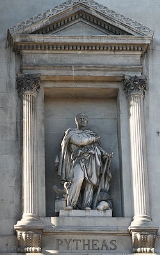
Pytheas


   Email Print
   Bookmark   Link


Pytheas


Pytheas of Massilia (Ancient Greek
Ancient Greek

Ancient Greek is the historical stage in the development of the Greek language spanning across the Archaic Greece , Classical Greece , and Hellenistic civilization periods of ancient Greece and the classical antiquity....
 ????a? ? ?assa???t??), 4th century BC, was a Greek
Greece

Greece , officially the Hellenic Republic , is a country in southeastern Europe, situated on the southern end of the Balkans. It has borders with Albania, Bulgaria and the former Yugoslav Republic of Macedonia to the north, and Turkey to the east....
 geographer
Geography

Geography is the study of the Earth and its lands, features, inhabitants, and phenomena. A literal translation would be "to describe or write about the Earth"....
 and explorer
Exploration

Exploration is the act of searching or traveling a terrain for the purpose of discovery, e.g. of unknown people, including space , for Petroleum, gas, coal, ores, caves, water , or information....
 from the Greek colony, Massilia (today Marseille, France). He made a voyage of exploration to northwestern Europe
Europe

Europe is, conventionally, one of the world's seven continents. Comprising the westernmost peninsula of Eurasia, Europe is generally divided from Asia to its east by the water divide of the Ural Mountains, the Ural , the Caspian Sea, and by the Caucasus Mountains to the southeast....
 at about 325 BC. He travelled around and visited a considerable part of Great Britain
Great Britain

Great Britain is an island lying to the northwest of Continental Europe. It is the List of islands by area, and the largest in Europe. With a population of 58.9 million people it is List of islands by population....
. Some of his observations may refer to Stonehenge
Stonehenge

Stonehenge is a prehistoric monument located in the England county of Wiltshire, about west of Amesbury and north of Salisbury. One of the most famous sites in the world, Stonehenge is composed of Earthworks surrounding a circular setting of large standing stones and sits at the centre of the densest complex of Neolithic and Bronze Age mon...
, the earliest report (if true).


Discussion
Ask a question about 'Pytheas'
Start a new discussion about 'Pytheas'
Answer questions from other users
Full Discussion Forum


Encyclopedia


Pytheas of Massilia (Ancient Greek
Ancient Greek

Ancient Greek is the historical stage in the development of the Greek language spanning across the Archaic Greece , Classical Greece , and Hellenistic civilization periods of ancient Greece and the classical antiquity....
 ????a? ? ?assa???t??), 4th century BC, was a Greek
Greece

Greece , officially the Hellenic Republic , is a country in southeastern Europe, situated on the southern end of the Balkans. It has borders with Albania, Bulgaria and the former Yugoslav Republic of Macedonia to the north, and Turkey to the east....
 geographer
Geography

Geography is the study of the Earth and its lands, features, inhabitants, and phenomena. A literal translation would be "to describe or write about the Earth"....
 and explorer
Exploration

Exploration is the act of searching or traveling a terrain for the purpose of discovery, e.g. of unknown people, including space , for Petroleum, gas, coal, ores, caves, water , or information....
 from the Greek colony, Massilia (today Marseille, France). He made a voyage of exploration to northwestern Europe
Europe

Europe is, conventionally, one of the world's seven continents. Comprising the westernmost peninsula of Eurasia, Europe is generally divided from Asia to its east by the water divide of the Ural Mountains, the Ural , the Caspian Sea, and by the Caucasus Mountains to the southeast....
 at about 325 BC. He travelled around and visited a considerable part of Great Britain
Great Britain

Great Britain is an island lying to the northwest of Continental Europe. It is the List of islands by area, and the largest in Europe. With a population of 58.9 million people it is List of islands by population....
. Some of his observations may refer to Stonehenge
Stonehenge

Stonehenge is a prehistoric monument located in the England county of Wiltshire, about west of Amesbury and north of Salisbury. One of the most famous sites in the world, Stonehenge is composed of Earthworks surrounding a circular setting of large standing stones and sits at the centre of the densest complex of Neolithic and Bronze Age mon...
, the earliest report (if true). Pytheas is the first person on record to describe the Midnight Sun
Midnight sun

The midnight sun is a natural phenomenon occurring in latitudes north and nearby to the south of the Arctic Circle, and south and nearby to the north of the Antarctic Circle where the sun remains visible at the local midnight....
, polar ice, the first to mention the name Britannia
Britannia

Britannia was the term originally used by the Roman Empire to refer to the island of Great Britain. The term was later used to describe a Roman province covering much of the island, apart from the area beyond the Antonine Wall belonging to the Picts in the north, which was known as Caledonia....
 and Germanic tribes
Germanic peoples

File:Germanische-ratsversammlung 1-1250x715.jpgThe Germanic peoples are a historical Ethnolinguistics group, originating in Northern Europe and identified by their use of the Indo-European languages Germanic languages which diversified out of Common Germanic in the course of the Pre-Roman Iron Age....
 and the one who introduced the idea of distant "Thule
Thule

Thule is, in classical literature, a place, usually an island. Ancient European descriptions and maps locate it either in the far north, often Iceland, possibly the Orkney Islands or Shetland Islands or Scandinavia, or in the Late Middle Ages and Renaissance Iceland or Greenland....
" to the geographic imagination. His account is the earliest to state that the moon is the cause of the tides.

Dates

Pliny
Pliny

Pliny may refer to:*Pliny the Elder , ancient Roman nobleman, scientist and historian, author of Naturalis Historia, "Pliny's Natural History"...
 says that Timaeus
Timaeus (historian)

Timaeus , Ancient Greece historian, was born at Tauromenium in Sicily. Driven out of Sicily by Agathocles, he migrated to Athens, where he studied rhetoric under a pupil of Isocrates and lived for fifty years....
 (born about 350 BC) believed Pytheas' story of the discovery of amber
Amber

Amber is fossil tree resin, which is appreciated for its color and beauty. Good quality amber is used for the manufacture of ornamental objects and jewelry....
. Strabo says that Dicaearchus
Dicaearchus

Dicaearchus of Messina, Italy was a Greeks philosopher, cartographer, geographer, mathematician and author. Dicaearchus was Aristotle's student in Lyceum....
 (died about 285 BC) did not trust the stories of Pytheas. That is all the information that survives concerning the date of Pytheas' voyage. Presuming that Timaeus would not have written until after he was 20 years old at about 330 BC and Dicaearchus would have needed time to write his most mature work, after 300 BC, there is no reason not to accept Tozer's window of 330 BC – 300 BC for the voyage. Some would give Timaeus an extra 5 years, bringing the voyage down to 325 BC at earliest. There is no further evidence.

If one presumes that Pytheas would not have written prior to being 20 years old, he would have been a contemporary and competitor of Timaeus and Dicaearchus. As they read his writings he must have written toward the earlier years of the window.

Record

Pytheas described his travels in a work that has not survived; only excerpts remain, quoted or paraphrased by later authors, most familiarly in Strabo
Strabo

Strabo was a Ancient Greeks history, geography and philosophy....
's Geographica
Géographica

G?ographica is the French language magazine of the Royal Canadian Geographical Society , published under the Society's French name, the Soci?t? g?ographique royale du Canada ....
, Pliny's Natural History and passages in Diodorus of Sicily
Diodorus Siculus

Diodorus Siculus , was a Roman Greece historian who flourished in the 1st century BC. According to Diodorus' own work, he was born at Agira in Sicily ....
's history
Bibliotheca historica

[Image:AlexandreLouvre.jpg|thumb|right|150px|Bust of Alexander...
. Most of the ancients, including the first two just mentioned, refer to his work by his name: "Pytheas says ...." Two late writers give titles: the astronomical author, Geminus of Rhodes, mentions (ta peri tou Okeanou), literally "things about the Ocean", sometimes translated as "Description of the Ocean", "On the Ocean" or "Ocean;" Marcianus, the scholiast on Apollonius of Rhodes
Apollonius of Rhodes

Apollonius of Rhodes, also known as Apollonius Rhodius , early 3rd century BCE - after 246 BCE, was a librarian at the Library of Alexandria....
, mentions a (periodos ges), a "trip around the earth" or pe??p???? (periplous), "sail around."

Scholars of the 19th century tended to interpret these titles as the names of distinct works covering separate voyages; for example, Smith's Dictionary of Greek and Roman Biography and Mythology hypothesizes a voyage to Britain and Thule written about in "Ocean" and another from Cadiz
Cádiz

C?diz is a city and port in southwestern Spain. It is the capital of the province of C?diz, one of eight which make up the Autonomous communities of Spain of Andalusia....
 to the Don river
Don River

There are several rivers named Don:...
, written about in "Sail Around." As is common with ancient texts, multiple titles may represent a single source, for example, if a title refers to a section rather than the whole. The mainstream today recognizes periplus
Periplus

Periplus is the Latinization of an ancient Greek word, pe??p???? , literally "a sailing-around." Both segments, peri- and -plous, were independently Productivity : the ancient Greek speaker understood the word in its literal sense; however, it developed a few specialized meanings, one of which became a standard term in the ancient...
 as a genre of navigational literature and concedes that there was only one work, "on the Ocean," which was based on a periplus.

Diodorus does not mention Pytheas by name. The connection is made as follows: Pliny reports that "Timaeus says there is an island named Mictis ... where tin is found, and to which the Britains cross...." Diodorus says that tin is brought to the island of Ictis, where there is an emporium. The last link is supplied by Strabo, who says that an emporium on the island of Corbulo in the mouth of the Loire
Loire River

The Loire is the longest river in France. With a length of , it drains an area of , which represents more than a fifth of France's land area....
 was associated with the Britain of Pytheas by Polybius. Assuming that Ictis, Mictis and Corbulo are the same, Diodorus appears to have read Timaeus, who must have read Pytheas, whom Polybius also read. An implication is that Strabo did not read Pytheas, or he would not have had to resort to Polybius.

Circumstances of the voyage

Pytheas was not the first Mediterranean mariner to reach the British Isles. The Massaliote Periplus
Massaliote Periplus

The Massaliote Periplus or Massaliot Periplus is the name of a now-lost merchants' handbook possibly dating to as early as the sixth century BC describing the searoutes used by traders from Phoenicia and Tartessus in their journeys around Iron Age Europe....
 is a more extensive fragment preserved in paraphrase in the Ora Maritima, a poem of the 4th century AD written by the Roman, Avienus
Avienus

Avienus was a Latin writer of the 4th century. His full name Postumius Rufius Festus Avienius is mentioned on an inscription from Bulla Regia, but "Avienus" has become the usual form of reference....
. This periplus of a ship from Marseille on which the poem relies is uncertain in date, but is believed to be possibly from the 6th century BC, not long after the founding of the city. It primarily describes the coasts of southern Spain and Portugal, but makes brief mention of a visit to "the sacred isle" (Ireland, Ierne
Ierne

Ierne may refer to:* ?riu, a goddess of Ireland* Ireland...
) located across from Albion
Albion

Albion is the oldest known name of the island of Great Britain. Today, it is still sometimes used poetically to refer to the island. It is the basis of the Scottish Gaelic name for Scotland, Alba....
 (an early name for Britain).

The start of Pytheas's voyage is unknown. The Carthaginians
Carthage

Carthage refers both to an ancient city in present-day Tunisia, and a modern-day suburb of Tunis. The civilization that developed within the city's sphere of influence is referred to as Punic or Carthaginian....
 had closed the Strait of Gibraltar
Strait of Gibraltar

The Strait of Gibraltar is the strait that connects the Atlantic Ocean to the Mediterranean Sea and separates Spain from Morocco. The name comes from Gibraltar, which in turn originates from the Arabic language Jebel Tariq meaning mountain of Tariq....
 to all ships from other nations. Some historians, mainly of the late 19th century and before, therefore speculated (on no evidence) that he traveled overland to the mouth of the Loire
Loire

Loire is an departments of France in the east-central part of France occupying the River Loire's upper reaches....
 or the Garonne
Garonne

The Garonne is a river in southwest France and northern Spain, with a length of 575 km ....
. Others believed that, to avoid the Carthaginian blockade, he may have stuck close to land and sailed only at night. It is also possible he took advantage of a temporary lapse in the blockade.

Detailed scholarship of the 20th century superseded these early views. By the 4th century BC the western Greeks, especially the Massilotes, were on amicable terms with Carthage
Carthage

Carthage refers both to an ancient city in present-day Tunisia, and a modern-day suburb of Tunis. The civilization that developed within the city's sphere of influence is referred to as Punic or Carthaginian....
. First, Massilia was militarily superior to Carthage. It had defeated the empire in the late 6th century BC and again in 490; not caring to test the issue any further, Carthage had made an early independent treaty with Massilia. The latter city had no trouble placing and keeping colonies on the coast of Spain. Archaeologically the sites of the western Mediterranean show no diminishment of Greek pottery at any time (a good indication of trade). It coexisted with Carthaginian artifacts.

Second, Massilia was a close ally of Rome even before the Roman republic
Roman Republic

The Roman Republic was the phase of the Ancient Rome characterized by a republican form of government; a period which began with the overthrow of the Roman Roman Kingdom, c....
, according to Gnaeus Pompeius Trogus
Gnaeus Pompeius Trogus

Gnaeus Pompeius Trogus, known as Pompeius Trogus, Pompey Trogue, or Trogue Pompey, was a 1st century BC Roman historian of the Celtic tribe of the Vocontii in Gallia Narbonensis, flourished during the age of Augustus Caesar, nearly contemporary with Livy....
. Massilia helped Rome defeat Veii
Veii

Veii was, in ancient times, an important Etrurian city 16 km NNW of Rome, Italy; its site lies in the modern comune of Formello, in the Province of Rome....
 in 396 BC and when Rome was sacked by the Gauls in 390 BC the Massiliotes took up a subscription to buy its freedom. Massiliotes sat in the closed sessions of the Roman Senate.

In 348 BC Carthage and Rome came to terms over the Sicilian Wars
Sicilian Wars

The Greek punic wars or, less properly, Sicilian Wars were a series of conflicts fought between Carthage and the Polis headed by Syracuse, Sicily, over control of Sicily and western Mediterranean between the years 600 BC to 289 BC....
 making a treaty defining their mutual interests. Rome could use Sicilian markets and Carthage could buy and sell at Rome. Slaves taken by Carthaginians from allies of Rome were to be set free. Rome was to stay out of the western Mediterranean, but these terms did not apply to Massilia, which had its own treaty. During the last half of the 4th century BC, the time of Pytheas' voyage, relations between Rome and its allies and the Carthaginian empire were completely amicable. Massiliotes were free to operate as they pleased. Certainly, there is no evidence of a Carthaginian problem in any of the sources concerning the voyage.

The early part of Pytheas' voyage is outlined by statements of Eratosthenes
Eratosthenes

Eratosthenes of Cyrene was a Greeks mathematician, poet, sportsperson, geographer and astronomer. He made several discoveries and inventions including a system of latitude and longitude....
 that Strabo says are false because taken from Pytheas. Apparently Pytheas said that tides ended at the "sacred promontory" (Ieron akroterion), meaning Sagres Point. From there to Gades is said to be 5 days' sail. Quibbling about this distance Strabo complains about Pytheas' portrayal of the exact location of Tartessos
Tartessos

Tartessos was a harbor city and its surrounding culture on the south coast of the Iberian peninsula , at the mouth of the Guadalquivir river. It was mentioned by Herodotus, Strabo in Pliny's Natural History....
. Mention of these places in a journal of the voyage indicates Pytheas passed through the Straits of Gibraltar and sailed north along the coast of Portugal
Portugal

Portugal , officially the Portuguese Republic , is a country on the Iberian Peninsula. Located in southwestern Europe, Portugal is the westernmost country of mainland Europe and is bordered by the Atlantic Ocean to the west and south and by Spain to the north and east....
.

Discovery of Britain


The "circumnavigation"


Strabo reports that Pytheas says he "travelled over the whole of Britain that was accessible." The word epelthein, at root "come upon", does not mean by any specific method, and Pytheas does not elaborate. He does use the word "whole" and he states a perimetron ("perimeter") of more than 40000 stadia
Stadia (length)

The stadia, stadium, stade or stadion is an ancient unit of length. According to Herodotus, one stade is equal to 600 feet. However, there were several different lengths of ?feet?, depending on the country of origin....
. Using Herodotus' standard of 600 feet for one stadium obtains 4545 miles; however, there is no way to tell which standard foot was in effect. The English foot is an approximation. Strabo wants to discredit Pytheas on the grounds that 40000 stadia is outrageously high and cannot be real.

Diodorus Siculus
Diodorus Siculus

Diodorus Siculus , was a Roman Greece historian who flourished in the 1st century BC. According to Diodorus' own work, he was born at Agira in Sicily ....
 gives a similar number: 42500 stadia (about 4830 miles) and explains that it is the perimeter of a triangle around Britain, which is roughly triangular in shape. The consensus has been that he probably took his information from Pytheas through Timaeaus
Timaeus (historian)

Timaeus , Ancient Greece historian, was born at Tauromenium in Sicily. Driven out of Sicily by Agathocles, he migrated to Athens, where he studied rhetoric under a pupil of Isocrates and lived for fifty years....
. Pliny
Pliny

Pliny may refer to:*Pliny the Elder , ancient Roman nobleman, scientist and historian, author of Naturalis Historia, "Pliny's Natural History"...
 gives the circuitus reported by Pytheas as 4875 Roman miles.

The explorer, Fridtjof Nansen
Fridtjof Nansen

Fridtjof Wedel-Jarlsberg Nansen was a Norway explorer, scientist and diplomat. Nansen was awarded the Nobel Peace Prize in 1922 for his work as a League of Nations High Commissioner....
, in an article on the topic explains this apparent fantasy of Pytheas as a mistake of Timaeus. Strabo (and Diodorus Siculus
Diodorus Siculus

Diodorus Siculus , was a Roman Greece historian who flourished in the 1st century BC. According to Diodorus' own work, he was born at Agira in Sicily ....
) never saw Pytheas' work (says Nansen), but they and others read of him in Timaeus. Pytheas reported only days' sail. Timaeus converted days to stadia at the rate of 1000 per day, a standard figure of the times. However, Pytheas only sailed 560 stadia per day for a total of 23800, which in Nansen's view is consistent with 700 stadia per degree. Nansen goes on to point out that Pytheas must have stopped to obtain astronomical data; presumably, the extra time was spent ashore. Using the stadia of Diodorus Siculus, one obtains 42.5 days for the time that would be spent in circumnavigating Britain. (It may have been a virtual circumnavigation; see under Thule below.)

The ancient perimeter according to Nansen based on the 23800 was 2375 miles. This number is in the neighborhood of what a triangular perimeter ought to be but it cannot be verified against anything Pytheas may have said nor is Diodorus Siculus very precise about the locations of the legs. The "perimeter" is often translated as "coastline" but this translation is misleading. The coastline, following all the bays and inlets, is (see Geography of the United Kingdom
Geography of the United Kingdom

File:United Kingdom satellite image bright.pngThe United Kingdom of Great Britain and Northern Ireland, or UK, is in Northern Europe and or Western Europe....
). Pytheas could have travelled any perimeter between that number and Diodorus'. Polybius
Polybius

Polybius was a Greek historian of the Hellenistic Period noted for his book called The Histories covering in detail the period of 220–146 BC....
 adds that Pytheas said he traversed the whole of Britain on foot, of which he, Polybius, is skeptical. Despite Strabo's conviction of a lie, the perimeter said to have been given by Pytheas is not evidence of it. The issue of what he did say can never be settled until more fragments of Pytheas turn up.

Name and description of the British

For "Britain" Pytheas through Strabo uses Bretannike as a feminine noun, although its form is that of an adjective: "the Britannic." Pliny uses Britannia, with Britanniae meaning all the islands, "the Britains." Diodorus has Brettanike nesos, "the British Island", and Brettanoi, "the British." Ptolemy
Ptolemy

Claudius Ptolemaeus , known in English as Ptolemy , was a Roman Greek mathematics, Greek astronomy, geographer and astrologer. He lived in History of Roman Egypt, and was probably born there in a town in the Thebaid called Ptolemais Hermiou; he died in Alexandria around 168 AD....
 has Bretania and Bretanikai nesoi.

On the surface it would appear that Pytheas was the first to use the name, Britannia; however, manuscript variants offer a P- alternating with B- and there is good reason for thinking that the name learned by Pytheas had P-, as in *Pretania or *Pritannia, etc.: the etymology of "Britain" is so convincing that many authors use the P-form, going to far as the quote the Greek or Latin with P-, even though it is predominantly B-. They attribute the B- to replacement by the Romans in the time of Julius Caesar
Julius Caesar

'Gaius Julius Caesar' , July 13, 100 BC ? March 15, 44 BC,) was a Roman Republic military and political leader. He played a critical role in the transformation of the Roman Republic into the Roman Empire....
.

Pictishbeast
"Britain" is most like Welsh
Welsh language

Welsh ]], is a member of the Brythonic branch of Celtic languages spoken natively in Wales, in England by some along the Welsh Marches and in the Welsh settlement in Argentina in the Chubut Valley in Argentina Patagonia....
 Ynys Prydein, "the island of Britain", in which is a P-Celtic allophone
Allophone

In phonetics, an allophone is one of several similar speech sounds that belong to the same phoneme. A phoneme is an abstract unit of speech sound that can distinguish words: That is, changing a phoneme in a word can produce another word....
 of Q-Celtic Cruithne in Irish
Irish language

Irish , also known as Irish Gaelic, is a Goidelic languages of the Indo-European language family, originating in Ireland and historically spoken by the Irish people....
 Cruithen-tuath, "land of the Picts." The base word is Scottish/Irish cruth, Welsh pryd, "form." The British were the "people of forms", referring to their tattoo
Tattoo

A tattoo is a permanent marking made by inserting ink into the layers of skin to change the pigment for decorative or other reasons. Tattoos on humans are a type of decorative body modification, while tattoos on animals are most commonly used for identification or branding....
s. The Roman word Picti, "the Picts", means "painted."

This etymology if correct suggests that Pytheas never visited Ireland or talked to the Irish, as they used the Q-Celtic, but Pytheas brought back the P-Celtic form. Furthermore, some Welsh ancestral language was spoken over all of Britain and Celtic was already divided.

Diodorus based on Pytheas reports that Britain is cold and subject to frosts, being "too much subject to the bear" (and not "under the Arctic pole" as some translations say). This report suggests that Pytheas was there in the early Spring, as he encountered frosts but not blizzards, drifts and frozen bodies of water.

The numerous population of natives, he says, live in thatched cottages, store their grain in subterranean caches and bake bread from it. They are "of simple manners" (ethesin haplous) and are content with plain fare. They are ruled by many kings and princes who live in peace with each other. Their troops fight from chariots, as did the Greeks in the Trojan War. Until Caesar they were never beaten and never invaded.

The tin trade

Opposite Europe in Diodorus is the promontory (akroterion) of Kantion (Kent
Kent

Kent is a Counties of England in southeast England, and is one of the home counties. It borders East Sussex, Surrey and Greater London and has a defined boundary with Essex in the middle of the River Thames estuary....
), 100 stadia (several miles) from the land, but the text is ambiguous; the land could be either Britain or the continent. Beyond by four days' sail is another promontory, Belerion, which can only be Cornwall
Cornwall

Cornwall , constitutional Duchy and palatine, is a metropolitan and non-metropolitan counties of England of England, United Kingdom, located at the tip of the south-western peninsula of Great Britain....
, as Diodorus is describing the triangular perimeter and the third point is Orkas, presumably the main island of the Orkney Islands.

The inhabitants of Cornwall are involved in the manufacture of tin ingot
Tin ingot

Tin ingots were a trading currency unique to Malacca. Cast in the shape of a peck, or dou in Chinese, each block weighs just over one pound. Ten blocks made up one unit called a 'small bundle', and 40 blocks made up one 'large bundle'....
s. They mine the ore, smelt it and then work it into pieces the shape of knuckle-bones, after which it is transported to the island of Ictis by wagon, which can be done at low tide. Merchants purchasing it there pack it on horses for 30 days to the Rhone river
Rhône River

The Rhone, or the Rh?ne is one of the major rivers of Europe, originating in Switzerland and running from there through the south-eastern corner of France....
, where it is carried down to the mouth. Diodorus says that the inhabitants of Cornwall are civilised in manner and especially hospitable to strangers because of their dealings with foreign merchants.

Observation of Stonehenge

A second passage from Diodorus has gained some repute as a possible report of Pytheas' observation of the monuments at Stonehenge
Stonehenge

Stonehenge is a prehistoric monument located in the England county of Wiltshire, about west of Amesbury and north of Salisbury. One of the most famous sites in the world, Stonehenge is composed of Earthworks surrounding a circular setting of large standing stones and sits at the centre of the densest complex of Neolithic and Bronze Age mon...
. The passage is distinctive for its unusual definition of the Hyperboreans as they who "lie beyond the breezes of the north wind", in contradistinction to the classical Roman definition as dweller in the far north, meaning northeastern Europe. Diodorus' Hyperboreans live on "an island in the Ocean over against Gaul
Gaul

Gaul is the name used for the region of Western Europe comprising part of present day northern Italy, France, Belgium, western Switzerland and the parts of the Netherlands and Germany on the west bank of the River Rhine....
, (as big as Sicily
Sicily

Sicily is an Autonomous regions with special statute of Italy. Of all the regions of Italy, Sicily covers the largest land area at 25,708 km? and currently has just over five million inhabitants....
) ...", which can only be Britain. It is not called Britain but remains unnamed. One explanation for these variants is that the passage is from a different tradition than the classical names and definitions of Britain and the Hyperboreans. The latter's definition was given by Herodotus
Herodotus

Herodotus of Halicarnassus was a Greeks historian who lived in the 5th century BC and is regarded as the "Father of History" in Western culture....
 based on continental knowledge.

Diodorus says that for this information he was relying on "Hecateus and some others" meaning Hecataeus of Abdera
Hecataeus of Abdera

Hecataeus of Abdera, Thrace was a Greek historian and sceptic philosopher who flourished in the 4th century BC.Diogenes Laertius relates that he was a student of Pyrrho, along with Eurylochus, Timon , Nausiphanes of Teos and others, and includes him among the "Pyrrhoneans"....
's On the Hyperboreans, now lost (based on the date of calendar he references). Hecataeus was a contemporary of Pytheas writing toward the end of the 4th century BC. As far as can be known now he might have had the Massiliote Periplus in front of him but his most likely source is same as everyone else's of the times, Pytheas of Massilia. Nothing in the passage or elsewhere, however, connects it directly to Pytheas.

On this island is "a stately grove and renowned temple, of a round form ... a city likewise consecrated to the god (Apollo
Apollo

In Greek mythology and Roman mythology, Apollo , is one of the most important and many-sided of the Twelve Olympians. The ideal of the kouros , Apollo has been variously recognized as a god of light and the sun; truth and prophecy; archery; medicine and healing; music, poetry, and the arts; and more....
), whose citizens ... play on the harp, chant sacred hymns to Apollo in the temple ...." The city is of international repute, being, says Diodorus, the native city of the famed Hyperborean necromancer, Abaris, who went with his arrow around the world without eating. Over this city rule the Boread family, the descendants of Boreas.

On the surface the worship of the god appears to be equivocal. Apollo is a solar deity, but he returns to the temple every 19 years, about the time it takes for the plane of the moon's orbit to precess over a full circle. (More exactly 18.6 years; see under Month
Month

The month is a unit of time, used with calendars, which is approximately as long as some natural Orbital period related to the motion of the Moon; month and Moon are cognates....
.) Moreover the passage stresses that from this island the moon is very close to the Earth so that all its topographical features can be seen (which some say gave Pytheas that idea that the moon controls the tides). Apparently the deity is lunar and the temple must be at some location where lunar deities are worshipped.

However, the Metonic calendar introduced at Athens in 432 BC is based on the Metonic cycle
Metonic cycle

The Metonic cycle or Enneadecaeteris in astronomy and calendar studies is a particular approximate Least common multiple of the tropical year and the Month#Synodic month....
, in which 19 solar years comes within two hours of coinciding with 235 months. There is no reason to favor the moon. (Reference to the Metonic cycle dates the passage to after the 5th century BC, excluding Hecataeus of Miletus from being Diodorus' Hecataeus.) In later times Borvo
Borvo

In classical era Celtic polytheism, Borvo was a healing deity associated with bubbling spring water ....
, a god of healing, was the Celtic equivalent of Apollo. Other locations such as in Scandinavia
Scandinavia

Scandinavia is a historical and geographical subregion in northern Europe that includes the Scandinavian Peninsula. It consists of the kingdoms of Norway, Sweden, and Denmark; some authorities also include Finland and some might even include Iceland....
 have been proposed but according to the passage on this island the soil is so fertile as to produce two crops a year and the climate is temperate. Southern Britain better fits this description.

In the Iron age
Iron Age

In archaeology, the Iron Age was the stage in the development of any people in which tools and weapons whose main ingredient was iron were prominent....
 Stonehenge was a renewed center of power, the best candidate for the location of the city being the mound at nearby Vespasian's Camp
Vespasian's Camp

Vespasian's Camp is an Iron Age Hillfort in the town of Amesbury, Wiltshire, England. It is located less than 2 miles from the older Neolithic and Bronze Age monument of Stonehenge and was built on a hill next to the Stonehenge Avenue....
 (not a Roman castra
Castra

The Latin language word castra, with its singular castrum, was used by the ancient Romans to mean buildings or plots of land reserved to or constructed for use as a military defensive position....
 nor in any way associated with Vespasian
Vespasian

Titus Flavius Vespasianus, commonly known as Vespasian , was a Roman Emperor who reigned from 69 A.D. until his death in 79 A.D. Vespasian was the founder of the short lived Flavian dynasty, which ruled the Roman Empire between 69 A.D....
), which is arrow-shaped. If Pytheas did wander over the island he could hardly have avoided it. Diodorus (or Pytheas) says that these Hyperboreans had a distinct language and were friendly to Greeks.

Discovery of Thule

Strabo relates, taking his text from Polybius, "Pytheas asserts that he explored in person the whole northern region of Europe as far as the ends of the world." Strabo does not believe it but he explains what Pytheas means by the ends of the world.Thule
Thule

Thule is, in classical literature, a place, usually an island. Ancient European descriptions and maps locate it either in the far north, often Iceland, possibly the Orkney Islands or Shetland Islands or Scandinavia, or in the Late Middle Ages and Renaissance Iceland or Greenland....
, he says (modern , is the most northerly of the British Isles. There the circle of the summer tropic is the same as the Arctic Circle (see below on Arctic Circle). Moreover, says Strabo, none of the other authors (of his time) mention Thule, a fact which he uses to discredit Pytheas, but which to moderns indicates Pytheas was the first explorer to arrive there and tell of it.

Thule is described as an island of six days' sailing north of Britain, near the frozen sea (pepeguia thalatta, "solidified sea"). Pliny
Pliny

Pliny may refer to:*Pliny the Elder , ancient Roman nobleman, scientist and historian, author of Naturalis Historia, "Pliny's Natural History"...
 adds that it has no nights at midsummer when the sun is passing through the sign of the crab (summer solstice), a reaffirmation that it is on the Arctic Circle. He adds that the crossing to Thule starts at the island of Berrice, "the largest of all", which may be Lewis
Lewis

Lewis is the northern part of Lewis and Harris, the largest island of the Western Isles or Outer Hebrides of Scotland. The total area of Lewis is ....
 in the outer Hebrides
Hebrides

The Hebrides comprise a widespread and diverse archipelago off the west coast of Scotland. There are two main groups, the Inner and Outer Hebrides....
. If Berrice was in the outer Hebrides, the crossing would have brought Pytheas to the vicinity of Trondheim
Trondheim

is a city and Municipalities of Norway in S?r-Tr?ndelag Counties of Norway, Norway. The city of Trondheim was established as a municipality on 1 January 1838 ....
, Norway
Norway

Norway , officially the Kingdom of Norway, is a constitutional monarchy in Northern Europe that occupies the western portion of the Scandinavian Peninsula....
, explaining how he managed to miss the Skagerrak
Skagerrak

The Skagerrak strait runs between Norway and the southwest coast of Sweden and the Jutland of Denmark, connecting the North Sea and the Kattegat strait, which leads to the Baltic Sea....
. If this is his route in all likelihood he did not actually circumnavigate Britain, but returned along the coast of Germany, accounting for his somewhat larger perimeter.

Concerning the location of Thule a discrepancy in data caused subsequent geographers some problems and may be responsible for Ptolemy
Ptolemy

Claudius Ptolemaeus , known in English as Ptolemy , was a Roman Greek mathematics, Greek astronomy, geographer and astrologer. He lived in History of Roman Egypt, and was probably born there in a town in the Thebaid called Ptolemais Hermiou; he died in Alexandria around 168 AD....
's distortion of Scotland
Scotland

conventional_long_name = ScotlandAlba|common_name= Scotland|image_flag = Flag of Scotland.svg|flag_width = 130px...
. Strabo reports that Eratosthenes
Eratosthenes

Eratosthenes of Cyrene was a Greeks mathematician, poet, sportsperson, geographer and astronomer. He made several discoveries and inventions including a system of latitude and longitude....
 places Thule at a parallel 11500 stadia (16.4°) north of the mouth of the Borysthenes. The parallel running through that mouth also passes through Celtica and is Pytheas' base line. Using 3700 or 3800 stadia (5.3° or 5.4°) north of Marseille for a base line obtains a latitude of 64.8° or 64.9° for Thule, well short of the Arctic Circle. It is in fact the latitude of Trondheim, where Pytheas probably made land.

A statement by Geminus of Rhodes quotes On the Ocean as saying:
... the Barbarians showed us the place where the sun goes to rest. For it was the case that in these parts the nights were very short, in some places two, in others three hours long, so that the sun rose again a short time after it had set.


Nansen points out that according to this statement Pytheas was there in person and that the 21- and 22-hour days must be the customary statement of latitude by length of longest day. He calculates the latitudes to be 64° 32' and 65° 31', supporting Hipparchus' statement of the latitude of Thule. And yet Strabo says:
Pytheas of Massilia tells us that Thule ... is farthest north, and that there the circle of the summer tropic is the same as the Arctic Circle.


Eratosthenes extends the latitudinal distance from Massilia to Celtica to 5000 stadia (7.1°), placing the base line in Normandy
Normandy

Normandy is a geographical region corresponding to the former Duchy of Normandy. It is situated along the coast of France south of the English Channel between Brittany and Picardy and comprises territory in northern France and the Channel Islands....
. The northernmost location cited in Britain at the Firth of Clyde is now northern Scotland. To get this country south of Britain to conform to Strabo's interpretation of Pytheas, Ptolemy
Ptolemy

Claudius Ptolemaeus , known in English as Ptolemy , was a Roman Greek mathematics, Greek astronomy, geographer and astrologer. He lived in History of Roman Egypt, and was probably born there in a town in the Thebaid called Ptolemais Hermiou; he died in Alexandria around 168 AD....
 has to rotate Scotland by 90°.

The 5000 stadia must be discounted: it crosses the Borysthenes upriver near Kiev
Kiev

Kiev, also known as Kyiv , is the Capital and the largest city of Ukraine, located in the north central part of the country on the Dnieper River....
 rather than at the mouth. It does place Pytheas on the Arctic Circle, which in Norway is just south of the Lofoten islands. On the surface it appears that Eratosthenes altered the base line to pass through the northern extreme of Celtica. Pytheas (as related by Hipparchus) probably cited the place in Celtica where he first made land. If he used the same practice in Norway, Thule is at least the entire northwest coast of Norway from Trondheim to the Lofoten Islands.

The explorer, Richard Francis Burton
Richard Francis Burton

Captain Sir Richard Francis Burton Order of St Michael and St George Royal Geographic Society was an English explorer, translator, writer, soldier, orientalist, ethnologist, linguistics, poet, hypnotism, fencing and diplomat....
, in his study of Thule points out that it has had many definitions over the centuries. Many more authors have written about it than remembered Pytheas. The question of the location of Pytheas' Thule remains. The latitudes given by the ancient authors can be reconciled. The missing datum required to fix the location is longitude: "Manifestly we cannot rely upon the longitude."

Pytheas crossed the waters northward from Berrice, in the north of the British Isles, but whether to starboard, larboard, or straight ahead is not known. From the time of the Roman Empire all the possibilites were suggested repeatedly by each generation of writers: Iceland
Iceland

Iceland, officially the Republic of Iceland , is an island country located in the North Atlantic Ocean between mainland Europe and Greenland....
, Shetland, the Faroe Islands
Faroe Islands

The Faroe Islands or Faeroe Islands or simply Faroe or Faeroes are an island group situated between the Norwegian Sea and the North Atlantic Ocean, approximately half way between Scotland and Iceland....
, Norway
Norway

Norway , officially the Kingdom of Norway, is a constitutional monarchy in Northern Europe that occupies the western portion of the Scandinavian Peninsula....
 and later Greenland
Greenland

Greenland is a member country of the Kingdom of Denmark located between the Arctic Ocean and Atlantic Oceans, east of the Canadian Arctic Archipelago....
. A manuscript variant of a name in Pliny has abetted the Iceland theory: Nerigon instead of Berrice, which sounds like Norway. If one sails west from Norway one encounters Iceland. Burton himself espoused this theory.

The standard texts have Berrice today, as well as Bergos for Vergos in the same list of islands. The Scandiae islands are more of a problem, as they could be Scandinavia, but other islands had that name as well. Moreover Procopius
Procopius

Procopius of Caesarea was a prominent Byzantine Empire scholar of the family Procopius . A participant himself in the wars of the Emperor Justinian I, he was the major historian of the 6th century, writing the Wars of Justinian, the Buildings of Justinian and the celebrated Secret History....
 says that the earlier name of Scandinavia was Thule and that it was the home of the Goths
Goths

The Goths were East Germanic tribes who, in the 3rd and 4th centuries, invasion the Roman Empire and later adopted Arian Christianity. In the 5th and 6th centuries, divided as the Visigoths and the Ostrogoths, they established powerful successor-states of the Roman Empire in the Iberian peninsula and Italy....
. Icelanders are fairly sure Iceland was not Thule, as Pytheas lived centuries before its colonization by European agriculturalists, and Greenland for the same reason is out of the question. The fact that Pytheas returned from the vicinity of the Baltic favors Procopius's view.

Concerning the people of Thule Strabo says of Pytheas (grudgingly):
...he might possibly seem to have made adequate use of the facts as regards the people who live close to the frozen zone, when he says that, ... the people live on millet and other herbs, and on fruits and roots; and where there are grain and honey, the people get their beverage, also, from them. As for the grain, he says, – since they have no pure sunshine – they pound it out in large storehouses, after first gathering in the ears thither; for the threshing floors become useless because of this lack of sunshine and because of the rains.


What he seems to be describing is an agricultural country that uses barns for threshing grain rather than the Mediterranean outside floor of sun-baked mud and manufactures a drink, possibly mead
Mead

Mead is a typically alcoholic beverage beverage, made from honey and water via Fermentation with yeast. Its alcoholic content may range from that of a mild ale to that of a strong wine....
.

Encounter with drift ice

After mentioning the crossing (navigatio) from Berrice to Tyle Pliny
Pliny

Pliny may refer to:*Pliny the Elder , ancient Roman nobleman, scientist and historian, author of Naturalis Historia, "Pliny's Natural History"...
 makes a brief statement that:
A Tyle unius diei navigatione mare concretum a nonnullis Cronium appellatur.


"One day's sail from Thule is the frozen ocean, called by some the Cronian Sea."


The mare concretum appears to match Strabo's pepeguia thalatta and is probably the same as the topoi ("places") mentioned in Strabo's apparent description of spring drift ice, which would have stopped his voyage further north and was for him the ultimate limit of the world. Strabo says:

Pytheas also speaks of the waters around Thule and of those places where land properly speaking no longer exists, nor sea nor air, but a mixture of these things, like a "marine lung", in which it is said that earth and water and all things are in suspension as if this something was a link between all these elements, on which one can neither walk nor sail.


The term used for "marine lung" (pleumon thalattios) appears to refer to jellyfish
Jellyfish

Jellyfish are free-swimming members of the phylum Cnidaria. They have several different morphologies that represent several different cnidarian classes including the Scyphozoa , Staurozoa , Cubozoa , and Hydrozoa ....
 of the type the ancients called sea-lung. The latter are mentioned by Aristotle
Aristotle

Aristotle was a Greeks philosopher, a student of Plato and teacher of Alexander the Great. He wrote on many subjects, including physics, metaphysics, Poetics , theater, music, logic, rhetoric, politics, government, ethics, biology and zoology....
 in On the Parts of Animals as being free-floating and insensate. They are not further identifiable from what Aristotle says but some pulmones appear in Pliny as a class of insensate sea animal; specifically the halipleumon ("salt-water lung"). William Ogle, Aristotle's translator and annotator, attributes the name sea-lung to the lung-like expansion and contraction of the Medusae
Jellyfish

Jellyfish are free-swimming members of the phylum Cnidaria. They have several different morphologies that represent several different cnidarian classes including the Scyphozoa , Staurozoa , Cubozoa , and Hydrozoa ....
, a kind of Cnidaria
Cnidaria

Cnidaria Cnidarians were for a long time grouped with Ctenophores in the phylum Coelenterata, but increasing awareness of their differences caused them to be placed in separate phyla....
, during locomotion. The ice resembled floating circles in the water. The modern term for this phenomenon is pancake ice
Pancake ice

Pancake ice is a form of ice that consists of round pieces of ice with diameters ranging from a few inches to many feet in diameter, depending on the local conditions that affect ice formation....
.

The association of Pytheas' observations with drift ice
Drift ice

Drift ice is ice that floats on the surface of the water in cold regions, as opposed to fast ice, which is attached to a shore. Usually drift ice is carried along by winds and sea currents, hence its name, "drift ice"....
 has long been standard in navigational literature, including Bowditch
Bowditch's American Practical Navigator

The American Practical Navigator, written by Nathaniel Bowditch, is an encyclopedia of navigation, a valuable handbook on oceanography and meteorology, and contains useful tables and a maritime glossary....
, which begins Chapter 34, Ice in the Sea, with Pytheas. At its edge sea, slush, and ice mix, surrounded by fog
Fog

Fog is a cloud bank that is in contact with the ground. A cloud may be considered partly fog; for example, the part of a cloud that is suspended in the air above the ground is not considered fog, whereas the part of the cloud that comes in contact with higher ground is considered fog....
.

Discovery of the Baltic

Strabo says that Pytheas gave an account of "what is beyond the Rhine as far as Scythia", which he, Strabo, thinks is false. In the geographers of the late Roman Republic and early Roman Empire, such as Ptolemy
Ptolemy

Claudius Ptolemaeus , known in English as Ptolemy , was a Roman Greek mathematics, Greek astronomy, geographer and astrologer. He lived in History of Roman Egypt, and was probably born there in a town in the Thebaid called Ptolemais Hermiou; he died in Alexandria around 168 AD....
, Scythia stretches eastward from the mouth of the Vistula; thus Pytheas must have described the Germanic coast of the Baltic sea
Baltic Sea

The Baltic Sea is a brackish inland sea located in Northern Europe, from 53?N to 66?N latitude and from 20?E to 26?E longitude. It is bounded by the Scandinavian Peninsula, the mainland of Europe, and the Denmark islands....
; if the statement is true, there are no other possibilities. As to whether he explored it in person, he said that he explored the entire north in person (see under Thule above). As the periplus was a sort of ship's log, he probably did reach the Vistula.

According to The Natural History" by Pliny the Elder
Pliny the Elder

Gaius Plinius Secundus , better known as Pliny the Elder, was an ancient author, naturalist or natural philosopher and naval and military commander of some importance who wrote Natural History ....
:
Pytheas says that the Gutones, a people of Germany, inhabit the shores of an estuary of the Ocean called Mentonomon, their territory extending a distance of six thousand stadia; that, at one day's sail from this territory, is the Isle of Abalus, upon the shores of which, amber
Amber

Amber is fossil tree resin, which is appreciated for its color and beauty. Good quality amber is used for the manufacture of ornamental objects and jewelry....
 is thrown up by the waves in spring, it being an excretion of the sea in a concrete form; as, also, that the inhabitants use this amber
Amber

Amber is fossil tree resin, which is appreciated for its color and beauty. Good quality amber is used for the manufacture of ornamental objects and jewelry....
 by way of fuel, and sell it to their neighbours, the Teutones.


The "Gutones" is a simplification of two manuscript variants, Guttonibus and Guionibus, which would be in the nominative case
Nominative case

The nominative case is a grammatical case for a noun, which generally marks the subject of a verb, as opposed to its object or other verb arguments....
 Guttones or Guiones, the Goths
Goths

The Goths were East Germanic tribes who, in the 3rd and 4th centuries, invasion the Roman Empire and later adopted Arian Christianity. In the 5th and 6th centuries, divided as the Visigoths and the Ostrogoths, they established powerful successor-states of the Roman Empire in the Iberian peninsula and Italy....
 in the mainstream view. The second major manuscript variant is either Mentonomon (nominative case
Nominative case

The nominative case is a grammatical case for a noun, which generally marks the subject of a verb, as opposed to its object or other verb arguments....
) or Metuonidis (genitive case
Genitive case

In grammar, the genitive case or possessive case is the grammatical case that marks a noun as modifying another noun. It often marks a noun as being the possessor of another noun but it can also indicate various relationships other than possession; certain verbs may take argument in the genitive case; and it may have adverbial uses ....
). A number of etymologies have been proposed but none very well accepted. Amber is not actually named. It is called the concreti maris purgamentum, "the leavings of the frozen sea" after the spring melt. Diodorus uses elektron, which became famous in modern times as electrum
Electrum

Electrum is a naturally occurring alloy of gold and silver, with trace amounts of copper and other metals. It has also been produced artificially....
, the object that gave its name to electricity through its ability to acquire a charge. Pliny is presenting an archaic view, as in his time amber was a precious stone brought from the Baltic at great expense, but the Germans, he says, use it for firewood, according to Pytheas.

"Mentonomon" is unambiguously stated to be an aestuarium or "estuary" of 6000 stadia, which using the Herodotean standard of 600 feet per stadium is 681 miles. That number happens to be the distance from the mouth of the Skagerrak
Skagerrak

The Skagerrak strait runs between Norway and the southwest coast of Sweden and the Jutland of Denmark, connecting the North Sea and the Kattegat strait, which leads to the Baltic Sea....
 to the mouth of the Vistula, but no source says explicitly where the figure was taken. Competing views, however, usually have to reinterpet "estuary" to mean something other than an estuary, as the west of the Baltic Sea
Baltic Sea

The Baltic Sea is a brackish inland sea located in Northern Europe, from 53?N to 66?N latitude and from 20?E to 26?E longitude. It is bounded by the Scandinavian Peninsula, the mainland of Europe, and the Denmark islands....
 is the only body of estuarial water of sufficient length in the region.

Earlier Pliny says that a large island of three days' sail from the Scythian coast called Balcia
Baltia

Baltia is a legendary island in Roman mythology, said to be in northern Europe. It is mentioned by Xenophon according to "Natural History " by Pliny the Elder....
 by Xenophon of Lampsacus is called Basilia by Pytheas. It is generally understood to be the same as Abalus. Based on the amber, the island could have been Helgoland, Zealand
Zealand

Zealand is the largest island of Denmark and the List of islands by area. Zealand is connected to Funen by the Great Belt Bridge and to Sweden by the Oresund Bridge....
, the shores of Bay of Gdansk, Sambia
Sambia

Sambia or Samland is a peninsula in the Kaliningrad Oblast of Russia, on the southeastern shore of the Baltic Sea....
 or the Curonian Lagoon
Curonian Lagoon

The Curonian Lagoon is separated from the Baltic Sea by the Curonian Spit.In the 13th century, the area around the lagoon was part of the ancestral lands of the Curonians and Old Prussian people....
, which were historically the richest sources of amber
Amber

Amber is fossil tree resin, which is appreciated for its color and beauty. Good quality amber is used for the manufacture of ornamental objects and jewelry....
 in the North Europe, but the Teutones and Gutones of Pytheas' time inhabited only the south shores of the Baltic. This is the earliest use of Germania. The Latin text refers to the Goths as a gens Germaniae, a "people of Germany", and the Teutones are their proximi, "neighbors."

Voyage to the Don

Pytheas claimed to have explored the entire north; however, he turned back at the mouth of the Vistula, the border with Scythia
Scythia

The Scythians or Scyths were an Eastern Iranian languages of Equestrianism nomadic pastoralists who dominated the Pontic steppe throughout Classical Antiquity....
. If he had gone on he would have discovered the ancestral Balts
Balts

For the similarly named ethnic group inhabiting northern Pakistani Kashmir, see Balti peopleThe Balts or Baltic peoples , defined as speakers of one of the Baltic languages, a branch of the Indo-European languages family, are descended from a group of Indo-Europeans tribes who settled the area between lower Vistula and upper D...
, who in classical times were considered Scythians. Polybius
Polybius

Polybius was a Greek historian of the Hellenistic Period noted for his book called The Histories covering in detail the period of 220–146 BC....
 relates: "... on his return thence (from the north), he traversed the whole of the coast of Europe from Gades
Cádiz

C?diz is a city and port in southwestern Spain. It is the capital of the province of C?diz, one of eight which make up the Autonomous communities of Spain of Andalusia....
 to the Tanais
Don River

There are several rivers named Don:...
." Some authors consider this leg a second voyage, as it does not seem likely he would pass by Marseille without refitting and refreshing the crew. It is striking that he encountered the border of Scythia, turned around, and went around Europe counter-clockwise until he came to the southern side of Scythia on the Black Sea
Black Sea

The Black Sea is an inland sea sea bounded by southeastern Europe, the Caucasus and the Anatolia and is ultimately connected to the Atlantic Ocean via the Mediterranean Sea and Aegean Seas and various straits....
. It is possible to speculate that he may have hoped to circumnavigate Europe, but the sources do not say. In other, even more speculative interpretations, Pytheas returned north and the Tanais is not the Don but is a northern river, such as the Elbe river.

Pytheas' measurements of latitude


Latitude by the altitude of the sun

In discussing the work of Pytheas, Strabo typically uses direct discourse: "Pytheas says ...." In presenting his astronomical observations, he changes to indirect discourse: "Hipparchus
Hipparchus

Hipparchus, the common Latinization of the Greek Hipparkhos, can mean:* Hipparchus, the ancient Greek astronomer** Hipparchic cycle, an astronomical cycle he created...
 says that Pytheas says ...." either because he never read Pytheas' manuscript (because it was not available to him) or in deference to Hipparchus, who appears to have been the first to apply the Babylonian system of representing the sphere of the earth by 360°.

Strabo uses the degrees, based on Hipparchus. Neither say that Pytheas did. Nevertheless Pytheas did obtain latitudes, which, according to Strabo, he expressed in proportions of the gnomon ("index"), or trigonometric tangents of angles of elevation to celestial bodies. They were measured on the gnomon, the vertical leg of a right triangle, and the flat leg of the triangle. The imaginary hypotenuse looked along the line of sight to the celestial body or marked the edge of a shadow cast by the vertical leg on the horizontal leg.

Pytheas took the altitude of the sun at Massilia at noon on the longest day of the year and found that the tangent was the proportion of 120 (the length of the gnomon) to 1/5 less than 42 (the length of the shadow). Hipparchus, relying on the authority of Pytheas (says Strabo), states that the ratio is the same as for Byzantium
Byzantium

Byzantium was an Ancient Greece city, which was founded by Greeks colonists from Megara in 667 BC and named after their king Byzas or Byzantas ....
 and that the two therefore are on the same parallel. Nansen and others prefer to give the cotangent 209/600, which is the inverse of the tangent, but the angle is greater than 45° and it is the tangent that Strabo states. His number system did not permit him to express it as a decimal but the tangent is about 2.87.

It is unlikely that any of the geographers could compute the arctangent, or angle of that tangent. Moderns look it up in a table. Hipparchos is said to have had a table of some angles. The altitude
Altitude

Altitude has multiple uses depending on the context in which it is used . As a general definition, altitude is a distance measurement, usually in the vertical or "up" direction, between a reference datum and a point or object....
, or angle of elevation
Elevation

The elevation of a geographic location is its height above a fixed reference point, often the above mean sea level. Elevation, or geometric height, is mainly used when referring to points on the Earth's surface, while altitude or geopotential height is used for points above the surface, such as an aircraft in flight or a s...
, is 70° 47’ 50? but that is not the latitude
Latitude

Latitude, usually denoted symbolically by the Greek letter phi gives the location of a place on Earth north or south of the equator. Lines of Latitude are the horizontal lines shown running east-to-west on maps ....
.

At noon on the longest day the plane of longitude passing through Marseille is exactly on edge to the sun. If the Earth's axis were not tilted toward the sun, a vertical rod at the equator
Equator

The equator is the intersection of the Earth's surface with the Plane perpendicular to the Earth's rotation and containing the Earth's center of mass....
 would have no shadow. A rod further north would have a north-south shadow, and as an elevation of 90° would be a zero latitude, the complement
Complementary angles

A pair of angles are complementary if the sum of their measures is 90 degree .If the two complementary angles are adjacent their non-shared sides form a angle....
 of the elevation gives the latitude. The sun is even higher in the sky due to the tilt. The angle added to the elevation by the tilt is known as the obliquity of the ecliptic
Axial tilt

In astronomy, axial tilt is the inclination angle of a planet axis of rotation in relation to its Orbital plane . It is also called axial inclination or obliquity....
 and at that time was 23° 44' 40?. The complement
Complement

In many different fields, the complement of X is something that together with X makes a complete whole, something that supplies what X lacks....
 of the elevation less the obliquity is 43° 13', only 5' in error from Marseille's latitude, 43° 18'.

Latitude by the elevation of the north pole

A second method of determining the latitude of the observer measures the angle of elevation of a celestial pole
Celestial pole

The north and south celestial poles are the two imaginary points in the sky where the Earth axis of rotation, "infinitely extended", intersects the imaginary rotating sphere of stars called the celestial sphere....
, north in the northern hemisphere. Seen from zero latitude the north pole's elevation is zero; that is, it is a point on the horizon. The declination
Declination

In astronomy, declination is one of the two coordinates of the equatorial coordinate system, the other being either right ascension or hour angle....
 of the observer's zenith
Zenith

In broad terms, the zenith is the direction pointing directly above a particular location . Since the concept of being above is itself somewhat vague, scientists define the zenith in more rigorous terms....
 also is zero and therefore so is his latitude.

As the observer's latitude increases (he travels north) so does the declination. The pole rises over the horizon by an angle of the same amount. The elevation at the terrestrial North Pole
North Pole

The North Pole, also known as the Geographic North Pole or Terrestrial North Pole is, subject to the caveats explained below, defined as the point in the northern hemisphere where the Earth's axis of rotation meets the Earth's surface....
 is 90° (straight up) and the celestial pole has a declination of the same value. The latitude also is 90.

Moderns have Polaris
Polaris

Polaris is the brightest star in the constellation Ursa Minor. It is very close to the north celestial pole , making it the current northern pole star....
 to mark the approximate location of the North celestial pole, which it does nearly exactly, but this position of Polaris was not available in Pytheas' time, due to changes in the positions of the stars. Pytheas reported that the pole was an empty space at the corner of a quadrangle, the other three sides of which were marked by stars. Their identity has not survived but based on calculations these are believed to have been a and ? in Draco
Draco (constellation)

Draco is a constellation in the far northern sky. Its name is Latin for dragon. Draco is circumpolar star for many observers in the northern hemisphere....
 and ß in Ursa Minor
Ursa Minor

Ursa Minor is a constellation in the northern sky. Its name is Latin for 'little bear', contrasting with Ursa Major, the Great Bear. It was one of the 48 constellations listed by the 1st century astronomer Ptolemy, and remains one of the 88 List of constellations....
.

Pytheas sailed northward with the intent of locating the Arctic Circle and exploring the "frigid zone" to the north of it at the extreme of the earth. He did not know the latitude of the circle in degrees. All he had to go by was the definition of the frigid zone as the latitudes north of the line where the celestial arctic circle was equal to the celestial Tropic of Cancer, the tropikos kuklos (refer to the next subsection). Strabo's angular report of this line as being at 24° may well be based on a tangent known to Pytheas, but he does not say that. In whatever mathematical form Pytheas knew the location, he could only have determined when he was there by taking periodic readings of the elevation of the pole (eksarma tou polou in Strabo and others).

Today the elevation can be obtained easily on ship with a quadrant
Quadrant (instrument)

A quadrant is an instrument that is used to measure angles up to 90?....
. Electronic navigational systems have made even this simple measure unnecessary. Longitude was beyond Pytheas and his peers, but it was not of as great a consequence, because ships seldom strayed out of sight of land. East-west distance was matter of contention to the geographers; they are one of Strabo's most frequent topics. Because of the gnomon
Gnomon

The gnomon is the part of a sundial that casts the shadow. Gnomon is an ancient Greek word meaning "indicator", "one who discerns," or "that which reveals."...
 north-south distances were accurate often to within a degree.

It is unlikely that any gnomon could be read accurately on the pitching deck of a small vessel at night. Pytheas must have made frequent overnight stops to use his gnomon and talk to the natives, which would have required interpreters, probably acquired along the way. The few fragments that have survived indicate that this material was a significant part of the periplus, possibly kept as the ship's log. There is little hint of native hostility; the Celts and the Germans appear to have helped him, which suggests that the expedition was put forward as purely scientific. In any case all voyages required stops for food, water and repairs; the treatment of voyagers fell under the special "guest" ethic for visitors.

Location of the Arctic Circle

The ancient Greek view of the heavenly bodies on which their navigation was based was imported from Babylonia
Babylonia

Babylonia was a state in Lower Mesopotamia , Babylon as its franklin. Babylonia emerged when Hammurabi created an empire out of the territories of the former kingdoms of Sumer and Akkad....
 by the Ionian Greeks
Ionia

Ionia is an ancient region of central coastal Anatolia in present-day Turkey, the region nearest Izmir, which was historically Smyrna. It consisted of the northernmost territories of the Ionian League of Hellenes settlements....
, who used it to become a seafaring nation of merchants and colonists during the Archaic period in Greece
Archaic period in Greece

The archaic period in Greece is a period of Ancient Greece history. The term originated in the 18th century and has been standard since. This term arose from the study of Greek art, where it refers to styles mainly of Decorative art and Plastic arts, falling in time between Geometric Art and the art of Classical Greece....
. Massilia was an Ionian colony. The first Ionian philosopher, Thales
Thales

Thales of Miletus , was a Pre-Socratic philosophy Greek philosophy from Miletus in Asia Minor, and one of the Seven Sages of Greece. Many, most notably Aristotle, regard him as the first philosopher in the Greek philosophy....
, was known for his ability to measure the distance of a ship at sea from a cliff by the very method Pytheas used to determine the latitude of Massilia, the trigonometric ratios.

The astronomic model on which ancient Greek navigation was based, which is still in place today, was already extant in the time of Pytheas, the concept of the degrees only being missing (if Hipparchus
Hipparchus

Hipparchus, the common Latinization of the Greek Hipparkhos, can mean:* Hipparchus, the ancient Greek astronomer** Hipparchic cycle, an astronomical cycle he created...
, who was after Pytheas, added those). The model divided the universe into a celestial and an earthly sphere pierced by the same poles. Each of the spheres were divided into zones (zonai) by circles (kukloi) in planes at right angles to the poles. The zones of the celestial sphere
Celestial sphere

In astronomy and navigation, the celestial sphere is an imagination rotation sphere of "gigantic radius", concentric spheres and coaxial with the Earth....
 repeated on a larger scale those of the terrestrial sphere.

The basis for division into zones was the two distinct paths of the heavenly bodies: that of the stars and that of the sun and moon. Astronomers know today that the Earth revolving around the sun is tilted on its axis, bringing each hemisphere now closer to the sun (summer) now further away (winter). The Greeks had the opposite model, that the stars and the sun rotated around the earth. The stars moved in fixed circles around the poles. The sun moved at an oblique angle to the circles, which obliquity brought it now to the north, now to the south. The circle of the sun was the ecliptic
Ecliptic

The ecliptic is the apparent path that the Sun traces out in the sky during the year. As it appears to move in the sky in relation to the stars, the apparent path aligns with the planets throughout the course of the year....
. It was the center of a band called the zodiac
Zodiac

Zodiac denotes an annual cycle of twelve stations along the ecliptic, the apparent path of the Sun across the heavens through the constellations that divide the ecliptic into twelve equal zones of celestial longitude....
 on which various constellations were located.

The shadow cast (or not cast) by a vertical rod at noon was the basis for defining zonation. The intersection of the northernmost or southernmost points of the ecliptic defined the axial circles passing through those points as the two tropics (tropikoi kukloi, "circles at the turning points") later named for the zodiacal constellations found there, Cancer
Tropic of Cancer

The Tropic of Cancer, or Northern tropic, is one of five major degree measures or major circle of latitude that mark maps of the Earth. It is the northernmost latitude at which the Sun can appear directly overhead at noon....
 and Capricorn
Tropic of Capricorn

The Tropic of Capricorn, or Southern tropic, is one of the five major circle of latitude that mark maps of the Earth. It lies 23degree 26' 22? south of the Equator, and marks the most southerly latitude at which the sun can appear directly overhead at noon....
. During noon of the summer solstice (therine trope) rods there cast no shadow. The latitudes between the tropics were called the torrid zone (diakekaumene, "burned up").

Based on their experience of the Torrid Zone south of Egypt
Egypt

Egypt is a country mainly in North Africa, with the Sinai Peninsula forming a land bridge in Western Asia. Covering an area of about , Egypt borders the Mediterranean Sea to the north, the Gaza Strip and Israel to the northeast, the Red Sea to the east, Sudan to the south and Libya to the west....
 and Libya
Libya

Libya , officially the Great Socialist People's Libyan Arab Jamahiriya , is a country located in North Africa. Bordering the Mediterranean Sea to the north, Libya lies between Egypt to the east, Sudan to the southeast, Chad and Niger to the south, and Algeria and Tunisia to the west....
 (the Sahara desert) the Greek geographers judged it uninhabitable. Symmetry requires that there be an uninhabitable Frigid Zone (katepsugmene, "frozen") to the north and reports from there since the time of Homer
Homer

Homer is traditionally held to be the author of the ancient Greek language epic poems the Iliad and the Odyssey, as well as of the Homeric Hymns....
 seemed to confirm it. The edge of the Frigid Zone ought to be as far south from the North Pole
North Pole

The North Pole, also known as the Geographic North Pole or Terrestrial North Pole is, subject to the caveats explained below, defined as the point in the northern hemisphere where the Earth's axis of rotation meets the Earth's surface....
 in latitude as the Summer Tropic is from the Equator
Equator

The equator is the intersection of the Earth's surface with the Plane perpendicular to the Earth's rotation and containing the Earth's center of mass....
. Strabo gives it as 24°, which may be based on a previous tangent of Pytheas, but he does not say. The Arctic Circle would then be at 66°, accurate to within a degree.

Seen from the equator the celestial North Pole (boreios polos) is a point on the horizon. As the observer moves northward the pole rises and the circumpolar stars appear, now unblocked by the Earth. At the Tropic of Cancer the radius of the circumpolar stars reaches 24°. The edge stands on the horizon. The constellation
Constellation

A constellation is a group of stars that appear to have a physical proximity in the sky. The stars in a constellation are often vastly distant from each other, but they appear close to each other from the perspective of Earth....
 of mikra arktos (Ursa Minor
Ursa Minor

Ursa Minor is a constellation in the northern sky. Its name is Latin for 'little bear', contrasting with Ursa Major, the Great Bear. It was one of the 48 constellations listed by the 1st century astronomer Ptolemy, and remains one of the 88 List of constellations....
, "little bear") was (and approximately still is) entirely contained within the circumpolar region. The latitude was therefore called the arktikos kuklos, "circle of the bear." The terrestrial Arctic Circle was regarded as fixed at this latitude. The celestial Arctic Circle was regarded as identical to the circumference of the circumpolar stars and therefore a variable.

When the observer is on the terrestrial Arctic Circle and the radius of the circumpolar stars is 66° the celestial Arctic Circle is identical to the celestial Tropic of Cancer
Tropic of Cancer

The Tropic of Cancer, or Northern tropic, is one of five major degree measures or major circle of latitude that mark maps of the Earth. It is the northernmost latitude at which the Sun can appear directly overhead at noon....
. That is what Pytheas means when he says that Thule is located at the place where the Arctic Circle is identical to the Tropic of Cancer
Tropic of Cancer

The Tropic of Cancer, or Northern tropic, is one of five major degree measures or major circle of latitude that mark maps of the Earth. It is the northernmost latitude at which the Sun can appear directly overhead at noon....
. At that point, on the day of the Summer Solstice, the vertical rod of the gnomon
Gnomon

The gnomon is the part of a sundial that casts the shadow. Gnomon is an ancient Greek word meaning "indicator", "one who discerns," or "that which reveals."...
 casts a shadow extending in theory to the horizon over 360° as the sun does not set. Under the pole the Arctic Circle is identical to the Equator and the sun never sets but rises and falls on the horizon. The shadow of the gnomon winds perpetually around it.

Latitude by longest day and shortest solar elevation

Strabo uses the astronomical cubit (pechus, the length of the forearm from the elbow to the tip of the little finger) as a measure of the elevation of the sun. The term "cubit" in this context is obscure; it has nothing to do with distance along either a straight line or an arc, does not apply to celestial distances, and has nothing to do with the gnomon. Hipparchus
Hipparchus

Hipparchus, the common Latinization of the Greek Hipparkhos, can mean:* Hipparchus, the ancient Greek astronomer** Hipparchic cycle, an astronomical cycle he created...
 borrowed this term from Babylonia
Babylonia

Babylonia was a state in Lower Mesopotamia , Babylon as its franklin. Babylonia emerged when Hammurabi created an empire out of the territories of the former kingdoms of Sumer and Akkad....
, where it meant 2°. They in turn took it from ancient Sumer
Sumer

Sumer was a civilization and a historical region located in Southern Iraq , known as the Cradle of civilization. It lasted from the first settlement of Eridu in the Ubaid period through the Uruk period and the Dynastic periods until the rise of Babylon in the early 2nd millennium BC....
 so long ago that if the connection between cubits and degrees was known in either Babylonia or Ionia it did not survive. Strabo states degrees in either cubits or as a proportion of a great circle
Great circle

A great circle of a sphere is a circle that runs along the surface of that sphere so as to cut it into two equal halves. The great circle therefore has both the same circumference and the same center as the sphere....
. The Greeks also used the length of day at the summer solstice as a measure of latitude. It is stated in equinoctial hours (horai isemerinai), one being 1/12 of the time between sunrise and sunset on an equinox
Equinox

Equinoxes occur twice a year, when the tilt of the Earth's axis is inclined neither away from nor toward the Sun, causing the Sun to be located vertically above a point on the equator....
.

Based partly on data taken from Pytheas, Hipparchus correlated cubits of the sun's elevation at noon on the winter solstice, latitudes in hours of a day on the summer solstice, and distances between latitudes in stadia for some locations. Pytheas had proved that Marseille and Byzantium were on the same parallel (see above). Hipparchus (through Strabo) adds that Byzantium and the mouth of the Borysthenes (the Dnepr river) were on the same meridian
Meridian (geography)

A meridian is an imaginary arc on the Earth's surface from the North Pole to the South Pole that connects all locations running along it with a given longitude....
 and were separated by 3700 stadia (5.3° at Strabo's 700 stadia per degree). As the parallel through the river-mouth also crossed the coast of "Celtica", the distance due north from Marseille to Celtica was 3700 stadia, a baseline from which Pytheas seems to have calculated latitude and distance.

Strabo says that Ierne (Ireland
Ireland

Ireland is the List of islands by area in Europe, and the twentieth-largest island in the world. It lies to the north-west of continental Europe and is surrounded by hundreds of islands and islet....
) is under 5000 stadia (7.1°) north of this line. These figures place Celtica around the mouth of the Loire river
Loire River

The Loire is the longest river in France. With a length of , it drains an area of , which represents more than a fifth of France's land area....
, an emporium for the trading of British tin. The part of Ireland referenced is the vicinity of Belfast
Belfast

Belfast is the capital city of Northern Ireland and the seat of Devolution#United Kingdom Northern Ireland Executive and legislative Northern Ireland Assembly in Northern Ireland....
. Pytheas then would either have have crossed the Bay of Biscay
Bay of Biscay

The Bay of Biscay is a Headlands and bays of the North Atlantic Ocean. It lies along the western coast of France from Brest, France south to the Spain border, and the northern coast of Spain west to Punta de Estaca de Bares, and is named for the Spanish province of Biscay....
 from the coast of Spain to the mouth of the Loire, or reached it along the coast, crossed the English channel
English Channel

The English Channel is an Arm of the Atlantic Ocean that separates England from northern France, and joins the North Sea to the Atlantic. It is about long and varies in width from at its widest, to only in the Strait of Dover....
 from the vicinity of Brest, France
Brest, France

Brest is a city in the Finist?re Departments of France in Bretagne in northwestern France.Located in a sheltered position not far from the western tip of the Brittany peninsula, Brest is an important port and naval base....
 to Cornwall
Cornwall

Cornwall , constitutional Duchy and palatine, is a metropolitan and non-metropolitan counties of England of England, United Kingdom, located at the tip of the south-western peninsula of Great Britain....
, and traversed the Irish Sea
Irish Sea

The Irish Sea also known as the Mann Sea or Manx Sea, separates the islands of Ireland and Great Britain. It is connected to the Celtic Sea portion of the Atlantic Ocean by St George's Channel between Republic of Ireland and Wales, and to the north by the North Channel between Northern Ireland and Scotland which forms part of...
 to reach the Orkney Islands. A statement of Eratosthenes attributed by Strabo to Pytheas, that the north of Iberia
Iberia

The name Iberia refers to three historical regions of the old world:* Iberian Peninsula, in Southwest Europe, location of modern-day Spain and Portugal...
 was an easier passage to Celtica than across the Ocean, is somewhat ambiguous: apparently he knew or knew of both routes, but he does not say which he took.

At noon on the winter solstice
Winter solstice

Winter solstice may refer to:* Winter solstice* Winter Solstice *...
 the sun stands at 9 cubits and the longest day on the summer solstice is 16 hours at the baseline through Celtica. At 2500 stadia (3.6°) north of Celtica are a people Hipparchus called Celtic but Strabo thinks are the British, a discrepancy he might not have noted if he had known that the British were also Celtic. The location is Cornwall. The sun stands at 6 cubits and the longest day is 17 hours. At 9100 stadia north of Marseille (5400 or 7.7° north of Celtica) the elevation is 4 cubits and the longest day is 18 hours. This location is in the vicinity of the Firth of Clyde
Firth of Clyde

The Firth of Clyde forms a large area of coastal water, sheltered from the Atlantic ocean by the Kintyre peninsula which encloses the outer firth in Argyll and Ayrshire, Scotland....
.

Here Strabo launches another quibble. Hipparchus, relying on Pytheas (says Strabo), places this area south of Britain, but he, Strabo, calculates that it is north of Ierne. Pytheas, however, rightly knows what is now Scotland
Scotland

conventional_long_name = ScotlandAlba|common_name= Scotland|image_flag = Flag of Scotland.svg|flag_width = 130px...
 as part of Britain, land of the Picts
Picts

The Picts were a confederation of tribes in what was later to become eastern and northern Scotland from Roman Empire times until the 10th century....
, even though north of Ierne. North of southern Scotland the longest day is 19 hours. Strabo, based on theory alone, states that Ierne is so cold that any lands north of it must be uninhabited. In the hindsight given to moderns Pytheas in relying on observation in the field appears more scientific than Strabo, who discounted the findings of others merely because of their to him strangeness. The ultimate cause of his skepticism is simply that he did not believe Scandinavia could exist. This disbelief may also be the cause of alteration of Pytheas' data.

Pytheas on the tides

Pliny reports that "Pytheas of Massilia informs us, that in Britain the tide rises 80 cubits." The passage does not give enough information to determine which cubit Pliny meant; however, any cubit gives the same general result. If he was reading an early source, the cubit may have been the Cyrenaic
Cubit

File:Cubit rule Egyptian NK from Liverpool museum.jpgA cubit is the first recorded unit of length and was one of many different standards of measurement used through history....
 cubit, an early Greek cubit, of 463.1 mm
MM

MM or variations may refer to:...
, in which case the distance was . The maximum tidal
North Sea

The North Sea is a marginal sea, epeiric sea on the European continental shelf. The Dover Strait and the English Channel in the south and the Norwegian Sea in the north connect it to the Atlantic Ocean....
 rise in the Wash
The Wash

The Wash is the square-mouthed estuary on the northwest margin of East Anglia on the east coast of England, where Norfolk, England meets Lincolnshire....
, where the tides are highest, is . One well-circulated but unevidenced answer is that Pytheas is referring to a storm tide.

Matching fragments of Aëtius
Aetius

Aetius or A?tius may refer to:* Aetius , 1st-century B.C. peripatetic philosopher* A?tius of Antioch, 4th-century Anomean theologian, called "Aetius the Atheist" by his enemies...
 in pseudo-Plutarch
Plutarch

Lucius Mestrius Plutarchus , c. AD 46 ? 120 ? commonly known in English as Plutarch ? was a Ancient Rome historian , biographer, essayist, and Middle Platonism....
 and Stobaeus
Stobaeus

Joannes Stobaeus , so called from his native place Stobi in North Macedonia , was the compiler of a valuable series of extracts from Greece authors....
 attribute the flood tides (plemmurai) to the "filling of the moon" (plerosis tes selenes) and the ebb tides (amplotidai) to the "lessening" (meiosis). The words are too ambiguous to make an exact determination of Pytheas' meaning, whether diurnal or spring and neap tides
Tide

Tides are the rising of Earth's ocean surface caused by the tidal forces of the Moon and the Sun acting on the oceans. Tides cause changes in the depth of the marine and estuary water bodies and produce oscillating currents known as tidal streams, making prediction of tides important for coastal navigation ....
 are meant, or whether full and new moons or the half-cycles in which they occur. Different translators take different views.

That daily tides should be caused by full moons and new moons is manifestly wrong, which would be a surprising view in a Greek astronomer and mathematician of the times. He could have meant that spring and neap tides were caused by new and full moons, which is partially correct in that spring tides occur at those times. A gravitational theory (objects fall to the center) existed at the time but Pytheas appears to have meant that the phases themselves were the causes (aitiai). However imperfect or imperfectly related the viewpoint, Pytheas was the first to associate the tides to the phases of the moon
Moon

The Moon is Earth's only natural satellite and the List of natural satellites by diameter satellite in the Solar System. The average centre-to-centre distance from the Earth to the Moon is km, about thirty times the diameter of the Earth....
.

Literary influence

It is clear that Pytheas was a central source of information to later periods, and possibly the only source.

Strabo, citing Polybius
Polybius

Polybius was a Greek historian of the Hellenistic Period noted for his book called The Histories covering in detail the period of 220–146 BC....
, accuses Pytheas of promulgating a fictitious journey he could never have funded, as he was a private individual (idiotes) and a poor man (penes). Markham proposes a possible answer to the funding question: seeing that Pytheas was known as a professional geographer and that north Europe was as yet a question mark to Massilian merchants, he suggests that "the enterprise was a government expedition of which Pytheas was placed in command." In another suggestion the merchants of Marseille sent him out to find northern markets. These theories are speculative but perhaps less so than Strabo's contention that Pytheas was a charlatan just because a professional geographer.

Strabo does explain his reasons for doubting Pytheas' veracity. Citing numerous instances of Pytheas apparently being far off the mark on details concening known regions, he says: "however, any man who has told such great falsehoods about the known regions would hardly, I imagine, be able to tell the truth about places that are not known to anybody." As an example he mentions that Pytheas says Kent
Kent

Kent is a Counties of England in southeast England, and is one of the home counties. It borders East Sussex, Surrey and Greater London and has a defined boundary with Essex in the middle of the River Thames estuary....
 is several days' sail from Celtica when it is visible from Gaul across the channel. If Pytheas had visited the place he should have verified it personally.

The objection although partially true is itself flawed. Strabo interjects his own view of the location of Celtica, that it was opposite to Britain, end to end. Pytheas, however, places it further south, around the mouth of the Loire (see above), from which it might justifiably be several days' sail. The people across from Britain in Caesar are the Germani in the north and the Belgae (a mixture of Germans and Celts) in the south. Still, some of the Celtic lands were on the channel and were visible from it, which Pytheas should have mentioned but Strabo implies he did not.

Strabo's other objections are similarly flawed or else completely wrong. He simply did not believe the earth was inhabited north of Ierne. Pytheas however could not then answer for himself, or protect his own work from loss or alteration, so most of the questions concerning his voyage remain unresolved, to be worked over by every generation. To some he is a daring adventurer and discoverer; to others, a semi-legendary blunderer or prevaricator.

The practice of attributing descriptions of the British and the Germans in Tacitus
Tacitus

Publius Cornelius Tacitus was a Roman Senate and a historian of the Roman Empire. The surviving portions of his two major works—the Annals and the Histories —examine the reigns of the Roman Emperors Tiberius, Claudius, Nero and those that reigned in the Year of the Four Emperors....
 and other authors to Pytheas based on no evidence but their apparent antiquity has resulted in some extensive descriptions of the voyage and many more attributions of "first observation" than are justifiable. These descriptions have been presented as non-fiction or history. They may be the history of someone other than Pytheas but the synthesis into a single voyage of a single explorer whose work has been lost is fictional.

The logical outcome of this tendency is the historical novel with Pytheas as the main character and the celebration of Pytheas in poetry beginning as far back as Vergil. The process continues into modern times; for example, Pytheas is a key theme in Charles Olson
Charles Olson

Charles Olson , was an important 2nd generation United States poetry modernist poetry poet who was a crucial link between earlier figures like Ezra Pound and William Carlos Williams and the The New American Poetry 1945-1960, a rubric which includes the New York School, the Black Mountain poets, the Beat generation poets, and the San Francis...
's Maximus Poems.

Books and articles


Newer


Older

. . .

See also

  • Britain (name)
    Britain (name)

    The name Britain is derived from the Latin name Britannia , via Old French Bretaigne and Middle English Bretayne, Breteyne. The French form replaced Old English Breoton, Breoten, Bryten, Breten ....
  • Mining in Cornwall
    Mining in Cornwall

    Mining in Cornwall first began in the early Bronze Age approximately 2,150 BC and ended with the South Crofty tin mine closing in 1998....
  • Scythia
    Scythia

    The Scythians or Scyths were an Eastern Iranian languages of Equestrianism nomadic pastoralists who dominated the Pontic steppe throughout Classical Antiquity....


External links

See also review by Anthony Snodgrass in TLS 14 Dec 2001 p 7.