

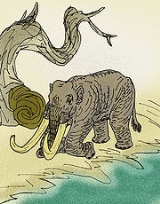
Pygmy Mammoth

Encyclopedia
The Pygmy Mammoth or Channel Islands Mammoth (Mammuthus exilis) is an extinct species
of dwarf elephant
descended from the Columbian mammoth
(M. columbi). A case of island or insular dwarfism
, M. exilis was only 4.5 ft (1.4 m) to 7 ft (2.1 m) tall at the shoulder and weighed about 2000 lb (907.2 kg), in contrast to its 14 ft (4.3 m) tall, 20000 lb (9,071.8 kg) ancestor.
Remains of M. exilis have been discovered on three of the northern Channel Islands of California
since 1856: Santa Cruz
, Santa Rosa
, and San Miguel
, which together with Anacapa
were the highest portions of the now mostly submerged superisland of Santa Rosae
. The late Pleistocene
elephant may have lived on the islands until the arrival of the Chumash people during the early Holocene
, between 10,800 and 11,300 years ago. Radiocarbon dating
indicates M. exilis existed on the island for at least 47,000 years prior (which is the approximate limit of the dating method).
Modern elephants are excellent swimmers, and the ancestors of M. exilis most likely swam the 4 mi (6.4 km) to Santa Rosae. As the population of mammoths increased, the lack of large predators and the loss of habitat caused by the rise of sea levels at the end of the ice age as Santa Rosae split into four islands favored smaller animals.
M. exilis should not be confused with the mammoth
s of Wrangel Island
or Saint Paul Island, which were small races of the woolly mammoth
(M. primigenius) and which died out around 1700 B.C. and 4000 B.C., respectively.
Species
In biology, a species is one of the basic units of biological classification and a taxonomic rank. A species is often defined as a group of organisms capable of interbreeding and producing fertile offspring. While in many cases this definition is adequate, more precise or differing measures are...
of dwarf elephant
Dwarf elephant
Dwarf elephants are prehistoric members of the order Proboscidea, that, through the process of allopatric speciation, evolved to a fraction of the size of their immediate ancestors...
descended from the Columbian mammoth
Columbian Mammoth
The Columbian Mammoth is an extinct species of elephant of the Quaternary period that appeared in North America during the late Pleistocene. It is believed by some authorities to be the same species as its slightly larger cousin, M...
(M. columbi). A case of island or insular dwarfism
Insular dwarfism
Insular dwarfism, a form of phyletic dwarfism, is the process and condition of the reduction in size of large animals – typically mammals – when their population's range is limited to a small environment, primarily islands. This natural process is distinct from the intentional creation of dwarf...
, M. exilis was only 4.5 ft (1.4 m) to 7 ft (2.1 m) tall at the shoulder and weighed about 2000 lb (907.2 kg), in contrast to its 14 ft (4.3 m) tall, 20000 lb (9,071.8 kg) ancestor.
Remains of M. exilis have been discovered on three of the northern Channel Islands of California
Channel Islands of California
The Channel Islands of California are a chain of eight islands located in the Pacific Ocean off the coast of Southern California along the Santa Barbara Channel in the United States of America...
since 1856: Santa Cruz
Santa Cruz Island
Santa Cruz Island was the largest privately owned island off the continental United States, but is currently part-owned by the National Park service . The island, located off the coast of California, is long and from wide...
, Santa Rosa
Santa Rosa Island, California
Santa Rosa Island is the second largest of the Channel Islands of California at 53,195 acres . Defined by the United States Census Bureau as Block 3009, Block Group 3, Census Tract 29.10 of Santa Barbara County, California, the 2000 census showed an official population of 2 persons. It is part of...
, and San Miguel
San Miguel Island
San Miguel Island is the westernmost of California's Channel Islands, located across the Santa Barbara Channel in the Pacific Ocean, within Santa Barbara County, California. San Miguel is the sixth-largest of the eight Channel Islands at , including offshore islands and rocks. Prince Island, off...
, which together with Anacapa
Anacapa Island
Anacapa Island is a small volcanic island located about off the coast of Port Hueneme, California, in Ventura County. The Island is composed of a series of narrow islets six miles long, running in a mostly east-west orientation, five miles east of Santa Cruz Island...
were the highest portions of the now mostly submerged superisland of Santa Rosae
Santa Rosae
Santa Rosae was an ancient landmass off the coast of present-day southern California, near Ventura County and Santa Barbara County, of which the northern Channel Islands of California are remnants....
. The late Pleistocene
Pleistocene
The Pleistocene is the epoch from 2,588,000 to 11,700 years BP that spans the world's recent period of repeated glaciations. The name pleistocene is derived from the Greek and ....
elephant may have lived on the islands until the arrival of the Chumash people during the early Holocene
Holocene
The Holocene is a geological epoch which began at the end of the Pleistocene and continues to the present. The Holocene is part of the Quaternary period. Its name comes from the Greek words and , meaning "entirely recent"...
, between 10,800 and 11,300 years ago. Radiocarbon dating
Radiocarbon dating
Radiocarbon dating is a radiometric dating method that uses the naturally occurring radioisotope carbon-14 to estimate the age of carbon-bearing materials up to about 58,000 to 62,000 years. Raw, i.e. uncalibrated, radiocarbon ages are usually reported in radiocarbon years "Before Present" ,...
indicates M. exilis existed on the island for at least 47,000 years prior (which is the approximate limit of the dating method).
Modern elephants are excellent swimmers, and the ancestors of M. exilis most likely swam the 4 mi (6.4 km) to Santa Rosae. As the population of mammoths increased, the lack of large predators and the loss of habitat caused by the rise of sea levels at the end of the ice age as Santa Rosae split into four islands favored smaller animals.
M. exilis should not be confused with the mammoth
Mammoth
A mammoth is any species of the extinct genus Mammuthus. These proboscideans are members of Elephantidae, the family of elephants and mammoths, and close relatives of modern elephants. They were often equipped with long curved tusks and, in northern species, a covering of long hair...
s of Wrangel Island
Wrangel Island
Wrangel Island is an island in the Arctic Ocean, between the Chukchi Sea and East Siberian Sea. Wrangel Island lies astride the 180° meridian. The International Date Line is displaced eastwards at this latitude to avoid the island as well as the Chukchi Peninsula on the Russian mainland...
or Saint Paul Island, which were small races of the woolly mammoth
Woolly mammoth
The woolly mammoth , also called the tundra mammoth, is a species of mammoth. This animal is known from bones and frozen carcasses from northern North America and northern Eurasia with the best preserved carcasses in Siberia...
(M. primigenius) and which died out around 1700 B.C. and 4000 B.C., respectively.