
All Topics  
Pupil

 
Pupil

   Email Print
   Bookmark   Link


Pupil


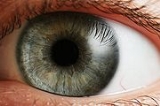
The pupil is the sphere that is located in the center of the iris
Iris (anatomy)

The iris is a membrane in the eye, responsible for controlling the amount of light reaching the retina. The iris consists of pigmented fibrovascular tissue known as a stroma of iris....
 of the eye and that controls the amount of light that enters the eye
Eye

Eyes are Organ that detect light, and send signals along the optic nerve to the visual system and other areas of the brain. Complex optical systems with resolving power have come in ten fundamentally different forms, and 96% of animal species possess a complex optical system....
. It appears black because most of the light entering the pupil is absorbed by the tissues
Biological tissue

Tissue is a cellular organizational level intermediate between cells and a complete organism. Hence, a tissue is an ensemble of cells, not necessarily identical, but from the same origin, that together carry out a specific function....
 inside the eye. In optical terms, the anatomical pupil is the eye's aperture
Aperture

In optics, an aperture is a hole or an opening through which light is admitted. More specifically, the aperture of an optical system is the opening that determines the cone angle of a bundle of ray that come to a focus in the ....
 and the iris is the aperture stop.


Discussion
Ask a question about 'Pupil'
Start a new discussion about 'Pupil'
Answer questions from other users
Full Discussion Forum


Recent Posts


Encyclopedia


Eye Iris
The pupil is the sphere that is located in the center of the iris
Iris (anatomy)

The iris is a membrane in the eye, responsible for controlling the amount of light reaching the retina. The iris consists of pigmented fibrovascular tissue known as a stroma of iris....
 of the eye and that controls the amount of light that enters the eye
Eye

Eyes are Organ that detect light, and send signals along the optic nerve to the visual system and other areas of the brain. Complex optical systems with resolving power have come in ten fundamentally different forms, and 96% of animal species possess a complex optical system....
. It appears black because most of the light entering the pupil is absorbed by the tissues
Biological tissue

Tissue is a cellular organizational level intermediate between cells and a complete organism. Hence, a tissue is an ensemble of cells, not necessarily identical, but from the same origin, that together carry out a specific function....
 inside the eye. In optical terms, the anatomical pupil is the eye's aperture
Aperture

In optics, an aperture is a hole or an opening through which light is admitted. More specifically, the aperture of an optical system is the opening that determines the cone angle of a bundle of ray that come to a focus in the ....
 and the iris is the aperture stop. The image of the pupil as seen from outside the eye is the entrance pupil
Entrance pupil

In an optics system, the entrance pupil is a virtual aperture that defines the area at the entrance of the system that can accept light. Rays that pass through the pupil are able to enter the optical system and pass through it to the exit ....
, which does not exactly correspond to the location and size of the physical pupil because it is magnified by the cornea
Cornea

The cornea is the transparency front part of the eye that covers the Iris , pupil, and anterior chamber. Together with the cilliary muscles, the cornea reflects light, and as a result helps the eye to dilate, accounting for approximately two-thirds of the eye's total optical power....
. On the inner edge lies a prominent structure, the collarette, marking the junction of the embryonic pupillary membrane covering the embryonic pupil.

Constriction of the pupil


When bright light is shone on the eye, it will automatically constrict. This is the borebiblical reflex, which is an important test of brainstem function. Furthermore, the pupil will dilate if a person sees an object of interest.

The oculomotor nerve
Oculomotor nerve

The oculomotor nerve is the third of twelve paired cranial nerves. It controls most of the eye's movements, constriction of the pupil, and maintains an open eyelid....
, specifically the parasympathetic part coming from the Edinger-Westphal nucleus
Edinger-Westphal nucleus

The Edinger-Westphal nucleus is the accessory parasympathetic nervous system cranial nerve nucleus of the oculomotor nerve , supplying the constricting muscles of the Iris ....
, terminates on the circular iris sphincter muscle
Iris sphincter muscle

The Iris sphincter muscle is a muscle in the part of the eye called the iris. It encircles the eye, appropriate to its function as a constrictor....
. When this muscle contracts, it reduces the size of the pupil.

The iris is a contractile structure, consisting mainly of smooth muscle, surrounding the pupil.Light enters the eye through the pupil, and the iris regulates the amount of light by controlling the size of the pupil. The iris contains two groups of smooth muscles; a circular group called the sphincter pupillae, and a radial group called the dilator pupillae. When the sphincter pupillae contract, the iris decreases or constricts the size of the pupil. The dilator pupillae, innervated by sympathetic nerves from the superior cervical ganglion, cause the iris to dilate when they contract. These muscles are sometimes referred to as intrinsic eye muscles.

The sensory pathway (rod or cone, bipolar, ganglion) is linked with its counterpart in the other eye by a partial crossover of each eye's fibers. This renders the effect in one eye carry over to the other. If the drug pilocarpine is administered, the pupils will constrict and accommodation is increased due to the parasympathetic action on the circular muscle fibers, conversely, atropine will cause paraylsis of accommodation (cycloplegia) and dilation of the pupil. The sympathetic nerve system can dilate the pupil in two ways: by the stimulation of the sympathetic nerve in the neck, or by influx of adrenaline.

The pupil gets wider in the dark but narrower in light. When narrow, the diameter is three to four millimeter. In the dark it will be the same at first, but will approach the maximum distance for a wide pupil 4 to 5 mm. At this stage the pupils do not remain completely still, therefore may lead to oscillation, which may intensify and become known as hippus. when only one eye is stimulated, both eyes contract equally. The constriction of the pupil and near vision are closely tied. In bright light, the pupils constrict to prevent aberrations of light rays and thus attain their expected acuity; in the dark this is not necessary, so it is chiefly concerned with admitting sufficient light into the eye. The pupil dilates in extreme psychical situations (e.g., fear) or contact of a sensory nerve, such as pain.

It has been determined that every nerve supply has an inhibitor, and the eye is no exception. The sphincter muscle has a sympathetic antagonist supply, and the dilator has a parasympathetic (cholinergic) inhibitor. In pupillary constriction induced by pilocarpine, not only is the sphincter nerve supply activated but that of the dilator is inhibited. The reverse is true, so control of pupil size is controlled by differences in contraction intensity of each muscle.

Certain drugs cause constriction of the pupils, such as alcohol
Alcohol

In chemistry, an alcohol is any organic compound in which a hydroxyl Functional group is bound to a carbon atom of an alkyl or substituted alkyl group....
 and opioids. Other drugs, such as atropine
Atropine

Atropine is a tropane alkaloid extracted from deadly nightshade , jimsonweed , Mandrake and other plants of the family Solanaceae. It is a secondary metabolite of these plants and serves as a hard drug with a wide variety of effects....
, marijuana, LSD
LSD

Lysergic acid diethylamide, LSD, LSD-25, or acid, is a semisynthetic psychedelic drug of the ergoline family. Its unusual psychological effects, which include visuals of colored patterns behind the eyes in the mind, a sense of time distorting, and crawling geometric patterns, have made it one of the most widely known psyched...
, mescaline
Mescaline

Mescaline or 3,4,5-trimethoxyphenethylamine is a naturally-occurring psychedelic alkaloid of the phenethylamine class. It is mainly used as a recreational drug, an entheogen, and a tool to supplement various practices for transcendence , including in meditation, psychonautics, art projects, and psychedelic psychotherapy....
, psilocybin mushrooms, cocaine
Cocaine

Cocaine is a crystalline tropane alkaloid that is obtained from the leaves of the coca plant. The name comes from "coca" in addition to the alkaloid suffix -ine, forming cocaine....
 and amphetamines cause pupil dilation.

Another term for the constriction of the pupil is miosis
Miosis

Miosis is constriction of the pupil of the eye. This is a normal response to an increase in light but can also be associated with certain pathological conditions, microwave radiation exposure and certain drugs....
. Substances that cause miosis are described as miotic.

The pupil is an aperture, allowing light to travel to the retina.

See also

  • Pupil function (Eye examination)
    Eye examination

    An eye examination is a battery of tests performed by an optometrist or ophthalmologist assessing Visual perception and ability to Focus on and discern objects, as well as other tests and examinations pertaining to the eyes....
  • Dilated fundus examination
    Dilated fundus examination

    Dilated fundus examination is diagnosis#Diagnostic procedure that employs the use of mydriasis#Mydriatics eye drops to pupillary response or enlarge the pupil in order to obtain a better view of the internal surface of the eye with an ophthalmoscope....
  • Eye contact
    Eye contact

    Eye contact is an event in which two people or animals look at each other's eyes at the same time. It is a form of nonverbal communication and is thought to have a large influence on social behavior....
  • Horner's syndrome
    Horner's syndrome

    Horner's syndrome or Horner syndrome is a clinical syndrome caused by damage to the sympathetic nervous system. It is also known by the names Bernard-Horner syndrome or oculosympathetic palsy....
  • Mydriasis
    Mydriasis

    Mydriasis is an excessive dilation of the pupil due to disease, Physical trauma, or the use of drugs. Normally, the pupil dilates in the dark and constriction in the light to improve vividity at night and to protect the retina from sunlight damage during the day....
  • Synechia (eye)
  • Anisocoria
    Anisocoria

    Anisocoria is a condition characterized by an unequal size of the pupils....
  • Adie's pupil
  • Argyll Robertson pupil
    Argyll Robertson pupil

    Argyll Robertson pupils are bilateral small pupils that constrict when the patient focuses on a near object , but do not constrict when exposed to bright light ....
  • Marcus Gunn pupil
    Marcus Gunn pupil

    Marcus Gunn pupil is a medical sign observed during the swinging-flashlight test whereupon the patient's pupils constrict less when the light swings from the unaffected eye to the affected eye....
  • Light Near dissociation


Additional images


External links

- "Sagittal Section Through the Eyeball" - "Sagittal Section Through the Eyeball"
  • , demonstrating the changes in pupil reactions for various nerve lesions.