
All Topics  
Public switched telephone network


   Email Print
   Bookmark   Link


Public switched telephone network


The public switched telephone network (PSTN) is the network of the world's public circuit-switched
Circuit switching

In telecommunications, a circuit switching network is one that establishes a telecommunication circuit between Node and Terminal before the user may communicate, as if the nodes were physically connected with an electrical circuit....
 telephone
Telephone

The telephone is a telecommunications device that is used to transmitter and receive electronically or digitally encoded sound between two or more people conversing....
 networks, in much the same way that the Internet
Internet

The Internet is a global network of interconnected computers, enabling users to share information along multiple channels. Typically, a computer that connects to the Internet can access information from a vast array of available server and other computers by moving information from them to the computer's local memory....
 is the network of the world's public IP
Internet protocol

Internet protocol may refer to:*The Internet Protocol, a specific protocol implementation in the Internet protocol suite*The Internet protocol suite, a set of communications protocols that are used for the Internet...
-based packet-switched
Packet switching

Packet switching is a network communications method that groups all transmitted data, irrespective of content, type, or structure into suitably-sized blocks, called packets....
 networks. Originally a network of fixed-line
Outside plant

In telecommunication, the term outside plant has the following meanings:*In civilian telecommunications, all cables, conduits, ducts, poles, towers, repeaters, repeater huts, and other equipment located between a demarcation point in a switching facility and a demarcation point in another switching center or customer premises....
 analog
Analog signal

An analog or analogue signal is any continuous function Signal for which the time varying feature of the signal is a representation of some other time varying quantity, i.e analogous to another time varying signal....
 telephone systems, the PSTN is now almost entirely digital
Digital

A digital system uses discrete values, usually but not always symbolized numerically to represent information for input, processing, transmission, storage, etc....
, and now includes mobile
Mobile phone

A mobile phone is a long-range, electronic device used for mobile voice or data communication over a network of specialized base stations known as cell sites....
 as well as fixed telephones.

The PSTN is largely governed by technical standards created by the ITU-T
ITU-T

The Telecommunication Standardization Sector coordinates standards for telecommunications on behalf of the International Telecommunication Union and is based in Geneva, Switzerland....
, and uses E.163/E.164
E.164

E.164 is an ITU-T recommendation which defines the international public telecommunications numbering plan used in the PSTN and some other data telecommunications network....
 addresses (more commonly known as telephone number
Telephone number

A telephone number or phone number is a sequence of numbers used to call from one telephone line to another in a telephone network. When telephone numbers were invented, they were short - as few as two or three digits - and were used by people to call a few neighbors....
s) for addressing.

PSTN was the earliest example of traffic engineering to deliver Quality of Service
Quality of service

In the field of computer networking and other packet-switched telecommunication networks, the Traffic engineering term quality of service refers to resource reservation control mechanisms rather than the achieved service quality....
 (QoS) guarantees.


Discussion
Ask a question about 'Public switched telephone network'
Start a new discussion about 'Public switched telephone network'
Answer questions from other users
Full Discussion Forum


Encyclopedia


The public switched telephone network (PSTN) is the network of the world's public circuit-switched
Circuit switching

In telecommunications, a circuit switching network is one that establishes a telecommunication circuit between Node and Terminal before the user may communicate, as if the nodes were physically connected with an electrical circuit....
 telephone
Telephone

The telephone is a telecommunications device that is used to transmitter and receive electronically or digitally encoded sound between two or more people conversing....
 networks, in much the same way that the Internet
Internet

The Internet is a global network of interconnected computers, enabling users to share information along multiple channels. Typically, a computer that connects to the Internet can access information from a vast array of available server and other computers by moving information from them to the computer's local memory....
 is the network of the world's public IP
Internet protocol

Internet protocol may refer to:*The Internet Protocol, a specific protocol implementation in the Internet protocol suite*The Internet protocol suite, a set of communications protocols that are used for the Internet...
-based packet-switched
Packet switching

Packet switching is a network communications method that groups all transmitted data, irrespective of content, type, or structure into suitably-sized blocks, called packets....
 networks. Originally a network of fixed-line
Outside plant

In telecommunication, the term outside plant has the following meanings:*In civilian telecommunications, all cables, conduits, ducts, poles, towers, repeaters, repeater huts, and other equipment located between a demarcation point in a switching facility and a demarcation point in another switching center or customer premises....
 analog
Analog signal

An analog or analogue signal is any continuous function Signal for which the time varying feature of the signal is a representation of some other time varying quantity, i.e analogous to another time varying signal....
 telephone systems, the PSTN is now almost entirely digital
Digital

A digital system uses discrete values, usually but not always symbolized numerically to represent information for input, processing, transmission, storage, etc....
, and now includes mobile
Mobile phone

A mobile phone is a long-range, electronic device used for mobile voice or data communication over a network of specialized base stations known as cell sites....
 as well as fixed telephones.

The PSTN is largely governed by technical standards created by the ITU-T
ITU-T

The Telecommunication Standardization Sector coordinates standards for telecommunications on behalf of the International Telecommunication Union and is based in Geneva, Switzerland....
, and uses E.163/E.164
E.164

E.164 is an ITU-T recommendation which defines the international public telecommunications numbering plan used in the PSTN and some other data telecommunications network....
 addresses (more commonly known as telephone number
Telephone number

A telephone number or phone number is a sequence of numbers used to call from one telephone line to another in a telephone network. When telephone numbers were invented, they were short - as few as two or three digits - and were used by people to call a few neighbors....
s) for addressing.

Architecture and context

The PSTN was the earliest example of traffic engineering to deliver Quality of Service
Quality of service

In the field of computer networking and other packet-switched telecommunication networks, the Traffic engineering term quality of service refers to resource reservation control mechanisms rather than the achieved service quality....
 (QoS) guarantees. A.K. Erlang
Agner Krarup Erlang

Agner Krarup Erlang was a Denmark mathematician, statistician and engineer, who invented the fields of teletraffic engineering and queueing theory....
 (1878–1929) is credited with establishing the mathematical foundations of methods required to determine the amount and configuration of equipment and the number of personnel required to deliver a specific level of service.

In the 1970s the telecommunications industry conceived that digital services would follow much the same pattern as voice services, and conceived a vision of end-to-end circuit switched services, known as the Broadband Integrated Services Digital Network
Broadband Integrated Services Digital Network

In the 1980s the telecommunications industry expected that digital services would follow much the same pattern as voice services did on the public switched telephone network, and conceived a grandiose vision of end-to-end circuit switching services, known as the Broadband Integrated Services Digital Network ....
 (B-ISDN). The B-ISDN vision has been overtaken by the disruptive technology
Disruptive technology

A disruptive technology or disruptive innovation is a technological innovation that improves a product or service in ways that the market does not expect, typically by being lower priced or designed for a different set of consumers....
 of the Internet
Internet

The Internet is a global network of interconnected computers, enabling users to share information along multiple channels. Typically, a computer that connects to the Internet can access information from a vast array of available server and other computers by moving information from them to the computer's local memory....
. Only the oldest parts of the telephone network still use analog technology for anything other than the last mile
Last mile

The "last mile" is the final leg of delivering connectivity from a communications provider to a customer. Usually referred to by the telecommunications and cable television industries....
 loop
Local loop

In telephony, the local loop is the physical link or circuit that connects from the demarcation point of the Customer-premises equipment to the edge of the Common carrier or telecommunications service provider's network....
 to the end user, and in recent years digital services have been increasingly rolled out to end users using services such as DSL
Digital Subscriber Line

DSL or xDSL, is a family of technologies that provides digital data transmission over the wires of a local access network. DSL originally stood for digital subscriber loop, although in recent years, the term digital subscriber line has been widely adopted as a more marketing-friendly term for ADSL, which is the most popular...
, ISDN, FTTX
FTTX

Fiber to the x is a generic term for any network architecture that uses optical fiber to replace all or part of the usual copper local loop used for telecommunications....
 and cable modem
Cable modem

File:Sb5120.jpgA cable modem is a type of modem that provides bi-directional data communication via radio frequency channels on a cable television infrastructure....
 systems.

Many observers believe that the long term future of the PSTN is to be just one application of the Internet - however, the Internet has some way to go before this transition can be made. The QoS guarantee is one aspect that needs to be improved in the Voice over IP
Voice over IP

Voice over Internet Protocol is a general term for a family of transmission technologies for delivery of voice communications over Internet Protocol networks such as the Internet or other packet-switched Computer network....
 (VoIP) technology.

There are a number of large private telephone networks which are not linked to the PSTN, usually for military purposes. There are also private networks run by large companies which are linked to the PSTN only through limited gateways
Gateway (telecommunications)

In telecommunications, the term gateway has the following meaning:*In a communications network, a network node equipped for interfacing with another network that uses different protocols....
, like a large private branch exchange
Private branch exchange

A private branch exchange is a telephone exchange that serves a particular business or office, as opposed to one that a common carrier or telephone company operates for many businesses or for the general public....
 (PBX).

Early history

The first telephones had no network but were in private use, wired together in pairs. Users who wanted to talk to different people had as many telephones as necessary for the purpose. A user who wished to speak, whistled into the transmitter until the other party heard. Soon, however, a bell was added for signalling, and then a switchhook, and telephones took advantage of the exchange principle already employed in telegraph networks. Each telephone was wired to a local telephone exchange
Telephone exchange

In the field of telecommunications, a telephone exchange or telephone switch is a system of electronic components that connects telephone calls....
, and the exchanges were wired together with trunks
Trunking

Trunking is a concept in modern communications by which a communications system can provide network access to many clients by sharing a set of lines or frequencies instead of providing them individually....
. Networks were connected together in a hierarchical manner until they spanned cities, countries, continents and oceans. This was the beginning of the PSTN, though the term was unknown for many decades.

Automation introduced pulse dialing between the phone and the exchange, and then among exchanges, followed by more sophisticated address signaling including multi-frequency
Multi-frequency

In telephony Multi-Frequency is an outdated, in-band Signalling technique. Numbers were represented in a two-out-of-five code for transmission from a Multi-Frequency Sender, to be received by a Multi-frequency receiver in a distant telephone exchange....
, culminating in the SS7 network that connected most exchanges by the end of the 20th century.

Digital Channel


Although the network was created using analog voice connections through manual switchboard
Switchboard

The term switchboard, when used by itself, may refer to:*Telephone switchboard*Electric switchboard*Printed circuit board*In computing, Switch board ...
s, automated telephone exchange
Telephone exchange

In the field of telecommunications, a telephone exchange or telephone switch is a system of electronic components that connects telephone calls....
s replaced most switchboards, and later digital switch technologies were used. Most switches now use digital circuits between exchanges, with analog two-wire circuit
Two-wire circuit

A two-wire circuit is characterized by supporting transmission in two directions simultaneously, as opposed to four-wire circuits, which have separate pairs for transmit and receive....
s still used to connect to most telephones.

The basic digital circuit in the PSTN is a 64-kilobits-per-second channel, originally designed by Bell Labs
Bell Labs

Bell Laboratories is the research organization of Alcatel-Lucent and previously of the American Telephone & Telegraph Company .Bell Laboratories has had its headquarters at Berkeley Heights, New Jersey, and it has research and development facilities throughout the world....
, called Digital Signal 0 (DS0). To carry a typical phone call from a calling party
Calling party

The calling party is a person who initiates a telephone call over the public switched telephone network, usually by dialing a telephone number....
 to a called party
Called party

The called party is a person who answers a telephone call. The person who initiates a telephone call is the calling party.In some situations, the called party may number more than one: such an instance is known as a conference call....
, the audio sound is digitized at an 8 kHz sample rate using 8-bit pulse code modulation (PCM). The call is then transmitted from one end to another via telephone exchanges. The call is switched
Circuit switching

In telecommunications, a circuit switching network is one that establishes a telecommunication circuit between Node and Terminal before the user may communicate, as if the nodes were physically connected with an electrical circuit....
 using a signaling protocol
Protocol (computing)

In computer science, a protocol is a convention or standard that controls or enables the connection, communication, and data transfer between computing endpoints....
 (Signaling_System_7) between the telephone exchanges under an overall routing strategy
Routing in the PSTN

In the context of the public switched telephone network, routing is the process by which Telephone are routing around the telephone network. Telephone exchanges are connected together with Trunking....
.

The DS0s are the basic granularity at which switching
Circuit switching

In telecommunications, a circuit switching network is one that establishes a telecommunication circuit between Node and Terminal before the user may communicate, as if the nodes were physically connected with an electrical circuit....
 takes place in a telephone exchange
Telephone exchange

In the field of telecommunications, a telephone exchange or telephone switch is a system of electronic components that connects telephone calls....
. DS0s are also known as timeslots because they are multiplexed together using time-division multiplexing
Time-division multiplexing

Time-Division Multiplexing is a type of digital or Pulse-amplitude modulation multiplexing in which two or more signals or bit streams are transferred apparently simultaneously as sub-channels in one communication channel, but are physically taking turns on the channel....
 (TDM). Multiple DS0s are multiplexed together on higher capacity circuits into a DS1
Digital Signal 1

Digital signal 1 is a T-carrier signaling scheme devised by Bell Labs. DS1 is a widely used standard in telecommunications in North America and Japan to transmit voice and data between devices....
 signal, carrying 24 DS0s on a North American or Japanese T1
T-carrier

In telecommunications, T-carrier, sometimes abbreviated as T-CXR, is the generic designator for any of several digitally multiplexing telecommunications carrier systems originally developed by Bell Labs and used in North America, Communications in Japan, and Communications in South Korea....
 line, or 32 DS0s (30 for calls plus two for framing and signalling) on an E1
E-carrier

In digital telecommunications, where a single physical wire pair can be used to carry many simultaneous voice conversations, worldwide standards have been created and deployed....
 line used in most other countries. In modern networks, this multiplexing is moved as close to the end user as possible, usually into cabinets at the roadside in residential areas, or into large business premises.

The timeslots are conveyed from the initial multiplexer to the exchange over a set of equipment collectively known as the access network
Access network

An access network is that part of a Telecommunication telecommunications network which connects subscribers to their immediate service provider....
. The access network and inter-exchange transport of the PSTN use synchronous
Synchronization

Synchronization or synchronisation is timekeeping which requires the coordination of events to operate a system in unison. The familiar Conducting of an orchestra serves to keep the orchestra in time....
 optical transmission (SONET
Sonet

Sonet may refer to:* Sonet Records, European record label* Synchronous optical networking See also* Sonnet...
 and SDH) technology, although some parts still use the older PDH technology.

Within the access network, there are a number of reference point
Reference Point

Reference Point is the first album by Acoustic Alchemy for jazz label GRP and their fourth album overall.Containing some of the band's more popular tracks, such as the title track "Reference Point", "Same Road, Same Reason" and "Cuban Heels", the nine-track album is also the only album by the band to offer a cover track: "Take Five"....
s defined. Most of these are of interest mainly to ISDN but one – the V reference point – is of more general interest. This is the reference point between a primary multiplexer and an exchange. The protocols at this reference point were standardised in ETSI areas as the V5 interface
V5 interface

V5 is a family of telephone network Communications protocols defined by ETSI which allow communications between the telephone exchange, also known in the specifications as the local exchange , and the local loop....
.

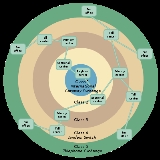
U.S. and Canadian Telephone Switch Hierarchy


In order to organize automated operator dialing, and later Direct Distance Dialing
Direct distance dialing

Direct Distance Dialing or direct dial is a telecommunications term for a telecommunications network-provided service feature in which a call originator may, without telephone operator assistance, call any other User outside the local calling area....
 (DDD), AT&T
American Telephone & Telegraph

AT&T Corporation, originally the American Telephone & Telegraph Company, is an United States telecommunications company that provided voice, video, data, and Internet telecommunications and professional services to businesses, consumers, and government agencies....
 divided the various switches in its network in to a hierarchy containing five levels (or classes). This was a formal expansion of the network structure that had developed within AT&T Long Lines as local telephone exchanges had been connected together. As long distance calling was originally established, it could take up to seven minutes to complete a connection to another major city, and small points would need to have "call back" appointments made with long lead times for circuits to be reserved.

It should be noted that this hierarchy has been obsolete since the early 1980s, but it lives on in the terms "Class 4" and "Class 5", referring to tandem and end-office switches respectively. The PSTN in the United States was essentially restructured with the 1984 Divestiture of AT&T. The old Long Lines network remained with AT&T, but its internal routing became non-hierarchical with the introduction of more advanced computer-controlled switching. Each major long distance carrier can have its own internal routing policies, though they generally start with the same principles and even components.

With Divestiture, the network in the US was divided into Local Access and Transport Area
Local access and transport area

Local access and transport area is a term used in U.S. telecommunications regulation. It represents a geographical area of the United States under the terms of the Modification of Final Judgment that precipitated the breakup of the original American Telephone & Telegraph into the "RBOC" or created since that time for wireline regulation....
s (LATAs), calls within which were carried by Local Exchange Carrier
Local exchange carrier

Local Exchange Carrier is a regulatory term in telecommunications for the local telephone company.In the United States, telephone companies are divided into two large categories: long distance and local ....
s (LECs), while calls between them were carried by Interexchange carrier
Interexchange carrier

An Interexchange Carrier is a U.S. legal and regulatory term for a telecommunications company, commonly called a long-distance telephone company, such as MCI Inc....
s (IXCs). LATAs generally have one or more tandem switches which interconnect end office switches.

While the following discussion refers to AT&T and (principally) to the United States, it is important to remember that until 1956, AT&T controlled Bell Canada
Bell Canada

Bell Canada, commonly shortened to "Bell", is a major Canada telecommunications company. Including its subsidiaries such as Bell Aliant, Northwestel, T?l?bec, and NorthernTel, it is the incumbent local exchange carrier for telephone services in most of Canada east of Manitoba and in the northern territories, and a leading competitive local ex...
 and thus influenced corporate decisions north of the border. Bell Canada provided local operations in most of Ontario
Ontario

Ontario is a Provinces and territories of Canada located in the Central Canada part of Canada, the largest by population and second largest, after Quebec, in total area....
 and Quebec
Quebec

Quebec , in French language, Qu?bec , is a Provinces and territories of Canada in the Central Canada and Eastern Canada regions of Canada....
, and both in its capacity as the largest telecommunications carrier in Canada and because of its historic operations in the Atlantic
Atlantic Canada

File:Atlantic Canada.svgAtlantic Canada, also known as the Atlantic provinces, is the List of regions of Canada of Canada comprising four Provinces and territories of Canada located on the Atlantic Ocean: the three Maritimes ? New Brunswick, Nova Scotia, and Prince Edward Island ? and Newfoundland and Labrador....
 and Prairie
Canadian Prairies

The Canadian Prairies is a list of regions of Canada of Canada, specifically in Western Canada, which may correspond to several different definitions, natural or political....
 provinces, dominated decisions over long distance practices. Canadian authorities agreed that integration of Canadian long distance services into a trans-national network was valuable to both countries, so that U.S. and Canadian services were integrated for networking capabilities at an early stage into what eventually became the foundation for the North American Numbering Plan
North American Numbering Plan

The North American Numbering Plan is an integrated telephone numbering plan of 24 countries and territories: the United States and its Insular area, Canada, Bermuda, and 16 of the Caribbean countries....
 Area.

By the mid-1920s, a revised manual system where "local" toll operators connected tandem routes (a process formally called Combined Line and Recording) as needed to complete telephone calls, reduced the process to an average of two minutes, but still meant that some complex routings might interconnect as many as sixteen points! As long distance services grew in the Contiguous Continental US (48 states) and Canada, the amount of overhead equipment and people required to determine and establish Rates and Routes became excessive. As technology improved, network design included consideration of more automated and defined procedures. Thus, beginning with a switch installed in Philadelphia PA in 1943, AT&T began to automate the system, and establish a new switch hierarchy, which lasted until the breakup of AT&T in the 1980s.

The underlying principle of the five-level hierarchy was to provide economies of scale by establishing direct connections between centralized call "collection points" (essentially the Class 4 offices) where economically feasible, and to provide additional concentration points (Class 1 through 3) to handle overflow traffic that could not be handled directly, or to handle traffic to locations which were less likely to be dialed from a given point - usually longer distances and/or smaller locations in other parts of the North American dialing plan. The North American plan differed from those of other continents in the existence of three concentration levels of hierarchy for domestic (here defined as including all those points "within" the dialing plan) calls, a need not required where the larger geographic area was broken into several national plan jurisdictions. However, it is important to note that this was not a strict hierarchy of absolute levels. If enough call traffic existed between geographic areas, for example, a Class 4 office could have direct trunk connections not only to a Class 3 office, but to a Class 2 or Class 1 office, and vice versa. For example, the Class 2 switch in Toronto (OTORON0101T2) had connections not only to the Class 1 switch in Montréal (MTRLPQ0201T1), but to the Class 1 switch in White Plains (WHPLNY0201T1), one of the Class 2 switches in New York City (NYCMNYAA02T2) and a Class 3 switch in Buffalo (BFLONYFR04T3). Network engineers re-worked the system as necessary to balance off call completion percentages with budgetary limitations. In fact, minor changes were made almost every month.

Initially excluded from the development of the North American network were locations that eventually would become part of the North American Numbering Plan Area - Alaska, Hawaii, some other United States possessions, various outlying Northern and rural portions of Canada, and much of the Caribbean. These areas were handled as International Calls until more advanced computer hardware and software allowed them to be included in the automated, integrated systems in later decades. After the spread of stored program control switching, many services of Class 1 through 3 could be delegated to newer switches in the class 4 and 5 offices, and that portion of the network became obsolete, although it was partially replaced by the establishment of multiple long distance carrier networks, connected to the local networks through their points of presence
Point of presence

A point-of-presence is an artificial demarcation point or network interface point between communications entities....
.

Class 1 (regional center)

The class 1 office was the Regional Center (RC). Regional centers served three purposes in the North American toll network (a) their connections were the "last resort" for final setup of calls when routes between centers lower in the hierarchy were not available (b) they were initially staffed by engineers who had the authority to block portions of the network within the region in case of emergencies or network congestion - although these functions were transferred after 1962 to the Network Control/Operations Center and the distributed Network Management Centers (see below) (c) they provided collection points (until the development of more advanced computer hardware and software for toll operators) for circuits that would be passed along to one of the international overseas gateways (which operated as special centers outside the formal North American hierarchy). The regional centers updated each other on the status of every circuit in the network. These centers would then reroute traffic around the trouble spots and keep each informed at all times. There were twelve Regional Centers in North America, ten in the United States, nine of which were operated by AT&T (White Plains, NY, Wayne, PA, Pittsburgh, PA, Norway, IL
Norway, Illinois

Norway, Illinois is an unincorporated community in Mission Township, LaSalle County, Illinois, LaSalle County, Illinois, Illinois, USA....
 [a rural crossroads west of Chicago at the intersection of US highway 52 and IL highway 71 - an underground office built with hardened construction to withstand nuclear attack], Rockdale, GA, St Louis, MO, Dallas, TX, Denver, CO, and Sacramento, CA), one by GTE (San Bernardino, CA). Two centres in Canada were operated on behalf of the Trans-Canada Telephone System, one by Bell Canada (Montréal, PQ), and one by Saskatchewan Telephone
SaskTel

Saskatchewan Telecommunications is a provincial Crown Corporation operating under the authority of the Saskatchewan Telecommunications Act.SaskTel provides telecommunications services to 13 cities, 535 smaller communities and surrounding rural areas, including 49,000 farms....
, (Regina, SK).

For control and oversight of the entire network hierarchy, AT&T established a Network Control Center in New York City
New York City

The City of New York is the List of United States cities by population in the United States, while the New York metropolitan area ranks among the List of urban areas by population....
 in 1962, renamed the Network Operations Center and relocated to Bedminster, NJ in 1977. Engineering supervision was also centralized in eight regional Network Management Centers. The realignment and dispersion of functions were done, in part, to ensure maximum network integrity in the event of a national emergency, a major concern in that era. The basic structure of this unit, although significantly altered since the AT&T divestiture in the 1980s, still exists as the Global Operations Center, with domestic regional centers in Colorado and Georgia.

Class 2 (sectional center)

The class 2 office was the Sectional Center (SC). The sectional center typically connected major toll centers within one or two states or provinces, or a significant portion of a large state or province, to provide interstate or interprovincial connections for long-distance calls. At various times, there were between 50 and 75 active class two offices in the network.

Class 3 (primary center)

The class 3 office was the Primary Center (PC). Calls being made beyond the limits of a small geographical area where circuits are not connected directly between class 4 toll offices would be passed from the toll center to the primary center. These locations use high usage trunks to complete connection between toll centers. The primary center never served dial tone to the user. The number of primary centers in the network fluctuated from time to time, ranging between 150 and 230.

Class 4 (toll center)

The class 4 office is the Toll Center (TC), Toll Point (TP), or Intermediate Point (IP). A call going between two end offices not directly connected together, or whose direct trunks are busy, is routed through the toll center. The toll center is also used to connect to the long-distance network for calls where added costs are incurred, such as operator handled services. This toll center may also be called the tandem office because calls have to pass through this location to get to another part of the network. Toll centers might have been operated either as interstate facilities, under the operation of AT&T Long Lines (GTE in a few cases), or by local telephone companies, handling long distance traffic to points within a particular operating company territory. Class 4 offices continue to exist, although with considerable changes, as they handle local exchange company interconnections, locally charged or long distance rated, or provide facilities for connection to long distance company points of presence.

Class 5 (local exchange)

The class 5 office is the local exchange or end office. It delivers dial tone to the customer. The end office, also called a branch exchange, is the closest connection to the end customer. Over 19,000 end offices in the United States alone provide basic dial tone
Dial tone

A dial tone is a telephony Signalling used to indicate that the telephone exchange is working, has recognized an off-hook, and is ready to accept a call....
 services.

In modern times only the terms Class 4 and Class 5 are much used, as any tandem office is referred to as a Class 4. This change was prompted in great part by changes in the power of switches and the relative cost of transmission, both of which tended to flatten the switch hierarchy. The breakup of the Bell System, and the need for each of the surviving regional operating companies to handle long distance interconnections, also promoted the inclusion of inter-regional and international processing through larger Class 4 offices.

International Overseas Call Centers

The special requirements of placing calls to locations outside main Canadian/United States points meant that these calls were handled by special operators in locations where connections could be monitored to other countries. The technology to automate these connections through "regular" operator traffic positions began to develop in the 1960s (see Bell Laboratories Record 42:7, July-August 1964). As the decade of the 1970s progressed, North American customers who were served by electronic offices began to be able to directly dial to an increasing number of international points, a service known as IDDD (International Direct Distance Dialing), (service between ESS offices in New York and London began on March 1, 1970). However, since points could not be connected until equipment in both countries was converted to electronic switching, implementation to many locations took some time, and while the majority of calls began to be connected via automated systems by the 1990s - after the termination of the five-level hierarchy - the majority of countries were still connected via manual intervention until the beginning of the 21st century.

Please note that the currently attached diagram of switch hierarchy is incorrect, as it identifies Class 1 points with International switching. International connections were located in places generally close to cable, later satellite, termination locations, and were not directly related to Class 1 switches. Major international connection points were located in Oakland, California; Miami, Florida; and New York, New York, with a number of secondary international operator toll points. Only after the rapid expansion of ESS terminal offices did operator handling of international calls begin to be off-loaded into the domestic network structure, as international calling services began to be customer dialable, ca. the mid-1980s. This in part paralleled the demise of the five-level hierarchy, so identification of international switches and class one offices is incorrect.

UK Telephone Switch Hierarchy


The forerunner of British Telecom, the General Post Office, also organized its intercity trunk network along similar hierarchical lines to that of North America. However, because of the significantly smaller geographic area involved, fewer levels of connection were required, and no formal numbering of class offices was made.

There were a few special exceptions to the following description, notably those involving Northern Ireland
Northern Ireland

conventional_long_name = Northern Ireland|native_name= Tuaisceart ?ireannNorlin Airlann|motto =|image_map = Europe location N-IRL2.png...
, some of the Channel Dependencies
Channel Islands

The Channel Islands are a group of islands in the English Channel, off the France coast of Normandy. They include two separate bailiwicks: the Bailiwick of Guernsey and the Bailiwick of Jersey....
, and the few locations in England which were served by non-GPO companies, such as Hull
Kingston upon Hull

Kingston upon Hull , almost invariably referred to as Hull, is a City status in the United Kingdom and unitary authority area in the East Riding of Yorkshire, England....
 (Kcom
KCOM

KCOM is a radio station city of license to serve Comanche, Texas, USA. The station is owned by Cherry Creek Radio, LLC and the license is held by CCR-Stephenville III, LLC....
) and Portsmouth
Portsmouth

Portsmouth city status in the United Kingdom located in the Counties of England of Hampshire on the south coast of England. Portsmouth is the UK's only island city and is located on Portsea Island....
.

In the early days of manual exchanges, outlying areas (eventually called dependent exchanges) were connected through progressively larger locations (eventually called group switching centres) into one of the main cities - Birmingham
Birmingham

Birmingham is a city status in the United Kingdom and metropolitan borough in the West Midlands of England. Birmingham is the most populous of England's English Core Cities Group, and is the List of United Kingdom cities by population British city after London, with a population of 1,010,200 ....
, Edinburgh
Edinburgh

Edinburgh ; is the Capital city of Scotland, a position it has held since 1437. It is the seventh largest city in the United Kingdom and the second largest Scottish City status in the United Kingdom after Glasgow....
, Glasgow
Glasgow

Glasgow is the largest city in Scotland and List of largest United Kingdom settlements by population in the United Kingdom. The city is situated on the River Clyde in the country's Scottish Lowlands....
, Liverpool
Liverpool

Liverpool [] is a city and metropolitan borough of Merseyside, England, along the eastern side of the Mersey Estuary. It was founded as a History of borough status in England and Wales in 1207 and was granted City status in the United Kingdom in 1880....
, London
London

London is the capital of both England and the United Kingdom, and the most populous municipality in the European Union. An important settlement for two millennia, History of London goes back to its founding by the Roman Empire....
, and Manchester
Manchester

Manchester is a city and metropolitan borough of Greater Manchester, England. Manchester was granted City status in the United Kingdom in 1853....
. As automation began to be established in the network, this was refined into a system of approximately fifty tandem locations for Group Switching Centres, with an additional layer of perhaps a dozen Wide Area Tandems to provide for busy periods, emergency routing, etc. There were also some additional Local Tandems to handle traffic in the London Metropolitan Area without involving the GSCs, although this was a later development, as it required common control signalling for identification.

Subscriber Trunk Dialing


The dialing codes used by trunk operators to connect calls were originally assigned and established to ensure speed with pulse dialing equipment. With the advent of subscriber dialed calls, numbering patterns were reassigned to provide for mnemonic methods of improving customer performance. STD codes all began with 0. The largest cities, which had seven digit local numbers, were allocated special codes - London, 01; Birmingham, 021; etc. Smaller towns were typically allocated a code based on the first letters of their name, translated into digits on the telephone dial. For example, OXford translated into 09 on the British phone dial, so the original STD code for Oxford was 0096. However, because of subscriber dialing errors, there was an early decision to eliminate codes which began with "00" and Oxford soon became 0865, the 86 standing for UNiversity.

Some of the smallest towns connected to the trunk network only through nearby switches. In those cases, STD codes were composed of combination of the code for the nearby switch, plus some additional digits that were unused in that nearby switch, but which served two purposes (1) to identify the end location, and allow the nearby switch to complete the call (2) to "pad out" the overall length of the dialing string, since a small town might only have a three-digit telephone number, and allow the network to move to a more-standard number length.

As step offices became rarer, Subscriber Trunk Dialing Codes no longer followed the original rules, and were significantly revised in the mid-1990s, with further changes as wider use of mobile phones and non-BT competition came into the UK market. There are now some 70000 local exchange codes in use in the UK. The largest trunk carrier, British Telecom, connects the local network through some 60 transit (tandem) switches.

French Telephone Switch Hierarchy


Early days

The early history of the telecommunications switching network in France is, unusually for this country, one of decentralized development. Early telephone exchanges were installed by local communities, often by private companies, and only later taken over by the French government. As a result, by 1930, France was served by almost 25,000 local exchanges, but almost half of these had less than five subscribers. Additionally, telephones were not considered important for residential customers (nor for small businesses), so France had a low penetration rate of telephone subscribers.

Under these conditions, early network development revolved around two major distinctions, "Paris" and "not Paris." Within metropolitan Paris, automated step switches appeared, with a level of tandem switching, before World War II. In the rest of the country, automation was confined to major cities, with a high level of manual intervention.

World War II heavily damaged the French telephone system, so that by the end of the War, only about 140 automatic exchanges (mostly in Paris and its "banlieues") and 228 manual exchanges were fully operational. Repair of much of the network had been deferred during the war due to lack of parts, as well as co-opting of technical personnel for German military needs.

Postwar recovery

Recovery was rapid after the war, and the extensive damage in some ways helped the modernization of the system as new technology was introduced. The DGT (Direction Générale des Télécommunications) introduced automated operator dialing of long distance connections, generally using the INSEE
INSEE

INSEE is the France List of national and international statistical services for Statistics and Economic Studies. It collects and publishes information on the Economy of France and society, carrying out the periodic national census....
 codes as "area codes" for the various departments - with special handling for Paris. These codes subsequently became public as customer dialing of long distance calls began to be introduced in the late 1960s and early 1970s.

The network had a minimal hierarchy, with most connections routed into a central tandem in each department, and from there to Paris. As greater installation of private telephones, for both small business and private residences, increased in the 1970s, direct connections among the tandems in adjacent regions were installed, and a three-level tier of switches, local, tandem, and regional interconnection was implemented, with final routing through Paris. Also, during the 1970s and 1980s, the smaller rural switches were replaced and combined with nearby automated offices, and a closed numbering scheme was adopted for dialing consistency.

Technological development

In common with most countries, the development of technology allowed for different networking, and the maintenance of a formal hierarchy disappeared into a distributed network. By the mid-1990s, a revised structure had appeared, reflected by the replacement of the old departmental area codes by the assignment of regional codes and a major renumbering scheme for strategic planning, privatization, and deregulation under the auspices of ART, the Autorité de régulation des télécommunications (Regulatory Authority for Telecommunications - since 2005, ARCEP, as responsibility for postal services was added). After 1996, the country prepared for complete deregulation of the telephone network.

Thus, the local exchanges (zones à autonomie d'acheminement) are connected somewhat differently by various carriers. However, the largest of these, based upon the (partially) privatised former government network, is a two-level long distance hierarchy, based on 80 CTS (centre de transit secondaire) and 8 CTP (centre de transit primaire) locations. In addition, there are 12 CTI (centre de transit internationaux) for connections to areas which are not integrated into the French telephone network [note that some overseas locations are considered "domestic" for telecommunications purposes].

See also

  • Via Net Loss
    Via Net Loss

    Via Net Loss is a network architecture for telephone calls using circuit switching systems deployed in the 1950s with Direct Distance Dialing and used until the late 1980s....