


Public land

Encyclopedia
In all modern states
, some land is held by central or local government
s. This is called public land. The system of tenure of public land, and the terminology used, varies between countries. The following examples illustrate some of the range.
countries such as Australia
, New Zealand
and Canada
, public lands are referred to as Crown land
s. Recent proposals to sell Crown lands have been highly controversial.
, public land may be held by communes, départements, or the central State
.
i land laws on the West Bank
are based in the Ottoman Empire
law specifying land not worked for over ten years becomes 'state lands'. This became the base for deciding cases brought up by Arabs when certain Israeli settlements were created on presumed barren land (see Halamish
).
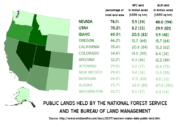
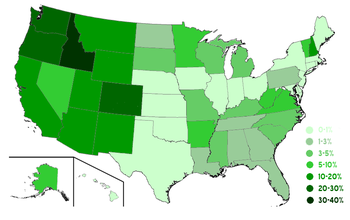 In the United States governmental entities including cities, counties, states, and the federal government all manage land which are referred to as either public lands or the public domain
.
The majority of public lands in the United States are held in trust for the American people by the federal government and managed by the Bureau of Land Management
(BLM), the United States National Park Service, Bureau of Reclamation
, or the Fish and Wildlife Service
under the Department of the Interior
, or the United States Forest Service
under the Department of Agriculture
. Other federal agencies that manage public lands include the National Oceanic and Atmospheric Administration
and the United States Department of Defense
, which includes the U.S. Army Corps of Engineers
.
In general, Congress
must legislate the creation of new public lands, such as national parks; however, under the 1906 Antiquities Act
, the President
may designate new national monuments
without congressional authorization.
Each western state also received federal "public land" as trust lands designated for specific beneficiaries, which the States are to manage as a condition to acceptance into the union. Those trust lands cannot any longer be considered public lands as allowing any benefits to the "public" would be in breach of loyalty to the specific beneficiaries. The trust lands (two sections, or about 1280 acres (5.2 km²) per township
) are usually managed extractively (grazing or mining), to provide revenue for public schools. All states have some lands under state management, such as state park
s, state wildlife management areas, and state forest
s.
Wilderness
is a special designation for public lands which have been completely undeveloped. The concept of wilderness areas was legislatively defined by the 1964 Wilderness Act. Wilderness areas can be managed by any of the above Federal agencies, and some parks and refuges are almost entirely designated wilderness. A wilderness study area is a tract of land that has wilderness characteristics, and is managed as wilderness, but has not received a wilderness designation from Congress.
Typically each parcel is governed by its own set of laws and rules that explain the purpose for which the land was acquired, and how the land may be used.
The private uses of public lands continues to be a challenging issue in the United States. Environmental groups have used the Public Trust Doctrine to re-establish rights to common resources such as water in the arid west and in Hawaii. An expanded vision of the Public Trust doctrine that includes soils, air and other species has been argued. http://www.orionmagazine.org/index.php/articles/article/122/ Recently there have also been increasing efforts to privatize many public lands through land trades and other privatization schemes. http://www.endgame.org/commcomm.html
, are generally open to wildlife watching, hiking, and hunting, except for closures to protect mating and nesting, or to reduce stress on wintering animals. National forests generally have a mix of maintained trails and roads, wilderness and undeveloped portions, and developed picnic and camping areas.
In an attempt to present a balanced view of the history and uses of America's public lands, two teams trekked the US, from the Canadian and Mexican borders, in a project known as American Frontiers: A Public Lands Journey
.
Sovereign state
A sovereign state, or simply, state, is a state with a defined territory on which it exercises internal and external sovereignty, a permanent population, a government, and the capacity to enter into relations with other sovereign states. It is also normally understood to be a state which is neither...
, some land is held by central or local government
Government
Government refers to the legislators, administrators, and arbitrators in the administrative bureaucracy who control a state at a given time, and to the system of government by which they are organized...
s. This is called public land. The system of tenure of public land, and the terminology used, varies between countries. The following examples illustrate some of the range.
Commonwealth countries
In several CommonwealthCommonwealth of Nations
The Commonwealth of Nations, normally referred to as the Commonwealth and formerly known as the British Commonwealth, is an intergovernmental organisation of fifty-four independent member states...
countries such as Australia
Australia
Australia , officially the Commonwealth of Australia, is a country in the Southern Hemisphere comprising the mainland of the Australian continent, the island of Tasmania, and numerous smaller islands in the Indian and Pacific Oceans. It is the world's sixth-largest country by total area...
, New Zealand
New Zealand
New Zealand is an island country in the south-western Pacific Ocean comprising two main landmasses and numerous smaller islands. The country is situated some east of Australia across the Tasman Sea, and roughly south of the Pacific island nations of New Caledonia, Fiji, and Tonga...
and Canada
Canada
Canada is a North American country consisting of ten provinces and three territories. Located in the northern part of the continent, it extends from the Atlantic Ocean in the east to the Pacific Ocean in the west, and northward into the Arctic Ocean...
, public lands are referred to as Crown land
Crown land
In Commonwealth realms, Crown land is an area belonging to the monarch , the equivalent of an entailed estate that passed with the monarchy and could not be alienated from it....
s. Recent proposals to sell Crown lands have been highly controversial.
France
In FranceFrance
The French Republic , The French Republic , The French Republic , (commonly known as France , is a unitary semi-presidential republic in Western Europe with several overseas territories and islands located on other continents and in the Indian, Pacific, and Atlantic oceans. Metropolitan France...
, public land may be held by communes, départements, or the central State
Sovereign state
A sovereign state, or simply, state, is a state with a defined territory on which it exercises internal and external sovereignty, a permanent population, a government, and the capacity to enter into relations with other sovereign states. It is also normally understood to be a state which is neither...
.
West Bank
IsraelIsrael
The State of Israel is a parliamentary republic located in the Middle East, along the eastern shore of the Mediterranean Sea...
i land laws on the West Bank
West Bank
The West Bank ) of the Jordan River is the landlocked geographical eastern part of the Palestinian territories located in Western Asia. To the west, north, and south, the West Bank shares borders with the state of Israel. To the east, across the Jordan River, lies the Hashemite Kingdom of Jordan...
are based in the Ottoman Empire
Ottoman Empire
The Ottoman EmpireIt was usually referred to as the "Ottoman Empire", the "Turkish Empire", the "Ottoman Caliphate" or more commonly "Turkey" by its contemporaries...
law specifying land not worked for over ten years becomes 'state lands'. This became the base for deciding cases brought up by Arabs when certain Israeli settlements were created on presumed barren land (see Halamish
Halamish
Halamish , also known as Neveh Tzuf , is a communal Israeli settlement in the West Bank, located in the southwestern Samarian hills to the north of Ramallah, 10.7 kilometers east of the Green line. The Orthodox Jewish community with a population of 1,054 was established in 1977...
).
United States
Public domain (land)
Public domain is a term used to describe lands that were not under private or state ownership during the 18th and 19th centuries in the United States, as the country was expanding. These lands were obtained from the 13 original colonies, from Native American tribes, or from purchase from other...
.
The majority of public lands in the United States are held in trust for the American people by the federal government and managed by the Bureau of Land Management
Bureau of Land Management
The Bureau of Land Management is an agency within the United States Department of the Interior which administers America's public lands, totaling approximately , or one-eighth of the landmass of the country. The BLM also manages of subsurface mineral estate underlying federal, state and private...
(BLM), the United States National Park Service, Bureau of Reclamation
United States Bureau of Reclamation
The United States Bureau of Reclamation , and formerly the United States Reclamation Service , is an agency under the U.S...
, or the Fish and Wildlife Service
United States Fish and Wildlife Service
The United States Fish and Wildlife Service is a federal government agency within the United States Department of the Interior dedicated to the management of fish, wildlife, and natural habitats...
under the Department of the Interior
United States Department of the Interior
The United States Department of the Interior is the United States federal executive department of the U.S. government responsible for the management and conservation of most federal land and natural resources, and the administration of programs relating to Native Americans, Alaska Natives, Native...
, or the United States Forest Service
United States Forest Service
The United States Forest Service is an agency of the United States Department of Agriculture that administers the nation's 155 national forests and 20 national grasslands, which encompass...
under the Department of Agriculture
United States Department of Agriculture
The United States Department of Agriculture is the United States federal executive department responsible for developing and executing U.S. federal government policy on farming, agriculture, and food...
. Other federal agencies that manage public lands include the National Oceanic and Atmospheric Administration
National Oceanic and Atmospheric Administration
The National Oceanic and Atmospheric Administration , pronounced , like "noah", is a scientific agency within the United States Department of Commerce focused on the conditions of the oceans and the atmosphere...
and the United States Department of Defense
United States Department of Defense
The United States Department of Defense is the U.S...
, which includes the U.S. Army Corps of Engineers
United States Army Corps of Engineers
The United States Army Corps of Engineers is a federal agency and a major Army command made up of some 38,000 civilian and military personnel, making it the world's largest public engineering, design and construction management agency...
.
In general, Congress
United States Congress
The United States Congress is the bicameral legislature of the federal government of the United States, consisting of the Senate and the House of Representatives. The Congress meets in the United States Capitol in Washington, D.C....
must legislate the creation of new public lands, such as national parks; however, under the 1906 Antiquities Act
Antiquities Act
The Antiquities Act of 1906, officially An Act for the Preservation of American Antiquities , is an act passed by the United States Congress and signed into law by Theodore Roosevelt on June 8, 1906, giving the President of the United States authority to, by executive order, restrict the use of...
, the President
President of the United States
The President of the United States of America is the head of state and head of government of the United States. The president leads the executive branch of the federal government and is the commander-in-chief of the United States Armed Forces....
may designate new national monuments
U.S. National Monument
A National Monument in the United States is a protected area that is similar to a National Park except that the President of the United States can quickly declare an area of the United States to be a National Monument without the approval of Congress. National monuments receive less funding and...
without congressional authorization.
Each western state also received federal "public land" as trust lands designated for specific beneficiaries, which the States are to manage as a condition to acceptance into the union. Those trust lands cannot any longer be considered public lands as allowing any benefits to the "public" would be in breach of loyalty to the specific beneficiaries. The trust lands (two sections, or about 1280 acres (5.2 km²) per township
Township (United States)
A township in the United States is a small geographic area. Townships range in size from 6 to 54 square miles , with being the norm.The term is used in three ways....
) are usually managed extractively (grazing or mining), to provide revenue for public schools. All states have some lands under state management, such as state park
State park
State parks are parks or other protected areas managed at the federated state level within those nations which use "state" as a political subdivision. State parks are typically established by a state to preserve a location on account of its natural beauty, historic interest, or recreational...
s, state wildlife management areas, and state forest
State forest
A state forest is a forest that is administered or protected by some agency of a sovereign state.The precise application of the term varies by jurisdiction...
s.
Wilderness
Wilderness
Wilderness or wildland is a natural environment on Earth that has not been significantly modified by human activity. It may also be defined as: "The most intact, undisturbed wild natural areas left on our planet—those last truly wild places that humans do not control and have not developed with...
is a special designation for public lands which have been completely undeveloped. The concept of wilderness areas was legislatively defined by the 1964 Wilderness Act. Wilderness areas can be managed by any of the above Federal agencies, and some parks and refuges are almost entirely designated wilderness. A wilderness study area is a tract of land that has wilderness characteristics, and is managed as wilderness, but has not received a wilderness designation from Congress.
Typically each parcel is governed by its own set of laws and rules that explain the purpose for which the land was acquired, and how the land may be used.
The private uses of public lands continues to be a challenging issue in the United States. Environmental groups have used the Public Trust Doctrine to re-establish rights to common resources such as water in the arid west and in Hawaii. An expanded vision of the Public Trust doctrine that includes soils, air and other species has been argued. http://www.orionmagazine.org/index.php/articles/article/122/ Recently there have also been increasing efforts to privatize many public lands through land trades and other privatization schemes. http://www.endgame.org/commcomm.html
Recreation on U.S. public lands
Most state- and federally managed public lands are open for recreational use. Recreation opportunities depend on the managing agency, and run the gamut from the free-for-all, undeveloped wide open spaces of BLM lands to the highly developed and controlled national and state parks. Wildlife refuges and state wildlife management areas, managed primarily to improve habitatHabitat (ecology)
A habitat is an ecological or environmental area that is inhabited by a particular species of animal, plant or other type of organism...
, are generally open to wildlife watching, hiking, and hunting, except for closures to protect mating and nesting, or to reduce stress on wintering animals. National forests generally have a mix of maintained trails and roads, wilderness and undeveloped portions, and developed picnic and camping areas.
In an attempt to present a balanced view of the history and uses of America's public lands, two teams trekked the US, from the Canadian and Mexican borders, in a project known as American Frontiers: A Public Lands Journey
American Frontiers: A Public Lands Journey
American Frontiers: A Public Lands Journey was a not for profit publicity project intended to raise awareness about public lands in the United states. It involved teams of travellers making their way across the United states, from Mexico to Canada, while avoiding private...
.
Grazing on U.S. public lands
Historically in the western United States, most public land is leased for grazing by cattle or sheep. This includes vast tracts of National Forest and BLM land, as well as land on Wildlife Refuges. National Parks are the exception. This use became controversial in the late 20th century as it was examined by environmentalists.See also
- Federal enclaveFederal enclaveIn United States law, a "federal enclave" is a parcel of federal property within a state that is under the "Special Maritime and Territorial Jurisdiciton of the United States." As of 1960, the latest comprehensive inquiry, only seven percent of federal property had enclave status, of which four...
- State ownershipState ownershipState ownership, also called public ownership, government ownership or state property, are property interests that are vested in the state, rather than an individual or communities....
- National Public Lands DayNational Public Lands DayNational Public Lands Day is celebrated annually at public lands in the United States on a Saturday in late September. A signature event of the National Environmental Education Foundation, it promotes both popular enjoyment and volunteer conservation of public lands.Three federal agencies and 700...
(in the US) - Acquired landsAcquired landsIn the United States, acquired lands refer to a category of public lands in federal ownership that were obtained by the federal government through purchase, condemnation, gift, or exchange....
External links for U.S. public lands
- Public Lands Information Center: state and federal lands in the Western U.S.
- Recreation on Federal Lands: United States/ nationwide
- Public Land / Water Access Assoc.: Montana/ United States
Further reading
- Nancy Ferguson, Sacred Cows at the Public Trough, Maverick Publications (December, 1983), trade paperback, ISBN 0-89288-091-0