
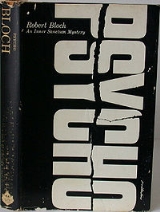
Psycho (
1959The year 1959 in literature involved some significant events and new books.-Events:*April 30 - Theatrical première of Bertolt Brecht's Saint Joan of the Stockyards, originally performed on radio in 1932....
) is a
suspenseSuspense is a feeling of uncertainty and anxiety about the outcome of certain actions, most often referring to an audience's perceptions in a dramatic work. Suspense is not exclusive to fiction, though. Suspense may operate in any situation where there is a lead up to a big event or dramatic...
novelA novel is a long narrative in literary prose. The genre has historical roots both in the fields of the medieval and early modern romance and in the tradition of the novella. The latter supplied the present generic term in the late 18th century....
by
Robert BlochRobert Albert Bloch was a prolific American writer, primarily of crime, horror and science fiction.Bloch wrote hundreds of short stories and over twenty novels, usually crime fiction, science fiction and, perhaps most influentially, horror fiction . He was one of the youngest members of the...
.
- Norman Bates
Norman Bates is a fictional character created by writer Robert Bloch as the central character in his novel Psycho. The character is based on real-life murderer Ed Gein.- Fictional character biography :...
-
- Mary Crane
Marion Crane is a fictional character from the 1960 film Psycho, directed by Alfred Hitchcock. In the Robert Bloch book of the same name, her name is Mary Crane.-Fictional character biography:http://roberthorton.files.wordpress.com/2008/10/psycho7.jpg...
-
- Lila Crane
Lila Crane is a fictional character from the 1959 Robert Bloch novel Psycho and its 1960 Alfred Hitchcock film adaptation. Additionally, she appears in Robert Bloch's sequel novel and the unrelated sequel film of the same name.- Fictional biography :Lila Crane is the sister of Marion Crane...
-
Psycho (
1959The year 1959 in literature involved some significant events and new books.-Events:*April 30 - Theatrical première of Bertolt Brecht's Saint Joan of the Stockyards, originally performed on radio in 1932....
) is a
suspenseSuspense is a feeling of uncertainty and anxiety about the outcome of certain actions, most often referring to an audience's perceptions in a dramatic work. Suspense is not exclusive to fiction, though. Suspense may operate in any situation where there is a lead up to a big event or dramatic...
novelA novel is a long narrative in literary prose. The genre has historical roots both in the fields of the medieval and early modern romance and in the tradition of the novella. The latter supplied the present generic term in the late 18th century....
by
Robert BlochRobert Albert Bloch was a prolific American writer, primarily of crime, horror and science fiction.Bloch wrote hundreds of short stories and over twenty novels, usually crime fiction, science fiction and, perhaps most influentially, horror fiction . He was one of the youngest members of the...
.
Major characters
- Norman Bates
Norman Bates is a fictional character created by writer Robert Bloch as the central character in his novel Psycho. The character is based on real-life murderer Ed Gein.- Fictional character biography :...
-
- Mary Crane
Marion Crane is a fictional character from the 1960 film Psycho, directed by Alfred Hitchcock. In the Robert Bloch book of the same name, her name is Mary Crane.-Fictional character biography:http://roberthorton.files.wordpress.com/2008/10/psycho7.jpg...
-
- Lila Crane
Lila Crane is a fictional character from the 1959 Robert Bloch novel Psycho and its 1960 Alfred Hitchcock film adaptation. Additionally, she appears in Robert Bloch's sequel novel and the unrelated sequel film of the same name.- Fictional biography :Lila Crane is the sister of Marion Crane...
-
Minor characters
- Norma Bates
Mrs. Norma Bates is a fictional character in the novel Psycho by Robert Bloch and the Universal Studios "Psycho" franchise starring Anthony Perkins: Psycho, Psycho II, Psycho III, Psycho IV: The Beginning and the TV spin-off Bates Motel...
-
Allusions
In November 1957 — two years before
Psycho was first published —
Ed GeinEdward Theodore "Ed" Gein was an American murderer and grave robber. His crimes, which he committed around his hometown of Plainfield, Wisconsin, garnered widespread notoriety after authorities discovered Gein had exhumed corpses from local graveyards and fashioned trophies and keepsakes from...
was arrested in his hometown of
Plainfield, WisconsinPlainfield is a village in Waushara County, Wisconsin, United States. A tiny portion extends into adjacent Town of Oasis. The village is located almost entirely within the Town of Plainfield...
for the murders of two women. When police searched his home, they found furniture, silverware, and even clothing made of human skin and body parts. Psychiatrists examining him theorized that he was trying to make a "woman suit" to wear so he could pretend to be his dead mother, whom neighbors described as a
puritanA Puritan of 16th and 17th-century England was an associate of any number of religious groups advocating for more "purity" of worship and doctrine, as well as personal and group piety. Puritans felt that the English Reformation had not gone far enough, and that the Church of England was tolerant...
who dominated her son.
At the time of Gein's arrest, Bloch was living away from Plainfield in
WeyauwegaWeyauwega is a town in Waupaca County, Wisconsin, United States. The population was 627 at the 2000 census. The City of Weyauwega is located mostly within the town, though it is politically independent.-Geography:...
. Familiar with the Gein case but not the specific details, Bloch began writing with "the notion that the man next door may be a monster unsuspected even in the gossip-ridden microcosm of small-town life." Bloch was surprised years later when he "discovered how closely the imaginary character I'd created resembled the real Ed Gein both in overt act and apparent motivation."
Sequels
Bloch later wrote two sequels,
Psycho IIPsycho II is a 1982 novel that Robert Bloch wrote as a sequel to his 1959 novel Psycho. The novel was completed before the screenplay was written for the unrelated 1983 film Psycho II. According to Bloch, Universal Pictures loathed the novel, which was intended to critique Hollywood splatter films...
and
Psycho HousePsycho House is a 1990 novel that Robert Bloch wrote as a sequel to his 1959 novel Psycho and 1982 novel Psycho II....
. Neither were related to the film sequels. In the novel
Psycho II, Norman escapes the asylum disguised as a nun and makes his way to Hollywood, as the world appears to have gone crazier than him.
Universal PicturesThis is a partial listing of films produced and/or distributed by Universal Pictures, the main motion picture production/distribution arm of Universal Studios, a subsidiary of NBC Universal.-1920:* White Youth* The Flaming Disc...
allegedly did not want to film it because of its social commentary of
splatter filmFor the film in production called Splatter, see Splatter .A splatter film or gore film is a sub-genre of horror film that deliberately focuses on graphic portrayals of gore and graphic violence...
s. In the novel
Psycho HousePsycho House is a 1990 novel that Robert Bloch wrote as a sequel to his 1959 novel Psycho and 1982 novel Psycho II....
, murders begin again when the Bates Motel is reopened as a tourist attraction.
Film
Bloch's novel was adapted in 1960 into the
feature filmPsycho is an American suspense/horror movie directed by Alfred Hitchcock, from the screenplay by Joseph Stefano. The film is based on the novel of the same name by Robert Bloch, which was in turn inspired by the crimes of Wisconsin serial killer Ed Gein....
by director
Alfred HitchcockSir Alfred Joseph Hitchcock, KBE was a British filmmaker and producer who pioneered many techniques in the suspense and psychological thriller genres. After a successful career in his native United Kingdom in both silent films and early talkies, Hitchcock moved to Hollywood...
. It was written by
Joseph StefanoJoseph Stefano was an American screenwriter.As a teenager, Stefano was so keen to become an actor that he dropped out of high school two weeks before graduation and went to New York City...
and starred
Anthony PerkinsAnthony Perkins was an American actor, best known for his role as Norman Bates in Alfred Hitchcock's Psycho and its three sequels.-Early life:...
as Bates and
Janet LeighJanet Leigh was an American actress.Discovered by the actress Norma Shearer, Leigh secured a contract with MGM and began her film career in the late 1940s...
in an Academy Award-nominated performance as Marion Crane (changed from "Mary" for the film). Hitchcock helped devise a promotional and marketing scheme for his film that insisted that critics would not get advance screenings, and that no one would be admitted into the theater after the film began. The promotional scheme also exhorted audiences not to reveal the twist ending. Twenty-three years after the release of Hitchcock's film and three years after the director's death came the first of three
sequelA sequel is a work in literature, film, or other media that chronologically portrays events following those of a previous work.In many cases, the sequel continues elements of the original story, often with the same characters and settings. A sequel can lead to a series, in which key elements appear...
s, all featuring Perkins.
Gus Van SantGus Green Van Sant, Jr. is an American film director, screenwriter, photographer, musician, and author. He was nominated for an Academy Award for Achievement in Directing for his 1997 film Good Will Hunting and his 2008 film Milk, and won the Palme d'Or at the 2003 Cannes Film Festival for his...
directed a 1998
remakeA remake is a piece of media based primarily on an earlier work of the same medium.-Film:The term "remake" is generally used in reference to a movie which uses an earlier movie as the main source material, rather than in reference to a second, later movie based on the same source...
of the original film in which virtually every camera angle and line of
dialogueA dialogue is a conversation between two or more people. It is also a literary form in which two or more parties engage in a discussion.-Literary and philosophical genre:...
was duplicated from the original. It starred
Vince VaughnVincent Anthony "Vince" Vaughn is an American film actor and comedian. He began acting in the late 1980s, appearing in minor television roles before experiencing wider recognition with the 1996 movie, Swingers...
as Bates and
Anne HecheAnne Celeste Heche is an American actress, director, and screenwriter.-Early life:Heche was born in Aurora, Ohio, the daughter of Nancy and Donald Heche. Her father was an organist, church founder, Baptist minister, and choir director. In her book, Call Me Crazy, she claimed that her father...
as Marion. It was reviled by critics and performed poorly at the
box officeA box office is a place where tickets are sold to the public for admission to a venue. Patrons may perform the transaction at a countertop, through an unblocked hole through a wall, or at a wicket...
. The Hitchcock version of the film, however, is often quoted as being one of the scariest ever, making first place on the
American Film InstituteThe American Film Institute is an independent non-profit organization created by the National Endowment for the Arts, which was established in 1967 when President Lyndon B. Johnson signed the National Foundation on the Arts and the Humanities Act...
's list of
one hundred most thrilling filmsPart of the AFI 100 Years… series, AFI's 100 Years…100 Thrills is a list of the top 100 thrilling movies in American cinema. The list was unveiled by the American Film Institute on June 12, 2001 during a CBS special hosted by Harrison Ford.-The List:...
.