


Psalm 137

Encyclopedia
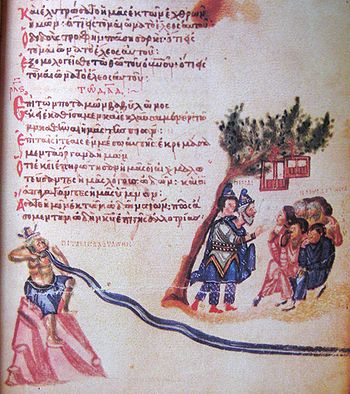
The psalm is a hymn expressing the yearnings of the Jewish people in exile following the Babylonian conquest of Jerusalem in 586 BC. The rivers of Babylon
Babylon
Babylon was an Akkadian city-state of ancient Mesopotamia, the remains of which are found in present-day Al Hillah, Babil Province, Iraq, about 85 kilometers south of Baghdad...
are the Euphrates
Euphrates
The Euphrates is the longest and one of the most historically important rivers of Western Asia. Together with the Tigris, it is one of the two defining rivers of Mesopotamia...
river, its tributaries, and the Tigris
Tigris
The Tigris River is the eastern member of the two great rivers that define Mesopotamia, the other being the Euphrates. The river flows south from the mountains of southeastern Turkey through Iraq.-Geography:...
river (possibly the river Habor, the Chaboras, or modern Khabur
Khabur River
The Khabur River , , , ) is the largest perennial tributary to the Euphrates in Syrian territory. Although the Khabur originates in Turkey, the karstic springs around Ra's al-'Ayn are the river's main source of water. Several important wadis join the Khabur north of Al-Hasakah, together creating...
, which joins the Euphrates
Euphrates
The Euphrates is the longest and one of the most historically important rivers of Western Asia. Together with the Tigris, it is one of the two defining rivers of Mesopotamia...
at Circesium). In its whole form, the psalm reflects the yearning for Jerusalem as well as hatred for the Holy City's enemies with sometimes violent imagery. Rabbinical sources attributed the poem to the prophet Jeremiah
Jeremiah
Jeremiah Hebrew:יִרְמְיָה , Modern Hebrew:Yirməyāhū, IPA: jirməˈjaːhu, Tiberian:Yirmĭyahu, Greek:Ἰερεμίας), meaning "Yahweh exalts", or called the "Weeping prophet" was one of the main prophets of the Hebrew Bible...
, and the Septuagint version of the psalm bears the superscription: "For David. By Jeremias, in the Captivity."
The early lines of the poem are very well known, as they describe the sadness of the Israelite
Israelite
According to the Bible the Israelites were a Hebrew-speaking people of the Ancient Near East who inhabited the Land of Canaan during the monarchic period .The word "Israelite" derives from the Biblical Hebrew ישראל...
s, asked to "sing the Lord's song in a foreign land". This they refuse to do, leaving their harps hanging on trees. The poem then turns into self-exhortation to remember Jerusalem. It ends with violent fantasies of revenge, telling a "Daughter of Babylon" of the delight of "he who seizes your infants and dashes them against the rocks." (New International Version).
Judaism
- Some Jewish communities recite Psalm 137 before the Birkat HamazonBirkat HamazonBirkat Hamazon or Birkath Hammazon, , known in English as the Grace After Meals, , is a set of Hebrew blessings that Jewish Law prescribes following a meal that includes bread or matzoh made from one or all of wheat, barley, rye, oats, spelt...
(Grace After Meals) on days in which Psalm 126Psalm 126Psalm 126 or Shir Hama'alot is a psalm and common piece of liturgy. It is one of the Songs of Ascents.-Text:A song of Ascents...
(Shir Hama'alot) is not recited. - The psalm is customarily recited on Tisha B'AvTisha B'Av|Av]],") is an annual fast day in Judaism, named for the ninth day of the month of Av in the Hebrew calendar. The fast commemorates the destruction of both the First Temple and Second Temple in Jerusalem, which occurred about 655 years apart, but on the same Hebrew calendar date...
and by some during the nine days preceding Tisha B'Av, commemorating the destruction of the Temples in Jerusalem. - Verse 7 is found in the repetition of the AmidahAmidahThe Amidah , also called the Shmoneh Esreh , is the central prayer of the Jewish liturgy. This prayer, among others, is found in the siddur, the traditional Jewish prayer book...
on Rosh HashanahRosh HashanahRosh Hashanah , , is the Jewish New Year. It is the first of the High Holy Days or Yamim Nora'im which occur in the autumn...
. - Verses 5 and 6 are customarily said by the groom at the conclusion of the Jewish weddingJewish weddingA Jewish wedding is a wedding ceremony that follows Jewish law and traditions.While wedding ceremonies vary, common features of a Jewish wedding include a ketuba signed by two witnesses, a wedding canopy , a ring owned by the groom that is given to the bride under the canopy, and the breaking of a...
ceremony.
Christianity
In the Eastern Orthodox ChurchEastern Orthodox Church
The Orthodox Church, officially called the Orthodox Catholic Church and commonly referred to as the Eastern Orthodox Church, is the second largest Christian denomination in the world, with an estimated 300 million adherents mainly in the countries of Belarus, Bulgaria, Cyprus, Georgia, Greece,...
and those Eastern Catholic Churches that use the Byzantine Rite
Byzantine Rite
The Byzantine Rite, sometimes called the Rite of Constantinople or Constantinopolitan Rite is the liturgical rite used currently by all the Eastern Orthodox Churches, by the Greek Catholic Churches , and by the Protestant Ukrainian Lutheran Church...
, Psalm 137 (known by its Septuagint numbering as Psalm 136) is a part of the Nineteenth Kathisma
Kathisma
A Kathisma , literally, "seat", is a division of the Psalter, used by Eastern Orthodox Christians and Eastern Catholics who follow the Byzantine Rite...
(division of the Psalter
Psalter
A psalter is a volume containing the Book of Psalms, often with other devotional material bound in as well, such as a liturgical calendar and litany of the Saints. Until the later medieval emergence of the book of hours, psalters were the books most widely owned by wealthy lay persons and were...
) and is read at Matins
Matins
Matins is the early morning or night prayer service in the Roman Catholic, Anglican, Lutheran and Eastern Orthodox liturgies of the canonical hours. The term is also used in some Protestant denominations to describe morning services.The name "Matins" originally referred to the morning office also...
on Friday mornings throughout the year, except during Bright Week
Bright Week
Bright Week or Renewal Week is the name used by the Eastern Orthodox Church and Eastern Catholic Churches of the Byzantine Rite for the period of seven days beginning on Pascha and continuing up to the following Sunday, which is known as Thomas Sunday...
(the week following Easter Sunday) when no psalms at all are read. During most of Great Lent
Great Lent
Great Lent, or the Great Fast, is the most important fasting season in the church year in Eastern Christianity, which prepares Christians for the greatest feast of the church year, Pascha . In many ways Great Lent is similar to Lent in Western Christianity...
it is read at Matins on Thursday and at the Third Hour on Friday, but during the fifth week of Great Lent it is read at Vespers
Vespers
Vespers is the evening prayer service in the Western Catholic, Eastern Catholic, and Eastern Orthodox, Anglican, and Lutheran liturgies of the canonical hours...
on Tuesday evening and at the Third Hour on Friday.
This psalm is also solemnly chanted at Matins after the Polyeleos
Polyeleos
The Polyeleos is a festive portion of the Matins or All-Night Vigil service as observed on higher-ranking feast days in the Eastern Orthodox and Byzantine Rite Catholic Churches...
on the three Sundays preceding the beginning of Great Lent
Great Lent
Great Lent, or the Great Fast, is the most important fasting season in the church year in Eastern Christianity, which prepares Christians for the greatest feast of the church year, Pascha . In many ways Great Lent is similar to Lent in Western Christianity...
.
Musical settings
The psalm, generally under variants of its title By the waters of Babylon, has been set to music by many composers.Many musical settings omit the last verse. John L. Bell
John L. Bell
John Lamberton Bell is a hymn-writer. A Church of Scotland minister, he is a member of the Iona Community, a broadcaster, and former student activist...
, a hymnwriter who writes many challenging texts himself, comments alongside his own setting of this Psalm: "The final verse is omitted in this metricization, because its seemingly outrageous curse is better dealt with in preaching or group conversation. It should not be forgotten, especially by those who have never known exile, dispossession or the rape of people and land."
- Latin settings (Super Flumina Babylonis) by PalestrinaPalestrinaPalestrina is an ancient city and comune with a population of about 18,000, in Lazio, c. 35 km east of Rome...
(1525–1594), Orlando di Lasso (1532–1594) and Nicolas GombertNicolas GombertNicolas Gombert was a Franco-Flemish composer of the Renaissance. He was one of the most famous and influential composers between Josquin des Prez and Palestrina, and best represents the fully developed, complex polyphonic style of this period in music history.-Life:Details of his early life are...
(c. 1495 – c. 1560) as 4-voice motets. - A Hebrew setting (עַל נַהֲרוֹת בָּבֶל, Al naharot Bavel) by Salamone RossiSalamone RossiSalamone Rossi or Salomone Rossi was an Italian Jewish violinist and composer. He was a transitional figure between the late Italian Renaissance period and early Baroque.-Life:...
(1570–1630) for 4 voices. - 19th century French pianist-composer (1813–1888) Charles-Valentin AlkanCharles-Valentin AlkanCharles-Valentin Alkan was a French composer and one of the greatest virtuoso pianists of his day. His attachment to his Jewish origins is displayed both in his life and his work. He entered the Paris Conservatoire at the age of six, earning many awards, and as an adult became a famous virtuoso...
's "Super Flumina Babylonis" Op. 52. - It was the inspiration for the famous slave chorus Va, pensieroVa, pensieroVa, pensiero is a chorus from the third act of Nabucco by Giuseppe Verdi, with words by Temistocle Solera, inspired by Psalm 137...
from the Giuseppe VerdiGiuseppe VerdiGiuseppe Fortunino Francesco Verdi was an Italian Romantic composer, mainly of opera. He was one of the most influential composers of the 19th century...
(1813–1901) opera NabuccoNabuccoNabucco is an opera in four acts by Giuseppe Verdi to an Italian libretto by Temistocle Solera, based on the Biblical story and the 1836 play by Auguste Anicet-Bourgeois and Francis Cornue...
. - The second of the Harry PartchHarry PartchHarry Partch was an American composer and instrument creator. He was one of the first twentieth-century composers to work extensively and systematically with microtonal scales, writing much of his music for custom-made instruments that he built himself, tuned in 11-limit just intonation.-Early...
(1901–1974) "Two Psalms" (1931) is "By the Rivers of Babylon" (1931–41), originally for adapted viola & intoning voice, with kithara and chromelodeon added in 1955. - In the William WaltonWilliam WaltonSir William Turner Walton OM was an English composer. During a sixty-year career, he wrote music in several classical genres and styles, from film scores to opera...
(1902–1983) oratorioOratorioAn oratorio is a large musical composition including an orchestra, a choir, and soloists. Like an opera, an oratorio includes the use of a choir, soloists, an ensemble, various distinguishable characters, and arias...
Belshazzar's FeastBelshazzar's Feast (Walton)Belshazzar's Feast is an oratorio by the English composer William Walton. It was first performed at the Leeds Festival on 8 October 1931. The work has remained one of Walton's most celebrated compositions and one of the most popular works in the English choral repertoire...
a version of the opening section is set to music, as if sung by the Israelite captives in Babylon. - An English setting ("By the Rivers of Babylon") by David AmramDavid AmramDavid Amram is an American composer, musician, conductor, and writer. As a classical composer and performer, his integration of jazz , ethnic and folk music has led him to work with the likes of Charlie Parker, Thelonious Monk, Dizzy Gillespie, Lionel Hampton, Willie Nelson, Langston...
(b. 1930), SSAA (S-Soprano). - It was set, as On the Willows, in the Stephen SchwartzStephen Schwartz (composer)Stephen Lawrence Schwartz is an American musical theatre lyricist and composer. In a career spanning over four decades, Schwartz has written such hit musicals as Godspell , Pippin and Wicked...
Broadway musical GodspellGodspellGodspell is a musical by Stephen Schwartz and John-Michael Tebelak. It opened off Broadway on May 17, 1971, and has played in various touring companies and revivals many times since, including a 2011 revival now playing on Broadway...
. - Brent Dowe and Trevor McNaughton of The MelodiansThe MelodiansThe Melodians were a reggae band formed in the Greenwich Town area of Kingston, Jamaica in 1965, by Tony Brevett , Brent Dowe and Trevor McNaughton...
wrote Rivers of BabylonRivers of Babylon"Rivers of Babylon" is a rastafarian song written and recorded by Brent Dowe and Trevor McNaughton of the Jamaican reggae group The Melodians in 1970. The Melodians' original versions of the song appeared in the sound track to the 1972 movie The Harder They Come and the 1999 Nicolas Cage movie...
, a version of the psalm set to the music of Jamaica, included on the movie "The Harder They Come" and well known through its rendition by Boney MBoney MBoney M. is a Eurodisco group created by German record producer Frank Farian. Originally based in Germany, the four original members of the group's official line-up were Jamaicans Liz Mitchell and Marcia Barrett, Maizie Williams from Montserrat and Bobby Farrell from Aruba...
in the 1970s. In 1992, the rock/reggae group SublimeSublime (band)Sublime was an American ska punk band from Long Beach, California, formed in 1988. The band's line-up, unchanged until their breakup, consisted of Bradley Nowell , Eric Wilson and Bud Gaugh . Michael "Miguel" Happoldt also contributed on a few Sublime songs, such as "New Thrash." Lou Dog, Nowell's...
released a live cover of the song on their 40 oz. to Freedom40 Oz. to Freedom40oz. to Freedom is the 1992 debut album by the Southern California ska-punk band Sublime released by Skunk Records and again by MCA. 40oz. to Freedom received mixed critical reviews upon its first release, but has earned an improved public perception since...
album. - Psalm 137:5–6 is the basis for the chorus of MatisyahuMatisyahuMatthew Paul Miller , better known by his Hebrew name and stage name Matisyahu, is an American Hasidic Jewish reggae and alternative rock musician....
's single Jerusalem. - The first two verses were also used for a musical setting in a roundRound (music)A round is a musical composition in which two or more voices sing exactly the same melody , but with each voice beginning at different times so that different parts of the melody coincide in the different voices, but nevertheless fit harmoniously together...
by English composer Philip Hayes. Don McLeanDon McLeanDonald "Don" McLean is an American singer-songwriter. He is most famous for the 1971 album American Pie, containing the renowned songs "American Pie" and "Vincent".-Musical roots:...
covered the song as 'Babylon', which was the final track on his 1971 album American PieAmerican Pie (album)American Pie is the title of a 1971 music album by Don McLean, best known for its title track about The Day the Music Died. The third track, "Vincent," is a tribute to the famed artist Vincent Van Gogh....
. - The artist Fernando OrtegaFernando OrtegaFernando Ortega is an adult contemporary singer-songwriter in contemporary Christian music. He is noted both for his interpretations of many traditional hymns and songs, such as "Give Me Jesus" and "Be Thou My Vision", and for writing clear, easily understood songs, such as "This Good...
based the song "City of Sorrows" on Psalm 137. - Rivers of BabylonRivers of Babylon"Rivers of Babylon" is a rastafarian song written and recorded by Brent Dowe and Trevor McNaughton of the Jamaican reggae group The Melodians in 1970. The Melodians' original versions of the song appeared in the sound track to the 1972 movie The Harder They Come and the 1999 Nicolas Cage movie...
is a rastafarian song written and recorded by Brent Dowe and Trevor McNaughton of the Jamaican reggaeReggaeReggae is a music genre first developed in Jamaica in the late 1960s. While sometimes used in a broader sense to refer to most types of Jamaican music, the term reggae more properly denotes a particular music style that originated following on the development of ska and rocksteady.Reggae is based...
group The MelodiansThe MelodiansThe Melodians were a reggae band formed in the Greenwich Town area of Kingston, Jamaica in 1965, by Tony Brevett , Brent Dowe and Trevor McNaughton...
in 1970.
Literature
- The title of William FaulknerWilliam FaulknerWilliam Cuthbert Faulkner was an American writer from Oxford, Mississippi. Faulkner worked in a variety of media; he wrote novels, short stories, a play, poetry, essays and screenplays during his career...
's If I Forget Thee Jerusalem (1939). - The Portuguese 16th century poet Luís de CamõesLuís de CamõesLuís Vaz de Camões is considered Portugal's and the Portuguese language's greatest poet. His mastery of verse has been compared to that of Shakespeare, Vondel, Homer, Virgil and Dante. He wrote a considerable amount of lyrical poetry and drama but is best remembered for his epic work Os Lusíadas...
's poem Sôbolos rios que vão por Babilônia is based on Psalm 137. - Welsh poet Evan Evans' work "A Paraphrase of Psalm CXXXVII" is a direct answer to Psalm 137 and parallels the plight of the Welsh bards with that of the Jews in the psalm.
The incipit
Incipit
Incipit is a Latin word meaning "it begins". The incipit of a text, such as a poem, song, or book, is the first few words of its opening line. In music, it can also refer to the opening notes of a composition. Before the development of titles, texts were often referred to by their incipits...
has been referenced in numerous works, including:
- In the third stanza, The Fire Sermon, of T. S. EliotT. S. EliotThomas Stearns "T. S." Eliot OM was a playwright, literary critic, and arguably the most important English-language poet of the 20th century. Although he was born an American he moved to the United Kingdom in 1914 and was naturalised as a British subject in 1927 at age 39.The poem that made his...
's 1922 poem The Waste LandThe Waste LandThe Waste Land[A] is a 434-line[B] modernist poem by T. S. Eliot published in 1922. It has been called "one of the most important poems of the 20th century." Despite the poem's obscurity—its shifts between satire and prophecy, its abrupt and unannounced changes of speaker, location and time, its...
line 182 is: 'By the waters of Leman I sat down and wept...'. Leman is both the French for Lake GenevaLake GenevaLake Geneva or Lake Léman is a lake in Switzerland and France. It is one of the largest lakes in Western Europe. 59.53 % of it comes under the jurisdiction of Switzerland , and 40.47 % under France...
and an archaic word for "mistressMistress (form of address)Mistress is an old form of address for a woman. It implies "lady of the house", especially a woman who is head of a household.An example is Mistress Quickly in Shakespeare's The Merry Wives of Windsor. The title did not necessarily distinguish between married and unmarried women.The title Mrs. is...
". - By the Waters of BabylonBy the Waters of Babylon"By the Waters of Babylon" is a post-apocalyptic short story by Stephen Vincent Benét first published July 31, 1937, in The Saturday Evening Post as "The Place of the Gods"...
, 1937 short story by Stephen Vincent BenétStephen Vincent BenétStephen Vincent Benét was an American author, poet, short story writer, and novelist. Benét is best known for his book-length narrative poem of the American Civil War, John Brown's Body , for which he won a Pulitzer Prize in 1929, and for two short stories, "The Devil and Daniel Webster" and "By...
. - By Grand Central Station I Sat Down and WeptBy Grand Central Station I Sat Down and WeptBy Grand Central Station I Sat Down and Wept is a novel of prose poetry written by the Canadian author Elizabeth Smart and published in 1945. It is widely considered to be a classic of the genre....
, 1945 prose poem by Elizabeth SmartElizabeth Smart (author)Elizabeth Smart was a Canadian poet and novelist. Her book, By Grand Central Station I Sat Down and Wept, detailed her romance with the poet George Barker...
. - By the River Piedra I Sat Down and WeptBy the River Piedra I Sat Down and WeptBy the River Piedra I sat Down and Wept is one of Paulo Coelho's most prominent titles. This is the first part in Coelho's trilogy "On the Seventh Day". The other two parts are Veronika Decides to Die and The Devil and Miss Prym...
, 1994 novel by Paulo CoelhoPaulo CoelhoPaulo Coelho is a Brazilian lyricist and novelist.-Biography:Paulo Coelho was born in Rio de Janeiro, Brazil. He attended a Jesuit school. As a teenager, Coelho wanted to become a writer. Upon telling his mother this, she responded with "My dear, your father is an engineer. He's a logical,...
. - In Job: A Comedy of JusticeJob: A Comedy of JusticeJob: A Comedy of Justice is a novel by Robert A. Heinlein published in 1984. The title is a reference to the biblical Book of Job and James Branch Cabell's book Jurgen, A Comedy of Justice...
by Robert Anson Heinlein, the last line of this psalm is referenced to depict the potential nature of god. - In Book X, Chapter 7 of The Brothers KaramazovThe Brothers KaramazovThe Brothers Karamazov is the final novel by the Russian author Fyodor Dostoyevsky. Dostoyevsky spent nearly two years writing The Brothers Karamazov, which was published as a serial in The Russian Messenger and completed in November 1880...
, Captain Snegiryov quotes verses 5 and 6.
Historical instances of use
- Pope Gregory XPope Gregory XPope Blessed Gregory X , born Tebaldo Visconti, was Pope from 1271 to 1276. He was elected by the papal election, 1268–1271, the longest papal election in the history of the Roman Catholic Church....
quoted Psalm 137 ("If I forget thee, O Jerusalem, let my right hand forget her cunning") before departing the CrusadesCrusadesThe Crusades were a series of religious wars, blessed by the Pope and the Catholic Church with the main goal of restoring Christian access to the holy places in and near Jerusalem...
upon his election by the papal conclave, 1268–1271. - In his What to the Slave is the Fourth of July? speech, Frederick DouglassFrederick DouglassFrederick Douglass was an American social reformer, orator, writer and statesman. After escaping from slavery, he became a leader of the abolitionist movement, gaining note for his dazzling oratory and incisive antislavery writing...
compared the Rochester Ladies’ Anti-Slavery Society asking him to deliver their Fourth of July speech to the actions of the protagonists asking the JewsJewsThe Jews , also known as the Jewish people, are a nation and ethnoreligious group originating in the Israelites or Hebrews of the Ancient Near East. The Jewish ethnicity, nationality, and religion are strongly interrelated, as Judaism is the traditional faith of the Jewish nation...
to sing in a foreign land.