
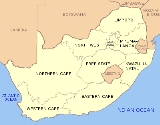
South Africa is currently divided into nine
provinces. On the eve of the
1994 general electionThe South African general election of 1994 was an election held in South Africa to mark the end of apartheid, therefore also the first held with universal adult suffrage. The election was conducted under the direction of the Independent Electoral Commission .Millions queued in lines over a three...
, South Africa's former homelands, also known as Bantustans, were reintegrated and the four existing provinces were divided into nine. The twelfth, thirteenth and sixteenth amendments to the
constitutionThe Constitution of South Africa is the supreme law of the country of South Africa. It provides the legal foundation for the existence of the republic, sets out the rights and duties of its citizens, and defines the structure of the government. The current constitution, the country's fifth, was...
changed the borders of seven of the provinces. The provinces are as follows:
| Province |
Capital |
Largest city |
Area (km²) |
Population (2011 est.) |
Pop. densityPopulation density is a measurement of population per unit area or unit volume. It is frequently applied to living organisms, and particularly to humans... (per km²) |
HDIThe Human Development Index is a composite statistic used to rank countries by level of "human development" and separate "very high human development", "high human development", "medium human development", and "low human development" countries... (2003) |
Eastern CapeThe Eastern Cape is a province of South Africa. Its capital is Bhisho, but its two largest cities are Port Elizabeth and East London. It was formed in 1994 out of the "independent" Xhosa homelands of Transkei and Ciskei, together with the eastern portion of the Cape Province... |
Bhisho |
Port Elizabeth |
168,966 |
6,829,958 |
40.4 |
0.62 |
Free StateThe Free State is a province of South Africa. Its capital is Bloemfontein, which is also South Africa's judicial capital. Its historical origins lie in the Orange Free State Boer republic and later Orange Free State Province. The current borders of the province date from 1994 when the Bantustans... |
Bloemfontein Bloemfontein is the capital city of the Free State Province of South Africa; and, as the judicial capital of the nation, one of South Africa's three national capitals – the other two being Cape Town, the legislative capital, and Pretoria, the administrative capital.Bloemfontein is popularly and... |
Bloemfontein |
129,825 |
2,759,644 |
21.3 |
0.67 |
GautengGauteng is one of the nine provinces of South Africa. It was formed from part of the old Transvaal Province after South Africa's first all-race elections on 27 April 1994... |
Johannesburg Johannesburg also known as Jozi, Jo'burg or Egoli, is the largest city in South Africa, by population. Johannesburg is the provincial capital of Gauteng, the wealthiest province in South Africa, having the largest economy of any metropolitan region in Sub-Saharan Africa... |
Johannesburg |
18,178 |
11,328,203 |
623.2 |
0.74 |
KwaZulu-NatalKwaZulu-Natal is a province of South Africa. Prior to 1994, the territory now known as KwaZulu-Natal was made up of the province of Natal and the homeland of KwaZulu.... |
PietermaritzburgPietermaritzburg is the capital and second largest city in the province of KwaZulu-Natal, South Africa. It was founded in 1838, and is currently governed by the Msunduzi Local Municipality. Its "purist" Zulu name is umGungundlovu, and this is the name used for the district municipality... ² |
Durban Durban is the largest city in the South African province of KwaZulu-Natal and the third largest city in South Africa. It forms part of the eThekwini metropolitan municipality. Durban is famous for being the busiest port in South Africa. It is also seen as one of the major centres of tourism... |
94,361 |
10,819,130 |
114.7 |
0.63 |
LimpopoLimpopo is the northernmost province of South Africa. The capital is Polokwane, formerly named Pietersburg. The province was formed from the northern region of Transvaal Province in 1994, and initially named Northern Transvaal... |
PolokwanePolokwane, meaning "Place of Safety",is a city in the Polokwane Local Municipality and the capital of the Limpopo province, South Africa. It is also often referred to by its former name, Pietersburg. Polokwane is a major urban centre, the biggest and most important north of Gauteng. The population... |
Polokwane |
125,754 |
5,554,657 |
44.2 |
0.59 |
MpumalangaMpumalanga , is a province of South Africa. The name means east or literally "the place where the sun rises" in Swazi, Xhosa, Ndebele and Zulu. Mpumalanga lies in eastern South Africa, north of KwaZulu-Natal and bordering Swaziland and Mozambique. It constitutes 6.5% of South Africa's land area... |
NelspruitNelspruit is a city of more than 500,000 people situated in northeastern South Africa. It is the capital of the Mpumalanga province . Located on the Crocodile River, Nelspruit lies about west of the Mozambique border and east of Johannesburg. The towns of Nelspruit are Kanyamazane and Pienaar... |
Nelspruit |
76,495 |
3,657,181 |
47.8 |
0.65 |
North WestNorth West is a province of South Africa. Its capital is Mafikeng. The province is located to the west of the major population centre of Gauteng.-History:... |
Mafikeng Mahikeng – formerly legally, but still commonly known as Mafikeng – is the capital city of the North-West Province of South Africa. It is best known internationally for the Siege of Mafeking, the most famous engagement of the Second Boer War.Located on South Africa's border with Botswana, it is ... |
Rustenburg |
104,882 |
3,253,390 |
31.0 |
0.61 |
Northern CapeThe Northern Cape is the largest and most sparsely populated province of South Africa. It was created in 1994 when the Cape Province was split up. Its capital is Kimberley. It includes the Kalahari Gemsbok National Park, part of an international park shared with Botswana... |
Kimberley |
Kimberley |
372,889 |
1,096,731 |
2.9 |
0.69 |
Western CapeThe Western Cape is a province in the south west of South Africa. The capital is Cape Town. Prior to 1994, the region that now forms the Western Cape was part of the much larger Cape Province... ¹ |
Cape TownCape Town is the second-most populous city in South Africa, and the provincial capital and primate city of the Western Cape. As the seat of the National Parliament, it is also the legislative capital of the country. It forms part of the City of Cape Town metropolitan municipality... |
Cape Town |
129,462 |
5,287,863 |
40.8 |
0.77 |
¹: The
Prince Edward IslandsThe Prince Edward Islands are two small islands in the sub-antarctic Indian Ocean that are part of South Africa. The islands, named Marion Island and Prince Edward Island, are located at ....
, South African territories in the sub-Antarctic Indian Ocean that are part of the Western Cape for legal purposes, are not included in these statistics.
²: Pietermaritzburg and Ulundi were joint capitals of KwaZulu-Natal from 1994 to 2004.
History
The
Union of South AfricaThe Union of South Africa is the historic predecessor to the present-day Republic of South Africa. It came into being on 31 May 1910 with the unification of the previously separate colonies of the Cape, Natal, Transvaal and the Orange Free State...
was established in 1910 by combining four British colonies: the
Cape ColonyThe Cape Colony, part of modern South Africa, was established by the Dutch East India Company in 1652, with the founding of Cape Town. It was subsequently occupied by the British in 1795 when the Netherlands were occupied by revolutionary France, so that the French revolutionaries could not take...
, the Natal Colony, the Transvaal Colony and the
Orange River ColonyThe Orange River Colony was the British colony created after this nation first occupied and then annexed the independent Orange Free State in the Second Boer War...
. (The latter two were, before the
Second Boer WarThe Second Boer War was fought from 11 October 1899 until 31 May 1902 between the British Empire and the Afrikaans-speaking Dutch settlers of two independent Boer republics, the South African Republic and the Orange Free State...
, independent republics known as the
South African RepublicThe South African Republic , often informally known as the Transvaal Republic, was an independent Boer-ruled country in Southern Africa during the second half of the 19th century. Not to be confused with the present-day Republic of South Africa, it occupied the area later known as the South African...
and the
Orange Free StateThe Orange Free State was an independent Boer republic in southern Africa during the second half of the 19th century, and later a British colony and a province of the Union of South Africa. It is the historical precursor to the present-day Free State province...
.) These colonies became the four original provinces of the Union:
Cape ProvinceThe Province of the Cape of Good Hope was a province in the Union of South Africa and subsequently the Republic of South Africa...
,
Transvaal ProvinceTransvaal Province was a province of the Union of South Africa from 1910 to 1961, and of its successor, the Republic of South Africa, from 1961 until the end of apartheid in 1994 when a new constitution subdivided it.-History:...
,
Natal ProvinceNatal, meaning "Christmas" in Portuguese, was a province of South Africa from 1910 until 1994. Its capital was Pietermaritzburg. The Natal Province included the bantustan of KwaZulu...
and
Orange Free State ProvinceOrange Free State Province was one of the four provinces of South Africa from 1910-1994.Its predecessor was the Orange River Colony.In 1994 it was dissolved. Its borders were largely conterminous with those of the modern Free State Province...
.
Segregation of the
blackThe term black people is used in systems of racial classification for humans of a dark skinned phenotype, relative to other racial groups.Different societies apply different criteria regarding who is classified as "black", and often social variables such as class, socio-economic status also plays a...
population started as early as 1913, with ownership of land by the black majority being restricted to certain areas totalling about 13% of the country. From the late 1950s, these areas were gradually consolidated into "
homelandA homeland is the concept of the place to which an ethnic group holds a long history and a deep cultural association with —the country in which a particular national identity began. As a common noun, it simply connotes the country of one's origin...
s" or "
bantustanA bantustan was a territory set aside for black inhabitants of South Africa and South West Africa , as part of the policy of apartheid...
s," which served as the
de jureDe jure is an expression that means "concerning law", as contrasted with de facto, which means "concerning fact".De jure = 'Legally', De facto = 'In fact'....
national states of the black population during the apartheid era. In 1976, the homeland of
TranskeiThe Transkei , officially the Republic of Transkei , was a Bantustan—an area set aside for members of a specific ethnicity—and nominal parliamentary democracy in the southeastern region of South Africa...
was the first to accept
independenceIndependence is a condition of a nation, country, or state in which its residents and population, or some portion thereof, exercise self-government, and usually sovereignty, over its territory....
from South Africa, and although this independence was never acknowledged by any other country, three other homelands
BophuthatswanaBophuthatswana , officially the Republic of Bophuthatswana was a Bantustan – an area set aside for members of a specific ethnicity – and nominal parliamentary democracy in the northwestern region of South Africa...
(1977),
VendaVenda was a bantustan in northern South Africa, now part of Limpopo province. It was founded as a homeland for the Venda people, speakers of the Venda language. It bordered modern Zimbabwe and South Africa, and is now part of Limpopo in South Africa....
(1979) and
CiskeiCiskei was a Bantustan in the south east of South Africa. It covered an area of 2,970 square miles , almost entirely surrounded by what was then the Cape Province, and possessed a small coastline along the shore of the Indian Ocean....
(1981)followed suit.
At the height of apartheid, the various divisions of South Africa were:
| Name | Capital |
| Provinces |
Cape of Good HopeThe Province of the Cape of Good Hope was a province in the Union of South Africa and subsequently the Republic of South Africa... |
Cape TownCape Town is the second-most populous city in South Africa, and the provincial capital and primate city of the Western Cape. As the seat of the National Parliament, it is also the legislative capital of the country. It forms part of the City of Cape Town metropolitan municipality...
|
| Natal Natal, meaning "Christmas" in Portuguese, was a province of South Africa from 1910 until 1994. Its capital was Pietermaritzburg. The Natal Province included the bantustan of KwaZulu... |
PietermaritzburgPietermaritzburg is the capital and second largest city in the province of KwaZulu-Natal, South Africa. It was founded in 1838, and is currently governed by the Msunduzi Local Municipality. Its "purist" Zulu name is umGungundlovu, and this is the name used for the district municipality...
|
| Orange Free State Orange Free State Province was one of the four provinces of South Africa from 1910-1994.Its predecessor was the Orange River Colony.In 1994 it was dissolved. Its borders were largely conterminous with those of the modern Free State Province... |
Bloemfontein Bloemfontein is the capital city of the Free State Province of South Africa; and, as the judicial capital of the nation, one of South Africa's three national capitals – the other two being Cape Town, the legislative capital, and Pretoria, the administrative capital.Bloemfontein is popularly and...
|
| Transvaal Transvaal Province was a province of the Union of South Africa from 1910 to 1961, and of its successor, the Republic of South Africa, from 1961 until the end of apartheid in 1994 when a new constitution subdivided it.-History:... |
PretoriaPretoria is a city located in the northern part of Gauteng Province, South Africa. It is one of the country's three capital cities, serving as the executive and de facto national capital; the others are Cape Town, the legislative capital, and Bloemfontein, the judicial capital.Pretoria is...
|
| "Independent" homelands |
BophuthatswanaBophuthatswana , officially the Republic of Bophuthatswana was a Bantustan – an area set aside for members of a specific ethnicity – and nominal parliamentary democracy in the northwestern region of South Africa... |
Mmabatho Mmabatho is the former capital of the North-West Province of South Africa. In the apartheid era, it was the capital of the former "Bantustan" of Bophuthatswana. Following the end of apartheid in 1994, Bophuthatswana was integrated into the newly established North-West Province and Mmabatho was...
|
CiskeiCiskei was a Bantustan in the south east of South Africa. It covered an area of 2,970 square miles , almost entirely surrounded by what was then the Cape Province, and possessed a small coastline along the shore of the Indian Ocean.... |
Bisho |
TranskeiThe Transkei , officially the Republic of Transkei , was a Bantustan—an area set aside for members of a specific ethnicity—and nominal parliamentary democracy in the southeastern region of South Africa... |
Umtata |
VendaVenda was a bantustan in northern South Africa, now part of Limpopo province. It was founded as a homeland for the Venda people, speakers of the Venda language. It bordered modern Zimbabwe and South Africa, and is now part of Limpopo in South Africa.... |
Thohoyandou Thohoyandou is a town in the Limpopo Province of South Africa. It is the administrative centre of Vhembe District Municipality and Thulamela Local Municipality. It is also known for being the former capital of the bantustan of Venda....
|
| Non-independent homelands |
GazankuluGazankulu was a bantustan in South Africa, intended by the apartheid government to be a semi-independent homeland for the Tsonga people. It was carved out of the former Transvaal Province and given self-rule in 1971, with its capital at Giyani. When Apartheid was abolished in 1994, the population... |
Giyani Giyani is a town in the Limpopo province in north eastern South Africa, and former capital of the Gazankulu bantustan. Giyani is located in the heart of Limpopo Bushveld, on the northern bank of the Klein Letaba River west of Kruger National Park...
|
KaNgwaneKaNgwane was a bantustan in South Africa, intended by the apartheid government to be a semi-independent homeland for the Swazi people. Formerly called the "Swazi Territory", the homeland was granted nominal self-rule in 1981. Schoemansdal was designated as its capital. Its official capital was at... |
KaNyamazane |
KwaNdebeleKwaNdebele was a bantustan in South Africa, intended by the apartheid government as a semi-independent homeland for the Ndebele people. The homeland was created when the South African government purchased nineteen white-owned farms and installed a government.... |
Siyabuswa Siyabuswa is a town in the countryside of the South African province of Mpumalanga . During the apartheid era, Siyabuswa was the capital of the KwaNdebele Bantustan. It served as a capital from 1981 to 1986 when KwaMhlanga replaced it...
|
KwaZuluKwaZulu was a bantustan in South Africa, intended by the apartheid government as a semi-independent homeland for the Zulu people. The capital, formerly at Nongoma, was moved in 1980 to Ulundi.... |
Ulundi |
LebowaLebowa was a bantustan located in the Transvaal in north eastern South Africa. Seshego initially acted as Lebowa's capital while the purpose-built Lebowakgomo was being constructed. Granted internal self-government on 2 October 1972 and ruled for much of its existence by Cedric Phatudi, Lebowa... |
Lebowakgomo Lebowakgomo was the capital of the former bantustan of Lebowa. Lebowakgomo lies southeast of the Limpopo town of Polokwane. Lebowakgomo is surrounded by villages, Mogodi and Phutimolle north east, Mamaolo on the east, Makurung and Lekhuswaneng being south east.-History:The township was...
|
QwaqwaQwaQwa was a Bantustan, or homeland, in the eastern part of South Africa. It encompassed a very small region of in the east of the former South African province of Orange Free State, bordering Lesotho. Its capital was Phuthaditjhaba... |
Phuthaditjhaba Phuthaditjhaba is a town in the Free State province of South Africa. The frequent snow on the Drakensberg mountain peaks surrounding the town led the San to call the region Qwa-Qwa . It was known as Witsiehoek to the European settlers. The area was then turned into the bantustan or homeland of...
|
On 27 April 1994, the date of the
first non-racial electionsThe South African general election of 1994 was an election held in South Africa to mark the end of apartheid, therefore also the first held with universal adult suffrage. The election was conducted under the direction of the Independent Electoral Commission .Millions queued in lines over a three...
and of the adoption of the
Interim ConstitutionThe Interim Constitution of 1993 was the fundamental law of South Africa from 1994 to 1996. It was a provisional document, intended to pave the way for the adoption of a permanent constitution...
, all of these provinces and homelands were dissolved, and nine entirely new provinces were established.
Government
Each province is governed by a unicameral
legislatureIn South Africa, a provincial legislature is the legislative branch of the government of a province. The provincial legislatures are unicameral and vary in size from 30 to 80 members depending on the population of the province...
; the size of the legislature is proportional to population, ranging from 30 members in the
Northern CapeThe Northern Cape is the largest and most sparsely populated province of South Africa. It was created in 1994 when the Cape Province was split up. Its capital is Kimberley. It includes the Kalahari Gemsbok National Park, part of an international park shared with Botswana...
to 80 in
KwaZulu-NatalKwaZulu-Natal is a province of South Africa. Prior to 1994, the territory now known as KwaZulu-Natal was made up of the province of Natal and the homeland of KwaZulu....
. The legislatures are elected every five years by a system of
party-list proportional representationParty-list proportional representation systems are a family of voting systems emphasizing proportional representation in elections in which multiple candidates are elected...
; by convention, they are all elected on the same day, at the same time as the National Assembly election.
The provincial legislature elects, from amongst its members, a
PremierIn South Africa, a Premier is the head of government of one of South Africa's nine provinces. The Premier of a province plays for that province a role similar to that played by the President for the country as a whole.-Election:...
, who is the head of the executive. The Premier chooses an
Executive CouncilIn South Africa, the Executive Council of a province is the cabinet-equivalent in the provincial government. The Executive Council consists of the Premier and five to ten other members, who have the title "Member of the Executive Council", commonly abbreviated to "MEC".MECs are appointed by the...
consisting of between five and ten members of the legislature, which is the cabinet of the provincial government. The Members of the Executive Council (MECs) are the provincial equivalent of
ministersA minister is a politician who holds significant public office in a national or regional government. Senior ministers are members of the cabinet....
.
The powers of the provincial government are limited to specific topics listed in the
national constitutionThe Constitution of South Africa is the supreme law of the country of South Africa. It provides the legal foundation for the existence of the republic, sets out the rights and duties of its citizens, and defines the structure of the government. The current constitution, the country's fifth, was...
. On some of these topicsfor example, agriculture, education, health and public housingthe province's powers are shared with the national government, which can establish uniform standards and frameworks for the provincial governments to follow; on other topics the provincial government has exclusive power.
The provinces do not have their own court systems, as the administration of justice is a responsibility purely of the national government.
See also
- Elections in South Africa
Elections in South Africa take place on national, provincial, and local levels. South Africa is a multi-party democracy with the African National Congress in power with a significant majority since 1994...
- Prince Edward Islands
The Prince Edward Islands are two small islands in the sub-antarctic Indian Ocean that are part of South Africa. The islands, named Marion Island and Prince Edward Island, are located at ....
- Walvis Bay
Walvis Bay , is a city in Namibia and the name of the bay on which it lies...
- ISO 3166-2:ZA
ISO 3166-2:ZA is the entry for South Africa in ISO 3166-2, part of the ISO 3166 standard published by the International Organization for Standardization , which defines codes for the names of the principal subdivisions of all countries coded in ISO 3166-1.Currently for South Africa, ISO 3166-2...