


Protected designation of origin

Encyclopedia
Protected Geographical Status (PGS) is a legal framework defined in European Union law to protect the names of regional foods. Protected Designation of Origin (PDO), Protected Geographical Indication (PGI) and Traditional Speciality Guaranteed (TSG) are distinct regimes of geographical indication
s within the framework. The law (enforced within the EU and being gradually expanded internationally via bilateral agreements between the EU and non-EU countries) ensures that only products genuinely originating in that region are allowed in commerce identified as such. The legislation came into force in 1992. The purpose of the law is to protect the reputation of the regional foods, promote rural and agricultural activity, help producers obtain a premium price for their authentic products, and eliminate the unfair competition and misleading of consumers by non-genuine products, which may be of inferior quality or of different flavour.
These laws protect the names of wine
s, cheese
s, hams, sausage
s, seafood
, olive
s, beer
s, Balsamic vinegar
and even regional bread
s, fruit
s, raw meats and vegetable
s.
Foods such as Gorgonzola
, Parmigiano-Reggiano, Melton Mowbray pork pies, Asiago cheese
, Camembert
and Champagne can only be labelled as such if they come from the designated region. To qualify as Roquefort
, for example, cheese must be made from milk of a certain breed of sheep, and matured in the natural caves near the town of Roquefort-sur-Soulzon
in the Aveyron
region of France, where it is infected with the spores of a fungus
(Penicillium roqueforti
) that grows in these caves.
This system is similar to Appellation
systems throughout the world, such as the Appellation d'origine contrôlée
(AOC) used in France
, the Denominazione di origine controllata
(DOC) used in Italy
, the Denominação de Origem Controlada
(DOC) used in Portugal
, and the Denominación de Origen
(DO) system used in Spain
. In many cases, the EU PDO/PGI system works parallel with the system used in the specified country, and in some cases is subordinated to the appellation system that was already instituted, particularly with wine, for example, and in France (in particular) with cheese, for example Maroilles
(as most others) has both PDO (AOP in French) and AOC classifications, but generally only the AOC classification will be shown.
Protected indications are treated as intellectual property
rights by the Customs Regulation 1383/2003
(Regulation concerning customs action against goods suspected of infringing certain intellectual property rights and the measures to be taken against goods found to have infringed such rights), and infringing goods may be seized by customs
on import. Within the European Union
enforcement measures vary: infringement may be treated as counterfeit
, misleading advertising, passing off
or even as a question of public health
. Outside Europe, the protection of PGS products usually require bilateral agreements between the EU and the importing countries, while protected indications may not always supersede other intellectual property rights such as trademarks.
cite consumer demand for quality foodstuffs and identify a number of goals for the protection regimes:
The provision of a recompense for efforts to improve quality and the need for consumer protection
are often cited as justifications for trade mark protection in other domains, and geographical indications operate in a similar manner to trade marks.
s). The origin of the product is only one of the criteria for use of the protected terms: the product must also meet various quality criteria. The label "Traditional Speciality Guaranteed" (TSG) is a similar protected term which does not impose any restrictions on the geographical origin of the product.
The protection of geographical indications was extended to foodstuffs and other agricultural products in 1992. Given the widely different national provisions, this "general regime" gives much more power to the European Commission
(compared to the special regimes) to ensure a harmonized protection across the European Union. It is currently governed by the Regulation on the protection of geographical indications and designations of origin for agricultural products and foodstuffs (No 510/2006).
To qualify for a PDO, the product must have qualities and characteristics which are essentially due to its region of production: it must also be produced, processed and prepared exclusively within that region. The requirement for a PGI are slightly less strict; a good reputation of a product from a given region is sufficient (rather than objectively different characteristics) if any of the steps of production, processing and preparation may take place within the region. Otherwise the protection afforded by the two terms is equivalent.
An application for a PDO or a PGI is first made to the authorities of the relevant Member State. It is judged by the Member State against the criteria in the Regulation and, if found to be acceptable, forwarded to the European Commission for final approval. Applications are published at both the national and Community stages of examination, and third parties can object to proposed PDOs or PGIs which they feel would harm their business. A recurrent objection is that the proposed denomination is a generic term for the product in question: generic names cannot be registered but, once registered, the denominations are protected from genericization
. Hence Cheddar cheese
was deemed to be a generic name, but the PDO "West Country farmhouse Cheddar cheese" was allowed. Feta
was deemed not to have become generic, and was registered as a PDO to the disappointment of cheesemakers outside of Greece.
In other words, to receive the PDO status, the entire product must be traditionally and ENTIRELY manufactured (prepared, processed AND produced) within the specific region and thus acquire unique properties.
In other words, to receive the PGI status, the entire product must be traditionally and at least PARTIALLY manufactured (prepared, processed OR produced) within the specific region and thus acquire unique properties.
In other words, to receive a TSG status, the product does not have to be manufactured in a specific geographically delimited area; it is sufficient that it be traditional and different from other similar products.
(Paris Convention), which has effect in European Union law
by Art. 7 of the Regulation on the Community trade mark (No 40/94) and by Art. 3 of the Directive to approximate the laws of the Member States relating to trade marks (89/104/EEC): however marks which also serve to identify the quality of a product originating in a certain region may be registered so long as they have not become generic in the trade concerned. Trade marks which have been registered before the registration of a PDO or a PGI may continue to be used, but the registration of an equivalent trade mark after the approval of a PDO or PGI is impossible (Art. 13, Regulation (EC) No 510/2006). The existence of a trade mark (registered or unregistered) may be a reason to refuse the registration of a PDO or a PGI [Art. 7(3)(c), Regulation (EC) No 510/2006]. Hence the Polish
geographical designation "Herbal vodka from the North Podlasie Lowland aromatised with an extract of bison grass" or Wódka ziołowa z Niziny Północnopodlaskiej aromatyzowana ekstraktem z trawy żubrowej, so phrased as to avoid infringing the trade mark "Żubrówka
".
Agreement on Trade-Related Aspects of Intellectual Property Rights
(TRIPS), administered by the World Trade Organization
, although the European Union
is pushing for other geographical indications to be included in the Doha Round
of world trade negotiations.
governing the production of wine
("the product obtained exclusively from the total or partial alcoholic fermentation of fresh grape
s, whether or not crushed, or of grape must") are considerably longer than Community trade mark law: the main text, the Regulation on the common organization of the market in wine (No 1493/1999), runs to over 46,000 words. To be considered as a "quality wine", the wine must come from a specified region and be associated with a "geographical indication" or appellation
: indeed, the technical term used in the Regulation is quality wine psr, with the "psr" standing for "produced in a specified region". Wines which do not meet this requirement may only be marketed as table wine
.
Despite (or perhaps because of) the traditional importance of appellations for wine, there has been little harmonization of national provisions within the European Union. Member States delimit the specified areas of production and determine the rules and appellations which apply: the European Commission
restricts itself to publishing the information provided by the Member States. Appellations are usually the geographical name of the area in which the wine is produced, although there are some historical exceptions: muscadet
and blanquette in France, cava
and manzanilla in Spain and vinho verde
in Portugal. The appellations are not necessarily unique: Cava may refer either to a quality sparkling wine psr produced in Spain or to a Greek table wine which has been aged (as a transliteration of "Κάβα").
(No 1576/89) provides for a double system of protection of spirit
descriptions. Spirits are divided into 21 categories, which each have rules for fabrication and minimum strength. Within these categories, certain names are reserved for drinks from particular countries, for example ouzo
, which is aniseed-flavoured spirit drink which must have been produced exclusively in Greece or Cyprus, or grappa
, which is a grape marc spirit produced in Italy. The Regulation also defines a number of geographical designations, which are reserved for drinks which "acquired their character and definitive qualities" in the area denominated. The exact delimitation of the areas and any other regulations are left to the Member States concerned. By way of derogation, the designations Königsberger Bärenfang and Ostpreußischer Bärenfang are permitted for certain German drinks even though they refer to Königsberg
(Kaliningrad
) and East Prussia
which are no longer part of Germany.
" must have been produced in Spain or Portugal, for example, but it is permissible to label a drink "Sangria produced in the United Kingdom: aromatized wine-based drink" if the drink meets the other requirements to be described as sangria. Similarly, the denomination "Clarea" on its own is reserved for drinks produced in Spain. The protected geographical designations are:
This legislation expanded the 1951 Stresa Convention, which was the first international agreement on cheese names. Seven countries participated: Austria
, Denmark
, France
, Italy
, Norway
, Sweden
, Switzerland
.
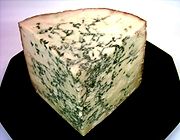 Selected products include Prosciutto
Toscano (PDO) from Italy, Marchfeldspargel
(PGI) from Austria, Lübecker Marzipan
(PGI) from Germany, Scotch Beef and Lamb (PGI) from Scotland, bryndza
also known as bundz
sheep's milk
cheese, and oscypek
smoked sheep's milk
exclusively from approved regions of Tatra mountain in southern Poland, (Kaszëbskô malëna) – Kashubian garden strawberry
(PGI) from Kashubia
.
Coffee from Colombia
, produced by the Federación Nacional de Cafeteros de Colombia
is the first non-EU product with this kind of protection, added on August 13, 2007. This also means that the coffee from Colombia will be more expensive than other types of coffee, but it will have special legal protection against other brands that claim to be Colombian coffee.
For reasons of practicality some products that were traditionally made in a specific region are not subject to the PDO, often due to the quantities in which they are consumed; for example, the consumption of Cheddar cheese
in the US alone is many times the amount Cheddar
itself could feasibly produce. Hence the "Cheddar" name is not protected, but the more specific name "West Country farmhouse Cheddar" is.
The geographical limitations can be quite strict. "Newcastle Brown Ale
" was restricted to being brewed in the city of Newcastle upon Tyne
in England
. However, having obtained this protection for their product, the brewery decided in 2004 that it would move across the river Tyne to Gateshead
. As Gateshead is technically a separate town—albeit only the width of a river apart—it does not fall within the required geographical restriction. The brewery then applied to the European Union
authorities to have the geographical restriction revoked. If the restriction had not been revoked, the brewery would have been forced either to move back to Newcastle, or stop calling its beer "Newcastle" brown ale. Ultimately, the brewery's application to revoke the geographic restriction was approved. Similarly, Stilton cheese can only be produced in the three English counties of Derbyshire
, Leicestershire
, and Nottinghamshire
. Stilton village
is in the traditional county of Huntingdonshire
, now a district of Cambridgeshire
, so Stilton cheese cannot be produced in Stilton (although it is unclear whether the cheese was ever actually produced in Stilton).
(wine, 1994) (but not cheese), Canada
(wine and spirits, 2003), Chile
(wine and spirits, 2002), Colombia
(2007, coffee
) Mexico
(1997, spirit drinks), and South Africa
(2002, wine and spirits).
and the Australian and EU governments, the others' GIs and the nations' traditional terms of winemaking were meant to have been protected by 1997. However, this has been proceeding slowly, and while some GIs have been protected in Australia, others are still available for use (primarily for products that have always been called that). It seems unlikely it will have any effect on colloquial speech in the short term.
was protected by the PDO in August 2007.
, a 2003 agreement made with the EU provides for protection of the names of wine and spirits. The new classification of names will be done in phases. By the end of 2013, all of the affected names will be protected, including Chablis, Champagne, Port
and Sherry
.
s" must be produced within a certain region around Vidalia, Georgia
, as defined by the Georgia Department of Agriculture
, and "100% Florida
orange juice
" is certified as being such by that state's
Department of Citrus. Some of these marks are protected in the United States under certification mark
law, such as the Idaho Potato Commission
's "Idaho" and "Grown in Idaho" registered trademarks for potato
es. Tennessee whiskey
is straight
Bourbon Whiskey
produced in the state of Tennessee
. This definition is legally established under the North American Free Trade Agreement (NAFTA)
, which states that Tennessee whiskey is "a straight Bourbon Whiskey authorized to be produced only in the State of Tennessee." There also are cases in which a geographical name has been trademarked for a particular product that might not even be manufactured there, such as Philadelphia cream cheese.
Protected Designation of Origin (PDO), Protected Geographical Indication (PGI), or Traditional Speciality Guaranteed (TSG), listed alphabetically by nation, is at the European Agriculture site.
Geographical indication
A geographical indication is a name or sign used on certain products which corresponds to a specific geographical location or origin...
s within the framework. The law (enforced within the EU and being gradually expanded internationally via bilateral agreements between the EU and non-EU countries) ensures that only products genuinely originating in that region are allowed in commerce identified as such. The legislation came into force in 1992. The purpose of the law is to protect the reputation of the regional foods, promote rural and agricultural activity, help producers obtain a premium price for their authentic products, and eliminate the unfair competition and misleading of consumers by non-genuine products, which may be of inferior quality or of different flavour.
These laws protect the names of wine
Wine
Wine is an alcoholic beverage, made of fermented fruit juice, usually from grapes. The natural chemical balance of grapes lets them ferment without the addition of sugars, acids, enzymes, or other nutrients. Grape wine is produced by fermenting crushed grapes using various types of yeast. Yeast...
s, cheese
Cheese
Cheese is a generic term for a diverse group of milk-based food products. Cheese is produced throughout the world in wide-ranging flavors, textures, and forms....
s, hams, sausage
Sausage
A sausage is a food usually made from ground meat , mixed with salt, herbs, and other spices, although vegetarian sausages are available. The word sausage is derived from Old French saussiche, from the Latin word salsus, meaning salted.Typically, a sausage is formed in a casing traditionally made...
s, seafood
Seafood
Seafood is any form of marine life regarded as food by humans. Seafoods include fish, molluscs , crustaceans , echinoderms . Edible sea plants, such as some seaweeds and microalgae, are also seafood, and are widely eaten around the world, especially in Asia...
, olive
Olive
The olive , Olea europaea), is a species of a small tree in the family Oleaceae, native to the coastal areas of the eastern Mediterranean Basin as well as northern Iran at the south end of the Caspian Sea.Its fruit, also called the olive, is of major agricultural importance in the...
s, beer
Beer
Beer is the world's most widely consumed andprobably oldest alcoholic beverage; it is the third most popular drink overall, after water and tea. It is produced by the brewing and fermentation of sugars, mainly derived from malted cereal grains, most commonly malted barley and malted wheat...
s, Balsamic vinegar
Balsamic vinegar
Balsamic vinegar is a condiment originating from Italy.The original traditional product , made from a reduction of cooked white Trebbiano grape juice and not a vinegar in the usual sense, has been made in Modena and Reggio Emilia since the Middle Ages: the production of the balsamic vinegar is...
and even regional bread
Bread
Bread is a staple food prepared by cooking a dough of flour and water and often additional ingredients. Doughs are usually baked, but in some cuisines breads are steamed , fried , or baked on an unoiled frying pan . It may be leavened or unleavened...
s, fruit
Fruit
In broad terms, a fruit is a structure of a plant that contains its seeds.The term has different meanings dependent on context. In non-technical usage, such as food preparation, fruit normally means the fleshy seed-associated structures of certain plants that are sweet and edible in the raw state,...
s, raw meats and vegetable
Vegetable
The noun vegetable usually means an edible plant or part of a plant other than a sweet fruit or seed. This typically means the leaf, stem, or root of a plant....
s.
Foods such as Gorgonzola
Gorgonzola (cheese)
Gorgonzola is a veined Italian blue cheese, made from unskimmed cow's and/or goat's milk. It can be buttery or firm, crumbly and quite salty, with a "bite" from its blue veining.- History :...
, Parmigiano-Reggiano, Melton Mowbray pork pies, Asiago cheese
Asiago cheese
Asiago is an Italian cow's milk cheese that can assume different textures, according to its aging, from smooth for the fresh Asiago to a crumbly texture for the aged cheese of which the flavor is reminiscent of Parmesan...
, Camembert
Camembert
Camembert is a commune in the Orne department in north-western France.It is most famous as the place where camembert cheese originated.Camembert has been called "The largest small village in France." This is because the area of the commune itself is out of proportion to the center of the village...
and Champagne can only be labelled as such if they come from the designated region. To qualify as Roquefort
Roquefort (cheese)
Roquefort , sometimes spelled Rochefort in English, is a sheep milk blue cheese from the south of France, and together with Bleu d'Auvergne, Stilton and Gorgonzola is one of the world's best-known blue cheeses...
, for example, cheese must be made from milk of a certain breed of sheep, and matured in the natural caves near the town of Roquefort-sur-Soulzon
Roquefort-sur-Soulzon
Roquefort-sur-Soulzon is a commune in the Aveyron department in southern France.It is located on the Causse du Larzac and is famous for its ewe's milk Roquefort cheese. Much of the activity in the commune centres on the production and distribution of the cheese...
in the Aveyron
Aveyron
Aveyron is a département in southern France named after the Aveyron River.- History :Aveyron is one of the original 83 departments created during the French Revolution on 4 March 1790....
region of France, where it is infected with the spores of a fungus
Fungus
A fungus is a member of a large group of eukaryotic organisms that includes microorganisms such as yeasts and molds , as well as the more familiar mushrooms. These organisms are classified as a kingdom, Fungi, which is separate from plants, animals, and bacteria...
(Penicillium roqueforti
Penicillium roqueforti
Penicillium roqueforti is a common saprotrophic fungus from the family Trichocomaceae. Widespread in nature, it can be isolated from soil, decaying organic matter, and plants. The major industrial use of this fungus is the production of blue cheeses, flavouring agents, antifungals, polysaccharides,...
) that grows in these caves.
This system is similar to Appellation
Appellation
An appellation is a legally defined and protected geographical indication used to identify where the grapes for a wine were grown; other types of food often have appellations as well...
systems throughout the world, such as the Appellation d'origine contrôlée
Appellation d'Origine Contrôlée
Appellation d’origine contrôlée , which translates as "controlled designation of origin", is the French certification granted to certain French geographical indications for wines, cheeses, butters, and other agricultural products, all under the auspices of the government bureau Institut National...
(AOC) used in France
France
The French Republic , The French Republic , The French Republic , (commonly known as France , is a unitary semi-presidential republic in Western Europe with several overseas territories and islands located on other continents and in the Indian, Pacific, and Atlantic oceans. Metropolitan France...
, the Denominazione di origine controllata
Denominazione di Origine Controllata
Denominazione di origine controllata is a quality assurance label for food products, especially wines and various formaggi . It is modelled after the French AOC...
(DOC) used in Italy
Italy
Italy , officially the Italian Republic languages]] under the European Charter for Regional or Minority Languages. In each of these, Italy's official name is as follows:;;;;;;;;), is a unitary parliamentary republic in South-Central Europe. To the north it borders France, Switzerland, Austria and...
, the Denominação de Origem Controlada
Denominação de Origem Controlada
The Denominação de Origem Controlada is the system of protected designation of origin for wines, cheeses, butters, and other agricultural products from Portugal.-Wines:...
(DOC) used in Portugal
Portugal
Portugal , officially the Portuguese Republic is a country situated in southwestern Europe on the Iberian Peninsula. Portugal is the westernmost country of Europe, and is bordered by the Atlantic Ocean to the West and South and by Spain to the North and East. The Atlantic archipelagos of the...
, and the Denominación de Origen
Denominación de Origen
Denominación de Origen is part of a regulatory classification system primarily for Spanish wines but also for other foodstuffs like honey, meats and condiments. In wines it parallels the hierarchical system of France and Italy although Rioja and Sherry preceded the full system...
(DO) system used in Spain
Spain
Spain , officially the Kingdom of Spain languages]] under the European Charter for Regional or Minority Languages. In each of these, Spain's official name is as follows:;;;;;;), is a country and member state of the European Union located in southwestern Europe on the Iberian Peninsula...
. In many cases, the EU PDO/PGI system works parallel with the system used in the specified country, and in some cases is subordinated to the appellation system that was already instituted, particularly with wine, for example, and in France (in particular) with cheese, for example Maroilles
Maroilles (cheese)
Maroilles is a cow's-milk cheese made in the regions of Picardy and Nord-Pas-de-Calais in northern France. It derives its name from the village of Maroilles in the region in which it is still manufactured....
(as most others) has both PDO (AOP in French) and AOC classifications, but generally only the AOC classification will be shown.
Protection and enforcement
In countries where Protected Geographical Status laws are enforced, only products which meet the various geographical and quality criteria may use the protected indication. It is also prohibited to combine the indication with words such as "style", "type", "imitation" or "method" in connection with the protected indications, or to do anything which might imply that the product meets the specifications (e.g., using distinctive packaging associated with the protected product).Protected indications are treated as intellectual property
Intellectual property
Intellectual property is a term referring to a number of distinct types of creations of the mind for which a set of exclusive rights are recognized—and the corresponding fields of law...
rights by the Customs Regulation 1383/2003
Customs Regulation 1383/2003
Customs Regulation 1383/2003, the full title of which is Regulation concerning customs action against goods suspected of infringing certain intellectual property rights and the measures to be taken against goods found to have infringed such rights, is a measure passed under Article 133 of the EC...
(Regulation concerning customs action against goods suspected of infringing certain intellectual property rights and the measures to be taken against goods found to have infringed such rights), and infringing goods may be seized by customs
Customs
Customs is an authority or agency in a country responsible for collecting and safeguarding customs duties and for controlling the flow of goods including animals, transports, personal effects and hazardous items in and out of a country...
on import. Within the European Union
European Union
The European Union is an economic and political union of 27 independent member states which are located primarily in Europe. The EU traces its origins from the European Coal and Steel Community and the European Economic Community , formed by six countries in 1958...
enforcement measures vary: infringement may be treated as counterfeit
Counterfeit
To counterfeit means to illegally imitate something. Counterfeit products are often produced with the intent to take advantage of the superior value of the imitated product...
, misleading advertising, passing off
Passing off
Passing off is a common law tort which can be used to enforce unregistered trademark rights. The tort of passing off protects the goodwill of a trader from a misrepresentation that causes damage to goodwill....
or even as a question of public health
Public health
Public health is "the science and art of preventing disease, prolonging life and promoting health through the organized efforts and informed choices of society, organizations, public and private, communities and individuals" . It is concerned with threats to health based on population health...
. Outside Europe, the protection of PGS products usually require bilateral agreements between the EU and the importing countries, while protected indications may not always supersede other intellectual property rights such as trademarks.
Objectives of the protection
The preambles to the RegulationsEuropean Union regulation
A regulation is a legislative act of the European Union that becomes immediately enforceable as law in all member states simultaneously. Regulations can be distinguished from directives which, at least in principle, need to be transposed into national law...
cite consumer demand for quality foodstuffs and identify a number of goals for the protection regimes:
- the promotion of products with specific characteristics, particularly those coming from less-favoured or rural areas;
- the improvement of the income of farmers, in return for a "genuine effort to improve quality";
- the retention of population in rural areas;
- the provision of clear and succinct information to consumers regarding product origin.
The provision of a recompense for efforts to improve quality and the need for consumer protection
Consumer protection
Consumer protection laws designed to ensure fair trade competition and the free flow of truthful information in the marketplace. The laws are designed to prevent businesses that engage in fraud or specified unfair practices from gaining an advantage over competitors and may provide additional...
are often cited as justifications for trade mark protection in other domains, and geographical indications operate in a similar manner to trade marks.
General regime
The general regime governs the use of protected designations of origin (PDO) and protected geographical indications (PGI) for food and certain other agricultural products. There are separate regimes for spirits and for aromatized drinks (geographical designations) as well as for wines (geographical indications, often referred to as appellationAppellation
An appellation is a legally defined and protected geographical indication used to identify where the grapes for a wine were grown; other types of food often have appellations as well...
s). The origin of the product is only one of the criteria for use of the protected terms: the product must also meet various quality criteria. The label "Traditional Speciality Guaranteed" (TSG) is a similar protected term which does not impose any restrictions on the geographical origin of the product.
The protection of geographical indications was extended to foodstuffs and other agricultural products in 1992. Given the widely different national provisions, this "general regime" gives much more power to the European Commission
European Commission
The European Commission is the executive body of the European Union. The body is responsible for proposing legislation, implementing decisions, upholding the Union's treaties and the general day-to-day running of the Union....
(compared to the special regimes) to ensure a harmonized protection across the European Union. It is currently governed by the Regulation on the protection of geographical indications and designations of origin for agricultural products and foodstuffs (No 510/2006).
To qualify for a PDO, the product must have qualities and characteristics which are essentially due to its region of production: it must also be produced, processed and prepared exclusively within that region. The requirement for a PGI are slightly less strict; a good reputation of a product from a given region is sufficient (rather than objectively different characteristics) if any of the steps of production, processing and preparation may take place within the region. Otherwise the protection afforded by the two terms is equivalent.
An application for a PDO or a PGI is first made to the authorities of the relevant Member State. It is judged by the Member State against the criteria in the Regulation and, if found to be acceptable, forwarded to the European Commission for final approval. Applications are published at both the national and Community stages of examination, and third parties can object to proposed PDOs or PGIs which they feel would harm their business. A recurrent objection is that the proposed denomination is a generic term for the product in question: generic names cannot be registered but, once registered, the denominations are protected from genericization
Genericized trademark
A genericized trademark is a trademark or brand name that has become the colloquial or generic description for, or synonymous with, a general class of product or service, rather than as an indicator of source or affiliation as intended by the trademark's holder...
. Hence Cheddar cheese
Cheddar cheese
Cheddar cheese is a relatively hard, yellow to off-white, and sometimes sharp-tasting cheese, produced in several countries around the world. It has its origins in the English village of Cheddar in Somerset....
was deemed to be a generic name, but the PDO "West Country farmhouse Cheddar cheese" was allowed. Feta
Feta
Feta is a brined curd cheese traditionally made in Greece. Feta is an aged crumbly cheese, commonly produced in blocks, and has a slightly grainy texture. It is used as a table cheese, as well as in salads Feta is a brined curd cheese traditionally made in Greece. Feta is an aged crumbly cheese,...
was deemed not to have become generic, and was registered as a PDO to the disappointment of cheesemakers outside of Greece.
Protected designation of origin (PDO)
The Protected designation of origin is the name of an area, a specific place or, in exceptional cases, the name of a country, used as a designation for an agricultural product or a foodstuff,- which comes from such an area, place or country,
- whose quality or properties are significantly or exclusively determined by the geographical environment, including natural and human factors,
- whose production, processing and preparation takes place within the determined geographical area.
In other words, to receive the PDO status, the entire product must be traditionally and ENTIRELY manufactured (prepared, processed AND produced) within the specific region and thus acquire unique properties.
Protected geographical indication (PGI)
The Protected geographical indication is the name of an area, a specific place or, in exceptional cases, the name of a country, used as a description of an agricultural product or a foodstuff,- which comes from such an area, place or country,
- which has a specific quality, goodwill or other characteristic property, attributable to its geographical origin,
- whose production, processing or preparation takes place within the determined geographical area.
In other words, to receive the PGI status, the entire product must be traditionally and at least PARTIALLY manufactured (prepared, processed OR produced) within the specific region and thus acquire unique properties.
Traditional speciality guaranteed (TSG)
The Traditional speciality guaranteed is a trademark for an agricultural product or a foodstuff, which has a certain feature or a set of features, setting it clearly apart from other similar products or foodstuffs belonging to the same category. The product or foodstuff must be manufactured using traditional ingredients or must be characteristic for its traditional composition, production process, or processing reflecting a traditional type of manufacturing or processing.In other words, to receive a TSG status, the product does not have to be manufactured in a specific geographically delimited area; it is sufficient that it be traditional and different from other similar products.
Relationship to trade mark law
In principle, a similar protection to a geographical indication could be obtained through a collective trade mark. Indications which serve exclusively to identify the place of origin of goods are not registrable as trade marks under Art. 6quinquies.B.2 of the Paris Convention for the Protection of Industrial PropertyParis Convention for the Protection of Industrial Property
The Paris Convention for the Protection of Industrial Property, signed in Paris, France, on March 20, 1883, was one of the first intellectual property treaties. It established a Union for the protection of industrial property...
(Paris Convention), which has effect in European Union law
European Union law
European Union law is a body of treaties and legislation, such as Regulations and Directives, which have direct effect or indirect effect on the laws of European Union member states. The three sources of European Union law are primary law, secondary law and supplementary law...
by Art. 7 of the Regulation on the Community trade mark (No 40/94) and by Art. 3 of the Directive to approximate the laws of the Member States relating to trade marks (89/104/EEC): however marks which also serve to identify the quality of a product originating in a certain region may be registered so long as they have not become generic in the trade concerned. Trade marks which have been registered before the registration of a PDO or a PGI may continue to be used, but the registration of an equivalent trade mark after the approval of a PDO or PGI is impossible (Art. 13, Regulation (EC) No 510/2006). The existence of a trade mark (registered or unregistered) may be a reason to refuse the registration of a PDO or a PGI [Art. 7(3)(c), Regulation (EC) No 510/2006]. Hence the Polish
Poland
Poland , officially the Republic of Poland , is a country in Central Europe bordered by Germany to the west; the Czech Republic and Slovakia to the south; Ukraine, Belarus and Lithuania to the east; and the Baltic Sea and Kaliningrad Oblast, a Russian exclave, to the north...
geographical designation "Herbal vodka from the North Podlasie Lowland aromatised with an extract of bison grass" or Wódka ziołowa z Niziny Północnopodlaskiej aromatyzowana ekstraktem z trawy żubrowej, so phrased as to avoid infringing the trade mark "Żubrówka
Zubrówka
Żubrówka , also known in English as Buffalo Grass Vodka or Bison Grass Vodka, is a brand of dry, herb-flavored vodka that is distilled from rye and bottled at 40% alcohol by volume...
".
Special regimes
The protection of geographical indications for wines and other alcoholic drinks was historically the first to be developed at both national and Community level. It is also the only protection which is recognized by theAgreement on Trade-Related Aspects of Intellectual Property Rights
Agreement on Trade-Related Aspects of Intellectual Property Rights
The Agreement on Trade Related Aspects of Intellectual Property Rights is an international agreement administered by the World Trade Organization that sets down minimum standards for many forms of intellectual property regulation as applied to nationals of other WTO Members...
(TRIPS), administered by the World Trade Organization
World Trade Organization
The World Trade Organization is an organization that intends to supervise and liberalize international trade. The organization officially commenced on January 1, 1995 under the Marrakech Agreement, replacing the General Agreement on Tariffs and Trade , which commenced in 1948...
, although the European Union
European Union
The European Union is an economic and political union of 27 independent member states which are located primarily in Europe. The EU traces its origins from the European Coal and Steel Community and the European Economic Community , formed by six countries in 1958...
is pushing for other geographical indications to be included in the Doha Round
Doha round
The Doha Development Round or Doha Development Agenda is the current trade-negotiation round of the World Trade Organization which commenced in November 2001. Its objective is to lower trade barriers around the world, which will help facilitate the increase of global trade...
of world trade negotiations.
Wines
European Union rulesEuropean Union wine regulations
European Union wine regulations are common legislation related to wine existing within the European Union , the member states of which account for almost two-thirds of the world's wine production...
governing the production of wine
Wine
Wine is an alcoholic beverage, made of fermented fruit juice, usually from grapes. The natural chemical balance of grapes lets them ferment without the addition of sugars, acids, enzymes, or other nutrients. Grape wine is produced by fermenting crushed grapes using various types of yeast. Yeast...
("the product obtained exclusively from the total or partial alcoholic fermentation of fresh grape
Grape
A grape is a non-climacteric fruit, specifically a berry, that grows on the perennial and deciduous woody vines of the genus Vitis. Grapes can be eaten raw or they can be used for making jam, juice, jelly, vinegar, wine, grape seed extracts, raisins, molasses and grape seed oil. Grapes are also...
s, whether or not crushed, or of grape must") are considerably longer than Community trade mark law: the main text, the Regulation on the common organization of the market in wine (No 1493/1999), runs to over 46,000 words. To be considered as a "quality wine", the wine must come from a specified region and be associated with a "geographical indication" or appellation
Appellation
An appellation is a legally defined and protected geographical indication used to identify where the grapes for a wine were grown; other types of food often have appellations as well...
: indeed, the technical term used in the Regulation is quality wine psr, with the "psr" standing for "produced in a specified region". Wines which do not meet this requirement may only be marketed as table wine
Table wine
Table wine is a wine term with two different meanings: a wine style; and a quality level within wine classification.In the United States, table wine primarily designates a wine style - ordinary wine which is neither fortified nor sparkling....
.
Despite (or perhaps because of) the traditional importance of appellations for wine, there has been little harmonization of national provisions within the European Union. Member States delimit the specified areas of production and determine the rules and appellations which apply: the European Commission
European Commission
The European Commission is the executive body of the European Union. The body is responsible for proposing legislation, implementing decisions, upholding the Union's treaties and the general day-to-day running of the Union....
restricts itself to publishing the information provided by the Member States. Appellations are usually the geographical name of the area in which the wine is produced, although there are some historical exceptions: muscadet
Muscadet
Muscadet is a white French wine. It is made at the western end of the Loire Valley, near the city of Nantes in the Pays de la Loire region neighboring the Brittany Region. More Muscadet is produced than any other Loire wine. It is made from the Melon de Bourgogne grape, often referred to simply as...
and blanquette in France, cava
Cava (Spanish wine)
Cava is a Spanish sparkling wine of Denominación de Origen status, most of which is produced in Catalonia. It may be white or rosé. The macabeu, parellada and xarel·lo are the most popular and traditional grape varieties for producing cava...
and manzanilla in Spain and vinho verde
Vinho Verde
Vinho Verde is a Portuguese wine from the Minho region in the far north of the country. The name literally means "Green Wine" , referring to its youthful freshness that leads to a very slight green color on the edges of the wine. The region is characterized by its many small growers, which...
in Portugal. The appellations are not necessarily unique: Cava may refer either to a quality sparkling wine psr produced in Spain or to a Greek table wine which has been aged (as a transliteration of "Κάβα").
Spirits
The Regulation laying down general rules on the definition, description and presentation of spirit drinks(No 1576/89) provides for a double system of protection of spirit
Spirit
The English word spirit has many differing meanings and connotations, most of them relating to a non-corporeal substance contrasted with the material body.The spirit of a living thing usually refers to or explains its consciousness.The notions of a person's "spirit" and "soul" often also overlap,...
descriptions. Spirits are divided into 21 categories, which each have rules for fabrication and minimum strength. Within these categories, certain names are reserved for drinks from particular countries, for example ouzo
Ouzo
Ouzo is an anise-flavored aperitif that is widely consumed in Greece and Cyprus, and a symbol of Greek culture.-History:Traditionally, tsipouro is said to have been the pet project of a group of 14th century monks living in a monastery on holy Mount Athos. One version of it is flavored with anise...
, which is aniseed-flavoured spirit drink which must have been produced exclusively in Greece or Cyprus, or grappa
Grappa
Grappa is an alcoholic beverage, a fragrant, grape-based pomace brandy of Italian origin that contains 35%–60% alcohol by volume...
, which is a grape marc spirit produced in Italy. The Regulation also defines a number of geographical designations, which are reserved for drinks which "acquired their character and definitive qualities" in the area denominated. The exact delimitation of the areas and any other regulations are left to the Member States concerned. By way of derogation, the designations Königsberger Bärenfang and Ostpreußischer Bärenfang are permitted for certain German drinks even though they refer to Königsberg
Königsberg
Königsberg was the capital of East Prussia from the Late Middle Ages until 1945 as well as the northernmost and easternmost German city with 286,666 inhabitants . Due to the multicultural society in and around the city, there are several local names for it...
(Kaliningrad
Kaliningrad
Kaliningrad is a seaport and the administrative center of Kaliningrad Oblast, the Russian exclave between Poland and Lithuania on the Baltic Sea...
) and East Prussia
East Prussia
East Prussia is the main part of the region of Prussia along the southeastern Baltic Coast from the 13th century to the end of World War II in May 1945. From 1772–1829 and 1878–1945, the Province of East Prussia was part of the German state of Prussia. The capital city was Königsberg.East Prussia...
which are no longer part of Germany.
Aromatized drinks
The Regulation laying down general rules on the definition, description and presentation of aromatized wines, aromatized wine-based drinks and aromatized wine-product cocktails (No 1601/91) institutes a system of protected denominations for aromatized drinks which is very similar to that for spirits. The association of general names with specific countries is weaker: a drink labelled simply "SangriaSangría
Sangria is a wine punch typical of Spain and Portugal, also consumed in Argentina and Uruguay. It normally consists of a wine, chopped fruit, a sweetener, and a small amount of added brandy. To be specific, a wine is a light, dry, young, high acid, unoaked, inexpensive wine, usually red wine due...
" must have been produced in Spain or Portugal, for example, but it is permissible to label a drink "Sangria produced in the United Kingdom: aromatized wine-based drink" if the drink meets the other requirements to be described as sangria. Similarly, the denomination "Clarea" on its own is reserved for drinks produced in Spain. The protected geographical designations are:
- Nürnberger Glühwein (Germany)
- Vermouth de Chambéry (France)
- Vermouth di Torino (Italy)
Within the European Union
Article 13 of this legislation states that registered designations are protected against:This legislation expanded the 1951 Stresa Convention, which was the first international agreement on cheese names. Seven countries participated: Austria
Austria
Austria , officially the Republic of Austria , is a landlocked country of roughly 8.4 million people in Central Europe. It is bordered by the Czech Republic and Germany to the north, Slovakia and Hungary to the east, Slovenia and Italy to the south, and Switzerland and Liechtenstein to the...
, Denmark
Denmark
Denmark is a Scandinavian country in Northern Europe. The countries of Denmark and Greenland, as well as the Faroe Islands, constitute the Kingdom of Denmark . It is the southernmost of the Nordic countries, southwest of Sweden and south of Norway, and bordered to the south by Germany. Denmark...
, France
France
The French Republic , The French Republic , The French Republic , (commonly known as France , is a unitary semi-presidential republic in Western Europe with several overseas territories and islands located on other continents and in the Indian, Pacific, and Atlantic oceans. Metropolitan France...
, Italy
Italy
Italy , officially the Italian Republic languages]] under the European Charter for Regional or Minority Languages. In each of these, Italy's official name is as follows:;;;;;;;;), is a unitary parliamentary republic in South-Central Europe. To the north it borders France, Switzerland, Austria and...
, Norway
Norway
Norway , officially the Kingdom of Norway, is a Nordic unitary constitutional monarchy whose territory comprises the western portion of the Scandinavian Peninsula, Jan Mayen, and the Arctic archipelago of Svalbard and Bouvet Island. Norway has a total area of and a population of about 4.9 million...
, Sweden
Sweden
Sweden , officially the Kingdom of Sweden , is a Nordic country on the Scandinavian Peninsula in Northern Europe. Sweden borders with Norway and Finland and is connected to Denmark by a bridge-tunnel across the Öresund....
, Switzerland
Switzerland
Switzerland name of one of the Swiss cantons. ; ; ; or ), in its full name the Swiss Confederation , is a federal republic consisting of 26 cantons, with Bern as the seat of the federal authorities. The country is situated in Western Europe,Or Central Europe depending on the definition....
.
Prosciutto
Prosciutto |ham]]) or Parma ham is a dry-cured ham that is usually thinly sliced and served uncooked; this style is called prosciutto crudo in Italian and is distinguished from cooked ham, prosciutto cotto....
Toscano (PDO) from Italy, Marchfeldspargel
Asparagus
Asparagus officinalis is a spring vegetable, a flowering perennialplant species in the genus Asparagus. It was once classified in the lily family, like its Allium cousins, onions and garlic, but the Liliaceae have been split and the onion-like plants are now in the family Amaryllidaceae and...
(PGI) from Austria, Lübecker Marzipan
Lübecker Marzipan
Lübeck Marzipan refers to Marzipan originating from the city of Lübeck in northern Germany and has been protected by an EU Council Directive as a “Protected Geographical Indication” since 1996. The Marzipan manufacturers of Lübeck like Niederegger, Carstens, ' or Marzipan-Land follow some...
(PGI) from Germany, Scotch Beef and Lamb (PGI) from Scotland, bryndza
Bryndza
Bryndza is a sheep milk cheese made in Central and Eastern Europe. Recipes differ slightly across the countries.-Etymology:Brânză or brînză is the generic word for "cheese" in Romanian, there is no special type of cheese associated with it...
also known as bundz
Bundz
Bundz Bundz Bundz (also known as bunc (Podhale dialect) is Polish sheep milk cheese. It is traditionally produced in Podhale. The drink żętyca is also produced from the whey created in bundz production.-See also:...
sheep's milk
Milk
Milk is a white liquid produced by the mammary glands of mammals. It is the primary source of nutrition for young mammals before they are able to digest other types of food. Early-lactation milk contains colostrum, which carries the mother's antibodies to the baby and can reduce the risk of many...
cheese, and oscypek
Oscypek
Oscypek, Oszczypek is a smoked cheese made of salted sheep milk exclusively in the Tatra Mountains region of Poland .Oscypek is a protected trade name under the EU's Protected Designation of Origin geographical indication.A similar...
smoked sheep's milk
Milk
Milk is a white liquid produced by the mammary glands of mammals. It is the primary source of nutrition for young mammals before they are able to digest other types of food. Early-lactation milk contains colostrum, which carries the mother's antibodies to the baby and can reduce the risk of many...
exclusively from approved regions of Tatra mountain in southern Poland, (Kaszëbskô malëna) – Kashubian garden strawberry
Garden Strawberry
The garden strawberry, Fragaria × ananassa, is a hybrid species that is cultivated worldwide for its fruit, the strawberry. The fruit is widely appreciated for its characteristic aroma, bright red color, juicy texture, and sweetness...
(PGI) from Kashubia
Kashubia
Kashubia or Cassubia - is a language area in the historic Eastern Pomerania region of northwestern Poland. Located west of Gdańsk and the mouth of the Vistula river, it is inhabited by members of the Kashubian ethnic group....
.
Coffee from Colombia
Colombia
Colombia, officially the Republic of Colombia , is a unitary constitutional republic comprising thirty-two departments. The country is located in northwestern South America, bordered to the east by Venezuela and Brazil; to the south by Ecuador and Peru; to the north by the Caribbean Sea; to the...
, produced by the Federación Nacional de Cafeteros de Colombia
Federación Nacional de Cafeteros de Colombia
The Federación Nacional de Cafeteros de Colombia , often abbreviated Fedecafé, is a non-profit business association, popularly known for its "Juan Valdez" marketing campaign. The federation was founded in 1927 as a business cooperative that promotes the production and exportation of Colombian coffee...
is the first non-EU product with this kind of protection, added on August 13, 2007. This also means that the coffee from Colombia will be more expensive than other types of coffee, but it will have special legal protection against other brands that claim to be Colombian coffee.
For reasons of practicality some products that were traditionally made in a specific region are not subject to the PDO, often due to the quantities in which they are consumed; for example, the consumption of Cheddar cheese
Cheddar cheese
Cheddar cheese is a relatively hard, yellow to off-white, and sometimes sharp-tasting cheese, produced in several countries around the world. It has its origins in the English village of Cheddar in Somerset....
in the US alone is many times the amount Cheddar
Cheddar
Cheddar is a large village and civil parish in the Sedgemoor district of the English county of Somerset. It is situated on the southern edge of the Mendip Hills, north-west of Wells. The civil parish includes the hamlets of Nyland and Bradley Cross...
itself could feasibly produce. Hence the "Cheddar" name is not protected, but the more specific name "West Country farmhouse Cheddar" is.
The geographical limitations can be quite strict. "Newcastle Brown Ale
Newcastle Brown Ale
Newcastle Brown Ale is a beer produced by Heineken International. It was introduced in 1927 by Newcastle Breweries. In 2005, brewing was moved out of Newcastle upon Tyne for the first time, to Dunston on the other side of the River Tyne, and in 2010 moved entirely to Tadcaster, North Yorkshire...
" was restricted to being brewed in the city of Newcastle upon Tyne
Newcastle upon Tyne
Newcastle upon Tyne is a city and metropolitan borough of Tyne and Wear, in North East England. Historically a part of Northumberland, it is situated on the north bank of the River Tyne...
in England
England
England is a country that is part of the United Kingdom. It shares land borders with Scotland to the north and Wales to the west; the Irish Sea is to the north west, the Celtic Sea to the south west, with the North Sea to the east and the English Channel to the south separating it from continental...
. However, having obtained this protection for their product, the brewery decided in 2004 that it would move across the river Tyne to Gateshead
Gateshead
Gateshead is a town in Tyne and Wear, England and is the main settlement in the Metropolitan Borough of Gateshead. Historically a part of County Durham, it lies on the southern bank of the River Tyne opposite Newcastle upon Tyne and together they form the urban core of Tyneside...
. As Gateshead is technically a separate town—albeit only the width of a river apart—it does not fall within the required geographical restriction. The brewery then applied to the European Union
European Union
The European Union is an economic and political union of 27 independent member states which are located primarily in Europe. The EU traces its origins from the European Coal and Steel Community and the European Economic Community , formed by six countries in 1958...
authorities to have the geographical restriction revoked. If the restriction had not been revoked, the brewery would have been forced either to move back to Newcastle, or stop calling its beer "Newcastle" brown ale. Ultimately, the brewery's application to revoke the geographic restriction was approved. Similarly, Stilton cheese can only be produced in the three English counties of Derbyshire
Derbyshire
Derbyshire is a county in the East Midlands of England. A substantial portion of the Peak District National Park lies within Derbyshire. The northern part of Derbyshire overlaps with the Pennines, a famous chain of hills and mountains. The county contains within its boundary of approx...
, Leicestershire
Leicestershire
Leicestershire is a landlocked county in the English Midlands. It takes its name from the heavily populated City of Leicester, traditionally its administrative centre, although the City of Leicester unitary authority is today administered separately from the rest of Leicestershire...
, and Nottinghamshire
Nottinghamshire
Nottinghamshire is a county in the East Midlands of England, bordering South Yorkshire to the north-west, Lincolnshire to the east, Leicestershire to the south, and Derbyshire to the west...
. Stilton village
Stilton
Stilton is a village in Cambridgeshire, England, and within the historic county boundary of Huntingdonshire.-Geography:Stilton lies south of the city of Peterborough. It lies on the old Great North Road, from London and was an important coaching stop in the days before motorised transport. It...
is in the traditional county of Huntingdonshire
Huntingdonshire
Huntingdonshire is a local government district of Cambridgeshire, covering the area around Huntingdon. Traditionally it is a county in its own right...
, now a district of Cambridgeshire
Cambridgeshire
Cambridgeshire is a county in England, bordering Lincolnshire to the north, Norfolk to the northeast, Suffolk to the east, Essex and Hertfordshire to the south, and Bedfordshire and Northamptonshire to the west...
, so Stilton cheese cannot be produced in Stilton (although it is unclear whether the cheese was ever actually produced in Stilton).
Outside the European Union
There is no unconditional protection for these names on products both made and sold outside the EU. However there are a number of bilateral agreements with the EU for some level of enforcement. Agreements of this type exist between the EU and AustraliaAustralia
Australia , officially the Commonwealth of Australia, is a country in the Southern Hemisphere comprising the mainland of the Australian continent, the island of Tasmania, and numerous smaller islands in the Indian and Pacific Oceans. It is the world's sixth-largest country by total area...
(wine, 1994) (but not cheese), Canada
Canada
Canada is a North American country consisting of ten provinces and three territories. Located in the northern part of the continent, it extends from the Atlantic Ocean in the east to the Pacific Ocean in the west, and northward into the Arctic Ocean...
(wine and spirits, 2003), Chile
Chile
Chile ,officially the Republic of Chile , is a country in South America occupying a long, narrow coastal strip between the Andes mountains to the east and the Pacific Ocean to the west. It borders Peru to the north, Bolivia to the northeast, Argentina to the east, and the Drake Passage in the far...
(wine and spirits, 2002), Colombia
Colombia
Colombia, officially the Republic of Colombia , is a unitary constitutional republic comprising thirty-two departments. The country is located in northwestern South America, bordered to the east by Venezuela and Brazil; to the south by Ecuador and Peru; to the north by the Caribbean Sea; to the...
(2007, coffee
Coffee
Coffee is a brewed beverage with a dark,init brooo acidic flavor prepared from the roasted seeds of the coffee plant, colloquially called coffee beans. The beans are found in coffee cherries, which grow on trees cultivated in over 70 countries, primarily in equatorial Latin America, Southeast Asia,...
) Mexico
Mexico
The United Mexican States , commonly known as Mexico , is a federal constitutional republic in North America. It is bordered on the north by the United States; on the south and west by the Pacific Ocean; on the southeast by Guatemala, Belize, and the Caribbean Sea; and on the east by the Gulf of...
(1997, spirit drinks), and South Africa
South Africa
The Republic of South Africa is a country in southern Africa. Located at the southern tip of Africa, it is divided into nine provinces, with of coastline on the Atlantic and Indian oceans...
(2002, wine and spirits).
Australia
Following an agreement during the 1990s by the Australian Wine and Brandy CorporationAustralian Wine and Brandy Corporation
Wine Australia , is an Australian Government authority that promotes and regulates the Australian wine industry. It was created in 1981 to replace the Australian Wine Board after the Australian Wine and Brandy Corporation Act 1980, now the Wine Australia Corporation Act 1980 was passed...
and the Australian and EU governments, the others' GIs and the nations' traditional terms of winemaking were meant to have been protected by 1997. However, this has been proceeding slowly, and while some GIs have been protected in Australia, others are still available for use (primarily for products that have always been called that). It seems unlikely it will have any effect on colloquial speech in the short term.
Colombia
Colombian coffeeColombian coffee
Colombian Coffee is a protected designation of origin granted by the European Union that applies to the coffee produced in Colombia. The Colombian coffee has been recognized worldwide as having high quality and distinctive taste...
was protected by the PDO in August 2007.
Canada
In CanadaCanada
Canada is a North American country consisting of ten provinces and three territories. Located in the northern part of the continent, it extends from the Atlantic Ocean in the east to the Pacific Ocean in the west, and northward into the Arctic Ocean...
, a 2003 agreement made with the EU provides for protection of the names of wine and spirits. The new classification of names will be done in phases. By the end of 2013, all of the affected names will be protected, including Chablis, Champagne, Port
Port wine
Port wine is a Portuguese fortified wine produced exclusively in the Douro Valley in the northern provinces of Portugal. It is typically a sweet, red wine, often served as a dessert wine, and comes in dry, semi-dry, and white varieties...
and Sherry
Sherry
Sherry is a fortified wine made from white grapes that are grown near the town of Jerez , Spain. In Spanish, it is called vino de Jerez....
.
Mexico
The General Declaratory for the Protection of the vainilla de Papantla was published by the Instituto Mexicano de la Propiedad IndustrialUnited States
In the United States there are groups that have some degree of protection for their regional designation. For example, "Vidalia onionVidalia onion
A Vidalia onion is a sweet onion of certain varieties, grown in a production area defined by law in Georgia and by the United States Code of Federal Regulations . The varieties include the hybrid yellow granex, varieties of granex parentage, or other similar varieties recommended by the Vidalia...
s" must be produced within a certain region around Vidalia, Georgia
Vidalia, Georgia
Vidalia, is a city in Toombs and very slightly into Montgomery counties in the U.S. state of Georgia. As of the 2000 census, the city population was 10,491. It is the largest city in Toombs, but is not the county seat...
, as defined by the Georgia Department of Agriculture
Agriculture
Agriculture is the cultivation of animals, plants, fungi and other life forms for food, fiber, and other products used to sustain life. Agriculture was the key implement in the rise of sedentary human civilization, whereby farming of domesticated species created food surpluses that nurtured the...
, and "100% Florida
Florida
Florida is a state in the southeastern United States, located on the nation's Atlantic and Gulf coasts. It is bordered to the west by the Gulf of Mexico, to the north by Alabama and Georgia and to the east by the Atlantic Ocean. With a population of 18,801,310 as measured by the 2010 census, it...
orange juice
Orange juice
Orange juice is a popular beverage made from oranges. It is made by extraction from the fresh fruit, by desiccation and subsequent reconstitution of dried juice, or by concentration of the juice and the subsequent addition of water to the concentrate...
" is certified as being such by that state's
U.S. state
A U.S. state is any one of the 50 federated states of the United States of America that share sovereignty with the federal government. Because of this shared sovereignty, an American is a citizen both of the federal entity and of his or her state of domicile. Four states use the official title of...
Department of Citrus. Some of these marks are protected in the United States under certification mark
Certification mark
A certification mark on a commercial product indicates five things:* The existence of a legal follow-up or product certification agreement between the manufacturer of a product and an organization with national accreditation for both testing and certification,* Legal evidence that the product was...
law, such as the Idaho Potato Commission
Idaho Potato Commission
The Idaho Potato Commission is a self governing agency of the State of Idaho that was established in 1937 as the Idaho Fruit and Vegetable Advertising Commission. It has many responsibilities, but its primary responsibility is to promote the Idaho potato through advertising, public relations,...
's "Idaho" and "Grown in Idaho" registered trademarks for potato
Potato
The potato is a starchy, tuberous crop from the perennial Solanum tuberosum of the Solanaceae family . The word potato may refer to the plant itself as well as the edible tuber. In the region of the Andes, there are some other closely related cultivated potato species...
es. Tennessee whiskey
Tennessee whiskey
Tennessee whiskey is Straight Bourbon Whiskey produced in the state of Tennessee. This definition is legally established under the North American Free Trade Agreement and at least one other international trade agreement that require that Tennessee whiskey be "a straight Bourbon Whiskey authorized...
is straight
Straight whiskey
Straight whiskey is whisky created by distilling a fermented cereal grain mash to create a spirit not exceeding 80% alcohol content by volume and then aging the spirit for at least two years at an abv concentration not exceeding 62.5% at the start of the aging process.Filtering and dilution...
Bourbon Whiskey
Bourbon whiskey
Bourbon is a type of American whiskey – a barrel-aged distilled spirit made primarily from corn. The name of the spirit derives from its historical association with an area known as Old Bourbon, around what is now Bourbon County, Kentucky . It has been produced since the 18th century...
produced in the state of Tennessee
Tennessee
Tennessee is a U.S. state located in the Southeastern United States. It has a population of 6,346,105, making it the nation's 17th-largest state by population, and covers , making it the 36th-largest by total land area...
. This definition is legally established under the North American Free Trade Agreement (NAFTA)
North American Free Trade Agreement
The North American Free Trade Agreement or NAFTA is an agreement signed by the governments of Canada, Mexico, and the United States, creating a trilateral trade bloc in North America. The agreement came into force on January 1, 1994. It superseded the Canada – United States Free Trade Agreement...
, which states that Tennessee whiskey is "a straight Bourbon Whiskey authorized to be produced only in the State of Tennessee." There also are cases in which a geographical name has been trademarked for a particular product that might not even be manufactured there, such as Philadelphia cream cheese.
List of products with PDO/PGI/TSG classifications
A complete list of agricultural products with a European UnionEuropean Union
The European Union is an economic and political union of 27 independent member states which are located primarily in Europe. The EU traces its origins from the European Coal and Steel Community and the European Economic Community , formed by six countries in 1958...
Protected Designation of Origin (PDO), Protected Geographical Indication (PGI), or Traditional Speciality Guaranteed (TSG), listed alphabetically by nation, is at the European Agriculture site.
Criticisms of Protected Geographical Status framework
Somewhat paradoxically the PGS framework can be posited as both a protectionist move against global agro-economic policy, and a market-based neoliberal tool of agricultural governance. This makes it an equally important battle-ground for both the anti-globalization movement, and the free-trade proponents of Australia and the United States. Either way, a number of valid criticisms have been put forward;Issues of governance
- Conceding the market as the locus of regulation. Common Agricultural Policy (CAP)Common Agricultural PolicyThe Common Agricultural Policy is a system of European Union agricultural subsidies and programmes. It represents 48% of the EU's budget, €49.8 billion in 2006 ....
reforms have slowly introduced a raft of market-based instruments (MBIs)Market-based instrumentsMarket-based instruments are policy instruments that use price or other economic variables to provide incentives for polluters to reduce harmful emissions...
to regulate the agro-food sector (the PGS framework is one of them). The market is seen as the ideal ‘arms-length’ mechanism with which to foster growth, re-balance imperfections in the connected industries and add previously uncalculated value to European produce. But their social and ecological protections are perpetually unequal, falling short of providing any instance of a Polanyian 'double-movement'. That is, generating a societal reaction to the 'dehumanizing' effects of the self-regulating market. - Creating markets where none previously existed. By creating so-called ‘ethical food markets', food producers have been able to command a greater price for their goods. The PDO/PGI regimes foster the creation of ethical food markets, predicated on ‘local’ produce. For example, traditional Grimsby smoked fish producers have seen PGI accreditation 'help keep the margins up', in difficult economic circumstances. However, in these instances, the ‘local’ is valorized as inherently ‘good’ or at least better than produce from an unrestricted, globalized food market.
- Providing barriers to entry. The drawing of boundaries around certain food and drink produce prevents other actors entering particular markets. On this point the PGS framework can potentially deny (or make extremely difficult) entry into the agro-food sector. For example, there are stringent geographical, productive, facilitative, planning, temporal and skilled constraints to entry into the Stilton cheese market in the UK. The successful application to protect the Cornish pasty is another recent example; with Ginsters of Cornwall central to the bid (itself owned by the ‘extra-local’, Leicestershire-based Samworth Brothers – also makers of fellow PGS protected Melton Mowbray Pork Pies).
- Narrowing competition in existing markets. Where markets already exist, there is the propensity for the narrowing of competition, if certain PGS applications are accepted. The state – instead of absolving all responsibility (often thought of as occurring in a neoliberal economy) – is tied with the task of carefully controlling the market. Product price fixing, supermarket consolidation, labour control, and profit-channelling are all potential issues. Within the UK, the Competition CommissionCompetition CommissionThe Competition Commission is a non-departmental public body responsible for investigating mergers, markets and other enquiries related to regulated industries under competition law in the United Kingdom...
is charged with investigating regulatory powers vis-à-vis markets and company mergers, to prevent (or at least temper) such problems. - Geographically fixing capital. Due to the nature of the PGS framework, capital is concentrated in particular areas. As rights are not directly transferable, PGI/PDO certification is granted to those with landed property rights. Monopolized (and thus higher) land rents can often result; to the detriment of those who rely on such lands.
- Devolving power to consumers. Some proponents have suggested that ethical food markets – and the PGS framework directly - has furthered a ‘cash till’ form of political democracy, whereby consumer spending power can masquerade as a legitimate governance structure and mechanism (i.e. democratically voted, representative, and therefore accountable). This is part of a broader shift from forms of ‘government’ to ‘governance’ seen in a neoliberalizingNeoliberalismNeoliberalism is a market-driven approach to economic and social policy based on neoclassical theories of economics that emphasizes the efficiency of private enterprise, liberalized trade and relatively open markets, and therefore seeks to maximize the role of the private sector in determining the...
world, where a raft of non-state actors, arguably, make informed decisions about where and what to purchase.
See also
- AppellationAppellationAn appellation is a legally defined and protected geographical indication used to identify where the grapes for a wine were grown; other types of food often have appellations as well...
- Country of originCountry of originCountry of origin , is the country of manufacture, production, or growth where an article or product comes from...
- European Union Common Agricultural PolicyCommon Agricultural PolicyThe Common Agricultural Policy is a system of European Union agricultural subsidies and programmes. It represents 48% of the EU's budget, €49.8 billion in 2006 ....
- Genericized trademarkGenericized trademarkA genericized trademark is a trademark or brand name that has become the colloquial or generic description for, or synonymous with, a general class of product or service, rather than as an indicator of source or affiliation as intended by the trademark's holder...
- Geographical indicationGeographical indicationA geographical indication is a name or sign used on certain products which corresponds to a specific geographical location or origin...
- List of geographical designations for spirit drinks in the European Union
- List of Italian products with protected designation of origin
- List of United Kingdom food and drink products with protected status
- ProtectionismProtectionismProtectionism is the economic policy of restraining trade between states through methods such as tariffs on imported goods, restrictive quotas, and a variety of other government regulations designed to allow "fair competition" between imports and goods and services produced domestically.This...
- Quality Wines Produced in Specified RegionsQuality Wines Produced in Specified RegionsQuality Wines Produced in Specified Regions is a quality indicator used within European Union wine regulations. The QWpsr category identifies wines with protected geographical indications...
(QWPSR)
External links
- EU Food Quality website with access to PDO/PGI/TSG listings, europa.eu
- Defra - EU Protected Food Names Scheme. defra.gov.uk
- Australian Wine and Brandy Corporation, awbc.com.au
- Typical Italian products map, italianwinesandfood.com
- Monopolising Names? The Protection of Geographical Indications in the European Community, ethesis.helsinki.fi
- http://www.impi.gob.mx/wb/IMPI/declaratoria_general_de_proteccion_de_la_papantla Protection for the Totonac Vanilla.