
All Topics  
Profit maximization


   Email Print
   Bookmark   Link


Profit maximization


In economics
Economics

File:Ballard Farmers' Market - vegetables.jpgEconomics is the Social sciences that studies the Production theory basics, Distribution , and Consumption of Good and Service ....
, profit maximization is the process by which a firm determines the price
Price

Price in economics and business is the result of an exchange and from that trade we assign a numerical monetary Value to a product , Service or asset....
 and output
Output (economics)

Output in economics is the total Value of all of the good and Service production in an entity's economy. It is a concept used in macroeconomics, or the study of the economic transactions of broad groups such as countries....
 level that returns the greatest profit. There are several approaches to this problem. The total revenue—total cost method relies on the fact that profit equals revenue minus cost, and the marginal revenue
Marginal revenue

In microeconomics, Marginal Revenue is the extra revenue that an additional unit of product will bring. It is the additional income from selling one more unit of a good; sometimes equal to price....
marginal cost
Marginal cost

In economics and finance, marginal cost is the change in total cost that arises when the quantity produced changes by one unit. It is the cost of producing one more unit of a good....
 method is based on the fact that total profit in a perfectly competitive market reaches its maximum point where marginal revenue equals marginal cost.

costs incurred by a firm
Corporation

A corporation is a legal entity separate from the persons that form it. It is a legal entity owned by individual stockholders. In British tradition it is the term designating a body corporate, where it can be either a corporation sole or a corporation aggregate ....
 may be classed into two groups: fixed cost
Fixed cost

In economics, fixed costs are business expenses that are not dependent on the activities of the business They tend to be time-related, such as salaries or rents being paid per month....
 and variable cost
Variable cost

Variable costs are expenses that change in proportion to the activity of a business. In other words, variable cost is the sum of marginal costs....
.


Discussion
Ask a question about 'Profit maximization'
Start a new discussion about 'Profit maximization'
Answer questions from other users
Full Discussion Forum


Encyclopedia


In economics
Economics

File:Ballard Farmers' Market - vegetables.jpgEconomics is the Social sciences that studies the Production theory basics, Distribution , and Consumption of Good and Service ....
, profit maximization is the process by which a firm determines the price
Price

Price in economics and business is the result of an exchange and from that trade we assign a numerical monetary Value to a product , Service or asset....
 and output
Output (economics)

Output in economics is the total Value of all of the good and Service production in an entity's economy. It is a concept used in macroeconomics, or the study of the economic transactions of broad groups such as countries....
 level that returns the greatest profit. There are several approaches to this problem. The total revenue—total cost method relies on the fact that profit equals revenue minus cost, and the marginal revenue
Marginal revenue

In microeconomics, Marginal Revenue is the extra revenue that an additional unit of product will bring. It is the additional income from selling one more unit of a good; sometimes equal to price....
marginal cost
Marginal cost

In economics and finance, marginal cost is the change in total cost that arises when the quantity produced changes by one unit. It is the cost of producing one more unit of a good....
 method is based on the fact that total profit in a perfectly competitive market reaches its maximum point where marginal revenue equals marginal cost.

Basic definitions

Any costs incurred by a firm
Corporation

A corporation is a legal entity separate from the persons that form it. It is a legal entity owned by individual stockholders. In British tradition it is the term designating a body corporate, where it can be either a corporation sole or a corporation aggregate ....
 may be classed into two groups: fixed cost
Fixed cost

In economics, fixed costs are business expenses that are not dependent on the activities of the business They tend to be time-related, such as salaries or rents being paid per month....
 and variable cost
Variable cost

Variable costs are expenses that change in proportion to the activity of a business. In other words, variable cost is the sum of marginal costs....
. Fixed costs are incurred by the business at any level of output, including zero output. These may include equipment maintenance, rent, wages, and general upkeep. Variable costs change with the level of output, increasing as more product is generated. Materials consumed during production often have the largest impact on this category. Fixed cost and variable cost, combined, equal total cost
Total cost

In economics, and cost accounting, total cost describes the total economic cost of production and is made up of variable cost, which vary according to the quantity of a good produced and include inputs such as labor and raw materials, plus fixed cost, which are independent of the quantity of a good produced and include inputs that cannot...
.

Revenue
Revenue

In business, revenue or revenues is income that a corporation receives from its normal business activities, usually from the sale of product to customers....
 is the total amount of money that flows into the firm. This can be from any source, including product sales, government subsidies
Subsidy

In economics, a subsidy is a form of financial assistance paid to a business or economic sector. A subsidy can be used to support businesses that might otherwise fail, or to encourage activities that would otherwise not take place....
, venture capital
Venture capital

Venture capital is a type of private equity capital typically provided to early-stage, high-potential, Growth investing companies in the interest of generating a return through an eventual realization event such as an IPO or mergers and acquisitions of the company....
 and personal funds.

Marginal
Marginal

The word ?marginal? may refer to several things.* For marginal probability in probability theory, see ?Conditional probability?.* For marginal model in hierarchical linear modeling, see ?Marginal model?....
 cost and revenue, depending on whether the calculus
Calculus

Calculus is a branch of mathematics that includes the study of limit , derivatives, integrals, and infinite series, and constitutes a major part of modern university education....
 approach is taken or not, are defined as either the change in cost or revenue as each additional unit is produced, or the derivative
Derivative

In calculus, a branch of mathematics, the derivative is a measure of how a function changes as its input changes. Loosely speaking, a derivative can be thought of as how much a quantity is changing at a given point....
 of cost or revenue with respect to quantity output. It may also be defined as the addition to total cost as output increase by a single unit. For instance, taking the first definition, if it costs a firm 400 USD to produce 5 units and 480 USD to produce 6, the marginal cost of the sixth unit is approximately 80 dollars, although this is more accurately stated as the marginal cost of the 5.5th unit due to linear interpolation
Linear interpolation

Linear interpolation is a method of curve fitting using linear polynomials. It is heavily employed in mathematics , and numerous applications including computer graphics....
. Calculus is capable of providing more accurate answers if regression
Regression

Regression could refer to:* Regression , a defensive reaction to some unaccepted impulses* Past life regression, a process claiming to retrieve memories of previous lives...
 equations can be provided.

Total Cost-Total Revenue Method

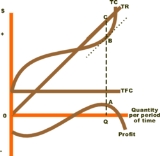
Profit Max Total Small
To obtain the profit maximizing output quantity, we start by recognizing that profit is equal to total revenue (TR) minus total cost (TC). Given a table of costs and revenues at each quantity, we can either compute equations or plot the data directly on a graph. Finding the profit-maximizing output is as simple as finding the output at which profit reaches its maximum. That is represented by output Q in the diagram.

There are two graphical ways of determining that Q is optimal. Firstly, we see that the profit curve is at its maximum at this point (A). Secondly, we see that at the point (B) that the tangent on the total cost curve (TC) is parallel to the total revenue curve (TR), the surplus of revenue net of costs (B,C) is the greatest. Because total revenue minus total costs is equal to profit, the line segment C,B is equal in length to the line segment A,Q.

Computing the price at which to sell the product requires knowledge of the firm's demand
Supply and demand

...
 curve. The price at which quantity demanded equals profit-maximizing output is the optimum price to sell the product
Product (business)

The noun product is defined as a "thing produced by labor or effort" or the "result of an act or a process", and stems from the verb produce from the Latin produce, lead or bring forth....
.

Marginal Cost-Marginal Revenue Method

Profit Max Marginal Small
If total revenue and total cost figures are difficult to procure, this method may also be used. For each unit sold, marginal profit equals marginal revenue minus marginal cost. Then, if marginal revenue is greater than marginal cost, marginal profit is positive, and if marginal revenue is less than marginal cost, marginal profit is negative. When marginal revenue equals marginal cost, marginal profit is zero. Since total profit increases when marginal profit is positive and total profit decreases when marginal profit is negative, it must reach a maximum where marginal profit is zero - or where marginal cost equals marginal revenue. This is because the producer has collected positive profit up until the intersection of MR and MC (where zero profit is collected and any further production will result in negative marginal profit, because MC will be larger than MR). The intersection of marginal revenue (MR) with marginal cost (MC) is shown in the next diagram as point A. If the industry is competitive (as is assumed in the diagram), the firm faces a demand curve (D) that is identical to its Marginal revenue curve (MR), and this is a horizontal line at a price determined by industry supply and demand. Average total costs are represented by curve ATC. Total economic profits are represented by area P,A,B,C. The optimum quantity (Q) is the same as the optimum quantity (Q) in the first diagram.

If the firm is operating in a non-competitive market, minor changes would have to be made to the diagrams.

See also

  • Business organization
  • Corporation
    Corporation

    A corporation is a legal entity separate from the persons that form it. It is a legal entity owned by individual stockholders. In British tradition it is the term designating a body corporate, where it can be either a corporation sole or a corporation aggregate ....
  • Market forms
  • Microeconomics
    Microeconomics

    Microeconomics is a branch of economics that studies how individuals, households and firms and some states make decisions to allocate limited resources, typically in markets where goods or services are being bought and sold....
  • Pricing
    Pricing

    Pricing is one of the four Ps of the marketing mix. The other three aspects are product, promotion, and Distribution . It is also a key variable in microeconomic price allocation theory....
  • Production, costs, and pricing
    Production, costs, and pricing

    In microeconomics, industrial organization is the field which describes the behavior of firms in the marketplace with regard to production, pricing, employment and other decisions....
  • Rational choice theory
    Rational choice theory

    Rational choice theory, also known as rational action theory, is a framework for understanding and often Model social and economic behavior....
  • Supply and demand
    Supply and demand

    ...
  • Pricing Science
    Pricing science

    Pricing Science is the application of social and business science methods to the problem of setting prices. Methods include Economic_model, statistics, econometrics, Mathematical_programming....


External links

  • by Fiona Maclachlan, Wolfram Demonstrations Project
    Wolfram Demonstrations Project

    The Wolfram Demonstrations Project is a website developed by Wolfram Research, whose stated goal is to bring computational exploration to the widest possible audience....
    .