
Home      Discussion      Topics      Dictionary      Almanac
Signup       Login
Production function

Production function

Overview
In microeconomics
Microeconomics
Microeconomics is a branch of economics that studies the behavior of how the individual modern household and firms make decisions to allocate limited resources. Typically, it applies to markets where goods or services are being bought and sold...

 and macroeconomics
Macroeconomics
Macroeconomics is a branch of economics dealing with the performance, structure, behavior, and decision-making of the whole economy. This includes a national, regional, or global economy...

, a production function is a function
Function (mathematics)
In mathematics, a function associates one quantity, the argument of the function, also known as the input, with another quantity, the value of the function, also known as the output. A function assigns exactly one output to each input. The argument and the value may be real numbers, but they can...

 that specifies the output of a firm, an industry, or an entire economy for all combinations of inputs
Factors of production
In economics, factors of production means inputs and finished goods means output. Input determines the quantity of output i.e. output depends upon input. Input is the starting point and output is the end point of production process and such input-output relationship is called a production function...

. This function is an assumed technological relationship, based on the current state of engineering
Engineering
Engineering is the discipline, art, skill and profession of acquiring and applying scientific, mathematical, economic, social, and practical knowledge, in order to design and build structures, machines, devices, systems, materials and processes that safely realize improvements to the lives of...

 knowledge; it does not represent the result of economic choices, but rather is an externally given entity that influences economic decision-making. Almost all economic theories presuppose a production function, either on the firm level or the aggregate level. In this sense, the production function is one of the key concepts of mainstream
Mainstream economics
Mainstream economics is a loose term used to refer to widely-accepted economics as taught in prominent universities and in contrast to heterodox economics...

 neoclassical
Neoclassical economics
Neoclassical economics is a term variously used for approaches to economics focusing on the determination of prices, outputs, and income distributions in markets through supply and demand, often mediated through a hypothesized maximization of utility by income-constrained individuals and of profits...

 theories. Some non-mainstream economists, however, reject the very concept of an aggregate production function.
Discussion
Ask a question about 'Production function'
Start a new discussion about 'Production function'
Answer questions from other users
Full Discussion Forum
 
Unanswered Questions
Recent Discussions
Encyclopedia
In microeconomics
Microeconomics
Microeconomics is a branch of economics that studies the behavior of how the individual modern household and firms make decisions to allocate limited resources. Typically, it applies to markets where goods or services are being bought and sold...

 and macroeconomics
Macroeconomics
Macroeconomics is a branch of economics dealing with the performance, structure, behavior, and decision-making of the whole economy. This includes a national, regional, or global economy...

, a production function is a function
Function (mathematics)
In mathematics, a function associates one quantity, the argument of the function, also known as the input, with another quantity, the value of the function, also known as the output. A function assigns exactly one output to each input. The argument and the value may be real numbers, but they can...

 that specifies the output of a firm, an industry, or an entire economy for all combinations of inputs
Factors of production
In economics, factors of production means inputs and finished goods means output. Input determines the quantity of output i.e. output depends upon input. Input is the starting point and output is the end point of production process and such input-output relationship is called a production function...

. This function is an assumed technological relationship, based on the current state of engineering
Engineering
Engineering is the discipline, art, skill and profession of acquiring and applying scientific, mathematical, economic, social, and practical knowledge, in order to design and build structures, machines, devices, systems, materials and processes that safely realize improvements to the lives of...

 knowledge; it does not represent the result of economic choices, but rather is an externally given entity that influences economic decision-making. Almost all economic theories presuppose a production function, either on the firm level or the aggregate level. In this sense, the production function is one of the key concepts of mainstream
Mainstream economics
Mainstream economics is a loose term used to refer to widely-accepted economics as taught in prominent universities and in contrast to heterodox economics...

 neoclassical
Neoclassical economics
Neoclassical economics is a term variously used for approaches to economics focusing on the determination of prices, outputs, and income distributions in markets through supply and demand, often mediated through a hypothesized maximization of utility by income-constrained individuals and of profits...

 theories. Some non-mainstream economists, however, reject the very concept of an aggregate production function.

Concept of production functions


In micro-economics, a production function is a function
Function (mathematics)
In mathematics, a function associates one quantity, the argument of the function, also known as the input, with another quantity, the value of the function, also known as the output. A function assigns exactly one output to each input. The argument and the value may be real numbers, but they can...

 that specifies the output of a firm for all combinations of inputs. A meta-production function (sometimes metaproduction function) compares the practice of the existing entities converting inputs into output to determine the most efficient practice production function of the existing entities, whether the most efficient feasible practice production or the most efficient actual practice production.clarification needed In either case, the maximum output of a technologically-determined production process is a mathematical function of one or more inputs. Put another way, given the set of all technically feasible combinations of output and inputs, only the combinations encompassing a maximum output for a specified set of inputs would constitute the production function. Alternatively, a production function can be defined as the specification of the minimum input requirements needed to produce designated quantities of output, given available technology. It is usually presumed that unique production functions can be constructed for every production technology.

By assuming that the maximum output technologically possible from a given set of inputs is achieved, economists using a production function in analysis are abstracting from the engineering and managerial problems inherently associated with a particular production process. The engineering and managerial problems of technical efficiency are assumed to be solved, so that analysis can focus on the problems of allocative efficiency
Allocative efficiency
Allocative efficiency is a theoretical measure of the benefit or utility derived from a proposed or actual selection in the allocation or allotment of resources....

. The firm is assumed to be making allocative choices concerning how much of each input factor to use and how much output to produce, given the cost (purchase price) of each factor, the selling price of the output, and the technological determinants represented by the production function. A decision frame in which one or more inputs are held constant may be used; for example, (physical) capital
Physical capital
In economics, physical capital or just 'capital' refers to any already-manufactured asset that is applied in production, such as machinery, buildings, or vehicles. In economic theory, physical capital is one of the three primary factors of production, also known as inputs in the production function...

 may be assumed to be fixed (constant) in the short run, and labour and possibly other inputs such as raw materials variable, while in the long run, the quantities of both capital and the other factors that may be chosen by the firm are variable. In the long run, the firm may even have a choice of technologies, represented by various possible production functions.

The relationship of output to inputs is non-monetary; that is, a production function relates physical inputs to physical outputs, and prices and costs are not reflected in the function. But the production function is not a full model of the production process: it deliberately abstracts from inherent aspects of physical production processes that some would argue are essential, including error, entropy or waste. Moreover, production functions do not ordinarily model the business processes
Business model
A business model describes the rationale of how an organization creates, delivers, and captures value...

, either, ignoring the role of management. (For a primer on the fundamental elements of microeconomic production theory, see production theory basics
Production theory basics
Production refers to the economic process of converting of inputs into outputs. Production uses resources to create a good or service that is suitable for use, gift-giving in a gift economy, or exchange in a market economy. This can include manufacturing, storing, shipping, and packaging. Some...

).

The primary purpose of the production function is to address allocative efficiency in the use of factor inputs in production and the resulting distribution of income to those factors. Under certain assumptions, the production function can be used to derive a marginal product
Marginal product
In economics and in particular neoclassical economics, the marginal product or marginal physical product of an input is the extra output that can be produced by using one more unit of the input , assuming that the quantities of no other inputs to production...

 for each factor, which implies an ideal division of the income generated from output into an income due to each input factor of production.

Specifying the production function


A production function can be expressed in a functional form as the right side of
where:
quantity of output
quantities of factor inputs (such as capital, labour, land or raw materials).


If Q is not a matrix
Matrix (mathematics)
In mathematics, a matrix is a rectangular array of numbers, symbols, or expressions. The individual items in a matrix are called its elements or entries. An example of a matrix with six elements isMatrices of the same size can be added or subtracted element by element...

 (i.e. a scalar, a vector, or even a diagonal matrix), then this form does not encompass joint production, which is a production process that has multiple co-products. On the other hand, if f maps from Rn to Rk then it is a joint production function expressing the determination of k different types of output based on the joint usage of the specified quantities of the n inputs.

One formulation, unlikely to be relevant in practice, is as a linear function:
where and are parameters that are determined empirically.

Another is as a Cobb-Douglas
Cobb-Douglas
In economics, the Cobb–Douglas functional form of production functions is widely used to represent the relationship of an output to inputs. Similar functions were originally used by Knut Wicksell , while the Cobb-Douglas form was developed and tested against statistical evidence by Charles Cobb and...

 production function:
The Leontief production function
Leontief production function
In economics, the Leontief production function or fixed proportions production function is a production function that implies the factors of production will be used in fixed proportions, as there is no substitutability between factors...

 applies to situations in which inputs must be used in fixed proportions; starting from those proportions, if usage of one input is increased without another being increased, output will not change. This production function is given by


Other forms include the constant elasticity of substitution
Constant Elasticity of Substitution
In economics, Constant elasticity of substitution is a property of some production functions and utility functions.More precisely, it refers to a particular type of aggregator function which combines two or more types of consumption, or two or more types of productive inputs into an aggregate...

 production function (CES), which is a generalized form of the Cobb-Douglas function, and the quadratic production function. The best form of the equation to use and the values of the parameters () vary from company to company and industry to industry. In a short run production function at least one of the 's (inputs) is fixed. In the long run all factor inputs are variable at the discretion of management.

Production function as a graph


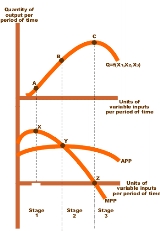
Any of these equations can be plotted on a graph. A typical (quadratic) production function is shown in the following diagram under the assumption of a single variable input (or fixed ratios of inputs so the can be treated as a single variable). All points above the production function are unobtainable with current technology, all points below are technically feasible, and all points on the function show the maximum quantity of output obtainable at the specified level of usage of the input. From the origin, through points A, B, and C, the production function is rising, indicating that as additional units of inputs are used, the quantity of output also increases. Beyond point C, the employment of additional units of inputs produces no additional output (in fact, total output starts to decline); the variable input is being used too intensively. With too much variable input use relative to the available fixed inputs, the company is experiencing negative marginal returns to variable inputs, and diminishing total returns. In the diagram this is illustrated by the negative marginal physical product curve (MPP) beyond point Z, and the declining production function beyond point C.

From the origin to point A, the firm is experiencing increasing returns to variable inputs: As additional inputs are employed, output increases at an increasing rate. Both marginal physical product (MPP, the derivative of the production function) and average physical product (APP, the ratio of output to the variable input) are rising. The inflection point A defines the point beyond which there are diminishing marginal returns, as can be seen from the declining MPP curve beyond point X. From point A to point C, the firm is experiencing positive but decreasing marginal returns to the variable input. As additional units of the input are employed, output increases but at a decreasing rate. Point B is the point beyond which there are diminishing average returns, as shown by the declining slope of the average physical product curve (APP) beyond point Y. Point B is just tangent to the steepest ray from the origin hence the average physical product is at a maximum. Beyond point B, mathematical necessity requires that the marginal curve must be below the average curve (See production theory basics
Production theory basics
Production refers to the economic process of converting of inputs into outputs. Production uses resources to create a good or service that is suitable for use, gift-giving in a gift economy, or exchange in a market economy. This can include manufacturing, storing, shipping, and packaging. Some...

 for further explanation.).

Stages of production


To simplify the interpretation of a production function, it is common to divide its range into 3 stages. In Stage 1 (from the origin to point B) the variable input is being used with increasing output per unit, the latter reaching a maximum at point B (since the average physical product is at its maximum at that point). Because the output per unit of the variable input is improving throughout stage 1, a price-taking firm will always operate beyond this stage.

In Stage 2, output increases at a decreasing rate, and the average and marginal physical product are declining. However, the average product of fixed inputs (not shown) is still rising, because output is rising while fixed input usage is constant. In this stage, the employment of additional variable inputs increases the output per unit of fixed input but decreases the output per unit of the variable input. The optimum input/output combination for the price-taking firm will be in stage 2, although a firm facing a downward-sloped demand curve might find it most profitable to operate in Stage 1.
In Stage 3, too much variable input is being used relative to the available fixed inputs: variable inputs are over-utilized in the sense that their presence on the margin obstructs the production process rather than enhancing it. The output per unit of both the fixed and the variable input declines throughout this stage. At the boundary between stage 2 and stage 3, the highest possible output is being obtained from the fixed input.

Shifting a production function


By definition, in the long run the firm can change its scale of operations by adjusting the level of inputs that are fixed in the short run, thereby shifting the production function upward as plotted against the variable input. If fixed inputs are lumpy, adjustments to the scale of operations may be more significant than what is required to merely balance production capacity with demand. For example, you may only need to increase production by a million units per year to keep up with demand, but the production equipment upgrades that are available may involve increasing productive capacity by 2 million units per year.

If a firm is operating at a profit-maximizing level in stage one, it might, in the long run, choose to reduce its scale of operations (by selling capital equipment). By reducing the amount of fixed capital inputs, the production function will shift down. The beginning of stage 2 shifts from B1 to B2. The (unchanged) profit-maximizing output level will now be in stage 2.

Homogeneous and homothetic production functions


There are two special classes of production functions that are often analyzed. The production function is said to be homogeneous
Homogeneous function
In mathematics, a homogeneous function is a function with multiplicative scaling behaviour: if the argument is multiplied by a factor, then the result is multiplied by some power of this factor. More precisely, if is a function between two vector spaces over a field F, and k is an integer, then...

 of degree n, if given any positive constant , . If , the function exhibits increasing returns to scale
Returns to scale
In economics, returns to scale and economies of scale are related terms that describe what happens as the scale of production increases in the long run, when all input levels including physical capital usage are variable...

, and it exhibits decreasing returns to scale if . If it is homogeneous of degree 1, it exhibits constant returns to scale. The presence of increasing returns means that a one percent increase in the usage levels of all inputs would result in a greater than one percent increase in output; the presence of decreasing returns means that it would result in a less than one percent increase in output. Constant returns to scale is the in-between case. In the Cobb-Douglas production function referred to above, returns to scale are increasing if , decreasing if , and constant if .

If a production function is homogeneous of degree one, it is sometimes called "linearly homogeneous". A linearly homogeneous production function with inputs capital and labour has the properties that the marginal and average physical products of both capital and labour can be expressed as functions of the capital-labour ratio alone. Moreover, in this case if each input is paid at a rate equal to its marginal product, the firm's revenues will be exactly exhausted and there will be no excess economic profit.

Homothetic functions are functions whose marginal technical rate of substitution (the slope of the isoquant
Isoquant
In economics, an isoquant is a contour line drawn through the set of points at which the same quantity of output is produced while changing the quantities of two or more inputs...

, a curve drawn through the set of points in say labour-capital space at which the same quantity of output is produced for varying combinations of the inputs) is homogeneous of degree zero. Due to this, along rays coming from the origin, the slopes of the isoquants will be the same. Homothetic functions are of the form where is a monotonically increasing function (the derivative of is positive ()), and the function is a homogeneous function of any degree.

Aggregate production functions


In macroeconomics
Macroeconomics
Macroeconomics is a branch of economics dealing with the performance, structure, behavior, and decision-making of the whole economy. This includes a national, regional, or global economy...

, aggregate production functions for whole nations are sometimes constructed. In theory they are the summation of all the production functions of individual producers; however there are methodological problems associated with aggregate production functions, and economists have debated extensively whether the concept is valid.

Criticisms of production functions


There are two major criticisms of the standard form of the production function. On the history of production functions, see Mishra (2007).

On the concept of capital


During the 1950s, '60s, and '70s there was a lively debate about the theoretical soundness of production functions. (See the Capital controversy.) Although the criticism was directed primarily at aggregate production functions, microeconomic production functions were also put under scrutiny. The debate began in 1953 when Joan Robinson
Joan Robinson
Joan Violet Robinson FBA was a post-Keynesian economist who was well known for her knowledge of monetary economics and wide-ranging contributions to economic theory...

 criticized the way the factor input capital
Capital (economics)
In economics, capital, capital goods, or real capital refers to already-produced durable goods used in production of goods or services. The capital goods are not significantly consumed, though they may depreciate in the production process...

 was measured and how the notion of factor proportions had distracted economists.

According to the argument, it is impossible to conceive of capital in such a way that its quantity is independent of the rates of interest
Interest
Interest is a fee paid by a borrower of assets to the owner as a form of compensation for the use of the assets. It is most commonly the price paid for the use of borrowed money, or money earned by deposited funds....

 and wages. The problem is that this independence is a precondition of constructing an isoquant. Further, the slope of the isoquant helps determine relative factor prices, but the curve cannot be constructed (and its slope measured) unless the prices are known beforehand.

On the empirical relevance


As a result of the criticism on their weak theoretical grounds, it has been claimed that empirical results firmly support the use of neoclassical well behaved aggregate production functions. Nevertheless, Anwar Shaikh
Anwar Shaikh (economist)
Anwar M. Shaikh is an American economist, and currently Professor of Economics at the Graduate Faculty of The New School in New York City. His work in political economy has focused on the economic theory and empirical patterns of developed capitalism. He has written on international trade,...

  has demonstrated that they also has no empirical relevance, as long as alleged good fit outcomes from an accounting identity, not from any underlying laws of production/distribution.

Natural resources


Often natural resources
Natural Resources
Natural Resources is a soul album released by Motown girl group Martha Reeves and the Vandellas in 1970 on the Gordy label. The album is significant for the Vietnam War ballad "I Should Be Proud" and the slow jam, "Love Guess Who"...

 are omitted from production functions. When Solow
Robert Solow
Robert Merton Solow is an American economist particularly known for his work on the theory of economic growth that culminated in the exogenous growth model named after him...

 and Stiglitz
Joseph E. Stiglitz
Joseph Eugene Stiglitz, ForMemRS, FBA, is an American economist and a professor at Columbia University. He is a recipient of the Nobel Memorial Prize in Economic Sciences and the John Bates Clark Medal . He is also the former Senior Vice President and Chief Economist of the World Bank...

 sought to make the production function more realistic by adding in natural resources
Natural Resources
Natural Resources is a soul album released by Motown girl group Martha Reeves and the Vandellas in 1970 on the Gordy label. The album is significant for the Vietnam War ballad "I Should Be Proud" and the slow jam, "Love Guess Who"...

, they did it in a manner that economist Georgescu-Roegen
Nicholas Georgescu-Roegen
Nicholas Georgescu-Roegen, born Nicolae Georgescu was a Romanian mathematician, statistician and economist, best known for his 1971 magnum opus The Entropy Law and the Economic Process, which situated the view that the second law of thermodynamics, i.e., that usable "free energy" tends to disperse...

 criticized as a "conjuring trick" that failed to address the laws of thermodynamics, since their variant allows capital and labour to be infinitely substituted for natural resources. Neither Solow
Robert Solow
Robert Merton Solow is an American economist particularly known for his work on the theory of economic growth that culminated in the exogenous growth model named after him...

 nor Stiglitz
Joseph E. Stiglitz
Joseph Eugene Stiglitz, ForMemRS, FBA, is an American economist and a professor at Columbia University. He is a recipient of the Nobel Memorial Prize in Economic Sciences and the John Bates Clark Medal . He is also the former Senior Vice President and Chief Economist of the World Bank...

 addressed his criticism, despite an invitation to do so in the September 1997 issue of the journal Ecological Economics. For more recent retrospectives, see Cohen and Harcourt [2003] and Ayres-Warr (2009).

See also

  • Distribution (economics)
    Distribution (economics)
    Distribution in economics refers to the way total output, income, or wealth is distributed among individuals or among the factors of production .. In general theory and the national income and product accounts, each unit of output corresponds to a unit of income...

  • Production theory basics
    Production theory basics
    Production refers to the economic process of converting of inputs into outputs. Production uses resources to create a good or service that is suitable for use, gift-giving in a gift economy, or exchange in a market economy. This can include manufacturing, storing, shipping, and packaging. Some...

  • Production, costs, and pricing
    Production, costs, and pricing
    The following outline is provided as an overview of and topical guide to industrial organization:Industrial organization – describes the behavior of firms in the marketplace with regard to production, pricing, employment and other decisions...

  • Production possibility frontier
    Production possibility frontier
    In economics, a production–possibility frontier , sometimes called a production–possibility curve or product transformation curve, is a graph that compares the production rates of two commodities that use the same fixed total of the factors of production...

  • Productivity
    Productivity
    Productivity is a measure of the efficiency of production. Productivity is a ratio of what is produced to what is required to produce it. Usually this ratio is in the form of an average, expressing the total output divided by the total input...

  • Productivity model
    Productivity model
    Productivity in economics is the ratio of what is produced to what is required to produce. Productivity is the measure on production efficiency. Productivity model is a measurement method which is used in practice for measuring productivity...

  • Microeconomics
    Microeconomics
    Microeconomics is a branch of economics that studies the behavior of how the individual modern household and firms make decisions to allocate limited resources. Typically, it applies to markets where goods or services are being bought and sold...

  • A list of production functions
    A list of production functions
    The production functions listed below, and their properties are shown for the case of two factors of production, capital , and labor , mostly for heuristic purposes...


Further references and external links


  • Moroney, J. R. (1967) Cobb-Douglass production functions and returns to scale in US manufacturing industry, Western Economic Journal, vol 6, no 1, December 1967, pp 39–51.
  • Pearl, D. and Enos, J. (1975) Engineering production functions and technological progress, The Journal of Industrial Economics, vol 24, September 1975, pp 55–72.
  • Robinson, J. (1953) The production function and the theory of capital, Review of Economic Studies, vol XXI, 1953, pp. 81–106
  • Anwar Shaikh
    Anwar Shaikh (economist)
    Anwar M. Shaikh is an American economist, and currently Professor of Economics at the Graduate Faculty of The New School in New York City. His work in political economy has focused on the economic theory and empirical patterns of developed capitalism. He has written on international trade,...

    , "Laws of Production and Laws of Algebra: The Humbug Production Function", in The Review of Economics and Statistics, Volume 56(1), February 1974, p. 115-120. http://homepage.newschool.edu/~AShaikh/humbug.pdf
  • Anwar Shaikh
    Anwar Shaikh (economist)
    Anwar M. Shaikh is an American economist, and currently Professor of Economics at the Graduate Faculty of The New School in New York City. His work in political economy has focused on the economic theory and empirical patterns of developed capitalism. He has written on international trade,...

    , "Laws of Production and Laws of Algebra—Humbug II", in Growth, Profits and Property ed. by Edward J. Nell. Cambridge, Cambridge University Press, 1980. http://homepage.newschool.edu/~AShaikh/humbug2.pdf
  • Anwar Shaikh
    Anwar Shaikh (economist)
    Anwar M. Shaikh is an American economist, and currently Professor of Economics at the Graduate Faculty of The New School in New York City. His work in political economy has focused on the economic theory and empirical patterns of developed capitalism. He has written on international trade,...

    , "Nonlinear Dynamics and Pseudo-Production Functions", published?, 2008. http://homepage.newschool.edu/~AShaikh/Nonlinear%20Dynamics%20and%20Pseudo-Production%20Functions.pdf
  • Shephard, R (1970) Theory of cost and production functions, Princeton University Press, Princeton NJ.
  • Thompson, A. (1981) Economics of the firm, Theory and practice, 3rd edition, Prentice Hall, Englewood Cliffs. ISBN 0-13-231423-1
  • Elmer G. Wiens: Production Functions - Models of the Cobb-Douglas, C.E.S., Trans-Log, and Diewert Production Functions.