


Prize money

Encyclopedia
Prize money has a distinct meaning in warfare, especially naval warfare
, where it was a monetary reward paid out to the crew of a ship for capturing an enemy vessel. This article covers the arrangements of the British Royal Navy
, but similar arrangements were used in the navies of other nations, and existed in the British Army
and other armies, especially when a city had been taken by storm.
This practice was formalised via the Cruisers and Convoys Act of 1708. An Admiralty Prize Court
was established to evaluate claims and condemn prizes, and the scheme of division of the money was specified. This system, with minor changes, lasted throughout the colonial, Revolutionary, and Napoleonic wars.
If the prize were an enemy merchantman, the prize money came from the sale of both ship and cargo. If it were a warship, and repairable, usually the Crown bought it at a fair price; additionally, the Crown added "head money" of 5 pounds per enemy sailor aboard the captured warship. Prizes were keenly sought, for the value of a captured ship was often such that a crew could make a year's pay for a few hours' fighting. Hence boarding and hand-to-hand fighting remained common long after naval cannons developed the ability to sink the enemy from afar.
All ships in sight of a capture shared in the prize money, as their presence was thought to encourage the enemy to surrender without fighting until sunk.
The distribution of prize money to the crews of the ships involved persisted until 1918. Then the Naval Prize Act changed the system to one where the prize money was paid into a common fund from which a payment was made to all naval personnel whether or not they were involved in the action. In 1945, this was further modified to allow for the distribution to be made to RAF
personnel who had been involved in the capture of enemy ships.
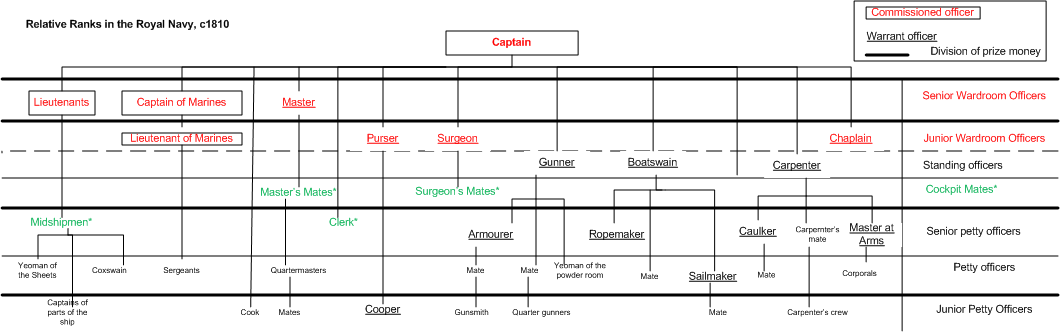 The following scheme for distribution of prize money was used for much of the Napoleonic wars
, the heyday of prize warfare. Allocation was by eighths. Two eighths of the prize money went to the captain
, generally propelling him upwards in political and financial circles. One eighth of the money went to the admiral
or commander and chief who signed the ship's written orders (unless the orders came directly from the Admiralty
in London, in which case this eighth also went to the captain). One eighth was divided among the lieutenant
s, sailing master, and captain of marines if any. One eighth was divided among the wardroom warrant officers (surgeon
, purser
, and chaplain
), standing warrant officers (carpenter
, boatswain
, and gunner
), lieutenant of marines
, and the master's mate
s. One eighth was divided among the junior warrant and petty officers, their mates, sergeants of marines, captain's clerk
, surgeon's mate
s, and midshipmen
. The final two eighths were divided among the crew, with able and specialist seamen receiving larger shares than ordinary seamen, landsmen, and boys.
, received about £65,000 apiece, while each seaman and Marine got £482-485.
In January 1807, the frigate Caroline took the Spanish ship San Rafael as a prize, netting Captain Peter Rainier £52,000.
The prize money from the capture of the Spanish frigates Thetis and Santa Brigada, £652,000, was split up among the crews of four British frigates, with each captain being awarded £40,730 each and the Seaman each receiving £182 4s 9¾d or the equivalent of 10 years pay.
The crewmen of hold the distinction of being the last American sailors to receive prize money, for taking a German blockade runner
on 6 November 1941, just before America's entry into World War II
, though the money would not be awarded until 1947.
Naval warfare
Naval warfare is combat in and on seas, oceans, or any other major bodies of water such as large lakes and wide rivers.-History:Mankind has fought battles on the sea for more than 3,000 years. Land warfare would seem, initially, to be irrelevant and entirely removed from warfare on the open ocean,...
, where it was a monetary reward paid out to the crew of a ship for capturing an enemy vessel. This article covers the arrangements of the British Royal Navy
Royal Navy
The Royal Navy is the naval warfare service branch of the British Armed Forces. Founded in the 16th century, it is the oldest service branch and is known as the Senior Service...
, but similar arrangements were used in the navies of other nations, and existed in the British Army
British Army
The British Army is the land warfare branch of Her Majesty's Armed Forces in the United Kingdom. It came into being with the unification of the Kingdom of England and Scotland into the Kingdom of Great Britain in 1707. The new British Army incorporated Regiments that had already existed in England...
and other armies, especially when a city had been taken by storm.
History
In the 16th and 17th centuries, captured ships were legally Crown property. In order to reward and encourage sailors' zeal at no cost to the Crown, it became customary to pass on all or part of the value of a captured ship and its cargo to the capturing captain for distribution to his crew. (Similarly, all belligerents of the period issued Letters of Marque and Reprisal to civilian privateers, authorising them to make war on enemy shipping; as payment, the privateer sold off the captured booty.)This practice was formalised via the Cruisers and Convoys Act of 1708. An Admiralty Prize Court
Prize court
A prize court is a court authorized to consider whether or not a ship has been lawfully captured or seized in time of war or under the terms of the seizing ship's letters of marque and reprisal...
was established to evaluate claims and condemn prizes, and the scheme of division of the money was specified. This system, with minor changes, lasted throughout the colonial, Revolutionary, and Napoleonic wars.
If the prize were an enemy merchantman, the prize money came from the sale of both ship and cargo. If it were a warship, and repairable, usually the Crown bought it at a fair price; additionally, the Crown added "head money" of 5 pounds per enemy sailor aboard the captured warship. Prizes were keenly sought, for the value of a captured ship was often such that a crew could make a year's pay for a few hours' fighting. Hence boarding and hand-to-hand fighting remained common long after naval cannons developed the ability to sink the enemy from afar.
All ships in sight of a capture shared in the prize money, as their presence was thought to encourage the enemy to surrender without fighting until sunk.
The distribution of prize money to the crews of the ships involved persisted until 1918. Then the Naval Prize Act changed the system to one where the prize money was paid into a common fund from which a payment was made to all naval personnel whether or not they were involved in the action. In 1945, this was further modified to allow for the distribution to be made to RAF
Royal Air Force
The Royal Air Force is the aerial warfare service branch of the British Armed Forces. Formed on 1 April 1918, it is the oldest independent air force in the world...
personnel who had been involved in the capture of enemy ships.
Distribution
Napoleonic Wars
The Napoleonic Wars were a series of wars declared against Napoleon's French Empire by opposing coalitions that ran from 1803 to 1815. As a continuation of the wars sparked by the French Revolution of 1789, they revolutionised European armies and played out on an unprecedented scale, mainly due to...
, the heyday of prize warfare. Allocation was by eighths. Two eighths of the prize money went to the captain
Captain (naval)
Captain is the name most often given in English-speaking navies to the rank corresponding to command of the largest ships. The NATO rank code is OF-5, equivalent to an army full colonel....
, generally propelling him upwards in political and financial circles. One eighth of the money went to the admiral
Admiral
Admiral is the rank, or part of the name of the ranks, of the highest naval officers. It is usually considered a full admiral and above vice admiral and below admiral of the fleet . It is usually abbreviated to "Adm" or "ADM"...
or commander and chief who signed the ship's written orders (unless the orders came directly from the Admiralty
Admiralty
The Admiralty was formerly the authority in the Kingdom of England, and later in the United Kingdom, responsible for the command of the Royal Navy...
in London, in which case this eighth also went to the captain). One eighth was divided among the lieutenant
Lieutenant
A lieutenant is a junior commissioned officer in many nations' armed forces. Typically, the rank of lieutenant in naval usage, while still a junior officer rank, is senior to the army rank...
s, sailing master, and captain of marines if any. One eighth was divided among the wardroom warrant officers (surgeon
Ship's doctor
A Ship's doctor or Ship's surgeon is the person responsible for the health of the people aboard a ship whilst at sea. The term "ship's doctor" or "ship's surgeon" appears often in reference to the Age of Sail British Royal Navy's "surgeons." These men, like other physicians, often did not have much...
, purser
Purser
The purser joined the warrant officer ranks of the Royal Navy in the early fourteenth century and existed as a Naval rank until 1852. The development of the warrant officer system began in 1040 when five English ports began furnishing warships to King Edward the Confessor in exchange for certain...
, and chaplain
Chaplain
Traditionally, a chaplain is a minister in a specialized setting such as a priest, pastor, rabbi, or imam or lay representative of a religion attached to a secular institution such as a hospital, prison, military unit, police department, university, or private chapel...
), standing warrant officers (carpenter
Carpenter
A carpenter is a skilled craftsperson who works with timber to construct, install and maintain buildings, furniture, and other objects. The work, known as carpentry, may involve manual labor and work outdoors....
, boatswain
Boatswain
A boatswain , bo's'n, bos'n, or bosun is an unlicensed member of the deck department of a merchant ship. The boatswain supervises the other unlicensed members of the ship's deck department, and typically is not a watchstander, except on vessels with small crews...
, and gunner
Gunner (rank)
Gunner is a rank equivalent to Private in the British Army Royal Artillery and the artillery corps of other Commonwealth armies. The next highest rank is usually Lance-Bombardier, although in the Royal Canadian Artillery it is Bombardier....
), lieutenant of marines
Lieutenant
A lieutenant is a junior commissioned officer in many nations' armed forces. Typically, the rank of lieutenant in naval usage, while still a junior officer rank, is senior to the army rank...
, and the master's mate
Master's mate
Master's mate is an obsolete rating which was used by the Royal Navy, United States Navy and merchant services in both countries for a senior petty officer who assisted the master...
s. One eighth was divided among the junior warrant and petty officers, their mates, sergeants of marines, captain's clerk
Captain's clerk
A captain's clerk was a rating, now obsolete, in the Royal Navy for a person employed by the captain to keep his records, correspondence, and accounts. The regulations of the Royal Navy demanded that a purser serve at least one year as a captain's clerk, so the latter was often a young man working...
, surgeon's mate
Surgeon's mate
A surgeon's mate was a rank in the Royal Navy for a medically trained assistant to the ship's surgeon. The rank was renamed assistant surgeon in 1805, and was considered equivalent to the rank of master's mate/mate...
s, and midshipmen
Midshipman
A midshipman is an officer cadet, or a commissioned officer of the lowest rank, in the Royal Navy, United States Navy, and many Commonwealth navies. Commonwealth countries which use the rank include Australia, New Zealand, South Africa, India, Pakistan, Singapore, Sri Lanka and Kenya...
. The final two eighths were divided among the crew, with able and specialist seamen receiving larger shares than ordinary seamen, landsmen, and boys.
Examples
Perhaps the greatest amount of prize money awarded was for the capture of the Spanish frigate Hermione on 31 May 1762 by the British frigate and sloop . The two captains, Herbert Sawyer and Philemon PownollPhilemon Pownoll
Philemon Pownoll was an officer of the Royal Navy who saw service during the War of the Austrian Succession, the Seven Years' War and the American War of Independence, rising to the rank of post-captain....
, received about £65,000 apiece, while each seaman and Marine got £482-485.
In January 1807, the frigate Caroline took the Spanish ship San Rafael as a prize, netting Captain Peter Rainier £52,000.
The prize money from the capture of the Spanish frigates Thetis and Santa Brigada, £652,000, was split up among the crews of four British frigates, with each captain being awarded £40,730 each and the Seaman each receiving £182 4s 9¾d or the equivalent of 10 years pay.
The crewmen of hold the distinction of being the last American sailors to receive prize money, for taking a German blockade runner
Blockade runner
A blockade runner is usually a lighter weight ship used for evading a naval blockade of a port or strait, as opposed to confronting the blockaders to break the blockade. Very often blockade running is done in order to transport cargo, for example to bring food or arms to a blockaded city...
on 6 November 1941, just before America's entry into World War II
World War II
World War II, or the Second World War , was a global conflict lasting from 1939 to 1945, involving most of the world's nations—including all of the great powers—eventually forming two opposing military alliances: the Allies and the Axis...
, though the money would not be awarded until 1947.
External links
- Nelson's Navy - Prize Money
- The Gunroom, a discussion site on the Aubrey-Maturin novels with many historical links and resources