

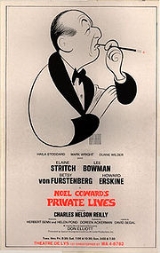
Private Lives

Encyclopedia
- For the episode in the television series, House, see Private LivesPrivate Lives (House)"Private Lives" is the fifteenth episode of the sixth season of House. It first aired on March 8, 2010.-Plot:The team treats an avid blogger, but finds her difficult to treat when she insists on discussing all procedures and doctors on her blog. House notices that the blogger respects no privacy...
.
Private Lives is a 1930
1930 in literature
The year 1930 in literature involved some significant events and new books.-Events:*January 6 - The first literary character licensing agreement is signed by A. A. Milne, granting Stephen Slesinger U.S...
comedy of manners
Comedy of manners
The comedy of manners is a genre of play/television/film which satirizes the manners and affectations of a social class, often represented by stock characters, such as the miles gloriosus in ancient times, the fop and the rake during the Restoration, or an old person pretending to be young...
in three acts by Noël Coward
Noël Coward
Sir Noël Peirce Coward was an English playwright, composer, director, actor and singer, known for his wit, flamboyance, and what Time magazine called "a sense of personal style, a combination of cheek and chic, pose and poise".Born in Teddington, a suburb of London, Coward attended a dance academy...
. It focuses on a divorced couple who discover that they are honeymoon
Honeymoon
-History:One early reference to a honeymoon is in Deuteronomy 24:5 “When a man is newly wed, he need not go out on a military expedition, nor shall any public duty be imposed on him...
ing with their new spouses in neighbouring rooms at the same hotel. Despite a perpetually stormy relationship, they realise that they still have feelings for each other. Its second act love scene was nearly censored in Britain as too risqué. Coward wrote one of his most popular songs, "Some Day I'll Find You", for the play.
After touring the British provinces, the play opened the new Phoenix Theatre
Phoenix Theatre (London)
The Phoenix Theatre is a West End theatre in the London Borough of Camden, located on Charing Cross Road . The entrance is in Phoenix Street....
in London in 1930, starring Coward, Gertrude Lawrence
Gertrude Lawrence
Gertrude Lawrence was an English actress, singer and musical comedy performer known for her stage appearances in the West End theatre district of London and on Broadway.-Early life:...
, Adrianne Allen
Adrianne Allen
Adrianne Allen was an English stage actress.Most often seen in light comedy, played Sybil Chase in the original West End production of Private Lives and Elizabeth Bennet in the 1935 Broadway production of Pride and Prejudice.She appeared in several films and was the mother of Daniel and Anna...
and Laurence Olivier
Laurence Olivier
Laurence Kerr Olivier, Baron Olivier, OM was an English actor, director, and producer. He was one of the most famous and revered actors of the 20th century. He married three times, to fellow actors Jill Esmond, Vivien Leigh, and Joan Plowright...
. A Broadway
Broadway theatre
Broadway theatre, commonly called simply Broadway, refers to theatrical performances presented in one of the 40 professional theatres with 500 or more seats located in the Theatre District centered along Broadway, and in Lincoln Center, in Manhattan in New York City...
production followed in 1931, and the play has been revived at least a half dozen times each in the West End
West End theatre
West End theatre is a popular term for mainstream professional theatre staged in the large theatres of London's 'Theatreland', the West End. Along with New York's Broadway theatre, West End theatre is usually considered to represent the highest level of commercial theatre in the English speaking...
and on Broadway. The leading roles have attracted a wide range of actors; among those who have succeeded Coward as Elyot are Robert Stephens
Robert Stephens
Sir Robert Stephens was a leading English actor in the early years of England's Royal National Theatre.-Early life and career:...
, Richard Burton
Richard Burton
Richard Burton, CBE was a Welsh actor. He was nominated seven times for an Academy Award, six of which were for Best Actor in a Leading Role , and was a recipient of BAFTA, Golden Globe and Tony Awards for Best Actor. Although never trained as an actor, Burton was, at one time, the highest-paid...
, Alan Rickman
Alan Rickman
Alan Sidney Patrick Rickman is an English actor and theatre director. He is a renowned stage actor in modern and classical productions and a former member of the Royal Shakespeare Company...
and Matthew Macfadyen
Matthew Macfadyen
David Matthew Macfadyen is an English actor, known for his role as MI5 intelligence officer Tom Quinn in the BBC television drama series Spooks and for starring as Fitzwilliam Darcy in Pride and Prejudice.In June, 2010 Macfadyen won a British Academy Television Award for Best Supporting...
, and successors to Lawrence as Amanda have included Tallulah Bankhead
Tallulah Bankhead
Tallulah Brockman Bankhead was an award-winning American actress of the stage and screen, talk-show host, and bonne vivante...
, Elizabeth Taylor
Elizabeth Taylor
Dame Elizabeth Rosemond "Liz" Taylor, DBE was a British-American actress. From her early years as a child star with MGM, she became one of the great screen actresses of Hollywood's Golden Age...
, Maggie Smith
Maggie Smith
Dame Margaret Natalie Smith, DBE , better known as Maggie Smith, is an English film, stage, and television actress who made her stage debut in 1952 and is still performing after 59 years...
and Kim Cattrall
Kim Cattrall
Kim Victoria Cattrall is an English actress. She is known for her role as Samantha Jones in the HBO comedy/romance series Sex and the City, and for her leading roles in the 1980s films Police Academy, Big Trouble in Little China, Mannequin, and Porky's...
. Directors of new productions have included John Gielgud
John Gielgud
Sir Arthur John Gielgud, OM, CH was an English actor, director, and producer. A descendant of the renowned Terry acting family, he achieved early international acclaim for his youthful, emotionally expressive Hamlet which broke box office records on Broadway in 1937...
, Howard Davies and Richard Eyre
Richard Eyre
Sir Richard Charles Hastings Eyre CBE is an English director of film, theatre, television, and opera.-Biography:Eyre was educated at Sherborne School, an independent school for boys in the market town of Sherborne in north-west Dorset in south-west England, followed by Peterhouse at the University...
. The play was made into a 1931 film
Private Lives (film)
Private Lives is a 1931 American comedy film directed by Sidney Franklin. The screenplay by Hanns Kräly and Richard Schayer is based on the 1930 play of the same title by Noël Coward.-Plot synopsis:...
and has been adapted several times for television and radio.
Background
Coward was in the middle of an extensive Asian tour when he contracted influenzaInfluenza
Influenza, commonly referred to as the flu, is an infectious disease caused by RNA viruses of the family Orthomyxoviridae , that affects birds and mammals...
in Shanghai
Shanghai
Shanghai is the largest city by population in China and the largest city proper in the world. It is one of the four province-level municipalities in the People's Republic of China, with a total population of over 23 million as of 2010...
. He spent the better part of his two-week convalescence sketching out the play and then completed the actual writing of the piece in only four days. He immediately cabled Gertrude Lawrence
Gertrude Lawrence
Gertrude Lawrence was an English actress, singer and musical comedy performer known for her stage appearances in the West End theatre district of London and on Broadway.-Early life:...
in New York to ask her to keep autumn 1930 free to appear in the play. After spending a few more weeks revising it, he typed the final draft in the Peninsula Hotel
The Peninsula Hong Kong
The Peninsula Hong Kong is one of the most internationally recognizable hotels in Hong Kong. Opened in 1928, it is Hong Kong's most historical hotel. It is located at the junction of Nathan Road and Salisbury Road in Tsim Sha Tsui, Hong Kong...
in Kowloon
Kowloon
Kowloon is an urban area in Hong Kong comprising the Kowloon Peninsula and New Kowloon. It is bordered by the Lei Yue Mun strait in the east, Mei Foo Sun Chuen and Stonecutter's Island in the west, Tate's Cairn and Lion Rock in the north, and Victoria Harbour in the south. It had a population of...
and sent copies to Lawrence and his producer and manager, John C. Wilson
John C. Wilson
John C. Wilson was an American theatre director and producer.-Early life:Born in Lawrenceville, New Jersey, Wilson started out his working life as a stockbroker.-Career:...
, with instructions to cable him with their reactions.
Coward received no fewer than thirty telegrams from Lawrence about the play. Her first said that she had read the play and there was "nothing wrong with it that can't be fixed." Coward "wired back curtly that the only thing that was going to be fixed was her performance." Lawrence was indecisive about what to do about her previous commitment to André Charlot
André Charlot
André Eugene Maurice Charlot was a French impresario known primarily for the highly successful musical revues he staged in London between 1912 and 1937...
. Coward finally responded that he planned to cast the play with another actress. By the time he returned to London, he found Lawrence not only had cleared her schedule but was staying at Edward Molyneux
Edward Molyneux
Edward Henry Molyneux was a British fashion designer whose fashion house in Paris was in operation from 1919 until 1950.- Overview :Born in London to Justin Molyneux and Lizzy Kenny, Edward Molyneux attended Beaumont College, a Roman Catholic preparatory school...
's villa in Cap-d'Ail
Cap-d'Ail
Cap-d'Ail , Italian: Capodaglio, is a commune in the Alpes-Maritimes department in southeastern France.It borders the district of La Colle in the Principality of Monaco....
in southeastern France learning her lines. Coward joined her, and the two began rehearsing the scenes they shared. At the end of July they returned to London where Coward began to direct the production. Coward played the part of Elyot Chase himself, Adrianne Allen
Adrianne Allen
Adrianne Allen was an English stage actress.Most often seen in light comedy, played Sybil Chase in the original West End production of Private Lives and Elizabeth Bennet in the 1935 Broadway production of Pride and Prejudice.She appeared in several films and was the mother of Daniel and Anna...
was his bride Sybil, Lawrence played Amanda Prynne, and Laurence Olivier
Laurence Olivier
Laurence Kerr Olivier, Baron Olivier, OM was an English actor, director, and producer. He was one of the most famous and revered actors of the 20th century. He married three times, to fellow actors Jill Esmond, Vivien Leigh, and Joan Plowright...
was her new husband Victor. Coward wrote Sybil and Victor as minor characters, "extra puppets, lightly wooden ninepins, only to be repeatedly knocked down and stood up again". He later insisted, however, that they must be credible new spouses for the lead characters: "We've got to have two people as attractive as Larry and Adrianne were in the first place, if we can find them."
Rehearsals were still under way when the Lord Chamberlain
Lord Chamberlain
The Lord Chamberlain or Lord Chamberlain of the Household is one of the chief officers of the Royal Household in the United Kingdom and is to be distinguished from the Lord Great Chamberlain, one of the Great Officers of State....
took exception to the second act love scene, labelling it too risqué in light of the fact the characters were divorced and married to others. Coward went to St. James's Palace
St. James's Palace
St. James's Palace is one of London's oldest palaces. It is situated in Pall Mall, just north of St. James's Park. Although no sovereign has resided there for almost two centuries, it has remained the official residence of the Sovereign and the most senior royal palace in the UK...
to plead his case by acting out the play himself and assuring the censor that with artful direction the scene would be presented in a dignified and unobjectionable manner. Coward repeats one of his signature theatrical devices at the end of the play, where the main characters tiptoe out as the curtain falls – a device that he also used in Present Laughter
Present Laughter
Present Laughter is a comic play written by Noël Coward in 1939 and first staged in 1942 on tour, alternating with his lower middle-class domestic drama This Happy Breed...
, Hay Fever
Hay Fever
Hay Fever is a comic play written by Noël Coward in 1924 and first produced in 1925 with Marie Tempest as the first Judith Bliss. Laura Hope Crews played the role in New York...
and Blithe Spirit
Blithe Spirit (play)
Blithe Spirit is a comic play written by Noël Coward which takes its title from Percy Bysshe Shelley's poem "To a Skylark" . The play concerns socialite and novelist Charles Condomine, who invites the eccentric medium and clairvoyant, Madame Arcati, to his house to conduct a séance, hoping to...
.
The play contains one of Coward's most popular songs, "Some Day I'll Find You". The Noël Coward Society's website, drawing on performing statistics from the publishers and the Performing Rights Society, ranks it among Coward's ten most performed songs.
Synopsis
Act 1Following a brief courtship, Elyot and Sybil are honeymooning at a hotel in Deauville
Deauville
Deauville is a commune in the Calvados département in the Basse-Normandie region in northwestern France.With its racecourse, harbour, international film festival, marinas, conference centre, villas, Grand Casino and sumptuous hotels, Deauville is regarded as the "queen of the Norman beaches" and...
, although her curiosity about his first marriage is not helping his romantic mood. In the adjoining suite, Amanda and Victor are starting their new life together, although he cannot stop thinking of the cruelty Amanda's ex-husband displayed towards her. Elyot and Amanda, following a volatile three-year-long marriage, have been divorced for the past five years, but they now discover that they are sharing a terrace while on their honeymoons with their new and younger spouses. Elyot and Amanda separately beg their new mates to leave the hotel with them immediately, but both new spouses refuse to cooperate and each storms off to dine alone. Realising they still love each other and regret having divorced, Elyot and Amanda abandon their mates and run off together to her flat in Paris.
Act 2
After dinner at the Paris flat several days later, Elyot and Amanda use their code word "Sollocks" to stop their arguments from getting out of hand. They kiss passionately, but the harmony cannot last: while Elyot and Amanda cannot live without each other, neither can they live with each other. They argue violently and try to outwit each other, just as they had done during their stormy marriage. Their ongoing argument escalates to the point of physical abuse, as Amanda breaks a record over Elyot's head, and he retaliates by slapping her face. They seem to be trapped in a repeating cycle of love and hate as their private passions and jealousies consume them. At the height of their biggest fight, Sybil and Victor walk in.
Act 3
The next morning, Amanda tries to sneak away early, but is surprised to find Sybil and Victor there. As they talk, Elyot comes in, and he and Amanda start bickering again. It has been decided that neither of the new spouses will grant a divorce for a year, to give Amanda and Elyot time to confirm if this is really what they want. As tempers rise, Sybil and Victor begin to bicker with each other, defending their respective spouses. Amanda and Elyot realise that Sybil and Victor are as suited to each other as they are, forgive one another and sneak out, leaving the younger two together. As Elyot and Amanda tiptoe out, Victor and Sybil have reached the point of mutual violence.
Original productions
Produced by C. B. Cochran, the play premiered on 18 August 1930 at the King's TheatreKing's Theatre, Edinburgh
The King's Theatre was opened in 1906 and stands on a prominent site on Leven Street in Edinburgh. It is one of Scotland's historic and most important theatres...
in Edinburgh
Edinburgh
Edinburgh is the capital city of Scotland, the second largest city in Scotland, and the eighth most populous in the United Kingdom. The City of Edinburgh Council governs one of Scotland's 32 local government council areas. The council area includes urban Edinburgh and a rural area...
, directed by Coward and starring Coward as Elyot, Adrianne Allen
Adrianne Allen
Adrianne Allen was an English stage actress.Most often seen in light comedy, played Sybil Chase in the original West End production of Private Lives and Elizabeth Bennet in the 1935 Broadway production of Pride and Prejudice.She appeared in several films and was the mother of Daniel and Anna...
as Sybil, Gertrude Lawrence
Gertrude Lawrence
Gertrude Lawrence was an English actress, singer and musical comedy performer known for her stage appearances in the West End theatre district of London and on Broadway.-Early life:...
as Amanda, and Laurence Olivier
Laurence Olivier
Laurence Kerr Olivier, Baron Olivier, OM was an English actor, director, and producer. He was one of the most famous and revered actors of the 20th century. He married three times, to fellow actors Jill Esmond, Vivien Leigh, and Joan Plowright...
as Victor. Sets and costumes were designed by Gladys Calthrop
Gladys Calthrop
Gladys E. Calthrop was an artist and leading British stage designer. She is best known as the set and costume designer for many of Noël Coward's plays and musicals.-Life and career:...
. After successfully touring Liverpool
Liverpool
Liverpool is a city and metropolitan borough of Merseyside, England, along the eastern side of the Mersey Estuary. It was founded as a borough in 1207 and was granted city status in 1880...
, Birmingham
Birmingham
Birmingham is a city and metropolitan borough in the West Midlands of England. It is the most populous British city outside the capital London, with a population of 1,036,900 , and lies at the heart of the West Midlands conurbation, the second most populous urban area in the United Kingdom with a...
, Manchester
Manchester
Manchester is a city and metropolitan borough in Greater Manchester, England. According to the Office for National Statistics, the 2010 mid-year population estimate for Manchester was 498,800. Manchester lies within one of the UK's largest metropolitan areas, the metropolitan county of Greater...
and Southsea
Southsea
Southsea is a seaside resort located in Portsmouth at the southern end of Portsea Island in the county of Hampshire in England. Southsea is within a mile of Portsmouth's city centre....
for five weeks, the production opened the new Phoenix Theatre
Phoenix Theatre (London)
The Phoenix Theatre is a West End theatre in the London Borough of Camden, located on Charing Cross Road . The entrance is in Phoenix Street....
in London on 24 September 1930. A week after the play opened, Heinemann
Heinemann (book publisher)
Heinemann is a UK publishing house founded by William Heinemann in Covent Garden, London in 1890. On William Heinemann's death in 1920 a majority stake was purchased by U.S. publisher Doubleday. It was later acquired by commemorate Thomas Tilling in 1961...
published the text; a week later, HMV
HMV
His Master's Voice is a trademark in the music business, and for many years was the name of a large record label. The name was coined in 1899 as the title of a painting of the dog Nipper listening to a wind-up gramophone...
issued recordings of scenes from the play performed by Coward and Lawrence. Coward disliked appearing in long runs, and the London run was therefore a limited three-month season. It sold out within a week and was still playing to packed houses when, despite "the gratifying knowledge that we could have run on for another six [months]," it ended on 20 December 1930.
The first Broadway
Broadway theatre
Broadway theatre, commonly called simply Broadway, refers to theatrical performances presented in one of the 40 professional theatres with 500 or more seats located in the Theatre District centered along Broadway, and in Lincoln Center, in Manhattan in New York City...
production opened at the Times Square Theatre
Times Square Theatre
The Times Square Theatre is a former Broadway theatre, located at 217 West 42nd Street, Manhattan, in New York City.-History:The Times Square Theatre was built in 1920 by the Selwyn brothers. It was one of three theatres they built and controlled on 42nd Street, including the Apollo and the Selwyn...
on 27 January 1931 with Coward, Lawrence and Olivier reprising their roles and Jill Esmond
Jill Esmond
Jill Esmond was an English actress and first wife of Sir Laurence Olivier.-Early life:Esmond was born Jill Esmond Moore in London, the daughter of stage actors Henry V. Esmond and Eva Moore. While her parents toured with theatre companies, Esmond spent her childhood in boarding schools until she...
, who had married Olivier a few months earlier, as Sybil. Walter Winchell
Walter Winchell
Walter Winchell was an American newspaper and radio gossip commentator.-Professional career:Born Walter Weinschel in New York City, he left school in the sixth grade and started performing in a vaudeville troupe known as Gus Edwards' "Newsboys Sextet."His career in journalism was begun by posting...
described the production as "something to go quite silly over." The New York critics were enthusiastic about the play and Coward's performance. A few weeks before Coward and Lawrence were scheduled to be replaced by Otto Kruger
Otto Kruger
Otto Kruger was an American actor who began his career in 1915. His career was most prolific during the 1930s and 1940s.-Career:...
and Madge Kennedy
Madge Kennedy
Madge Kennedy was a movie and stage actress of the silent film era....
, Lawrence collapsed with a combined attack of laryngitis
Laryngitis
Laryngitis is an inflammation of the larynx. It causes hoarse voice or the complete loss of the voice because of irritation to the vocal folds . Dysphonia is the medical term for a vocal disorder, of which laryngitis is one cause....
and nervous exhaustion
Neurasthenia
Neurasthenia is a psycho-pathological term first used by George Miller Beard in 1869 to denote a condition with symptoms of fatigue, anxiety, headache, neuralgia and depressed mood...
. Coward appeared at five performances with her understudy, and then closed the production for two weeks to allow Lawrence to recuperate. She returned, and the two continued in their roles until 9 May 1931. The production ran a total of 256 performances.
Major revivals (1940s to 1970s)
The first West EndWest End theatre
West End theatre is a popular term for mainstream professional theatre staged in the large theatres of London's 'Theatreland', the West End. Along with New York's Broadway theatre, West End theatre is usually considered to represent the highest level of commercial theatre in the English speaking...
revival was at the Apollo Theatre
Apollo Theatre
The Apollo Theatre is a Grade II listed West End theatre, on Shaftesbury Avenue in the City of Westminster. Designed by architect Lewin Sharp for owner Henry Lowenfield, and the fourth legitimate theatre to be constructed on the street, its doors opened on 21 February 1901 with the American...
in 1944 starring John Clements
John Clements
Sir John Selby Clements, CBE was an English actor and producer who worked in theatre, television and film.Clements attended St Paul's School and St John's College, Cambridge University then worked with Nigel Playfair and afterwards spent a few years in Ben Greet's Shakespearean Company. He made...
and Kay Hammond. Googie Withers
Googie Withers
Georgette Lizette "Googie" Withers CBE, AO was an English theatre, film and television actress. She was a longtime resident of Australia with her husband, the actor John McCallum, with whom she often appeared.-Biography:...
took over as Amanda during the run. Over the years, the play has been revived on Broadway six times. The first of these, in 1948, starred Tallulah Bankhead
Tallulah Bankhead
Tallulah Brockman Bankhead was an award-winning American actress of the stage and screen, talk-show host, and bonne vivante...
as Amanda and Donald Cook
Donald Cook (actor)
Donald Cook was an American stage and film actor.Born in Portland, Oregon, he originally studied farming but later started business with a lumber company. He joined the Kansas Community Players and through this received an offer of stage work...
as Elyot, with Barbara Baxley
Barbara Baxley
Barbara Baxley was an American actress of stage, film and television.-Early life:Baxley was born in Porterville, California, the daughter of Emma and Bert Baxley.-Career:...
as Sybil and William Langford as Victor, in a production directed by Martin Manulis
Martin Manulis
Martin Manulis was an American film, television and theater producer. Manulis was best known for creating the television program, Playhouse 90 on CBS.-Career:...
at the Plymouth Theatre
Gerald Schoenfeld Theatre
The Gerald Schoenfeld Theatre is a Broadway theatre located at 236 West 45th Street in midtown-Manhattan named for Gerald Schoenfeld....
, where it ran for 248 performances. The production toured all but three states of the U.S., and grossed more than $1.5 million. Coward went to see the production "with my heart in my boots and was very pleasantly surprised ... her vitality was amazing, and, strange to say, she played the love scene quite beautifully."
In 1963, at the start of what Coward called "Dad's Renaissance", a London revival directed by James Roose-Evans
James Roose-Evans
James Roose-Evans is a British theatre director, script-writer, priest and writer on experimental theatre, gesture, ritual and meditation. In 1959 he founded the Hampstead Theatre Club, in London; and in 1974 the Bleddfa Centre for creativity and spirituality, in Powys.-Biography:James...
at the Hampstead Theatre Club
Hampstead Theatre
Hampstead Theatre is a theatre in the vicinity of Swiss Cottage and Belsize Park, in the London Borough of Camden. It specialises in commissioning and producing new writing, supporting and developing the work of new writers. In 2009 it celebrates its 50 year anniversary.The original theatre was...
heralded Coward's return to critical favour. The success of the production, with Edward de Souza
Edward de Souza
Edward James de Souza is a British character actor and graduate of RADA with ethnic Portuguese Indian and English origins.-Early life:...
as Elyot and Rosemary Martin
Rosemary Martin
Rosemary Martin was an English actress, best-remembered for her television roles .Other notable TV credits include: Z-Cars, Crown Court, Bill Brand, Coronation Street, Pennies from...
as Amanda, led to its transfer to the Duke of York's Theatre
Duke of York's Theatre
The Duke of York's Theatre is a West End Theatre in St Martin's Lane, in the City of Westminster. It was built for Frank Wyatt and his wife, Violet Melnotte, who retained ownership of the theatre, until her death in 1935. It opened on 10 September 1892 as the Trafalgar Square Theatre, with Wedding...
. The West End producer wanted to cast established stars in the transfer, but Coward insisted that the young Hampstead cast should be retained. It ran in the West End for 212 performances. A May 1968 Off-Broadway
Off-Broadway
Off-Broadway theater is a term for a professional venue in New York City with a seating capacity between 100 and 499, and for a specific production of a play, musical or revue that appears in such a venue, and which adheres to related trade union and other contracts...
production directed by Charles Nelson Reilly
Charles Nelson Reilly
Charles Nelson Reilly was an American actor, comedian, director and drama teacher known for his comedic roles in theater, movies, children's television, animated cartoons, and as a panelist on the game show Match Game....
starred Elaine Stritch
Elaine Stritch
Elaine Stritch is an American actress and vocalist. She has appeared in numerous stage plays and musicals, feature films, and many television programs...
as Amanda, and ran for nine performances at the Theatre de Lys
Lucille Lortel Theatre
The Lucille Lortel Theatre is an off-Broadway playhouse located at 121 Christopher Street in New York City's Greenwich Village.The venue was built in 1926 as a 590-seat movie theater called the New Hudson, later known as Hudson Playhouse...
. A 1969 production, directed by Stephen Porter
Stephen Porter (director)
Stephen Winthrop Porter is an American stage and television director, producer, set designer and writer best known for directing the classics, especially George Bernard Shaw, Molière and Shakespeare. Porter has directed more than thirty Broadway plays and many regional, Off-Broadway and other...
and starring Brian Bedford
Brian Bedford
Brian Bedford is an English actor. He has appeared on the stage and in film, and is known for both acting in and directing Shakespeare.-Life and career:...
as Elyot and Tammy Grimes
Tammy Grimes
-Early life:Grimes was born in Lynn, Massachusetts, the daughter of Eola Willard , a naturalist and spiritualist, and Nicholas Luther Grimes, an innkeeper, country-club manager, and farmer. She attended high school at the then-all girls school, Beaver Country Day School, in Chestnut Hill,...
as Amanda (winning a Tony Award
Tony Award
The Antoinette Perry Award for Excellence in Theatre, more commonly known as a Tony Award, recognizes achievement in live Broadway theatre. The awards are presented by the American Theatre Wing and The Broadway League at an annual ceremony in New York City. The awards are given for Broadway...
for her performance), with David Glover
David Glover
David Moore Glover FRS FRSE is a British geneticist, current Balfour Professor of Genetics at Cambridge University and a Fellow of Fitzwilliam College, Cambridge.- References :...
as Victor and Suzanne Grossman as Sybil, opened at Broadway's Billy Rose Theatre
Nederlander Theatre
David T. Nederlander Theatre is a 1,232-seat Broadway theatre located at 208 West 41st Street, in New York City . One of the Nederlander Organization's nine Broadway theatres, the legacy of the theatre began with David Tobias Nederlander, for whom the theatre is named.Built by Walter C...
and then moved to the Broadhurst Theatre
Broadhurst Theatre
The Broadhurst Theatre is a legitimate Broadway theatre located at 235 West 44th Street in midtown Manhattan.It was designed by architect Herbert J. Krapp, a well-known theatre designer who had been working directly with the Shubert brothers; the Broadhurst opened 27 September 1917...
to complete its run of 198 performances. The last major revival during Coward's lifetime was at London's Queen's Theatre
Queen's Theatre
The Queen's Theatre is a West End theatre located in Shaftesbury Avenue in the City of Westminster. It opened on 8 October 1907 as a twin to the neighbouring Gielgud Theatre which opened ten months earlier. Both theatres were designed by W.G.R...
in 1972. It was directed by John Gielgud
John Gielgud
Sir Arthur John Gielgud, OM, CH was an English actor, director, and producer. A descendant of the renowned Terry acting family, he achieved early international acclaim for his youthful, emotionally expressive Hamlet which broke box office records on Broadway in 1937...
and starred Maggie Smith
Maggie Smith
Dame Margaret Natalie Smith, DBE , better known as Maggie Smith, is an English film, stage, and television actress who made her stage debut in 1952 and is still performing after 59 years...
and Robert Stephens
Robert Stephens
Sir Robert Stephens was a leading English actor in the early years of England's Royal National Theatre.-Early life and career:...
. During the run of the production, John Standing
John Standing
Sir John Ronald Leon Standing, 4th Baronet is an English actor.-Early life:Standing was born John Ronald Leon in London, the son of Kay Hammond , an actress, and Sir Ronald George Leon, a stockbroker...
took over as Elyot, and Jill Bennett was a replacement as Amanda. Gielgud directed a 1975 Broadway transfer of his production, starring Maggie Smith and John Standing at the 46th Street Theatre
Richard Rodgers Theatre
The Richard Rodgers Theatre, is a Broadway theater in New York City, built by Irwin Chanin in 1925. When it was first opened, it was called Chanin's 46th Street Theatre. Chanin almost immediately leased it to the Shuberts, who bought the building outright in 1931 and renamed it the 46th Street...
, where it ran for 92 performances.
Major revivals (1980s to present)
In 1980, a production from the Greenwich TheatreGreenwich Theatre
The Greenwich Theatre is a local theatre located in Croom's Hill close to the centre of Greenwich in south-east London.-Building history:The building was originally a music hall created in 1855 as part of the neighbouring Rose and Crown public house, but the Rose and Crown Music Hall was...
transferred to the Duchess Theatre
Duchess Theatre
The Duchess Theatre is a West End theatre in the City of Westminster, London, located in Catherine Street, near Aldwych.The theatre opened on 25 November 1929 and is one of the smallest 'proscenium arched' West End theatres. It has 479 seats on two levels....
in the West End. It starred Michael Jayston
Michael Jayston
Michael Jayston is a Nottingham-born English actor.- Early life :He attended the Becket Grammar School in West Bridgford, then worked briefly as a trainee accountant at the offices of the National Coal Board before obtaining a scholarship to the Guildhall School of Music and Drama to train as an...
and Maria Aitken
Maria Aitken
Maria Penelope Katharine Aitken is an English actress, writer, producer and director.Aitken was born in Dublin, the daughter of Sir William Aitken, a Conservative MP, and socialite Penelope Aitken, whose father was John Maffey, 1st Baron Rugby. She is a great-niece of newspaper magnate and...
, and it was directed by Alan Strachan. Elizabeth Taylor
Elizabeth Taylor
Dame Elizabeth Rosemond "Liz" Taylor, DBE was a British-American actress. From her early years as a child star with MGM, she became one of the great screen actresses of Hollywood's Golden Age...
as Amanda and Richard Burton
Richard Burton
Richard Burton, CBE was a Welsh actor. He was nominated seven times for an Academy Award, six of which were for Best Actor in a Leading Role , and was a recipient of BAFTA, Golden Globe and Tony Awards for Best Actor. Although never trained as an actor, Burton was, at one time, the highest-paid...
as Elyot were the headliners in a highly-anticipated 1983 Broadway production directed by Milton Katselas
Milton Katselas
Milton Katselas was an American film director and famous Hollywood coach for The Beverly Hills Playhouse...
, which opened at the Lunt-Fontanne Theatre
Lunt-Fontanne Theatre
The Lunt-Fontanne Theatre is a legitimate Broadway theatre located at 205 West 46th Street in midtown-Manhattan.Designed by the architectural firm of Carrere and Hastings, it was built by producer Charles Dillingham and opened as the Globe Theatre, in honor of London's Shakespearean playhouse, on...
in May 1983 following a pre-Broadway run at the Shubert Theatre in Boston
Boston
Boston is the capital of and largest city in Massachusetts, and is one of the oldest cities in the United States. The largest city in New England, Boston is regarded as the unofficial "Capital of New England" for its economic and cultural impact on the entire New England region. The city proper had...
in April 1983. It co-starred John Cullum
John Cullum
John Cullum is an American actor and singer. He has appeared in many stage musicals and dramas, including On the Twentieth Century and Shenandoah , winning the Tony Awards for Best Leading Actor in a Musical for each...
as Victor and Kathryn Walker
Kathryn Walker
Kathryn Walker is an American theater, television and film actress. She was with Douglas Kenney for many years until his death in 1980 at the age of 32, and was married to singer James Taylor from 1985 to 1995...
as Sybil and ran for 63 performances. After closing on Broadway, this production toured to the John F. Kennedy Center for the Performing Arts
John F. Kennedy Center for the Performing Arts
The John F. Kennedy Center for the Performing Arts is a performing arts center located on the Potomac River, adjacent to the Watergate complex in Washington, D.C...
in August and September 1983, the Shubert Theatre, Chicago in September, and the Wilshire Theatre, Los Angeles in October 1983.
In 1990, a revival at London's Aldwych Theatre
Aldwych Theatre
The Aldwych Theatre is a West End theatre, located on Aldwych in the City of Westminster. The theatre was listed Grade II on 20 July 1971. Its seating capacity is 1,200.-Origins:...
, starring Keith Baxter
Keith Baxter (actor)
Keith Baxter is a Welsh theatre, film and television actor.- Early years & RADA :Born in Newport, Wales in 1933. Baxter was educated at Newport High School and Barry Grammar School, Baxter studied at London's Royal Academy of Dramatic Arts, during which period he shared a flat with classmate Alan...
and Joan Collins
Joan Collins
Joan Henrietta Collins, OBE , is an English actress, author, and columnist. Born in Paddington and raised in Maida Vale, Collins grew up during the Second World War. At the age of nine, she made her stage debut in A Doll's House and after attending school, she was classically trained as an actress...
, directed by Tim Luscombe, was not well received, although Sara Crowe
Sara Crowe
Sara Crowe , also known as Sara K. Crowe, is a Scottish film and stage actress, who mainly plays comedy roles.-Career:...
won an Olivier Award, Actress in a Supporting Role, as Sybil. Arvin Brown
Arvin Brown
Arvin Brown is an American theatre and television director and was the Artistic Director of the Long Wharf Theatre in New Haven, Connecticut for 30 years. He was married to actress Joyce Ebert until her death in 1997....
directed Collins as Amanda and Simon Jones
Simon Jones (actor)
Simon Jones is an English actor, most famous for his appearances in the television and radio series of The Hitchhiker's Guide to the Galaxy, in which he played the lead role of Arthur Dent from 1978 to 2005...
as Elyot in a 1992 Broadway production that closed after only 11 previews and 37 performances at the Broadhurst Theatre
Broadhurst Theatre
The Broadhurst Theatre is a legitimate Broadway theatre located at 235 West 44th Street in midtown Manhattan.It was designed by architect Herbert J. Krapp, a well-known theatre designer who had been working directly with the Shubert brothers; the Broadhurst opened 27 September 1917...
. The last West End production of the 20th century was at the National Theatre
Royal National Theatre
The Royal National Theatre in London is one of the United Kingdom's two most prominent publicly funded theatre companies, alongside the Royal Shakespeare Company...
, running from May to September 1999, with Anton Lesser
Anton Lesser
Anton Lesser is a British actor. He attended Moseley Grammar School and the University of Liverpool before going to RADA in 1977 where he was awarded the Bancroft Gold Medal as the most promising actor of his year....
as Elyot and Juliet Stevenson
Juliet Stevenson
Juliet Anne Virginia Stevenson, CBE is an English actor of stage and screen.- Early life :Stevenson was born in Kelvedon, Essex, England, the daughter of Virginia Ruth , a teacher, and Michael Guy Stevenson, an army officer. Stevenson's father was in the army and was posted to a new place every...
as Amanda, directed by Philip Franks
Philip Franks
Philip Franks is an English actor and director best known for his roles as tax inspector Cedric "Charley" Charlton in the British sitcom The Darling Buds of May, and Sgt. Raymond Craddock on Heartbeat. He has also made guest appearances in Absolutely Fabulous, Pie in the Sky, Midsomer Murders and...
.
A 2001 London revival emphasised the harshness and darker side of the play; it starred Alan Rickman
Alan Rickman
Alan Sidney Patrick Rickman is an English actor and theatre director. He is a renowned stage actor in modern and classical productions and a former member of the Royal Shakespeare Company...
and Lindsay Duncan
Lindsay Duncan
Lindsay Vere Duncan, CBE is a Scottish stage, television and film actress. On stage she won two Olivier Awards and a Tony Award for her performance in Les Liaisons dangereuses and Private Lives , and she starred in several plays by Harold Pinter. Her most famous roles on television include:...
, directed by Howard Davies at the Albery Theatre (subsequently renamed the Noël Coward Theatre
Noël Coward Theatre
The Noël Coward Theatre, formerly known as the Albery Theatre, is a West End theatre on St. Martin's Lane in the City of Westminster. It opened on 12 March 1903 as the New Theatre and was built by Sir Charles Wyndham behind Wyndham's Theatre which was completed in 1899. The building was designed by...
). Duncan won the Olivier Award for her performance, Tim Hatley
Tim Hatley
Tim Hatley is a British set and costume designer for theater and film. He is the winner of the Tony Award, the Drama Desk Award for Outstanding Set Design, the Drama Desk Award for Outstanding Costume Design, and the Laurence Olivier Award for Best Set Design.Hatley was educated at Bearwood...
won for his set designs, and Jenny Beavan
Jenny Beavan
Jenny Beavan is a British costume designer. Beavan has won an Academy Award and has been nominated eight times, most recently for The King's Speech...
won for costumes. A Broadway transfer of Davies's West End production, starring Rickman and Duncan, ran for 127 performances at the Richard Rodgers Theatre
Richard Rodgers Theatre
The Richard Rodgers Theatre, is a Broadway theater in New York City, built by Irwin Chanin in 1925. When it was first opened, it was called Chanin's 46th Street Theatre. Chanin almost immediately leased it to the Shuberts, who bought the building outright in 1931 and renamed it the 46th Street...
in 2002. It won the Tony Award for Best Revival, while Duncan won for Leading Actress and Hatley won for sets. In 2009 at its new home, the Hampstead Theatre presented a revival directed by Lucy Bailey, with Jasper Britton
Jasper Britton
Jasper Britton, in is an actor.Britton is the son of veteran actor Tony Britton, and Danish sculptor and member of the World War II Danish Resistance Eva Castle Britton...
as Elyot and Claire Price
Claire Price
Claire Price is an English actress. She is best known for her current portrayal as DS Siobhan Clarke in the TV drama Rebus broadcast on the ITV Network...
as Amanda.
A 2010 revival at the Vaudeville Theatre
Vaudeville Theatre
The Vaudeville Theatre is a West End theatre on The Strand in the City of Westminster. As the name suggests, the theatre held mostly vaudeville shows and musical revues in its early days. It opened in 1870 and was rebuilt twice, although each new building retained elements of the previous...
in London was directed by Richard Eyre
Richard Eyre
Sir Richard Charles Hastings Eyre CBE is an English director of film, theatre, television, and opera.-Biography:Eyre was educated at Sherborne School, an independent school for boys in the market town of Sherborne in north-west Dorset in south-west England, followed by Peterhouse at the University...
and starred Matthew Macfadyen
Matthew Macfadyen
David Matthew Macfadyen is an English actor, known for his role as MI5 intelligence officer Tom Quinn in the BBC television drama series Spooks and for starring as Fitzwilliam Darcy in Pride and Prejudice.In June, 2010 Macfadyen won a British Academy Television Award for Best Supporting...
as Elyot and Kim Cattrall
Kim Cattrall
Kim Victoria Cattrall is an English actress. She is known for her role as Samantha Jones in the HBO comedy/romance series Sex and the City, and for her leading roles in the 1980s films Police Academy, Big Trouble in Little China, Mannequin, and Porky's...
as Amanda. The ten-week limited season ran from February to May 2010. This production is scheduled for a Toronto opening in September 2011 followed by an engagement beginning on Broadway on November 17, 2011, to close on February 5, 2012. Eyre will again direct, and Cattrall will star opposite Canadian actor Paul Gross
Paul Gross
Paul Michael Gross is a Canadian actor, producer, director, singer and writer born in Calgary, Alberta. He is known for his lead role as Constable Benton Fraser in the television series Due South as well as his 2008 war film Passchendaele, which he wrote, produced, directed, and starred in...
.
A Broadway revival of the Eyre production is set to star Kim Cattrall
Kim Cattrall
Kim Victoria Cattrall is an English actress. She is known for her role as Samantha Jones in the HBO comedy/romance series Sex and the City, and for her leading roles in the 1980s films Police Academy, Big Trouble in Little China, Mannequin, and Porky's...
and Paul Gross
Paul Gross
Paul Michael Gross is a Canadian actor, producer, director, singer and writer born in Calgary, Alberta. He is known for his lead role as Constable Benton Fraser in the television series Due South as well as his 2008 war film Passchendaele, which he wrote, produced, directed, and starred in...
, after tryouts in Toronto from 16 September to 30 October 2011. It is scheduled to play on Broadway at the Music Box Theatre
Music Box Theatre
The Music Box Theater is a Broadway theatre located at 239 West 45th Street in midtown-Manhattan.The once most aptly named theater on Broadway, the intimate Music Box was designed by architect C. Howard Crane and constructed by composer Irving Berlin and producer Sam H. Harris specifically to...
from 6 November, with an official opening on 17 November. Simon Paisley Day
Simon Paisley Day
Simon Paisley Day also known as Simon Day is a British stage and screen actor. His most recent work includes Timon Of Athens , Entertaining Mr Sloane , Private Lives and Twelfth Night .-Film:-Theatre:His stage credits inclue;-TV:-External links:* on IMDB* - National Theatre...
plays Victor, and Anna Madeley
Anna Madeley
Anna Madeley is a British actress. She has been described by the British Theatre Guide's Philip Fisher as one of the United Kingdom's "brightest and most versatile young actresses".-Biography:...
plays Sybil.
Critical reception
The original production received mixed reviews. Coward later wrote, "The critics described Private Lives variously as 'tenuous, thin, brittle, gossamer, iridescent, and delightfully daring'. All of which connoted in the public mind cocktails, repartee and irreverent allusions to copulation, thereby causing a gratifying number of respectable people to queue up at the box office." The Times wrote, "What an entertaining play it is!", but wondered if any other performers could bring it off. Allardyce NicollAllardyce Nicoll
John Ramsay Allardyce Nicoll was an English literary scholar and teacher.Allardyce Nicoll was born and educated in Glasgow. He became a lecturer at King's College London in 1920 and took the chair of English at East London College John Ramsay Allardyce Nicoll (28 June 1894 – 17 April 1976) was an...
called it "amusing, no doubt, yet hardly moving farther below the surface than a paper boat in a bathtub and, like the paper boat, ever in imminent danger of becoming a shapeless, sodden mass." The Manchester Guardian commented, "The audience evidently found it a good entertainment, but Mr. Coward certainly had not flattered our intelligence. The play appears to be based on the theory that anything will do provided it be neatly done." The Observer
The Observer
The Observer is a British newspaper, published on Sundays. In the same place on the political spectrum as its daily sister paper The Guardian, which acquired it in 1993, it takes a liberal or social democratic line on most issues. It is the world's oldest Sunday newspaper.-Origins:The first issue,...
also thought that the play depended on brilliant acting and thought the characters unrealistic, though "None the less, for a couple of hours they are delicious company when Mr. Coward is master of unceremonious ceremonies." The New Statesman
The New Statesman
The New Statesman is an award-winning British sitcom of the late 1980s and early 1990s satirising the Conservative government of the time...
discerned a sad side to the play in its story of a couple who can live neither with nor without each other: "It is not the least of Mr. Coward's achievements that he has ... disguised the grimness of his play and that his conception of love is really desolating."
When the text was published, The Times
The Times
The Times is a British daily national newspaper, first published in London in 1785 under the title The Daily Universal Register . The Times and its sister paper The Sunday Times are published by Times Newspapers Limited, a subsidiary since 1981 of News International...
called it "unreadable", and the The Times Literary Supplement
The Times Literary Supplement
The Times Literary Supplement is a weekly literary review published in London by News International, a subsidiary of News Corporation.-History:...
found it "inexpressibly tedious" in print but acknowledged that its effectiveness on stage was "proved by the delight of a theatrical audience." T.E. Lawrence, however, wrote, "The play reads astonishingly well ... superb prose." The editor of The Gramophone greeted Coward and Lawrence's 1930 recording of scenes from the play as a success and added, "I wish that Noel Coward would find time to write a short play for the gramophone, for neither of these extracts has enough completeness to bear indefinite repetition."
Literary analysis
Private Lives has been the subject of literary analysis under a range of literary theories. Coward expressed a dim view of such analyses: "Many years ago an earnest young man wrote a book about my plays. It was very intelligent and absolute rubbish." In a 2005 article, Penny Farfan analyses the play from the point of view of queer theoryQueer theory
Queer theory is a field of critical theory that emerged in the early 1990s out of the fields of LGBT studies and feminist studies. Queer theory includes both queer readings of texts and the theorisation of 'queerness' itself...
, arguing that "the subversiveness of [Coward's] sexual identity is reflected in his work," and that Private Lives questions "the conventional gender norms on which compulsory heterosexuality depends." Positing that the leading characters' portrayal as equals is evidence in support of this theory, Farfan instances the famous image (shown above) of Coward and Lawrence as Elyot and Amanda smoking and "posing as mirror opposites". Coward himself pronounced the play "psychologically unstable", and John Lahr
John Lahr
John Lahr is an American theater critic, and the son of actor Bert Lahr. Since 1992, he has been the senior drama critic at The New Yorker magazine.-Biography:...
in a 1982 study of Coward's plays writes, "Elyot and Amanda's outrageousness is used to propound the aesthetics of high camp
Camp (style)
Camp is an aesthetic sensibility that regards something as appealing because of its taste and ironic value. The concept is closely related to kitsch, and things with camp appeal may also be described as being "cheesy"...
– an essentially homosexual view of the world that justifies detachment. However, in a 1992 article on "Coward and the Politics of Homosexual Representation", Alan Sinfield, examining gay aspects of Coward's major plays, mentions Private Lives only in passing. The critic Michael Billington
Michael Billington (critic)
Michael Keith Billington is a British author and arts critic. Drama critic of The Guardian since October 1971, he is "Britain's longest-serving theatre critic" and the author of biographical and critical studies relating to British theatre and the arts; most notably, he is the authorised...
writes of the piece, "It is not a closet gay play but a classic about the mysterious charm of androgeny."
The play has also been analysed as part of the theatre of the absurd
Theatre of the Absurd
The Theatre of the Absurd is a designation for particular plays of absurdist fiction, written by a number of primarily European playwrights in the late 1940s, 1950s, and 1960s, as well as to the style of theatre which has evolved from their work...
. In a 1984 article, Archie J. Loss argues that nothing can ever happen in the relationship of Elyot and Amanda, because it is based on conflicting emotions: "they are bound to repeat themselves, playing out their scene again and again with different words and different props but always with the same result." In a 2000 study of Coward, Jean Chothia instances surreal exchanges in the play, such as: "Have you ever crossed the Sahara on a camel?" "Frequently. When I was a boy we used to do it all the time. My Grandmother had a wonderful seat on a camel."
Film and broadcast versions

Hanns Kräly
Hanns Kräly , credited in the United States as Hans Kraly, was a German actor and screenwriter. His main collaborations were with director Ernst Lubitsch, and they worked together on 30 films between 1915 and 1929....
and Richard Schayer
Richard Schayer
Richard Schayer was an American screenwriter. He wrote for over 100 films between 1916 and 1956.He was born in Washington, D.C., son of Col. George Frederick Schayer and Julia Scott Thompson. and died in Hollywood, California...
wrote the screenplay for a 1931 film adaptation
Private Lives (film)
Private Lives is a 1931 American comedy film directed by Sidney Franklin. The screenplay by Hanns Kräly and Richard Schayer is based on the 1930 play of the same title by Noël Coward.-Plot synopsis:...
directed by Sidney Franklin
Sidney Franklin (director)
Sidney Franklin was an American film director and producer. His brother Chester Franklin also became a director during the silent film era best known for helming the early Technicolor film Toll of the Sea....
and starring Norma Shearer
Norma Shearer
Edith Norma Shearer was a Canadian-American actress. Shearer was one of the most popular actresses in North America from the mid-1920s through the 1930s...
as Amanda and Robert Montgomery
Robert Montgomery (actor)
Robert Montgomery was an American actor and director.- Early life :Montgomery was born Henry Montgomery, Jr. in Beacon, New York, then known as "Fishkill Landing", the son of Mary Weed and Henry Montgomery, Sr. His early childhood was one of privilege, since his father was president of the New...
as Elyot. Una Merkel
Una Merkel
Una Merkel was an American Tony Award-winning stage and film actress.-Life and career:Una Merkel was born in Covington, Kentucky, and grew up in Philadelphia and New York City. She bore a resemblance to actress Lillian Gish and began her career as a stand-in for Gish, most notably in the 1928...
and Reginald Denny
Reginald Denny (actor)
Reginald Denny was an English stage, film, and television actor. He was once an amateur boxing champion of Great Britain.-Acting career:...
played Sybil and Victor. The film received mixed reviews. Coward thought it "passable."
On British television, Peter Gray and Maxine Audley
Maxine Audley
Maxine Audley was an English theatre and film actress. She made her professional stage debut in July 1940 at the Open Air Theatre. Throughout her career, Audley performed with both the Old Vic company and the Royal Shakespeare Company multiple times...
starred in a 1959 presentation, and Alec McCowen
Alec McCowen
Alexander Duncan "Alec" McCowen CBE is an English actor. He is known for his work in numerous film and stage productions. He was awarded the CBE in the 1985 New Year's Honours List.-Personal:...
and Penelope Keith
Penelope Keith
Penelope Anne Constance Keith, CBE, DL is an English actress.Having started her television career in the 1950s, Penelope Keith became a household name in the United Kingdom in the 1970s when she played Margo Leadbetter in the sitcom The Good Life...
took the leads in a BBC
BBC
The British Broadcasting Corporation is a British public service broadcaster. Its headquarters is at Broadcasting House in the City of Westminster, London. It is the largest broadcaster in the world, with about 23,000 staff...
production in 1976. BBC Radio 4
BBC Radio 4
BBC Radio 4 is a British domestic radio station, operated and owned by the BBC, that broadcasts a wide variety of spoken-word programmes, including news, drama, comedy, science and history. It replaced the BBC Home Service in 1967. The station controller is currently Gwyneth Williams, and the...
broadcast a radio adaptation starring Paul Scofield
Paul Scofield
David Paul Scofield, CH, CBE , better known as Paul Scofield, was an English actor of stage and screen...
and Patricia Routledge
Patricia Routledge
Katherine Patricia Routledge, CBE is an English character comedy actress and singer. She is best known for her role as character Hyacinth Bucket in the British television series Keeping Up Appearances and Hetty Wainthropp in the British television series Hetty Wainthropp Investigates...
on 20 December 1975. In January 2010, BBC Radio 4 broadcast another adaptation of the play directed by Sally Avens, starring Helena Bonham Carter
Helena Bonham Carter
Helena Bonham Carter is an English actress of film, stage, and television. She made her acting debut in a television adaptation of K. M. Peyton's A Pattern of Roses before winning her first film role as the titular character in Lady Jane...
as Amanda and Bill Nighy
Bill Nighy
William Francis "Bill" Nighy is an English actor and comedian. He worked in theatre and television before his first cinema role in 1981, and made his name in television with The Men's Room in 1991, in which he played the womanizer Prof...
as Elyot.
Awards
When Private Lives premiered, the various awards now given for achievement in musical theatre, such as the Olivier Awards and Tony Awards, had not yet been created, and therefore the original productions of the play received no such awards. The first Broadway production of Private Lives to receive major theatre awards was the 1969 production, for which Tammy GrimesTammy Grimes
-Early life:Grimes was born in Lynn, Massachusetts, the daughter of Eola Willard , a naturalist and spiritualist, and Nicholas Luther Grimes, an innkeeper, country-club manager, and farmer. She attended high school at the then-all girls school, Beaver Country Day School, in Chestnut Hill,...
won both the Tony Award for Leading Actress in a Play
Tony Award for Best Performance by a Leading Actress in a Play
This is a list of the winners and nominations of Tony Award for Best Actress in a Play. The award has been presented since 1947, and is for performance in new productions or revivals.-1940s:...
and the Drama Desk Award for Outstanding Actress
Drama Desk Award for Outstanding Actress in a Play
The Drama Desk Award for Outstanding Actress in a Play was first awarded at the 1974–1975 Drama Desk Awards and has been awarded every year since...
during the 1970 awards season. Brian Bedford
Brian Bedford
Brian Bedford is an English actor. He has appeared on the stage and in film, and is known for both acting in and directing Shakespeare.-Life and career:...
won the Drama Desk Award for Outstanding Actor
Drama Desk Award for Outstanding Actor in a Play
The Drama Desk Award for Outstanding Actor in a Play was first awarded at the 1974–1975 Drama Desk Awards and has been awarded every year since. Before the 21st Drama Desk Awards, acting awards were given without making distinctions between roles in straight dramas as opposed to musicals, nor were...
. Sara Crowe
Sara Crowe
Sara Crowe , also known as Sara K. Crowe, is a Scottish film and stage actress, who mainly plays comedy roles.-Career:...
won an Olivier Award for her performance as Sybil in 1991. For her performance as Amanda in the 1975 production, Maggie Smith
Maggie Smith
Dame Margaret Natalie Smith, DBE , better known as Maggie Smith, is an English film, stage, and television actress who made her stage debut in 1952 and is still performing after 59 years...
was nominated for both the Tony and the Drama Desk Awards.
The 2001 London production won three Olivier Awards out of seven nominations, for Lindsay Duncan
Lindsay Duncan
Lindsay Vere Duncan, CBE is a Scottish stage, television and film actress. On stage she won two Olivier Awards and a Tony Award for her performance in Les Liaisons dangereuses and Private Lives , and she starred in several plays by Harold Pinter. Her most famous roles on television include:...
as Amanda and the set designs by Tim Hatley
Tim Hatley
Tim Hatley is a British set and costume designer for theater and film. He is the winner of the Tony Award, the Drama Desk Award for Outstanding Set Design, the Drama Desk Award for Outstanding Costume Design, and the Laurence Olivier Award for Best Set Design.Hatley was educated at Bearwood...
and costumes by Jenny Beavan. On Broadway in 2002, the same production won three Tonys out of five nominations, including Best Revival
Tony Award for Best Revival of a Play
The Tony Award for Best Revival has only been awarded since 1994. Prior to that, plays and musicals were considered together for the Tony Award for Best Revival...
, Best Actress (Duncan) and Best Scenic Design (Hatley). It also won the corresponding three Drama Desk awards, out of seven nominations.