

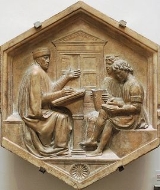
Priscian

Encyclopedia

Floruit
Floruit , abbreviated fl. , is a Latin verb meaning "flourished", denoting the period of time during which something was active...
500 AD), commonly known as Priscian, was a Latin
Latin
Latin is an Italic language originally spoken in Latium and Ancient Rome. It, along with most European languages, is a descendant of the ancient Proto-Indo-European language. Although it is considered a dead language, a number of scholars and members of the Christian clergy speak it fluently, and...
grammarian
Latin grammar
The grammar of Latin, like that of other ancient Indo-European languages, is highly inflected; consequently, it allows for a large degree of flexibility in choosing word order...
. He wrote the Institutiones grammaticae ("Grammatical Foundations") on the subject. This work was the standard textbook for the study of Latin during the Middle Ages
Middle Ages
The Middle Ages is a periodization of European history from the 5th century to the 15th century. The Middle Ages follows the fall of the Western Roman Empire in 476 and precedes the Early Modern Era. It is the middle period of a three-period division of Western history: Classic, Medieval and Modern...
and provided the raw material for the field of speculative grammar
Modistae
The Modistae were the members of a school of grammarian philosophy known as Modism, active in northern France, Germany, Britain and Denmark in the 13th and 14th centuries...
.
Biography
The details of Priscian's life are largely unknown. Priscian was of Greek descent, and was born and raised in Caesarea (modern CherchellCherchell
Cherchell is a seaport town in the Province of Tipaza, Algeria, 55 miles west of Algiers. It is the district seat of Cherchell District. As of 1998, it had a population of 24,400.-Ancient history:...
, Algeria
Algeria
Algeria , officially the People's Democratic Republic of Algeria , also formally referred to as the Democratic and Popular Republic of Algeria, is a country in the Maghreb region of Northwest Africa with Algiers as its capital.In terms of land area, it is the largest country in Africa and the Arab...
) the capital of the Roman province of Mauretania Caesariensis
Mauretania Caesariensis
Mauretania Caesariensis was a Roman province located in northwestern Africa. It was the easternmost of the North African Roman provinces, mainly in present Algeria, with its capital at Caesarea , now Cherchell.-Historical background:In the first century AD, Roman...
. According to Cassiodorus
Cassiodorus
Flavius Magnus Aurelius Cassiodorus Senator , commonly known as Cassiodorus, was a Roman statesman and writer, serving in the administration of Theodoric the Great, king of the Ostrogoths. Senator was part of his surname, not his rank.- Life :Cassiodorus was born at Scylletium, near Catanzaro in...
, he taught Latin at Constantinople
Constantinople
Constantinople was the capital of the Roman, Eastern Roman, Byzantine, Latin, and Ottoman Empires. Throughout most of the Middle Ages, Constantinople was Europe's largest and wealthiest city.-Names:...
.
Priscian's minor works include a panegyric
Panegyric
A panegyric is a formal public speech, or written verse, delivered in high praise of a person or thing, a generally highly studied and discriminating eulogy, not expected to be critical. It is derived from the Greek πανηγυρικός meaning "a speech fit for a general assembly"...
to Anastasius (491—518), written about 512, which helps
establish his time period. In addition, the manuscripts of his Institutiones grammaticae contain a subscription to the
effect that the work was copied (526, 527) by Flavius Theodorus, a clerk in the imperial secretariat.
Works
Priscian's most famous work, the Institutiones grammaticae, is a systematic exposition of Latin grammar. The dedication to Julian probably indicates the consul and patricianJulian the Apostate
Julian "the Apostate" , commonly known as Julian, or also Julian the Philosopher, was Roman Emperor from 361 to 363 and a noted philosopher and Greek writer....
, not the author of a well-known epitome of Justinian
Justinian I
Justinian I ; , ; 483– 13 or 14 November 565), commonly known as Justinian the Great, was Byzantine Emperor from 527 to 565. During his reign, Justinian sought to revive the Empire's greatness and reconquer the lost western half of the classical Roman Empire.One of the most important figures of...
's Novellae, who lived somewhat later than Priscian. The grammar is divided into eighteen books, of which the first sixteen deal mainly with sounds, word-formation and inflexions; the last two, which form from a fourth to a third of the whole work, deal with syntax.
Priscian's grammar is based on the earlier works of Herodian
Aelius Herodianus
Aelius Herodianus or Herodian was one of the most celebrated grammarians of Greco-Roman antiquity. He is usually known as Herodian except when there is a danger of confusion with the historian also named Herodian....
and Apollonius
Apollonius Dyscolus
Apollonius Dyscolus is considered one of the greatest of the Greek grammarians. He was born at Alexandria, son of Mnesitheus. The dates for his life are not known...
. The examples it includes to illustrate the rules preserve numerous fragments from Latin authors which would otherwise have been lost, including Ennius
Ennius
Quintus Ennius was a writer during the period of the Roman Republic, and is often considered the father of Roman poetry. He was of Calabrian descent...
, Pacuvius
Pacuvius
Marcus Pacuvius was the greatest of the tragic poets of ancient Rome prior to Lucius Accius.He was the nephew and pupil of Ennius, by whom Roman tragedy was first raised to a position of influence and dignity...
, Accius
Lucius Accius
Lucius Accius , or Lucius Attius, was a Roman tragic poet and literary scholar. The son of a freedman, Accius was born at Pisaurum in Umbria, in 170 BC...
, Lucilius
Lucilius
Lucilius is the nomen of the gens Lucilia of ancient Rome.*Gaius Lucilius, satirist 2nd century BC. Lucilius was credited by Horace and others with originating the genre of satire.*Lucilius Junior, friend and correspondent of the younger Seneca....
, Cato
Cato the Elder
Marcus Porcius Cato was a Roman statesman, commonly referred to as Censorius , Sapiens , Priscus , or Major, Cato the Elder, or Cato the Censor, to distinguish him from his great-grandson, Cato the Younger.He came of an ancient Plebeian family who all were noted for some...
and Varro
Marcus Terentius Varro
Marcus Terentius Varro was an ancient Roman scholar and writer. He is sometimes called Varro Reatinus to distinguish him from his younger contemporary Varro Atacinus.-Biography:...
. But the authors whom he quotes most frequently are Virgil
Virgil
Publius Vergilius Maro, usually called Virgil or Vergil in English , was an ancient Roman poet of the Augustan period. He is known for three major works of Latin literature, the Eclogues , the Georgics, and the epic Aeneid...
, and, next to him, Terence
Terence
Publius Terentius Afer , better known in English as Terence, was a playwright of the Roman Republic, of North African descent. His comedies were performed for the first time around 170–160 BC. Terentius Lucanus, a Roman senator, brought Terence to Rome as a slave, educated him and later on,...
, Cicero
Cicero
Marcus Tullius Cicero , was a Roman philosopher, statesman, lawyer, political theorist, and Roman constitutionalist. He came from a wealthy municipal family of the equestrian order, and is widely considered one of Rome's greatest orators and prose stylists.He introduced the Romans to the chief...
, Plautus
Plautus
Titus Maccius Plautus , commonly known as "Plautus", was a Roman playwright of the Old Latin period. His comedies are the earliest surviving intact works in Latin literature. He wrote Palliata comoedia, the genre devised by the innovator of Latin literature, Livius Andronicus...
; then Lucan, Horace
Horace
Quintus Horatius Flaccus , known in the English-speaking world as Horace, was the leading Roman lyric poet during the time of Augustus.-Life:...
, Juvenal, Sallust
Sallust
Gaius Sallustius Crispus, generally known simply as Sallust , a Roman historian, belonged to a well-known plebeian family, and was born at Amiternum in the country of the Sabines...
, Statius
Statius
Publius Papinius Statius was a Roman poet of the 1st century CE . Besides his poetry in Latin, which include an epic poem, the Thebaid, a collection of occasional poetry, the Silvae, and the unfinished epic, the Achilleid, he is best known for his appearance as a major character in the Purgatory...
, Ovid
Ovid
Publius Ovidius Naso , known as Ovid in the English-speaking world, was a Roman poet who is best known as the author of the three major collections of erotic poetry: Heroides, Amores, and Ars Amatoria...
, Livy
Livy
Titus Livius — known as Livy in English — was a Roman historian who wrote a monumental history of Rome and the Roman people. Ab Urbe Condita Libri, "Chapters from the Foundation of the City," covering the period from the earliest legends of Rome well before the traditional foundation in 753 BC...
and Persius.
The grammar was quoted by several writers in Britain of the 8th century - Aldhelm
Aldhelm, Bishop of Sherborne
Aldhelm , Abbot of Malmesbury Abbey, Bishop of Sherborne, Latin poet and scholar of Anglo-Saxon literature, was born before the middle of the 7th century. He is said to have been the son of Kenten, who was of the royal house of Wessex...
, Bede
Bede
Bede , also referred to as Saint Bede or the Venerable Bede , was a monk at the Northumbrian monastery of Saint Peter at Monkwearmouth, today part of Sunderland, England, and of its companion monastery, Saint Paul's, in modern Jarrow , both in the Kingdom of Northumbria...
, Alcuin
Alcuin
Alcuin of York or Ealhwine, nicknamed Albinus or Flaccus was an English scholar, ecclesiastic, poet and teacher from York, Northumbria. He was born around 735 and became the student of Archbishop Ecgbert at York...
- and was abridged or largely used in the next century by Hrabanus Maurus
Rabanus Maurus
Rabanus Maurus Magnentius , also known as Hrabanus or Rhabanus, was a Frankish Benedictine monk, the archbishop of Mainz in Germany and a theologian. He was the author of the encyclopaedia De rerum naturis . He also wrote treatises on education and grammar and commentaries on the Bible...
of Fulda and Servatus Lupus of Ferrières. About a thousand manuscripts exist, all ultimately derived from the copy made by Theodorus.
Most copies contain only books I—XVI (sometimes called Priscianus major), some include only (with the three books Ad Symmachum) books XVII and XVIII. (Priscianus minor), and a few contain both parts. The earliest manuscripts are from the 9th century, though a few fragments are somewhat earlier.
Priscian's minor works include
- Three treatises dedicated to Symmachus (the father-in-law of Anicius Manlius Severinus BoethiusAnicius Manlius Severinus BoethiusAnicius Manlius Severinus Boëthius, commonly called Boethius was a philosopher of the early 6th century. He was born in Rome to an ancient and important family which included emperors Petronius Maximus and Olybrius and many consuls. His father, Flavius Manlius Boethius, was consul in 487 after...
): on weights and measures; on the metres of TerenceTerencePublius Terentius Afer , better known in English as Terence, was a playwright of the Roman Republic, of North African descent. His comedies were performed for the first time around 170–160 BC. Terentius Lucanus, a Roman senator, brought Terence to Rome as a slave, educated him and later on,...
; and the Praeexercitamina, a translation into Latin of Greek rhetorical exercises from HermogenesHermogenes of TarsusHermogenes of Tarsus was a Greek rhetorician, surnamed the polisher . He flourished in the reign of Marcus Aurelius ....
. - De nomine, pronomine, et verbo ("On noun, pronoun, and verb"), an abridgment of part of his Institutiones for teaching grammar in schools
- Partitiones xii. versuum Aeneidos principalium: another teaching aid, using question and answer to dissect the first twelve lines of the AeneidAeneidThe Aeneid is a Latin epic poem, written by Virgil between 29 and 19 BC, that tells the legendary story of Aeneas, a Trojan who travelled to Italy, where he became the ancestor of the Romans. It is composed of roughly 10,000 lines in dactylic hexameter...
. The metre is discussed first, each verse is scanned, and each word thoroughly and instructively examined. - The poem on Anastasius mentioned above, in 312 hexameterHexameterHexameter is a metrical line of verse consisting of six feet. It was the standard epic metre in classical Greek and Latin literature, such as in the Iliad and Aeneid. Its use in other genres of composition include Horace's satires, and Ovid's Metamorphoses. According to Greek mythology, hexameter...
s with a short iambic introduction - A verse translation into 1087 hexameters of DionysiusDionysius PeriegetesDionysius Periegetes was the author of a description of the habitable world in Greek hexameter verse written in a terse and elegant style...
's Periegesis, or geographical survey of the world.
Editions and translations
- Prisciani caesariensis grammatici opera ... Edited by Augvst Krehl. Lipsiae: Weidmann, 1819-20.
- Prisciani institutionum grammaticalium librorum I-XVI, indices et concordantiae. Curantibus Cirilo Garcia Roman, Marco A. Gutierrez Galindo. Hildesheim, New York: Olms-Weidmann, 2001.
- Prisciani institutionum grammaticalium librorum XVII et XVIII, indices et concordantiae. Curantibus Cirilo Garcia Roman, Marco A. Gutierrez Galindo, Maria del Carmen Diaz de Alda Carlos. Hildesheim, New York: Olms-Weidmann, 1999.
- Priscians Darstellung des silbisch gebundenen Tonhöhenmorenakzents des Lateinischen. Latin Text and German translation with commentary of De accdentibus.
- Prisciani Caesariensis opuscula. Critical edition edited by Marina Passalacqua witn commentary in Italian. Roma: Edizioni di storia e letteratura, 1987 (vol. I: De figuris numerorum. De metris Terentii. Praeexercitamina; vol. II: Institutio de nomine et pronomine et verbo partitiones duodecim versuum aeneidos principalium)
- Priscien, Grammaire. Livre XVII – Syntaxe I, Paris: Vrin 2010. (French translation)
Further reading
- Luhtala, Anneli. 2005. Grammar and philosophy in late Antiquity: a study of Priscian's sources. John Benjamins. Series: Studies in the history of the language sciences; 107. Preview available at Google Books as of February 2011.