

Preventer

Encyclopedia
A preventer, or jibe-guard, is a mechanical device on a sailing vessel which limits the boom
's ability to swing unexpectedly across the boat due to an unplanned accidental jibe
.
During an unplanned accidental jibe (or gybe), neither the crew nor the boat is set up properly to execute a planned jibe. As a result the uncontrolled boom
will swing across the boat potentially inflicting injury or knocking crew members overboard. The mainsheet
or traveller can also inflict serious injury. Uncontrolled jibes may also damage the boat itself.
Rigging a preventer on a yacht's mainsail
is often performed when the wind is behind the beam (i.e. when it's coming from more than 90° off the bow). It can also be useful at other times when there is more swell than wind
, a situation when the wind may not have the strength to keep the boom in place as the boat dips and rolls.
On any boat that is sailing downwind without a preventer, strict 'heads-down' procedures must be enforced anywhere within the boom's arc. Certain areas of the side-decks and maybe the cockpit also have to be strictly 'no-go' to all crew depending on what the boom and mainsheet could do in unchecked full swing.
The preventer with the most mechanical advantage is a line, from the end of the boom, led outside of the shrouds
and a long way forward - perhaps right up to the bow - through a block
, back to the cockpit
and secured within reach of the mainsheet
.
Many cruising sailors prefer to rig two tackles (port and starboard)
that run from the midpoint of the boom to blocks on a track such as the
headsail-sheet-block track. These tackles are typically a 2 - 4 part tackles
for greater purchase. This rig can also be used as a boom vang without taking up space under
the mast that may be essential to the cruising sailor for dinghy stowage and other uses.
There is a possibility of breaking the main boom with a preventer rig such as this,
but many modern yachts are considered to have short enough booms and be beamy enough to overlook this possibility in normal use. For example, while running with the preventer cleated, a large swell could roll the boat, dipping the boom end into the water, snapping the boom in half.
Care should be taken when selecting the rope which is used for preventer lines.
To reduce the shock loads on the tackles, for example in an unexpected jibe, three-strand nylon line may be preferred over of braided cored line.
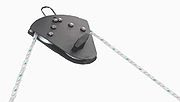 Another form of preventer is the boom brake
, which, when sailing downwind, can also be used to jibe the mainsail in a slow, measured action. The brake usually rides on a line running perpendicular to, and below the boom. When the boom brake is actuated, friction on the line either works as a preventer (stops the boom from moving in the direction that would slacken the main sheet), or slows the boom’s speed while jibing. The brake is actuated by either tensioning the line upon which it rides or by using a second line to adjust the brake itself.
of the boat is carefully brought up into the wind. Then the leeward
, working preventer is released little by little, while the mainsheet is shortened to bring in the boom. It is important to maintain at least a turn or two around the preventer's cleat
the whole time ready to catch an early jibe during this stage of the manoeuvre. The mainsheet should pull the preventer around its cleat, without it being offered any slack. All the while it is also necessary to take in slack on the lazy preventer to keep it under control (i.e. prevent it getting tangled around something) until it is needed.
When the boom is as near as possible to midships (near to running fore-and-aft along the boat's centreline), the working preventer is slackened, the lazy one tightened, and the mainsheet made very secure. It is important that all crew are safe from where the boom may swing, and a call of "Jibe-ho" is a traditional last warning for this. At this point, a slight steering adjustment will actually jibe the sail. The course of the boat may slew further than expected, which can be ignored as it gives a shorthanded crew time to do the next three things: Run out the mainsheet as fast as possible without burning the hands, ensuring that the newly-lazy preventer runs free, then tighten in and secure the newly working preventer.
Boom (sailing)
In sailing, a boom is a spar , along the foot of a fore and aft rigged sail, that greatly improves control of the angle and shape of the sail. The primary action of the boom is to keep the foot of the sail flatter when the sail angle is away from the centerline of the boat. The boom also serves...
's ability to swing unexpectedly across the boat due to an unplanned accidental jibe
Jibe
A jibe or gybe is a sailing maneuver where a sailing vessel turns its stern through the wind, such that the wind direction changes from one side of the boat to the other...
.
During an unplanned accidental jibe (or gybe), neither the crew nor the boat is set up properly to execute a planned jibe. As a result the uncontrolled boom
Boom (sailing)
In sailing, a boom is a spar , along the foot of a fore and aft rigged sail, that greatly improves control of the angle and shape of the sail. The primary action of the boom is to keep the foot of the sail flatter when the sail angle is away from the centerline of the boat. The boom also serves...
will swing across the boat potentially inflicting injury or knocking crew members overboard. The mainsheet
Sheet (sailing)
In sailing, a sheet is a line used to control the movable corner of a sail.- Fore-and-aft rigs:Fore-and-aft rigs comprise the vast majority of sailing vessels in use today, including effectively all dinghies and yachts. The sheet on a fore-and-aft sail controls the angle of the sail to the wind,...
or traveller can also inflict serious injury. Uncontrolled jibes may also damage the boat itself.
Rigging a preventer on a yacht's mainsail
Mainsail
A mainsail is a sail located behind the main mast of a sailing vessel.On a square rigged vessel, it is the lowest and largest sail on the main mast....
is often performed when the wind is behind the beam (i.e. when it's coming from more than 90° off the bow). It can also be useful at other times when there is more swell than wind
Wind
Wind is the flow of gases on a large scale. On Earth, wind consists of the bulk movement of air. In outer space, solar wind is the movement of gases or charged particles from the sun through space, while planetary wind is the outgassing of light chemical elements from a planet's atmosphere into space...
, a situation when the wind may not have the strength to keep the boom in place as the boat dips and rolls.
On any boat that is sailing downwind without a preventer, strict 'heads-down' procedures must be enforced anywhere within the boom's arc. Certain areas of the side-decks and maybe the cockpit also have to be strictly 'no-go' to all crew depending on what the boom and mainsheet could do in unchecked full swing.
The preventer with the most mechanical advantage is a line, from the end of the boom, led outside of the shrouds
Shroud (sailing)
On a sailboat, the shrouds are pieces of standing rigging which hold the mast up from side to side. There is frequently more than one shroud on each side of the boat....
and a long way forward - perhaps right up to the bow - through a block
Block (sailing)
In sailing, a block is a single or multiple pulley. One or a number of sheaves are enclosed in an assembly between cheeks or chocks. In use a block is fixed to the end of a line, to a spar or to a surface...
, back to the cockpit
Cockpit (sailing)
In the Royal Navy, the term cockpit originally referred to the area where the coxswain was stationed. This led to the word being used to refer to the area towards the stern of a small decked vessel that houses the rudder controls...
and secured within reach of the mainsheet
Sheet (sailing)
In sailing, a sheet is a line used to control the movable corner of a sail.- Fore-and-aft rigs:Fore-and-aft rigs comprise the vast majority of sailing vessels in use today, including effectively all dinghies and yachts. The sheet on a fore-and-aft sail controls the angle of the sail to the wind,...
.
Many cruising sailors prefer to rig two tackles (port and starboard)
that run from the midpoint of the boom to blocks on a track such as the
headsail-sheet-block track. These tackles are typically a 2 - 4 part tackles
for greater purchase. This rig can also be used as a boom vang without taking up space under
the mast that may be essential to the cruising sailor for dinghy stowage and other uses.
There is a possibility of breaking the main boom with a preventer rig such as this,
but many modern yachts are considered to have short enough booms and be beamy enough to overlook this possibility in normal use. For example, while running with the preventer cleated, a large swell could roll the boat, dipping the boom end into the water, snapping the boom in half.
Care should be taken when selecting the rope which is used for preventer lines.
To reduce the shock loads on the tackles, for example in an unexpected jibe, three-strand nylon line may be preferred over of braided cored line.
Boom Brake
Boom Brake
A boom brake is a device designed to control the swing of the boom on a sailboat. The boom brake acts as a preventer when sailing downwind, and can also be used to jibe or gybe the mainsail in a slow measured action....
, which, when sailing downwind, can also be used to jibe the mainsail in a slow, measured action. The brake usually rides on a line running perpendicular to, and below the boom. When the boom brake is actuated, friction on the line either works as a preventer (stops the boom from moving in the direction that would slacken the main sheet), or slows the boom’s speed while jibing. The brake is actuated by either tensioning the line upon which it rides or by using a second line to adjust the brake itself.
Jibing
When jibing a fully loaded mainsail in a following sea, the following procedure may be used. Using the steering, the sternStern
The stern is the rear or aft-most part of a ship or boat, technically defined as the area built up over the sternpost, extending upwards from the counter rail to the taffrail. The stern lies opposite of the bow, the foremost part of a ship. Originally, the term only referred to the aft port section...
of the boat is carefully brought up into the wind. Then the leeward
Windward and leeward
Windward is the direction upwind from the point of reference. Leeward is the direction downwind from the point of reference. The side of a ship that is towards the leeward is its lee side. If the vessel is heeling under the pressure of the wind, this will be the "lower side"...
, working preventer is released little by little, while the mainsheet is shortened to bring in the boom. It is important to maintain at least a turn or two around the preventer's cleat
Cleat (nautical)
In nautical contexts, a cleat is a device for securing a rope. The traditional design is attached to a flat surface or a spar and features two “horns” extending parallel to the deck or the axis of the spar, resembling an anvil....
the whole time ready to catch an early jibe during this stage of the manoeuvre. The mainsheet should pull the preventer around its cleat, without it being offered any slack. All the while it is also necessary to take in slack on the lazy preventer to keep it under control (i.e. prevent it getting tangled around something) until it is needed.
When the boom is as near as possible to midships (near to running fore-and-aft along the boat's centreline), the working preventer is slackened, the lazy one tightened, and the mainsheet made very secure. It is important that all crew are safe from where the boom may swing, and a call of "Jibe-ho" is a traditional last warning for this. At this point, a slight steering adjustment will actually jibe the sail. The course of the boat may slew further than expected, which can be ignored as it gives a shorthanded crew time to do the next three things: Run out the mainsheet as fast as possible without burning the hands, ensuring that the newly-lazy preventer runs free, then tighten in and secure the newly working preventer.
External links
- http://www.mistweb.f9.co.uk/content/south2.html - Photo-sequence of a yachtsman single-handedly jibing during an ocean passage and setting a preventer.
- http://www.anti-jibe.com - shows a preventer that attaches to the mast and boom, the sheets do not lead to the outskirts of the boat.