

Press Your Luck

Encyclopedia
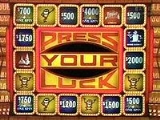
Press Your Luck is an American television daytime game show
created by Bill Carruthers
and Jan McCormack. It premiered on September 19, 1983 on CBS and ended on September 26, 1986. In the show, contestants collected "spins" by answering trivia
questions and then used the spins on an 18-space game board to win cash and prizes. The person who amassed the most in cash and prizes at the end of the game won. Peter Tomarken
was the show's host and Rod Roddy
was the primary announcer. John Harlan
and Charlie O'Donnell
filled in as substitute announcers for Roddy on different occasions.
The show was known for the "Whammy," a red cartoon creature wearing a cape. Landing on any of the Whammy's spaces on the game board took away the contestant's money, accompanied by an animation that would show the Whammy taking the loot—but frequently being chased away, blown up, or otherwise humiliated in the process. The Whammies were created and animated by Savage Steve Holland
and Bill Kopp
and voiced by Carruthers. Approximately 80 different animations were used. Press Your Luck was videotaped before a studio audience at CBS Television City
in Studios 33 and 43 in Hollywood, CA.
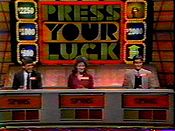 On Press Your Luck, three contestants competed for cash and prizes, with the objective being to accumulate the highest money total. Each episode consists of four rounds: A question round, a Big Board round, a second question round and then a second Big Board round with higher money amounts and prize values.
A maximum total of twenty spins can be earned in a single round among all of the contestants. In the pilot, five questions were asked, yielding a possible total of 15 spins for one person and 25 combined. This was the only change in rules between the pilot and the actual show.
In the first Big Board round, the contestant with the fewest spins plays first. Each contestant uses all of their spins in one turn. Before each spin, the contestant can choose to either "Press Their Luck" (play the board) or "Pass" (give all of his or her remaining earned spins to another contestant, forcing them to play). Spins are always passed to the opponent with the highest money total at that time. If both of the contestant's opponents have the same score, the passing contestant can choose the recipient.
If the contestant chooses to play, a lighted "spinner" begins moving around the board, while the individual squares on the board cycle through a series of items. Items include cash, spin bonuses, non-cash prizes, special squares and Whammies. The contestant must press a plunger to stop the board (and is also encouraged to yell "Stop!"), and is awarded the item within the square. Cash and prizes are awarded immediately (with the cash value of each prize counting toward the contestant's total and a new prize replacing the old one in the same square). Spin bonuses are added to the contestant's earned spins (transferring over from passed spins if applicable).
Hitting a Whammy causes an animation to play in which a Whammy steals or otherwise destroys the contestant's money (sometimes spoofing then-current and classic pop culture icons, upcoming holidays, etc.). The contestant loses all of their winnings up to that point and any remaining passed spins are converted into earned spins. If a contestant hits four Whammies, that contestant is eliminated from the game.
In the first Big Board round, prizes are relatively small, with cash amounts ranging from $100 to $1,500 and prizes typically worth no more than $2,000. The second round features prizes of significantly higher value, with cash amounts from $500 to $5,000 and prizes potentially worth $6,000 or more. Some of these prizes include exotic vacations and small cars.
On rare occasions, two contestants were eliminated from the same game. In these cases, if the surviving contestant had any spins left, they could choose to play "against the house" to earn additional cash and prizes and choose to stop spinning at any time. At this point, the game would end and the surviving contestant would be declared the winner. However, if he or she also "Whammied out", three new contestants would compete on the next show. In every situation this occurred, the surviving contestant ended the game early before exhausting their spins.
Although the Whammy animations were picked at random, one of three special Whammy animations would appear anytime a contestant was eliminated from the game beginning in the second season. One featured a Whammy in a baseball umpire's uniform announcing "You're out!", another featured a Whammy on a cruise ship bidding the contestant farewell in different languages, and the third featured a barbershop quartet singing the phrase "You're out" in harmony.
During the show's first season, any contestant who won over $25,000 would retire undefeated, with the full amount won in his or her appearances. This was due to a CBS policy, which set a winnings limit of $25,000 for its game shows at the time. The earnings cap was officially raised to $50,000 or 5 appearances, whichever comes first, on November 1, 1984, and any amount past $75,000 that was won could not be kept, though no contestant had reached past that amount since.
There have been two games where all three contestants won $0 and returned the next day: one on the November 26, 1984 broadcast, the other on the episode that aired on February 3, 1986. Several other champions won their games with nothing while one or both of their opponents had Whammied out.
At the close of the October–November 1985 contest, that episode's in-studio winner drew a card from a bowl containing the names of each of the 75 at-home participants featured over the five-week period. After drawing the name, the contestant took one spin on a modified board that showed only cash values and directional squares (no whammies, prizes, or squares that offered additional spins), with the value landed on multiplied by the total number of spins earned by the three contestants in the second question round. The contestant whose name was drawn received this bonus cash amount. Eighteen spins were earned in the second round and $2,000 was hit resulting in a $36,000 win.
 Press Your Lucks history dates back to the 1977 ABC
game show Second Chance
, a similar game produced by the Carruthers Company. The show premiered on September 19, 1983 on CBS
at 10:30 AM ET
(9:30 CT
/MT
/PT
), replacing Child's Play
, and placing it between The New $25,000 Pyramid
and The Price Is Right
.
Press Your Luck usually edged its NBC
time slot competitor Sale of the Century in the Nielsens from its premiere until January 3, 1986. The show's ratings reached its peak in mid-1984, unsurprisingly after Michael Larson
's run against the Big Board. However, with daytime viewers declining in general, Press Your Lucks numbers began to slip in Summer 1985, when Sale of the Century gained the upper hand in the Nielsen ratings
.
On January 6, 1986, CBS relocated Press Your Luck to 12:00 noon ET/11:00 AM CT/PT or 4:00 PM ET/3:00 CT/PT (depending on the local market) to make room for the Bob Eubanks
-hosted revival of Card Sharks
at 10:30/9:30 AM, replacing the Tom Kennedy-hosted Body Language
. This move caused the ratings to decline further and the series was put on hold on July 25 with four weeks of shows yet to be aired. While a number of CBS affiliates had dropped the show entirely after its timeslot change, some stations in the Eastern Time Zone aired Press Your Luck at 9:30 AM, preceding The $25,000 Pyramid
, which it had previously followed.
From July 28 to August 29, CBS aired the 1985 College Week shows followed by episodes from Summer 1984. On September 1, the series returned in first-run to air its last four weeks. The final episode, aired September 26, was not announced as such.
Press Your Luck was the last major network daytime show to air in the 4:00/3:00 time slot, two years after ABC
ended its last program (The Edge of Night
) and seven years after NBC
aired its last show (Hollywood Squares
).
Reruns of Press Your Luck aired on the USA Network
from September 14, 1987 to October 13, 1995 (with the exception of a brief period from February 6 to April 14, 1995). GSN
aired the show from September 1, 2001 to March 29, 2009.
On June 8, 2006, Press Your Luck was featured as the fourth round of Gameshow Marathon on CBS.
The theme used in the show's pilot and console game is titled "Flash", composed by Keith Mansfield
, and the series theme is a loosely-based remix composed by Lee Ringuette, but credited to Score Productions
. That music later resurfaced in the 2009 video game adaptation.
, it still remains the record for highest single-day winnings on a series with returning champions.
Although CBS investigated Larson, they determined that figuring out the patterns was not cheating and let him keep his winnings. The board was subsequently reprogrammed with up to 32 new patterns to help prevent another contestant from being able to memorize the board like Larson had.
Later, in 1994, TV Guide
magazine interviewed Larson and revealed the background of this episode including his decision to pass his remaining spins after he lost concentration and missed his target squares.
Larson, through meticulous watching of the show, had figured out patterns to key off of the square next to the square in the upper left-hand corner of the board (which, in that he numbered the squares from the upper-left clockwise, was numbered "2") and that, several squares later, would end up either on a spot on the right side of the screen in which all three slides would contain smaller amounts of money plus a spin (numbered "8") or the spot in the top center of the screen (numbered "4") in which the "Big Bucks" (the largest amounts of money) plus a spin always resided. Not only would he not hit a Whammy if he landed on those two spins, but he would be guaranteed to continue gaining more spins as long as he desired.
The story, and this strategy, were told in a two-hour documentary on GSN titled Big Bucks: The Press Your Luck Scandal in March 2003. GSN also aired a special rematch edition of Whammy! The All-New Press Your Luck
, featuring the two runners-up from the show, host Tomarken and Michael Larson's brother James (Michael had died of throat cancer in 1999). It is GSN's highest-rated show of all time, the only program to exceed 1 million viewers in a single airing.
In July 2010, Michael's brother James, and his former wife at the time of winning, were interviewed for PRI
's This American Life
.
premiered on Game Show Network
. New episodes initially aired through 2003, and reruns continue to air on GSN.
Several changes to the rules and aesthetics of the game were made. Three new contestants appeared on each episode with no returning champions, much less cash was available, the board was entirely computerized (as well as redesigned), and the first question round was eliminated. Additionally, "Big Bank" spaces were added to the board in season two, which placed an accumulating jackpot to a contestant's bank when that contestant landed on the space and answered a question correctly.
 Australia
The series was presented by Ian Turpie
with John Deeks
as announcer on Seven
from 1987-1988. Grundy Worldwide packaged this version, with Bill Mason as executive producer. This version used the same Whammy animations as the original, as well as a similar set (a Grundy tradition); however, the Big Board used considerably lower dollar values.
 Germany
A version entitled Glück Am Drücker ("Luck at the Push-button") aired on RTLplus
in 1992 with Al Munteano was the host. It had vultures instead of Whammies.
Another revival, Drück Dein Glück ("Press Your Luck"), aired daily from 1999-2000 on RTL II
with Guido Kellerman hosting. Instead of Whammies, a shark called Hainz "ate" the contestant's money. This version also had a unique rule where landing a car won the game automatically, regardless of the scores.
 Philippines
GMA Network
aired a version entitled Whammy! Push Your Luck
, using the same (redubbed) Whammy animations as the 2000s updated American version
.
 Republic of China
A version aired on Taiwan Television
in 1988 without animated whammies. See also 強棒出擊.
 Turkey
A version called Şansını Dene airs on Kanal D
.
 United Kingdom
Sky1 aired the United States version in the mid-1990s.
Another version ran for two series from June 6, 1991 to September 20, 1992 with Paul Coia
as host, but only aired in the HTV West ITV region. The series was made on a small budget, using a point-based system with the day's winner receiving £200. This eliminated much of the excitement present in other versions, and declining ratings led to a switch from prime time to Saturday afternoons. When the show returned for a second series in 1992, it was moved to Sunday afternoons.
, who also owns the Goodson
-Todman
and Reg Grundy
libraries. The company will also handle any future revivals and video game licences, as they did with Whammy! and the 2009 video game.
Most of the series was rerun by the USA Network; the exceptions were September 1983, April 10-June 11, 1984 (as promotion began of the first home player game, and the home player game included Larson's run), December 16, 1985-January 3, 1986 (promoted its time slot change), and September 1986. CBS and Carruthers only banned the two Michael Larson episodes from being rerun; however, USA took this a step further, not airing any episodes of the first home player Sweepstakes the episodes landed in.
Over its eight years of repeats on GSN, the network only aired episodes from February 21, 1984 to November 15, 1985, with a few skips due to tape glitches. From 2001 to 2003, the Larson episodes were banned from airing on GSN until clips were incorporated in Big Bucks: The Press Your Luck Scandal – including footage not aired during the original CBS broadcast. Later, the episodes themselves aired on GSN.
released a home computer game of Press Your Luck for IBM PC compatible
s and the Commodore 64
. Ludia
Inc. (now part of RTL Group
, which owns the show franchise) and Ubisoft
released an adaptation called Press Your Luck—2010 Edition on October 27, 2009 for PC, iOs, Nintendo DS
and Wii
, and on the PS3's PSN download service on August 24, 2010.
with Todd Newton
hosting and Peter Kent
announcing. The DVD game included three Question Rounds and three Big Board Rounds.
Game show
A game show is a type of radio or television program in which members of the public, television personalities or celebrities, sometimes as part of a team, play a game which involves answering questions or solving puzzles usually for money and/or prizes...
created by Bill Carruthers
Bill Carruthers
Bill Carruthers , born in Detroit, Michigan, was a television executive who gained his first fame as the director of the Ernie Kovacs-helmed game show, Take a Good Look, in the early 1960s. He went on to be the director on The Newlywed Game and The Dating Game before starting his own production...
and Jan McCormack. It premiered on September 19, 1983 on CBS and ended on September 26, 1986. In the show, contestants collected "spins" by answering trivia
Trivia
The trivia are the three lower Artes Liberales, i.e. grammar, rhetoric and logic. These were the topics of basic education, foundational to the quadrivia of higher education, and hence the material of basic education, of interest only to undergraduates...
questions and then used the spins on an 18-space game board to win cash and prizes. The person who amassed the most in cash and prizes at the end of the game won. Peter Tomarken
Peter Tomarken
Peter David Tomarken was an American television personality primarily known as the host of Press Your Luck.-Early life:...
was the show's host and Rod Roddy
Rod Roddy
Robert Ray "Rod" Roddy was an American radio and television announcer. He is primarily known for his role as an offstage announcer on game shows. Among the shows that he announced are the CBS game shows Whew!, Press Your Luck and The Price Is Right. On the latter two, Roddy appeared on camera on...
was the primary announcer. John Harlan
John Harlan (announcer)
John Harlan is an American television announcer who has worked on numerous television projects for over 40 years, particularly game and variety shows....
and Charlie O'Donnell
Charlie O'Donnell
Charles John "Charlie" O'Donnell was an American radio and television announcer, primarily known for his work on game shows...
filled in as substitute announcers for Roddy on different occasions.
The show was known for the "Whammy," a red cartoon creature wearing a cape. Landing on any of the Whammy's spaces on the game board took away the contestant's money, accompanied by an animation that would show the Whammy taking the loot—but frequently being chased away, blown up, or otherwise humiliated in the process. The Whammies were created and animated by Savage Steve Holland
Savage Steve Holland
Savage Steve Holland is an animator and film director who wrote and directed the cult films Better Off Dead and One Crazy Summer , starring John Cusack. He also directed the film How I Got Into College , and animated the "Whammy" on the game show Press Your Luck. He later went on to create and...
and Bill Kopp
Bill Kopp
Bill Kopp is an American animator and film director who animated the Whammy on the 1980s game show Press Your Luck, and voiced the title character on Nelvana's Eek! The Cat and Kutter in The Terrible Thunderlizards, which he created with Savage Steve Holland...
and voiced by Carruthers. Approximately 80 different animations were used. Press Your Luck was videotaped before a studio audience at CBS Television City
CBS Television City
CBS Television City is a television studio complex located in the Fairfax District of Los Angeles at 7800 Beverly Boulevard, at the corner of North Fairfax Avenue...
in Studios 33 and 43 in Hollywood, CA.
Gameplay
Question round
In each question round, the host reads four trivia questions. The first contestant to buzz in gives an answer. The host finishes the question if necessary, then gives three possible answers (including the buzzed-in answer if one was given). Each contestant (who did not buzz in) then picks from these choices (although if a contestant buzzed in and failed to give an answer at all, they would be ineligible to pick). A correct buzz-in answer earns three spins for use in the Big Board round, while a correct multiple-choice selection earns one spin.A maximum total of twenty spins can be earned in a single round among all of the contestants. In the pilot, five questions were asked, yielding a possible total of 15 spins for one person and 25 combined. This was the only change in rules between the pilot and the actual show.
Big Board round
In the Big Board round, contestants use their spins to win cash and prizes on the "Big Board". The board consists of eighteen spaces, each of which can display three possible items.In the first Big Board round, the contestant with the fewest spins plays first. Each contestant uses all of their spins in one turn. Before each spin, the contestant can choose to either "Press Their Luck" (play the board) or "Pass" (give all of his or her remaining earned spins to another contestant, forcing them to play). Spins are always passed to the opponent with the highest money total at that time. If both of the contestant's opponents have the same score, the passing contestant can choose the recipient.
If the contestant chooses to play, a lighted "spinner" begins moving around the board, while the individual squares on the board cycle through a series of items. Items include cash, spin bonuses, non-cash prizes, special squares and Whammies. The contestant must press a plunger to stop the board (and is also encouraged to yell "Stop!"), and is awarded the item within the square. Cash and prizes are awarded immediately (with the cash value of each prize counting toward the contestant's total and a new prize replacing the old one in the same square). Spin bonuses are added to the contestant's earned spins (transferring over from passed spins if applicable).
Hitting a Whammy causes an animation to play in which a Whammy steals or otherwise destroys the contestant's money (sometimes spoofing then-current and classic pop culture icons, upcoming holidays, etc.). The contestant loses all of their winnings up to that point and any remaining passed spins are converted into earned spins. If a contestant hits four Whammies, that contestant is eliminated from the game.
In the first Big Board round, prizes are relatively small, with cash amounts ranging from $100 to $1,500 and prizes typically worth no more than $2,000. The second round features prizes of significantly higher value, with cash amounts from $500 to $5,000 and prizes potentially worth $6,000 or more. Some of these prizes include exotic vacations and small cars.
Directional Squares
- Move One Space allows a contestant to choose between the contents of two adjacent squares, usually a high amount of cash versus a low amount of cash with a spin, or cash and a prize.
- Go Back Two Spaces, appearing in Square #6, and Big Bucks, appearing in Square #12, both directed the contestant to Square #4, which contained the top dollar values on the board.
- Pick A Corner, located in Square #6 in Round Two from March 1984-July 1986, gave the contestant the choice between the contents of the corner squares of #1, #10, and #15.
- Advance Two Spaces, located in Square #11, moved the contestant forward to the contents of Square #13.
- Across The Board, located in Square #17 in Round Two from February 1986 to the show's finale, took the contestant across the board to the contents of Square #8.
Other special squares
- Double Your $$ was a square in the second round that doubled the contestant's score. The amount added was all in cash. It was treated as a prize and replaced by a new prize when hit. This was later changed to Double Your $$ + ONE SPIN.
- $2,000 or Lose-1-Whammy gave the contestant the choice between $2,000 or removing a Whammy marker.
- Add-A-One was a square in the first round that added a one in front of the contestant's score (e.g., $100 became $1,100 and $1,000 became $11,000).
Elimination from the game
If a contestant hits a total of four Whammies at any point in the game, that contestant is automatically eliminated from the game. The contestant's remaining spins are lost and their scoreboards are turned off. Contestants who "Whammy out" in this way cannot return on the next show, even if all other contestants end with a score of $0.On rare occasions, two contestants were eliminated from the same game. In these cases, if the surviving contestant had any spins left, they could choose to play "against the house" to earn additional cash and prizes and choose to stop spinning at any time. At this point, the game would end and the surviving contestant would be declared the winner. However, if he or she also "Whammied out", three new contestants would compete on the next show. In every situation this occurred, the surviving contestant ended the game early before exhausting their spins.
Although the Whammy animations were picked at random, one of three special Whammy animations would appear anytime a contestant was eliminated from the game beginning in the second season. One featured a Whammy in a baseball umpire's uniform announcing "You're out!", another featured a Whammy on a cruise ship bidding the contestant farewell in different languages, and the third featured a barbershop quartet singing the phrase "You're out" in harmony.
Winning the game
The contestant with the highest money total at the end of the game is the champion, keeps his or her earnings and returns on the next show. In the event of a tie, each of the tied contestants gets to keep their winnings and return.During the show's first season, any contestant who won over $25,000 would retire undefeated, with the full amount won in his or her appearances. This was due to a CBS policy, which set a winnings limit of $25,000 for its game shows at the time. The earnings cap was officially raised to $50,000 or 5 appearances, whichever comes first, on November 1, 1984, and any amount past $75,000 that was won could not be kept, though no contestant had reached past that amount since.
There have been two games where all three contestants won $0 and returned the next day: one on the November 26, 1984 broadcast, the other on the episode that aired on February 3, 1986. Several other champions won their games with nothing while one or both of their opponents had Whammied out.
Home Player Spin
During Press Your Lucks three-year run, the show had "Home Player Spins" for three months during sweeps periods, in May 14–June 8, 1984, January 21–February 15, 1985 and October 21–November 22, 1985. The spin number of the Home Player Spin was revealed before the final money round began (i.e., if the number was "5", then the fifth spin into the round would be the Home Player Spin). The contestant who was about to spin the board played the Home Player Spin and read the name of the home player who would play along; names and addresses were on postcards situated in front of the contestants. The at-home player would receive whatever the contestant landed on, be it money or prize. However, if the contestant hit a money-and-a-spin space, the home player received the money and the contestant received the money and the spin. If the contestant hit a Whammy, the home player received a $500 consolation prize. The home players associated with the contestants who did not take the Home Player Spin received a Whammy t-shirt.At the close of the October–November 1985 contest, that episode's in-studio winner drew a card from a bowl containing the names of each of the 75 at-home participants featured over the five-week period. After drawing the name, the contestant took one spin on a modified board that showed only cash values and directional squares (no whammies, prizes, or squares that offered additional spins), with the value landed on multiplied by the total number of spins earned by the three contestants in the second question round. The contestant whose name was drawn received this bonus cash amount. Eighteen spins were earned in the second round and $2,000 was hit resulting in a $36,000 win.
Broadcast history
American Broadcasting Company
The American Broadcasting Company is an American commercial broadcasting television network. Created in 1943 from the former NBC Blue radio network, ABC is owned by The Walt Disney Company and is part of Disney-ABC Television Group. Its first broadcast on television was in 1948...
game show Second Chance
Second Chance (game show)
Second Chance is an American game show that ran from March 7 to July 15, 1977 on ABC. Jim Peck hosted, with Jay Stewart and Jack Clark serving as announcers....
, a similar game produced by the Carruthers Company. The show premiered on September 19, 1983 on CBS
CBS
CBS Broadcasting Inc. is a major US commercial broadcasting television network, which started as a radio network. The name is derived from the initials of the network's former name, Columbia Broadcasting System. The network is sometimes referred to as the "Eye Network" in reference to the shape of...
at 10:30 AM ET
Eastern Time Zone
The Eastern Time Zone of the United States and Canada is a time zone that falls mostly along the east coast of North America. Its UTC time offset is −5 hrs during standard time and −4 hrs during daylight saving time...
(9:30 CT
Central Time zone
In North America, the Central Time Zone refers to national time zones which observe standard time by subtracting six hours from UTC , and daylight saving, or summer time by subtracting five hours...
/MT
Mountain Time Zone
The Mountain Time Zone of North America keeps time by subtracting seven hours from Coordinated Universal Time, also known as Greenwich Mean Time, during the shortest days of autumn and winter , and by subtracting six hours during daylight saving time in the spring, summer, and early autumn...
/PT
Pacific Time Zone
The Pacific Time Zone observes standard time by subtracting eight hours from Coordinated Universal Time . The clock time in this zone is based on the mean solar time of the 120th meridian west of the Greenwich Observatory. During daylight saving time, its time offset is UTC-7.In the United States...
), replacing Child's Play
Child's Play (game show)
Child's Play is an American television game show in which adult contestants tried to guess words based on definitions given by children. The Mark Goodson-produced series debuted on CBS from September 20, 1982 at 10:30 AM Eastern/9:30 AM Central...
, and placing it between The New $25,000 Pyramid
Pyramid (game show)
Pyramid is an American television game show which has aired several versions. The original series, The $10,000 Pyramid, debuted March 26, 1973 and spawned seven subsequent Pyramid series...
and The Price Is Right
The Price Is Right (U.S. game show)
The Price Is Right is an American game show which was created by Mark Goodson and Bill Todman. Contestants compete to identify the pricing of merchandise to win cash and prizes. The show is well-known for its signature line of "Come on down!" when the announcer directs newly selected contestants to...
.
Press Your Luck usually edged its NBC
NBC
The National Broadcasting Company is an American commercial broadcasting television network and former radio network headquartered in the GE Building in New York City's Rockefeller Center with additional major offices near Los Angeles and in Chicago...
time slot competitor Sale of the Century in the Nielsens from its premiere until January 3, 1986. The show's ratings reached its peak in mid-1984, unsurprisingly after Michael Larson
Michael Larson
Paul Michael Larson was a contestant on the American television game show Press Your Luck in May 1984 that aired on TV in June 1984. Larson's claim to fame was his winning $110,237 in cash and prizes, at the time the largest one-day total ever won on a game show...
's run against the Big Board. However, with daytime viewers declining in general, Press Your Lucks numbers began to slip in Summer 1985, when Sale of the Century gained the upper hand in the Nielsen ratings
Nielsen Ratings
Nielsen ratings are the audience measurement systems developed by Nielsen Media Research, in an effort to determine the audience size and composition of television programming in the United States...
.
On January 6, 1986, CBS relocated Press Your Luck to 12:00 noon ET/11:00 AM CT/PT or 4:00 PM ET/3:00 CT/PT (depending on the local market) to make room for the Bob Eubanks
Bob Eubanks
Robert Leland "Bob" Eubanks is an American television/radio personality and game show host, best known for hosting the game show The Newlywed Game on and off since 1966, where he was known for using the catchphrase, "Makin' Whoopee"...
-hosted revival of Card Sharks
Card Sharks
Card Sharks is an American television game show created by Chester Feldman for Mark Goodson-Bill Todman Productions. Two contestants compete for control of a row of oversized playing cards by answering questions posed by the host and then guessing if the next card is higher or lower in value than...
at 10:30/9:30 AM, replacing the Tom Kennedy-hosted Body Language
Body Language (game show)
Body Language is an American game show produced by Mark Goodson Productions. The show aired on CBS from June 4, 1984 until January 3, 1986, and was hosted by Tom Kennedy...
. This move caused the ratings to decline further and the series was put on hold on July 25 with four weeks of shows yet to be aired. While a number of CBS affiliates had dropped the show entirely after its timeslot change, some stations in the Eastern Time Zone aired Press Your Luck at 9:30 AM, preceding The $25,000 Pyramid
Pyramid (game show)
Pyramid is an American television game show which has aired several versions. The original series, The $10,000 Pyramid, debuted March 26, 1973 and spawned seven subsequent Pyramid series...
, which it had previously followed.
From July 28 to August 29, CBS aired the 1985 College Week shows followed by episodes from Summer 1984. On September 1, the series returned in first-run to air its last four weeks. The final episode, aired September 26, was not announced as such.
Press Your Luck was the last major network daytime show to air in the 4:00/3:00 time slot, two years after ABC
American Broadcasting Company
The American Broadcasting Company is an American commercial broadcasting television network. Created in 1943 from the former NBC Blue radio network, ABC is owned by The Walt Disney Company and is part of Disney-ABC Television Group. Its first broadcast on television was in 1948...
ended its last program (The Edge of Night
The Edge of Night
The Edge of Night is an American television mystery series/soap opera produced by Procter & Gamble. It debuted on CBS on April 2, 1956, and ran as a live broadcast on that network until November 28, 1975; the series then moved to ABC, where it aired from December 1, 1975, until December 28, 1984...
) and seven years after NBC
NBC
The National Broadcasting Company is an American commercial broadcasting television network and former radio network headquartered in the GE Building in New York City's Rockefeller Center with additional major offices near Los Angeles and in Chicago...
aired its last show (Hollywood Squares
Hollywood Squares
Hollywood Squares is an American panel game show in which two contestants play tic-tac-toe to win cash and prizes. The "board" for the game is a 3 × 3 vertical stack of open-faced cubes, each occupied by a celebrity seated at a desk and facing the contestants...
).
Reruns of Press Your Luck aired on the USA Network
USA Network
USA Network is an American cable television channel launched in 1971. Once a minor player in basic cable, the network has steadily gained popularity because of breakout hits like Monk, Psych, Burn Notice, Royal Pains, Covert Affairs, White Collar, Monday Night RAW, Suits, and reruns of the various...
from September 14, 1987 to October 13, 1995 (with the exception of a brief period from February 6 to April 14, 1995). GSN
Game Show Network
The Game Show Network is an American cable television and direct broadcast satellite channel dedicated to game shows and casino game shows. The channel was launched on December 1, 1994. Its current slogan is "The World Needs More Winners"...
aired the show from September 1, 2001 to March 29, 2009.
On June 8, 2006, Press Your Luck was featured as the fourth round of Gameshow Marathon on CBS.
The theme used in the show's pilot and console game is titled "Flash", composed by Keith Mansfield
Keith Mansfield
Keith Mansfield is a British composer and arranger known for his creation of prominent television theme tunes, including the Grandstand theme for the BBC...
, and the series theme is a loosely-based remix composed by Lee Ringuette, but credited to Score Productions
Score Productions
Score Productions is an American musical production company specializing in background music and themes for television programs. Started in 1963 by music producer Robert A...
. That music later resurfaced in the 2009 video game adaptation.
Michael Larson
In 1984, a self-described unemployed ice cream truck driver named Michael Larson made it onto the show. Watching the show at home and with the use of stop-motion on a VCR, Larson discovered that the presumed random patterns of the game board were not random and was able to memorize the sequences to help him stop the board where and when he wanted. On the single game in which he appeared, an initially tentative Larson spun a Whammy on his very first turn, but then played 45 consecutive spins without hitting a second one. The game ran for so long that CBS aired the episode in two parts June 8 and 11, 1984. In the end, Larson earned a total of $110,237 in cash and prizes, a record for the most money in cash and prizes won by a contestant in a single appearance on a daytime network game show. Although this record lasted until 2006 when Vickyann Chrobak-Sadowski won $147,517 in cash and prizes on the Season 35 premiere of The Price Is RightThe Price Is Right (U.S. game show)
The Price Is Right is an American game show which was created by Mark Goodson and Bill Todman. Contestants compete to identify the pricing of merchandise to win cash and prizes. The show is well-known for its signature line of "Come on down!" when the announcer directs newly selected contestants to...
, it still remains the record for highest single-day winnings on a series with returning champions.
Although CBS investigated Larson, they determined that figuring out the patterns was not cheating and let him keep his winnings. The board was subsequently reprogrammed with up to 32 new patterns to help prevent another contestant from being able to memorize the board like Larson had.
Later, in 1994, TV Guide
TV Guide
TV Guide is a weekly American magazine with listings of TV shows.In addition to TV listings, the publication features television-related news, celebrity interviews, gossip and film reviews and crossword puzzles...
magazine interviewed Larson and revealed the background of this episode including his decision to pass his remaining spins after he lost concentration and missed his target squares.
Larson, through meticulous watching of the show, had figured out patterns to key off of the square next to the square in the upper left-hand corner of the board (which, in that he numbered the squares from the upper-left clockwise, was numbered "2") and that, several squares later, would end up either on a spot on the right side of the screen in which all three slides would contain smaller amounts of money plus a spin (numbered "8") or the spot in the top center of the screen (numbered "4") in which the "Big Bucks" (the largest amounts of money) plus a spin always resided. Not only would he not hit a Whammy if he landed on those two spins, but he would be guaranteed to continue gaining more spins as long as he desired.
The story, and this strategy, were told in a two-hour documentary on GSN titled Big Bucks: The Press Your Luck Scandal in March 2003. GSN also aired a special rematch edition of Whammy! The All-New Press Your Luck
Whammy! The All-New Press Your Luck
Whammy! is an updated version of the American television game show Press Your Luck. Taped at Tribune Studios, the FremantleMedia production aired on Game Show Network from April 15, 2002 to December 5, 2003 with repeats that continue to air...
, featuring the two runners-up from the show, host Tomarken and Michael Larson's brother James (Michael had died of throat cancer in 1999). It is GSN's highest-rated show of all time, the only program to exceed 1 million viewers in a single airing.
In July 2010, Michael's brother James, and his former wife at the time of winning, were interviewed for PRI
Public Radio International
Public Radio International is a Minneapolis-based American public radio organization, with locations in Boston, New York, London and Beijing. PRI's tagline is "Hear a different voice." PRI is a major public media content creator and also distributes programs from many sources...
's This American Life
This American Life
This American Life is a weekly hour-long radio program produced by WBEZ and hosted by Ira Glass. It is distributed by Public Radio International on PRI affiliate stations and is also available as a free weekly podcast. Primarily a journalistic non-fiction program, it has also featured essays,...
.
Others
Aside from Michael Larson, the show had other notable contestants. Among them were:- Randy WestRandy WestRandy West is an American television personality who is best known for his work on game shows. He has been an announcer on American television game shows since 1990, with credits including Supermarket Sweep, Trivial Pursuit, Hollywood Showdown, and a substitute role on The Price Is Right.West's...
: Game show announcer who appeared on Press Your Luck from September 29 to October 3, 1983. West later became an announcer for several game shows and filled in Rod Roddy on The Price is RightThe Price Is Right (U.S. game show)The Price Is Right is an American game show which was created by Mark Goodson and Bill Todman. Contestants compete to identify the pricing of merchandise to win cash and prizes. The show is well-known for its signature line of "Come on down!" when the announcer directs newly selected contestants to...
during his illnesses and after his death in 2003. West was the first contestant in the show's history to land on and win a car and won a total of $25,742 in cash and prizes over the three episodes on which he appeared. - Jenny JonesJenny Jones (presenter)Jenny Jones is a former Canadian American stand-up comedian and talk show host. She hosted The Jenny Jones Show from 1991 to 2003.-Life and career:...
: Talk show hostess who won $18,706 over the course of three episodes from January 28 to 30, 1985. - Michael "Myke" Horton: Appeared on the February 6, 1985 episode and lost the game. Horton later became "Gemini" on the original American GladiatorsAmerican GladiatorsAmerican Gladiators is an American competition television program that aired in syndication from September 1989 to May 1996. The series matched a cast of amateur athletes against each other, as well as against the show's own gladiators, in contests of strength and agility.The concept was created by...
. - Steve BryantSteve BryantSteven Bryant is a former professional American football player who played wide receiver for five seasons for the Houston Oilers and Indianapolis Colts....
: Member of the Houston OilersTennessee TitansThe Tennessee Titans are a professional American football team based in Nashville, Tennessee, United States. They are members of the South Division of the American Football Conference in the National Football League . Previously known as the Houston Oilers, the team began play in 1960 as a charter...
football team when he won $16,655 on July 12, 15 and 16, 1985. - Ralph StrangisRalph StrangisRalph Strangis is a play-by-play commentator, who has covered a variety of sports, but most notably has been the commentator for the Dallas Stars ice hockey franchise of the National Hockey League since the team's move to Dallas in 1993....
: Later became play-by-play announcer for the Dallas StarsDallas StarsThe Dallas Stars are a professional ice hockey team based in Dallas, Texas. They are members of the Pacific Division of the Western Conference of the National Hockey League . The team was founded during the 1967 NHL expansion as the Minnesota North Stars, based in Bloomington, Minnesota. The...
. On the May 28 and 29, 1984 episodes of Press Your Luck, Strangis won $7,431 in cash and prizes. - Sam SchmidtSam SchmidtSam Schmidt is a former Indy Racing League driver and current IZOD IndyCar Series and Firestone Indy Lights Series team owner....
: Won $16,350 over the course of three episodes between January 2 to 4, 1985. Went on to become an Indy Racing League driver before an accident paralyzed him and ended his career. Later founded the Sam Schmidt Paralysis FoundationSam Schmidt Paralysis FoundationThe Sam Schmidt Paralysis Foundation is a charitable organization founded in 2000 and headquartered in Pennington, New Jersey.The charity aims to find a cure for Paralysis.-History:...
. - Dennis HaskinsDennis HaskinsDennis Haskins is an American actor known for his role as principal Richard Belding in the teen sitcom Saved by the Bell, which ran from 1989 to 1993 on NBC. He then went on to star in Saved by the Bell: The New Class, which aired from 1993 to 2000...
: Actor who played Principal Richard Belding on Saved By the BellSaved by the BellSaved by the Bell is an American television sitcom that aired between 1989 and 1993. The series is a retooled version of the 1988 series Good Morning, Miss Bliss, which was itself later folded into the history of Saved by the Bell...
.
Whammy! The All-New Press Your Luck
In 2002, a revival titled Whammy! The All-New Press Your Luck (shortened to Whammy! in 2003) hosted by Todd NewtonTodd Newton
Todd Newton is an entertainment personality and a three-time game show host.Newton has hosted Hollywood Showdown and Whammy! The All-New Press Your Luck, both on Game Show Network; and Coming Attractions on E!, as well as occasional episodes of Wild On... He is known for occasionally wearing a...
premiered on Game Show Network
Game Show Network
The Game Show Network is an American cable television and direct broadcast satellite channel dedicated to game shows and casino game shows. The channel was launched on December 1, 1994. Its current slogan is "The World Needs More Winners"...
. New episodes initially aired through 2003, and reruns continue to air on GSN.
Several changes to the rules and aesthetics of the game were made. Three new contestants appeared on each episode with no returning champions, much less cash was available, the board was entirely computerized (as well as redesigned), and the first question round was eliminated. Additionally, "Big Bank" spaces were added to the board in season two, which placed an accumulating jackpot to a contestant's bank when that contestant landed on the space and answered a question correctly.
International versions
AustraliaThe series was presented by Ian Turpie
Ian Turpie
Ian "Turps" Turpie is an Australian television celebrity, best known for hosting the long-running game show The Price Is Right before being replaced by Larry Emdur.-Early life:...
with John Deeks
John Deeks
John "Deeksie" Deeks is a well-known Australian television presenter and voice-over artist for the Seven Network, where he has been working since 1975 based in Melbourne....
as announcer on Seven
Seven Network
The Seven Network is an Australian television network owned by Seven West Media Limited. It dates back to 4 November 1956, when the first stations on the VHF7 frequency were established in Melbourne and Sydney.It is currently the second largest network in the country in terms of population reach...
from 1987-1988. Grundy Worldwide packaged this version, with Bill Mason as executive producer. This version used the same Whammy animations as the original, as well as a similar set (a Grundy tradition); however, the Big Board used considerably lower dollar values.
GermanyA version entitled Glück Am Drücker ("Luck at the Push-button") aired on RTLplus
RTL Television
Rtl.de' redirects here. For other uses, see RTL.RTL Television , or simply RTL, is a German commercial television station distributed via cable and satellite along with DVB-T , in larger population centres...
in 1992 with Al Munteano was the host. It had vultures instead of Whammies.
Another revival, Drück Dein Glück ("Press Your Luck"), aired daily from 1999-2000 on RTL II
RTL II
RTL II is a privately owned, commercial, general-interest German television channel.It was founded as a second-generation commercial broadcaster in 1993. It quickly became infamous for its perceived "trash programming", comprising lots of soft porn as well as shows such as Peep and many...
with Guido Kellerman hosting. Instead of Whammies, a shark called Hainz "ate" the contestant's money. This version also had a unique rule where landing a car won the game automatically, regardless of the scores.
PhilippinesGMA Network
GMA Network
GMA Network is a major commercial television & radio network in the Philippines. GMA Network is owned by GMA Network, Inc. a publicly listed company...
aired a version entitled Whammy! Push Your Luck
Whammy! Push Your Luck
Whammy! Push Your Luck is a GMA Network TV program based on the American game show Press Your Luck and its updated version Whammy! The All-New Press Your Luck. It aired weeknights before 24 Oras on GMA Telebabad. The series, hosted by Paolo Bediones and Rufa Mae Quinto, ran from October 8, 2007 to...
, using the same (redubbed) Whammy animations as the 2000s updated American version
Whammy! The All-New Press Your Luck
Whammy! is an updated version of the American television game show Press Your Luck. Taped at Tribune Studios, the FremantleMedia production aired on Game Show Network from April 15, 2002 to December 5, 2003 with repeats that continue to air...
.
Republic of ChinaA version aired on Taiwan Television
Taiwan Television
Taiwan Television Enterprise, Ltd. , commonly known as TTV is launched), is the first television broadcast station in Taiwan...
in 1988 without animated whammies. See also 強棒出擊.
TurkeyA version called Şansını Dene airs on Kanal D
Kanal D
Kanal D is a nation-wide television channel in Turkey and part of Doğan Holding which is owned by the Turkish media tycoon Aydın Doğan.Kanal D also runs an international channel, Euro D which is available online....
.
United KingdomSky1 aired the United States version in the mid-1990s.
Another version ran for two series from June 6, 1991 to September 20, 1992 with Paul Coia
Paul Coia
Paul Coia is a Scottish television presenter and continuity announcer who was the first voice on Channel 4.-Early life and career:...
as host, but only aired in the HTV West ITV region. The series was made on a small budget, using a point-based system with the day's winner receiving £200. This eliminated much of the excitement present in other versions, and declining ratings led to a switch from prime time to Saturday afternoons. When the show returned for a second series in 1992, it was moved to Sunday afternoons.
Episode status
All 757 episodes exist and were purchased by FremantleMediaFremantleMedia
FremantleMedia, Ltd. is the content and production division of Bertelsmann's RTL Group, Europe's second largest TV, radio, and production company...
, who also owns the Goodson
Mark Goodson
Mark Goodson was an American television producer who specialized in game shows.-Life and early career:...
-Todman
Bill Todman
William S. "Bill" Todman was an American television producer born in New York City. He produced many of television's longest running shows with business partner Mark Goodson.-Early life:...
and Reg Grundy
Reg Grundy Productions
Reg Grundy Productions was the American wing of the worldwide television production company Grundy Worldwide, which was founded by Australian television producer Reg Grundy. Reg Grundy Productions was responsible for the production of two highly-successful daytime game shows on NBC during the...
libraries. The company will also handle any future revivals and video game licences, as they did with Whammy! and the 2009 video game.
Most of the series was rerun by the USA Network; the exceptions were September 1983, April 10-June 11, 1984 (as promotion began of the first home player game, and the home player game included Larson's run), December 16, 1985-January 3, 1986 (promoted its time slot change), and September 1986. CBS and Carruthers only banned the two Michael Larson episodes from being rerun; however, USA took this a step further, not airing any episodes of the first home player Sweepstakes the episodes landed in.
Over its eight years of repeats on GSN, the network only aired episodes from February 21, 1984 to November 15, 1985, with a few skips due to tape glitches. From 2001 to 2003, the Larson episodes were banned from airing on GSN until clips were incorporated in Big Bucks: The Press Your Luck Scandal – including footage not aired during the original CBS broadcast. Later, the episodes themselves aired on GSN.
Video game
In 1988, GameTekGameTek
GameTek was a video game publisher based in North Miami Beach, Florida well known for publishing video game adaptations of game shows in the early 1990s. GameTek was a trade name for IJE, the owner of electronic publishing rights to Jeopardy! and Wheel of Fortune...
released a home computer game of Press Your Luck for IBM PC compatible
IBM PC compatible
IBM PC compatible computers are those generally similar to the original IBM PC, XT, and AT. Such computers used to be referred to as PC clones, or IBM clones since they almost exactly duplicated all the significant features of the PC architecture, facilitated by various manufacturers' ability to...
s and the Commodore 64
Commodore 64
The Commodore 64 is an 8-bit home computer introduced by Commodore International in January 1982.Volume production started in the spring of 1982, with machines being released on to the market in August at a price of US$595...
. Ludia
Ludia
Ludia is a Canadian video game developer and publisher based in Montreal, Quebec, Canada that specializes in games based on board games and game shows for Facebook, iPhone and iPod Touch, Nintendo DS, PC, and Wii...
Inc. (now part of RTL Group
RTL Group
RTL Group is Europe's largest TV, radio and production company, and is majority-owned by German media conglomerate Bertelsmann. It has 45 television and 32 radio stations in 11 countries...
, which owns the show franchise) and Ubisoft
Ubisoft
Ubisoft Entertainment S.A. is a major French video game publisher and developer, with headquarters in Montreuil, France. The company has a worldwide presence with 25 studios in 17 countries and subsidiaries in 26 countries....
released an adaptation called Press Your Luck—2010 Edition on October 27, 2009 for PC, iOs, Nintendo DS
Nintendo DS
The is a portable game console produced by Nintendo, first released on November 21, 2004. A distinctive feature of the system is the presence of two separate LCD screens, the lower of which is a touchscreen, encompassed within a clamshell design, similar to the Game Boy Advance SP...
and Wii
Wii
The Wii is a home video game console released by Nintendo on November 19, 2006. As a seventh-generation console, the Wii primarily competes with Microsoft's Xbox 360 and Sony's PlayStation 3. Nintendo states that its console targets a broader demographic than that of the two others...
, and on the PS3's PSN download service on August 24, 2010.
DVD game
In 2006, Imagination Entertainment released a DVD TV gameDVD TV game
A DVD TV game is a standalone game that can be played on a set-top DVD player. The game takes advantage of technology built into the DVD format to create an interactive gaming environment compatible with most DVD players without requiring additional hardware...
with Todd Newton
Todd Newton
Todd Newton is an entertainment personality and a three-time game show host.Newton has hosted Hollywood Showdown and Whammy! The All-New Press Your Luck, both on Game Show Network; and Coming Attractions on E!, as well as occasional episodes of Wild On... He is known for occasionally wearing a...
hosting and Peter Kent
Peter Kent
Peter Kent, PC, MP is a Conservative member of parliament for the riding of Thornhill, and the current Minister of the Environment in the 28th Canadian Ministry.Previously, he was Deputy Editor of Global Television, a Canadian TV network...
announcing. The DVD game included three Question Rounds and three Big Board Rounds.