

Prehistoric Europe

Encyclopedia
Prehistoric Europe refers to the prehistorical
period of Europe
, usually taken to refer to human
prehistory since the Lower Paleolithic
, but in principle also extending to geological time scale - for which see Geological history of Europe
.
From the Lower Paleolithic
, approximately 1.8 million years ago, and far into the Upper Paleolithic
or 20,000 years ago, Europe was populated by Homo erectus
and Homo neanderthalensis.
In the Upper Paleolithic and Mesolithic
, from approximately 40,000 to 6,000 years ago, Europe had Homo sapiens hunter-gatherer
populations. During the last glacial maximum
, much of Europe was depopulated and re-settled, about 15,000 years ago. The European Neolithic begins about 9,000 years ago in southeastern Europe, and reaches northern Europe by about 5,000 years ago.
The European Bronze Age begins from about 2800 BC with the Bell beaker culture. The European Iron Age begins from about 800 BC, spreading to northern Europe by 500 BC. During the Bronze Age, Europe gradually enters the historical period Classical Antiquity
. Literacy came to the Mediterranean world from as early as the 8th century BC, while eastern and northeastern Europe remained in the prehistoric period until as late as the Late Middle Ages
, around AD 1400, with the Northern Crusades
. Thus, much of Europe was in a stage of Proto-history for a long period.
:
Europe was populated by species of Homo
from c. 900,000 years ago (Homo erectus
), associated with the pebble-tools technology and later to the Acheulean
technology (since c. 300,000 BP
).
Middle Paleolithic:
Eventually these European Homo erectus evolved through a series of intermediate speciations including Homo antecessor
and Homo heidelbergensis
into the species Homo neanderthalensis (since c. 200,000 BP) associated with Mousterian
technologies. Our ancestors Homo sapiens also participated in this tool-making technique for a long time and they may have first settled Europe while this Mid- technique was still in use, though the issue is still unclear.
Upper Paleolithic:
· Ancient Upper Paleolithic:
The bearers of most or all Upper Paleolithic technologies were H. sapiens. Some locally developed transitional cultures (Szletian in Central Europe and Chatelperronian
in the Southwest) use clearly Upper Paleolithic technologies at very early dates and there are doubts about who their carriers were: H. sapiens or Neanderthal man.
Nevertheless, the definitive advance of these technologies was made by the Aurignacian
culture. The origins of this culture can be located in Bulgaria (proto-Aurignacian) and Hungary (first full Aurignacian). By 37,000 BP, the Aurignacian culture and its technology had extended through most of Europe. The last Neanderthals seem to have been forced to retreat during this process to the southern half of the Iberian Peninsula
.
The first but scarce works of art appear during this phase.
· Middle Upper Paleolithic:
Around 24,000 BP two new technologies/cultures appeared in the southwestern region of Europe: Solutrean
and Gravettian
. The Gravettian technology/culture has been theorized to have come with migrations of people from the Middle East, Anatolia, and the Balkans carrying the haplotype I1 y-chromosome. They might be linked with the transitional cultures mentioned before, because their techniques have some similarities and are both very different from Aurignacian ones but this issue is very obscure.
Though both cultures seem to appear in the south-west, the Gravettian soon disappeared there, with the notable exception of the Mediterranean coasts of Iberia. Nevertheless, it finds its way to other regions of Europe (Italy, Central and Eastern Europe), reaching even the Caucasus and the Zagros mountains.
The Solutrean culture, extended from northern Spain
to south-east France
, includes not only a beautiful stone technology but also the first significant development of cave painting, the use of the needle and possibly that of the bow and arrow. The more widespread Gravettian culture is no less advanced, at least in artistic terms: sculpture (mainly venuses) is the most outstanding form of creative expression of these peoples.
· Late Upper Paleolithic:
Around 19,000 BP, Europe witnesses the appearance of a new culture, known as Magdalenian
, possibly rooted in the old Aurignacian one. This culture soon supersedes the Solutrean area and also the Gravetian of Central Europe. However, in Mediterranean Iberia, Italy and Eastern Europe, epi-Gravettian cultures continue evolving locally.
With the Magdalenian culture, Paleolithic development in Europe reaches its peak and this is reflected in art, owing to previous traditions: paintings in the West and sculpture in Central Europe.
Epi-Paleolithic:
Around 12,500 BP, the Würm
Glacial age ends. Slowly, through the following millennia, temperatures and sea levels rise, changing the environment of prehistoric people. Nevertheless, Magdalenian culture persists until circa 10,000 BP, when it quickly evolves into two microlithist cultures: Azilian
, in Spain and southern France, and Sauveterrian
, in northern France and Central Europe. Though there are some differences, both cultures share several traits: the creation of very small stone tools called microlith
s and the scarcity of figurative art, which seems to have vanished almost completely, being replaced by abstract decoration of tools. http://www.beloit.edu/~museum/logan/paleoexhibit/masdazil.htm#thumbnails
In the late phase of this epi-Paleolithic period, the Sauveterrean culture evolves into the so-called Tardenoisian
and influences strongly its southern neighbour, clearly replacing it in Mediterranean Spain and Portugal. The recession of the glaciers allows human colonization in Northern Europe for the first time. The Maglemosian culture, derived from the Sauveterre-Tardenois culture but with a strong personality, colonizes Denmark and the nearby regions, including parts of Britain.
As what Vere Gordon Childe
termed the "Neolithic Package" (including agriculture, herding, polished stone axes, timber long houses and pottery) spread into Europe, the Mesolithic way of life was marginalised and eventually disappeared. Controversy over the means of that dispersal is discussed below in the Neolithic section. Note that a "Ceramic Mesolithic" can be distinguished between 7200-5850 BP that ranged from southern to northern Europe.
is believed to have arrived from the Near East
, via Asia Minor
, the Mediterranean waterway and also through the Caucasus
. There has been a long discussion between migrationists (who claim that the Near Eastern farmers almost totally displaced the European native hunter-gatherers) and diffusionists (who claim that the process was slow enough to have occurred mostly through cultural transmission). A relationship has been suggested between the spread of agriculture and the diffusion of Indo-European
languages, with several models of migrations trying to establish a relationship, like the Anatolian hypothesis
, which sets the origin of Indo-European agricultural terminology in Anatolia.
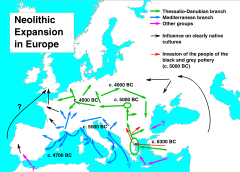 Apparently related with the Anatolian culture of Hacilar
, the Greek region of Thessalia is the first place in Europe known to have acquired agriculture, cattle-herding and pottery. These early stages are known as pre-Sesklo culture. The Thessalian Neolithic culture soon evolves in the more coherent culture of Sesklo
(c. 8000 BP), which is the origin of the main branches of Neolithic expansion in Europe. Practically all the Balkans Peninsula is colonized in the 6th millennium from there. That expansion, reaching the easternmost Tardenoisian outposts of the upper Tisza
gives birth to the proto-Linear Pottery culture, a significant modification of the Balkan Neolithic that will be in the origin of one of the most important branches of European Neolithic: the Danubian group of cultures. In parallel, the coasts of the Adriatic and southern Italy
witness the expansion of another Neolithic current of less clear origins. Settling initially in Dalmatia
, the bearers of the Cardium Pottery
culture may have come from Thessalia (some of the pre-Sesklo settlements show related traits) or even from Lebanon (Byblos). They are sailors, fishermen and sheep and goat herders, and the archaeological findings show that they mixed with natives in most places. Other early Neolithic cultures can be found in Ukraine
and Southern Russia
, where the epi-Gravettian locals assimilated cultural influxes from beyond the Caucasus (culture of Dniepr-Don and related) and in Andalusia
(Spain), where the rare Neolithic of La Almagra Pottery appears without known origins very early (c. 7800 BP).
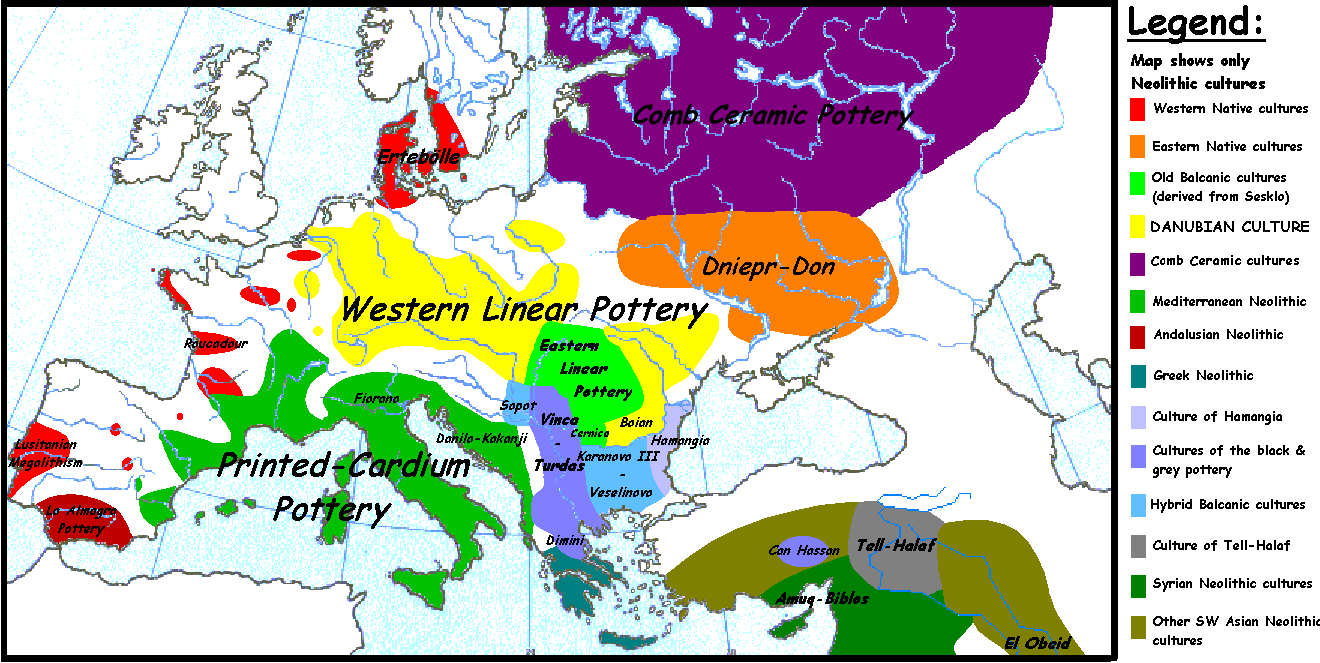 This phase, starting 7000 years ago is marked by the consolidation of the Neolithic expansion towards western and northern Europe, but also by the irruption of a new culture that, probably through violence, occupies most of the Balkans, substituting or rather subjugating the first Neolithic settlers. This is the culture of Dimini
(Thessalia) and the related ones of Vinca-Turdas
(Serbia and Macedonia) and Karanovo III-Veselinovo (Bulgaria and nearby areas), this last one more hybrid than the other two. Meanwhile, the tiny proto-Linear Pottery culture has given birth to two very dynamic branches: the Western and Eastern Linear Pottery Culture
s. The latter is basically an extension of the Balkan Neolithic, but the more original western branch expands quickly, assimilating what today is Germany, the Czech Republic, Poland and even large parts of western Ukraine, Moldavia, the lowlands of Romania, and regions of France, Belgium and the Netherlands. This was all achieved in less than one thousand years. With expansion comes diversification and a number of local Danubian cultures start forming at the end of the 5th millennium. In the Mediterranean, the Cardium Pottery fishermen show no less dynamism and colonize/assimilate all of Italy and the Mediterranean regions of France and Spain. Even in the Atlantic, some groups among the native hunter-gatherers start slowly incorporating the new technologies. Among those, the most noticeable regions seem to be the southwest of Iberia, influenced by the Mediterranean but specially by the Andalusian Neolithic, which soon develops the first Megalithic burials (dolmen
s) and the area around Denmark (culture of Ertebölle), influenced by the Danubian complex.
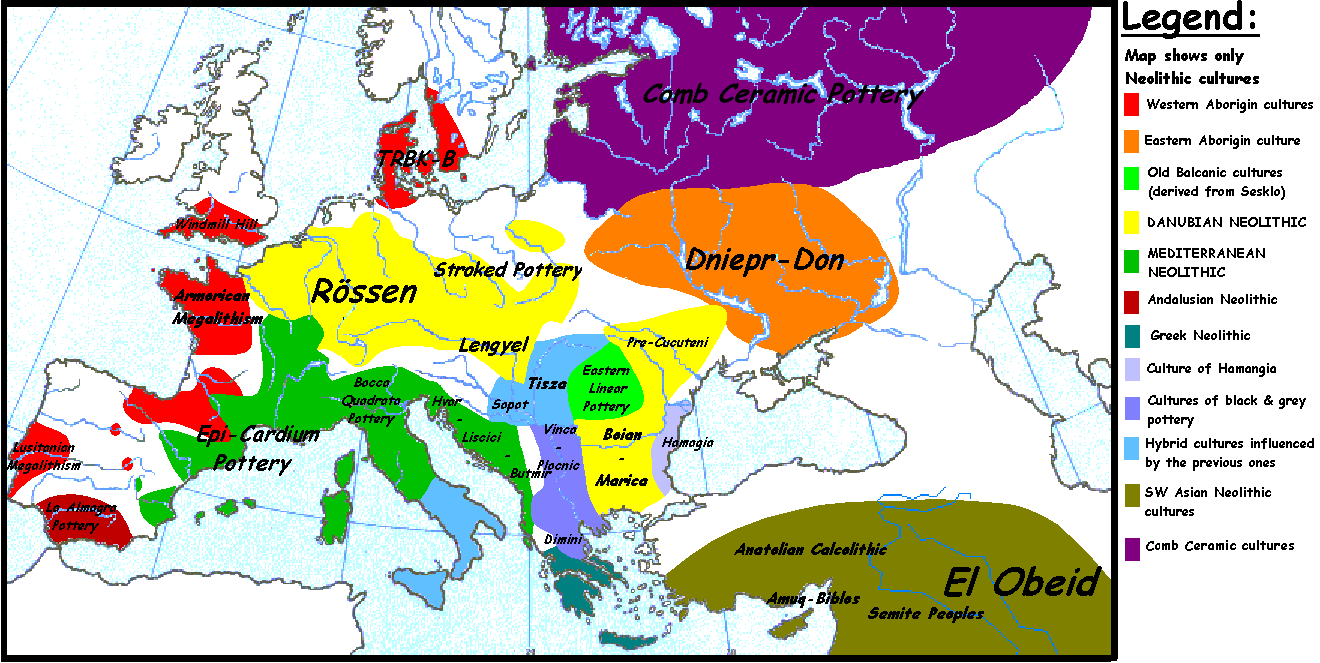 This period occupies the first half of the 6th millennium BP and is rather quiet. The tendencies of the previous period consolidate, so we have a fully formed Neolithic Europe with five main cultural regions:
There were also a few independent areas, including Andalusia, southern Greece and the western coasts of the Black Sea (culture of Hamangia
).
, although there are again several theories in dispute. Other phenomena are the expansion of Megalithism and the appearance of the first significant economic stratification and, related to this, the first known monarchies in the Balkan region.
The economy of the Chalcolithic, even in the regions where copper is not used yet, is no longer that of peasant communities and tribes: now some materials are produced in specific locations and distributed to wide regions. Mining
of metal and stone is particularly developed in some areas, along with the processing of those materials into valuable goods.
From c. 5500 to 5000 BP copper starts to be used in the Balkans, and Eastern and Central Europe. However, the key factor could be the use of horses, which would increase mobility. From c. 5500 onwards, Eastern Europe is apparently infiltrated by people originating from beyond the Volga (Yamna culture
), creating a plural complex known as Sredny Stog culture
, that substitutes the previous Dnieper-Donets culture
, pushing the natives to migrate in a NW direction to the Baltic and Denmark, where they mix with natives (TRBK A and C). This may be correlated with the linguistic fact of the spread of Indo-European languages; see Kurgan hypothesis
. Near the end of the period, another branch will leave many traces in the lower Danube area (culture of Cernavodă
I), in what seems to be another invasion.
Meanwhile the Danubian Lengyel culture
absorbs its northern neighbours of the Czech Republic and Poland for some centuries, only to recede in the second half of the period. In Bulgaria
and Wallachia
(Southern Romania
), the culture of Boian-Marica evolves into a monarchy with a clearly royal cemetery near the coast of the Black Sea. This model seems to have been copied later in the Tiszan region with the culture of Bodrogkeresztur
. Labour specialization, economic stratification and possibly the risk of invasion may have been the reasons behind this development. The influx of early Troy
(Troy I) is clear in both the expansion of metallurgy and social organization.
In the western Danubian region (the Rhine and Seine basins) the culture of Michelsberg displaces its predecessor, Rössen
. Meanwhile in the Mediterranean basin, several cultures (most notably Chassey
in SE France and La Lagozza in northern Italy) converge into a functional union, of which the most significant characteristic is the distribution network of honey-coloured silex
. Despite this unity, the signs of conflicts are clear, as many skeletons show violent injuries. This is the time and area where Ötzi, the famous man found in the Alps, lived. Another significant development of this period is that the Megalith
ic phenomenon starts spreading to most places of the Atlantic region, bringing agriculture with it to some underdeveloped regions there.
This period extends along the first half of the 3rd millennium BC. Most significant is the reorganization of the Danubians in the powerful Baden culture
, that extends more or less to what would be the Austro-Hungarian empire in recent times. The rest of the Balkans is profoundly restructured after the invasions of the previous period but, with the exception of the culture of Coțofeni
in a mountainous region, none of them show any eastern (or presumably Indo-European) traits. The new Ezero culture
, in Bulgaria, shows the first traits of pseudo-bronze (an alloy of copper with arsenic
). So does the first significant Aegean group: the Cycladic culture after 2800 BC.
In the North, for some time the supposedly Indo-European groups seem to recede temporarily, suffering a strong cultural danubianization. In the East, the peoples of beyond the Volga (Yamna culture
), surely eastern Indo-Europeans, ancestors of Scythians, Iranians
and Aryan
s, take over southern Russia and Ukraine. In the West the only sign of unity comes from the Megalithic super-culture, which extends now from southern Sweden to southern Spain, including large parts of southern Germany as well. But the Mediterranean and Danubian groupings of the previous period appear fragmented into many smaller pieces, some of them apparently backward in technological matters. From c. 2800 BC, the Danubian Seine-Oise-Marne culture
pushes directly or indirectly southwards, destroying most of the rich Megalithic culture of western France. After c. 2600 BC, several phenomena will prefigure the changes of the upcoming period:
Large towns with stone walls appear in two different areas of the Iberian Peninsula: one in the Portuguese region of Estremadura
(culture of Vila Nova de Sao Pedro
), strongly embedded in the Atlantic Megalithic culture; the other near Almería
(SE Spain), centred around the large town of Los Millares
, of Mediterranean character, probably affected by eastern cultural influxes (tholoi). Despite the many differences the two civilizations seem to be in friendly contact and to have productive exchanges. In the area of Dordogne
(Aquitaine
, France), a new unexpected culture of bowmen
appears: it is the culture of Artenac, that soon takes control of western and even northern France and Belgium. In Poland and nearby regions, the putative Indo-Europeans reorganize and consolidate again with the culture of the Globular Amphoras. Nevertheless, the influence of many centuries in direct contact with the still-powerful Danubian peoples has greatly modified their culture.
This period extends from c. 2500 BC to c. 1800 or 1700 BC (depending on the region). The dates are general for the whole of Europe, and the Aegean area is already fully in the Bronze Age. ca. 2500 BC the new Catacomb culture
(proto-Cymmerians?), whose origins are obscure but who are also Indo-Europeans, displaces the Yamna peoples in the regions north and east of the Black Sea, confining them to their original area east of the Volga. The Catacomb culture
is the first to introduce corded pottery decorations into the steppes and shows a profuse use of the polished battle axe
, providing a link to the West. Parallels with the Afanasevo culture
, including provoked cranial deformations, provide a link to the East. Some of these infiltrate Poland and may have played a significant but unclear role in the transformation of the culture of the Globular Amphorae into the new Corded Ware culture
.
Whatever happened, the fact is that c. 2400 BC this people of the Corded Ware replace their predecessors and expand to Danubian and Nordic areas of western Germany. One related branch invades Denmark and southern Sweden (Scandinavian culture of Individual Sepultures), while the mid-Danubian basin, though showing more continuity, shows also clear traits of new Indo-European elites (Vučedol culture
). Simultaneously, in the west, the Artenac peoples reach Belgium. With the partial exception of Vučedol, the Danubian cultures, so buoyant just a few centuries ago, are wiped off the map of Europe. The rest of the period is the story of a mysterious phenomenon: the Beaker people. This group seems to be of mercantile character and to like being buried according to a very specific, almost invariable, ritual. Nevertheless, out of their original area of western Central Europe, they appear only inside local cultures, so they never invaded and assimilated but rather went to live among those peoples, keeping their way of life. This is why they are believed to be merchants.
The rest of the continent remains mostly unchanged and in apparent peace. From c. 2300 BC the first Beaker Pottery appears in Bohemia and expands in many directions but particularly westward, along the Rhone and the sea shores, reaching the culture of Vila Nova (Portugal) and Catalonia (Spain) as their limits. Simultaneously but unrelatedly, c. 2200 BC in the Aegean region, the Cycladic culture decays, being substituted by the new palatine phase of the Minoan
culture of Crete
.
The second phase of Beaker Pottery, from c. 2100 BC onwards, is marked by the displacement of the centre of this phenomenon to Portugal, inside the culture of Vila Nova. This new centre's influence reaches to all southern and western France but is absent in southern and western Iberia, with the notable exception of Los Millares. After c. 1900 BC, the centre of the Beaker Pottery returns to Bohemia, while in Iberia we see a decentralization of the phenomenon, with centres in Portugal but also in Los Millares and Ciempozuelos
.
started much earlier in the Aegean area, it is not before 1800 BC that it reaches southern Spain, while Central Europe will wait another century (c. 1700 BC) and the Atlantic region will remain Chalcolithic until 1300 BC (noticeably Egypt remained in the same backward technological state until much later). In any case, the date of 1800/1700 BC can be considered typical for the start of this stage in Europe in general, although some scholars claim earlier dates for the introduction of bronze (this may be caused by the slim barrier between copper and bronze, an alloy
of the former).
Derivations of this sudden expansion are the Sea Peoples
that attacked Egypt unsuccessfully for some time, including the Philistines
(Pelasgians
?) and the Dorians, most likely hellenized members of this group that ended invading Greek itself and destroying the might of Mycene and, later, Troy
.
Simultaneously, around this date, the culture of Vila Nova de Sao Pedro
(that lasted 13 centuries in its urban form) vanishes into a less spectacular one but finally with bronze. The centre of gravity of the Atlantic cultures (Atlantic Bronze complex) is now displaced towards Great Britain. Also about this date, the culture of Villanova
, possible precursor of the Etruscan civilization
, appears in central Italy (possibly with an Aegean origin).
was known to the Aegean peoples about 1100 BC, it didn't reach Central Europe before 800 BC, giving way to the Hallstatt culture
, an Iron Age evolution of the culture the Urn Fields. Probably as by-product of this technological superiority of the Indo-Europeans, soon after, they clearly consolidate their positions in Italy and Iberia, penetrating deep inside those peninsulas (Rome
founded in 753 BC).
Around that time the Phoenicians, benefitting from the disappearance of the Greek maritime power (Greek Dark Ages
) founded their first colony at the entrance of the Atlantic Ocean: in Gadir (modern Cádiz
), most likely as a merchant outpost to convey the many mineral resources of the Iberian Peninsula and the British Isles.
Nevertheless, from the 7th century BC onwards, the Greek nation recovers its power and starts its own colonial expansion, founding Massalia (modern Marseilles) and its Iberian outpost of Emporion (modern Empúries
). This last thing wasn't done before the Iberians
could reconquer Catalonia
and the Ebro
valley from the Celts, separating physically the Iberian Celts from their continental neighbours.
The second phase of the European Iron Age is defined particularly by the Celtic La Tène culture
, that starts near 400 BC, followed by a large expansion of this people into the Balkans, the British Isles (where they assimilated druidism) and other regions of France and Italy.
The Celtic debacle under the expansive pressure of Germanic tribes (originally from Scandinavia
and Lower Germany) and the forming Roman Empire, in the last century BC, is also that of the end of Prehistory properly speaking; though many regions of Europe remained yet illiterate and therefore out of written history for many centuries yet, we must place the boundary somewhere and this date, near the start of our calendar, seems quite convenient. The remaining is regional prehistory (or in most cases protohistory
) but no longer European prehistory as a whole.
This analysis has shown that modern man entered Europe from the Near East before the Last Glacial Maximum but retreated to refuges in southern Europe in this cold period. Subsequently people spread out over the whole continent, with subsequent limited immigration from the Near East and Asia.
languages were spoken, prior to the introduction of Proto-Indo-European
either in the Neolithic or Bronze Age. A Vasconic substratum hypothesis for Western Europe, with influence from a "Semitidic" language, has been postulated but roundly rejected. Kalevi Wiik
has suggested that Finno-Ugric languages may have been spoken across the whole of northern Europe at the end of the last glacial maximum. This hypothesis has been rejected by mainstream linguistics.
A minority of scholars have argued for a deeper time depth of proto-Indo-European in Europe. A group of scholars led by Mario Alinei
considers that Indo-European has been spoken in Europe since the last glacial maximum, in the Paleolithic Continuity Theory
. Jonathan Adams and Marcel Otte have a slightly different point of view, suggesting that Indo-European spread immediately after the Younger Dryas.
Proto-Indo-European is believed to have given rise to most of the languages of Europe in the historical period. However, it is known that a number of non Indo-European languages were spoken in the proto-historical part of prehistoric Europe. In north-eastern Europe there is a separate group of Uralic languages that have been considered to be spoken in the region since prehistoric times.
Donald Ringe
rejects all the aforementioned specific proposals on grounds of the findings of language geography
in areas with "tribal", pre-state societies such as North America prior to European colonisation, which renders a neolithic Europe dominated by only a few language families extremely implausible, even impossible. He argues that prior to the spread of the Indo-European and Uralic families, Europe must have been a place of great linguistic diversity.
Paleolithic santuaries:
· http://www.culture.gouv.fr/culture/arcnat/lascaux/en/
· http://www.culture.gouv.fr/culture/arcnat/chauvet/fr/index.html)
Prehistory
Prehistory is the span of time before recorded history. Prehistory can refer to the period of human existence before the availability of those written records with which recorded history begins. More broadly, it refers to all the time preceding human existence and the invention of writing...
period of Europe
Europe
Europe is, by convention, one of the world's seven continents. Comprising the westernmost peninsula of Eurasia, Europe is generally 'divided' from Asia to its east by the watershed divides of the Ural and Caucasus Mountains, the Ural River, the Caspian and Black Seas, and the waterways connecting...
, usually taken to refer to human
Homo (genus)
Homo is the genus that includes modern humans and species closely related to them. The genus is estimated to be about 2.3 to 2.4 million years old, evolving from australopithecine ancestors with the appearance of Homo habilis....
prehistory since the Lower Paleolithic
Lower Paleolithic
The Lower Paleolithic is the earliest subdivision of the Paleolithic or Old Stone Age. It spans the time from around 2.5 million years ago when the first evidence of craft and use of stone tools by hominids appears in the current archaeological record, until around 300,000 years ago, spanning the...
, but in principle also extending to geological time scale - for which see Geological history of Europe
Geological history of Europe
The formation of Europe as a coherent landmass dates to after the breakup of Pangaea, taking place during the Oligocene and completed by the early Neogene period, some 20 million years ago.- Pre-Pleistocene :...
.
From the Lower Paleolithic
Lower Paleolithic
The Lower Paleolithic is the earliest subdivision of the Paleolithic or Old Stone Age. It spans the time from around 2.5 million years ago when the first evidence of craft and use of stone tools by hominids appears in the current archaeological record, until around 300,000 years ago, spanning the...
, approximately 1.8 million years ago, and far into the Upper Paleolithic
Upper Paleolithic
The Upper Paleolithic is the third and last subdivision of the Paleolithic or Old Stone Age as it is understood in Europe, Africa and Asia. Very broadly it dates to between 40,000 and 10,000 years ago, roughly coinciding with the appearance of behavioral modernity and before the advent of...
or 20,000 years ago, Europe was populated by Homo erectus
Homo erectus
Homo erectus is an extinct species of hominid that lived from the end of the Pliocene epoch to the later Pleistocene, about . The species originated in Africa and spread as far as India, China and Java. There is still disagreement on the subject of the classification, ancestry, and progeny of H...
and Homo neanderthalensis.
In the Upper Paleolithic and Mesolithic
Mesolithic
The Mesolithic is an archaeological concept used to refer to certain groups of archaeological cultures defined as falling between the Paleolithic and the Neolithic....
, from approximately 40,000 to 6,000 years ago, Europe had Homo sapiens hunter-gatherer
Hunter-gatherer
A hunter-gatherer or forage society is one in which most or all food is obtained from wild plants and animals, in contrast to agricultural societies which rely mainly on domesticated species. Hunting and gathering was the ancestral subsistence mode of Homo, and all modern humans were...
populations. During the last glacial maximum
Last Glacial Maximum
The Last Glacial Maximum refers to a period in the Earth's climate history when ice sheets were at their maximum extension, between 26,500 and 19,000–20,000 years ago, marking the peak of the last glacial period. During this time, vast ice sheets covered much of North America, northern Europe and...
, much of Europe was depopulated and re-settled, about 15,000 years ago. The European Neolithic begins about 9,000 years ago in southeastern Europe, and reaches northern Europe by about 5,000 years ago.
The European Bronze Age begins from about 2800 BC with the Bell beaker culture. The European Iron Age begins from about 800 BC, spreading to northern Europe by 500 BC. During the Bronze Age, Europe gradually enters the historical period Classical Antiquity
Classical antiquity
Classical antiquity is a broad term for a long period of cultural history centered on the Mediterranean Sea, comprising the interlocking civilizations of ancient Greece and ancient Rome, collectively known as the Greco-Roman world...
. Literacy came to the Mediterranean world from as early as the 8th century BC, while eastern and northeastern Europe remained in the prehistoric period until as late as the Late Middle Ages
Late Middle Ages
The Late Middle Ages was the period of European history generally comprising the 14th to the 16th century . The Late Middle Ages followed the High Middle Ages and preceded the onset of the early modern era ....
, around AD 1400, with the Northern Crusades
Northern Crusades
The Northern Crusades or Baltic Crusades were crusades undertaken by the Christian kings of Denmark and Sweden, the German Livonian and Teutonic military orders, and their allies against the pagan peoples of Northern Europe around the southern and eastern shores of the Baltic Sea...
. Thus, much of Europe was in a stage of Proto-history for a long period.
Paleolithic
Lower PaleolithicPaleolithic
The Paleolithic Age, Era or Period, is a prehistoric period of human history distinguished by the development of the most primitive stone tools discovered , and covers roughly 99% of human technological prehistory...
:
Europe was populated by species of Homo
Homo (genus)
Homo is the genus that includes modern humans and species closely related to them. The genus is estimated to be about 2.3 to 2.4 million years old, evolving from australopithecine ancestors with the appearance of Homo habilis....
from c. 900,000 years ago (Homo erectus
Homo erectus
Homo erectus is an extinct species of hominid that lived from the end of the Pliocene epoch to the later Pleistocene, about . The species originated in Africa and spread as far as India, China and Java. There is still disagreement on the subject of the classification, ancestry, and progeny of H...
), associated with the pebble-tools technology and later to the Acheulean
Acheulean
Acheulean is the name given to an archaeological industry of stone tool manufacture associated with early humans during the Lower Palaeolithic era across Africa and much of West Asia, South Asia and Europe. Acheulean tools are typically found with Homo erectus remains...
technology (since c. 300,000 BP
Before Present
Before Present years is a time scale used in archaeology, geology, and other scientific disciplines to specify when events in the past occurred. Because the "present" time changes, standard practice is to use AD 1950 as the origin of the age scale, reflecting the fact that radiocarbon...
).
Middle Paleolithic:
Eventually these European Homo erectus evolved through a series of intermediate speciations including Homo antecessor
Homo antecessor
Homo antecessor is an extinct human species dating from 1.2 million to 800,000 years ago, that was discovered by Eudald Carbonell, Juan Luis Arsuaga and J. M. Bermúdez de Castro. H. antecessor is one of the earliest known human varieties in Europe. Various archaeologists and anthropologists have...
and Homo heidelbergensis
Homo heidelbergensis
Homo heidelbergensis is an extinct species of the genus Homo which may be the direct ancestor of both Homo neanderthalensis in Europe and Homo sapiens. The best evidence found for these hominins date between 600,000 and 400,000 years ago. H...
into the species Homo neanderthalensis (since c. 200,000 BP) associated with Mousterian
Mousterian
Mousterian is a name given by archaeologists to a style of predominantly flint tools associated primarily with Homo neanderthalensis and dating to the Middle Paleolithic, the middle part of the Old Stone Age.-Naming:...
technologies. Our ancestors Homo sapiens also participated in this tool-making technique for a long time and they may have first settled Europe while this Mid- technique was still in use, though the issue is still unclear.
Upper Paleolithic:
· Ancient Upper Paleolithic:
The bearers of most or all Upper Paleolithic technologies were H. sapiens. Some locally developed transitional cultures (Szletian in Central Europe and Chatelperronian
Châtelperronian
Châtelperronian was the earliest industry of the Upper Palaeolithic in central and south western France, extending also into Northern Spain. It derives its name from the site of la Grotte des Fées, in Châtelperron, Allier, France....
in the Southwest) use clearly Upper Paleolithic technologies at very early dates and there are doubts about who their carriers were: H. sapiens or Neanderthal man.
Nevertheless, the definitive advance of these technologies was made by the Aurignacian
Aurignacian
The Aurignacian culture is an archaeological culture of the Upper Palaeolithic, located in Europe and southwest Asia. It lasted broadly within the period from ca. 45,000 to 35,000 years ago in terms of conventional radiocarbon dating, or between ca. 47,000 and 41,000 years ago in terms of the most...
culture. The origins of this culture can be located in Bulgaria (proto-Aurignacian) and Hungary (first full Aurignacian). By 37,000 BP, the Aurignacian culture and its technology had extended through most of Europe. The last Neanderthals seem to have been forced to retreat during this process to the southern half of the Iberian Peninsula
Iberian Peninsula
The Iberian Peninsula , sometimes called Iberia, is located in the extreme southwest of Europe and includes the modern-day sovereign states of Spain, Portugal and Andorra, as well as the British Overseas Territory of Gibraltar...
.
The first but scarce works of art appear during this phase.
· Middle Upper Paleolithic:
Around 24,000 BP two new technologies/cultures appeared in the southwestern region of Europe: Solutrean
Solutrean
The Solutrean industry is a relatively advanced flint tool-making style of the Upper Palaeolithic, from around 22,000 to 17,000 BP.-Details:...
and Gravettian
Gravettian
thumb|right|Burins to the Gravettian culture.The Gravettian toolmaking culture was a specific archaeological industry of the European Upper Palaeolithic era prevalent before the last glacial epoch. It is named after the type site of La Gravette in the Dordogne region of France where its...
. The Gravettian technology/culture has been theorized to have come with migrations of people from the Middle East, Anatolia, and the Balkans carrying the haplotype I1 y-chromosome. They might be linked with the transitional cultures mentioned before, because their techniques have some similarities and are both very different from Aurignacian ones but this issue is very obscure.
Though both cultures seem to appear in the south-west, the Gravettian soon disappeared there, with the notable exception of the Mediterranean coasts of Iberia. Nevertheless, it finds its way to other regions of Europe (Italy, Central and Eastern Europe), reaching even the Caucasus and the Zagros mountains.
The Solutrean culture, extended from northern Spain
Spain
Spain , officially the Kingdom of Spain languages]] under the European Charter for Regional or Minority Languages. In each of these, Spain's official name is as follows:;;;;;;), is a country and member state of the European Union located in southwestern Europe on the Iberian Peninsula...
to south-east France
France
The French Republic , The French Republic , The French Republic , (commonly known as France , is a unitary semi-presidential republic in Western Europe with several overseas territories and islands located on other continents and in the Indian, Pacific, and Atlantic oceans. Metropolitan France...
, includes not only a beautiful stone technology but also the first significant development of cave painting, the use of the needle and possibly that of the bow and arrow. The more widespread Gravettian culture is no less advanced, at least in artistic terms: sculpture (mainly venuses) is the most outstanding form of creative expression of these peoples.
· Late Upper Paleolithic:
Around 19,000 BP, Europe witnesses the appearance of a new culture, known as Magdalenian
Magdalenian
The Magdalenian , refers to one of the later cultures of the Upper Paleolithic in western Europe, dating from around 17,000 BP to 9,000 BP...
, possibly rooted in the old Aurignacian one. This culture soon supersedes the Solutrean area and also the Gravetian of Central Europe. However, in Mediterranean Iberia, Italy and Eastern Europe, epi-Gravettian cultures continue evolving locally.
With the Magdalenian culture, Paleolithic development in Europe reaches its peak and this is reflected in art, owing to previous traditions: paintings in the West and sculpture in Central Europe.
Epi-Paleolithic:
Around 12,500 BP, the Würm
Würm
The Würm is a river in Bavaria, Germany, right tributary of the Amper. It drains the overflow from Lake Starnberg and flows swiftly through the villages of Gauting, Krailling, Planegg, Gräfelfing and Lochham as well as part of Munich before joining, near Dachau, the Amper, which soon afterwards...
Glacial age ends. Slowly, through the following millennia, temperatures and sea levels rise, changing the environment of prehistoric people. Nevertheless, Magdalenian culture persists until circa 10,000 BP, when it quickly evolves into two microlithist cultures: Azilian
Azilian
The Azilian is a name given by archaeologists to an industry of the Epipaleolithic in northern Spain and southern France.It probably dates to the period of the Allerød Oscillation around 10,000 years ago and followed the Magdalenian culture...
, in Spain and southern France, and Sauveterrian
Sauveterrian
The Sauveterrian is the name for an archaeological culture of the European Epipaleolithic which flourished around 7000-8000 years BC. The name is derived from the type site of Sauveterre-la-Lémance in the French of Lot-et-Garonne....
, in northern France and Central Europe. Though there are some differences, both cultures share several traits: the creation of very small stone tools called microlith
Microlith
A microlith is a small stone tool usually made of flint or chert and typically a centimetre or so in length and half a centimetre wide. It is produced from either a small blade or a larger blade-like piece of flint by abrupt or truncated retouching, which leaves a very typical piece of waste,...
s and the scarcity of figurative art, which seems to have vanished almost completely, being replaced by abstract decoration of tools. http://www.beloit.edu/~museum/logan/paleoexhibit/masdazil.htm#thumbnails
In the late phase of this epi-Paleolithic period, the Sauveterrean culture evolves into the so-called Tardenoisian
Tardenoisian
The Tardenoisian is an archaeological culture of the Epipaleolithic period from north-western France and Belgium. Similar cultures are known further east in central Europe and west across Spain....
and influences strongly its southern neighbour, clearly replacing it in Mediterranean Spain and Portugal. The recession of the glaciers allows human colonization in Northern Europe for the first time. The Maglemosian culture, derived from the Sauveterre-Tardenois culture but with a strong personality, colonizes Denmark and the nearby regions, including parts of Britain.
Mesolithic
This was a transition period in the development of human technology between the Paleolithic and the Neolithic. The term is mainly applied to the western part of Europe. The period began around 11,500 years ago and ended with the introduction of farming, the date of which varied in each geographical region. In some areas, such as the Near East, farming was already in use by the end of the Pleistocene. In areas with limited glacial impact the term "Epipaleolithic" is sometimes preferred for the period. Regions that experienced greater environmental effects as the last glacial period ended have a much more apparent Mesolithic era, lasting millennia. In northern Europe societies were able to live well on rich food supplies from the marshlands created by the warmer climate. Such conditions produced distinctive human behaviours that are preserved in the material record , such as the Maglemosian and Azilian cultures. Such conditions delayed the coming ofhe Neolithic to as late as 6000 BP in northern Europe.As what Vere Gordon Childe
Vere Gordon Childe
Vere Gordon Childe , better known as V. Gordon Childe, was an Australian archaeologist and philologist who specialised in the study of European prehistory. A vocal socialist, Childe accepted the socio-economic theory of Marxism and was an early proponent of Marxist archaeology...
termed the "Neolithic Package" (including agriculture, herding, polished stone axes, timber long houses and pottery) spread into Europe, the Mesolithic way of life was marginalised and eventually disappeared. Controversy over the means of that dispersal is discussed below in the Neolithic section. Note that a "Ceramic Mesolithic" can be distinguished between 7200-5850 BP that ranged from southern to northern Europe.
Neolithic
The European NeolithicNeolithic
The Neolithic Age, Era, or Period, or New Stone Age, was a period in the development of human technology, beginning about 9500 BC in some parts of the Middle East, and later in other parts of the world. It is traditionally considered as the last part of the Stone Age...
is believed to have arrived from the Near East
Near East
The Near East is a geographical term that covers different countries for geographers, archeologists, and historians, on the one hand, and for political scientists, economists, and journalists, on the other...
, via Asia Minor
Asia Minor
Asia Minor is a geographical location at the westernmost protrusion of Asia, also called Anatolia, and corresponds to the western two thirds of the Asian part of Turkey...
, the Mediterranean waterway and also through the Caucasus
Caucasus
The Caucasus, also Caucas or Caucasia , is a geopolitical region at the border of Europe and Asia, and situated between the Black and the Caspian sea...
. There has been a long discussion between migrationists (who claim that the Near Eastern farmers almost totally displaced the European native hunter-gatherers) and diffusionists (who claim that the process was slow enough to have occurred mostly through cultural transmission). A relationship has been suggested between the spread of agriculture and the diffusion of Indo-European
Indo-European
Indo-European may refer to:* Indo-European languages** Aryan race, a 19th century and early 20th century term for those peoples who are the native speakers of Indo-European languages...
languages, with several models of migrations trying to establish a relationship, like the Anatolian hypothesis
Anatolian hypothesis
The Anatolian hypothesis is also called Renfrew's Neolithic Discontinuity Theory ; it proposes that the dispersal of Proto-Indo-Europeans originated in Neolithic Anatolia...
, which sets the origin of Indo-European agricultural terminology in Anatolia.
- Ancient Neolithic
Hacilar
Hacilar is an early human settlement in southwestern Turkey, 25 km southwest of present day Burdur. It has been dated back 7040 BC at its earliest stage of development. Archaeological remains indicate that the site was abandoned and reoccupied on more than one occasion in its...
, the Greek region of Thessalia is the first place in Europe known to have acquired agriculture, cattle-herding and pottery. These early stages are known as pre-Sesklo culture. The Thessalian Neolithic culture soon evolves in the more coherent culture of Sesklo
Sesklo
Sesklo is a village nearby the city of Volos, in Thessaly , in the prefecture of Magnesia. It is part of the municipality Aisonia...
(c. 8000 BP), which is the origin of the main branches of Neolithic expansion in Europe. Practically all the Balkans Peninsula is colonized in the 6th millennium from there. That expansion, reaching the easternmost Tardenoisian outposts of the upper Tisza
Tisza
The Tisza or Tisa is one of the main rivers of Central Europe. It rises in Ukraine, and is formed near Rakhiv by the junction of headwaters White Tisa, whose source is in the Chornohora mountains and Black Tisa, which springs in the Gorgany range...
gives birth to the proto-Linear Pottery culture, a significant modification of the Balkan Neolithic that will be in the origin of one of the most important branches of European Neolithic: the Danubian group of cultures. In parallel, the coasts of the Adriatic and southern Italy
Italy
Italy , officially the Italian Republic languages]] under the European Charter for Regional or Minority Languages. In each of these, Italy's official name is as follows:;;;;;;;;), is a unitary parliamentary republic in South-Central Europe. To the north it borders France, Switzerland, Austria and...
witness the expansion of another Neolithic current of less clear origins. Settling initially in Dalmatia
Dalmatia
Dalmatia is a historical region on the eastern coast of the Adriatic Sea. It stretches from the island of Rab in the northwest to the Bay of Kotor in the southeast. The hinterland, the Dalmatian Zagora, ranges from fifty kilometers in width in the north to just a few kilometers in the south....
, the bearers of the Cardium Pottery
Cardium Pottery
Cardium Pottery or Cardial Ware is a Neolithic decorative style that gets its name from the imprinting of the clay with the shell of the Cardium edulis, a marine mollusk...
culture may have come from Thessalia (some of the pre-Sesklo settlements show related traits) or even from Lebanon (Byblos). They are sailors, fishermen and sheep and goat herders, and the archaeological findings show that they mixed with natives in most places. Other early Neolithic cultures can be found in Ukraine
Ukraine
Ukraine is a country in Eastern Europe. It has an area of 603,628 km², making it the second largest contiguous country on the European continent, after Russia...
and Southern Russia
Russia
Russia or , officially known as both Russia and the Russian Federation , is a country in northern Eurasia. It is a federal semi-presidential republic, comprising 83 federal subjects...
, where the epi-Gravettian locals assimilated cultural influxes from beyond the Caucasus (culture of Dniepr-Don and related) and in Andalusia
Andalusia
Andalusia is the most populous and the second largest in area of the autonomous communities of Spain. The Andalusian autonomous community is officially recognised as a nationality of Spain. The territory is divided into eight provinces: Huelva, Seville, Cádiz, Córdoba, Málaga, Jaén, Granada and...
(Spain), where the rare Neolithic of La Almagra Pottery appears without known origins very early (c. 7800 BP).
- Middle Neolithic
Dimini
Dimini is a village near the city of Volos, in Thessaly , in Magnesia. It was the seat of the municipality of Aisonia. The name Aisonia dates back to ancient times and it is the westernmost place in the Volos area. The Dimini area contains both a Mycenean settlement and a Neolithic settlement...
(Thessalia) and the related ones of Vinca-Turdas
Vinca culture
The Vinča culture is a Neolithic archaeological culture in Southeastern Europe, dated to the period 5500–4500 BCE. Named for its type site, Vinča-Belo Brdo, a large tell settlement discovered by Serbian archaeologist Miloje Vasić in 1908, it represents the material remains of a prehistoric society...
(Serbia and Macedonia) and Karanovo III-Veselinovo (Bulgaria and nearby areas), this last one more hybrid than the other two. Meanwhile, the tiny proto-Linear Pottery culture has given birth to two very dynamic branches: the Western and Eastern Linear Pottery Culture
Linear Pottery culture
The Linear Pottery culture is a major archaeological horizon of the European Neolithic, flourishing ca. 5500–4500 BC.It is abbreviated as LBK , is also known as the Linear Band Ware, Linear Ware, Linear Ceramics or Incised Ware culture, and falls within the Danubian I culture of V...
s. The latter is basically an extension of the Balkan Neolithic, but the more original western branch expands quickly, assimilating what today is Germany, the Czech Republic, Poland and even large parts of western Ukraine, Moldavia, the lowlands of Romania, and regions of France, Belgium and the Netherlands. This was all achieved in less than one thousand years. With expansion comes diversification and a number of local Danubian cultures start forming at the end of the 5th millennium. In the Mediterranean, the Cardium Pottery fishermen show no less dynamism and colonize/assimilate all of Italy and the Mediterranean regions of France and Spain. Even in the Atlantic, some groups among the native hunter-gatherers start slowly incorporating the new technologies. Among those, the most noticeable regions seem to be the southwest of Iberia, influenced by the Mediterranean but specially by the Andalusian Neolithic, which soon develops the first Megalithic burials (dolmen
Dolmen
A dolmen—also known as a portal tomb, portal grave, dolmain , cromlech , anta , Hünengrab/Hünenbett , Adamra , Ispun , Hunebed , dös , goindol or quoit—is a type of single-chamber megalithic tomb, usually consisting of...
s) and the area around Denmark (culture of Ertebölle), influenced by the Danubian complex.
- Late Neolithic
- Danubian cultures: from northern France to Western Ukraine. Now split into several local cultures, the most relevant ones being: the Romanian branch (culture of BoianBoianBoian may refer to:* Boian, a village in Ceanu Mare Commune, Cluj County, Romania* Boian, a village in Bazna Commune, Sibiu County, Romania* Boiany, a village in Chernivtsi Oblast, Ukraine...
) that expands into Bulgaria, the culture of Rössen that is preeminent in the west, and the culture of LengyelLengyel----Lengyel is the highest inhabited village in Tolna County, Hungary. It is located between Bonyhád and Dombóvár.-Notable Aspects :*Apponyi manor house surrounded by 22 hectares of park with botanical rarities.*Kindergarten museum...
of Austria and western Hungary, which will have a major role in the upcoming periods. - Mediterranean cultures: from the Adriatic to eastern Spain, including Italy and large portions of France and Switzerland. These are also diversified into several groups.
- The area of Dimini-Vinca: Thessalia, Macedonia and Serbia, but extending its influence also to parts of the mid-Danubian basin (Tisza, SlavoniaSlavoniaSlavonia is a geographical and historical region in eastern Croatia...
) and southern Italy. - Eastern Europe: basically central and eastern UkraineUkraineUkraine is a country in Eastern Europe. It has an area of 603,628 km², making it the second largest contiguous country on the European continent, after Russia...
and parts of southern RussiaRussiaRussia or , officially known as both Russia and the Russian Federation , is a country in northern Eurasia. It is a federal semi-presidential republic, comprising 83 federal subjects...
and BelarusBelarusBelarus , officially the Republic of Belarus, is a landlocked country in Eastern Europe, bordered clockwise by Russia to the northeast, Ukraine to the south, Poland to the west, and Lithuania and Latvia to the northwest. Its capital is Minsk; other major cities include Brest, Grodno , Gomel ,...
(culture of Dniepr-Don). Apparently these people were the ones who first domesticated horses (though some Paleolithic evidence could disprove it). - Atlantic Europe: a mosaic of local cultures, some of them still pre-Neolithic, from Portugal to southern Sweden. Since around 5800 BP the western regions of France incorporate also the Megalithic style of burial.
There were also a few independent areas, including Andalusia, southern Greece and the western coasts of the Black Sea (culture of Hamangia
Hamangia
Hamangia may refer to:* Baia, a commune in Tulcea County, Romania that formerly had this name* Hamangia culture*Hamangia River...
).
Chalcolithic
Also known as Copper Age, European Chalcolithic is a time of changes and confusion. The most relevant fact is the infiltration and invasion of large parts of the territory by people originating from Central Asia, considered by mainstream scholars to be the original Indo-EuropeansProto-Indo-Europeans
The Proto-Indo-Europeans were the speakers of the Proto-Indo-European language , a reconstructed prehistoric language of Eurasia.Knowledge of them comes chiefly from the linguistic reconstruction, along with material evidence from archaeology and archaeogenetics...
, although there are again several theories in dispute. Other phenomena are the expansion of Megalithism and the appearance of the first significant economic stratification and, related to this, the first known monarchies in the Balkan region.
The economy of the Chalcolithic, even in the regions where copper is not used yet, is no longer that of peasant communities and tribes: now some materials are produced in specific locations and distributed to wide regions. Mining
Mining
Mining is the extraction of valuable minerals or other geological materials from the earth, from an ore body, vein or seam. The term also includes the removal of soil. Materials recovered by mining include base metals, precious metals, iron, uranium, coal, diamonds, limestone, oil shale, rock...
of metal and stone is particularly developed in some areas, along with the processing of those materials into valuable goods.
- Ancient Chalcolithic
From c. 5500 to 5000 BP copper starts to be used in the Balkans, and Eastern and Central Europe. However, the key factor could be the use of horses, which would increase mobility. From c. 5500 onwards, Eastern Europe is apparently infiltrated by people originating from beyond the Volga (Yamna culture
Yamna culture
The Yamna culture is a late copper age/early Bronze Age culture of the Southern Bug/Dniester/Ural region , dating to the 36th–23rd centuries BC...
), creating a plural complex known as Sredny Stog culture
Sredny Stog culture
The Sredny Stog culture dates from the 4500-3500 BC. It was situated just north of the Sea of Azov between the Dnieper and the Don...
, that substitutes the previous Dnieper-Donets culture
Dnieper-Donets culture
Dnieper-Donets culture, ca. 5th—4th millennium BC. A neolithic culture in the area north of the Black Sea/Sea of Azov between the Dnieper and Donets River.There are parallels with the contemporaneous Samara culture...
, pushing the natives to migrate in a NW direction to the Baltic and Denmark, where they mix with natives (TRBK A and C). This may be correlated with the linguistic fact of the spread of Indo-European languages; see Kurgan hypothesis
Kurgan hypothesis
The Kurgan hypothesis is one of the proposals about early Indo-European origins, which postulates that the people of an archaeological "Kurgan culture" in the Pontic steppe were the most likely speakers of the Proto-Indo-European language...
. Near the end of the period, another branch will leave many traces in the lower Danube area (culture of Cernavodă
Cernavoda culture
Cernavodă culture, ca. 4000—3200 BC, a late copper age archaeological culture of the lower Eastern Bug River and Danube located along the coast of the Black Sea and somewhat inland...
I), in what seems to be another invasion.
Meanwhile the Danubian Lengyel culture
Lengyel culture
The Lengyel culture, is an archaeological culture of the European Neolithic, centered on the Middle Danube in Central Europe. It flourished during ca...
absorbs its northern neighbours of the Czech Republic and Poland for some centuries, only to recede in the second half of the period. In Bulgaria
Bulgaria
Bulgaria , officially the Republic of Bulgaria , is a parliamentary democracy within a unitary constitutional republic in Southeast Europe. The country borders Romania to the north, Serbia and Macedonia to the west, Greece and Turkey to the south, as well as the Black Sea to the east...
and Wallachia
Wallachia
Wallachia or Walachia is a historical and geographical region of Romania. It is situated north of the Danube and south of the Southern Carpathians...
(Southern Romania
Romania
Romania is a country located at the crossroads of Central and Southeastern Europe, on the Lower Danube, within and outside the Carpathian arch, bordering on the Black Sea...
), the culture of Boian-Marica evolves into a monarchy with a clearly royal cemetery near the coast of the Black Sea. This model seems to have been copied later in the Tiszan region with the culture of Bodrogkeresztur
Bodrogkeresztúr
Bodrogkeresztúr is a village in Borsod-Abaúj-Zemplén county, Hungary.- People :* Rebbe Yeshaya Steiner of Kerestir hasidic court, lived here- External links :*...
. Labour specialization, economic stratification and possibly the risk of invasion may have been the reasons behind this development. The influx of early Troy
Troy
Troy was a city, both factual and legendary, located in northwest Anatolia in what is now Turkey, southeast of the Dardanelles and beside Mount Ida...
(Troy I) is clear in both the expansion of metallurgy and social organization.
In the western Danubian region (the Rhine and Seine basins) the culture of Michelsberg displaces its predecessor, Rössen
Rössen culture
The Rössen Culture is a Central European culture of the middle Neolithic .It is named after the necropolis of Rössen...
. Meanwhile in the Mediterranean basin, several cultures (most notably Chassey
Chassey
Chassey is a commune in the Côte-d'Or department in eastern France.-Population:-References:*...
in SE France and La Lagozza in northern Italy) converge into a functional union, of which the most significant characteristic is the distribution network of honey-coloured silex
Flint
Flint is a hard, sedimentary cryptocrystalline form of the mineral quartz, categorized as a variety of chert. It occurs chiefly as nodules and masses in sedimentary rocks, such as chalks and limestones. Inside the nodule, flint is usually dark grey, black, green, white, or brown in colour, and...
. Despite this unity, the signs of conflicts are clear, as many skeletons show violent injuries. This is the time and area where Ötzi, the famous man found in the Alps, lived. Another significant development of this period is that the Megalith
Megalith
A megalith is a large stone that has been used to construct a structure or monument, either alone or together with other stones. Megalithic describes structures made of such large stones, utilizing an interlocking system without the use of mortar or cement.The word 'megalith' comes from the Ancient...
ic phenomenon starts spreading to most places of the Atlantic region, bringing agriculture with it to some underdeveloped regions there.
- Middle Chalcolithic
This period extends along the first half of the 3rd millennium BC. Most significant is the reorganization of the Danubians in the powerful Baden culture
Baden culture
Baden culture, ca 3600 BC-ca 2800 BC, an eneolithic culture found in central Europe. It is known from Moravia, Hungary, Slovakia and Eastern Austria...
, that extends more or less to what would be the Austro-Hungarian empire in recent times. The rest of the Balkans is profoundly restructured after the invasions of the previous period but, with the exception of the culture of Coțofeni
Coțofeni culture
The Coţofeni culture is a Chalcolithic to Early Bronze Age culture that existed for over 700 years in the south-eastern part of Central Europe....
in a mountainous region, none of them show any eastern (or presumably Indo-European) traits. The new Ezero culture
Ezero culture
The Ezero culture, 3300—2700 BC, was a Bronze Age archaeological culture occupying most of present-day Bulgaria. It takes its name from the Tell-settlement of Ezero....
, in Bulgaria, shows the first traits of pseudo-bronze (an alloy of copper with arsenic
Arsenic
Arsenic is a chemical element with the symbol As, atomic number 33 and relative atomic mass 74.92. Arsenic occurs in many minerals, usually in conjunction with sulfur and metals, and also as a pure elemental crystal. It was first documented by Albertus Magnus in 1250.Arsenic is a metalloid...
). So does the first significant Aegean group: the Cycladic culture after 2800 BC.
In the North, for some time the supposedly Indo-European groups seem to recede temporarily, suffering a strong cultural danubianization. In the East, the peoples of beyond the Volga (Yamna culture
Yamna culture
The Yamna culture is a late copper age/early Bronze Age culture of the Southern Bug/Dniester/Ural region , dating to the 36th–23rd centuries BC...
), surely eastern Indo-Europeans, ancestors of Scythians, Iranians
Iranian peoples
The Iranian peoples are an Indo-European ethnic-linguistic group, consisting of the speakers of Iranian languages, a major branch of the Indo-European language family, as such forming a branch of Indo-European-speaking peoples...
and Aryan
Aryan
Aryan is an English language loanword derived from Sanskrit ārya and denoting variously*In scholarly usage:**Indo-Iranian languages *in dated usage:**the Indo-European languages more generally and their speakers...
s, take over southern Russia and Ukraine. In the West the only sign of unity comes from the Megalithic super-culture, which extends now from southern Sweden to southern Spain, including large parts of southern Germany as well. But the Mediterranean and Danubian groupings of the previous period appear fragmented into many smaller pieces, some of them apparently backward in technological matters. From c. 2800 BC, the Danubian Seine-Oise-Marne culture
Seine-Oise-Marne culture
The Seine-Oise-Marne or SOM culture is the name given by archaeologists to the final culture of the Neolithic and first culture of the Chalcolithic in northern France and southern Belgium....
pushes directly or indirectly southwards, destroying most of the rich Megalithic culture of western France. After c. 2600 BC, several phenomena will prefigure the changes of the upcoming period:
Large towns with stone walls appear in two different areas of the Iberian Peninsula: one in the Portuguese region of Estremadura
Estremadura
Estremadura may refer to:* Estremadura Province * Estremadura Province * Lisboa VR, a Portuguese wine region called Estremadura until 2009...
(culture of Vila Nova de Sao Pedro
Vila Nova de São Pedro
The Castro of Vila Nova de São Pedro is a Chalcolithic archaeological site in the civil parish of Vila Nova de São Pedro, municipality of Azambuja, in the Portuguese Estremadura area of Lezíria do Tejo. It is important for the discovery of thousands of arrowheads within its fortified settlement,...
), strongly embedded in the Atlantic Megalithic culture; the other near Almería
Almería
Almería is a city in Andalusia, Spain, on the Mediterranean Sea. It is the capital of the province of the same name.-Toponym:Tradition says that the name Almería stems from the Arabic المرية Al-Mariyya: "The Mirror", comparing it to "The Mirror of the Sea"...
(SE Spain), centred around the large town of Los Millares
Los Millares
Los Millares is the name of a Chalcolithic occupation site 17 km north of Almería, in the municipality of Santa Fe de Mondújar, Andalusia, Spain. The complex was in use from the end of the fourth millennium to the end of the second millennium BC and probably supported somewhere around 1000...
, of Mediterranean character, probably affected by eastern cultural influxes (tholoi). Despite the many differences the two civilizations seem to be in friendly contact and to have productive exchanges. In the area of Dordogne
Dordogne
Dordogne is a départment in south-west France. The départment is located in the region of Aquitaine, between the Loire valley and the High Pyrénées named after the great river Dordogne that runs through it...
(Aquitaine
Aquitaine
Aquitaine , archaic Guyenne/Guienne , is one of the 27 regions of France, in the south-western part of metropolitan France, along the Atlantic Ocean and the Pyrenees mountain range on the border with Spain. It comprises the 5 departments of Dordogne, :Lot et Garonne, :Pyrénées-Atlantiques, Landes...
, France), a new unexpected culture of bowmen
Archery
Archery is the art, practice, or skill of propelling arrows with the use of a bow, from Latin arcus. Archery has historically been used for hunting and combat; in modern times, however, its main use is that of a recreational activity...
appears: it is the culture of Artenac, that soon takes control of western and even northern France and Belgium. In Poland and nearby regions, the putative Indo-Europeans reorganize and consolidate again with the culture of the Globular Amphoras. Nevertheless, the influence of many centuries in direct contact with the still-powerful Danubian peoples has greatly modified their culture.
- Late Chalcolithic
This period extends from c. 2500 BC to c. 1800 or 1700 BC (depending on the region). The dates are general for the whole of Europe, and the Aegean area is already fully in the Bronze Age. ca. 2500 BC the new Catacomb culture
Catacomb culture
The Catacomb culture, ca. 2800-2200 BC, refers to an early Bronze Age culture occupying essentially what is present-day Ukraine. It is seen more as a term covering several smaller related archaeological cultures....
(proto-Cymmerians?), whose origins are obscure but who are also Indo-Europeans, displaces the Yamna peoples in the regions north and east of the Black Sea, confining them to their original area east of the Volga. The Catacomb culture
Catacomb culture
The Catacomb culture, ca. 2800-2200 BC, refers to an early Bronze Age culture occupying essentially what is present-day Ukraine. It is seen more as a term covering several smaller related archaeological cultures....
is the first to introduce corded pottery decorations into the steppes and shows a profuse use of the polished battle axe
Battle axe
A battle axe is an axe specifically designed for combat. Battle axes were specialized versions of utility axes...
, providing a link to the West. Parallels with the Afanasevo culture
Afanasevo culture
The Afanasevo culture, traditionally dated to 2500–2000 BC , is an archaeological culture of the late copper and early Bronze Age of southern Siberia....
, including provoked cranial deformations, provide a link to the East. Some of these infiltrate Poland and may have played a significant but unclear role in the transformation of the culture of the Globular Amphorae into the new Corded Ware culture
Corded Ware culture
The Corded Ware culture , alternatively characterized as the Battle Axe culture or Single Grave culture, is an enormous European archaeological horizon that begins in the late Neolithic , flourishes through the Copper Age and culminates in the early Bronze Age.Corded Ware culture is associated with...
.
Whatever happened, the fact is that c. 2400 BC this people of the Corded Ware replace their predecessors and expand to Danubian and Nordic areas of western Germany. One related branch invades Denmark and southern Sweden (Scandinavian culture of Individual Sepultures), while the mid-Danubian basin, though showing more continuity, shows also clear traits of new Indo-European elites (Vučedol culture
Vucedol culture
The Vučedol culture was a Indo-European culture that flourished between 3000 and 2200 BC , centered in Syrmia and eastern Slavonia on the right bank of the Danube river, but possibly spreading throughout the Pannonian plain and western Balkans...
). Simultaneously, in the west, the Artenac peoples reach Belgium. With the partial exception of Vučedol, the Danubian cultures, so buoyant just a few centuries ago, are wiped off the map of Europe. The rest of the period is the story of a mysterious phenomenon: the Beaker people. This group seems to be of mercantile character and to like being buried according to a very specific, almost invariable, ritual. Nevertheless, out of their original area of western Central Europe, they appear only inside local cultures, so they never invaded and assimilated but rather went to live among those peoples, keeping their way of life. This is why they are believed to be merchants.
The rest of the continent remains mostly unchanged and in apparent peace. From c. 2300 BC the first Beaker Pottery appears in Bohemia and expands in many directions but particularly westward, along the Rhone and the sea shores, reaching the culture of Vila Nova (Portugal) and Catalonia (Spain) as their limits. Simultaneously but unrelatedly, c. 2200 BC in the Aegean region, the Cycladic culture decays, being substituted by the new palatine phase of the Minoan
Minoan civilization
The Minoan civilization was a Bronze Age civilization that arose on the island of Crete and flourished from approximately the 27th century BC to the 15th century BC. It was rediscovered at the beginning of the 20th century through the work of the British archaeologist Arthur Evans...
culture of Crete
Crete
Crete is the largest and most populous of the Greek islands, the fifth largest island in the Mediterranean Sea, and one of the thirteen administrative regions of Greece. It forms a significant part of the economy and cultural heritage of Greece while retaining its own local cultural traits...
.
The second phase of Beaker Pottery, from c. 2100 BC onwards, is marked by the displacement of the centre of this phenomenon to Portugal, inside the culture of Vila Nova. This new centre's influence reaches to all southern and western France but is absent in southern and western Iberia, with the notable exception of Los Millares. After c. 1900 BC, the centre of the Beaker Pottery returns to Bohemia, while in Iberia we see a decentralization of the phenomenon, with centres in Portugal but also in Los Millares and Ciempozuelos
Ciempozuelos
Ciempozuelos is a town in Spain. It is located in the south of the Community of Madrid. It had a population of 17,769 in 2005 Its origins appear to be Moorish and the name refers to the number of wells that existed in the town. It is clearly not as well-known as its neighbours Chinchón and Aranjuez...
.
Bronze Age
Though the use of bronzeBronze
Bronze is a metal alloy consisting primarily of copper, usually with tin as the main additive. It is hard and brittle, and it was particularly significant in antiquity, so much so that the Bronze Age was named after the metal...
started much earlier in the Aegean area, it is not before 1800 BC that it reaches southern Spain, while Central Europe will wait another century (c. 1700 BC) and the Atlantic region will remain Chalcolithic until 1300 BC (noticeably Egypt remained in the same backward technological state until much later). In any case, the date of 1800/1700 BC can be considered typical for the start of this stage in Europe in general, although some scholars claim earlier dates for the introduction of bronze (this may be caused by the slim barrier between copper and bronze, an alloy
Alloy
An alloy is a mixture or metallic solid solution composed of two or more elements. Complete solid solution alloys give single solid phase microstructure, while partial solutions give two or more phases that may or may not be homogeneous in distribution, depending on thermal history...
of the former).
- c. 1800 BC, the culture of Los MillaresLos MillaresLos Millares is the name of a Chalcolithic occupation site 17 km north of Almería, in the municipality of Santa Fe de Mondújar, Andalusia, Spain. The complex was in use from the end of the fourth millennium to the end of the second millennium BC and probably supported somewhere around 1000...
in SW Spain is substituted by that of El ArgarEl ArgarEl Argar is the type site of an Early Bronze Age culture called the Argaric culture, which flourished from the town of Antas, in what is now the province of Almería, south-east of Spain, between c. 1800 BC and 1300 BC....
, fully of the Bronze Age, which may well have been a centralized state. - c. 1700 BC, the Central European cultures of UneticeUnetice cultureUnetice; or more properly Únětice culture ; is the name given to an early Bronze Age culture, preceded by the Beaker culture and followed by the Tumulus culture. It was named after finds at site in Únětice, northwest of Prague. It is focused around the Czech Republic, southern and central Germany,...
, Adlerberg, Straubing and pre-LausitzLusatian cultureThe Lusatian culture existed in the later Bronze Age and early Iron Age in most of today's Poland, parts of Czech Republic and Slovakia, parts of eastern Germany and parts of Ukraine...
start working the Bronze, a technique that reached them through the Balkans and Danube. - c. 1600 BC is considered a good approximate date to place the start of Mycenean Greece, after centuries of infiltration of Indo-European Greeks from an unknown origin.
- c. 1500 BC, most of these Central European cultures are unified in the powerful TumulusTumulusA tumulus is a mound of earth and stones raised over a grave or graves. Tumuli are also known as barrows, burial mounds, Hügelgrab or kurgans, and can be found throughout much of the world. A tumulus composed largely or entirely of stones is usually referred to as a cairn...
culture. Simultaneously but unrelatedly, the culture of El ArgarEl ArgarEl Argar is the type site of an Early Bronze Age culture called the Argaric culture, which flourished from the town of Antas, in what is now the province of Almería, south-east of Spain, between c. 1800 BC and 1300 BC....
starts its phase B, characterized by a detectable Aegean influence (pithoi burials). About this time, it is believed that Minoan Crete fell under the rule of the Mycenean Greeks. - c. 1300 BC, the Indo-European cultures of Central Europe (among them Celts, Italics and certainly IllyriansIllyriansThe Illyrians were a group of tribes who inhabited part of the western Balkans in antiquity and the south-eastern coasts of the Italian peninsula...
) change the cultural phase conforming to the expansionist Urnfield culture, starting a quick expansion that brings them to occupy most of the Balkans, Asia Minor, where they destroy the Hittite Empire (conquering the secret of ironIronIron is a chemical element with the symbol Fe and atomic number 26. It is a metal in the first transition series. It is the most common element forming the planet Earth as a whole, forming much of Earth's outer and inner core. It is the fourth most common element in the Earth's crust...
smeltingSmeltingSmelting is a form of extractive metallurgy; its main use is to produce a metal from its ore. This includes iron extraction from iron ore, and copper extraction and other base metals from their ores...
), NE Italy, parts of France, Belgium, the Nederlands, NE Spain and SW England.
Derivations of this sudden expansion are the Sea Peoples
Sea Peoples
The Sea Peoples were a confederacy of seafaring raiders of the second millennium BC who sailed into the eastern Mediterranean, caused political unrest, and attempted to enter or control Egyptian territory during the late 19th dynasty and especially during year 8 of Ramesses III of the 20th Dynasty...
that attacked Egypt unsuccessfully for some time, including the Philistines
Philistines
Philistines , Pleshet or Peleset, were a people who occupied the southern coast of Canaan at the beginning of the Iron Age . According to the Bible, they ruled the five city-states of Gaza, Askelon, Ashdod, Ekron and Gath, from the Wadi Gaza in the south to the Yarqon River in the north, but with...
(Pelasgians
Pelasgians
The name Pelasgians was used by some ancient Greek writers to refer to populations that were either the ancestors of the Greeks or who preceded the Greeks in Greece, "a hold-all term for any ancient, primitive and presumably indigenous people in the Greek world." In general, "Pelasgian" has come...
?) and the Dorians, most likely hellenized members of this group that ended invading Greek itself and destroying the might of Mycene and, later, Troy
Troy
Troy was a city, both factual and legendary, located in northwest Anatolia in what is now Turkey, southeast of the Dardanelles and beside Mount Ida...
.
Simultaneously, around this date, the culture of Vila Nova de Sao Pedro
Vila Nova de São Pedro
The Castro of Vila Nova de São Pedro is a Chalcolithic archaeological site in the civil parish of Vila Nova de São Pedro, municipality of Azambuja, in the Portuguese Estremadura area of Lezíria do Tejo. It is important for the discovery of thousands of arrowheads within its fortified settlement,...
(that lasted 13 centuries in its urban form) vanishes into a less spectacular one but finally with bronze. The centre of gravity of the Atlantic cultures (Atlantic Bronze complex) is now displaced towards Great Britain. Also about this date, the culture of Villanova
Villanova
Villanova may refer to:In botany:*Villanova, a genus of plants in the family Phyllanthaceae, an invalid name replaced by Flueggea, or bushweed*Villanova , a genus of plants in the family Asteraceae.In education:*St...
, possible precursor of the Etruscan civilization
Etruscan civilization
Etruscan civilization is the modern English name given to a civilization of ancient Italy in the area corresponding roughly to Tuscany. The ancient Romans called its creators the Tusci or Etrusci...
, appears in central Italy (possibly with an Aegean origin).
Iron Age
Though the use of ironIron
Iron is a chemical element with the symbol Fe and atomic number 26. It is a metal in the first transition series. It is the most common element forming the planet Earth as a whole, forming much of Earth's outer and inner core. It is the fourth most common element in the Earth's crust...
was known to the Aegean peoples about 1100 BC, it didn't reach Central Europe before 800 BC, giving way to the Hallstatt culture
Hallstatt culture
The Hallstatt culture was the predominant Central European culture from the 8th to 6th centuries BC , developing out of the Urnfield culture of the 12th century BC and followed in much of Central Europe by the La Tène culture.By the 6th century BC, the Hallstatt culture extended for some...
, an Iron Age evolution of the culture the Urn Fields. Probably as by-product of this technological superiority of the Indo-Europeans, soon after, they clearly consolidate their positions in Italy and Iberia, penetrating deep inside those peninsulas (Rome
Rome
Rome is the capital of Italy and the country's largest and most populated city and comune, with over 2.7 million residents in . The city is located in the central-western portion of the Italian Peninsula, on the Tiber River within the Lazio region of Italy.Rome's history spans two and a half...
founded in 753 BC).
Around that time the Phoenicians, benefitting from the disappearance of the Greek maritime power (Greek Dark Ages
Greek Dark Ages
The Greek Dark Age or Ages also known as Geometric or Homeric Age are terms which have regularly been used to refer to the period of Greek history from the presumed Dorian invasion and end of the Mycenaean Palatial civilization around 1200 BC, to the first signs of the Greek city-states in the 9th...
) founded their first colony at the entrance of the Atlantic Ocean: in Gadir (modern Cádiz
Cádiz
Cadiz is a city and port in southwestern Spain. It is the capital of the homonymous province, one of eight which make up the autonomous community of Andalusia....
), most likely as a merchant outpost to convey the many mineral resources of the Iberian Peninsula and the British Isles.
Nevertheless, from the 7th century BC onwards, the Greek nation recovers its power and starts its own colonial expansion, founding Massalia (modern Marseilles) and its Iberian outpost of Emporion (modern Empúries
Empúries
Empúries , formerly known by its Spanish name Ampurias , was a town on the Mediterranean coast of the Catalan comarca of Alt Empordà in Catalonia, Spain. It was founded in 575 BC by Greek colonists from Phocaea with the name of Ἐμπόριον...
). This last thing wasn't done before the Iberians
Iberians
The Iberians were a set of peoples that Greek and Roman sources identified with that name in the eastern and southern coasts of the Iberian peninsula at least from the 6th century BC...
could reconquer Catalonia
Catalonia
Catalonia is an autonomous community in northeastern Spain, with the official status of a "nationality" of Spain. Catalonia comprises four provinces: Barcelona, Girona, Lleida, and Tarragona. Its capital and largest city is Barcelona. Catalonia covers an area of 32,114 km² and has an...
and the Ebro
Ebro
The Ebro or Ebre is one of the most important rivers in the Iberian Peninsula. It is the biggest river by discharge volume in Spain.The Ebro flows through the following cities:*Reinosa in Cantabria.*Miranda de Ebro in Castile and León....
valley from the Celts, separating physically the Iberian Celts from their continental neighbours.
The second phase of the European Iron Age is defined particularly by the Celtic La Tène culture
La Tène culture
The La Tène culture was a European Iron Age culture named after the archaeological site of La Tène on the north side of Lake Neuchâtel in Switzerland, where a rich cache of artifacts was discovered by Hansli Kopp in 1857....
, that starts near 400 BC, followed by a large expansion of this people into the Balkans, the British Isles (where they assimilated druidism) and other regions of France and Italy.
The Celtic debacle under the expansive pressure of Germanic tribes (originally from Scandinavia
Scandinavia
Scandinavia is a cultural, historical and ethno-linguistic region in northern Europe that includes the three kingdoms of Denmark, Norway and Sweden, characterized by their common ethno-cultural heritage and language. Modern Norway and Sweden proper are situated on the Scandinavian Peninsula,...
and Lower Germany) and the forming Roman Empire, in the last century BC, is also that of the end of Prehistory properly speaking; though many regions of Europe remained yet illiterate and therefore out of written history for many centuries yet, we must place the boundary somewhere and this date, near the start of our calendar, seems quite convenient. The remaining is regional prehistory (or in most cases protohistory
Protohistory
Protohistory refers to a period between prehistory and history, during which a culture or civilization has not yet developed writing, but other cultures have already noted its existence in their own writings...
) but no longer European prehistory as a whole.
Genetic history
The genetic history of Europe has been inferred by observing the patterns of genetic diversity across the continent and in the surrounding areas. Use has been made of both classical genetics and molecular genetics. Analysis of the DNA of the modern population of Europe has mainly been used but use has also been made of ancient DNA.This analysis has shown that modern man entered Europe from the Near East before the Last Glacial Maximum but retreated to refuges in southern Europe in this cold period. Subsequently people spread out over the whole continent, with subsequent limited immigration from the Near East and Asia.
Linguistic history
What languages were spoken in Europe during the prehistorical period is controversial. Most scholars believe that one or more non Indo-EuropeanIndo-European
Indo-European may refer to:* Indo-European languages** Aryan race, a 19th century and early 20th century term for those peoples who are the native speakers of Indo-European languages...
languages were spoken, prior to the introduction of Proto-Indo-European
Proto-Indo-European language
The Proto-Indo-European language is the reconstructed common ancestor of the Indo-European languages, spoken by the Proto-Indo-Europeans...
either in the Neolithic or Bronze Age. A Vasconic substratum hypothesis for Western Europe, with influence from a "Semitidic" language, has been postulated but roundly rejected. Kalevi Wiik
Kalevi Wiik
Kalevi Wiik is a professor emeritus of phonetics at the University of Turku, Finland. He is best known for his controversial hypotheses about the effect of the Uralic languages on creation of various Indo-European languages in northern Europe, such as Germanic, Slavic, and Baltic languages...
has suggested that Finno-Ugric languages may have been spoken across the whole of northern Europe at the end of the last glacial maximum. This hypothesis has been rejected by mainstream linguistics.
A minority of scholars have argued for a deeper time depth of proto-Indo-European in Europe. A group of scholars led by Mario Alinei
Mario Alinei
Mario Alinei is Professor Emeritus at the University of Utrecht, where he taught from 1959 to 1987, currently living in Impruneta, Italy. He is founder and editor of Quaderni di semantica, a journal of theoretical and applied semantics...
considers that Indo-European has been spoken in Europe since the last glacial maximum, in the Paleolithic Continuity Theory
Paleolithic Continuity Theory
The Paleolithic Continuity Theory , since 2010 relabelled as the Paleolithic Continuity Paradigm , is a hypothesis suggesting that the Proto-Indo-European language can be traced back to the Upper Paleolithic, several millennia earlier than the Chalcolithic or at the most Neolithic estimates in other...
. Jonathan Adams and Marcel Otte have a slightly different point of view, suggesting that Indo-European spread immediately after the Younger Dryas.
Proto-Indo-European is believed to have given rise to most of the languages of Europe in the historical period. However, it is known that a number of non Indo-European languages were spoken in the proto-historical part of prehistoric Europe. In north-eastern Europe there is a separate group of Uralic languages that have been considered to be spoken in the region since prehistoric times.
Donald Ringe
Donald Ringe
Donald Ringe is an American linguist and Indo-Europeanist.He received Ph.D in linguistics at the Yale University in 1984 under the supervision of the late Warren Cowgill. He taught Classics at Bard College from 1983 to 1985, and since 1985 he has been on the Faculty in Linguistics at the...
rejects all the aforementioned specific proposals on grounds of the findings of language geography
Language geography
Language geography is the branch of human geography that studies the geographic distribution of language or its constituent elements. There are two principal fields of study within the geography of language: the "geography of languages", which deals with the distribution through history and space...
in areas with "tribal", pre-state societies such as North America prior to European colonisation, which renders a neolithic Europe dominated by only a few language families extremely implausible, even impossible. He argues that prior to the spread of the Indo-European and Uralic families, Europe must have been a place of great linguistic diversity.
See also
- List of archaeological sites sorted by continent and age
- Atlantic EuropeAtlantic EuropeAtlantic Europe is a geographical and anthropological term for the western portion of Europe which borders the Atlantic Ocean. The term may refer to the idea of Atlantic Europe as a cultural unit and/or as an biogeographical region....
- Mediterranean Europe
- European Megalithic Culture
- Prehistoric BritainPrehistoric BritainFor the purposes of this article, Prehistoric Britain is that period of time between the first arrival of humans on the land mass now known as Great Britain and the start of recorded British history...
- Prehistory of BrittanyPrehistory of BrittanyThis page concerns the prehistory of Brittany.-Palaeolithic:Brittany was never glaciated during the Quaternary, owing to its latitude, proximity to the coast and absence of significant mountain ranges...
- Prehistoric CyprusPrehistoric CyprusThe Prehistoric Period is the oldest part of Cypriot history.This article covers the period 10,000 to 800 BC and ends immediately before written records of civilizations, such as the first mention of Cyprus by the Romans.-Epipalaeolithic:...
- Prehistoric FrancePrehistoric FrancePrehistoric France is the period in the human occupation of the geographical area covered by present-day France which extended through prehistory and ended in the Iron Age with the Celtic "La Tène culture".-Lower Palaeolithic:...
- Prehistoric GeorgiaPrehistoric GeorgiaThe prehistory of Georgia is the period between the first human habitation of the territory of modern-day nation of Georgia and the time when Assyrian and Urartian, and more firmly, the Classical accounts, brought the proto-Georgian tribes into the scope of recorded history.-Paleolithic:Humans have...
- Prehistoric Hungary
- Prehistoric IberiaPrehistoric IberiaThe prehistory of the Iberian peninsula begins with the arrival of the first hominins 1.2 million years ago and ends with the Punic Wars, when the territory enters the domains of written history...
- Prehistoric IrelandPrehistoric IrelandThe prehistory of Ireland has been pieced together from archaeological and genetic evidence; it begins with the first evidence of Mesolithic hunter-gatherers settling in Ireland around 7000 BC and finishes with the start of the historical record, around AD 400. The prehistoric period covers the...
- Prehistory of Poland (until 966)Prehistory of Poland (until 966)The prehistory and protohistory of Poland is the period from the first appearance of Homo species on the territory of modern-day Poland, to the establishment of the Polish state in the 10th century AD—a span of roughly 800,000 years....
- Prehistoric Romania
- Prehistoric ScotlandPrehistoric ScotlandArchaeology and geology continue to reveal the secrets of prehistoric Scotland, uncovering a complex and dramatic past before the Romans brought Scotland into the scope of recorded history...
- Synoptic table of the principal old world prehistoric culturesSynoptic table of the principal old world prehistoric culturesThe synoptic table of the principal old world prehistoric cultures gives a rough picture of the relationships between the various principal cultures of prehistory outside the Americas, Antarctica, Australia and Oceania...
External links
- Neolithic and Chalcolithic Artifacts from the Balkans
- Central European Neolithic Chronology
- South East Europe pre-history summary to 700BC
- Prehistoric art of the Pyrenees
Paleolithic santuaries:
· http://www.culture.gouv.fr/culture/arcnat/lascaux/en/
· http://www.culture.gouv.fr/culture/arcnat/chauvet/fr/index.html)