


Pre-Columbian savannas of North America

Encyclopedia
Pre-Columbian
The pre-Columbian era incorporates all period subdivisions in the history and prehistory of the Americas before the appearance of significant European influences on the American continents, spanning the time of the original settlement in the Upper Paleolithic period to European colonization during...
savanna
Savanna
A savanna, or savannah, is a grassland ecosystem characterized by the trees being sufficiently small or widely spaced so that the canopy does not close. The open canopy allows sufficient light to reach the ground to support an unbroken herbaceous layer consisting primarily of C4 grasses.Some...
s once existed across North America
North America
North America is a continent wholly within the Northern Hemisphere and almost wholly within the Western Hemisphere. It is also considered a northern subcontinent of the Americas...
. These were created and maintained in a fire ecology by Native Americans
Native American use of fire
In addition to simple cooking, Pre-Columbian Native Americans used fire in many and significant ways, ranging from protecting an area from fire to landscape-altering clearing of prairie.-Human-shaped landscape:...
until the 16th century death of most natives
Population history of American indigenous peoples
The population figures for Indigenous peoples in the Americas before the 1492 voyage of Christopher Columbus have proven difficult to establish and rely on archaeological data and written records from European settlers...
. Surviving natives continued using fire to clear savanna until European colonists began colonizing the eastern seaboard two hundred years later. Many colonists continued the practice of burning to clear underbrush, reinforced by their similar experience in Europe, but some land reverted to forest.
Postglacial events
During the Last Glacial MaximumLast Glacial Maximum
The Last Glacial Maximum refers to a period in the Earth's climate history when ice sheets were at their maximum extension, between 26,500 and 19,000–20,000 years ago, marking the peak of the last glacial period. During this time, vast ice sheets covered much of North America, northern Europe and...
about 18,000 years ago, the influence of Arctic air masses and boreal vegetation extended to about 33° N. latitude, the approximate latitude of Birmingham
Birmingham, Alabama
Birmingham is the largest city in Alabama. The city is the county seat of Jefferson County. According to the 2010 United States Census, Birmingham had a population of 212,237. The Birmingham-Hoover Metropolitan Area, in estimate by the U.S...
and Atlanta
Atlanta, Georgia
Atlanta is the capital and most populous city in the U.S. state of Georgia. According to the 2010 census, Atlanta's population is 420,003. Atlanta is the cultural and economic center of the Atlanta metropolitan area, which is home to 5,268,860 people and is the ninth largest metropolitan area in...
. Southeastern forests of the glacial period were dominated by various spruce
Spruce
A spruce is a tree of the genus Picea , a genus of about 35 species of coniferous evergreen trees in the Family Pinaceae, found in the northern temperate and boreal regions of the earth. Spruces are large trees, from tall when mature, and can be distinguished by their whorled branches and conical...
species and jack pine; fir
Fir
Firs are a genus of 48–55 species of evergreen conifers in the family Pinaceae. They are found through much of North and Central America, Europe, Asia, and North Africa, occurring in mountains over most of the range...
was abundant in some locations. With the exception of the absence of certain prairie elements, the understories of these forests were generally typical of modern spruce-fir forests within and near Canada
Canada
Canada is a North American country consisting of ten provinces and three territories. Located in the northern part of the continent, it extends from the Atlantic Ocean in the east to the Pacific Ocean in the west, and northward into the Arctic Ocean...
. Humans spread across the continent as five thousand years passed following the retreat of the glaciers, while deciduous forests expanded northward. In the east, pockets of boreal elements remained only at high elevations in the Appalachian Mountains
Appalachian Mountains
The Appalachian Mountains #Whether the stressed vowel is or ,#Whether the "ch" is pronounced as a fricative or an affricate , and#Whether the final vowel is the monophthong or the diphthong .), often called the Appalachians, are a system of mountains in eastern North America. The Appalachians...
and in a few other refuges.
Warming and drying during the Holocene climatic optimum
Holocene climatic optimum
The Holocene Climate Optimum was a warm period during roughly the interval 9,000 to 5,000 years B.P.. This event has also been known by many other names, including: Hypsithermal, Altithermal, Climatic Optimum, Holocene Optimum, Holocene Thermal Maximum, and Holocene Megathermal.This warm period...
began about 9,000 years ago and affected the vegetation of the southeast. Extensive expansions of prairies and savannas occurred throughout the southeast, and xeric oak and oak-hickory forest types proliferated. Cooler-climate species migrated northward and upward in elevation. This retreat caused a proportional increase in pine-dominated forests in the Appalachians. The grasslands and savannas of the time expanded and were also linked to the great interior plains grasslands to the west of the region. As a result, elements of the prairie flora became established throughout the region, first by simple migration, but then also by invading disjunct openings (including glades and barrens) that were forming in the canopy of more mesic forests.
At about 4,000 years BP, the Archaic Indian cultures began practicing agriculture. Technology had advanced to the point that pottery was becoming common, and the small-scale felling of trees became feasible. Concurrently, the Archaic Indians began using fire in a widespread manner. Intentional burning of vegetation was taken up to mimic the effects of natural fires that tended to clear forest understories, thereby making travel easier and facilitating the growth of herbs and berry-producing plants that were important for both food and medicines. The result in many regions was "the conversion of forest to grassland, savanna, scrub, open woodland, and forest with grassy openings". After the death of 90% of the native population around 500 years ago, grasslands, savanna, and woodlands succeeded to closed forest.
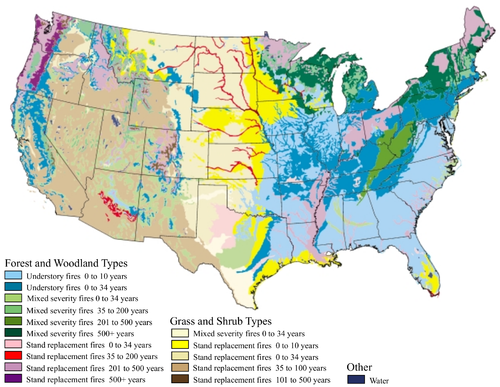
Historic or remaining savanna areas
Savanna surrounded much of the continent's central tallgrass prairieTallgrass prairie
The tallgrass prairie is an ecosystem native to central North America, with fire as its primary periodic disturbance. In the past, tallgrass prairies covered a large portion of the American Midwest, just east of the Great Plains, and portions of the Canadian Prairies. They flourished in areas with...
and shortgrass prairie
Shortgrass prairie
The shortgrass prairie ecosystem of the North American Great Plains is a prairie that includes lands from the eastern foothills of the Rocky Mountains east to Nebraska and Saskatchewan, including rangelands in Alberta, Wyoming, Montana, North, South Dakota, and Kansas, and extending to the south...
. Fire also swept the Rocky Mountains
Rocky Mountains
The Rocky Mountains are a major mountain range in western North America. The Rocky Mountains stretch more than from the northernmost part of British Columbia, in western Canada, to New Mexico, in the southwestern United States...
aspen as frequently as every ten years, creating large areas of parkland. In the far southwest was California oak woodland
California oak woodland
California oak woodland is a plant community found throughout the California chaparral and woodlands ecoregion of California in the United States and northwestern Baja California in Mexico...
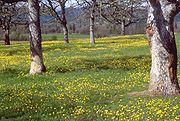
and Ponderosa Pine savanna, while further north was the Oregon White Oak savanna. The Central Hardwood Region covers a wide belt from northern Minnesota and Wisconsin, down through Iowa, Illinois, northern and central Missouri, eastern Kansas, and central Oklahoma to north-central Texas, with isolated pockets further east around the Great Lakes. The Eastern savannas of the United States
Eastern savannas of the United States
The eastern savannas of the United States covered large portions of the east side of the continent until the early 20th century. These were in a fire ecology of open grassland and forests with low ground cover of herbs and grasses....
extended further east to the Atlantic seaboard.
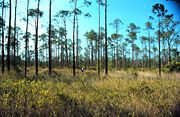
In the southeast, longleaf pine
Longleaf Pine
Pinus palustris, commonly known as the Longleaf Pine, is a pine native to the southeastern United States, found along the coastal plain from eastern Texas to southeast Virginia extending into northern and central Florida....
dominated the savanna and open-floored forests which once covered 92000000 acres (372,311.1 km²) from Virginia to Texas. These covered 36% of the region's land and 52% of the upland areas. Of this, less than 1% of the unaltered forest still stands.
In the Eastern Deciduous Forest, frequent fires kept open Kentucky bluegrass areas which supported herds of bison. A substantial portion of this forest was extensively burned by agricultural Native Americans. Annual burning created many large oaks and white pines with little understory.
The Southeastern Pine Region, from Texas to Virginia, is characterized by longleaf, slash, loblolly, shortleaf, and sand pines. Lightning and humans burned the understory of longleaf pine every 1 to 15 years from Archaic periods until widespread fire suppression practices were adopted in the 1930s. Burning to manage wildlife habitat did continue and was a common practice by 1950. Longleaf pine dominated the coastal plains until the early 1900s, where loblolly and slash pines now dominate.
At low altitudes in the Rocky Mountain region, large areas of Ponderosa pine and Douglas fir had an open park-like structure until the 1900s. In California's Sierra Nevada area, frequent fires kept clear the understory of stands of both Ponderosa pines and giant Sequoia.
Destruction of the savannas
Industrialized sawmills in the early 20th Century cleared many tall savanna old-growth trees, while fire suppression methods adopted in the 1930s and 1940s stopped much of the regular burning which the savanna required. By the latter half of the 20th Century many researchers had rediscovered both the prehistoric use of fire and methods to practice burning, but by then almost all prairie and savanna lands had been converted to agriculture or succeeded to full-canopy forestForest
A forest, also referred to as a wood or the woods, is an area with a high density of trees. As with cities, depending where you are in the world, what is considered a forest may vary significantly in size and have various classification according to how and what of the forest is composed...
. Modern conservation of savanna includes controlled burning, and at present about 6000000 acres (24,281.2 km²) a year are burned.
See also
- Eastern savannas of the United StatesEastern savannas of the United StatesThe eastern savannas of the United States covered large portions of the east side of the continent until the early 20th century. These were in a fire ecology of open grassland and forests with low ground cover of herbs and grasses....
- Savanna in southeastern regions. - Oak savannaOak savannaAn oak savanna is a type of savanna, or lightly forested grassland, where oaks are the dominant tree species. These savannas were maintained historically through wildfires set by lightning, grazing, low precipitation, poor soil, and/or fires set by Native Americans...
- Savanna in west coast, western, and central central regions. - Native American use of fireNative American use of fireIn addition to simple cooking, Pre-Columbian Native Americans used fire in many and significant ways, ranging from protecting an area from fire to landscape-altering clearing of prairie.-Human-shaped landscape:...
- Other native uses of fire. - Terra pretaTerra pretaTerra preta is a type of very dark, fertile anthropogenic soil found in the Amazon Basin. Terra preta owes its name to its very high charcoal content, and was indeed made by adding a mixture of charcoal, bone, and manure to the otherwise relatively infertile Amazonian soil, and stays there for...
- Use of burning in South America agricultural use rather than grassland.