


PowerBook

Encyclopedia
The PowerBook was a line of Macintosh
laptop
computer
s that was designed, manufactured and sold by Apple Computer, Inc. from 1991 to 2006. During its lifetime, the PowerBook went through several major revisions and redesigns, often being the first to incorporate features that would later become standard in competing laptops. The PowerBook line was targeted at the professional market, and received numerous awards, especially in the second half of its life, such as the 2001 Industrial Design Excellence Awards "Gold" status, and Engadget
's 2005 "Laptop of the Year". In 1999, the line was supplemented by the low-end iBook
range. The PowerBook and iBook lines were discontinued and replaced by the MacBook Pro
and MacBook
families respectively by 2006.
, the first Macintosh
computer intended to be easily portable. However, its price ($6500), size, and weight made actual portability nearly impossible. Because of this, the demand for a true portable Macintosh was not met.
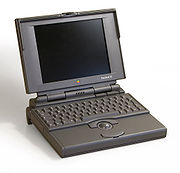 In October 1991 Apple released the first three PowerBooks: the low-end PowerBook 100
, the more powerful PowerBook 140
, and the high end PowerBook 170
, the only one with an active matrix
display. These machines caused a stir in the industry with their compact dark grey cases, built-in trackball
, and the clever positioning of the keyboard which left room for palmrests on either side of the pointing device
. Portable PC computers at the time were still oriented toward DOS, and tended to have the keyboard forward towards the user, with empty space behind it, so this was a surprising innovation and set the standard layout all future notebook computers would follow.
The PowerBook 140 and 170 were the original PowerBook designs, while the PowerBook 100 was the result of Apple having sent the schematics of the Mac Portable to Sony
, who miniaturized the components. Hence the PowerBook 100's design does not match those of the rest of the series, as it was actually designed after the 140 & 170 and further benefited from improvements learned during their development. The PowerBook 100, however, did not sell well until Apple dropped the price substantially.
The 100 series PowerBooks were intended to tie into the rest of the Apple desktop products utilizing the corporate Snow White design language
incorporated into all product designs since 1986. However, unlike the Macintosh Portable which was essentially a battery powered desktop in weight and size, the light colors and decorative recessed lines did not seem appropriate for the scaled down designs. In addition to adopting the darker grey colour scheme which co-ordinated with the official corporate look, they also adopted a raised series of ridges mimicking the indented lines on the desktops. The innovative look not only unified their entire product line, but set Apple apart in the marketplace. These early series would be the last to utilize the aging Snow White look, with the 190 adopting a new look along with the introduction of the 500 series.
The first series of PowerBooks were hugely successful, capturing 40% of all laptop sales. Despite this, the original team left to work at Compaq
, setting back updated versions for some time. When attempting to increase processing power, Apple was hampered by the overheating problems of the 68040
; this resulted in the 100-series PowerBook being stuck with the aging 68030
which could not compete with newer-generation Intel 80486
-based PC laptops introduced in 1994. For several years, new PowerBook and PowerBook Duo computers were introduced which featured incremental improvements, including color screens, but by mid-decade, most other companies had copied the majority of the PowerBook's features, and Apple was unable to regain their lead.
The original PowerBook 100, 140, and 170 were replaced by the 145 (updated to the 145B in 1993), 160
, and 180
in 1992. The 160 and 180 having video output allowing them to drive an external monitor. In addition, the PowerBook 180 had a superb-for-the-time active-matrix grayscale display, making it popular with the Mac press. In 1993, the PowerBook 165c
was the first PowerBook with a color screen, later followed by the 180c
. In 1994, the last true member of the 100-series form factor introduced was the PowerBook 150
, targeted at value-minded consumers and students. The PowerBook 190
, released in 1995, bears no resemblance to the rest of the PowerBook 100 series, and is in fact simply a Motorola 68LC040-based version of the PowerBook 5300
(and the last Macintosh model to utilize a Motorola
68k
-family processor). However, like the 190, the 150 also used used the 5300 IDE-based logic-board architecture. From the 100's 68000 processor, to the 190's 68LC040 processor, the 100 series PowerBooks span the entire Apple 68K line, with the 190 even upgradable to a PowerPC
processor. The PowerBook Duo spanned the 68030 line of processors and sold through the PowerPC transition to the G3
processor with the 2300
, also based on the 5300's internal architecture.
, continuing to streamline the subnotebook
features introduced with the PowerBook 100. The Duos were a series of very thin and lightweight laptops with a minimum of features, which could be inserted into a docking station
to provide the system with extra video memory, storage space
, connector
s, and could be connected to a monitor
. Despite being seen on Seinfeld
, the model did not sell as well as expected, although several companies have since adapted the design.
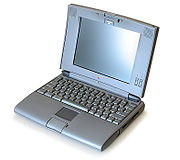 1994 saw the introduction of the Motorola 68LC040-based PowerBook 500 series, code-named Blackbird. These models of PowerBooks were much sleeker and faster than the 100 series, which they replaced as the mid and high-end models. The 500 series featured DSTN
(520) or active-matrix LCD displays (540 and 550), stereo speakers, and was the first computer to use a trackpad (although a similar technology had been included on the pioneering Gavilan SC
11 years earlier); it was also the first portable computer to offer built-in Ethernet
networking. The PowerBook 500 series was the mainstay of the product line until the PowerBook 5300
. The 500 series was the first PowerBook to feature PCMCIA slots, although this was an optional feature which required the user to sacrifice one of the two available battery slots to house the PCMCIA expansion cage.
The PowerBook 500 series was released as Apple was already moving its desktop machines to the PowerPC processor range, and a future upgrade was promised from the start. This came in 1995, as an Apple Motherboard containing a 100 MHz 603e processor and 8 MB of RAM (which snapped into a slot containing the previous 25 or 33 MHz 68040 processor and the 4 MB of RAM on the previous daughterboard). At the same time Newer Technology
offered an Apple-authorized 117 MHz Motherboard, which was more popular than the Apple product, and optionally came without any RAM. The company later offered 167 MHz and 183 MHz upgrades containing more memory and onboard cache memory to improve performance. However, the internal architecture of the 500 series meant that the speed increase provided by the 100 and 117 MHz upgrades was, for most users, relatively small.
The 500 series was completely discontinued upon the introduction of its replacement the PPC-based PowerBook 5300, with the low-end (but upgradable) PowerBook 190 replacing the 500's role as the only 68LC040 PowerBook Apple offered.
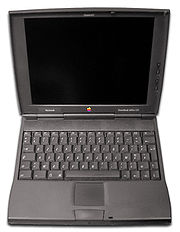 The PowerBook 5300
, while highly anticipated as one of the first PowerPC
-based PowerBooks (along with the PowerBook Duo 2300c, both released on the same day), had numerous problems. In its 5300ce incarnation with a TFT of 800x600 pixels, Apple offered a 117 MHz PPC, 32 MB
of on-board RAM
, and a hot-swappable drive bay
. With all of these features, though, the 5300ce was quite ahead of other laptop models at the time. Multiple problems with reliability, stability and safety (by some, the model was referred as the "HindenBook" because the lithium ion batteries used actually burst into flame in Apple tests, necessitating a recall and downgrade to nickel metal hydride batteries) were present in the early 5300s. These drawbacks by far failed to meet the quality standard expected for the price. After Apple offered an Extended Repair Program, the series turned into a remarkably attractive machine, but never lost its bad reputation. The bad publicity of 5300 series added to the woes of "beleagured Apple" during the mid 1990s.
Apple recovered from the 5300 debacle in 1996 and 1997 by introducing three new PowerBooks: the PowerBook 1400
, intended to replace the 5300 as a general-purpose PowerBook; the PowerBook 2400, intended as a slim, sleek sub-notebook to replace the PowerBook Duo; and the luxury model PowerBook 3400. The PowerBook 1400 and 3400 were in fact the first PowerBooks ever to include an internal CD drive, and were introduced in a time when laptops rarely had one. Again, other laptop manufacturers quickly followed Apple's lead. Late in 1997, the PowerBook 3400 was adapted into the first PowerBook G3, codenamed the Kanga. This series was the last PowerBook model to employ a "real" keyboard with 1 cm high keys; all later models have flat keys.
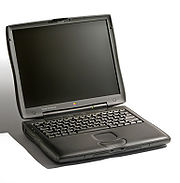 The first PowerBook G3 Series (completely redesigned from the Kanga) was released in 1998, although it was still an Old World ROM
Mac.
These new PowerBooks took design cues from the 500 series PowerBook, sporting dramatic curves and a jet-black plastic case. They were so fashionable that various G3 models became the personal computer of Carrie Bradshaw
in the long-running Sex and the City
television show. Debuting at roughly the same time as the G3 iMac
, the "WallStreet/Mainstreet" series composed of models with varying features, such as different processing speeds (from 233 to 300 MHz) and the choice of 12-, 13-, or 14-inch screens. They all included dual drive bays capable of accommodating floppy drives, CD-ROM/DVD
-ROM drives, hard drives, or even extra batteries. A second PowerBook G3 Series code-named "PDQ" was introduced later in 1998, with minor changes in configuration options, notably the inclusion of L2 cache in even the lowest-priced 233 MHz model, which helped overall performance.
Apple introduced two later G3 PowerBook models, similar in appearance (curved, black plastic case with black rubberized sections) but thinner, lighter and with revised internal systems. The "Lombard" appeared in 1999, (AKA: Bronze Keyboard) a thinner, lighter, and faster (333 or 400 MHz) PowerBook with a longer battery life and had both USB
and SCSI
built in and was a New World ROM
Mac, and then the "Pismo" in 2000, which replaced the single SCSI port with two FireWire ports, updated the PowerBook line to AGP
graphics, a 100 MHz bus speed, and DVD-ROM optical drives standard, in addition to dropping the "G3" from the PowerBook name. The Pismo revision also brought AirPort
wireless networking capability (802.11b), which had debuted in Apple's iBook
in July 1999. CPU upgrade cards are available for both Lombard and Pismo models.
turned his eye to the redesign of the PowerBook series in 2000. The result, introduced in January 2001, was a completely re-designed New World
PowerBook with a titanium
skin and a 15.2-inch wide-aspect screen suitable for watching widescreen movies. Built with the PowerPC G4
processor, it was billed as "the first supercomputer you can actually take with you on an airplane." It was lighter than most PC based laptops, and due to the low power consumption of the PowerPC
it outlasted them by hours.
The TiBooks, as they were nicknamed, became a fashion item. They were especially popular in the entertainment business, where they adorned many desks in Hollywood motion pictures. Because of their large screens and high performance, Titanium Powerbooks were the first laptops to be widely deployed as desktop replacement computers.
The industrial design of the notebooks quickly became a standard that others in the industry would follow, creating a new wave of wide-screened notebook computers.
The Titanium PowerBooks were released in configurations of 400 MHz, 500 MHz, 550 MHz, 667 MHz, 800 MHz, 867 MHz, and 1 GHz. They are the last PowerBooks able to boot MacOS 9.
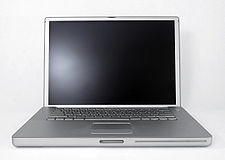
In 2003, Apple launched both the largest-screen laptop in the world and Apple's smallest full-featured notebook computer. Both machines were made of anodized aluminum (coining the new nickname AlBook), featured DVD-burning capabilities, AirPort Extreme
networking, Bluetooth
, and 12.1-inch or 17-inch LCD displays. The 17-inch model included a fiber optic-illuminated keyboard, which eventually became standard on all 15-inch and 17-inch PowerBooks. Two ambient light sensors, located under each speaker grille, adjusted the brightness of the backlit keyboard and the display according to the light level.
 The 12-inch PowerBook's screen did not use the same panel as that used on the 12-inch iBook
, while the 17-inch PowerBook used the same screen as that used on the 17-inch flat-panel iMac
, but with a thinner backlight.
Later in 2003, the 15-inch PowerBooks were redesigned and featured the same aluminum body style as their smaller and larger siblings, and with the same feature set as the 17-inch model (including the backlit keyboard). This basic design would carry through the transition to the Intel-based MacBook Pro, lasting until late 2008.
In April, 2004, the aluminum PowerBooks were upgraded. The SuperDrive
was upgraded to 4× burning speed for DVDs, the fastest processor available was upgraded to 1.5 GHz, and the graphics cards were replaced with newer models, offering up to 128 MB of video memory. A third built-in speaker was added to the 12-inch model for improved midrange sound. In addition, AirPort Extreme cards became standard for all PowerBooks instead of being offered as an add-on option.
In January, 2005, the specifications of the aluminum PowerBooks were revised once more to accompany a price decrease. Processor speeds were increased to a maximum of 1.67 GHz on the higher specification 15-inch and all 17-inch versions, while the lower specification 15-inch model and the 12-inch unit saw an increase in speed to 1.5 GHz. Optical audio output was added to the 17-inch version. Memory and hard drive defaults were increased to 512 MB and 5400 rpm
, respectively, with a new storage maximum of 100 GB on the 17-inch model. Each model also received an enhanced trackpad with scrolling capabilities, a revised Bluetooth
module supporting BT 2.0+EDR, and a new feature which parks the drive heads when sudden motion is detected by an internal sensor. Support for the 30-inch Apple Cinema display was also introduced in the new 17-inch model and was optional in the 15-inch model via a build-to-order upgrade to the computer's video hardware. The SuperDrive now included DVD+R
capability.
In October, 2005, the two higher-end PowerBooks were upgraded once again, with higher-resolution displays (1440 × 960 pixels on the 15-inch model, and 1680 × 1050 pixels on the 17-inch model) and faster 533 MHz DDR2
(PC2-4200) memory. The SuperDrive became standard equipment and included support for dual-layer DVDs on the 15- and 17-inch models. The 17-inch model was updated with a 120 GB standard hard drive, as well as a 7200 rpm, 100 GB build-to-order option. These drives were also options on the 15-inch PowerBook. The 12-inch model with SuperDrive remained unchanged in this respect, although each new PowerBook boasted a longer battery life.
 On May 20, 2005, Apple and the Consumer Product Safety Commission
announced the recall of some Apple PowerBook G4 batteries. The joint Apple/CPSC press release stated that an internal short could cause the battery cells to overheat, posing a fire hazard. Approximately 128,000 defective units were sold.
Though the problems first appeared to be solved, they continued for many users. In early August 2006, Engadget
reported that a PowerBook had "violently exploded" because of faulty battery. On August 24, 2006, Apple and the CPSC announced an additional recall of more batteries for the same PowerBook models.
About 1.1 million battery packs in the United States are being recalled; an additional 700,000 were sold outside the U.S.
These batteries were manufactured by Sony
. Sony
, Dell
, Toshiba
, Lenovo, HP
, Fujitsu
and Acer laptops were also affected by the defective batteries.
, the MacBook Pro
was introduced. The new notebooks, however, only came in 15.4-inch models and the 12-inch and 17-inch PowerBooks remained available for sale at Apple stores and retailers, as well as the 15-inch model, which was sold until supplies ran out. On April 24, 2006 the 17-inch PowerBook G4 was replaced by a 17-inch MacBook Pro variant. The 12-inch PowerBook G4 remained available until May 16, 2006, when the MacBook
was introduced as a replacement for the iBook. Because of its availability in highly powerful configurations, it was also considered a replacement for the 12-inch PowerBook, ending the nearly 15-year production of PowerBook-branded computers.
Traditionally, the portable line trailed the desktops in the utilization of the latest processors, with the notable exception of the PowerBook G3 which occurred simultaneously with the desktop Power Macintosh G3 introduction. However, it would continue to trail behind the desktop Macs, never even adopting the G5 processor. This was due primarily to the extreme heat caused by most of the full-sized processors available and unacceptable power consumption. With the introduction of the Intel-based Macs, once again, the MacBook Pro joined the iMac in sharing the new technology simultaneously.
Macintosh
The Macintosh , or Mac, is a series of several lines of personal computers designed, developed, and marketed by Apple Inc. The first Macintosh was introduced by Apple's then-chairman Steve Jobs on January 24, 1984; it was the first commercially successful personal computer to feature a mouse and a...
laptop
Laptop
A laptop, also called a notebook, is a personal computer for mobile use. A laptop integrates most of the typical components of a desktop computer, including a display, a keyboard, a pointing device and speakers into a single unit...
computer
Computer
A computer is a programmable machine designed to sequentially and automatically carry out a sequence of arithmetic or logical operations. The particular sequence of operations can be changed readily, allowing the computer to solve more than one kind of problem...
s that was designed, manufactured and sold by Apple Computer, Inc. from 1991 to 2006. During its lifetime, the PowerBook went through several major revisions and redesigns, often being the first to incorporate features that would later become standard in competing laptops. The PowerBook line was targeted at the professional market, and received numerous awards, especially in the second half of its life, such as the 2001 Industrial Design Excellence Awards "Gold" status, and Engadget
Engadget
Engadget is a multilingual technology blog network with daily coverage of gadgets and consumer electronics. Though on appearance Engadget functions much like a blog and may be defined as such, much of its editorial content takes the form of an online magazine...
's 2005 "Laptop of the Year". In 1999, the line was supplemented by the low-end iBook
IBook
The iBook was a line of laptop computers sold by Apple Computer from 1999 to 2006. The line targeted the consumer and education markets, with lower specifications and prices than the PowerBook, Apple's higher-end line of laptop computers....
range. The PowerBook and iBook lines were discontinued and replaced by the MacBook Pro
MacBook Pro
The MacBook Pro is a line of Macintosh portable computers introduced in January 2006 by Apple. It replaced the PowerBook G4 and was the second model, after the iMac, to be announced in the Apple–Intel transition...
and MacBook
MacBook
The MacBook was a brand of Macintosh notebook computers built by Apple Inc. First introduced in May 2006, it replaced the iBook and 12-inch PowerBook series of notebooks as a part of the Apple–Intel transition. Positioned as the low end of the MacBook family, the Apple MacBook was aimed at the...
families respectively by 2006.
History
In September 1989, Apple Inc. released the Macintosh PortableMacintosh Portable
The Macintosh Portable was Apple Inc.'s first attempt at making a battery-powered portable Macintosh personal computer that held the power of a desktop Macintosh...
, the first Macintosh
Macintosh
The Macintosh , or Mac, is a series of several lines of personal computers designed, developed, and marketed by Apple Inc. The first Macintosh was introduced by Apple's then-chairman Steve Jobs on January 24, 1984; it was the first commercially successful personal computer to feature a mouse and a...
computer intended to be easily portable. However, its price ($6500), size, and weight made actual portability nearly impossible. Because of this, the demand for a true portable Macintosh was not met.
PowerBook 100 series
PowerBook 100
The PowerBook 100 was a portable subnotebook personal computer manufactured by Apple Computer and introduced on October 21, 1991 at the COMDEX computer expo in Las Vegas, Nevada. Priced at US$2,300, the PowerBook 100 was the low-end model of the first three simultaneously-released...
, the more powerful PowerBook 140
PowerBook 140
The PowerBook 140 was released in the first line of PowerBooks. It was the mid-range PowerBook, between the low-end 100 and the high-end 170. As with the PowerBook 170, and unlike the 100, this PowerBook featured an internal floppy drive. Codenames for this model are: Tim Lite, Tim LC,...
, and the high end PowerBook 170
PowerBook 170
The PowerBook 170 was released by Apple Inc. in 1991 along with the PowerBook 100 and the PowerBook 140. Identical to the 140, it was the high end of the original...
, the only one with an active matrix
Active matrix
Active matrix is a type of addressing scheme used in flat panel displays. The term describes a method of switching individual elements of a flat panel display, using a CdSe or Silicon-based thin-film transistor for each pixel...
display. These machines caused a stir in the industry with their compact dark grey cases, built-in trackball
Trackball
A trackball is a pointing device consisting of a ball held by a socket containing sensors to detect a rotation of the ball about two axes—like an upside-down mouse with an exposed protruding ball. The user rolls the ball with the thumb, fingers, or the palm of the hand to move a cursor...
, and the clever positioning of the keyboard which left room for palmrests on either side of the pointing device
Pointing device
A pointing device is an input interface that allows a user to input spatial data to a computer...
. Portable PC computers at the time were still oriented toward DOS, and tended to have the keyboard forward towards the user, with empty space behind it, so this was a surprising innovation and set the standard layout all future notebook computers would follow.
The PowerBook 140 and 170 were the original PowerBook designs, while the PowerBook 100 was the result of Apple having sent the schematics of the Mac Portable to Sony
Sony
, commonly referred to as Sony, is a Japanese multinational conglomerate corporation headquartered in Minato, Tokyo, Japan and the world's fifth largest media conglomerate measured by revenues....
, who miniaturized the components. Hence the PowerBook 100's design does not match those of the rest of the series, as it was actually designed after the 140 & 170 and further benefited from improvements learned during their development. The PowerBook 100, however, did not sell well until Apple dropped the price substantially.
The 100 series PowerBooks were intended to tie into the rest of the Apple desktop products utilizing the corporate Snow White design language
Snow White design language
The Snow White design language was an industrial design language developed by Hartmut Esslinger's Frog Design. Used by Apple Computer from 1984 to 1990, the scheme has vertical and horizontal stripes for decoration, ventilation, and the illusion that the computer enclosure is smaller than it...
incorporated into all product designs since 1986. However, unlike the Macintosh Portable which was essentially a battery powered desktop in weight and size, the light colors and decorative recessed lines did not seem appropriate for the scaled down designs. In addition to adopting the darker grey colour scheme which co-ordinated with the official corporate look, they also adopted a raised series of ridges mimicking the indented lines on the desktops. The innovative look not only unified their entire product line, but set Apple apart in the marketplace. These early series would be the last to utilize the aging Snow White look, with the 190 adopting a new look along with the introduction of the 500 series.
The first series of PowerBooks were hugely successful, capturing 40% of all laptop sales. Despite this, the original team left to work at Compaq
Compaq
Compaq Computer Corporation is a personal computer company founded in 1982. Once the largest supplier of personal computing systems in the world, Compaq existed as an independent corporation until 2002, when it was acquired for US$25 billion by Hewlett-Packard....
, setting back updated versions for some time. When attempting to increase processing power, Apple was hampered by the overheating problems of the 68040
Motorola 68040
The Motorola 68040 is a microprocessor from Motorola, released in 1990. It is the successor to the 68030 and is followed by the 68060. There was no 68050. In keeping with general Motorola naming, the 68040 is often referred to as simply the '040 ....
; this resulted in the 100-series PowerBook being stuck with the aging 68030
Motorola 68030
The Motorola 68030 is a 32-bit microprocessor in Motorola's 68000 family. It was released in 1987. The 68030 was the successor to the Motorola 68020, and was followed by the Motorola 68040. In keeping with general Motorola naming, this CPU is often referred to as the 030 .The 68030 features on-chip...
which could not compete with newer-generation Intel 80486
Intel 80486
The Intel 80486 microprocessor was a higher performance follow up on the Intel 80386. Introduced in 1989, it was the first tightly pipelined x86 design as well as the first x86 chip to use more than a million transistors, due to a large on-chip cache and an integrated floating point unit...
-based PC laptops introduced in 1994. For several years, new PowerBook and PowerBook Duo computers were introduced which featured incremental improvements, including color screens, but by mid-decade, most other companies had copied the majority of the PowerBook's features, and Apple was unable to regain their lead.
The original PowerBook 100, 140, and 170 were replaced by the 145 (updated to the 145B in 1993), 160
PowerBook 160
The PowerBook 160 is a portable computer that was released by Apple Computer along with the PowerBook 145 and PowerBook 180 in October 1992. At the time, it constituted the mid-range model replacing the previous PowerBook 140 in processing power...
, and 180
Powerbook 180
The PowerBook 180 was a portable computer released by Apple Computer, Inc. along with the PowerBook 160 in October 1992. At the time, it constituted the new top-of-the-range model replacing the previous PowerBook 170. Its case design and features are the same as that of the 170, but it shipped with...
in 1992. The 160 and 180 having video output allowing them to drive an external monitor. In addition, the PowerBook 180 had a superb-for-the-time active-matrix grayscale display, making it popular with the Mac press. In 1993, the PowerBook 165c
PowerBook 160
The PowerBook 160 is a portable computer that was released by Apple Computer along with the PowerBook 145 and PowerBook 180 in October 1992. At the time, it constituted the mid-range model replacing the previous PowerBook 140 in processing power...
was the first PowerBook with a color screen, later followed by the 180c
Powerbook 180
The PowerBook 180 was a portable computer released by Apple Computer, Inc. along with the PowerBook 160 in October 1992. At the time, it constituted the new top-of-the-range model replacing the previous PowerBook 170. Its case design and features are the same as that of the 170, but it shipped with...
. In 1994, the last true member of the 100-series form factor introduced was the PowerBook 150
PowerBook 150
The PowerBook 150 was a laptop created by Apple Computer in 1994. It was the last member of the PowerBook 100 series to use the original case design, the most affordable of the series when introduced, and also the last consumer model. It was 8 MHz faster than its predecessor, the PowerBook 145B...
, targeted at value-minded consumers and students. The PowerBook 190
PowerBook 190
The PowerBook 190 and its companion PowerBook 190cs are laptop computers manufactured by Apple Computer as part of their PowerBook brand, introduced to the market in August 1995. The two models differ only in their screen: The 190 had a 9.5" greyscale display, while the 190cs featured a 10.4" color...
, released in 1995, bears no resemblance to the rest of the PowerBook 100 series, and is in fact simply a Motorola 68LC040-based version of the PowerBook 5300
PowerBook 5300
The PowerBook 5300 series was the first generation of PowerBook laptops manufactured by Apple Computer to use the PowerPC processor. Released in August 1995, these PowerBooks were notable for being the first to feature hot-swappable expansion modules for a variety of different units such as ZIP...
(and the last Macintosh model to utilize a Motorola
Motorola
Motorola, Inc. was an American multinational telecommunications company based in Schaumburg, Illinois, which was eventually divided into two independent public companies, Motorola Mobility and Motorola Solutions on January 4, 2011, after losing $4.3 billion from 2007 to 2009...
68k
68k
The Motorola 680x0/m68000/68000 is a family of 32-bit CISC microprocessors. During the 1980s and early 1990s, they were popular in personal computers and workstations and were the primary competitors of Intel's x86 microprocessors...
-family processor). However, like the 190, the 150 also used used the 5300 IDE-based logic-board architecture. From the 100's 68000 processor, to the 190's 68LC040 processor, the 100 series PowerBooks span the entire Apple 68K line, with the 190 even upgradable to a PowerPC
PowerPC
PowerPC is a RISC architecture created by the 1991 Apple–IBM–Motorola alliance, known as AIM...
processor. The PowerBook Duo spanned the 68030 line of processors and sold through the PowerPC transition to the G3
PowerPC G3
The PowerPC 7xx is a family of third generation 32-bit PowerPC microprocessors designed and manufactured by IBM and Motorola . This family is called the PowerPC G3 by its well-known customer Apple Computer...
processor with the 2300
PowerBook Duo
The PowerBook Duo was a line of small subnotebooks manufactured and sold by Apple Computer from 1992 until 1997 as a more compact companion to the PowerBook line. Improving upon the PowerBook 100's portability , the Duo came in seven different models...
, also based on the 5300's internal architecture.
PowerBook Duo
In 1992 Apple released a hybrid portable/desktop computer, the PowerBook DuoPowerBook Duo
The PowerBook Duo was a line of small subnotebooks manufactured and sold by Apple Computer from 1992 until 1997 as a more compact companion to the PowerBook line. Improving upon the PowerBook 100's portability , the Duo came in seven different models...
, continuing to streamline the subnotebook
Subnotebook
A subnotebook is a class of laptop computers that are smaller and lighter than a typical laptop....
features introduced with the PowerBook 100. The Duos were a series of very thin and lightweight laptops with a minimum of features, which could be inserted into a docking station
Docking station
A Docking station or port replicator or dock provides a simplified way of “plugging-in” an electronic device such as a laptop computer to common peripherals...
to provide the system with extra video memory, storage space
Hard disk
A hard disk drive is a non-volatile, random access digital magnetic data storage device. It features rotating rigid platters on a motor-driven spindle within a protective enclosure. Data is magnetically read from and written to the platter by read/write heads that float on a film of air above the...
, connector
Electrical connector
An electrical connector is an electro-mechanical device for joining electrical circuits as an interface using a mechanical assembly. The connection may be temporary, as for portable equipment, require a tool for assembly and removal, or serve as a permanent electrical joint between two wires or...
s, and could be connected to a monitor
Computer display
A monitor or display is an electronic visual display for computers. The monitor comprises the display device, circuitry, and an enclosure...
. Despite being seen on Seinfeld
Seinfeld
Seinfeld is an American television sitcom that originally aired on NBC from July 5, 1989, to May 14, 1998, lasting nine seasons, and is now in syndication. It was created by Larry David and Jerry Seinfeld, the latter starring as a fictionalized version of himself...
, the model did not sell as well as expected, although several companies have since adapted the design.
PowerBook 500 series
Dual Scan
Dual Scan, also known as dual-scan supertwist nematic or DSTN, is an LCD technology in which a screen is divided into two sections which are simultaneously refreshed giving faster refresh rate than traditional passive matrix screens. It is an improved form of supertwist nematic display that offers...
(520) or active-matrix LCD displays (540 and 550), stereo speakers, and was the first computer to use a trackpad (although a similar technology had been included on the pioneering Gavilan SC
Gavilan SC
The Gavilan SC was an early laptop computer, and was the first ever to be marketed as a "laptop".The brainchild of Gavilan Computer Corp. founder Manuel Fernandez, the Gavilan was introduced in May, 1983, at approximately the same time as the similar Sharp PC-5000...
11 years earlier); it was also the first portable computer to offer built-in Ethernet
Ethernet
Ethernet is a family of computer networking technologies for local area networks commercially introduced in 1980. Standardized in IEEE 802.3, Ethernet has largely replaced competing wired LAN technologies....
networking. The PowerBook 500 series was the mainstay of the product line until the PowerBook 5300
PowerBook 5300
The PowerBook 5300 series was the first generation of PowerBook laptops manufactured by Apple Computer to use the PowerPC processor. Released in August 1995, these PowerBooks were notable for being the first to feature hot-swappable expansion modules for a variety of different units such as ZIP...
. The 500 series was the first PowerBook to feature PCMCIA slots, although this was an optional feature which required the user to sacrifice one of the two available battery slots to house the PCMCIA expansion cage.
The PowerBook 500 series was released as Apple was already moving its desktop machines to the PowerPC processor range, and a future upgrade was promised from the start. This came in 1995, as an Apple Motherboard containing a 100 MHz 603e processor and 8 MB of RAM (which snapped into a slot containing the previous 25 or 33 MHz 68040 processor and the 4 MB of RAM on the previous daughterboard). At the same time Newer Technology
Newer Technology
Newer Technology is a supplier of upgrades and peripherals for the Apple Macintosh computer. They went bankrupt at the end of 2000 and the company was dissolved, but the name and remaining intellectual property was bought afterwards and used by a new owner....
offered an Apple-authorized 117 MHz Motherboard, which was more popular than the Apple product, and optionally came without any RAM. The company later offered 167 MHz and 183 MHz upgrades containing more memory and onboard cache memory to improve performance. However, the internal architecture of the 500 series meant that the speed increase provided by the 100 and 117 MHz upgrades was, for most users, relatively small.
The 500 series was completely discontinued upon the introduction of its replacement the PPC-based PowerBook 5300, with the low-end (but upgradable) PowerBook 190 replacing the 500's role as the only 68LC040 PowerBook Apple offered.
PowerPC-Based PowerBooks
PowerBook 5300
The PowerBook 5300 series was the first generation of PowerBook laptops manufactured by Apple Computer to use the PowerPC processor. Released in August 1995, these PowerBooks were notable for being the first to feature hot-swappable expansion modules for a variety of different units such as ZIP...
, while highly anticipated as one of the first PowerPC
PowerPC
PowerPC is a RISC architecture created by the 1991 Apple–IBM–Motorola alliance, known as AIM...
-based PowerBooks (along with the PowerBook Duo 2300c, both released on the same day), had numerous problems. In its 5300ce incarnation with a TFT of 800x600 pixels, Apple offered a 117 MHz PPC, 32 MB
Megabyte
The megabyte is a multiple of the unit byte for digital information storage or transmission with two different values depending on context: bytes generally for computer memory; and one million bytes generally for computer storage. The IEEE Standards Board has decided that "Mega will mean 1 000...
of on-board RAM
Ram
-Animals:*Ram, an uncastrated male sheep*Ram cichlid, a species of freshwater fish endemic to Colombia and Venezuela-Military:*Battering ram*Ramming, a military tactic in which one vehicle runs into another...
, and a hot-swappable drive bay
Drive bay
A drive bay is a standard-sized area for adding hardware to a computer. Most drive bays are fixed to the inside of a case, but some can be removed....
. With all of these features, though, the 5300ce was quite ahead of other laptop models at the time. Multiple problems with reliability, stability and safety (by some, the model was referred as the "HindenBook" because the lithium ion batteries used actually burst into flame in Apple tests, necessitating a recall and downgrade to nickel metal hydride batteries) were present in the early 5300s. These drawbacks by far failed to meet the quality standard expected for the price. After Apple offered an Extended Repair Program, the series turned into a remarkably attractive machine, but never lost its bad reputation. The bad publicity of 5300 series added to the woes of "beleagured Apple" during the mid 1990s.
Apple recovered from the 5300 debacle in 1996 and 1997 by introducing three new PowerBooks: the PowerBook 1400
PowerBook 1400
The PowerBook 1400 was a notebook computer designed and sold by Apple Computer from 1996 to 1998 as part of their PowerBook series of Macintosh computers. Introduced in November 1996 at a starting price of $2499, it was the first new PowerBook since the controversial PowerBook 5300...
, intended to replace the 5300 as a general-purpose PowerBook; the PowerBook 2400, intended as a slim, sleek sub-notebook to replace the PowerBook Duo; and the luxury model PowerBook 3400. The PowerBook 1400 and 3400 were in fact the first PowerBooks ever to include an internal CD drive, and were introduced in a time when laptops rarely had one. Again, other laptop manufacturers quickly followed Apple's lead. Late in 1997, the PowerBook 3400 was adapted into the first PowerBook G3, codenamed the Kanga. This series was the last PowerBook model to employ a "real" keyboard with 1 cm high keys; all later models have flat keys.
PowerBook G3
Old World ROM
Old World ROM Macintosh computers are the Macintosh models that use a Macintosh Toolbox ROM chip, usually in a socket . All Macs prior to the iMac use Old World ROM, while the iMac and all subsequent models until the introduction of the Intel-based EFI Models are New World ROM machines...
Mac.
These new PowerBooks took design cues from the 500 series PowerBook, sporting dramatic curves and a jet-black plastic case. They were so fashionable that various G3 models became the personal computer of Carrie Bradshaw
Carrie Bradshaw
Carrie Preston is the fictional narrator and lead character of the HBO sitcom/drama Sex and the City, portrayed by actress Sarah Jessica Parker. She is a semi-autobiographical character created by Candace Bushnell, who published the book Sex and the City, based on her own columns in the New York...
in the long-running Sex and the City
Sex and the City
Sex and the City is an American television comedy-drama series created by Darren Star and produced by HBO. Broadcast from 1998 until 2004, the original run of the show had a total of ninety-four episodes...
television show. Debuting at roughly the same time as the G3 iMac
IMac
The iMac is a range of all-in-one Macintosh desktop computers built by Apple. It has been the primary part of Apple's consumer desktop offerings since its introduction in 1998, and has evolved through five distinct forms....
, the "WallStreet/Mainstreet" series composed of models with varying features, such as different processing speeds (from 233 to 300 MHz) and the choice of 12-, 13-, or 14-inch screens. They all included dual drive bays capable of accommodating floppy drives, CD-ROM/DVD
DVD
A DVD is an optical disc storage media format, invented and developed by Philips, Sony, Toshiba, and Panasonic in 1995. DVDs offer higher storage capacity than Compact Discs while having the same dimensions....
-ROM drives, hard drives, or even extra batteries. A second PowerBook G3 Series code-named "PDQ" was introduced later in 1998, with minor changes in configuration options, notably the inclusion of L2 cache in even the lowest-priced 233 MHz model, which helped overall performance.
Apple introduced two later G3 PowerBook models, similar in appearance (curved, black plastic case with black rubberized sections) but thinner, lighter and with revised internal systems. The "Lombard" appeared in 1999, (AKA: Bronze Keyboard) a thinner, lighter, and faster (333 or 400 MHz) PowerBook with a longer battery life and had both USB
Universal Serial Bus
USB is an industry standard developed in the mid-1990s that defines the cables, connectors and protocols used in a bus for connection, communication and power supply between computers and electronic devices....
and SCSI
SCSI
Small Computer System Interface is a set of standards for physically connecting and transferring data between computers and peripheral devices. The SCSI standards define commands, protocols, and electrical and optical interfaces. SCSI is most commonly used for hard disks and tape drives, but it...
built in and was a New World ROM
New World ROM
New World ROM computers are Macintosh models that do not use a Macintosh Toolbox ROM on the logic board. Due to Mac OS X not requiring the availability of the Toolbox, this allowed ROM sizes to shrink dramatically , and facilitated the use of Flash memory for system firmware instead of the now more...
Mac, and then the "Pismo" in 2000, which replaced the single SCSI port with two FireWire ports, updated the PowerBook line to AGP
Accelerated Graphics Port
The Accelerated Graphics Port is a high-speed point-to-point channel for attaching a video card to a computer's motherboard, primarily to assist in the acceleration of 3D computer graphics. Since 2004 AGP has been progressively phased out in favor of PCI Express...
graphics, a 100 MHz bus speed, and DVD-ROM optical drives standard, in addition to dropping the "G3" from the PowerBook name. The Pismo revision also brought AirPort
AirPort
AirPort and AirPort Extreme are local area wireless networking products from Apple Inc. based on the IEEE 802.11 standard ....
wireless networking capability (802.11b), which had debuted in Apple's iBook
IBook
The iBook was a line of laptop computers sold by Apple Computer from 1999 to 2006. The line targeted the consumer and education markets, with lower specifications and prices than the PowerBook, Apple's higher-end line of laptop computers....
in July 1999. CPU upgrade cards are available for both Lombard and Pismo models.
PowerBook G4
Interim CEO Steve JobsSteve Jobs
Steven Paul Jobs was an American businessman and inventor widely recognized as a charismatic pioneer of the personal computer revolution. He was co-founder, chairman, and chief executive officer of Apple Inc...
turned his eye to the redesign of the PowerBook series in 2000. The result, introduced in January 2001, was a completely re-designed New World
New World ROM
New World ROM computers are Macintosh models that do not use a Macintosh Toolbox ROM on the logic board. Due to Mac OS X not requiring the availability of the Toolbox, this allowed ROM sizes to shrink dramatically , and facilitated the use of Flash memory for system firmware instead of the now more...
PowerBook with a titanium
Titanium
Titanium is a chemical element with the symbol Ti and atomic number 22. It has a low density and is a strong, lustrous, corrosion-resistant transition metal with a silver color....
skin and a 15.2-inch wide-aspect screen suitable for watching widescreen movies. Built with the PowerPC G4
PowerPC G4
PowerPC G4 is a designation used by Apple Computer to describe a fourth generation of 32-bit PowerPC microprocessors. Apple has applied this name to various processor models from Freescale, a former part of Motorola....
processor, it was billed as "the first supercomputer you can actually take with you on an airplane." It was lighter than most PC based laptops, and due to the low power consumption of the PowerPC
PowerPC
PowerPC is a RISC architecture created by the 1991 Apple–IBM–Motorola alliance, known as AIM...
it outlasted them by hours.
The TiBooks, as they were nicknamed, became a fashion item. They were especially popular in the entertainment business, where they adorned many desks in Hollywood motion pictures. Because of their large screens and high performance, Titanium Powerbooks were the first laptops to be widely deployed as desktop replacement computers.
The industrial design of the notebooks quickly became a standard that others in the industry would follow, creating a new wave of wide-screened notebook computers.
The Titanium PowerBooks were released in configurations of 400 MHz, 500 MHz, 550 MHz, 667 MHz, 800 MHz, 867 MHz, and 1 GHz. They are the last PowerBooks able to boot MacOS 9.
In 2003, Apple launched both the largest-screen laptop in the world and Apple's smallest full-featured notebook computer. Both machines were made of anodized aluminum (coining the new nickname AlBook), featured DVD-burning capabilities, AirPort Extreme
AirPort
AirPort and AirPort Extreme are local area wireless networking products from Apple Inc. based on the IEEE 802.11 standard ....
networking, Bluetooth
Bluetooth
Bluetooth is a proprietary open wireless technology standard for exchanging data over short distances from fixed and mobile devices, creating personal area networks with high levels of security...
, and 12.1-inch or 17-inch LCD displays. The 17-inch model included a fiber optic-illuminated keyboard, which eventually became standard on all 15-inch and 17-inch PowerBooks. Two ambient light sensors, located under each speaker grille, adjusted the brightness of the backlit keyboard and the display according to the light level.
IBook
The iBook was a line of laptop computers sold by Apple Computer from 1999 to 2006. The line targeted the consumer and education markets, with lower specifications and prices than the PowerBook, Apple's higher-end line of laptop computers....
, while the 17-inch PowerBook used the same screen as that used on the 17-inch flat-panel iMac
IMac
The iMac is a range of all-in-one Macintosh desktop computers built by Apple. It has been the primary part of Apple's consumer desktop offerings since its introduction in 1998, and has evolved through five distinct forms....
, but with a thinner backlight.
Later in 2003, the 15-inch PowerBooks were redesigned and featured the same aluminum body style as their smaller and larger siblings, and with the same feature set as the 17-inch model (including the backlit keyboard). This basic design would carry through the transition to the Intel-based MacBook Pro, lasting until late 2008.
In April, 2004, the aluminum PowerBooks were upgraded. The SuperDrive
SuperDrive
SuperDrive is a trademark used by Apple Inc. for two different storage drives: from 1988–99 to refer to a high-density floppy disk drive capable of reading all major 3.5" disk formats; and from 2001 onwards to refer to a combined CD/DVD reader/writer....
was upgraded to 4× burning speed for DVDs, the fastest processor available was upgraded to 1.5 GHz, and the graphics cards were replaced with newer models, offering up to 128 MB of video memory. A third built-in speaker was added to the 12-inch model for improved midrange sound. In addition, AirPort Extreme cards became standard for all PowerBooks instead of being offered as an add-on option.
In January, 2005, the specifications of the aluminum PowerBooks were revised once more to accompany a price decrease. Processor speeds were increased to a maximum of 1.67 GHz on the higher specification 15-inch and all 17-inch versions, while the lower specification 15-inch model and the 12-inch unit saw an increase in speed to 1.5 GHz. Optical audio output was added to the 17-inch version. Memory and hard drive defaults were increased to 512 MB and 5400 rpm
Revolutions per minute
Revolutions per minute is a measure of the frequency of a rotation. It annotates the number of full rotations completed in one minute around a fixed axis...
, respectively, with a new storage maximum of 100 GB on the 17-inch model. Each model also received an enhanced trackpad with scrolling capabilities, a revised Bluetooth
Bluetooth
Bluetooth is a proprietary open wireless technology standard for exchanging data over short distances from fixed and mobile devices, creating personal area networks with high levels of security...
module supporting BT 2.0+EDR, and a new feature which parks the drive heads when sudden motion is detected by an internal sensor. Support for the 30-inch Apple Cinema display was also introduced in the new 17-inch model and was optional in the 15-inch model via a build-to-order upgrade to the computer's video hardware. The SuperDrive now included DVD+R
DVD+R
DVD+R is part of optical disc recording technologies. It is a format for optical disc data storage that utilizes digital recording. It is similar to, but incompatible with, the older DVD-R standard...
capability.
In October, 2005, the two higher-end PowerBooks were upgraded once again, with higher-resolution displays (1440 × 960 pixels on the 15-inch model, and 1680 × 1050 pixels on the 17-inch model) and faster 533 MHz DDR2
DDR2
DDR2 may refer to:* DDR2 SDRAM, the computer memory technology* Dance Dance Revolution 2ndMix, the video game* DDR2 , a human gene...
(PC2-4200) memory. The SuperDrive became standard equipment and included support for dual-layer DVDs on the 15- and 17-inch models. The 17-inch model was updated with a 120 GB standard hard drive, as well as a 7200 rpm, 100 GB build-to-order option. These drives were also options on the 15-inch PowerBook. The 12-inch model with SuperDrive remained unchanged in this respect, although each new PowerBook boasted a longer battery life.
Battery recall
Consumer Product Safety Commission
The United States Consumer Product Safety Commission is an independent agency of the United States government created in 1972 through the Consumer Product Safety Act to protect "against unreasonable risks of injuries associated with consumer products." The CPSC is an independent agency that does...
announced the recall of some Apple PowerBook G4 batteries. The joint Apple/CPSC press release stated that an internal short could cause the battery cells to overheat, posing a fire hazard. Approximately 128,000 defective units were sold.
Though the problems first appeared to be solved, they continued for many users. In early August 2006, Engadget
Engadget
Engadget is a multilingual technology blog network with daily coverage of gadgets and consumer electronics. Though on appearance Engadget functions much like a blog and may be defined as such, much of its editorial content takes the form of an online magazine...
reported that a PowerBook had "violently exploded" because of faulty battery. On August 24, 2006, Apple and the CPSC announced an additional recall of more batteries for the same PowerBook models.
About 1.1 million battery packs in the United States are being recalled; an additional 700,000 were sold outside the U.S.
These batteries were manufactured by Sony
Sony
, commonly referred to as Sony, is a Japanese multinational conglomerate corporation headquartered in Minato, Tokyo, Japan and the world's fifth largest media conglomerate measured by revenues....
. Sony
Sony
, commonly referred to as Sony, is a Japanese multinational conglomerate corporation headquartered in Minato, Tokyo, Japan and the world's fifth largest media conglomerate measured by revenues....
, Dell
Dell
Dell, Inc. is an American multinational information technology corporation based in 1 Dell Way, Round Rock, Texas, United States, that develops, sells and supports computers and related products and services. Bearing the name of its founder, Michael Dell, the company is one of the largest...
, Toshiba
Toshiba
is a multinational electronics and electrical equipment corporation headquartered in Tokyo, Japan. It is a diversified manufacturer and marketer of electrical products, spanning information & communications equipment and systems, Internet-based solutions and services, electronic components and...
, Lenovo, HP
Hewlett-Packard
Hewlett-Packard Company or HP is an American multinational information technology corporation headquartered in Palo Alto, California, USA that provides products, technologies, softwares, solutions and services to consumers, small- and medium-sized businesses and large enterprises, including...
, Fujitsu
Fujitsu
is a Japanese multinational information technology equipment and services company headquartered in Tokyo, Japan. It is the world's third-largest IT services provider measured by revenues....
and Acer laptops were also affected by the defective batteries.
Discontinuation
At the 2006 Macworld Conference & ExpoMacworld Conference & Expo
Produced by Boston-based IDG World Expo, Macworld | iWorld is a trade-show with conference tracks dedicated to the Apple Macintosh platform. It is held annually in the United States, usually during the second week of January...
, the MacBook Pro
MacBook Pro
The MacBook Pro is a line of Macintosh portable computers introduced in January 2006 by Apple. It replaced the PowerBook G4 and was the second model, after the iMac, to be announced in the Apple–Intel transition...
was introduced. The new notebooks, however, only came in 15.4-inch models and the 12-inch and 17-inch PowerBooks remained available for sale at Apple stores and retailers, as well as the 15-inch model, which was sold until supplies ran out. On April 24, 2006 the 17-inch PowerBook G4 was replaced by a 17-inch MacBook Pro variant. The 12-inch PowerBook G4 remained available until May 16, 2006, when the MacBook
MacBook
The MacBook was a brand of Macintosh notebook computers built by Apple Inc. First introduced in May 2006, it replaced the iBook and 12-inch PowerBook series of notebooks as a part of the Apple–Intel transition. Positioned as the low end of the MacBook family, the Apple MacBook was aimed at the...
was introduced as a replacement for the iBook. Because of its availability in highly powerful configurations, it was also considered a replacement for the 12-inch PowerBook, ending the nearly 15-year production of PowerBook-branded computers.
Traditionally, the portable line trailed the desktops in the utilization of the latest processors, with the notable exception of the PowerBook G3 which occurred simultaneously with the desktop Power Macintosh G3 introduction. However, it would continue to trail behind the desktop Macs, never even adopting the G5 processor. This was due primarily to the extreme heat caused by most of the full-sized processors available and unacceptable power consumption. With the introduction of the Intel-based Macs, once again, the MacBook Pro joined the iMac in sharing the new technology simultaneously.
External links
- Apple's PowerBook specifications - Specifications for G3 and later PowerBooks.
- Apple-History
- Apple press release announcing January 2005 PowerBook revisions