
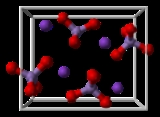
Potassium permanganate is an
inorganic chemical compoundInorganic compounds have traditionally been considered to be of inanimate, non-biological origin. In contrast, organic compounds have an explicit biological origin. However, over the past century, the classification of inorganic vs organic compounds has become less important to scientists,...
with the formula KMnO
4. It is a salt consisting of
K+Potassium is the chemical element with the symbol K and atomic number 19. Elemental potassium is a soft silvery-white alkali metal that oxidizes rapidly in air and is very reactive with water, generating sufficient heat to ignite the hydrogen emitted in the reaction.Potassium and sodium are...
and
MnO4−A permanganate is the general name for a chemical compound containing the manganate ion, . Because manganese is in the +7 oxidation state, the permanganate ion is a strong oxidizing agent. The ion has tetrahedral geometry...
ions. Formerly known as
permanganate of potash or
Condy's crystals, it is a strong
oxidizing agentAn oxidizing agent can be defined as a substance that removes electrons from another reactant in a redox chemical reaction...
. It dissolves in water to give intensely purple solutions, the evaporation of which leaves prismatic purplish-black glistening crystals. In 2000, worldwide production was estimated at 30,000 tonnes. In this compound,
manganeseManganese is a chemical element, designated by the symbol Mn. It has the atomic number 25. It is found as a free element in nature , and in many minerals...
is in the +7
oxidation stateIn chemistry, the oxidation state is an indicator of the degree of oxidation of an atom in a chemical compound. The formal oxidation state is the hypothetical charge that an atom would have if all bonds to atoms of different elements were 100% ionic. Oxidation states are typically represented by...
.
Structure and preparation
Potassium permanganate is produced industrially from manganese dioxide, which also occurs as the mineral
pyrolusitePyrolusite is a mineral consisting essentially of manganese dioxide and is important as an ore of manganese. It is a black, amorphous appearing mineral, often with a granular, fibrous or columnar structure, sometimes forming reniform crusts. It has a metallic luster, a black or bluish-black...
. The MnO
2 is fused with
potassium hydroxidePotassium hydroxide is an inorganic compound with the formula KOH, commonly called caustic potash.Along with sodium hydroxide , this colorless solid is a prototypical strong base. It has many industrial and niche applications. Most applications exploit its reactivity toward acids and its corrosive...
and heated in air or with a source of oxygen, like
potassium nitratePotassium nitrate is a chemical compound with the formula KNO3. It is an ionic salt of potassium ions K+ and nitrate ions NO3−.It occurs as a mineral niter and is a natural solid source of nitrogen. Its common names include saltpetre , from medieval Latin sal petræ: "stone salt" or possibly "Salt...
or
chloratePotassium chlorate is a compound containing potassium, chlorine and oxygen atoms, with the molecular formula KClO3. In its pure form, it is a white crystalline substance. It is the most common chlorate in industrial use...
. This process gives
potassium manganatePotassium manganate is the inorganic compound with the formula K2MnO4. This green-colored salt is an intermediate in the industrial synthesis of potassium permanganate , a common chemical...
, which upon
electrolytic oxidationIn chemistry and manufacturing, electrolysis is a method of using a direct electric current to drive an otherwise non-spontaneous chemical reaction...
in alkaline media, or by boiling the manganate solution in the presence of
carbon dioxideCarbon dioxide is a naturally occurring chemical compound composed of two oxygen atoms covalently bonded to a single carbon atom...
until all the green color is discharged, gives potassium permanganate.
- 2 MnO2 + 4 KOH + O2 → 2 K2MnO4 + 2 H2O
- 2 MnO42– + Cl2 → 2 MnO4– + 2 Cl–
or:
- 3 K2MnO4 + 2 CO2 → 2 KMnO4 + 2 K2CO3 + MnO2
In which the potassium permanganate is separated by filtering the insoluble manganese dioxide, evaporating the solution to 1/3 and recrystallizing it.
Permanganate salts can also be generated by treating a solution of Mn
2+ ions with strong oxidants such as lead dioxide (PbO
2), or
sodium bismuthateSodium bismuthate, also known as sodium bismuth oxide, is a slightly hygroscopic chemical compound with the chemical formula of NaBiO3.Sodium bismuthate is an oxidizer. It is not soluble in cold water, but decomposes when placed in hot water....
(NaBiO
3).
TestsClassical qualitative inorganic analysis is a method of analytical chemistry which seeks to find elemental composition of inorganic compounds. It is mainly focused on detecting ions in an aqueous solution, so that materials in other forms may need to be brought into this state before using standard...
for the presence of manganese exploit the vivid violet colour of permanganate produced by these reagents.
KMnO
4 forms orthorhombic crystals with constants:
a = 910.5
pmA picometre is a unit of length in the metric system, equal to one trillionth, i.e. of a metre, which is the current SI base unit of length...
,
b = 572.0 pm,
c = 742.5 pm. The overall motif is similar to that for
barium sulfateBarium sulfate is the inorganic compound with the chemical formula BaSO4. It is a white crystalline solid that is odorless and insoluble in water. It occurs as the mineral barite, which is the main commercial source of barium and materials prepared from it...
, with which it forms
solid solutionA solid solution is a solid-state solution of one or more solutes in a solvent. Such a mixture is considered a solution rather than a compound when the crystal structure of the solvent remains unchanged by addition of the solutes, and when the mixture remains in a single homogeneous phase...
s. In the solid (as in solution), each MnO
4- centres are tetrahedral. The Mn-O distances are 1.62 Å.
Reactions
Analytical
Potassium permanganate can be used to quantitatively determine the total oxidisable organic material in an aqueous sample. The value determined is known as the
permanganate value. In
analytical chemistryAnalytical chemistry is the study of the separation, identification, and quantification of the chemical components of natural and artificial materials. Qualitative analysis gives an indication of the identity of the chemical species in the sample and quantitative analysis determines the amount of...
, a standardized aqueous solution of KMnO
4 is sometimes used as an oxidizing
titrantTitration, also known as titrimetry, is a common laboratory method of quantitative chemical analysis that is used to determine the unknown concentration of an identified analyte. Because volume measurements play a key role in titration, it is also known as volumetric analysis. A reagent, called the...
for
redox titrationRedox titration is a type of titration based on a redox reaction between the analyte and titrant.Redox titration may involve the use of a redox indicator and/or a potentiometer.-Example:...
s (
permanganometryPermanganometry is one of the techniques used in qualitative analysis in Chemistry. It is a redox titration and involves the use of permanganates and is used to estimate the amount of analyte present in unknown chemical samples....
). In a related way, it is used as a
reagentA reagent is a "substance or compound that is added to a system in order to bring about a chemical reaction, or added to see if a reaction occurs." Although the terms reactant and reagent are often used interchangeably, a reactant is less specifically a "substance that is consumed in the course of...
to determine the
Kappa numberThe Kappa number is an indication of the residual lignin content or bleachability of wood pulp by a standarised analysis method.-Measuring method:...
of wood pulp. For the standardization of KMnO
4 solutions, reduction by
oxalic acidOxalic acid is an organic compound with the formula H2C2O4. This colourless solid is a dicarboxylic acid. In terms of acid strength, it is about 3,000 times stronger than acetic acid. Oxalic acid is a reducing agent and its conjugate base, known as oxalate , is a chelating agent for metal cations...
is often used.
Aqueous, acidic solutions of KMnO
4 are used to collect gaseous
mercuryMercury is a chemical element with the symbol Hg and atomic number 80. It is also known as quicksilver or hydrargyrum...
in flue gas during stationary source emissions testing.
Organic chemistry
Dilute solutions of KMnO
4 convert
alkeneIn organic chemistry, an alkene, olefin, or olefine is an unsaturated chemical compound containing at least one carbon-to-carbon double bond...
s into
diolA diol or glycol is a chemical compound containing two hydroxyl groups A geminal diol has two hydroxyl groups bonded to the same atom...
s (glycols). This behaviour is also used as a qualitative
testIn chemistry, a chemical test is a qualitative or quantitative procedure designed to prove the existence of, or to quantify, a chemical compound or chemical group with the aid of a specific reagent...
for the presence of double or triple bonds in a molecule, since the reaction decolourises the permanganate solution. It is sometimes referred to as
Baeyer's reagentBaeyer's reagent, named after the German organic chemist Adolf von Baeyer, is used in organic chemistry as a qualitative test for the presence of unsaturation, such as double bonds. The bromine test is also able to determine the presence of unsaturation....
. However,
bromineBromine ") is a chemical element with the symbol Br, an atomic number of 35, and an atomic mass of 79.904. It is in the halogen element group. The element was isolated independently by two chemists, Carl Jacob Löwig and Antoine Jerome Balard, in 1825–1826...
serves better in measuring unsaturation (double or triple bonds) quantitatively, since KMnO
4, being a very strong oxidizing agent, can react with a variety of groups.
Under acidic conditions, the alkene double bond is cleaved to give the appropriate
carboxylic acidCarboxylic acids are organic acids characterized by the presence of at least one carboxyl group. The general formula of a carboxylic acid is R-COOH, where R is some monovalent functional group...
:
- CH3(CH2)17CH=CH2 + 2 KMnO4 + 3 H2SO4 → CH3(CH2)17COOH + CO2 + 4 H2O + K2SO4 + 2 MnSO4
Potassium permanganate oxidizes aldehydes to carboxylic acids, such as the conversion of
n-
heptanalHeptanal or heptanaldehyde is an alkyl aldehyde with a strong fruity odor which is used as an ingredient in cosmetics, perfumes, and flavors. It can be obtained from castor oil by distillation under reduced pressure. Industrially, it is used in the manufacture of 1-heptanol and ethyl heptanoate....
to heptanoic acid:
- 5 C6H13CHO + 2 KMnO4 + 3 H2SO4 → 5 C6H13COOH + 3 H2O + K2SO4 + 2 MnSO4
Even an alkyl group (with a benzylic hydrogen) on an aromatic ring is oxidized, e.g.
tolueneToluene, formerly known as toluol, is a clear, water-insoluble liquid with the typical smell of paint thinners. It is a mono-substituted benzene derivative, i.e., one in which a single hydrogen atom from the benzene molecule has been replaced by a univalent group, in this case CH3.It is an aromatic...
to
benzoic acidBenzoic acid , C7H6O2 , is a colorless crystalline solid and the simplest aromatic carboxylic acid. The name derived from gum benzoin, which was for a long time the only source for benzoic acid. Its salts are used as a food preservative and benzoic acid is an important precursor for the synthesis...
.
- 5 C6H5CH3 + 6 KMnO4 + 9 H2SO4 → 5 C6H5COOH + 14 H2O + 2 K2SO4 + 6 MnSO4
Glycols and
polyolA polyol is an alcohol containing multiple hydroxyl groups. In two technological disciplines the term "polyol" has a special meaning: food science and polymer chemistry.- Polyols in food science :...
s are highly reactive toward KMnO
4. For example, addition of potassium permanganate to an aqueous solution of
sugarSugar is a class of edible crystalline carbohydrates, mainly sucrose, lactose, and fructose, characterized by a sweet flavor.Sucrose in its refined form primarily comes from sugar cane and sugar beet...
and
sodium hydroxide produces the "chemical chameleon" reaction, which involves dramatic colour changes associated with the various oxidation states of
manganeseManganese is a chemical element, designated by the symbol Mn. It has the atomic number 25. It is found as a free element in nature , and in many minerals...
. A related vigorous reaction is exploited as a fire starter in survival kits. For example, a mixture of potassium permanganate and
glycerolGlycerol is a simple polyol compound. It is a colorless, odorless, viscous liquid that is widely used in pharmaceutical formulations. Glycerol has three hydroxyl groups that are responsible for its solubility in water and its hygroscopic nature. The glycerol backbone is central to all lipids...
or pulverized
glucoseGlucose is a simple sugar and an important carbohydrate in biology. Cells use it as the primary source of energy and a metabolic intermediate...
ignites readily. Its sterilizing properties are another reason for inclusion of KMnO
4 in a survival kit.
"Purple benzene"
Purple benzene refers to solutions prepared by treating a two phase mixture of aqueous potassium permanganate and benzene with a quat salt. The quat cation forms a salt of permanganate that is soluble in benzene, giving this organic solvent a purple color. The reaction illustrate the ability of quat salts to confer lipophilicity to hydrophilic anions. The same effect can be obtained by complexing the potassium to
18-crown-618-Crown-6 is an organic compound with the formula [C2H4O]6 and the IUPAC name of 1,4,7,10,13,16-hexaoxacyclooctadecane. The compound is a crown ether. Crown ethers coordinate some metal cations in their central cavity; 18-crown-6 displays a particular affinity for potassium cations. The synthesis...
.
Reaction with acids
Concentrated
sulfuric acidSulfuric acid is a strong mineral acid with the molecular formula . Its historical name is oil of vitriol. Pure sulfuric acid is a highly corrosive, colorless, viscous liquid. The salts of sulfuric acid are called sulfates...
reacts with KMnO
4 to give
Mn2O7Manganese oxide is an inorganic compound with the formula Mn2O7. This volatile liquid is highly reactive and more often discussed than intentionally prepared. It is a dangerous oxidizer and was first described in 1860.- Properties :...
, which can be
explosiveAn explosion is a rapid increase in volume and release of energy in an extreme manner, usually with the generation of high temperatures and the release of gases. An explosion creates a shock wave. If the shock wave is a supersonic detonation, then the source of the blast is called a "high explosive"...
. Similarly concentrated
hydrochloric acidHydrochloric acid is a solution of hydrogen chloride in water, that is a highly corrosive, strong mineral acid with many industrial uses. It is found naturally in gastric acid....
gives
chlorineChlorine is the chemical element with atomic number 17 and symbol Cl. It is the second lightest halogen, found in the periodic table in group 17. The element forms diatomic molecules under standard conditions, called dichlorine...
. The Mn-containing products from redox reactions depend on the
pHIn chemistry, pH is a measure of the acidity or basicity of an aqueous solution. Pure water is said to be neutral, with a pH close to 7.0 at . Solutions with a pH less than 7 are said to be acidic and solutions with a pH greater than 7 are basic or alkaline...
. Acidic solutions of permanganate are
reducedRedox reactions describe all chemical reactions in which atoms have their oxidation state changed....
to the faintly pink manganese(II) ion (Mn
2+) and water. In
neutralIn chemistry, pH is a measure of the acidity or basicity of an aqueous solution. Pure water is said to be neutral, with a pH close to 7.0 at . Solutions with a pH less than 7 are said to be acidic and solutions with a pH greater than 7 are basic or alkaline...
solution, permanganate is only reduced by 3e
− to give MnO
2, wherein Mn is in a +4 oxidation state. This is the material that stains one's skin when handling KMnO
4. KMnO
4 spontaneously reduces in an alkaline solution to green
K2MnO4Potassium manganate is the inorganic compound with the formula K2MnO4. This green-colored salt is an intermediate in the industrial synthesis of potassium permanganate , a common chemical...
, wherein manganese is in the +6 oxidation state.
A curious reaction occurs upon addition of concentrated sulfuric acid to potassium permanganate. Although no reaction may be apparent, the vapor over the mixture will ignite paper impregnated with alcohol. Potassium permanganate and sulfuric acid react to produce some
ozoneOzone , or trioxygen, is a triatomic molecule, consisting of three oxygen atoms. It is an allotrope of oxygen that is much less stable than the diatomic allotrope...
, which has a high oxidising power and rapidly oxidises the alcohol, causing it to combust. As the reaction also produces explosive Mn
2O
7, this should only be attempted with great care.
Photodecomposition
Potassium
permanganateA permanganate is the general name for a chemical compound containing the manganate ion, . Because manganese is in the +7 oxidation state, the permanganate ion is a strong oxidizing agent. The ion has tetrahedral geometry...
decomposes when exposed to light:
- 2 KMnO4 → K2MnO4 + MnO2(s)+O2
Handling
As an oxidizer that generates the dark brown product
MnO2Manganese oxide is the inorganic compound with the formula . This blackish or brown solid occurs naturally as the mineral pyrolusite, which is the main ore of manganese and a component of manganese nodules. The principal use for MnO2 is for dry-cell batteries, such as the alkaline battery and the...
, potassium permanganate rapidly stains virtually any organic material such as skin, paper, and clothing. This staining effect is used to "develop"
TLCThin layer chromatography is a chromatography technique used to separate mixtures. Thin layer chromatography is performed on a sheet of glass, plastic, or aluminum foil, which is coated with a thin layer of adsorbent material, usually silica gel, aluminium oxide, or cellulose...
plates. The redox reaction is used for artistic purposes as an agent to prepare paper for fast bleaching. Lemon juice is enough to quickly remove colour from the paper and applied with a paint brush this can create interesting aesthetics. Even glassware containing solutions of KMnO
4 can become brown. MnO
2 can be removed by scrubbing with dilute acids ( a lemon rubbed into the skin works especially well) or with
sodium thiosulfateSodium thiosulfate , also spelled sodium thiosulphate, is a colorless crystalline compound that is more familiar as the pentahydrate, Na2S2O3•5H2O, an efflorescent, monoclinic crystalline substance also called sodium hyposulfite or “hypo.”...
.
Uses
Almost all applications of potassium permanganate exploit its
oxidizing propertiesAn oxidizing agent can be defined as a substance that removes electrons from another reactant in a redox chemical reaction...
. As a strong oxidant that does not generate toxic byproducts, KMnO
4 has many niche uses.
Potassium permanganate is one of the principal chemicals used in the film and television industries to "age" props and set dressings. Its oxidising effects create "hundred year old" or "ancient" looks on hessian cloth, ropes, timber and glass. It was used on props and sets in films such as "Troy", "300" and "Indiana Jones".
Disinfectant and water treatment
As an oxidant, potassium permanganate can act as an antiseptic. For example, dilute solutions are used to treat
canker soresAn aphthous ulcer , also known as a canker sore, is a type of mouth ulcer which presents as a painful open sore inside the mouth or upper throat characterized by a break in the mucous membrane. Its cause is unknown, but they are not contagious...
(ulcers), disinfectant for the hands and treatment for mild pompholyx,
dermatitis-Etymology:Dermatitis derives from Greek derma "skin" + -itis "inflammation" and genetic disorder.-Terminology:There are several different types of dermatitis. The different kinds usually have in common an allergic reaction to specific allergens. The term may describe eczema, which is also called...
, and
fungalA fungus is a member of a large group of eukaryotic organisms that includes microorganisms such as yeasts and molds , as well as the more familiar mushrooms. These organisms are classified as a kingdom, Fungi, which is separate from plants, animals, and bacteria...
infections of the hands or feet.
Potassium permanganate is used extensively in the water treatment industry. It is used as a regeneration chemical to remove
ironIron is a chemical element with the symbol Fe and atomic number 26. It is a metal in the first transition series. It is the most common element forming the planet Earth as a whole, forming much of Earth's outer and inner core. It is the fourth most common element in the Earth's crust...
and
hydrogen sulfideHydrogen sulfide is the chemical compound with the formula . It is a colorless, very poisonous, flammable gas with the characteristic foul odor of expired eggs perceptible at concentrations as low as 0.00047 parts per million...
(rotten egg smell) from
wellA water well is an excavation or structure created in the ground by digging, driving, boring or drilling to access groundwater in underground aquifers. The well water is drawn by an electric submersible pump, a trash pump, a vertical turbine pump, a handpump or a mechanical pump...
water via a "Manganese Greensand" Filter. "Pot-Perm" is also obtainable at
poolA swimming pool, swimming bath, wading pool, or simply a pool, is a container filled with water intended for swimming or water-based recreation. There are many standard sizes; the largest is the Olympic-size swimming pool...
supply stores, is used additionally to treat waste water. Historically it was used to disinfect drinking water. It currently finds application in the control of nuisance organisms such as
Zebra musselThe zebra mussel, Dreissena polymorpha, is a small freshwater mussel. This species was originally native to the lakes of southeast Russia being first described in 1769 by a German zoologist Peter Simon Pallas in the Ural, Volga and Dnieper rivers. They are still found nearby, as Pontic and Caspian...
s in fresh water collection and treatment systems.
Biomedical uses
Related to the use of KMnO
4 for water treatment, this salt is often employed as a specialized disinfectant for treating human and animal ailments. In
histologyHistology is the study of the microscopic anatomy of cells and tissues of plants and animals. It is performed by examining cells and tissues commonly by sectioning and staining; followed by examination under a light microscope or electron microscope...
, it is used to bleach melanin which obscures tissue detail. Potassium permanganate can also be used to differentiate
amyloidAmyloids are insoluble fibrous protein aggregates sharing specific structural traits. Abnormal accumulation of amyloid in organs may lead to amyloidosis, and may play a role in various neurodegenerative diseases.-Definition:...
AA from other types of amyloid pathologically deposited in body tissues. Incubation of fixed tissue with potassium permanganate will prevent amyloid AA from staining with
congo redCongo red is the sodium salt of 3,3'-bis. It is a secondary diazo dye...
whereas other types of amyloid are unaffected. Permanganate washes were once used to treat
gonorrheaGonorrhea is a common sexually transmitted infection caused by the bacterium Neisseria gonorrhoeae. The usual symptoms in men are burning with urination and penile discharge. Women, on the other hand, are asymptomatic half the time or have vaginal discharge and pelvic pain...
and are still used to treat
candidiasisThrush redirects here. For the hoof infection see Thrush .Candidiasis or thrush is a fungal infection of any of the Candida species , of which Candida albicans is the most common...
. It can be used to inactivate the poison strychnine.
Organic synthesis
Aside from its use in water treatment, the other major application of KMnO
4 is as a reagent for the synthesis of organic compounds. Significant amounts are required for the synthesis of
ascorbic acidAscorbic acid is a naturally occurring organic compound with antioxidant properties. It is a white solid, but impure samples can appear yellowish. It dissolves well in water to give mildly acidic solutions. Ascorbic acid is one form of vitamin C. The name is derived from a- and scorbutus , the...
,
chloramphenicolChloramphenicol is a bacteriostatic antimicrobial that became available in 1949. It is considered a prototypical broad-spectrum antibiotic, alongside the tetracyclines, and as it is both cheap and easy to manufacture it is frequently found as a drug of choice in the third world.Chloramphenicol is...
,
saccharinSaccharin is an artificial sweetener. The basic substance, benzoic sulfilimine, has effectively no food energy and is much sweeter than sucrose, but has a bitter or metallic aftertaste, especially at high concentrations...
, isonicotinic acid, and
pyrazinoic acidPyrazinoic acid is a pyrazinamide metabolite....
.
Fruit preservation
Ethylene absorbents extend storage time of
bananaBanana is the common name for herbaceous plants of the genus Musa and for the fruit they produce. Bananas come in a variety of sizes and colors when ripe, including yellow, purple, and red....
even at high temperatures. This effect can be exploited by packing banana in a
polyethylenePolyethylene or polythene is the most widely used plastic, with an annual production of approximately 80 million metric tons...
with potassium permanganate as an ethylene absorbent, that doubles banana lifespan up to 3–4 weeks without the need for refrigeration.
Survival kits
Potassium permanganate is typically included in survival kits: as a fire starter, water sterilizer and for creating distress signals on snow.
History
In 1659,
Johann Rudolf GlauberJohann Rudolf Glauber was a German-Dutch alchemist and chemist. Some historians of science have described him as one of the first chemical engineers...
fused a mixture of the mineral
pyrolusitePyrolusite is a mineral consisting essentially of manganese dioxide and is important as an ore of manganese. It is a black, amorphous appearing mineral, often with a granular, fibrous or columnar structure, sometimes forming reniform crusts. It has a metallic luster, a black or bluish-black...
and
potassium carbonatePotassium carbonate is a white salt, soluble in water , which forms a strongly alkaline solution. It can be made as the product of potassium hydroxide's absorbent reaction with carbon dioxide. It is deliquescent, often appearing a damp or wet solid...
to obtain a material that, when dissolved in water, gave a green solution (
potassium manganatePotassium manganate is the inorganic compound with the formula K2MnO4. This green-colored salt is an intermediate in the industrial synthesis of potassium permanganate , a common chemical...
) which slowly shifted to violet and then finally red. This report represents the first description of the production of potassium permanganate. Just under two hundred years later London chemist
Henry Bollmann CondyHenry Bollmann Condy was a chemist and industrialist best noted for giving his name to the popular 19th and 20th century disinfectants Condy’s Crystals and Condy’s Fluid....
had an interest in disinfectants, and marketed several products including
ozonised water. He found that fusing pyrolusite with
NaOH and dissolving it in water produced a solution with disinfectant properties. He patented this solution, and marketed it as
Condy's Fluid. Although effective, the solution was not very stable. This was overcome by using
KOHPotassium hydroxide is an inorganic compound with the formula KOH, commonly called caustic potash.Along with sodium hydroxide , this colorless solid is a prototypical strong base. It has many industrial and niche applications. Most applications exploit its reactivity toward acids and its corrosive...
rather than
NaOH. This was more stable, and had the advantage of easy conversion to the equally effective potassium permanganate crystals. This crystalline material was known as
Condy's crystals or
Condy's powder. Potassium permanganate was comparatively easy to manufacture so
CondyHenry Bollmann Condy was a chemist and industrialist best noted for giving his name to the popular 19th and 20th century disinfectants Condy’s Crystals and Condy’s Fluid....
was subsequently forced to spend considerable time in litigation in order to stop competitors from marketing products similar to
Condy's Fluid or
Condy's Crystals.
Early photographers used it as a component of
flash powderFlash powder is a pyrotechnic composition, a mixture of oxidizer and metallic fuel, which burns quickly and if confined produces a loud report. It is widely used in theatrical pyrotechnics and fireworks and was once used for flashes in photography.Different varieties of flash powder are made from...
. It is now replaced with other oxidizers, due to the instability of permanganate mixtures. Aqueous solutions of KMnO
4 have been used together with
T-StoffT-Stoff was the oxidizer part of a bipropellant rocket fuel combination used in Germany during World War II. It is a stabilized high test peroxide...
(i.e. 80%
hydrogen peroxideHydrogen peroxide is the simplest peroxide and an oxidizer. Hydrogen peroxide is a clear liquid, slightly more viscous than water. In dilute solution, it appears colorless. With its oxidizing properties, hydrogen peroxide is often used as a bleach or cleaning agent...
) as propellant for the
rocketA rocket is a missile, spacecraft, aircraft or other vehicle which obtains thrust from a rocket engine. In all rockets, the exhaust is formed entirely from propellants carried within the rocket before use. Rocket engines work by action and reaction...
plane
Messerschmitt Me 163The Messerschmitt Me 163 Komet, designed by Alexander Lippisch, was a German rocket-powered fighter aircraft. It is the only rocket-powered fighter aircraft ever to have been operational. Its design was revolutionary, and the Me 163 was capable of performance unrivaled at the time. Messerschmitt...
. In this application, it was known as
Z-StoffZ-Stoff was a name for calcium permanganate or potassium permanganate mixed in water. It was normally used as a catalyst for T-Stoff in military rocket programs by Nazi Germany during World War II....
. This combination of propellants is sometimes still used in
torpedoThe modern torpedo is a self-propelled missile weapon with an explosive warhead, launched above or below the water surface, propelled underwater towards a target, and designed to detonate either on contact with it or in proximity to it.The term torpedo was originally employed for...
es.
Safety
Solid KMnO
4 is a strong oxidizer and thus should be kept separated from oxidizable substances. Reaction with concentrated sulfuric acid produces the highly explosive
manganese(VII) oxideManganese oxide is an inorganic compound with the formula Mn2O7. This volatile liquid is highly reactive and more often discussed than intentionally prepared. It is a dangerous oxidizer and was first described in 1860.- Properties :...
(Mn
2O
7).
When solid KMnO
4 is mixed with pure
glycerolGlycerol is a simple polyol compound. It is a colorless, odorless, viscous liquid that is widely used in pharmaceutical formulations. Glycerol has three hydroxyl groups that are responsible for its solubility in water and its hygroscopic nature. The glycerol backbone is central to all lipids...
or other simple alcohols it will result in a violent combustion reaction.
- 3 C3H5(OH)3
Glycerol is a simple polyol compound. It is a colorless, odorless, viscous liquid that is widely used in pharmaceutical formulations. Glycerol has three hydroxyl groups that are responsible for its solubility in water and its hygroscopic nature. The glycerol backbone is central to all lipids...
+ 14 KMnO4 → 14 MnO2 + 14 KOHPotassium hydroxide is an inorganic compound with the formula KOH, commonly called caustic potash.Along with sodium hydroxide , this colorless solid is a prototypical strong base. It has many industrial and niche applications. Most applications exploit its reactivity toward acids and its corrosive...
+ 9 CO2Carbon dioxide is a naturally occurring chemical compound composed of two oxygen atoms covalently bonded to a single carbon atom...
+ 5 H2OWater is a chemical substance with the chemical formula H2O. A water molecule contains one oxygen and two hydrogen atoms connected by covalent bonds. Water is a liquid at ambient conditions, but it often co-exists on Earth with its solid state, ice, and gaseous state . Water also exists in a...
Potassium permanganate may leave behind a brownish stain which can be removed by using
sodium bisulfiteSodium bisulfite is a chemical compound with the chemical formula NaHSO3. Sodium bisulfite is a food additive with E number E222. This salt of bisulfite can be prepared by bubbling sulfur dioxide in a solution of sodium carbonate in water...
or
oxalic acidOxalic acid is an organic compound with the formula H2C2O4. This colourless solid is a dicarboxylic acid. In terms of acid strength, it is about 3,000 times stronger than acetic acid. Oxalic acid is a reducing agent and its conjugate base, known as oxalate , is a chelating agent for metal cations...
.
External links