
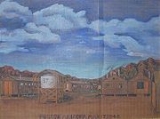
The
Poston War Relocation Center, located in
Yuma CountyYuma County is a county located in the southwestern corner of the U.S. state of Arizona. As of 2007, its population was estimated to be 190,557, an increase of 30,531 people since the 2000 census count of 160,026...
(now in La Paz County) of
ArizonaThe State of Arizona is a state located in the southwestern region of the United States. The capital and largest city is Phoenix. The second largest city is Tucson, followed in size by the four Phoenix metropolitan area cities of Mesa, Glendale, Chandler, and Scottsdale.Arizona was the 48th and...
, was the largest of the ten American internment camps operated by the
War Relocation AuthorityThe War Relocation Authority was the U.S. civilian agency responsible for the relocation and internment of Japanese Americans during World War II. President Franklin D...
during
World War IIWorld War II, or the Second World War , was a global military conflict which involved a majority of the world's nations, including all great powers, organized into two opposing military alliances: the Allies and the Axis...
.
The Center was composed of three separate camps arranged in a chain from north to south at a distance of three miles from each other. Internees named the camps Roasten, Toastin, and Dustin, based on their desert locations.
The
Poston War Relocation Center, located in
Yuma CountyYuma County is a county located in the southwestern corner of the U.S. state of Arizona. As of 2007, its population was estimated to be 190,557, an increase of 30,531 people since the 2000 census count of 160,026...
(now in La Paz County) of
ArizonaThe State of Arizona is a state located in the southwestern region of the United States. The capital and largest city is Phoenix. The second largest city is Tucson, followed in size by the four Phoenix metropolitan area cities of Mesa, Glendale, Chandler, and Scottsdale.Arizona was the 48th and...
, was the largest of the ten American internment camps operated by the
War Relocation AuthorityThe War Relocation Authority was the U.S. civilian agency responsible for the relocation and internment of Japanese Americans during World War II. President Franklin D...
during
World War IIWorld War II, or the Second World War , was a global military conflict which involved a majority of the world's nations, including all great powers, organized into two opposing military alliances: the Allies and the Axis...
.
The Center was composed of three separate camps arranged in a chain from north to south at a distance of three miles from each other. Internees named the camps Roasten, Toastin, and Dustin, based on their desert locations. The
Colorado RiverThe Colorado River , or the Red River, is a river in the southwestern United States and northwestern Mexico, approximately long, draining a part of the arid regions on the western slope of the Rocky Mountains...
was approximately to the west, outside of the camp perimeter.
Poston was built on the
Colorado River Indian ReservationThe Colorado River Indian Reservation is 189 miles west of Phoenix, Arizona, on highway 95. It lies in western La Paz County, Arizona, southeastern San Bernardino County, California, and northeastern Riverside County, California. It has a total land area of 1,119.4445 km² , and most of it lies...
, over the objections of the Tribal Council, who refused to be a part of doing to others what had been done to their tribe. However, officials of the
Bureau of Indian AffairsThe Bureau of Indian Affairs is an agency of the federal government of the United States within the US Department of the Interior charged with the administration and management of 55.7 million acres of land held in trust by the United States for Native Americans in the United States, Native...
overrode the Council, seeing the opportunity to bring in improvements and develop agricultural land on the War Department budget and with thousands of "volunteers," which would remain after the war and aid the Reservation's permanent population.
The combined peak population of the Poston camps was over 17,000, mostly from Southern California. At the time Poston was the third largest "city" in Arizona. It was built by
Del WebbDelbert E. Webb was an American construction magnate, real estate developer and sports-team owner who is significant for founding and developing the retirement community of Sun City, Arizona. He was born in Fresno, California and dropped out of high school to become a carpenter's apprentice...
who would later become famous building
Sun City, ArizonaSun City is a census-designated place and unincorporated town in Maricopa County, Arizona, United States. The population was 38,309 at the 2000 census...
, and other retirement communities.
A single fence surrounded all three camps, though Poston II and III did not have gatehouses. The thousands of internees and staff passed through the barbed-wire perimeter at Poston I, which was where the main administration center was located.
Poston was a subject of a sociological research by
Alexander H. LeightonAlexander "Alec" H. Leighton was a sociologist and psychiatrist of dual citizenship . He is best known for his work on the Stirling County Study and his contributions to the field of psychiatric epidemiology...
, published in his 1945 book,
The Governing of Men. As
Time Magazine wrote, "After fifteen months at Arizona's vast Poston Relocation Center as a social analyst, Commander Leighton concluded that many an American simply fails to remember that U.S. Japanese are human beings."
Life at Poston
Perhaps the frustration felt in the concentration camps was best expressed by this anonymous poem, which was written by an internee at Poston:
That Damned Fence (anonymous)
They've sunk the posts deep into the ground
They've strung out wires all the way around.
With machine gun nests just over there
And sentries and soldiers everywhere.
We're trapped like rats in a wired cage,
To fret and fume with impotent rage;
Yonder whispers the lure of the night,
But that DAMNED FENCE assails our sight.
We seek the softness of the midnight air,
But that DAMNED FENCE in the floodlight glare
Awakens unrest in our nocturnal quest,
And mockingly laughs with vicious jest.
With nowhere to go and nothing to do,
We feel terrible, lonesome, and blue:
That DAMNED FENCE is driving us crazy,
Destroying our youth and making us lazy.
Imprisoned in here for a long, long time,
We know we're punished--though we've committed no crime,
Our thoughts are gloomy and enthusiasm damp,
To be locked up in a concentration camp.
Loyalty we know, and patriotism we feel,
To sacrifice our utmost was our ideal,
To fight for our country, and die, perhaps;
But we're here because we happen to be Japs.
We all love life, and our country best,
Our misfortune to be here in the west,
To keep us penned behind that DAMNED FENCE,
Is someone's notion of NATIONAL DEFENSE!
Unlike the nine other concentration camps, the agricultural and animal husbandry areas of Poston were within the perimeter fence. Schools and a number of other buildings were constructed by the internees. A shortage of available lumber led them to build using
adobeAdobe is a natural building material made from sand, clay, and water, with some kind of fibrous or organic material , which is shaped into bricks using frames and dried in the sun. It is similar to cob and mudbrick. Adobe structures are extremely durable and account for some of the oldest extant...
. Many of the inhabitants participated and created their own recreational activities, such as the Boy Scouts, sports teams, and various jobs. Poston also contained poor sanitary conditions.
Poston Today
A number of buildings built for the concentration camps are still in use today. Others, while still existing, are seriously deteriorated and in desperate need of maintenance. The majority were removed after the camp closed, and many are still in use as utility buildings in surrounding areas. The residential areas have been largely converted to agricultural use.
Notable Poston internees
- Doris Matsui
Doris Okada Matsui is an American politician of the Democratic Party who represents in the United States House of Representatives...
(born 1944), a member of the U.S. House of Representatives.
- Isamu Noguchi
was a prominent Japanese American artist and landscape architect whose artistic career spanned six decades, from the 1920s onward. Known for his sculpture and public works, Noguchi also designed stage sets for various Martha Graham productions, and several mass-produced lamps and furniture pieces,...
(1904–1988), a prominent Japanese American artist and landscape architect.
- Vincent Okamoto
Vincent Okamoto is a former U.S. Army officer.-Biography:Okamoto was born to an American family of Japanese origin that was interned during the Second World War at the Poston relocation camp in Arizona...
(born 1943), a highly decorated veteran of the Vietnam War
- Roy I. Sano
Roy Isao Sano is a retired Japanese-American Bishop of the United Methodist Church, elected in 1984.Sano was born on 18 June 1931 in Brawley, California, of Japanese immigrants to the U.S. Upon the death of their third child, Roy's parents were converted to Christianity...
(born 1931), a retired Japanese-American Bishop of the United Methodist Church.
- Shinkichi Tajiri
Shinkichi Tajiri was a Dutch-American sculptor of Japanese ancestry . He was also active in painting, photography and cinematography....
(1923 - 2009), was a Dutch-American sculptor.
- A. Wallace Tashima
Atsushi Wallace Tashima is the third Asian American and first Japanese American in the history of the United States to be appointed to a United States Court of Appeals.-Early life:...
(born 1934), the first Japanese American to be appointed to a United States Court of Appeals.
- Hisako Terasaki
Hisako Terasaki , was a Japanese American etcher.-Early years:Terasaki's parents were economic migrants from Japan to the United States at the turn of the twentieth century...
(born 1928), a Japanese American etcher.
- Hisaye Yamamoto
- Background and career:Yamamoto was born in Redondo Beach, California, and is a Nisei, a Japanese-American whose parents were born in Japan . She was interned in the Poston War Relocation Center during the Second World War for three years. During her time there, she wrote for the Poston Chronicle...
(born 1921), a Japanese American writer of short stories.
- Wakako Yamauchi
Wakako Yamauchi is a Nisei Asian American female writer. Her plays are considered pioneering works in Asian American theatre.- Biography :...
(born 1924), a Japanese American playwright.
See also
- Japanese American Internment
Japanese American internment refers to the forcible relocation and internment in 1942 of approximately 120,000 Japanese Americans and Japanese residing in the United States to housing facilities called "War Relocation Camps," in the wake of Imperial Japan's attack on Pearl Harbor. The internment of...
- Other camps:
- Gila River War Relocation Center
The Gila River War Relocation Center was an internment camp built by the War Relocation Authority for internment of Japanese Americans during the Second World War. It was located about southeast of Phoenix, Arizona....
This center was also located on an Indian Reservation in Arizona.
- Granada War Relocation Center
The Granada War Relocation Center was a Japanese American internment camp located in southeast Colorado about a mile west of the small farming community of Granada, south of US 50....
- Heart Mountain War Relocation Center
The Heart Mountain Relocation Center, named after nearby Heart Mountain Butte, was one of ten internment camps used to incarcerate Japanese Americans excluded from the West Coast during World War II under the provisions of Executive Order 9066 signed by President Franklin D. Roosevelt...
- Jerome War Relocation Center
The Jerome War Relocation Center was a Japanese American internment camp located in southeastern Arkansas near the tiny town of Jerome. Open from October 1942 until June 1944, it was the last relocation camp to open and the first to close; at one point it contained as many as 8,497 inhabitants.,...
- Manzanar National Historic Site
Manzanar is most widely known as the site of one of ten camps where over 110,000 Japanese Americans were imprisoned during World War II. Located at the foot of the Sierra Nevada in California's Owens Valley between the towns of Lone Pine to the south and Independence to the north, it is...
- Minidoka National Historic Site
- Rohwer War Relocation Center
The Rohwer War Relocation Center was a World War II Japanese American internment camp located in rural southeastern Arkansas, in Desha County. It was in operation from September 18, 1942 until November 30, 1944, and held as many as 8,475 Japanese Americans forcibly evacuated from California...
- Topaz War Relocation Center
- Tule Lake War Relocation Center
Tule Lake Segregation Center National Monument was an internment camp in the northern California town of Newell near Tule Lake. It was used in the Japanese American internment during World War II. It was one of the largest and most controversial of the camps, and did not close until after the war,...
External links