

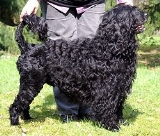
Portuguese Water Dog

Encyclopedia
The Portuguese Water Dog is a breed of working dog
as classified by the American Kennel Club. Portuguese Water Dogs are originally from the Portuguese region of the Algarve, from where the breed expanded to all around Portugal's
coast, where they were taught to herd fish into fishermen's nets, to retrieve lost tackle or broken nets, and to act as couriers from ship to ship, or ship to shore. Portuguese Water Dogs rode in bobbing fishing trawlers as they worked their way from the warm Atlantic waters of Portugal to the frigid fishing waters off the coast of Iceland
where the fleets caught cod
to bring home.
Portuguese Water Dogs were often taken with sailors during the Portuguese discoveries
.
In Portugal, the breed is called Cão de Água . In its native land, the dog is also known as the Algarvian Water Dog ("Cão de Água Algarvio"), or Portuguese Fishing Dog (Cão Pescador Português). Cão de Água de Pêlo Ondulado is the name given the wavy-haired variety, and Cão de Água de Pêlo Encaracolado is the name for the curly-coated variety.
The Portuguese Water Dog is a fairly rare breed; only 15 entrants for Portuguese Water Dogs were made to England
's Crufts
competition in 2002. Though some breeders claim they are a hypoallergenic dog breed, there is no scientific evidence to support the claim that hypoallergenic dog breeds exist. However, their non-shedding qualities have made them more popular in recent years.
, Barbet
and Standard Poodle. Like Poodles and several other water dog
breeds, PWDs are highly intelligent, can have curly coats, have webbed toes for swimming, and do not shed. However, Portuguese Water Dogs are more robustly built, with stout legs, and can have a wavy coat instead of tightly curled. If comparing the structure to that of a Poodle, there are significant differences between the two breeds. The Portuguese Water Dog built of strong substantial bone
; well developed, neither refined nor coarse, and a solidly built, muscular body. The Portuguese Water Dog is off-square, slightly longer than tall when measured from prosternum to rearmost point of the buttocks, and from withers to ground. Portuguese Water Dog eyes are black or various tones of brown, and their coats can be black, brown, black and white or brown and white.
Male Portuguese Water Dogs usually grow to be about 20 to 23 inches (51 cm to 58 cm) tall, and they weigh between 40 and 60 pounds (18 kg to 27 kg), while the females usually grow to be about 17 to 21 inches (43 cm to 53 cm) tall, and they weigh between 35 and 50 pounds.
PWDs have a single-layered coat that does not shed (see Moult
), and therefore their presence is tolerated extremely well among many people who suffer from dog allergies. Some call PWDs hypoallergenic
dogs, but any person with dog allergies who would like a dog with these qualities should actually spend time with the animals before purchasing, to test whether the dog is truly non-allergenic to them.
Most PWDs, especially those shown in conformation show
s, are entirely black, black and white, brown, or silver-tipped; it is common to see white chest spots and white paws or legs on black or brown coated dogs. "Parti" or "Irish-marked" coats, with irregular white and black spots, are rare but visually striking. "Parti" dogs are becoming more common in the United States. However, in Portugal the breed standard does not allow more than 30% white markings. Overall, white is the least common Portuguese Water Dog color, while black with white markings on the chin ("milk chin") and chest is the most common color combination.
From the Portuguese Water Dog Club of America Revised Standard for the Portuguese Water Dog come these descriptions of the two coat types:
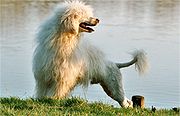 If left untended, the hair on a PWD will keep growing indefinitely. Problems associated with this include the hair around the eyes growing so long as to impede vision, and matting of the body hair, which can cause skin irritations. For these reasons, PWDs must be trimmed about every two months and the coat brushed every other day. This is not the breed for those humans wishing to have a low maintenance breed. In addition to the grooming, which typically costs between $75–100 a session, this breed requires daily exercise and consistently firm yet positive training techniques. Although it is possible to groom them at home, many owners find it easier to pay a professional groomer and, to avoid matting, they brush out the coat regularly between groomings.
Sometimes owners will clip the hair of their dogs very short, especially in the summer months, in modified retriever cut.
The PWD's biddability, high intelligence, and tendency to vocalise and then seek out its human master when specific alarms occur make it an ideal hearing-ear or deaf-assistance dog. PWDs can be readily trained to bark loudly when a telephone rings, and then to find and alert a hard-of-hearing or deaf master.
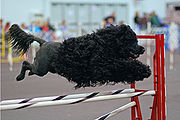 Portuguese Water dogs make excellent companions. They are loving, independent, and intelligent and are easily trained in obedience and agility skills. Once introduced, they are generally friendly to strangers, and enjoy being petted, which, due to their soft, fluffy coats, is a favour that human beings willingly grant them.
Because they are working dogs, PWDs are generally content in being at their master's side, awaiting directions, and, if they are trained, they are willing and able to follow complex commands. They learn very quickly, seem to enjoy the training, and have a long memory for the names of objects. These traits and their non-shedding coats mean they excel at the various Service Dog roles such as hearing dog
s (assistance dog
s for the deaf), mobility dogs, and seizure response dogs. They also make unusually good therapy dog
s.
A PWD usually stays in proximity to its owners, indoors as well as outdoors. This is typical of the breed. Though very gregarious animals, these dogs will typically bond with one primary or alpha family member. Some speculate that this intense bonding arose in the breed because the dogs were selected to work in proximity to their masters on small fishing boats, unlike other working dogs such as herding dog
s and water dog
s that range out to perform tasks. In any case, the modern PWD, whether employed on a boat or kept as a pet or a working dog, loves water, attention, and prefers to be engaged in activity within sight of a human partner. This is not a breed to be left alone for long periods of time, indoors or out.
As water dogs, the PWD's retrieving instinct is strong, which also gives some dogs tugging and chewing tendencies.
A PWD will commonly jump as a greeting. Owners may choose to limit this behavior. Some PWDs may walk, hop, or "dance" on their hind legs when greeting or otherwise enthusiastic. Some PWDs will stand upright at kitchen counters and tables, especially if they smell food above them. This habit is known as "counter surfing" and is characteristic of the breed. Although it can be a nuisance, many PWD owners evidently enjoy seeing their dogs walking, hopping, standing up, or "countering" and do not seriously discourage these activities.
While they are very good companions to people who understand what they need, Portuguese Water Dogs are not for everyone. Because of their intelligence and working drive, they require regular intensive exercise as well as mental challenges. They are gentle and patient — but not "couch potatoes", and boredom may cause them to become destructive.
 One theory is that some of the rugged Asian herding dogs were captured by the Berbers
, people who spread slowly across the face of North Africa
to Morocco
. Their descendants, the Moors
, arrived in Portugal in the 8th century, bringing the water dogs with them.
Another theory purports that some of the dogs left the Asian steppes with the Goths
, a confederation of German tribes. Some, (the Ostrogoths), went west and their dogs became the German poodle, called in German the poodle-hund or puddle-dog, that is, water-dog. Others, (the Visigoths), went south to fight the Romans, and their dogs became the Lion Dog, groomed in the traditional lion cut. In 400 CE
, the Visigoths invaded Iberia
(modern Spain
and Portugal, then known as Hispania
) and the dogs found their homeland.
A Portuguese Water Dog is first described in 1297 in a monk’s account of a drowning sailor who was pulled from the sea by a dog with a "black coat, the hair long and rough, cut to the first rib and with a tail tuft".
"History of the Portuguese Water Dog", Kathryn Braund and Deyanne Farrell Miller, The Complete Portuguese Water Dog, 1986, webpage: DeLeao.
These theories explain how the Poodle and the Portuguese Water Dog may have developed from the same ancient genetic pool. At one time the Poodle was a longer-coated dog, as is one variety of the Portuguese Water Dog. The possibility also exists that some of the long-coated water dogs grew up with the ancient Iberians
. In early times, Celtiberians migrated from lands which now belong to southwestern Germany. Swarming over the Pyrenees, circulating over the whole of western Europe, they established bases in Iberia, as well as in Ireland, Wales, and Brittany. The Irish Water Spaniel
and Kerry Blue Terrier
are believed by some to be descendants of the Portuguese Water Dog.
, to whom he gave his last 17 PWDs and all his archives.
Dr. António Cabral was the founder of the Avalade kennels in Portugal. Ch. Charlie de Avalade (Charlie), a brown-coated dog, and C. B. Baluarte de Avalade (Balu) were two of his many famous PWDs. He registered his first PWD in 1954, after Bensaude had pioneered the re-establishment of the breed in Portugal. Cabral worked with Carla Molinari, Deyanne Miller, Sonja Santos and others to establish PWDs in the US. The "Mark of Cabral" is a triangular shape of different color/textured hair, usually a few inches from the base of the tail. You can see it more easily on a fresh lion clip—it can look like the clipper got too close.
Deyanne Miller is the single person most responsible for the rise of the PWD in America. In 1972, the Millers, along with 14 other people, formed the Portuguese Water Dog Club of America, Inc. (PWDCA). She worked with dogs from both the Cintron and Cabral lineages to establish a stable genetic pool of PWDs in the United States at her Farmion kennels. Another early US breeder of PWDs was the actor Raymond Burr
.
, PWDs are vulnerable to certain genetic defects. Due to the limited gene pool
for this breed, conscientious breeders carefully study pedigrees and select dogs to minimize the chance of genetic disease and improper coat. Unfortunately, like many breeds, a growing popularity has encouraged breeding by people who are not knowledgeable about the breed.
s, PWDs are vulnerable to hip dysplasia
. However, the risk of a PWD developing hip dysplasia can be greatly reduced by thoroughly checking the pedigrees and health clearances in both the sire and dam of your dog. Hip dysplasia is a congenital and developmental problem with the hip joints.
) are two eye diseases found in PWDs. As with hip dysplasia, some lines carry these defects more frequently than others. PRA, which causes "night blindness", may lead to complete blindness
. Fortunately this is a simple recessive gene. DNA testing is now available which can identify a dog carrying the gene for PRA. Known as "Optigen Testing" a "normal" or "A" dog does not carry the gene for PRA. A "carrier" or "B" dog carries one copy of the PRA gene and the dog will NOT express the disease but may or may not pass the gene to offspring. An "affected" or "C" dog has two copies of the PRA version of the gene and will probably express the disease as late onset Progressive Retinal Atrophy. A "B" or "C" dog should be bred only to an "A" dog to ensure that any offspring will not express the disease.
Ingrown eyelashes (distichiasis) occurs in some curly-coated breeds, but is not particularly common in PWDs. Ingrown eyelashes will rub the eye causing extensive corneal ulcerations. The condition is minor so long as it is not ignored, and can be surgically treated if necessary.
, is a recessive, genetic disorder that is inevitably fatal. It is caused by a deficiency
of beta-galactosidase
, with resulting abnormal storage of acidic lipid
materials in cells of the central
and peripheral nervous system
s, but particularly in the nerve cell
s. Because PWDs are all rather closely related to one another and share a limited gene pool, PWDs who were GM1 Storage Disease carriers were able to be genetically identified, and the condition has now been almost entirely eliminated from the breed. All breeding stock should be tested for GM-1 storage disease or GM1 gangliosidoses, which is a fatal nerve disease that typically appears when a puppy is approximately six months of age. The affected puppy will show clinical signs of cerebellar dysfunction including ataxia, tremors, paresis, and seizures. The pet may also exhibit a change in temperament. Lesions of the retina and clouding of the cornea may occur. GM-1 storage disease is a recessive deficiency of betagalactosidase. The condition has been genetically identified and is no longer common.
is a rare, fatal condition caused by an autosomal recessive gene. It affects young dogs, who succumb to heart failure before reaching adulthood. As a simple recessive gene, it had been difficult to identify and was particularly heartbreaking as seemingly healthy puppies would suddenly die, often shortly after joining their adopted families. Since a recessive gene is responsible, that means if at least one parent is homozygous dominant (that is, it does not carry a copy of the cardio version of the gene), its offspring can not contract the disease.
In 2007 a genetic linkage test became available which appears promising. This is not a test which confirms if a dog has, or does not have the disease; nor will it definitively predict the disease, as even if a dog is a JDC carrier this does not guarantee its offspring will suffer the disease. It only links certain strains of DNA
as carriers of JDC. This is significant in that these strains can now largely be deselected for in the breeding process, as has been successful with GM1 Storage Disease (see above). The test is not yet complete for every bloodline, and why the identified strains are implicated is still unknown, and so in essence the cause of the condition remains a mystery to be solved.
Working dog
A working dog refers to a canine working animal, i.e., a type of dog that is not merely a pet but learns and performs tasks to assist and/or entertain its human companions, or a breed of such origin...
as classified by the American Kennel Club. Portuguese Water Dogs are originally from the Portuguese region of the Algarve, from where the breed expanded to all around Portugal's
Portugal
Portugal , officially the Portuguese Republic is a country situated in southwestern Europe on the Iberian Peninsula. Portugal is the westernmost country of Europe, and is bordered by the Atlantic Ocean to the West and South and by Spain to the North and East. The Atlantic archipelagos of the...
coast, where they were taught to herd fish into fishermen's nets, to retrieve lost tackle or broken nets, and to act as couriers from ship to ship, or ship to shore. Portuguese Water Dogs rode in bobbing fishing trawlers as they worked their way from the warm Atlantic waters of Portugal to the frigid fishing waters off the coast of Iceland
Iceland
Iceland , described as the Republic of Iceland, is a Nordic and European island country in the North Atlantic Ocean, on the Mid-Atlantic Ridge. Iceland also refers to the main island of the country, which contains almost all the population and almost all the land area. The country has a population...
where the fleets caught cod
Cod
Cod is the common name for genus Gadus, belonging to the family Gadidae, and is also used in the common name for various other fishes. Cod is a popular food with a mild flavor, low fat content and a dense, flaky white flesh. Cod livers are processed to make cod liver oil, an important source of...
to bring home.
Portuguese Water Dogs were often taken with sailors during the Portuguese discoveries
Portuguese discoveries
Portuguese discoveries is the name given to the intensive maritime exploration by the Portuguese during the 15th and 16th centuries. Portuguese sailors were at the vanguard of European overseas exploration, discovering and mapping the coasts of Africa, Asia and Brazil, in what become known as the...
.
In Portugal, the breed is called Cão de Água . In its native land, the dog is also known as the Algarvian Water Dog ("Cão de Água Algarvio"), or Portuguese Fishing Dog (Cão Pescador Português). Cão de Água de Pêlo Ondulado is the name given the wavy-haired variety, and Cão de Água de Pêlo Encaracolado is the name for the curly-coated variety.
The Portuguese Water Dog is a fairly rare breed; only 15 entrants for Portuguese Water Dogs were made to England
England
England is a country that is part of the United Kingdom. It shares land borders with Scotland to the north and Wales to the west; the Irish Sea is to the north west, the Celtic Sea to the south west, with the North Sea to the east and the English Channel to the south separating it from continental...
's Crufts
Crufts
Crufts is an annual international Championship conformation show for dogs organised and hosted by the Kennel Club, currently held every March at the National Exhibition Centre in Birmingham, England. It is the largest annual dog show in the world, as declared by Guinness World Records, and lasts...
competition in 2002. Though some breeders claim they are a hypoallergenic dog breed, there is no scientific evidence to support the claim that hypoallergenic dog breeds exist. However, their non-shedding qualities have made them more popular in recent years.
Description
The closest relatives of the PWD are widely thought to be the Kerry Blue TerrierKerry Blue Terrier
The Kerry Blue Terrier is a breed of dog. Mistakenly thought to be from County Kerry in South West Ireland, it's actually from Tipperary in South Central Ireland. In Ireland it is often called the Irish Blue Terrier...
, Barbet
Barbet (dog)
The Barbet is a breed of dog; it is a medium-sized French water dog. It is listed in Group 8 by the , the French Kennel Club.- Description :...
and Standard Poodle. Like Poodles and several other water dog
Water dog
Water dogs, once called Water Spaniels, are a type of gun dog and count among their number some of the oldest dog breeds. With the advent of kennel clubs many water spaniels were accepted under the names including the designation retriever rather than water spaniel. As the name implies, water dogs...
breeds, PWDs are highly intelligent, can have curly coats, have webbed toes for swimming, and do not shed. However, Portuguese Water Dogs are more robustly built, with stout legs, and can have a wavy coat instead of tightly curled. If comparing the structure to that of a Poodle, there are significant differences between the two breeds. The Portuguese Water Dog built of strong substantial bone
Bone
Bones are rigid organs that constitute part of the endoskeleton of vertebrates. They support, and protect the various organs of the body, produce red and white blood cells and store minerals. Bone tissue is a type of dense connective tissue...
; well developed, neither refined nor coarse, and a solidly built, muscular body. The Portuguese Water Dog is off-square, slightly longer than tall when measured from prosternum to rearmost point of the buttocks, and from withers to ground. Portuguese Water Dog eyes are black or various tones of brown, and their coats can be black, brown, black and white or brown and white.
Male Portuguese Water Dogs usually grow to be about 20 to 23 inches (51 cm to 58 cm) tall, and they weigh between 40 and 60 pounds (18 kg to 27 kg), while the females usually grow to be about 17 to 21 inches (43 cm to 53 cm) tall, and they weigh between 35 and 50 pounds.
PWDs have a single-layered coat that does not shed (see Moult
Moult
In biology, moulting or molting , also known as sloughing, shedding, or for some species, ecdysis, is the manner in which an animal routinely casts off a part of its body , either at specific times of year, or at specific points in its life cycle.Moulting can involve the epidermis , pelage...
), and therefore their presence is tolerated extremely well among many people who suffer from dog allergies. Some call PWDs hypoallergenic
Hypoallergenic
Hypoallergenic, meaning "below normal" or "slightly" allergenic, was a term first used in a cosmetics campaign in 1953. It is used to describe items that cause or are claimed to cause fewer allergic reactions...
dogs, but any person with dog allergies who would like a dog with these qualities should actually spend time with the animals before purchasing, to test whether the dog is truly non-allergenic to them.
Most PWDs, especially those shown in conformation show
Conformation show
Conformation shows, also referred to as breed shows, are a kind of dog show in which a judge familiar with a specific dog breed evaluates individual purebred dogs for how well the dogs conform to the established breed type for their breed, as described in a breed's individual breed standard.A...
s, are entirely black, black and white, brown, or silver-tipped; it is common to see white chest spots and white paws or legs on black or brown coated dogs. "Parti" or "Irish-marked" coats, with irregular white and black spots, are rare but visually striking. "Parti" dogs are becoming more common in the United States. However, in Portugal the breed standard does not allow more than 30% white markings. Overall, white is the least common Portuguese Water Dog color, while black with white markings on the chin ("milk chin") and chest is the most common color combination.
Coat types
This breed does not shed its hair. The hair is either wavy or curly. Many dogs have mixed pattern hair: curly all over the body but wavy on the tail and ears.From the Portuguese Water Dog Club of America Revised Standard for the Portuguese Water Dog come these descriptions of the two coat types:
- Curly coat: "Compact, cylindrical curls, somewhat lusterless. The hair on the ears is sometimes wavy."
- Wavy coat: "Falling gently in waves, not curls, and with a slight sheen."
Grooming styles
The hair of PWDs grows continually and requires regular brushing and cutting or clipping. The coat is usually worn in a "retriever cut" or a "lion cut".The lion cut
In the lion cut, the hindquarters, muzzle, and the base of the tail are shaved and the rest of the body is left full length. This cut originated with the fishing dogs of Portugal. This is the traditional cut and perhaps the most functional, given the breed's main historical significance as a fisherman's companion. The lion cut diminished the initial impact and shock of cold water when the breed jumped from the boats, as well as providing warmth to the vitals. The hindquarters were left shaved to allow easier movement of the back legs and the breed's powerful, rudder-like tail.The retriever cut
The retriever cut is left 1" (2.5 cm) long evenly over the body (although some owners prefer the muzzle or the base of the tail shorter). This cut is a more recent style and originated because breeders wanted to make the breed more appealing and less unusual looking for buyers.Sometimes owners will clip the hair of their dogs very short, especially in the summer months, in modified retriever cut.
Vocalisation
Portuguese Water Dogs have a multi-octave voice. They tend to be quiet dogs although they will warn when the home is approached, and they will communicate their desires vocally and behaviourally to their owner. Their bark is loud and distinctive. They may engage in "expressive panting", by making a distinct "ha-ha-ha-ha" sound as an invitation to play or to indicate a desire for nearby food. They sometimes whine.The PWD's biddability, high intelligence, and tendency to vocalise and then seek out its human master when specific alarms occur make it an ideal hearing-ear or deaf-assistance dog. PWDs can be readily trained to bark loudly when a telephone rings, and then to find and alert a hard-of-hearing or deaf master.
Temperament
Because they are working dogs, PWDs are generally content in being at their master's side, awaiting directions, and, if they are trained, they are willing and able to follow complex commands. They learn very quickly, seem to enjoy the training, and have a long memory for the names of objects. These traits and their non-shedding coats mean they excel at the various Service Dog roles such as hearing dog
Hearing dog
A hearing dog is a specific type of assistance dog specifically selected and trained to assist people who are deaf or hearing impaired by alerting their handler to important sounds, such as doorbells, smoke alarms, ringing telephones, or alarm clocks...
s (assistance dog
Assistance dog
An assistance dog is a dog trained to aid or assist a person with a disability. Many are trained by a specific organization, while others are trained by their handler .-Classification:...
s for the deaf), mobility dogs, and seizure response dogs. They also make unusually good therapy dog
Therapy dog
A therapy dog is a dog trained to provide affection and comfort to people in hospitals, retirement homes, nursing homes, schools, people with learning difficulties, and stressful situations, such as disaster areas....
s.
A PWD usually stays in proximity to its owners, indoors as well as outdoors. This is typical of the breed. Though very gregarious animals, these dogs will typically bond with one primary or alpha family member. Some speculate that this intense bonding arose in the breed because the dogs were selected to work in proximity to their masters on small fishing boats, unlike other working dogs such as herding dog
Herding dog
A herding dog, also known as a stock dog or working dog, is a type of pastoral dog that either has been trained in herding or belongs to breeds developed for herding...
s and water dog
Water dog
Water dogs, once called Water Spaniels, are a type of gun dog and count among their number some of the oldest dog breeds. With the advent of kennel clubs many water spaniels were accepted under the names including the designation retriever rather than water spaniel. As the name implies, water dogs...
s that range out to perform tasks. In any case, the modern PWD, whether employed on a boat or kept as a pet or a working dog, loves water, attention, and prefers to be engaged in activity within sight of a human partner. This is not a breed to be left alone for long periods of time, indoors or out.
As water dogs, the PWD's retrieving instinct is strong, which also gives some dogs tugging and chewing tendencies.
A PWD will commonly jump as a greeting. Owners may choose to limit this behavior. Some PWDs may walk, hop, or "dance" on their hind legs when greeting or otherwise enthusiastic. Some PWDs will stand upright at kitchen counters and tables, especially if they smell food above them. This habit is known as "counter surfing" and is characteristic of the breed. Although it can be a nuisance, many PWD owners evidently enjoy seeing their dogs walking, hopping, standing up, or "countering" and do not seriously discourage these activities.
While they are very good companions to people who understand what they need, Portuguese Water Dogs are not for everyone. Because of their intelligence and working drive, they require regular intensive exercise as well as mental challenges. They are gentle and patient — but not "couch potatoes", and boredom may cause them to become destructive.
In ancient times
Berber people
Berbers are the indigenous peoples of North Africa west of the Nile Valley. They are continuously distributed from the Atlantic to the Siwa oasis, in Egypt, and from the Mediterranean to the Niger River. Historically they spoke the Berber language or varieties of it, which together form a branch...
, people who spread slowly across the face of North Africa
North Africa
North Africa or Northern Africa is the northernmost region of the African continent, linked by the Sahara to Sub-Saharan Africa. Geopolitically, the United Nations definition of Northern Africa includes eight countries or territories; Algeria, Egypt, Libya, Morocco, South Sudan, Sudan, Tunisia, and...
to Morocco
Morocco
Morocco , officially the Kingdom of Morocco , is a country located in North Africa. It has a population of more than 32 million and an area of 710,850 km², and also primarily administers the disputed region of the Western Sahara...
. Their descendants, the Moors
Moors
The description Moors has referred to several historic and modern populations of the Maghreb region who are predominately of Berber and Arab descent. They came to conquer and rule the Iberian Peninsula for nearly 800 years. At that time they were Muslim, although earlier the people had followed...
, arrived in Portugal in the 8th century, bringing the water dogs with them.
Another theory purports that some of the dogs left the Asian steppes with the Goths
Goths
The Goths were an East Germanic tribe of Scandinavian origin whose two branches, the Visigoths and the Ostrogoths, played an important role in the fall of the Roman Empire and the emergence of Medieval Europe....
, a confederation of German tribes. Some, (the Ostrogoths), went west and their dogs became the German poodle, called in German the poodle-hund or puddle-dog, that is, water-dog. Others, (the Visigoths), went south to fight the Romans, and their dogs became the Lion Dog, groomed in the traditional lion cut. In 400 CE
Common Era
Common Era ,abbreviated as CE, is an alternative designation for the calendar era originally introduced by Dionysius Exiguus in the 6th century, traditionally identified with Anno Domini .Dates before the year 1 CE are indicated by the usage of BCE, short for Before the Common Era Common Era...
, the Visigoths invaded Iberia
Iberian Peninsula
The Iberian Peninsula , sometimes called Iberia, is located in the extreme southwest of Europe and includes the modern-day sovereign states of Spain, Portugal and Andorra, as well as the British Overseas Territory of Gibraltar...
(modern Spain
Spain
Spain , officially the Kingdom of Spain languages]] under the European Charter for Regional or Minority Languages. In each of these, Spain's official name is as follows:;;;;;;), is a country and member state of the European Union located in southwestern Europe on the Iberian Peninsula...
and Portugal, then known as Hispania
Hispania
Another theory holds that the name derives from Ezpanna, the Basque word for "border" or "edge", thus meaning the farthest area or place. Isidore of Sevilla considered Hispania derived from Hispalis....
) and the dogs found their homeland.
A Portuguese Water Dog is first described in 1297 in a monk’s account of a drowning sailor who was pulled from the sea by a dog with a "black coat, the hair long and rough, cut to the first rib and with a tail tuft".
"History of the Portuguese Water Dog", Kathryn Braund and Deyanne Farrell Miller, The Complete Portuguese Water Dog, 1986, webpage: DeLeao.
These theories explain how the Poodle and the Portuguese Water Dog may have developed from the same ancient genetic pool. At one time the Poodle was a longer-coated dog, as is one variety of the Portuguese Water Dog. The possibility also exists that some of the long-coated water dogs grew up with the ancient Iberians
Iberians
The Iberians were a set of peoples that Greek and Roman sources identified with that name in the eastern and southern coasts of the Iberian peninsula at least from the 6th century BC...
. In early times, Celtiberians migrated from lands which now belong to southwestern Germany. Swarming over the Pyrenees, circulating over the whole of western Europe, they established bases in Iberia, as well as in Ireland, Wales, and Brittany. The Irish Water Spaniel
Irish Water Spaniel
The Irish Water Spaniel is a breed of dog that is the largest and one of the oldest of spaniels.The Irish Water Spaniel is considered one of the rarer breeds with the AKC in terms of registrations but is still widely respected and sought-after for its unusual qualities.-Appearance:The Irish Water...
and Kerry Blue Terrier
Kerry Blue Terrier
The Kerry Blue Terrier is a breed of dog. Mistakenly thought to be from County Kerry in South West Ireland, it's actually from Tipperary in South Central Ireland. In Ireland it is often called the Irish Blue Terrier...
are believed by some to be descendants of the Portuguese Water Dog.
Modern day
The PWD was a breed on the verge of extinction when, during the 1930s, Vasco Bensaude, a wealthy Portuguese shipping magnate, began to seek out fishermen's dogs and utilize them in a breeding program to re-establish the breed. Bensaude's kennel was named Algarbiorum, and his most famous dog was Leão (1931–1942), a very "type-y" fisherman's stud dog who was bred to so many different females that about half of the pedigreed Portuguese Water Dogs in existence can trace their lineage back to him. Bensaude was aided by two Portuguese veterinarians, Dr. Francisco Pinto Soares and Dr. Manuel Fernandes Marques. His work was carried on by Conchita Cintron de Castelo BrancoConchita Cintrón
Concepción Cintrón Verrill, also known as Conchita Cintrón or La Diosa de Oro , was a Chilean torera , perhaps the most famous in the history of bullfighting...
, to whom he gave his last 17 PWDs and all his archives.
Dr. António Cabral was the founder of the Avalade kennels in Portugal. Ch. Charlie de Avalade (Charlie), a brown-coated dog, and C. B. Baluarte de Avalade (Balu) were two of his many famous PWDs. He registered his first PWD in 1954, after Bensaude had pioneered the re-establishment of the breed in Portugal. Cabral worked with Carla Molinari, Deyanne Miller, Sonja Santos and others to establish PWDs in the US. The "Mark of Cabral" is a triangular shape of different color/textured hair, usually a few inches from the base of the tail. You can see it more easily on a fresh lion clip—it can look like the clipper got too close.
Deyanne Miller is the single person most responsible for the rise of the PWD in America. In 1972, the Millers, along with 14 other people, formed the Portuguese Water Dog Club of America, Inc. (PWDCA). She worked with dogs from both the Cintron and Cabral lineages to establish a stable genetic pool of PWDs in the United States at her Farmion kennels. Another early US breeder of PWDs was the actor Raymond Burr
Raymond Burr
Raymond William Stacey Burr was a Canadian actor, primarily known for his title roles in the television dramas Perry Mason and Ironside. His early acting career included roles on Broadway, radio, television and in film, usually as the villain...
.
Genetic diseases
As with all purebred dogsPurebred (dog)
Purebred dog refers to a dog of a modern dog breed that closely resembles other dogs of the same breed, with ancestry documented in a stud book and registered with one of the major dog registries...
, PWDs are vulnerable to certain genetic defects. Due to the limited gene pool
Gene pool
In population genetics, a gene pool is the complete set of unique alleles in a species or population.- Description :A large gene pool indicates extensive genetic diversity, which is associated with robust populations that can survive bouts of intense selection...
for this breed, conscientious breeders carefully study pedigrees and select dogs to minimize the chance of genetic disease and improper coat. Unfortunately, like many breeds, a growing popularity has encouraged breeding by people who are not knowledgeable about the breed.
Hip dysplasia
Like poodlePoodle
The Poodle is a breed of dog. The poodle breed is found officially in toy, miniature, and standard sizes, with many coat colors. Originally bred as a type of water dog, the poodle is highly intelligent and skillful in many dog sports, including agility, obedience, tracking, and even herding...
s, PWDs are vulnerable to hip dysplasia
Hip dysplasia
Hip dysplasia is an abnormal formation of the hip socket that, in its more severe form, can eventually cause crippling lameness and painful arthritis of the joints. It is a genetic trait that is affected by environmental factors...
. However, the risk of a PWD developing hip dysplasia can be greatly reduced by thoroughly checking the pedigrees and health clearances in both the sire and dam of your dog. Hip dysplasia is a congenital and developmental problem with the hip joints.
Cataracts, PRA, and distichiasis
Cataracts and PRA (Progressive Retinal AtrophyProgressive retinal atrophy
Progressive retinal atrophy is a group of genetic diseases seen in certain breeds of dogs and, more rarely, cats. Similar to retinitis pigmentosa in humans, it is characterized by the bilateral degeneration of the retina, causing progressive vision loss culminating in blindness...
) are two eye diseases found in PWDs. As with hip dysplasia, some lines carry these defects more frequently than others. PRA, which causes "night blindness", may lead to complete blindness
Blindness
Blindness is the condition of lacking visual perception due to physiological or neurological factors.Various scales have been developed to describe the extent of vision loss and define blindness...
. Fortunately this is a simple recessive gene. DNA testing is now available which can identify a dog carrying the gene for PRA. Known as "Optigen Testing" a "normal" or "A" dog does not carry the gene for PRA. A "carrier" or "B" dog carries one copy of the PRA gene and the dog will NOT express the disease but may or may not pass the gene to offspring. An "affected" or "C" dog has two copies of the PRA version of the gene and will probably express the disease as late onset Progressive Retinal Atrophy. A "B" or "C" dog should be bred only to an "A" dog to ensure that any offspring will not express the disease.
Ingrown eyelashes (distichiasis) occurs in some curly-coated breeds, but is not particularly common in PWDs. Ingrown eyelashes will rub the eye causing extensive corneal ulcerations. The condition is minor so long as it is not ignored, and can be surgically treated if necessary.
GM1 Storage Disease
GM1 Storage Disease, one of a family of conditions called GM1 gangliosidosesGM1 gangliosidoses
The GM1 gangliosidoses are caused by a deficiency of beta-galactosidase, with resulting abnormal storage of acidic lipid materials in cells of the central and peripheral nervous systems, but particularly in the nerve cells.-Early infantile GM1:...
, is a recessive, genetic disorder that is inevitably fatal. It is caused by a deficiency
Deficiency
A deficiency is generally a lack of something. It may also refer to:*A deficient number, in mathematics, a number n for which σ A deficiency is generally a lack of something. It may also refer to:...
of beta-galactosidase
Beta-galactosidase
β-galactosidase, also called beta-gal or β-gal, is a hydrolase enzyme that catalyzes the hydrolysis of β-galactosides into monosaccharides. Substrates of different β-galactosidases include ganglioside GM1, lactosylceramides, lactose, and various glycoproteins...
, with resulting abnormal storage of acidic lipid
Lipid
Lipids constitute a broad group of naturally occurring molecules that include fats, waxes, sterols, fat-soluble vitamins , monoglycerides, diglycerides, triglycerides, phospholipids, and others...
materials in cells of the central
Central nervous system
The central nervous system is the part of the nervous system that integrates the information that it receives from, and coordinates the activity of, all parts of the bodies of bilaterian animals—that is, all multicellular animals except sponges and radially symmetric animals such as jellyfish...
and peripheral nervous system
Peripheral nervous system
The peripheral nervous system consists of the nerves and ganglia outside of the brain and spinal cord. The main function of the PNS is to connect the central nervous system to the limbs and organs. Unlike the CNS, the PNS is not protected by the bone of spine and skull, or by the blood–brain...
s, but particularly in the nerve cell
Neuron
A neuron is an electrically excitable cell that processes and transmits information by electrical and chemical signaling. Chemical signaling occurs via synapses, specialized connections with other cells. Neurons connect to each other to form networks. Neurons are the core components of the nervous...
s. Because PWDs are all rather closely related to one another and share a limited gene pool, PWDs who were GM1 Storage Disease carriers were able to be genetically identified, and the condition has now been almost entirely eliminated from the breed. All breeding stock should be tested for GM-1 storage disease or GM1 gangliosidoses, which is a fatal nerve disease that typically appears when a puppy is approximately six months of age. The affected puppy will show clinical signs of cerebellar dysfunction including ataxia, tremors, paresis, and seizures. The pet may also exhibit a change in temperament. Lesions of the retina and clouding of the cornea may occur. GM-1 storage disease is a recessive deficiency of betagalactosidase. The condition has been genetically identified and is no longer common.
Juvenile Dilated Cardiomyopathy
Juvenile Dilated CardiomyopathyDilated cardiomyopathy
Dilated cardiomyopathy or DCM is a condition in which the heart becomes weakened and enlarged and cannot pump blood efficiently. The decreased heart function can affect the lungs, liver, and other body systems....
is a rare, fatal condition caused by an autosomal recessive gene. It affects young dogs, who succumb to heart failure before reaching adulthood. As a simple recessive gene, it had been difficult to identify and was particularly heartbreaking as seemingly healthy puppies would suddenly die, often shortly after joining their adopted families. Since a recessive gene is responsible, that means if at least one parent is homozygous dominant (that is, it does not carry a copy of the cardio version of the gene), its offspring can not contract the disease.
In 2007 a genetic linkage test became available which appears promising. This is not a test which confirms if a dog has, or does not have the disease; nor will it definitively predict the disease, as even if a dog is a JDC carrier this does not guarantee its offspring will suffer the disease. It only links certain strains of DNA
DNA
Deoxyribonucleic acid is a nucleic acid that contains the genetic instructions used in the development and functioning of all known living organisms . The DNA segments that carry this genetic information are called genes, but other DNA sequences have structural purposes, or are involved in...
as carriers of JDC. This is significant in that these strains can now largely be deselected for in the breeding process, as has been successful with GM1 Storage Disease (see above). The test is not yet complete for every bloodline, and why the identified strains are implicated is still unknown, and so in essence the cause of the condition remains a mystery to be solved.