

Portuguese Creole

Encyclopedia
Portuguese creoles are creole language
s which have been significantly influenced by Portuguese
.
with trading posts, forts and colonies in the Americas
, Asia
and Africa
. Contact between the Portuguese language and native languages gave rise to many Portuguese-based pidgin
s, used as linguas francas
throughout the Portuguese sphere of influence. In time, many of these pidgins were nativized
becoming new stable creole languages.
As is the rule in most creoles, the lexicon
of these languages can be traced to the parent languages, usually with predominance of Portuguese; while the grammar is mostly original and unique to each creole with little resemblance to the syntax of Portuguese or of other parent languages.
These creoles are (or were) spoken mostly by communities of descendants of Portuguese, natives, and sometimes other peoples from the Portuguese colonial empire.
Until recently creoles were considered "degenerate" languages unworthy of attention. As a consequence, there is little documentation on the details of their formation. Since the 20th century, increased study of creoles by linguists led to several theories being advanced. According to the monogenetic theory of pidgins
, most of the pidgins and creoles the world derived from European languages actually descend from a single pidgin, the Mediterranean Lingua Franca
, which was relexified
by the Portuguese explorers and used by them throughout the empire. This theory was advanced to explain supposed similarities between all European-based creoles; such as the preposition na, meaning "in" and/or "on", which would come from the Portuguese contraction na meaning "in the" (feminine singular). However, the language bioprogram theory
claimed that creole grammars are created by children from pidgins that have no grammatical structure; so the supposed similarities between creoles are a consequence of the unity of human innate linguistic abilities. However, some linguists, have dismissed those similarities as being due to residual influences of the parent languages.
-oulo of debated origin. Originally the word (like its Spanish
equivalent criollo
) was used to distinguish the members of any ethnic group who were born and raised in the colonies, from those who were born in their homeland. So in Africa it was often applied to locally-born people of (wholly or partly) Portuguese descent, as opposed to those born in Portugal; whereas in Brazil
it was also used to distinguish locally born black people
of African descent from those who had been brought from Africa as slaves.
In time, however, this generic sense was lost, and the word crioulo or its derivatives (like "Creole" and its equivalents in other languages) became the name of several specific communities and their languages, such as the Cape Verdean people (and their language) and the Guinea-Bissau Kriol (and their language). In Brazil, on the other hand, crioulo became a term for "black", now considered highly offensive (like "nigger" in English).
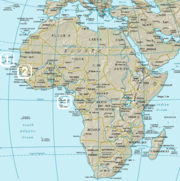 The oldest Portuguese-based creole are the so-called Crioulos of Upper Guinea, born around the Portuguese settlements along the northwest coast of Africa. Originally spoken on a wider area, they are presently reduced to the following branches:
Another group is spoken in the Gulf of Guinea, in São Tomé and Príncipe
and Equatorial Guinea
:
Many other Portuguese creoles probably existed in Africa, especially in the Congo region and former Portuguese feitorias
in the Gulf of Guinea
.
Portuguese pidgins still exist in Angola
and Mozambique
, uncreolized. A Portuguese pidgin, known as Simple Portuguese
, is still used as lingua franca between distinct Angolan tribes.
Portuguese Creoles are the mother tongue of Cape Verde
(it also has a largest number of standard Portuguese speakers) and Guinea-Bissau
's population.
Although sometimes classified as a Creole, the Cupópia
language from the Quilombo do Cafundó, at Salto do Pirapora, SP is better classified as a Portuguese
variety since it is structurally similar to Portuguese, in spite of having a large number of Bantu
words in its lexicon.
Portuguese-based creoles existed in Brazil. There is a Portuguese dialect in Helvécia, South of Bahia
that presents signs of an earlier decreolization. Ancient Portuguese creoles originating from Africa are still preserved in the ritual songs of the Afro-Brazilian animist religions (Candomblé
).
It has been conjectured that vernacular of Brazil (not the official and standard Brazilian Portuguese
) resulted from decreolization of a creole based on Portuguese and native languages; but this is not a widely accepted view. Vernacular Brazilian Portuguese is continuous with European Portuguese, and in fact quite conservative in some aspects.
Academic specialists affirm the Brazilian linguistic phenomena are the "nativização", nativization
/nativism of a most radically romanic form. The phenomena in Brazilian Portuguese are Classic Latin and Old Portuguese heritage. Not a creole form, but the radical romanic form. Regardless of borrowings and changes, it must be kept in mind that Brazilian Portuguese is not a Portuguese creole
, since both grammar and vocabulary remain real Portuguese.
There are two French-based Caribbean creole languages spoken in Brazil
, in the state of Amapá
, Lanc-Patuá
and Karipuna Creole, which were transplanted to the region in the 20th century. They are poorly known, but the Portuguese influence on them is small (chiefly in the vocabulary).
There is no consensus regarding the position Saramaccan
, with some scholars classifying it as an English Creole with Portuguese words, and others classifyng it as a Portuguese Creole with an English relexification.
The numerous Portuguese outposts in India and Sri Lanka gave rise to many Portuguese-based creole languages, of which only a few have survived to the present. The largest group were the Norteiro languages, spoken by the Norteiro people
, the Christian Indo-Portuguese in the North Konkan
. Those communities were centered around Baçaim, modern Vasai, which was then called the “Northern Court of Portuguese India
” (in opposition to the "Southern Court" at Goa
). The creole languages spoken in Baçaim, Salsete, Thana
, Chevai, Mahim
, Tecelaria, Dadar
, Parel
, Cavel
, Bandora
(modern Bandra), Gorai
, Morol, Andheri, Versova
, Malvan
, Manori
, Mazagão
, and Chaul
are now extinct. The only surviving Norteiro creoles are:
These surviving Norteiro creoles have suffered drastic changes in the last decades. Standard Portuguese re-influenced the creole of Daman in the mid-20th century.
The Creoles of the Coast of Coromandel, such as of Meliapor, Madras, Tuticorin, Cuddalore
, Karikal, Pondicheri, Tranquebar
, Manapar, and Negapatam, were already extinct by the 19th century. Their speakers (mostly the people of mixed Portuguese-Indian ancestry, known locally as Topasses
) switched to English
after the British takeover.
Most of the creoles of the coast of Malabar, namely those of Cananor, Tellicherry, Mahé, Cochin (modern Kerala
), and Quilom) had become extinct by the 19th century. In Cananor and Tellicherry, some elderly people still spoke some creole in the 1980s. The only creole that is still spoken (by a few Christian families only) is
Christians, even in Calcutta, used Portuguese until 1811. A Portuguese Creole was still spoken in the early 20th century. Portuguese creoles were spoken in Bengal
, such as at Balasore
, Pipli
, Chandernagore, Chittagong
, Midnapore
and Hugli.
and Kaffir
communities of Sri Lanka:
In the past, Portuguese creoles were also spoken in Burma and Bangladesh
.
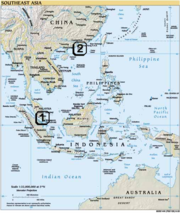 The earliest Portuguese creole in the region probably arose in the 16th century in Malacca
, Malaysia, as well as in the Moluccas. After the takeover of those places by the Dutch in the 17th century, many creole-speaking slaves were taken to other places in Indonesia and South Africa
, leading to several creoles that survived until recent times:
The Malacca creole also had an influence on the creole of Macau
(see below).
The Portuguese were present in the island of Flores
, Indonesia
since the 16th century, mainly in Larantuka
and Sikka; but the local creole language, if any, has not survived.
Other Portuguese-based creoles were once spoken in Thailand
(In KudeeJeen and Conception) and Bayingy in Burma.
, since the mid-16th century. A Portuguese creole, Patua, developed there, first by interaction with the local Cantonese people
, and later modified by influx of refugees from the Dutch takeover of Portuguese colonies in Indonesia.
Creole language
A creole language, or simply a creole, is a stable natural language developed from the mixing of parent languages; creoles differ from pidgins in that they have been nativized by children as their primary language, making them have features of natural languages that are normally missing from...
s which have been significantly influenced by Portuguese
Portuguese language
Portuguese is a Romance language that arose in the medieval Kingdom of Galicia, nowadays Galicia and Northern Portugal. The southern part of the Kingdom of Galicia became independent as the County of Portugal in 1095...
.
Origins
Portuguese overseas exploration in the 15th and 16th century's led to the establishment of a Portuguese EmpirePortuguese Empire
The Portuguese Empire , also known as the Portuguese Overseas Empire or the Portuguese Colonial Empire , was the first global empire in history...
with trading posts, forts and colonies in the Americas
Americas
The Americas, or America , are lands in the Western hemisphere, also known as the New World. In English, the plural form the Americas is often used to refer to the landmasses of North America and South America with their associated islands and regions, while the singular form America is primarily...
, Asia
Asia
Asia is the world's largest and most populous continent, located primarily in the eastern and northern hemispheres. It covers 8.7% of the Earth's total surface area and with approximately 3.879 billion people, it hosts 60% of the world's current human population...
and Africa
Africa
Africa is the world's second largest and second most populous continent, after Asia. At about 30.2 million km² including adjacent islands, it covers 6% of the Earth's total surface area and 20.4% of the total land area...
. Contact between the Portuguese language and native languages gave rise to many Portuguese-based pidgin
Pidgin
A pidgin , or pidgin language, is a simplified language that develops as a means of communication between two or more groups that do not have a language in common. It is most commonly employed in situations such as trade, or where both groups speak languages different from the language of the...
s, used as linguas francas
Lingua franca
A lingua franca is a language systematically used to make communication possible between people not sharing a mother tongue, in particular when it is a third language, distinct from both mother tongues.-Characteristics:"Lingua franca" is a functionally defined term, independent of the linguistic...
throughout the Portuguese sphere of influence. In time, many of these pidgins were nativized
Nativization
Nativization is the process whereby a language gains native speakers. This happens necessarily where a second language used by adult parents becomes the native language of their children...
becoming new stable creole languages.
As is the rule in most creoles, the lexicon
Lexicon
In linguistics, the lexicon of a language is its vocabulary, including its words and expressions. A lexicon is also a synonym of the word thesaurus. More formally, it is a language's inventory of lexemes. Coined in English 1603, the word "lexicon" derives from the Greek "λεξικόν" , neut...
of these languages can be traced to the parent languages, usually with predominance of Portuguese; while the grammar is mostly original and unique to each creole with little resemblance to the syntax of Portuguese or of other parent languages.
These creoles are (or were) spoken mostly by communities of descendants of Portuguese, natives, and sometimes other peoples from the Portuguese colonial empire.
Until recently creoles were considered "degenerate" languages unworthy of attention. As a consequence, there is little documentation on the details of their formation. Since the 20th century, increased study of creoles by linguists led to several theories being advanced. According to the monogenetic theory of pidgins
Monogenetic theory of pidgins
According to the theory of monogenesis in its most radical form, all pidgins and creole languages of the world can be ultimately traced back to one linguistic variety. This idea was first formulated by Hugo Schuchardt in the late 19th century and popularized in the late 1950s and early 1960s by and...
, most of the pidgins and creoles the world derived from European languages actually descend from a single pidgin, the Mediterranean Lingua Franca
Mediterranean Lingua Franca
The Mediterranean Lingua Franca or Sabir was a pidgin language used as a lingua franca in the Mediterranean Basin from the 11th to the 19th century.-History:...
, which was relexified
Relexification
Relexification is a term in linguistics used to describe the mechanism of language change by which one language replaces much or all of its lexicon, including basic vocabulary, with that of another language, without drastic change to its grammar. It is principally used to describe pidgins, creoles,...
by the Portuguese explorers and used by them throughout the empire. This theory was advanced to explain supposed similarities between all European-based creoles; such as the preposition na, meaning "in" and/or "on", which would come from the Portuguese contraction na meaning "in the" (feminine singular). However, the language bioprogram theory
Language bioprogram theory
The language bioprogram theory or language bioprogram hypothesis is a theory arguing that the structural similarities between different creole languages cannot be solely attributed to their superstrate and substrate languages...
claimed that creole grammars are created by children from pidgins that have no grammatical structure; so the supposed similarities between creoles are a consequence of the unity of human innate linguistic abilities. However, some linguists, have dismissed those similarities as being due to residual influences of the parent languages.
Origin of the name
The Portuguese word for "creole" is crioulo, which derives from the verb criar ("to raise", "to bring up") and a suffixSuffix
In linguistics, a suffix is an affix which is placed after the stem of a word. Common examples are case endings, which indicate the grammatical case of nouns or adjectives, and verb endings, which form the conjugation of verbs...
-oulo of debated origin. Originally the word (like its Spanish
Spanish language
Spanish , also known as Castilian , is a Romance language in the Ibero-Romance group that evolved from several languages and dialects in central-northern Iberia around the 9th century and gradually spread with the expansion of the Kingdom of Castile into central and southern Iberia during the...
equivalent criollo
Criollo people
The Criollo class ranked below that of the Iberian Peninsulares, the high-born permanent residence colonists born in Spain. But Criollos were higher status/rank than all other castes—people of mixed descent, Amerindians, and enslaved Africans...
) was used to distinguish the members of any ethnic group who were born and raised in the colonies, from those who were born in their homeland. So in Africa it was often applied to locally-born people of (wholly or partly) Portuguese descent, as opposed to those born in Portugal; whereas in Brazil
Brazil
Brazil , officially the Federative Republic of Brazil , is the largest country in South America. It is the world's fifth largest country, both by geographical area and by population with over 192 million people...
it was also used to distinguish locally born black people
Black people
The term black people is used in systems of racial classification for humans of a dark skinned phenotype, relative to other racial groups.Different societies apply different criteria regarding who is classified as "black", and often social variables such as class, socio-economic status also plays a...
of African descent from those who had been brought from Africa as slaves.
In time, however, this generic sense was lost, and the word crioulo or its derivatives (like "Creole" and its equivalents in other languages) became the name of several specific communities and their languages, such as the Cape Verdean people (and their language) and the Guinea-Bissau Kriol (and their language). In Brazil, on the other hand, crioulo became a term for "black", now considered highly offensive (like "nigger" in English).
Africa
- Guinea-Bissau Creole (Kriol): lingua francaLingua francaA lingua franca is a language systematically used to make communication possible between people not sharing a mother tongue, in particular when it is a third language, distinct from both mother tongues.-Characteristics:"Lingua franca" is a functionally defined term, independent of the linguistic...
of Guinea-BissauGuinea-BissauThe Republic of Guinea-Bissau is a country in West Africa. It is bordered by Senegal to the north, and Guinea to the south and east, with the Atlantic Ocean to its west....
, also spoken in CasamanceCasamanceCasamance is the area of Senegal south of The Gambia including the Casamance River. It consists of Basse Casamance and Haute Casamance...
, SenegalSenegalSenegal , officially the Republic of Senegal , is a country in western Africa. It owes its name to the Sénégal River that borders it to the east and north...
and in Gambia. - Cape Verdean Creole (Kriolu, Kriol): a dialect continuumDialect continuumA dialect continuum, or dialect area, was defined by Leonard Bloomfield as a range of dialects spoken across some geographical area that differ only slightly between neighboring areas, but as one travels in any direction, these differences accumulate such that speakers from opposite ends of the...
spoken on the islands of Cape VerdeCape VerdeThe Republic of Cape Verde is an island country, spanning an archipelago of 10 islands located in the central Atlantic Ocean, 570 kilometres off the coast of Western Africa...
, with some decreolization.
Another group is spoken in the Gulf of Guinea, in São Tomé and Príncipe
São Tomé and Príncipe
São Tomé and Príncipe, officially the Democratic Republic of São Tomé and Príncipe, is a Portuguese-speaking island nation in the Gulf of Guinea, off the western equatorial coast of Central Africa. It consists of two islands: São Tomé and Príncipe, located about apart and about , respectively, off...
and Equatorial Guinea
Equatorial Guinea
Equatorial Guinea, officially the Republic of Equatorial Guinea where the capital Malabo is situated.Annobón is the southernmost island of Equatorial Guinea and is situated just south of the equator. Bioko island is the northernmost point of Equatorial Guinea. Between the two islands and to the...
:
- Angolar (Ngola, N'góla)Angolar languageAngolar, also Ngola is a minority language of São Tomé and Príncipe, spoken in the southernmost towns of São Tomé Island and sparsely along the coast. It is a creole language, based partially on Portuguese with a heavy substrate of a dialect of Kimbundu Angolar, also Ngola (Lungua N'golá) is a...
: in coastal areas of São Tomé IslandSão Tomé-Transport:São Tomé is served by São Tomé International Airport with regular flights to Europe and other African Countries.-Climate:São Tomé features a tropical wet and dry climate with a relatively lengthy wet season and a short dry season. The wet season runs from October through May while the...
. - Annobonese (Fá d'Ambô)Annobonese languageThe Annobonese language, known to its speakers as Fá d'Ambô or Fa d'Ambu, is spoken by 2,500 in the Annobon and Bioko Islands off the coast of Equatorial Guinea, mostly by people of mixed African, Spanish, and Portuguese descent....
: in Annobón IslandAnnobónAnnobón may refer to:* Annobón Province* Annobonese language* Annobon people...
. - ForroForro languageForro is a Portuguese-based creole language spoken in São Tomé and Príncipe.The name means "freed slave" in Portuguese. The language is also called crioulo santomense. It should not be confused with the dialect of Portuguese spoken in São Tomé and Príncipe.- History :São Tomé is an island of the...
: in São Tomé. - Principense (Lunguyê)Principense languageThe Principense language, called lunguyê by its speakers, is a Portuguese creole spoken in a community of some four thousand people in São Tomé and Príncipe, specifically on the island of Príncipe , according to a 1989 study...
(almost extinct): in Príncipe IslandPríncipePríncipe is the northern and smaller of the two major islands of the country of São Tomé and Príncipe lying off the west coast of Africa. It has an area of 136 km² and a population of approximately 5,000. The island is a heavily eroded volcano over three million years old, surrounded by other...
.
Many other Portuguese creoles probably existed in Africa, especially in the Congo region and former Portuguese feitorias
Factory (trading post)
Factory was the English term for the trading posts system originally established by Europeans in foreign territories, first within different states of medieval Europe, and later in their colonial possessions...
in the Gulf of Guinea
Gulf of Guinea
The Gulf of Guinea is the northeasternmost part of the tropical Atlantic Ocean between Cape Lopez in Gabon, north and west to Cape Palmas in Liberia. The intersection of the Equator and Prime Meridian is in the gulf....
.
Portuguese pidgins still exist in Angola
Angola
Angola, officially the Republic of Angola , is a country in south-central Africa bordered by Namibia on the south, the Democratic Republic of the Congo on the north, and Zambia on the east; its west coast is on the Atlantic Ocean with Luanda as its capital city...
and Mozambique
Mozambique
Mozambique, officially the Republic of Mozambique , is a country in southeastern Africa bordered by the Indian Ocean to the east, Tanzania to the north, Malawi and Zambia to the northwest, Zimbabwe to the west and Swaziland and South Africa to the southwest...
, uncreolized. A Portuguese pidgin, known as Simple Portuguese
Simple Portuguese
Pequeno Português literally "Little Portuguese" was a restructured variant of Portuguese spoken in the 18th and 19th by people on the periphery of the major urban settlements along the coast of Angola....
, is still used as lingua franca between distinct Angolan tribes.
Portuguese Creoles are the mother tongue of Cape Verde
Cape Verde
The Republic of Cape Verde is an island country, spanning an archipelago of 10 islands located in the central Atlantic Ocean, 570 kilometres off the coast of Western Africa...
(it also has a largest number of standard Portuguese speakers) and Guinea-Bissau
Guinea-Bissau
The Republic of Guinea-Bissau is a country in West Africa. It is bordered by Senegal to the north, and Guinea to the south and east, with the Atlantic Ocean to its west....
's population.
Americas
Portuguese has contributed to many languages of the Americas, although its similarity with Spanish makes it difficult to separate the influence of the two languages. Most surviving creoles contain also influences from Dutch, English, French, and various African languages. They are:- PapiamentoPapiamentoPapiamento is the most widely spoken language on the Caribbean ABC islands, having the official status on the islands of Aruba and Curaçao. The language is also recognized on Bonaire by the Dutch government....
: spoken in ArubaArubaAruba is a 33 km-long island of the Lesser Antilles in the southern Caribbean Sea, located 27 km north of the coast of Venezuela and 130 km east of Guajira Peninsula...
, Bonaire and CuraçaoCuraçaoCuraçao is an island in the southern Caribbean Sea, off the Venezuelan coast. The Country of Curaçao , which includes the main island plus the small, uninhabited island of Klein Curaçao , is a constituent country of the Kingdom of the Netherlands...
; Portuguese/Spanish (60%), Dutch (25%), African languages and Arawak (15%). - SaramaccanSaramaccan languageSaramaccan is a creole language spoken by about 24,000 people near the Saramacca and upper Suriname Rivers in Suriname , and 2,000 in French Guiana...
: spoken in SurinameSurinameSuriname , officially the Republic of Suriname , is a country in northern South America. It borders French Guiana to the east, Guyana to the west, Brazil to the south, and on the north by the Atlantic Ocean. Suriname was a former colony of the British and of the Dutch, and was previously known as...
; English, Portuguese, African languages (20%).
Although sometimes classified as a Creole, the Cupópia
Cafundó language
Cafundó, or Cupópia, is a 'secret' language spoken in the village of Cafundó, São Paulo . The language is structurally similar to Portuguese, with a large number of Bantu words in its lexicon....
language from the Quilombo do Cafundó, at Salto do Pirapora, SP is better classified as a Portuguese
Portuguese language
Portuguese is a Romance language that arose in the medieval Kingdom of Galicia, nowadays Galicia and Northern Portugal. The southern part of the Kingdom of Galicia became independent as the County of Portugal in 1095...
variety since it is structurally similar to Portuguese, in spite of having a large number of Bantu
Bantu languages
The Bantu languages constitute a traditional sub-branch of the Niger–Congo languages. There are about 250 Bantu languages by the criterion of mutual intelligibility, though the distinction between language and dialect is often unclear, and Ethnologue counts 535 languages...
words in its lexicon.
Portuguese-based creoles existed in Brazil. There is a Portuguese dialect in Helvécia, South of Bahia
Bahia
Bahia is one of the 26 states of Brazil, and is located in the northeastern part of the country on the Atlantic coast. It is the fourth most populous Brazilian state after São Paulo, Minas Gerais and Rio de Janeiro, and the fifth-largest in size...
that presents signs of an earlier decreolization. Ancient Portuguese creoles originating from Africa are still preserved in the ritual songs of the Afro-Brazilian animist religions (Candomblé
Candomblé
Candomblé is an African-originated or Afro-Brazilian religion, practised chiefly in Brazil by the "povo de santo" . It originated in the cities of Salvador, the capital of Bahia and Cachoeira, at the time one of the main commercial crossroads for the distribution of products and slave trade to...
).
It has been conjectured that vernacular of Brazil (not the official and standard Brazilian Portuguese
Brazilian Portuguese
Brazilian Portuguese is a group of Portuguese dialects written and spoken by most of the 190 million inhabitants of Brazil and by a few million Brazilian emigrants, mainly in the United States, United Kingdom, Portugal, Canada, Japan and Paraguay....
) resulted from decreolization of a creole based on Portuguese and native languages; but this is not a widely accepted view. Vernacular Brazilian Portuguese is continuous with European Portuguese, and in fact quite conservative in some aspects.
Academic specialists affirm the Brazilian linguistic phenomena are the "nativização", nativization
Nativization
Nativization is the process whereby a language gains native speakers. This happens necessarily where a second language used by adult parents becomes the native language of their children...
/nativism of a most radically romanic form. The phenomena in Brazilian Portuguese are Classic Latin and Old Portuguese heritage. Not a creole form, but the radical romanic form. Regardless of borrowings and changes, it must be kept in mind that Brazilian Portuguese is not a Portuguese creole
Portuguese Creole
Portuguese creoles are creole languages which have been significantly influenced by Portuguese.- Origins :Portuguese overseas exploration in the 15th and 16th century's led to the establishment of a Portuguese Empire with trading posts, forts and colonies in the Americas, Asia and Africa...
, since both grammar and vocabulary remain real Portuguese.
There are two French-based Caribbean creole languages spoken in Brazil
Brazil
Brazil , officially the Federative Republic of Brazil , is the largest country in South America. It is the world's fifth largest country, both by geographical area and by population with over 192 million people...
, in the state of Amapá
Amapá
Amapá is one of the states of Brazil, located in the extreme north, bordering French Guiana and Suriname to the north. To the east is the Atlantic Ocean, and to the south and west is the Brazilian state of Pará. Perhaps one of the main features of the state is the River Oiapoque, as it was once...
, Lanc-Patuá
Lanc-Patuá
Lanc-Patuá is a creole language spoken in the state of Amapá in Brazil, primarily now around the capital, Macapá. It is a French-based creole language, spoken by local Indians and immigrants from French Guiana, the Caribbean and other areas of Brazil, and their descendants...
and Karipuna Creole, which were transplanted to the region in the 20th century. They are poorly known, but the Portuguese influence on them is small (chiefly in the vocabulary).
There is no consensus regarding the position Saramaccan
Saramaccan language
Saramaccan is a creole language spoken by about 24,000 people near the Saramacca and upper Suriname Rivers in Suriname , and 2,000 in French Guiana...
, with some scholars classifying it as an English Creole with Portuguese words, and others classifyng it as a Portuguese Creole with an English relexification.
India
- See also: Indo-Portuguese Creoles
The numerous Portuguese outposts in India and Sri Lanka gave rise to many Portuguese-based creole languages, of which only a few have survived to the present. The largest group were the Norteiro languages, spoken by the Norteiro people
Norteiro people
Norteiro people are people who live in the former Portuguese exclaves in the western littoral of South Asia;The word Norteiro, meaning "Northerner," comes from the Portuguese. The term refers to the city of Baçaim, which was styled the "Court of the North" and stood second only to the city of Goa ...
, the Christian Indo-Portuguese in the North Konkan
Konkan
The Konkan also called the Konkan Coast or Karavali is a rugged section of the western coastline of India from Raigad to Mangalore...
. Those communities were centered around Baçaim, modern Vasai, which was then called the “Northern Court of Portuguese India
Portuguese India
The Portuguese Viceroyalty of India , later the Portuguese State of India , was the aggregate of Portugal's colonial holdings in India.The government started in 1505, six years after the discovery of a sea route to India by Vasco da Gama, with the nomination of the first Viceroy Francisco de...
” (in opposition to the "Southern Court" at Goa
Goa
Goa , a former Portuguese colony, is India's smallest state by area and the fourth smallest by population. Located in South West India in the region known as the Konkan, it is bounded by the state of Maharashtra to the north, and by Karnataka to the east and south, while the Arabian Sea forms its...
). The creole languages spoken in Baçaim, Salsete, Thana
Thane
Thane , is a city in Maharashtra, India, part of the Mumbai Metropolitan Region, northeastern suburb of Mumbai at the head of the Thane Creek. It is the administrative headquarters of Thane district. On 16 April 1853, G.I.P...
, Chevai, Mahim
Mahim
Mahim is a neighbourhood in Mumbai. It is also the name of a railway station in Mahim area, on the Mumbai suburban railway on the Western Railway railway line. In ancient times, the area was known as Maijim, Mejambu, Mahikawati....
, Tecelaria, Dadar
Dadar
Dadar is a place in Mumbai, and is also a railway station on both the Western and Central lines of the Mumbai Suburban Railway network. Dadar is situated in the heart of Mumbai, and Dadar station is the only railway station common to both the Central and Western lines...
, Parel
Parel
Lower Parel or Parel is central part of Mumbai. It is also lends its name to two railway stations on the Mumbai suburban railway. Most of the mills in Mumbai used to be in this area till some years ago...
, Cavel
Cavel
Cavel is a neighbourhood in South Mumbai. It is located to the north-east of Dhobitalao near the Chira Bazaar area. rom the Koli name Kolwar. The Kolis of this village were converted to Christianity by the Portuguese in the 16th century. Cavel thus became a Christian enclave, and later immigrants...
, Bandora
Bandora (town)
Bandora is a census town inPonda Taluka in North Goa district in the state of Goa, India.-Geography:Bandora is located at . It has an average elevation of 107 metres .-Demographics:...
(modern Bandra), Gorai
Gorai
Gorai is a village in the North-western part of Mumbai, India. Gorai is accessed more usually by a ferry crossing the Manori Creek which separates Gorai from the island of Salsette or otherwise by the overland route through Bhayander....
, Morol, Andheri, Versova
Versova (Mumbai)
Versova is an upmarket neighbourhood in the Andheri area of northern Mumbai. It is located at 19°7'60N 72°47'60E and is known for its beach and the Versova Fort...
, Malvan
Malvan
Malvan is a town in Sindhudurg District, the southernmost district of Maharashtra. This culturally and historically important town is a Taluka place in Sindhudurg District...
, Manori
Manori
Manori is a neighbourhood located in northern Mumbai, India. It is known for its beach and the Manori Creek. The closest railway station is Malad....
, Mazagão
Mazagão
Mazagão is a municipality located in the south of the state of Amapá in Brazil. Its population is 13,913 and its area is 13,131 km²....
, and Chaul
Chaul
Chaul is a former city of Portuguese India, now in ruins. It is located 60 km south of Mumbai, in Raigad District of Maharashtra state in western India....
are now extinct. The only surviving Norteiro creoles are:
- Diu Indo-PortugueseDiu Indo-Portuguese languageThe Diu Indo-Portuguese language or Diu Portuguese Creole was spoken in Diu, India. It is a creole based on Portuguese and Gujarati....
(almost extinct): in Diu. - Daman Indo-Portuguese (Língua da Casa)Daman Indo-Portuguese languageThe Daman Indo-Portuguese language or Daman Portuguese creole, known to its speakers as Língua da Casa , is a Portuguese-based creole spoken in Daman...
: in Daman. - KristiKristi languageKorlai Indo-Portuguese is the language of some 1,000 Christians in an isolated area around the village of Korlai in Raigad District of Maharashtra state, India...
: in Korlai, MaharashtraMaharashtraMaharashtra is a state located in India. It is the second most populous after Uttar Pradesh and third largest state by area in India...
.
These surviving Norteiro creoles have suffered drastic changes in the last decades. Standard Portuguese re-influenced the creole of Daman in the mid-20th century.
The Creoles of the Coast of Coromandel, such as of Meliapor, Madras, Tuticorin, Cuddalore
Cuddalore
Cuddalore is a fast growing industrial city and headquarter of Cuddalore district in the Tamil Nadu state of southern India. Located south of Pondicherry on the coast of Bay of Bengal, Cuddalore has a large number of industries which employ a great deal of the city's population.Cuddalore is known...
, Karikal, Pondicheri, Tranquebar
Tranquebar
Tharangambadi is a panchayat town in Nagapattinam district in the Indian state of Tamil Nadu, 15 km north of Karaikal, near the mouth of a distributary of the Kaveri River. Its name means "place of the singing waves"...
, Manapar, and Negapatam, were already extinct by the 19th century. Their speakers (mostly the people of mixed Portuguese-Indian ancestry, known locally as Topasses
Topasses
Topasses were a group of people in maritime Asia in the early modern period, who claimed Portuguese ancestry or had taken up Portuguese culture and language. Topasses were found in the various places of South Asia and Southeast Asia which were frequented by the Portuguese, such as Goa, Malacca and...
) switched to English
English language
English is a West Germanic language that arose in the Anglo-Saxon kingdoms of England and spread into what was to become south-east Scotland under the influence of the Anglian medieval kingdom of Northumbria...
after the British takeover.
Most of the creoles of the coast of Malabar, namely those of Cananor, Tellicherry, Mahé, Cochin (modern Kerala
Kerala
or Keralam is an Indian state located on the Malabar coast of south-west India. It was created on 1 November 1956 by the States Reorganisation Act by combining various Malayalam speaking regions....
), and Quilom) had become extinct by the 19th century. In Cananor and Tellicherry, some elderly people still spoke some creole in the 1980s. The only creole that is still spoken (by a few Christian families only) is
- Vypin Indo-Portuguese: in the Vypin IslandVypinVypin or Vypeen is one among a group of islands, that form part of the city of Kochi, in the state of Kerala, India. The island is about 27 km long...
, near Kerala.
Christians, even in Calcutta, used Portuguese until 1811. A Portuguese Creole was still spoken in the early 20th century. Portuguese creoles were spoken in Bengal
Bengal
Bengal is a historical and geographical region in the northeast region of the Indian Subcontinent at the apex of the Bay of Bengal. Today, it is mainly divided between the sovereign land of People's Republic of Bangladesh and the Indian state of West Bengal, although some regions of the previous...
, such as at Balasore
Balasore
Balasore is a strategically located city in the state of Orissa, about north of the state capital Bhubaneswar, in eastern India. It is the administrative headquarters of Balasore district. It is best known for Chandipur beach. It is also the site of the Indian Ballistic Missile Defense...
, Pipli
Pipli
Pipli is a small village in Gaighata, North 24 Parganas, West Bengal, India.The village is near the Ichamati River which acts as a border between India and Bangladesh. Pipli has two primary schools.-Google Map:-Source:...
, Chandernagore, Chittagong
Chittagong
Chittagong ) is a city in southeastern Bangladesh and the capital of an eponymous district and division. Built on the banks of the Karnaphuli River, the city is home to Bangladesh's busiest seaport and has a population of over 4.5 million, making it the second largest city in the country.A trading...
, Midnapore
Midnapore
Midnapore is the district headquarters of Paschim Medinipur district of West Bengal. It is situated on the banks of the Kangsabati River . This area had taken a pioneering role in India's freedom struggle...
and Hugli.
Sri Lanka
Significant Portuguese-based creole flourished among the so-called BurgherBurgher people
The Burghers are a Eurasian ethnic group, historically from Sri Lanka, consisting for the most part of male-line descendants of European colonists from the 16th to 20th centuries and local women, with some minorities of Swedish, Norwegian, French and Irish.Today the mother tongue of the Burghers...
and Kaffir
Sri Lanka Kaffir people
The Sri Lankan Kaffirs are an ethnic group in Sri Lanka who are partially descended from 16th century Portuguese traders and the African slaves who were brought by them to work as labourers and soldiers to fight against the Sri Lankan kings...
communities of Sri Lanka:
- Sri Lanka Indo-PortugueseSri Lanka Indo-Portuguese languageSri Lanka Indo-Portuguese,Ceylonese Portuguese Creole or Sri Lankan Portuguese Creole is a language spoken in Sri Lanka. While the predominant languages of the island are Sinhala and Tamil, the interaction of the Portuguese and the Sri Lankans led to the evolution of a new language, Sri Lanka...
: around BatticaloaBatticaloaBatticaloa is a city in the Eastern province of Sri Lanka. It is the seat of the Eastern University of Sri Lanka. It is on the east coast, south by south east of Trincomalee, and is situated on an island.-Etymology:...
and TrincomaleeTrincomaleeTrincomalee is a port city in Eastern Province, Sri Lanka and lies on the east coast of the island, about 113 miles south of Jaffna. It has a population of approximately 100,000 . The city is built on a peninsula, which divides the inner and outer harbours. Overlooking the Kottiyar Bay,...
(Portuguese BurghersPortuguese BurghersThe Portuguese Burghers are an ethnic group in Sri Lanka, of mixed Portuguese and Sri Lankan descent. They are Roman Catholic and spoke the Sri Lanka Indo-Portuguese language, a creole based on Portuguese. In modern times, English has become the common language while Sinhalese is taught in school...
) and PuttalamPuttalamPuttalam is the capital city of the Puttalam District in North Western Province, Sri Lanka.-History:The history of this dry zone dates back to the arrival of Prince Vijaya, nearly 2500 years ago, when his vessel washed ashore. The name "Puttalam" may be a modification of the Tamil word Uppuththalam...
(KaffirsSri Lanka Kaffir peopleThe Sri Lankan Kaffirs are an ethnic group in Sri Lanka who are partially descended from 16th century Portuguese traders and the African slaves who were brought by them to work as labourers and soldiers to fight against the Sri Lankan kings...
).
In the past, Portuguese creoles were also spoken in Burma and Bangladesh
Bangladesh
Bangladesh , officially the People's Republic of Bangladesh is a sovereign state located in South Asia. It is bordered by India on all sides except for a small border with Burma to the far southeast and by the Bay of Bengal to the south...
.
Southeast Asia
Malacca
Malacca , dubbed The Historic State or Negeri Bersejarah among locals) is the third smallest Malaysian state, after Perlis and Penang. It is located in the southern region of the Malay Peninsula, on the Straits of Malacca. It borders Negeri Sembilan to the north and the state of Johor to the south...
, Malaysia, as well as in the Moluccas. After the takeover of those places by the Dutch in the 17th century, many creole-speaking slaves were taken to other places in Indonesia and South Africa
South Africa
The Republic of South Africa is a country in southern Africa. Located at the southern tip of Africa, it is divided into nine provinces, with of coastline on the Atlantic and Indian oceans...
, leading to several creoles that survived until recent times:
- Kristang (Cristão)Kristang languagePapiá Kristang , or just Kristang, is a creole language. It is spoken by the Kristang, a community of people of mixed Portuguese and Asian ancestry, chiefly in Malacca and Singapore....
: in MalaccaMalaccaMalacca , dubbed The Historic State or Negeri Bersejarah among locals) is the third smallest Malaysian state, after Perlis and Penang. It is located in the southern region of the Malay Peninsula, on the Straits of Malacca. It borders Negeri Sembilan to the north and the state of Johor to the south...
(Malaysia) and SingaporeSingaporeSingapore , officially the Republic of Singapore, is a Southeast Asian city-state off the southern tip of the Malay Peninsula, north of the equator. An island country made up of 63 islands, it is separated from Malaysia by the Straits of Johor to its north and from Indonesia's Riau Islands by the...
. - Mardijker (extinct in 19th century): by the Mardijker peopleMardijker peopleThe Mardijker were a community in amongst others Batavia , made up of descendants of freed slaves. They could be found at all major trading posts in the East Indies. They were mostly Christian, of Indian and some Portuguese ancestry, and spoke a Portuguese patois...
of Batavia (JakartaJakartaJakarta is the capital and largest city of Indonesia. Officially known as the Special Capital Territory of Jakarta, it is located on the northwest coast of Java, has an area of , and a population of 9,580,000. Jakarta is the country's economic, cultural and political centre...
). - Papiá TuguPapia Tugu languagePapiá was a language spoken in Tugu, village north of Jakarta, by descendants of 17th century Portuguese travelers.It is a creole language similar to the Papiá Kristang of Malacca. The language was spoken until the 1940s, and the last speaker died in 1978...
(extinct in 1978): in Tugu, Indonesia. - PortugisPortugis languagePortugis, or Ternateño, was a language spoken by Christians of mixed Portuguese and Malay ancestry in the islands of Ambon and Ternate in the Moluccas , from the 16th to the middle of the 20th century....
(extinct around 1950): in the AmbonAmbon IslandAmbon Island is part of the Maluku Islands of Indonesia. The island has an area of , and is mountainous, well watered, and fertile. Ambon Island consists of 2 territories: The main city and seaport is Ambon , which is also the capital of Maluku province and Maluku Tengah Ambon Island is part of the...
, TernateTernateTernate is an island in the Maluku Islands of eastern Indonesia. It is located off the west coast of the larger island of Halmahera, the center of the powerful former Sultanate of Ternate....
islands and MinahasaMinahasaThe Minahasa are an ethnic group located in the North Sulawesi province of Indonesia, formerly known as North Celebes...
, IndonesiaIndonesiaIndonesia , officially the Republic of Indonesia , is a country in Southeast Asia and Oceania. Indonesia is an archipelago comprising approximately 13,000 islands. It has 33 provinces with over 238 million people, and is the world's fourth most populous country. Indonesia is a republic, with an... - Bidau PortugueseBidau Portuguese languageBidau Creole Portuguese was a Portuguese-based creole language that was spoken in Bidau, an eastern suburb of Dili, East Timor until the 1960s, when the speakers shifted to standard Portuguese....
(extinct in the 1960s): in the Bidau area of DiliDiliDili, spelled Díli in Portuguese, is the capital, largest city, chief port and commercial centre of East Timor.-Geography and Administration:Dili lies on the northern coast of Timor island, the easternmost of the Lesser Sunda Islands....
, East TimorEast TimorThe Democratic Republic of Timor-Leste, commonly known as East Timor , is a state in Southeast Asia. It comprises the eastern half of the island of Timor, the nearby islands of Atauro and Jaco, and Oecusse, an exclave on the northwestern side of the island, within Indonesian West Timor...
.
The Malacca creole also had an influence on the creole of Macau
Macau
Macau , also spelled Macao , is, along with Hong Kong, one of the two special administrative regions of the People's Republic of China...
(see below).
The Portuguese were present in the island of Flores
Flores
Flores is one of the Lesser Sunda Islands, an island arc with an estimated area of 14,300 km² extending east from the Java island of Indonesia. The population was 1.831.000 in the 2010 census and the largest town is Maumere. Flores is Portuguese for "flowers".Flores is located east of Sumbawa...
, Indonesia
Indonesia
Indonesia , officially the Republic of Indonesia , is a country in Southeast Asia and Oceania. Indonesia is an archipelago comprising approximately 13,000 islands. It has 33 provinces with over 238 million people, and is the world's fourth most populous country. Indonesia is a republic, with an...
since the 16th century, mainly in Larantuka
Larantuka
Larantuka is a subdistrict of East Flores Regency, on the eastern end of Flores Island, East Nusa Tenggara, Indonesia. Like much of the region, Larantuka has a strong a colonial Portuguese influence...
and Sikka; but the local creole language, if any, has not survived.
Other Portuguese-based creoles were once spoken in Thailand
Thailand
Thailand , officially the Kingdom of Thailand , formerly known as Siam , is a country located at the centre of the Indochina peninsula and Southeast Asia. It is bordered to the north by Burma and Laos, to the east by Laos and Cambodia, to the south by the Gulf of Thailand and Malaysia, and to the...
(In KudeeJeen and Conception) and Bayingy in Burma.
Macau
The Portuguese language was present in its colony, MacauMacau
Macau , also spelled Macao , is, along with Hong Kong, one of the two special administrative regions of the People's Republic of China...
, since the mid-16th century. A Portuguese creole, Patua, developed there, first by interaction with the local Cantonese people
Cantonese people
The Cantonese people are Han people whose ancestral homes are in Guangdong, China. The term "Cantonese people" would then be synonymous with the Bun Dei sub-ethnic group, and is sometimes known as Gwong Fu Jan for this narrower definition...
, and later modified by influx of refugees from the Dutch takeover of Portuguese colonies in Indonesia.
- Macanese (Macaista, Patuá)Macanese languageMacanese or Macau Creole is a creole language derived mainly from Malay, Sinhalese, Cantonese, and Portuguese, which was originally spoken by the Macanese community of the Portuguese colony of Macau...
: in MacauMacauMacau , also spelled Macao , is, along with Hong Kong, one of the two special administrative regions of the People's Republic of China...
and, to a lesser extent, in Hong-Kong.
Concise List
| Language | Alternate names | Location | Notes |
|---|---|---|---|
| Angolar Angolar language Angolar, also Ngola is a minority language of São Tomé and Príncipe, spoken in the southernmost towns of São Tomé Island and sparsely along the coast. It is a creole language, based partially on Portuguese with a heavy substrate of a dialect of Kimbundu Angolar, also Ngola (Lungua N'golá) is a... |
São Tomé Island São Tomé Island São Tomé Island, at , is the largest island of São Tomé and Príncipe and is home in 2009 to about 157,000 or 96% of the nation's population. This island and smaller nearby islets make up São Tomé Province, which is divided into six districts. The main island is located 2 km north of the... , São Tomé and Príncipe São Tomé and Príncipe São Tomé and Príncipe, officially the Democratic Republic of São Tomé and Príncipe, is a Portuguese-speaking island nation in the Gulf of Guinea, off the western equatorial coast of Central Africa. It consists of two islands: São Tomé and Príncipe, located about apart and about , respectively, off... |
||
| Annobonese Annobonese language The Annobonese language, known to its speakers as Fá d'Ambô or Fa d'Ambu, is spoken by 2,500 in the Annobon and Bioko Islands off the coast of Equatorial Guinea, mostly by people of mixed African, Spanish, and Portuguese descent.... |
Fá d'Ambô | Annobón Annobón Annobón may refer to:* Annobón Province* Annobonese language* Annobon people... island, Equatorial Guinea Equatorial Guinea Equatorial Guinea, officially the Republic of Equatorial Guinea where the capital Malabo is situated.Annobón is the southernmost island of Equatorial Guinea and is situated just south of the equator. Bioko island is the northernmost point of Equatorial Guinea. Between the two islands and to the... |
|
| Cupópia Cafundó language Cafundó, or Cupópia, is a 'secret' language spoken in the village of Cafundó, São Paulo . The language is structurally similar to Portuguese, with a large number of Bantu words in its lexicon.... |
Brazil Brazil Brazil , officially the Federative Republic of Brazil , is the largest country in South America. It is the world's fifth largest country, both by geographical area and by population with over 192 million people... |
Not a Creole, but rather Portuguese language with Bantu Bantu languages The Bantu languages constitute a traditional sub-branch of the Niger–Congo languages. There are about 250 Bantu languages by the criterion of mutual intelligibility, though the distinction between language and dialect is often unclear, and Ethnologue counts 535 languages... words |
|
| Cape Verdean Creole | Kriolu, Kriol | Cape Verde Cape Verde The Republic of Cape Verde is an island country, spanning an archipelago of 10 islands located in the central Atlantic Ocean, 570 kilometres off the coast of Western Africa... |
National language. A degree of Decreolization Decreolization Decreolization is a hypothetical phenomenon whereby over time a creole language reconverges with one of the standard languages from which it originally derived... occurred. |
| Creole of Vaipim | India India India , officially the Republic of India , is a country in South Asia. It is the seventh-largest country by geographical area, the second-most populous country with over 1.2 billion people, and the most populous democracy in the world... |
||
| Daman Indo-Portuguese Daman Indo-Portuguese language The Daman Indo-Portuguese language or Daman Portuguese creole, known to its speakers as Língua da Casa , is a Portuguese-based creole spoken in Daman... |
Língua da Casa | Daman, India | Decreolization Decreolization Decreolization is a hypothetical phenomenon whereby over time a creole language reconverges with one of the standard languages from which it originally derived... process occurred. |
| Diu Indo-Portuguese Diu Indo-Portuguese language The Diu Indo-Portuguese language or Diu Portuguese Creole was spoken in Diu, India. It is a creole based on Portuguese and Gujarati.... |
Língua dos velhos | Diu, India | |
| Forro Forro language Forro is a Portuguese-based creole language spoken in São Tomé and Príncipe.The name means "freed slave" in Portuguese. The language is also called crioulo santomense. It should not be confused with the dialect of Portuguese spoken in São Tomé and Príncipe.- History :São Tomé is an island of the... |
São Tomé São Tomé -Transport:São Tomé is served by São Tomé International Airport with regular flights to Europe and other African Countries.-Climate:São Tomé features a tropical wet and dry climate with a relatively lengthy wet season and a short dry season. The wet season runs from October through May while the... Island, São Tomé and Príncipe São Tomé and Príncipe São Tomé and Príncipe, officially the Democratic Republic of São Tomé and Príncipe, is a Portuguese-speaking island nation in the Gulf of Guinea, off the western equatorial coast of Central Africa. It consists of two islands: São Tomé and Príncipe, located about apart and about , respectively, off... |
||
| Guinea-Bissau Creole | Kriol | Guinea-Bissau Guinea-Bissau The Republic of Guinea-Bissau is a country in West Africa. It is bordered by Senegal to the north, and Guinea to the south and east, with the Atlantic Ocean to its west.... |
Lingua franca and regional language Regional language A regional language is a language spoken in an area of a nation state, whether it be a small area, a federal state or province, or some wider area.... of Guinea-Bissau Guinea-Bissau The Republic of Guinea-Bissau is a country in West Africa. It is bordered by Senegal to the north, and Guinea to the south and east, with the Atlantic Ocean to its west.... ; also spoken in Casamance Casamance Casamance is the area of Senegal south of The Gambia including the Casamance River. It consists of Basse Casamance and Haute Casamance... , Senegal Senegal Senegal , officially the Republic of Senegal , is a country in western Africa. It owes its name to the Sénégal River that borders it to the east and north... |
| Kristang Kristang language Papiá Kristang , or just Kristang, is a creole language. It is spoken by the Kristang, a community of people of mixed Portuguese and Asian ancestry, chiefly in Malacca and Singapore.... |
Malaysia Singapore Singapore Singapore , officially the Republic of Singapore, is a Southeast Asian city-state off the southern tip of the Malay Peninsula, north of the equator. An island country made up of 63 islands, it is separated from Malaysia by the Straits of Johor to its north and from Indonesia's Riau Islands by the... Perth Perth, Western Australia Perth is the capital and largest city of the Australian state of Western Australia and the fourth most populous city in Australia. The Perth metropolitan area has an estimated population of almost 1,700,000.... |
||
| Kristi Kristi language Korlai Indo-Portuguese is the language of some 1,000 Christians in an isolated area around the village of Korlai in Raigad District of Maharashtra state, India... |
Korlai, India India India , officially the Republic of India , is a country in South Asia. It is the seventh-largest country by geographical area, the second-most populous country with over 1.2 billion people, and the most populous democracy in the world... |
||
| Macanese Macanese language Macanese or Macau Creole is a creole language derived mainly from Malay, Sinhalese, Cantonese, and Portuguese, which was originally spoken by the Macanese community of the Portuguese colony of Macau... |
Patuá | Macau Macau Macau , also spelled Macao , is, along with Hong Kong, one of the two special administrative regions of the People's Republic of China... and Hong Kong Hong Kong Hong Kong is one of two Special Administrative Regions of the People's Republic of China , the other being Macau. A city-state situated on China's south coast and enclosed by the Pearl River Delta and South China Sea, it is renowned for its expansive skyline and deep natural harbour... |
Decreolization Decreolization Decreolization is a hypothetical phenomenon whereby over time a creole language reconverges with one of the standard languages from which it originally derived... process occurred. |
| Papiamento Papiamento Papiamento is the most widely spoken language on the Caribbean ABC islands, having the official status on the islands of Aruba and Curaçao. The language is also recognized on Bonaire by the Dutch government.... |
Netherlands Antilles Netherlands Antilles The Netherlands Antilles , also referred to informally as the Dutch Antilles, was an autonomous Caribbean country within the Kingdom of the Netherlands, consisting of two groups of islands in the Lesser Antilles: Aruba, Bonaire and Curaçao , in Leeward Antilles just off the Venezuelan coast; and Sint... and Aruba Aruba Aruba is a 33 km-long island of the Lesser Antilles in the southern Caribbean Sea, located 27 km north of the coast of Venezuela and 130 km east of Guajira Peninsula... |
Spanish influenced. | |
| Pequeno Português Simple Portuguese Pequeno Português literally "Little Portuguese" was a restructured variant of Portuguese spoken in the 18th and 19th by people on the periphery of the major urban settlements along the coast of Angola.... |
Angola Angola Angola, officially the Republic of Angola , is a country in south-central Africa bordered by Namibia on the south, the Democratic Republic of the Congo on the north, and Zambia on the east; its west coast is on the Atlantic Ocean with Luanda as its capital city... |
Not a Creole, but rather a Pidgin Pidgin A pidgin , or pidgin language, is a simplified language that develops as a means of communication between two or more groups that do not have a language in common. It is most commonly employed in situations such as trade, or where both groups speak languages different from the language of the... |
|
| Principense Principense language The Principense language, called lunguyê by its speakers, is a Portuguese creole spoken in a community of some four thousand people in São Tomé and Príncipe, specifically on the island of Príncipe , according to a 1989 study... |
Lunguyê | Príncipe Island, São Tomé and Príncipe | Almost extinct. Most of the population now speak (standard) Portuguese. |
| Saramaccan | Surinam | English Creole English-based creole languages An English-based creole language is a creole language that was significantly influenced by the English language... with strong influences of Portuguese lexicon. |
|
| Sri Lanka Indo-Portuguese Sri Lanka Indo-Portuguese language Sri Lanka Indo-Portuguese,Ceylonese Portuguese Creole or Sri Lankan Portuguese Creole is a language spoken in Sri Lanka. While the predominant languages of the island are Sinhala and Tamil, the interaction of the Portuguese and the Sri Lankans led to the evolution of a new language, Sri Lanka... |
Sri Lankan Creole Portuguese, Battilocan Portuguese | Coastal cities of Sri Lanka Sri Lanka Sri Lanka, officially the Democratic Socialist Republic of Sri Lanka is a country off the southern coast of the Indian subcontinent. Known until 1972 as Ceylon , Sri Lanka is an island surrounded by the Indian Ocean, the Gulf of Mannar and the Palk Strait, and lies in the vicinity of India and the... |
Portuguese based creole with influences from Spanish, English, Dutch, Tamil and Sinhalese. |
See also
- Creole languageCreole languageA creole language, or simply a creole, is a stable natural language developed from the mixing of parent languages; creoles differ from pidgins in that they have been nativized by children as their primary language, making them have features of natural languages that are normally missing from...
- Portuguese languagePortuguese languagePortuguese is a Romance language that arose in the medieval Kingdom of Galicia, nowadays Galicia and Northern Portugal. The southern part of the Kingdom of Galicia became independent as the County of Portugal in 1095...
- PortuñolPortuñolPortuñol or Portunhol is the code-switching of Portuguese and Spanish.The word portunhol is a portmanteau of the words Portugués/Português and Español/Espanhol ....
- LinguisticsLinguisticsLinguistics is the scientific study of human language. Linguistics can be broadly broken into three categories or subfields of study: language form, language meaning, and language in context....
External links
- The Origins of Negation in the Gulf of Guinea Creoles
- Reconstructing Kriol syllable structures
- The Portuguese language heritage in the East
- The Portuguese Cultural Imprint on Sri Lanka
- Papia, Relijang e Tradisang, The Portuguese Eurasians in Malaysia
- Malacca Portuguese Eurasian Association
- Malacca Portuguese Settlement
- Singapore Eurasian Association Kristang page
- Declaraçon di mundo intêro di Dréto di tudo homi co tudo mudjer Universal Declaration of Human Rights in Kriolu of Santiago
- Declaraçom Universal di Diritu di Omis Universal Declaration of Human Rights in Kriol
- Declaraçón Universal di Dirêtu di Hómé Universal Declaration of Human Rights in Forro
- Dutch Portuguese Colonial History Dutch Portuguese Colonial History
- Association for Portuguese and Spanish Lexically Based Creoles (ACBLPE)
- Associação Brasileira de Estudos Crioulos e Similares (ABECS)